Published by Faculty of Science, Kaduna State University
Automatic Code Generation from UML Diagrams: The State-of-the-Art
AUTOMATIC CODE GENERATION FROM UML DIAGRAMS: THE
STATE-OF-THE-ART
1Maryam I. Mukhtar, 2Bashir S. Galadanci
1,2Department of Software Engineering, Bayero University, Kano.
Authors Email Addresses: 1[email protected], 2[email protected]
ABSTRACT
The emergence of the Unified Modeling Language (UML) as the de-facto standard for modeling software systems has encouraged the development of automated software tools that facilitate automatic code generation. UML diagrams are used to diagrammatically model and specify the static structure as well as the dynamic behavior of object-oriented systems and the software tools then go ahead and automatically produce code from the given diagrams. In the last two decades substantial work has been done in this area of automatic code generation. This paper is aimed at identifying and classifying this work pertaining to automatic code generation from UML diagrams, restricting the search neither to a specific context nor to a particular programming language. A Systematic literature review (SLR) using the keywords “automatic code generation”, “MDE”, “code generation” and “UML” is used to identify 40 research papers published during the years 2000–2016 which are broadly classified into three groups: Approaches, Frameworks and Tools. For each paper, an analysis is made of the achievements and the gaps, the UML diagrams used the programming languages and the platform. This analysis helps to answer the main questions that the paper addresses including what techniques or implementation methods have been used for automatic code generation from UML Diagrams, what are the achievements and gaps in the field of automatic code generation from UML diagrams, which UML diagram is most used for automatic code generation from UML diagrams, which programming language source code is mostly automatically generated from the design models and which is the most used target platform? The answers provided in this paper will assist researchers, practitioners and developers to know the current state-of-the-art in automatic code generation from UML diagrams.
Keywords: Automatic Code Generation (ACG); Unified Modeling Language (UML); Model Driven Engineering (MDE)
INTRODUCTION
Model Driven Engineering (MDE) was introduced as an engineering approach that uses models directly as primary artifacts throughout the software development life cycle (SDLC) rather than using source code (Klein et al.,2015) The best known MDE initiative is Model Driven Architecture (MDA) which was proposed by the Object Oriented Group (OMG) in 2001 as a new software development paradigm (Summerville,2009) that uses a subset of UML diagrams such as class diagrams, sequence diagrams and state diagrams. It was started because there was the necessity to decrease development efforts, create and use analysis and design models at each stage of the software development process and automate code generation from models
(Eveleens & Verhoef, 2009). Automatic code generation has gained a lot of attention in Software Engineering because it has many benefits including reuse, being less error prone than writing code manually, maintainability and accuracy. Furthermore, the advantages of high-level modeling and analysis are significantly enhanced if code can be generated automatically from a model such that the correspondence between the model and code is precisely understood (Niaz, 2005). While automatic code generation appears to be more popular than visual programming, it is interesting to note that they have similar objectives of reducing the learning and production effort of programmers and software developers.
The need of automated tools to generate source code from visual models has been increasing over time and a lot of work has been done on the automatic transformation of UML models to source code (Thongmak & Muenchaisri, 2002). Taking this into account, the objective of this systematic literature review (SLR) is to identify, review and analyze the research done in the field of automatic code generation from UML diagrams.
Related Work
Numerous studies such as those of (Loniewski et.al.,2010; Nguyen et.al.,2013; Nguyen et.al.,2015; Graciano et.al.,2014; Queiroz & Braga,2014; Heineck et.al.,2016; Boussaïd et.al.,2017; Essaadi et.al.,2017) have concentrated on Model Driven Engineering as a whole. Boussaïd et.al.(2017) conducted a survey on search-based techniques and model-driven engineering and found out that among the trends that focus on managing software complexity through automation, Search based Software Engineering has gained major recognition and has been applied successfully in many areas; Queiroz & Braga(2014) did a survey on the “Development of Critical Embedded Systems Using Model-driven and Product Lines Techniques” and found out that, until recently, there were limited studies that develop safety critical embedded systems using Model Driven Engineering; Loniewski et.al.(2010) conducted a “Systematic Review of the Use of Requirements Engineering Techniques in Model-Driven Development” and found out that at the requirements level most Model Driven Development approaches use only partially defined requirements models or even natural language; Graciano
et.al.(2014) conducted a systematic literature review of the
state-of-the-art in the field of Model Driven Development for System of Systems (SoS) and found out that Model Based Software Systems have not been sufficiently used for modeling and synthesis of System of Systems; Essaadi et.al.(2017) proposed a systematic mapping study of Wireless Sensor Networks(WSNs) MDE-based modeling languages and revealed that few studies take into account rigorous and exhaustive verification in analysis; Heineck et.al.(2016) conducted a systematic literature review on
Automatic Code Generation from UML Diagrams: The State-of-the-Art
Model Driven Development in Robotics Domain approaches and proved that the existing approaches mostly use a component-based development paradigm to provide interesting capabilities.; Nguyen et.al.(2013) carried out a systematic review to identify, classify and evaluate different Model Driven Security approaches and their results revealed that most approaches focus on authorization and confidentiality with a few focusing on security concerns like integrity, availability, and authentication; Nguyen
et.al.(2015) conducted an “Extensive Systematic Review on
Model-Driven Development of Secure Systems” and found out that developing domain-specific languages are a major factor in Model Driven Security approaches.
Others such as those of (Dias et.al.,2007; Mohi-aldeen
et.al.,2014; Maheshwari & Prasanna,2015; Salman &
Hashim,2016; Shah et.al.,2016) have focused on automatic test case generation; Shah et.al.(2016) carried out a review on various approaches that use class diagrams to support test case generation activities. Their results showed that while 76% of the techniques used intermediate forms for generating test cases, 23% of them did not. So also 65% of the studies developed a tool for their frameworks but 35% did not. Maheshwari & Prasanna (2015) did a review of literature on automatic test case generation and found out that the optimization approach gave the most efficient test suite for the given problem model; Dias
et.al.(2007) conducted a systematic review performed on model-
based testing (MBT) approaches. Their results showed that MBT approaches are rarely integrated in software development processes and are not evaluated empirically and/or not transferred to the industrial environment; Salman & Hashim (2016) did a review on Automatic Test Case Generation from UML State Chart Diagrams. Their results revealed that most of the works on state chart test case generation methods are on the Depth First Search DFS algorithm and that some of the test case generation do not work for maximum test coverage, with some producing significant numbers of tests with less test coverage; Mohi-aldeen et.al.(2014) carried out a “Systematic Mapping Study in Automatic Test Case” and found out that most researchers focus on code coverage, the Genetic Algorithm (GA) had the most published studies and research interest in reduction of test case generation topped the list as the dominant research concern. A few studies such as those of (Mehmood & Jawawi, 2013; Rashid et.al. 2015;Rosales-Morales, et.al. 2015;Rashid &Anwar, 2016; Syriani et.al. 2018) have focused on areas relating to automatic code generation; Rosales-Morales, et.al. (2015) carried out an analysis and evaluation of CASE tools, IDEs tools and frameworks for automated software development and automatic code generation in order to determine whether they met a set of quality metrics. Their results revealed that most tools provided a user friendly interface, academic tools were mostly used as prototypes unlike commercial tools that supported modularity principles and functions with well- defined purposes, and almost all automatic code generation tools provided good documentation for users; Rashid &Anwar(2016)carried out a “Systematic Investigation of Tools in Model Based System Engineering for Embedded Systems” and their results revealed that Eclipse was the leading platform, providing a variety of MBSE tools for embedded systems while Topcased, Rhapsody, Papyrus and Magic Draw were the most popular and frequently used modelling tools and SIMULINK was the leading simulation tool; Mehmood & Jawawi (2013) conducted a review on Aspect-oriented Model Driven code generation. Their results showed that the most
examined aspect-oriented model driven code generation topics are modeling notations and process, model composition and interaction management, aspect-oriented code generation, code generation from specification of non-functional requirements, and applicability of aspect-oriented modeling and code generation approaches. So also 52% of the research on Aspect-oriented Model Driven code generation are in conferences proceedings, 21% in workshop and 27 % in journals. Syriani et.al. (2018) carried out a review on Template-based Code Generation (TBGC) which is a technique that produces code from high-level specifications. Their results showed that TBGC had greatly benefited from MDE and is being used for code generation in a variety of domains for almost 15 years now and that both MDE and non-MDE tools were becoming current development resources/tools in industry; Rashid et.al.(2015) also did a systematic review on tools selection in Model Based System Engineering (MBSE) for Embedded Systems and found out that UML and its SYSML/MARTE construct were mostly used for specifying structural and behavioral aspects of a system; Bajovs
et.al.(2013)gave an overview of the state-of-the-art and the
practical implications of code generation from UML Models. From their review it was realized that there were some good quality MDA based systems; however, there were not many of them all over the world. This means to date majority of the programming is done by human specialists rather than code generators and even though there were tools that could convert from design models to code, those tools were rarely used in the industry. This is probably as a result of the tools being too complex to use and having no documentation about the platforms they could work on. The research reported in Domí et.al.(2012) conducted a systematic literature review of code generation proposals from state machines and found out that the State Design pattern was the most used for implementing state machine specifications, the elements of state machines considered by most proposals included context class, the current state, the state-transition process, guards, simple states, events, and actions and only a few papers had considered qualitative aspects in Software Engineering in their implementation strategies.
From the review, it is clear that there is a dearth of literature regarding papers that have tried to analyze the work done so far on automatic code generation from UML Diagrams. This review seeks to fill this void.
METHODOLOGY
A systematic literature review has been used to carry out this research (Kitchenham, 2004). A systematic review is a type of literature review that collects and critically analyzes multiple research studies or papers in a particular subject of interest. The research aims to address the following questions.
RQ1: What techniques or implementation methods have been used for automatic code generation from UML diagrams? RQ2: What are the achievements and gaps in the field of automatic code generation from UML diagrams?
RQ3: Which UML diagram is the most used for automatic code generation?
RQ4: Which programming language source code is mostly automatically generated from the design models?
RQ5: Which is the most used target platform?
The SLR has been performed systematically to provide an answer to each of the given research questions. Taking into account RQ1, we have analyzed the general context of each paper in
Automatic Code Generation from UML Diagrams: The State-of-the-Art
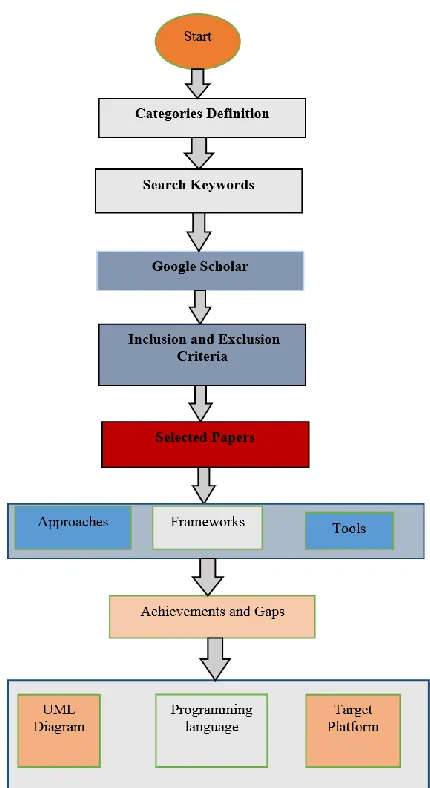
terms of the implementation technique it proposes. We have classified these papers depending on whether they propose approaches, frameworks or tools. Considering RQ2, we have analyzed what achievements have been made in each paper and what gaps are remaining. Regarding question RQ3 and RQ4, we have analyzed which UML diagrams (Class Diagrams, State Charts, Sequence Diagrams, Activity Diagrams, Others) are used in each paper and what type of code (Java/Java Android, C/Objective C/ System C/C++/ C#, Unspecified, Others). Considering which platform, we have classified them into four namely Object Oriented Platforms, Embedded Platforms, More Than One Platform and Unspecified Platform. The methodology depicted in Figure 1 was followed during this SLR in order to answer the research questions.
This section explains the different stages we considered to undertake this review.
Classification Definition: We have defined three classification categories in order to organize the selected researches. These classifications enabled us to easily provide answers to our research questions. The three classifications are:
Approaches: This comprises of strategies that have been proposed to tackle automatic code generation from UML diagrams.
Frameworks: This consists of frameworks that are used for automatic code generation from UML diagrams.
Tools: This entails software tools that perform automatic code generation from UML diagrams.
Search Keywords:
Two sets of search keywords were used in this SLR. They are: 1. “Automatic Code Generation”, “Model Driven Engineering” 2. “Code Generation”, “UML”
The search was made using the Google Scholar academic database. Papers retrieved included those that were published in IEEE, Cite Seer, ACM, Elsevier Science Direct, Research Gate, ProQuest and some other publishers.
Inclusion and Exclusion Criteria
Starting from an initial list of 1980 papers, some papers were excluded based on the criteria explained below:
1. Relevance: Select the research only if it is relevant to one of the three predefined classifications (Section 2.1). Reject all other researches that do not belong to any of the predefined categories. 2. 2000–2016: Selected research work must be published from 2000 to 2016. Reject all researches that are published before 2000.
3. Type: All papers that are published in journal articles and conference proceedings are included. Reject all other researches that are in books, theses, book series and web sites.
4. Code generation: Selected research work must offer code generation, implementation of pseudo code or code schemas from UML diagrams. Reject all other researches that generate other things (not codes) from the UML diagrams.
Figure 1: Research Methodology
RESULTS
The SLR yielded 40 papers which were broken down into approaches, developed tools and frameworks (see Table 1).
Automatic Code Generation from UML Diagrams: The State-of-the-Art Table 1: Classification of selected papers
Automatic Code Generation from UML Diagrams: The State-of-the-Art
The classification of the papers showed that majority of the papers for automatic code generation from UML diagrams proposed approaches and tools to implement the approaches. So
Automatic Code Generation from UML Diagrams: The State-of-the-Art
also majority of papers selected were published in 2009, 2010 and 2012. (See Figure 2 and Figure 3)
Figure 2: A chart showing the number of approaches, tools and frameworks
Figure 3: A chart showing yearly distribution of papers
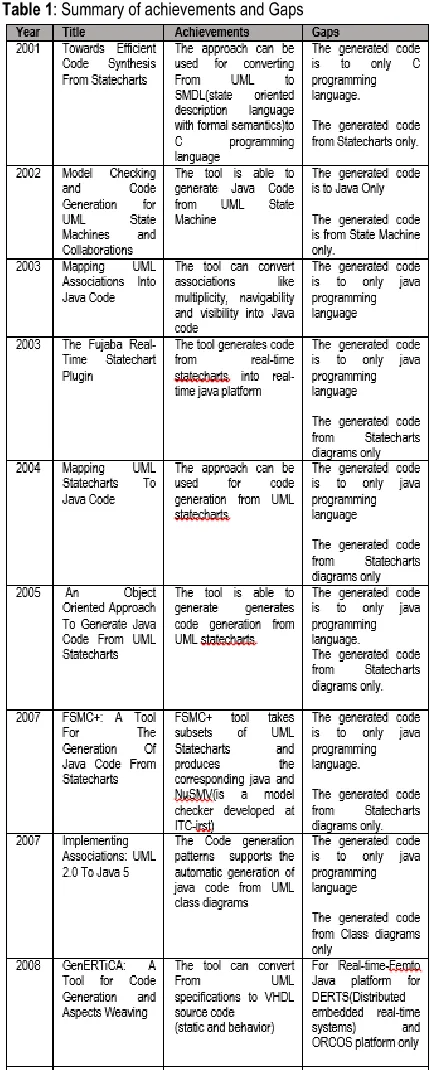
Each paper was analyzed in terms of its achievements and gaps. Table 2 gives a summary of the achievements and gaps of each paper.
Table 1: Summary of achievements and Gaps
Automatic Code Generation from UML Diagrams: The State-of-the-Art
In order to enable us to further analyze and answer our research questions, the charts in Figure 4, Figure 5 and Figure 6 are used to illustrate each of the three factors.
Automatic Code Generation from UML Diagrams: The State-of-the-Art Figure 4: UML Diagrams Used in the Selected Papers
Figure 5: Programming Languages Used in the Selected Papers
Figure 6: Target Platforms Used in the Selected Papers
DISCUSSION
Discussion on RQ1: The techniques that are used for code generation from UML diagrams can be classified into three, namely approaches, tools and frameworks. We found out that out of the 40 selected papers, 13 papers proposed only approaches to code generation from UML diagrams, 13 papers proposed approaches and developed tools to implement their proposed approaches, 4 papers proposed frameworks for code generation from UML diagrams, 2 papers proposed a framework and developed a tool to implement the framework and 8 papers presented tools for automatic code generation from UML diagrams. From the analysis, it is clear that most papers are on approaches and tools for automatic code generation. For now there are only few developed frameworks.
Discussion on RQ2: MDA was established with a fundamental notion of completely automated transformation of UML diagrams to code. It can be seen from Table 2 that automatic code
generation from UML diagrams to source code has been achieved in all the 40 selected papers. However, only a few papers have used up to 3 UML diagrams for code generation. In fact, half of the papers analyzed were generating source code from a single UML diagram. Also, in a majority of the papers, the UML diagrams are automatically converted to a single programming language source code. Furthermore, in most papers the source code that is being automatically generated from the UML diagrams is targeting a single platform.
Discussion on RQ3: State chart diagrams are the most used UML diagrams during 2000-2016. Generating source code from state chart diagrams is one of the challenging tasks due to its dynamic nature and because many state machine concepts are not supported by the object-oriented programming languages (Domí et.al. 2012).This is probably the reason why code generation from state charts received great attention during 2000-2016. Class diagramsare the second most used UML diagrams during 2000-2016. In early years class diagrams were the easiest to automate as there was a direct mapping between it and many OO programming languages (Jakimi & Koutbi, 2009b). In later years a new version of UML became available and generating code from class diagrams was revisited. However the code that is automatically generated from only class diagrams generates a skeleton code/framework consisting of class attributes and method signatures and thus cannot be run (Pawde & Chole, 2014). Sequence diagrams are the third most used UML diagrams followed by activity diagrams.
Discussion on RQ4: Java is the most used programming language in the 40 selected papers. One of the major reasons is that UML diagrams can only be implemented in a programming language that supports concepts like classes, objects, composition and inheritance (Jakimi & Koutbi, 2009a) and Java supports all these concepts. Another reason is probably because there exist mapping rules from UML diagrams onto Java source code (Niaz & Tanaka, 2004; Thongmak & Muenchaisri, 2002) and similar object oriented languages. Also Java is both a programming language and a programming environment of wide use in the context of heterogeneous and network-wide distributed applications (Marinschek, 2003). Java is followed by similar object oriented languages because of the same reasons. From the analysis, it is clear that most papers are on automatic Java code generation from UML diagrams.
Discussion on RQ5: Object oriented platforms are the most used target platforms used in the 40 selected papers. This is because majority of the 40 selected papers were generating Java and C source code, and both of them are OO programming languages that can be executed on object oriented platforms.
Conclusion
This research has tried to find out the progress made so far on automatic code generation from UML diagrams. To accomplish this objective, a SLR was performed to identify and analyze a set of 40 relevant research papers. The main findings are: The result of the review showed that most papers (34 papers) are on approaches and tools for automatic code generation with only a few (6 papers) on developed frameworks. Also we found out that automatic code generation from UML diagrams to source codes has been largely achieved; however 50% of the selected papers
Automatic Code Generation from UML Diagrams: The State-of-the-Art
were generating source code from a single UML diagram, 47% of the selected papers were generating java source code from the UML diagrams and 54% of the selected papers were targeting object oriented platforms. As a general conclusion, we have to say that there is still a huge gap in automatically transforming all UML diagrams to several source codes for use in a wide variety of platforms.
This research should be of value to researchers in knowing the gaps remaining in automatic code generation from UML diagrams. This will prompt them to propose satisfactory solutions for bridging these gaps and realizing the MDE dream of automatically generating source codes from UML diagrams. This research is limited in terms of the database used which is Google Scholar. Future research should involve carrying out the review using databases such as Scopus.
REFERENCES
Akehurst, D., Howells, G. and Mcdonald-maier, K., 2007. Implementing associations : UML 2 . 0 to Java 5 Software &
Systems Modeling, 6(1), pp. 3–35.
Andolfato, L., Chiozzi, G., Migliorini, N. and Morales, C.,2011. A platform independent framework for statecharts code generation. In proceedings of the 13th International Conference on Accelerator and Large Experimental Physics
Control Systems (ICALEPS),Grenoble, France. pp. 614–
617.
Bajovs, A., Nikiforova, O. and Sejans, J.,2013. Code Generation from UML Model : State of the Art and Practical Implications.
Applied Computer Systems 14(1), pp. 9–18.
Bennett, J. , Cooper, K. and Dai, L.,2010. Aspect-oriented Model-Driven Skeleton Code Generation: A Graph based Transformation Approach. Science of Computer
Programming, 75(8) pp. 689–725.
Bjorklund, D., Lilius, J. and Porres, I.,2001. Towards Efficient Code Synthesis from Statecharts. In pUML, (pp. 29–41). Bousetta, B., Beggar, O. E. and Gadi, T.,2014. A Model
Transformation Approach For Code Generation From State Machine Diagram. IADISInternational Journal on Computer
Science and Information Systems, 9, pp. 1–15.
Boussaïd, I., Siarry, P. and Ahmed-nacer, M., 2017. A survey on search-based model-driven engineering. Automated
Software Engineering,24(2), pp. 233–294.
Boutekkouk,F.,2010. Automatic SystemC Code Generation from UML Models at Early Stages of Systems on Chip Design.
International Journal of Computer Applications, 8(6). pp.
10–17.
Burmester, S. and Giese,H.,2003. The Fujaba Real-Time Statechart Plugin. Proc. of the fujaba Days.
Chama, W., Elmansouri, R. and Chaoui, A.,2012. Model Checking and Code Generation for UML Diagrams Using Graph Transformation. International Journal of Software
Engineering & Applications, 3(6) p. 39.
Ciccozzi, F., Cicchetti, A . and Sjödin, M.,2012. Full Code Generation from UML Models for Complex Embedded Systems. In Second International Software Technology
Exchange Workshop(STEW) November 28th, Kista, 2012.
Ciccozzi, F. and Sjödin, M., 2012, September. Enhancing the Generation Of Correct-By-Construction Code from Design Models For Complex Embedded Systems. In Emerging
Technologies & Factory Automation(ETFA),2012 IEEE 17th
IEEE, 2012 on ( pp. 1–4). IEEE.
Dias Neto,A. C., Subramanyan,R., Vieira,M. and Travassos,G.H ,2007. A Survey on Model-based Testing Approaches : A Systematic Review. In Empirical Assessment of Software Engineering Languages and Technologies: held in conjunction with 22nd IEEE/ACM International Conference
on Automated Software Engineering (ASE), 1st ACM
Internal Workshop on pp. 31–36.
Derezinska A. and Pilitowski, R., 2007. Event Processing in Code Generation and Execution Framework of UML State Machines. Software Engineering in Progress, Nakom,
Poznan, pp. 80–92.
Derezińska, A. and Pilitowski, R.,2009. Realization of UML Class and State Machine Models in the C # Code Generation and Execution Framework Related work Code generation and execution support. Informatica(Slovenia), 33(4) on pp. 431– 440.
Domí, E., Pérez, B. and Rubio, Á. L., 2012.A systematic review of code generation proposals from state machine specification. Information and Software Technology, 54(10), pp. 1045–1066.
Ebeid, E. Fummi, F. and Quaglia, D., 2015. HDL code generation from UML / MARTE sequence diagrams for verification and synthesis. Design automation for embedded
systems, 19(3), pp. 277–299.
El Beggar, O., Bousetta, B. and Gadi, T.,2012,October. Generating Methods Signatures From Transition State Diagram: A Model Transformation Approach. In Information
Science and Technology (CIST), Colloquium, 2012
Colloquium in (pp.4-9). IEEE.
Essaadi, F., Maissa, Y.B. and Dahchour, M.,2017. MDE-based Languages for Wireless Sensor Networks Modeling : A Systematic Mapping Study. In Advances in Ubiquitous
Networking 2 (pp. 331–346). Springer, Singapore.
Eveleens,J.L. and Verhoef,C., 2009. The Rise and Fall of the Chaos Report Figures. IEEE Software,(1), pp. 30–36. Fertalj, K. and Brcic, M., 2008. A Source Code Generator Based
on UML Specification. International Journal of Computers
and Communication.2(1) pp. 10–19.
Genova, G., Del Castillo, C.R. and Llorens, J.,2003 Mapping UML Associations into Java. Journal of Object Technology, 2(5), pp. 135–162.
Graciano Neto,V.V.,Guessi, M., Oliveira,L.B.R., Oquendo, and Nakagawa, E.Y., 2014. Investigating the Model-Driven Development for Systems-of-systems.In Proceedings of the 2014 European Conference on Software Architecture workshops(p.22).ACM.
Gurad, H. D. and Mahalle, V. S, 2014. An Approach to Code Generation from UML Diagrams. International Journal of
Engineering Sciences & Research Technology, 3(1).
Heineck,T.,Goncalves,E.,Sousa,A.,Oliveira,M and Castro, J.,2016,September. Model-Driven Development in Robotics Domain:A Systematic Literature Review. In Software Components, Architectures and Reuse (SBCARS), 2016 X
Brazilian Symposium on (pp. 151–160). IEEE.
Hussein, B. M. and Salah, A.,2013. A Framework for Model-Based Code Generation from a Flowchart. International
Journal of Computing Academic Research., 2(5), pp. 167–
181.
Jakimi A. and El Koutbi, M.,2009. An Object-Oriented Approach to UML Scenarios Engineering and Code Generation.
Automatic Code Generation from UML Diagrams: The State-of-the-Art
International journal of Computer Theory and Engineering.,
1(1), pp. 1793-8201.
Jakimi A. and El Koutbi,2009. Automatic Code Generation FromUML Statechart. International journal of Engineering
and Techmology, 1(2), pp. 1793–8236.
Kitchenham, B.,2004.Procedures for Performing Systematic Reviews. Keele, UK,Keele University, 33(2004),pp.1-26. Klein,J.,Levinson,H. and Marchetti,J.,2015. Model-Driven
Engineering : Automatic Code Generation and Beyond. CARNEGIE-MELLON UNIV PITTSBURGH PA PITTSBURGH United States.
Knapp A. and Merz, S.,2002. Model Checking and Code Generation for UML State Machines and Collaborations.
Proc. 5th Wsh. Tools for System Design and Verification,
pp. 59–64.
Lennis, L. and Aedo, J.,2013, January. Generation of Efficient Embedded C Code from UML / MARTE Models. in
Proceedings of the International Conference on Software
Engineering Research and Practice (SERP)(p.1). The
Steering Committee of The World Congress in Computer Science, Computer Engineering and Applied Computing (WorldComp).
Lindlar,F. and Zimmermann,A., 2008, July. A code generation tool for embedded automotive systems based on finite state machines. In Industrial Informatics, 2008. INDIN 20008. 6th
IEEE International Conference on ( pp. 1539–1544).IEEE. Loniewski, G., Insfran, E. and Abrahão, S., 2010,October. A
Systematic Review of the Use of Requirements Engineering Techniques in Model-Driven Development. In Internation Conference on Model Driven Engineering Languages and
System( pp. 213–227) Springer, Berlin, Heidelberg.
Maheshwari V., and Prasanna, M.,2015. Generation of Test Case using Automation in Software Systems – A Review. In
Indian Journal of Science and Technology, 8(35).
Marinschek,M., 2003. Towards Executable UML - Code Generation From Interaction And State Chart Diagrams. na. Mehmood A. and Jawawi, D.N.,2013. Aspect-oriented model-driven code generation : A systematic mapping study.
Information and Software Technology, 55(2), pp. 395–411.
Mohi-aldeen, S. M., Deris, S. and Mohamad, R., 2014. Systematic Mapping Study in Automatic Test Case Generation. In SoMet (pp. 703–720).
Montrieux, L., Jürjens, J., Haley, C. B., Yu,Y.,Schobbens,P.Y. and Toussaint, H.,2010. Tool Support for Code Generation from a UMLsec Property. In Proceedings of the IEEE/ACM international conference on Automated Software
Engineering (pp. 357–358) ACM.
Moreira, T. G., Wehrmeister, M. A. Pereira, C. E.. Petin, J. F. and Levrat, E., 2010a,July. Automatic Code Generation For Embedded Systems: From UML specification to VHDL Code. In Industrial Informatics (INDIN), 2010 8th IEEE
International Conference on (pp. 1085–1090).IEEE.
Moreira, T. G., Wehrmeister, M. A., Pereira, C. E., Petin,J.F. and Levrat, E., 2010b. Generating VHDL source code from UML models of embedded systems. In Distributed, Parallel and Biologically Inspired Systems 2010 (pp. 125–136).Springer, Berlin, Heidelberg.
Nguyen, P. H., Klein, J.,Le Traon, Y. and Kramer, M. E., 2013,December. A Systematic Review of Model-Driven Security. In Software Engineering Conference
(APSEC),2013 20th Asia-Pacific. ( Vol.1, pp. 432–
441).IEEE.
Nguyen, P. H., Kramer, M., Klein, J. and Le Traon, Y.,2015.An Extensive Systematic Review on Model-Driven Development of Secure Systems.Information and Software
Technology, 68,pp. 62–81.
Niaz, I.A., 2005. Automatic Code Generation From UML Class and Statechart Diagrams.
Niaz,I.A. and Tanaka,J., 2004, February. Mapping uml statecharts to java code. in ASTED Conf. on Software
Engineering, pp. 111–116.
Niaz, I. A. and Tanaka, J.,2005. An Object-Oriented Approach To Generate Java Code From UML Statecharts. International
Journal Computer & Information Scence., 6(2), pp.83-98.
Omar, E.B., BOUSETTA, B. and Gadi, T. ,2012. Automatic code generation by model transformation from sequence diagram of system ’ s internal behavior. detail, 1(2) pp. 129–146. Parada, A. G. , Siegert, E. and De Brisolara, L. B.
,2011,November. Generating Java code from UML Class and Sequence Diagrams. In on Computing System
Engineering(SBESC), 2011 Brazilian Symposium on (pp.
99–101).IEEE.
Parada, A., Marques,M and De Brisolara,L.B.,2015. Automating mobile application development : UML-based code generation for Android and Windows Phone. Revista de
Informatica Teorica e Aplicade, 22(2), pp. 31–50.
Pawde, P. R. and Chole, V., 2014. Generation of Java Code Structure from UML Class Diagram. International Journal
Innovation Science and Modern Engineering, 2(7) pp.
2319-6386.
Qu, M.C., Meng, L.J, Wu,X.H. and Cui, N.G.,2015,June. Software Modelling and Automatic Code Generation Based on Reactive State Diagram. In International Conference on
Computer Information Systems and Industrial
Applications(CISIA), pp. 899–901
Queiroz, P.G.G. and Braga,R.T.V.,2014,September. Development of Critical Embedded Systems Using Model-driven and Product Lines Techniques : A Systematic Review. In Software Components, Architectures and Reuse (SBCARS), 2014 Eight Brazilian Symposium on ( pp. 74– 83). IEEE.
Rashid, M., Anwar, M.W. and Khan, A.M.,2015. Towards the Tools Selection in Model Based System Engineering for Embedded Systems - A Systematic Literature Review.
Journal of Systems and Software, 106, pp. 150–163.
Rashid M. and Anwar, M.W.,2016,June. A systematic investigation of tools in model based System Engineering for Embedded Systems. In System of Systems Engineering
Conference (soSE),2016 11th. (pp. 1–6). IEEE.
Rodrigues, A.W.O., Guyomarc,F. and Dekeyser,J.L.,2013. An MDE Approach for Automatic Code Generation from MARTE to OpenCL. Computing in Science & Engineering, 15(1), pp.46-55.
Rosales-Morales, V.Y., Alor.-Hernandez,G.,Garcia-Alcaraz,J.,L. Zatarain-Cabada, R. and Barron-Estrada, M.L.,2015. An analysis of tools for automatic software development and automatic code generation. Revista. Facultad de Ingenieria
Universidad de Antioquia,(77), pp. 75–87.
Salman, Y. D. and Hashim, N. L., 2016. Automatic Test Case Generation from UML State Chart Diagram : A Survey. In
Advanced Computer and Communication Engineering
Technology(pp.123-134).Springer,Cham.
Automatic Code Generation from UML Diagrams: The State-of-the-Art
Shah, S.A.A., Shahzad, R. K., Bukhari, S.S.A., Minhas, N. M. and Humayun, M.,2016. A Review of Class Based Test Case Generation Techniques. JSW, 11(5), pp. 464–480. Summerville,I.,2009. Software Engineering, 9th ed. PEARSON. Syriani, E., Luhunu, L. and Sahraoui, H.,2018. Systematic
Mapping Study of Template-based Code Generation.Computer Languages, Systems & Structures, 52, pp.43-62.
Thongmak,M. and Muenchaisri,P.,2002. Design of rules for transforming UML sequence diagrams into Java code. In Software Engineering Conference,2002. Ninth Asia-Pacific
(pp.485-494). IEEE.
Tiella,R.,Villafiorita,A.andTomasi,S.,2007,September. FSMC+. a tool for the generation of Java Code from Statecharts. In
Proceedings of the 5th International Symposium on
Principles and Practice of Programming in Java(pp. 93–
102). ACM.
Usman M. and Nadeem, A.,2009. Automatic Generation of Java Code from UML Diagrams using UJECTOR. International
Journal of Software Engineering and Its Applications, 3(2),
pp. 21–37.
Vadakkumcheril, T., Mythily, M. and. Valarmathi, M. L., 2013. A Simple Implementation of UML Sequence Diagram to Java Code Generation through XMI Representation. International Journal of Emerging Technology and Advanced
Engineering, 3, pp. 12.
Vidal, J., De Lamotte, F., Gogniat, G., Soulard, P. and Diguet, J.P.,2009,April. A co-design approach for embedded system modeling and code generation with UML and MARTE. In
Proceedings of the Conference on Design, Automation and
Test in Europe (pp. 226–231). European Design and
Automation.
Villa, S., Serna, D. and Aedo, J. ,2011. SystemC Code Generation from UML for Wireless Sensor Networks Design. In proceedings of the International Conference on
Modelling,Simulation and Visualization Methods (MSV)
(p.1). The Steering Committee of The World Congress in Computer Science, Computer Engineering and Applied
Computing (WorldComp).
Wehrmeister, M. A., Freitas, E. P., Pereira, C. E. and Rammig,F., 2008,May. GenERTiCA: A Tool for Code Generation and Aspect Weaving. In Object Oriented Real-Time Distributed
Computing (ISORC), 2008 11th IEEE International
Symposium on (pp. 234–238). IEEE.