ISSN: 2149-214X
www.jeseh.net
Promoting
Preservice
Teachers’
Attitudes toward Socioscientific Issues
Sundus Yerdelen1, Mustafa Cansiz2, Nurcan Cansiz2, Hakan Akcay3
1
Kafkas University
2Artvin Coruh University 3Yildiz Technical University
To cite this article:
Yerdelen, S., Cansiz, M., Cansiz, N., & Akcay, H. (2018). Promoting preservice teachers’
attitudes toward socioscientific issues.
Journal of Education in Science, Environment and
Health (JESEH), 4
(1), 1- 11. DOI:10.21891/jeseh.387465
This article may be used for research, teaching, and private study purposes.
Any substantial or systematic reproduction, redistribution, reselling, loan, sub-licensing,
systematic supply, or distribution in any form to anyone is expressly forbidden.
Authors alone are responsible for the contents of their articles. The journal owns the
copyright of the articles.
Promoting Preservice Teachers’ Attitudes toward Socioscientific Issues
Sundus Yerdelen, Mustafa Cansiz, Nurcan Cansiz, Hakan Akcay
Article Info
Abstract
Article History
Received: 17 August 2017
In this study, we aimed to improve preservice teachers’ attitudes toward socioscientific issues through socioscientific issue course. Moreover, we investigated whether this course influences preservice teachers studying in a science education and non-science education in a similar way. For this purpose, a semester-long socioscientific issues course was designed and implemented. Data were collected from a science education group (preservice science teachers) and a non-science education group (preservice social-science teachers). In order to evaluate participants’ attitudes towards socioscientific issues, Attitudes towards Socioscientific Issues Scale was utilized before and after the course. This scale evaluates attitudes under three themes: liking of socioscientific issues, interest and usefulness of socioscientific issues, and anxiety towards socioscientific issues. The result revealed that socioscientific issues course provided similar gains for both preservice science teachers and preservice social-science teachers on interest and usefulness of socioscientific issues, liking of socioscientific issues, and anxiety towards socioscientific issues. That is both groups derived a similar benefit from the socioscientific issues course. Specifically, socioscientific issues course contributed to preservice teachers’ interest and usefulness of socioscientific issues, and liking of socioscientific issues positively. On the other hand, their anxiety scores did not change significantly after the course. These findings imply that, regardless of majors, socioscientific issues course has potential to favor preservice teachers’ attitudes toward socioscientific issues. Accepted:
16 November 2017
Keywords
Socioscientific issues Preservice teachers Attitude toward SSI Science education Social-science education
Introduction
SSI are suitable contexts to engage students in discussions of science-related social issues. These issues have been a part of school curricula since the negotiation of these issues are accepted as an essential characteristic of citizens in modern democratic societies. There is substantial effort to include SSI in lessons to improve science content knowledge, nature of science views, argumentation skills, or critical thinking skills. Scholarly papers emphasize the teaching of SSI as one of the goals of science education for educating scientifically literate citizens (Hofstein, Eilks, & Bybee, 2011; Lee, Chang, Choi, Kim, & Zeidler, 2012; Sadler, et al, 2007; Zeidler, Sadler, Simmons, & Howes, 2005). However, SSI has been implemented not only in science education but also in many different disciplines.
In this study, we focused on preservice science and social science teachers’ attitudes toward SSI because these two disciplines represent the science and social aspects of SSI. Moreover, they are all citizens of the society and they all should be responsible members regardless of the major. As citizens, they need to know about local, national, and global SSI and have the necessary skills for negotiation and decision-making. For those reasons, their attitudes toward SSI become important. In a general sense, attitude is defined as ―a general and enduring positive or negative feeling about some person, object, or issue‖ (Petty, & Cacioppo, 1996, p.7). Maio and Haddock (2009) underlined that attitudes "influence how we view the world, what we think, and what we do" (p. 4). Teachers’ positive attitudes toward SSI play a crucial role in deciding whether they incorporate SSI into their lessons. Teachers’ willingness to engage in science-related issues may increase their students’ interest in SSI. Teachers’ implementation of SSI-based practices in their classrooms requires engaging with SSI beforehand. Therefore, SSI-based practices should be a part of their training in teacher education programs. Preservice teachers’ (PTs) negotiation of SSI is important to improve their personal decisions making skills that every PTs need to use at some stage in their both daily life as a citizen and professional life as a teacher (Cansiz & Cansiz, 2015). When PTs are equipped with knowledge and skills about SSI during their teacher training, they transform these knowledge and skills to their student when they start teaching. As a result, their students are also engaged in SSI and have necessary knowledge and skills to make informed decisions on these issues. In light of this, we designed a course on SSI to engage preservice science teachers (PSTs) and preservice social science teachers (PSSTs) in socioscientific argumentation and decision making.
Incorporating SSI in a classroom environment is an effective way of supporting the development of students to be more informed and to be engaged citizens, which is one of the fundamental goals of science education (Sadler, 2011). SSI instructions facilitate students’ learning science by using complicated and socially relevant issues as contexts (Sadler, 2011). Previous research showed that using SSI in teaching is beneficial for students to learn science content knowledge; develop interest, attitude, and motivation; understand nature of science; and use higher order thinking skills such as informal reasoning, problem-solving, scientific reasoning, argumentation, and critical thinking (Sadler, 2009). Some studies compared the effect of implementations including SSI with traditional science teaching methods. For example, students who participated in an intervention considering Science Technology and Society based curricula developed more positive attitudes towards science than others (Lee & Erdogan, 2007; Yager, Lim, & Yager, 2006). In another study with university students, Barber (2001) concluded that SSI-related course has a positive influence on students’ interest in science and evaluation of the science content they learned. Thus, in a general sense, it can be concluded that including SSI in the classroom teaching results in enhancement of students’ positive affective outcomes (Sadler, 2009).
Similarly, Cansiz and Cansiz (2015) investigated preservice science teachers' views and knowledge about a specific SSI, nuclear power plant, which has recently been a hot topic on the agenda of Turkey. The results indicated that PSTs were knowledgeable about some aspects of nuclear energy yet they know little about some other aspects. For instance, while PSTs are aware of the economic burden of removing nuclear power plants, they know little about the amount of radiation emitted by nuclear power plants. Another line of research indicated that Turkish preservice teachers do not feel confident in teaching SSI as well (e.g. Alaçam–Akşit, 2011; Kara, 2012). The abovementioned studies point out that PTs' knowledge and concerns about SSI have an important role in teaching SSI. Therefore, their knowledge and confidence should be improved to prepare them to teach SSI in their future classroom.
Fostering PTs’ positive attitudes toward SSI may help them to increase their knowledge about SSI as well as to reduce their concerns about teaching SSI. Having positive attitudes towards SSI means having interest to these issues, reading and discussing them, and being aware of that SSI does not adversely influence society (Topcu, 2010). People who like SSI and are interested in SSI are more likely to criticize and justify their decisions about SSI by using scientific reasoning, decision-making, and argumentation skills. Despite the educational researchers' growing interest in teaching and learning SSI, studies about attitude toward SSI are limited. One of these few studies was conducted by Topcu (2010): he developed and validated Attitudes towards Socioscientific Issues Scale, in the Turkish context. In the same study, Topcu compared science education majors and non-science education majors' attitudes towards SSI and found that non-science education majors have more positive attitudes toward SSI than non-science education majors. In another study, Cebesoy and Dönmez-Şahin (2013) examined PTs' attitudes in terms of gender and grade level. The authors found that there is no difference between PTs' attitudes toward SSI with respect to gender and grade level. These studies addressed PTs' existing attitudes toward SSI. However, there is a need for studies focusing on how to improve PTs attitudes towards SSI. Since it takes a long period of time to develop attitudes, PTs' positive attitudes toward SSI should be improved, before they become a teacher, to achieve the goals of the curricula. Promoting PTs’ attitudes is possible through the courses which mainly focus on the SSI (Sadler, 2009). Thus, we aimed to design an SSI course in which students were engaged in role plays and argumentation on different SSI to present their ideas and refute others’ who advocate a different point of view. We expect to enhance preservice teachers’ interest, and liking of SSI and decrease their concerns about SSI by this course. Thus, the overarching research question and corresponding sub-questions guided this study are:
I. Do PSTs and PSSTs benefit from the SSI course similarly in terms of attitude toward SSI? i. How does SSI course affect PSTs’ attitudes toward SSI?
ii. How does SSI course affect PSSTs’ attitudes toward SSI?
Method
In this study, we used ―try something and systematically observe what happens‖ approach as emphasized by Fraenkel and Wallen (2006, p. 268). This is also known as establishing cause and effect relationship between independent and dependent variables. To do this, we manipulated the independent variable (SSI course) to observe the extent to which our dependent variable (attitudes towards SSI) is affected by it. Manipulating independent variables makes this study an experimental study which is a type of quantitative research methodology (Fraenkel & Wallen, 2006).
Sample
Instrument
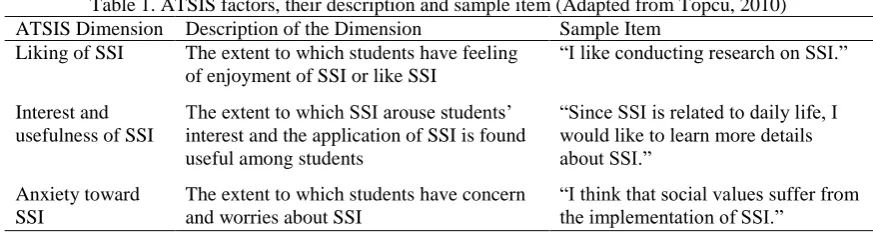
Attitudes towards Socioscientific Issues Scale (ATSIS), developed by Topcu (2010), is a five-point Likert type scale and its response format is ranging from (1) strongly disagree to (5) strongly agree. In the development process of the scale, the author conducted exploratory factor analysis (EFA) as well as confirmatory factor analysis (CFA) with the data from two different samples of undergraduate students. The ultimate result of EFA yielded three factors named as liking of SSI (7 items), interest and usefulness of SSI (17 items), and anxiety toward SSI (6 items) with a total of 30 items. The cross-validation of ATSIS using CFA provided evidence that three-factor structure of the scale has a good model fit to the data. These factors, their description and sample item for each were given in Table 1.
Table 1. ATSIS factors, their description and sample item (Adapted from Topcu, 2010) ATSIS Dimension Description of the Dimension Sample Item
Liking of SSI The extent to which students have feeling of enjoyment of SSI or like SSI
―I like conducting research on SSI.‖
Interest and usefulness of SSI
The extent to which SSI arouse students’ interest and the application of SSI is found useful among students
―Since SSI is related to daily life, I would like to learn more details about SSI.‖
Anxiety toward SSI
The extent to which students have concern and worries about SSI
―I think that social values suffer from the implementation of SSI.‖
In addition to EFA and CFA, Topcu (2010) administered reliability analysis to screen the internal consistency of the scale for each sub-dimension. He found Cronbach alpha coefficients of .90 for interest and usefulness of SSI, .81 for the liking of SSI and .70 for the anxiety towards SSI, suggesting high internal consistency of the data. Backed up by literature from attitude studies, based on related reliability and validity evidence, it was concluded that ATSIS is an appropriate instrument to measure undergraduate students’ attitudes towards SSI.
In order to compare participants’ pre-existing and post-implementation attitudes, we have used ATSIS before and after the implementation. Internal consistencies for each dimension related to pre-implementation were, based on Cronbach alphas, .77 for the liking of SSI, .85 for interest and usefulness of SSI, and .72 for anxiety towards SSI which satisfy the criterion of acceptability. Cronbach alphas obtained from post-implementation were found to be .85, .92, and .71 for the liking of SSI, interest and usefulness of SSI, and anxiety towards SSI, respectively. In other words, all dimensions of ATSIS were found to be reliable with our sample.
SSI Course Framework
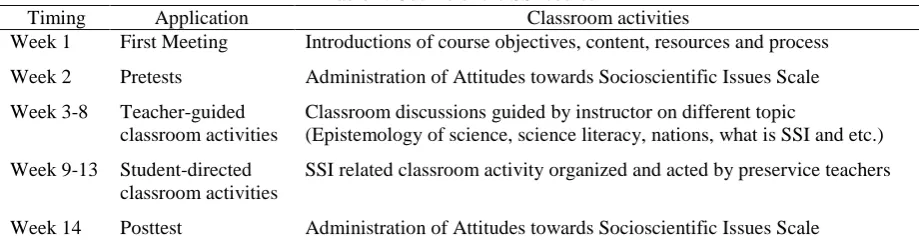
Table 2. Outline of the SSI course
Timing Application Classroom activities
Week 1 First Meeting Introductions of course objectives, content, resources and process Week 2 Pretests Administration of Attitudes towards Socioscientific Issues Scale Week 3-8 Teacher-guided
classroom activities
Classroom discussions guided by instructor on different topic
(Epistemology of science, science literacy, nations, what is SSI and etc.) Week 9-13 Student-directed
classroom activities
SSI related classroom activity organized and acted by preservice teachers
Week 14 Posttest Administration of Attitudes towards Socioscientific Issues Scale
Teacher-guided Classroom Activities
In teacher-guided classroom activities, PTs engaged in a variety of activities under the guidance of the instructors. First of all, they discussed what science is and the life of some of the most influential scientists such as Leonardo da Vinci. The aim here was to develop PTs’ understanding about the complex epistemology of science. Following that we let PTs focus on scientific and technological literacy and the status of Turkey regarding scientific and technological literacy. Then, instructors guided PTs to argue about science and technology in developed, developing, and underdeveloped countries, as well as the situation in Turkey. The teacher-guided classroom activities continued with science, technology, and society and the complex relationship between them. In the context of this topic, PTs watched a documentary film about how science, technology, and society influence each other and they reflected on it. More specifically the documentary focuses on how the modern world evolves under the influence of geographical factors as well as technological developments. Moreover, it includes how the wars among the nations have led and accelerated technological developments and how scientifically developed nations better take care of epidemic diseases than underdeveloped nations. Following week, students were introduced SSI for the first time. The classroom discussions were based on what SSI is, historical fundamentals of SSI, SSI elements in the curriculum, and teaching of SSI. We completed teacher-guided classroom activities by letting students to discuss if science is naturally good or bad. That is, when science is used in the good sense, it can be for people's benefit, but it can also be one of the greatest enemy of mankind when used in the wrong direction. For example, nuclear technology can be used in cancer treatment as well as nuclear bomb at the same time.
During teacher-guided classroom activities, the aim was not to provide PTs with teacher-centered instruction. On the contrary, instructors made every effort to avoid it and acted as a guide to make PTs explicitly and reflectively discuss each and every activity. Both instructors encouraged them to introduce their own ideas, defense it, listen to others’ ideas, elaborate them, and challenge with counter-claims. While PTs were working on the activities, instructors followed them that they were active during discussions. In brief, during the first half of the instruction, discussion and argumentation methods were utilized mainly and students actively participated in teacher-guided classroom activities.
Student-Directed Classroom Activities
Student-directed classroom activities lasted for five weeks. Each week two groups completed their activities which were mostly based on role-playing and argumentation. By means of these activities, we anticipated achieving more than one objectives. Firstly, we aimed to stimulate PTs’ imagination and creativity by role playing activities. Secondly, we engaged them in argumentation and decision-making process. Moreover, we expect them to develop social skills such as communication, being empathetic, and cooperative during problem-solving by group work. Above all, we aimed to improve their socioscientific reasoning skills such as looking at the same problem from multiple perspectives, understanding the importance of scientific information, and building arguments and counter arguments in the negotiation of socioscientific issues.
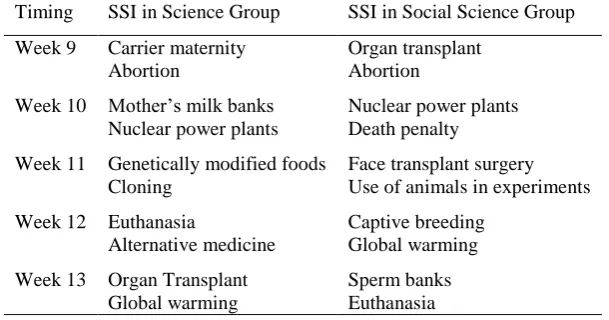
a physician, or a local person. By providing concrete evidence to support themselves, group members presented their positions on the issue adhering to their role. Moreover, each PT struggled to refute others’ arguments by using diverse evidence. During the end of the activity, a whole-class discussion took place by the question-and-answer method. In the end, each group aimed at reaching a possible solution of that SSI by evaluating each stakeholders’ positions and evidence. Some of the example SSI were abortion, the death penalty, sperm banks, and euthanasia. A complete list of SSI was tabulated in Table 3. The selected SSI was quite similar in both groups as seen in Table 3.
Table 3. The list of SSI role played in both groups (sorted by application order) Timing SSI in Science Group SSI in Social Science Group Week 9 Carrier maternity
Abortion
Organ transplant Abortion Week 10 Mother’s milk banks
Nuclear power plants
Nuclear power plants Death penalty Week 11 Genetically modified foods
Cloning
Face transplant surgery Use of animals in experiments Week 12 Euthanasia
Alternative medicine
Captive breeding Global warming Week 13 Organ Transplant
Global warming
Sperm banks Euthanasia
In order to avoid PTs to engage in shallow discussion solely based on their intuitive assumptions and anecdotal evidence during role play, they were required to prepare a report containing concrete evidence like statistics reports, government documents, articles, and documentary notes before the activity. To create a deeper sense of reality, preservice teachers were encouraged to dress similar to whom they were acting during role play as well.
Results
The main objective of this study was to develop PTs’ favorable attitudes toward socioscientific issues through socioscientific issue course. After a semester-long SSI course, we tested statistically if the course has an effect on preservice teachers’ attitudes toward SSI as well as if this impact differs for PSTs and PSSTs by using mixed between-within subjects ANOVA. Further evaluation of assumptions showed that the data did not include any univariate or multivariate outliers, any serious deviation from normality, and unequal distribution of variance. The examination of descriptive data indicated that PSTs and PSSTs have similar scores on all three subscales of ATSIS (i.e. interest and usefulness of SSI, liking of SSI, anxiety toward SSI). For example, PSTs’ anxiety toward SSI (M = 2.27, SD = .61) and PSSTs’ anxiety toward SSI (M = 2.23, SD = .65) were quite similar before the course and they both indicated a low level of anxiety toward SSI. Other descriptive statistics are given in Table 4.
Table 4. Descriptive statistics related to PSTs’ and PSSTs’ ATSIS scores
PST PSST
Pretest Mean (SD)
Posttest Mean (SD)
Pretest Mean (SD)
Posttest Mean (SD) Liking of SSI 3.74 (.50) 4.06 (.55) 3.89 (.61) 4.19 (.46) Interest & usefulness of SSI 4.12 (.33) 4.31 (.42) 4.32 (.37) 4.43 (.40) Anxiety towards SSI 2.27 (.61) 2.30 (.63) 2.23 (.65) 2.26 (.61)
Liking of SSI
resulting from multiple comparisons, Bonferroni adjustment was applied. PSTs' scores on liking of SSI significantly increased from pre-implementation to post implementation, F (1, 84) = 22.47, p < .001, partial eta squared = .21. Similarly, there was a statistically significant increase in PSSTs’ scores on liking of SSI, F (1, 84) = 12.47, p = .001, partial eta squared = .13. Namely, both groups showed a significant increase in their liking of SSI scores after SSI course.
Interest & Usefulness of SSI
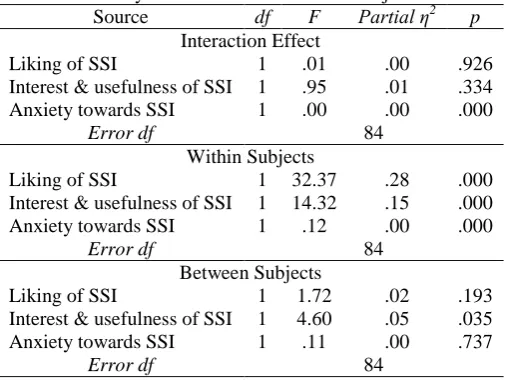
In terms of interest and usefulness of SSI, -as evident from the non-significant interaction effect- the course resulted in similar changes for both PSTs and PSSTs, Wilks Lambda = .99, F (1, 84) = .95, p = .334, partial eta squared = .01. This means that the impact of the course on interest and usefulness of SSI does not differ in terms of the majors. The main effect for time signified that SSI course yielded a significant increase in interest and usefulness of SSI (Wilks Lambda = .85, F (1, 84) = 14.32, p < .001, partial eta squared = .15) in both groups. Bonferroni-adjusted post-hoc comparison illustrated that PST’ interest and usefulness of SSI scores significantly increased after SSI course, F (1, 84) = 15.21, p < .001, partial eta squared = .15. Although PSSTs’ interest and usefulness of SSI scores increased after SSI course (mean difference = .11, CI: -0.01 to 0.23), this increase did not reach statistical significance, F (1, 84) = 3.15, p = .080, partial eta squared = .04.
Anxiety towards SSI
In terms of anxiety towards SSI, the result of mixed between-within subjects ANOVA demonstrated that the interaction between group and time was not statistically significant. That is, SSI course yielded similar change for PSTs and PSSTs on anxiety towards SSI. (Wilks Lambda = 1.00, F (1, 84) = .00, p = .958, partial eta squared < .001). The main effect for time indicated that SSI course did not change participants’ anxiety towards SSI scores significantly in either group (Wilks Lambda = 1.00, F (1, 84) = .12, p = .730, partial eta squared < .001). A summary of mixed between-within subjects ANOVAs are given at Table 5.
Table 5. Summary of mixed between-within subjects ANOVAs
Source df F Partial η2 p
Interaction Effect
Liking of SSI 1 .01 .00 .926
Interest & usefulness of SSI 1 .95 .01 .334
Anxiety towards SSI 1 .00 .00 .000
Error df 84
Within Subjects
Liking of SSI 1 32.37 .28 .000
Interest & usefulness of SSI 1 14.32 .15 .000
Anxiety towards SSI 1 .12 .00 .000
Error df 84
Between Subjects
Liking of SSI 1 1.72 .02 .193
Interest & usefulness of SSI 1 4.60 .05 .035
Anxiety towards SSI 1 .11 .00 .737
Error df 84
Discussion
The first finding of this study showed that both groups of PTs similarly benefitted from the SSI course. After taking the SSI course, enhancements were observed in their liking of SSI, and interest and usefulness of SSI scores, while there was no change in both groups’ anxiety towards SSI scores. To account for this improvement in their interest and liking of SSI, the nature of activities appears to be the primary reason. In designing SSI course, we followed the main strategies in a series of research studies that made use of different SSI. Argumentation, as one of them, is used widely in many studies to enhance individuals' skills on the development of arguments and justifications to discuss SSI (e.g. Dawson & Venville, 2013; Erduran, Simon, & Osborne, 2004; Patronis, Potari, & Spiliotopoulou, 1999).
Argumentation is mostly incorporated into decision-making activities in the literature. In Patronis et al.'s (1999) study, students formed arguments to make decisions about a road construction in their local area. A similar strategy was also used in the study conducted by Jime´nez-Aleixandre (2002) who let the students engage in argumentation and decision making process about an environmental issue. It is clear from these studies that argumentation and decision-making activities quite-well accompanied with socioscientific issues. Inspired by such examples from the literature, the SSI course in this study involved small group activities in which students formed arguments and try to reach a decision on the SSI they selected. Since Khishfe (2012) suggested that socioscientific issues that are more relevant to students have more potential to initiate interest, we asked them to select an SSI which were most relevant to them. On the other hand, while anxiety scores increased in some amount in both groups, the changes were not statistically significant. At the beginning, we expected that engaging in SSI through different classroom activities may reduce their anxiety toward SSI because they have become informed about several of SSI. However, as mentioned, this is not the result that we found. The reason for the slight increase in anxiety scores can be attributed to the nature of specific SSI. That is socioscientific issues such as abortion, sperm bank, mother's milk bank, euthanasia, and career maternity are topics that are very sensitive in terms of religion. Having thought the religious beliefs of Turkish citizens, it is rational that the anxiety scores did not reduce. However, this finding is not disappointing since they already had low levels of concern and worry about SSI before the course.
One key finding of this study is that preservice teachers’ interests and liking of SSI increased in both groups after participating in SSI course. The goal of the course was to educate PTs' as informed citizens about SSI and to enhance their attitudes towards SSI. Moreover, we aimed to prepare them to argue and form opinions based on different aspects of socioscientific issues. Thus, within the course, they learned how to present arguments for and against the issue under discussion. Therefore, we can conclude that the discussions and the activities in the course were effective in fostering teacher candidates’ interest and usefulness of SSI as well as liking of SSI. Another reason for this improvement may be due to the fact that they were not involved in student directed group activities without preparation. Before each group's discussion, group members searched for the SSI they have chosen. This let them have prior knowledge about the issue. To be knowledgeable about the issue increases students' interest in the issue and helps them form arguments (Khishfe, 2012; Mason & Scirica, 2006).
majors, we can suggest that including SSI course in teacher education program will be beneficial to enhance different major PTs' interest and liking of SSI and this, in turn, will help them include SSI as a context in their future classrooms. For this purpose, SSI course can be a part of teacher education programs to make PTs gain more experiences to discuss and learn about socially relevant issues (Topcu et al., 2014). A teacher is one of the most important factors among the school related variables to influence students' learning (Sanders, Wright, & Horn, 1997). Thus teachers' attitudes towards SSI seem important, as it is potential to influence their students’ attitudes.
Implications and Limitations
This study has some implications for preservice teacher education. Firstly, teachers’ attitudes towards SSI is important for their students to develop positive SSI attitudes. Therefore, while training preservice teachers, their attitudes should be developed through such courses.
This study showed that science background is not a decisive factor for the effectiveness of SSI course on increasing attitude towards SSI. It may be because of the education level of the participants of this study. Since they are university students, they should have some fundamental science content knowledge. Therefore, it can be expressed that having fundamental science background might be sufficient to understand the science lying behind the SSI, conduct research about SSI, to analyze the findings, and to participate in class discussions to defense an idea about SSI against others. Therefore, teacher educators should utilize similar activities while teaching complex and multidimensional science topics. Moreover, this course can be offered for other teacher education programs and disciplines. This is promising for increasing the number of scientifically literate people.
Lastly, we have some suggestions for future research. First, this study provided empirical evidence that SSI course can increase PTs' interest of SSI and liking of SSI. However, further research is needed to figure out how long this effect will last. Second, longitudinal studies are needed to explore how PTs' attitudes towards SSI will influence their students in their future classrooms. Lastly, the effect of such SSI courses on younger students (middle or high school students) may also be investigated to make sound inferences about the effect of such courses in earlier years.
Although this study has successfully demonstrated that the SSI course has improved PTs' attitudes towards SSI, it has limitations as well. It is unfortunate that this study did not include a comparison group, we could not compare the effectiveness of the classroom activities used in the SSI course with a different approach to teach SSI. Moreover, as we did not have control groups, more evidence is needed to conclude that the SSI course accounted for the increase in PTs' attitudes towards SSI. Lastly, the instrument used in this study (ATSIS) does not focus on a specific SSI, instead, it considers SSI in general. Therefore, it is not possible to explore participants' attitudes on a unique SSI. Their attitudes may change in some degree for specific SSI. We hope that taking into account these limitations, in future, studies will carry SSI studies one step further.
Note
All authors have equally contributed to this paper.
References
Alaçam-Akşit, A. C. (2011). Sınıf öğretmeni adaylarının sosyobilimsel konularla ve bu konuların öğretimiyle ilgili görüşleri [Primary school teachers’ views about socioscientific isssues and teaching them]. Unpublished master thesis. Ege University, Turkey.
Barber, M. (2001). A comparison of NEAB and Salters A-level Chemistry: Students views and achievements.
York, UK: University of York.
Cansiz, N., & Cansiz, M. (2015). Views and knowledge of preservice science teachers about nuclear power plants. International Journal on New Trends in Education and Their Implications, 6(2), 216-224.
Cebesoy, Ü. B., & Dönmez-Şahin, M. (2013). Investigating Pre-Service Science Teachers’ Attitudes towards
Socioscientific Issues in terms of Gender and Class Level. Marmara University Journal of Educational
Dawson, V. & Venville, G. (2013). Introducing high school biology students to argumentation about socioscientific issues. Canadian Journal of Science, Mathematics and Technology Education, 13(4), 356-372.
DeBoer, G. E. (2011). The globalization of science education. Journal of Research in Science Teaching, 48(6), 567-591.
Erduran, S., Simon, S., & Osborne, J. (2004). TAPping into argumentation: Developments in the application of Toulmin’s Argument Pattern for studying science discourse. Science Education, 88(6), 915–933.
Gogolin, L., & Swartz, F. (1992). A quantitative and qualitative inquiry into the attitudes toward science of nonscience college majors. Journal of Research in Science Teaching, 29(5), 487504.
Hofstein, A., Eilks, I., & Bybee, R. (2011). Societal issues and their importance for contemporary science education—A pedagogical justification and the state-of-the-art in Israel, Germany, and the USA.
International Journal of Science and Mathematics Education, 9(6), 1459–1483.
Jime´nez-Aleixandre, M. P. (2002). Knowledge producers or knowledge consumers? Argumentation and decision making about environmental management. International Journal of Science Education, 24(11), 1171-1190.
Khishfe, R. (2012). Relationship between nature of science understandings and argumentation skills: A role for counterargument and contextual factors. Journal of Research in Science Teaching, 49(4), 489–514. Lee, H., Chang, H., Choi, K., Kim, S.-W., & Zeidler, D. L. (2012). Developing character and values for global
citizens: analysis of pre-service science teachers’ moral reasoning on socioscientific issues. International Journal of Science Education, 34(6), 925–953.
Lee, M.-K., & Erdogan, I. (2007). The effect of science-technology-society teaching on students’ attitudes toward science and certain aspects of creativity. International Journal of Science Education, 11, 1315– 1327.
Maio, G., & Haddock, G. (2009). The psychology of attitudes and attitude change. SAGE Publications.
Mason, L., & Scirica, F. (2006). Prediction of students’ argumentation skills about controversial topics by epistemological understanding. Learning and Instruction, 16, 492-509.
Massialas, B. G., Sprague, N. F., & Hurst, J. B. (1975). Social Issues through inquiry: Coping in an age of crises. Englewood Cliffs, N. J.:Prentice-Hall
Ministry of National Education of Turkey. (2013). Science and technology curriculum of elementary schools (3th–8th grades). Ankara: Board of Education.
Patronis, T., Potari, D., & Spiliotopoulou, V. (1999). Students' argumentation in decision-making on a socio-scientific issue: Implications for teaching. International Journal of Science Education, 21(7), 745-754. Petty, R. E., & Cacioppo, J. T. (1996). Attitudes and persuasion: Classic and contemporary approaches.
Boulder, CO: Westview Press.
Roberts, D.A. (2007). Scientific literacy/science literacy. In S.K. Abell, & N.G. Lederman (Eds.), Handbook of research on science education (pp. 729–780). Mahwah, NJ: Lawrence Erlbaum Associates.
Sadler, T. D. (2004). Informal reasoning regarding socioscientific issues: A critical review of research. Journal of Research in Science Teaching, 41(5), 513–536.
Sadler, T. D. (2009). Situated learning in science education: socio‐ scientific issues as contexts for practice.
Studies in Science Education, 45(1), 1-42.
Sadler, T. D., Barab, S. A., & Scott, B. (2007). What do students gain by engaging in socioscientific inquiry?
Research in Science Education, 37(4), 371–391.
Sadler, T. D. (2011). Socio-scientific issues-based education: What we know about science education in the context of SSI. In Socio-scientific Issues in the Classroom (pp. 355-369). Springer Netherlands.
Sanders, W. L., Wright, S. P., & Horn, S. P. (1997). Teacher and classroom context effects on student achievement: Implications for teacher evaluation. Journal of Personnel Evaluation in Education, 11(1), 57-67.
Soysal, Y. (2012). Sosyobilimsel argümantasyon kalitesine alan bilgisi düzeyinin etkisi: Genetiği değiştirilmiş organizmalar [Influence of content knowledge level to socioscientific argumentation quality: genetically modified organisms] Unpublished master thesis. Abant Izzet Baysal University, Turkey.
Sönmez, A., & Kılınç, A. (2012). Preservice science teachers’ self-efficacy beliefs about teaching GM Foods: The potential effects of some psychometric factors. Necatibey Journal of Science and Mathematics Education, 6(2), 49-76.
Sürmeli, H., & Şahin, F. (2012). Preservice teachers’ opinions and ethical perceptions in relation to cloning studies. Çukurova University Faculty of Education Journal, 41(2), 76-86.
Topcu, M. S. (2010). Development of attitudes towards socioscientific issues scale for undergraduate students.
Evaluation & Research in Education, 23(1), 51-67.
Topcu, M. S., Mugaloglu, E. Z., & Guven, D. (2014). Socioscientific issues in science education: The case of Turkey. Educational Sciences: Theory and Practice, 14(6), 2340-2348.
Topçu, M. S., Yilmaz-Tuzun, O., & Sadler, T. D. (2011). Turkish preservice science teachers’ informal reasoning regarding socioscientific issues and the factors influencing their informal reasoning. Journal of Science Teacher Education, 22(4), 313-332.
Yager, S.O., Lim, G., & Yager, R. (2006). The advantages of an STS approach over a typical textbook dominated approach in middle school science. School Science and Mathematics, 106, 248–260.
Young, T. (1998). Student teachers’ attitudes towards science (STATS). Evaluation and Research in Education, 12(2), 96111.
Zeidler, D. L., Sadler, T. D., Simmons, M. L., & Howes, E. V. (2005). Beyond STS: A research-based framework for socioscientific issues education. Science Education, 89(3), 357–377.
Author Information
Sundus Yerdelen Kafkas University Kars, Turkey
Contact e-mail: [email protected]
Mustafa Cansiz Artvin Çoruh University Artvin, Turkey
Nurcan Cansiz Artvin Coruh University Artvin, Turkey
Hakan Akcay