ISSN 1597-6343
ON A NUMERICAL ALGORITHM
FOR UNCERTAIN SYSTEM
*ABIOLA,B. & IBIWOYE, A.
Department of Actuarial Science& Insurance, University of Lagos, Nigeria.
ABSTRACT
A numerical method for computing stable control signals for system with bounded input disturbance is developed. The algorithm is an elaboration of the gradient technique and variable metric method for computing control variables in linear and non-linear optimization problems. This method is developed for an integral quadratic problem subject to a dynamic system with input bounded uncertainty.
Key words: Stable Control, Gradient Technique, Variable Metric
Method and Input bounded Uncertainty.
INTRODUCTION
This paper is concerned with the development of a numerical method for the computation of controls for system with bounded input disturbances. Existing numerical methods for computing control signals for optimisation problems do not consider the situation when uncertainties are involved in the system, this work is set to give consideration to such problem and for a start we shall develop this method for an integral quadratic problem subject to a dynamical system with input bounded uncertainty.
Formulation of Problem:
Consider
Min
T
dt
t
Ru
t
u
t
Qx
t
x
0
{
(
)
(
)
(
)
(
)}
… (1)subject to
)
(
)
(
)
(
)
(
t
Ax
t
Bu
t
Cv
t
x
… (2)and
,
)
0
(
0x
x
given,t
[
0
,
T
],
… (3)N
R
X
t
x
(
)
, is the state vectoru
(
t
)
U
R
Mis the control vector and
v
(
t
)
V
R
M is the uncertain vector..
V
U
T is the final time.Q
R
NMis positive semi-definite (symmetric)R
R
M is a positive definite matrix. We state the following assumptions:1
A
: We assume that A is a stable matrix and if otherwise there exist a matrixN M
R
K
such thatA
A
B
TK
.Given that
PD
N denotes the set of positive symmetric members ofR
NNThen
,
0
1
A
P
Q
A
P
TQ
1
PD
N … (4):
2
A
v
(
t
)
is a Caratheodory function and givenm
,
m
,
IR
m
v
(
t
)
m
:
3
A
(A
,
B
)
,is controllable.For our subsequent development of this paper, we now consider
)
(
)
(
t
Ax
t
x
… (5)Let
(
t
0,
t
)
be a transition matrix for (5) then we can write the solution for equations(2) and (3) as
t
t
x
Tt
x
0 0 0
,
)
(
)
(
)}
(
)
(
)
,
(
t
Bu
Cv
d
… (6)We calculate the transition matrix using the following formula
n
k
n
j i j
j k
I
A
f
A
f
1 1
)
(
)
(
… (7)Where
k
denotes the eigen-value of the matrix A.Let
B
[
IR
N,
IR
M]
be the set of bounded linear map betweenN
IR
andIR
M . We now define a map]
,
[
]
,
[
:
B
IR
NIR
MB
IR
NIR
ML
Be such that
Bu
d
t
Lu
t(
,
)
(
)
0
… (8)And similarly define
tt
Cv
Kv
0
(
,
)
(
)
d
… (9)For arbitrary elements
w
1,
w
2
IR
N, define the inner product onIR
N asdt
t
w
t
w
w
w
,
t(
)
T 2(
)
0 1 2
1
… (10)Ful
l Le
ngt
h
R
es
ea
rc
Let
(
t
0,
t
)
x
0
z
1 … (11)Therefore
Kv
Lu
z
t
x
(
)
1
… (12)We can now write (1) as
(
),
(
)
(
),
(
)
)
,
(
u
v
x
t
Qx
t
u
t
Ru
t
J
=
z
1
Lu
Kv
,
Q
(
z
1
Lu
Kv
u
,
Ru
… (13)Therefore,
Kv
KQ
v
Qz
K
v
Lu
Q
z
Kv
LQ
u
Lu
KQ
v
u
R
L
LQ
u
v
u
J
T T
T
T T
T
,
,
2
2
,
2
,
)
(
,
)
,
(
1 ,
1
… (14)
We state the following remarks
Remark (1):
J
(
u
,
v
)
is convex with respect tou
U
IR
MProof; Consider
0
)
,
,
(
]
)
(
,
[
u
LQ
TL
R
u
Lu
LQ
Tu
u
Ru
This implies convexity.
Remark (2): Under the assumption that
u
(
t
)
is a minimizer forJ
(
u
,
v
)
andv
(
t
)
is a maximizer , then
J
(
u
,
v
)
is concave with respect tov
IR
MProof: Let
i bel
dimensional row vector of matrixKQ
TK
. Denote the norm ofv
byv
. Sincev
is assumed bounded there existm
~
such thatv
m
~
. Now consider0
]
[
)
(
,
2 2 22
1 2
1 2
d
K
KQ
Tr
m
v
v
Kv
KQ
v
Tl
i i l
i i T
…(15)
Assumption:
4
A
: By Minimax theorem (Abiola, 2009) we assumev
(
t
)
m
0u
(
t
)
wherem
v
(
t
)
m
, and).
(
2
1
0m
m
m
UsingA
4, we writeJ
(
u
,
v
)
as
Qz
K
u
m
Lu
Q
z
u
L
KQ
m
m
R
L
LQ
u
u
J
T T
T T
,
2
,
2
)
)(
2
)
((
)
(
,
)
(
0 1
0 2 0
…(16)
We state the following proposition from (14).
Proposition (1)
For every
m
0
0
,{(
LQ L
T
R
) (
m
o)
2
2
m KQ L
o(
T)}
0
The prove of the above proposition is an obvious fact.
Numerical Method
The problem under consideration is the minimization of
J u
( )
defined in (16) with respect to the control signalu t
( )
IR
n.( )
J u
is non-linear, continuous and twice differentiable. We wish to find numericallyu
*
such that:( *)
( )
J u
J u
u u u
:
*
Suppose
J u
( )
denotes the gradient ofJ u
( )
, and we also set( )
( )
J u
g u
… (17)Let
2
( )
( )
J u
A u
… (18)Where
A
(
u
)
denotes the Hessian matrix at pointu
.
we assume thatA
(
u
)
is non-degenerate at pointu
*. The first order condition for minimum is that( )
0
J u
… (19)A second order condition for minimum is that
2
( )
( )
0
J u
A u
… (20)We see from proposition (1) that
A x
( )
0
One way of minimizing an unconstrained optimization problem is by application of Newton’s Method, which is described briefly below:
We consider the problem described as:
Min
F
(
x
),
x
IR
n … (21)Find
x
*
such that
x
*x
x
andF x
(
*)
F x
( )
.Suppose
F x
( )
g x
( )
is the gradient ofF x
( )
at pointx
and
2F x
( )
A x
( )
is the Hessian matrix, then the function( )
F x
at each iteration is approximated by a quadratic model
and effectively minimized as:1
(
)
( )
( )
(
( ) )
2
T T
x
p
F x
g x
P
P A x P
… (22)Using the first order condition for minimum, we have
(
x
p
)
F x
( )
A x P
( )
0
… (23)Solving equation (23) we have
)
(
)
(
x
p
F
x
A
… (24)On the basis of (24) we state the Newton’s Algorithm.
Newton’s Algorithm
Step 1 Calculate
F
(
x
k).
g
(
x
k),
A
(
x
k)
Step 2. Check if
g
(
x
k)
for a predetermined
,
if so stop, elseStep3. Set
A
(
x
k)
P
k=
g
(
x
k)
Step4. Set
x
k1
x
k
P
kStep5. Set
k
k
1
,
and go to Step1.The Newton’s algorithm described above can be shown to have second order convergence (Dixon, 1975). This is because it utilizes quadratic model which is minimized at each iteration. The global convergence of Newton’s method is not guaranteed because the iteration
can diverge from arbitrary starting points. Since Newton’s equations have to be solved at each iteration, it breaks down when
A
(
x
k)
issingular. However, to circumvent the drawback posed by the possibility of singularity of
A
(
x
k)
, a variable metric algorithm was proposed (Dixon, 1975)The scheme involves the following:
)
(
1 k
k k k
k
x
P
g
x
x
… (25)0 0
,
P
x
are guessed arbitrarily.
k is determined by a suitable line search method.P
0is a positive definite matrix and normallyP
k is intended to be approximation of the inverse of the Hessian matrix
2F
(
x
)
.This matrix is updated using information obtained in each iterative step as follows:
)
,
,
,
(
1 k k k k
k
z
y
v
P
P
… (26)
Where
v
k
x
k1
x
k,y
k
g
k1
g
k,
andz
k is a vector parameter.Variants of the variable metric algorithm are derived in the way in which the appropriate inverse matrices are constructed. A lot of methods
for determining
P
khave been proposed. For example (Dixon, 1975) proposed an updating rule forP
k such thatD
P
P
k1
k
… (27)where D is required to be very small as much as possible in some norm. He suggested the following Frobenious norm, defined as:
]
[
2 T
D
W
D
W
Tr
D
… (28)W
is a positive definite matrix.D
is assumed symmetric such that0
D
D
T … (29)The quasi-newton condition defined as:
y
P
W
r
r
Dy
k
0
… (30)
is also satisfied.
Minimising (28) subject to (29) and (30) using Lagrange method an analytical solution for D was derived as:
T
T T
y
b
Py
W
b
Py
w
D
{
(
)
(
)
}
… (31)where
,
1
y
W
y
W
y
Py
y
W
y
b
TT T
1
)
(
2
/
1
We next consider a method for constructing an approximation inverse for the Hessian matrix which also takes into consideration the uncertainty nature of the problem under investigation. This is the crux of this paper.
Minimising Algorithm
Consider the problem defined in (1) – (3) and let
))
(
)
(
)
(
(
)
(
)
(
)
(
)
(
)
,
,
,
(
x
u
v
x
t
Qx
t
u
t
Ru
t
Ax
t
Bu
t
Cv
t
H
T
T
T
…. (32)be the system Hamiltonian.
Compute the gradient of (32) with respect to
u
(
t
)
as follows:)
,
,
,
(
x
u
h
v
H
=x
(
t
)
TQx
(
t
)
(
u
h
)(
t
)
TR
(
u
h
)(
t
)
T(
Ax
(
t
)
B
(
u
h
)(
t
)
Cv
(
t
))
. . . (33)Since R is symmetric then
R
T
R
Therefore,Bh
Rh
t
u
v
u
x
H
v
h
u
x
H
(
,
,
,
)
(
,
,
,
)
2
(
)
T
T … (34)Now,
B
R
t
u
h
v
u
x
H
v
h
u
x
H
T Th
2
(
)
)
,
,
,
(
)
,
,
,
(
lim
0 … (35)Therefore
B
R
t
u
u
H
T T
)
(
2
… (36)We now choose
(
t
)
2
Px
(
t
)
… (37)P is a positive definite matrix calculated from (4), we then have
))
(
)
(
(
2
u
t
R
B
Px
t
u
H
T T
… (38)
This is expressible as
H
u
u
t
R
BP
Tt
t
x
tt
Bu
d
m
tt
Cu
d
0 0
0
0
,
)
(
,
)
(
)
(
,
)
(
)
(
)
(
2
)
(
…(39)We can now propose the following algorithm:
Define
J
(
u
)
by equation (16),
H
(
u
)
by (39), thenStep 1: Choose
u
0 arbitrarily and computeJ
(
u
0)
,
H
(
u
0)
and setk k
g
u
H
(
)
, and setg
k
F
k,
k
0
Step 2: If
g
k
,
for a predetermined
,
stop, else setStep 3:
u
k1
u
k
kW
kF
k(
u
k),
where
k k
k k k
F
A
F
g
g
,
,
A
(
LQ
TL
R
)
((
m
0)
2
2
m
0)(
KQ
TL
)
21
0
1 1
)
(
)
(
t
k k
k
d
u
H
P
u
H
P
W
To avoid the possibility of
W
k being negative definite, P is a positive definite matrix calculated from:0
A
P
Q
PA
TUpdating of sequences is by gradient technique, which is defined as follows:
k k k
k
g
A
F
g
1
k k k
k
g
F
F
1
1
k k
k k k
g
g
g
g
,
1 , 1
Step 4: Set
k
k
1
and go to step 1The convergence of this algorithm is similar to conjugate gradient algorithm given by Ibiejugba & Abiola (1985)
In what follows we show the procedure to derive the operator
W
kSuppose at iteration
k
andk
1
k k
k
u
u
u
1
… (40)Let
S
(
u
)
be such that
Tu
kt
dt
u
H
u
S
0
(
)
)
(
… (41)where
H
(
u
)
u
H
which was defined in (39)
Let a distance function be defined between
u
k1 andu
k as follows:
S
)
T(
u
k)
P
(
u
k)
d
(
0
2
… (42)P
is a positive definite matrix calculated as before. We consider only when,
0
S
and suppose there is an infinitesimal change in
u
k which is defined as
d
ds
u
d
P
ds
u
d
T k k
0)
(
)
(
=1 … (43)
Then the corresponding change in (41) is given as
d
ds
u
d
u
H
ds
u
dS
T k T
0)
(
)
(
… (44)We now minimise (44) by choosing
ds
u
d
(
k)
as control. In doing, this we use the
Lagrange multiplier technique and let
be the multiplier such that:
d
ds
u
d
P
ds
u
d
ds
u
d
u
H
S
T k T k kT
0)
(
)
(
)
(
… (45)We define the Hamiltonian as follows:
ds
u
d
P
ds
u
d
ds
u
d
ds
u
d
u
H
H
k k T k kT
)
(
)
(
)
(
)
(
… (46)
ds
u
d
P
u
H
ds
u
d
H
T kk
)
(
2
)
(
… (47)Setting (47) equals to zero implies
0
(
ds
u
d
H
k … (48) Therefore,u
H
P
ds
u
d
k
12
1
)
(
… (49)Using (49) in (43) we have:
2
2 1 0 1
d
u
H
P
u
H
T … (50) Therefore 2 1 0 1 1
T kd
u
H
P
u
H
u
H
P
ds
u
d
… (51) Numerical IllustrationFollowing Corless & Leitmann (1981), consider the following system defined by:
)
(
)
(
)
(
)
(
)
(
)
(
2 2 1 2 2 1t
v
t
u
t
x
t
x
t
x
t
x
… (52)The objective function is defined as
Minimize
J
u
v
x
u
(
t
)
u
(
t
)
dt
2
1
)
,
,
(
222 1
From the above, it is easy to see that
2
1
0
0
2
1
R
,
1
0
C
B
and
0
1
1
0
A
We also note that
A
is unstable. We therefore selectK
k
1k
2
such thatk
1
0
,
k
2
0
21
1
0
k
BK
A
A
Let
Then if
0
A
P
Q
A
P
T , we can compute
1 2 1 2 2
2
1
2
1
2
1
k
k
k
P
Suppose
2
1
2
k
then,
2
2
1
2
1
2
P
which inverse is computed to be:
15
8
15
2
15
2
15
8
P
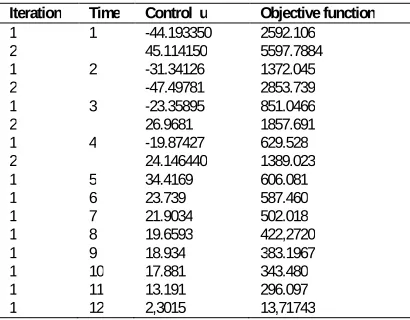
Applying the proposed algorithm, we have Table 1:
TABLE 1. CONTROL AND OBJECTIVE FUNCTION
Iteration Time Control u Objective function
1 1 -44.193350 2592.106 2 45.114150 5597.7884 1 2 -31.34126 1372.045 2 -47.49781 2853.739 1 3 -23.35895 851.0466 2 26.9681 1857.691 1 4 -19.87427 629.528 2 24.146440 1389.023 1 5 34.4169 606.081 1 6 23.739 587.460 1 7 21.9034 502.018 1 8 19.6593 422,2720 1 9 18.934 383.1967 1 10 17.881 343.480 1 11 13.191 296.097 1 12 2,3015 13,71743
Conclusion
We achieve the minimum of the objective function in just 12 iterations which can be considered as good enough. In our subsequent paper we shall consider the application of this algorithm water quality control system where uncertainties are involved. Furthermore we have demonstrated in this paper that it is possible to derive a numerical algorithm for some class of control problems where uncertainties are involved.
REFERENCES
Abiola, B. (2009). Control of Dynamical System in the Presence of Bounded Uncertainty. Ph.D Thesis, Department of Mathematics, University of Agriculture Abeokuta
Corless. M. & Leitmann, G. (1981). Continuous State Feedback Guaranteeing Uniform Ultimate Boundedness for Uncertain Dynamical System.IEE Transaction on Automatic Control, AC-26 No 5.
Dixon, L. C. W. (1975). On the Convergence of the Variable Metric Method with Numerical Derivatives and the Effect of Noise in the Function Evaluation, Optimization and Operation Research, Springer Verlag, Heidelberg, New York.
Ibiejugba, M. A. & Abiola, B. (1985). On the Convergence Rate of the Conjugate Gradient Method. AMSE Periodical, Advances in Modelling and Simulation, 2:21-31.