Hierarchical Authority Based Weighted Attribute
Encryption Scheme
Qiuting Tian, Dezhi Han, and Yanmei Jiang
College of Information Engineering, Shanghai Maritime University Shanghai, China
{tqt2018, jym2097}@163.com, [email protected]
Abstract. With the development of cloud storage technology, data storage secu-rity has become increasingly serious. Aiming at the problem that existing attribute-based encryption schemes do not consider hierarchical authorities and the weight of attribute. A hierarchical authority based weighted attribute encryption scheme is proposed. This scheme will introduce hierarchical authorities and the weight of attribute into the encryption scheme, so that the authorities have a hierarchical relationship and different attributes have different importance. At the same time, the introduction of the concept of weight makes this scheme more flexible in the cloud storage environment and enables fine-grained access control. In addition, this scheme implements an online/offline encryption mechanism to improve the secu-rity of stored data. Secusecu-rity proof and performance analysis show that the scheme is safe and effective, and it can resist collusion attacks by many malicious users and authorization centers. It is more suitable for cloud storage environments than other schemes.
Keywords: cloud storage, attribute-based encryption, weighted attribute, access control, hierarchical authority.
1.
Introduction
first proposed the ABE scheme of the multi-authority, but the scheme only supports the basic ABE algorithm and lacks the flexibility of access. In [6], in view of the hidden dangers of the existence of central authority (CA), an improved CA-free multi-authority ABE scheme is proposed. Yang et al. [24] proposed an effective data access control for multi-authority cloud storage systems, which outsources the decrypted main calculations to the cloud server. Gorasia et al. [12] proposed a multi-authority ABE scheme for fast decryption algorithm, but did not give corresponding security proof.
Since the disadvantage of the traditional ABE mechanism is that the attribute structure is not layered, all attributes have the same security level, and it supports only a single assignment of attributes. Such an attribute structure makes it difficult to have flexible, fine-grained access. Although there are many multi-authority based on attribute access control, most of these solutions do not consider the weight of attributes, that is to say, attributes are equal. But in practical applications, the attribute with weight has practical significance.
Aiming at the above problems, this paper designs a flexible and efficient hierarchi-cal authority based weighted attribute encryption scheme. Our research contributions are summarized as follows:
1) This method uses a layered certification authority to distribute private keys for users. On the one hand, it avoids problems such as server load operation caused by a single certification authority; on the other hand, it facilitates management by trusted authorities. It can achieve more efficient hierarchical management between authorities.
2) The method introduces attribute weights into the encryption scheme, so that the highest weights of the attribute private keys distributed by the authorities of different levels to the users are different, thereby achieving fine-grained access control. By splitting the attributes into different sets, each level of authority selects the appropriate subset based on the weights and distributes them to the lower authority or user. This scheme is suitable for large authorities, which is convenient for managing users and authorities at each level, and also improves system security.
3) This method divides the encryption process into two phases, online and offline. The offline phase pre-processes complex calculations, while the online phase requires only a small amount of simple calculations. The online and offline double-layer encryption greatly improves the security of the entire encryption phase, and is suitable for cloud computing users with limited computing power.
The remaining of the paper is organized as follows. In Section 2, we introduce the research results of the other researchers, related to our research. Some preliminaries are given in Section 3. In Section 4, we propose the scheme formalization and security model. Next, the corresponding specific algorithm is presented. Section 6 presents the security analysis. Section 7 gives the performance analysis of our scheme. In the final section, the conclusion is given.
2.
Related Work
hierarchical ABE scheme, but in this scheme, there is no hierarchical difference in system attributes. Ref. [21] proposed a layered attribute set encryption scheme, which can achieve scalability through a layered structure. Ref. [27] began to study the attribute set and subset, and realized the stratification between attributes. The only drawback of these two schemes is that the connection between the authorities has not yet been given. If there is no inter-section between the user’s attribute sets, the application in the real scene is restricted. Subsequently, Ref. [17] proposed a hierarchical multi-authority and attribute-based en-cryption scheme, it employs character attribute subsets to achieve flexible fine-grained access control. In the system, trusted authority manages hierarchical attribute authorities, but must ensure that the trusted authority is absolutely trustworthy and that it is limited by the size of the attribute set. Ref. [1] gave the encryption scheme of the hierarchical authority, and the scheme does not consider the problem of attribute weights. In practical applications, each attribute has a different role and status, and the attribute has a practical value. In this scenario, the status of each attribute in the system is equal. Therefore, the concept of weights introduced into attributes is more suitable for the needs of practical systems.
Subsequently, Ref. [15] proposed a ciphertext-policy weighted ABE scheme, the at-tributes have different weights according to their importance. Ref. [23] proposed a multi-authority based weighted attribute encryption scheme. The attribute authorities assign dif-ferent weights to attributes according to their importance. Ref. [9] proposed a weighted multi-authority attribute encryption based on ciphertext policy, which implements the encryption mechanism without a trusted center. However, in this scheme, the user’s at-tribute private key and system key are calculated by the atat-tribute authorization center, which causes a load of a single authorization center to be too large, and may eventu-ally cause the attribute authority to crash. Although these schemes introduce the concept of weights, they do not consider the hierarchical relationship between the authorities. Ref. [8] proposed a multi-authority and hierarchical weighted attribute-based encryption scheme, which uses different levels of authorities to distribute different weighted attribute private keys. Thereby, finer-grained access control can be achieved, but the computational overhead of the scheme is large.
3.
Preliminaries
3.1. Bilinear Pairing Map [4]
LetG1andG2be two multiplicative cyclic groups with the prime orderP, and set the
generator of groupG1to beg. There exists a bilinear mape:G1×G1→G2that satisfies
the following properties:
(1) Bilinearity: for allu, v ∈G1,a, b∈Zp, there ise(ua, vb) =e(u, v)ab.
(2) Non-degeneracy: for anyg∈G, there ise(g, g)6= 1.
(3) Computability: for allu, v ∈ G1, there is an effective algorithm for calculating
e(u, v)∈G2.
3.2. Access Structure [8]
Let{p1, p2, ..., pn} denote a set of parties, setP = 2{p1, p2,..., pn}. Access structureA
monotonic, then for∀B, C, ifB ∈ AandB ⊆ C, thenC ∈ A. The sets inAare the authorized sets, and the sets outsideAare unauthorized sets.
3.3. Weighted Threshold Access Structure [2]
LetU be the set of all attributes, weight function isω:U → N, threshold isT ∈ N, defineω(A) = P
u∈A
ω(u)andΓ ={A⊂U:ω(A)≥T}. ThenΓ is called as a weighted
threshold access structure onU.
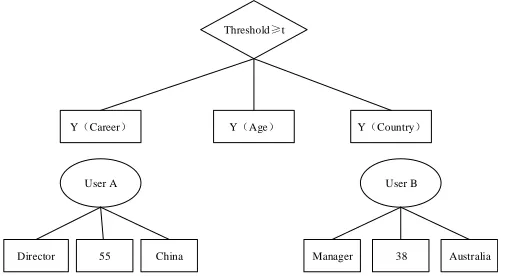
Each leaf node corresponds to the weight of one attribute, and the root node corre-sponds to the threshold. The size of the weight must be expressed as a positive integer. As is shown in Fig. 1, an example of a weighted threshold access structure is given. Suppose someone has three attributes: career, age and country. It distributes the corresponding weights of the three attributes in the leaf node. When the threshold valuet is less than or equal to the sum of the weights of the three parts in the private key, it can decrypt the ciphertext. If user A’s attribute set is{Director,55,China}, User B’s attribute set is {Manager,38,Australia}. The system assigns weight values{7,1,1}and{9,4,1} to the attribute sets of users A and B, respectively. If the system threshold is set to 11, then the sum of the user’s attribute weights must be greater than or equal to 11. All attribute weight values of user A add up to 9, which is less than the threshold value and cannot be decrypted. The total weight of the user B adds up to 14, which is greater than the threshold value, and it can decrypt the ciphertext to get the plaintext.
Threshold t
Y(Career) Y(Age) Y(Country)
User A
Director 55 China
User B
Manager 38 Australia
Fig. 1.Weighted threshold access structure
3.4. Attribute Set Split [16]
Split all the attributes in the system. For any attributeλiin the attribute setΓ ={λ1, λ2, ...,
λn}, the maximum weight is computed as:
According to the calculation resultωi, the attributeλiis divided into(λi,1), ...,(λi, ωi). Assuming that the smallest split unit is 1 and the weights are only integers, the set formed is the split setΓ∗of weighted attributes.
4.
Scheme Formalization and Security Model
This paper proposes a hierarchical authority based weighted attribute encryption scheme, which supports layering between authorities, and different attributes have different im-portance. Different levels of authority can be used to distribute the difference in attribute weights, enabling more fine-grained access control. In addition, because of the complex-ity of the access policy and the number of attributes in the existing ABE scheme, the overhead of encryption and key generation becomes large. This scheme introduces on-line/offline encryption technology, which divides the encryption process into an offline phase and an online phase [26]. The offline phase pre-processes complex calculations by the data owner during idle periods. In this way, the online phase requires only a small amount of simple calculations to generate ciphertext. This scheme is mainly composed of the following five parts: Cloud Service Provider (CSP), Trust Authority (TA), Attribute Authority (AA), Data owner (DO) and User.
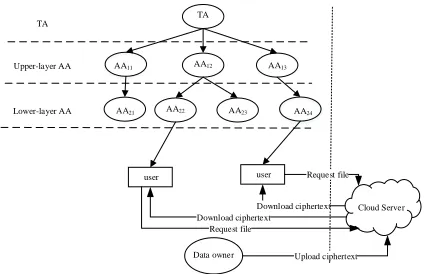
CSP mainly provides cloud data storage service, stores data uploaded by DO; TA is responsible for generating and distributing system parameters, and manages upper-layer AA; upper-layer AA authorizes the lower-layer AA so that the lower-layer AA has the right to in charge some of the user’s attributes. DO encrypts its own data and uploads it to the CSP, which is stored by the CSP; the user sends a file request to the CSP according to his/her needs, downloads the file from the cloud and decrypts it with the user’s secret key. The structure of the system is shown in Fig. 2.
AA11
TA
Upper-layer AA
TA
AA12
Lower-layer AA AA22 AA23 AA24
user user
Cloud Server
Data owner Upload ciphertext Download ciphertext
Request file
Request file
Download ciphertext AA21
AA13
Fig. 2.System architecture of hierarchical authority
all AAs in the chain of authorization centers they are in. Suppose the user’s attribute set isAu = {A1, A2, ..., An}, andAu is automatically divided intoK disjoint subsets according to the hierarchy.
The divided subset is managed byKAAs on the AA chain and satisfies K
P
k=1
Aku=Au.
As shown in Fig. 2 above, the user belongs toAA24, assuming that all attribute sets owned
by the user are:{N ame: Java,ID : 687921,{Age : 18,Sex : Female,{Job : Manager,
Tel : 1255766}}}.
Then TA manages attribute{N ame: Java,ID : 687921};A13manages attribute{Age :
18,Sex : Female}; andA24manages attribute{Job : Manager,Tel : 1255766}.
4.1. Concepts of the Scheme Formalization
This scheme is mainly composed of the following basic algorithms. The specific structure is as follows:
(1) TASetup(γ,S) → (PK,MK): Takes input as the security parameter γand all attribute setsSin the system, and the system outputs public keyP K and the master key
M K.
(2) AASetup(A,λ, λi, λi,j) → (MKk+1,Mj): Operates the initial algorithm with every AA by inputting the arbitrary parameterλ,λi,λi,j and the attribute setAof the upper-layer authority; the master keyMKk+1 and the public keyMjof the lower-layer
authority are output.
(3)KeyGen(MK,Mj,MKk+1,u)→(P Ku,SKu,SK): The user applies for a private key to the AA. Takes input as the master keyM K,Mj, user identifiersuandMKk+1in
the system, and the system outputs the user’s system public keyP Ku, system private key
SKuand user’s private keySK.
(4)EncryptOffline(P K,Mj, Λ)→IT: The data owner invokes the offline encryption algorithm according to the system public keyP K, the authority public keyMj, and the access structureΛto obtain the middle ciphertextIT.
(5)EncryptOnline(IT ,m, S)→CT: The data owner invokes the online encryption
algorithm according to the middle ciphertext IT, plaintext m and attribute set S, and obtains the complete ciphertextCT uploads it to the CSP.
(6) Decrypt(MKk+1,SK,CT) → m: The user accesses the CSP and downloads
the file to the local, and then calls the decryption algorithm to decrypt the ciphertextCT
according to the private keyMKk+1of the attribute authority and the user private keySK.
If the attribute related to the user satisfies the access policy embedded in the ciphertext
CT, the decryption obtains the plaintextm; otherwise the decryption fails.
4.2. Security Model
Theorem 1: If any attacker’s advantageAdvAd(k)in the security game is negligible, then the scheme is called CPA (Chosen-Plaintext Attack) [3] security. The following is the construction process of choosing the plaintext security model in the security game plan. Let the attacker beAdand the challenger be C. The specific game process is as follows:
(2) Setup: TA first executes the initialization algorithm and obtains the system public keyP K. At the same time, each attribute authority also executes an initialization algo-rithm to obtain the public keyMj. The public key of the system and the public key of the attribute authority are sent to the attackerAdby the challenger C.
(3) Phase 1: AttackerAdsends a challenged attribute split setA∗1, ..., A∗q requesting the construction of a private key, which includes the subset of attributes being queried. However, arbitrary A∗
i (1≤i≤q)and access tree structureΛ∗ are inconsistent. Chal-lenger C sends the obtained private keyAj,A0j(1≤j≤q)to attackerAdafter perform-ing the key generation algorithm.
(4) Challenge: AttackerAdselects two equal length plaintextM0andM1, and sends
them to challenger C. Challenger C randomly selectsb∈ {0,1}and sends the ciphertext
CT to Challenger C by encrypting the plaintext. (5) Phase 2: Phase 1 is repeated.
(6) Guess: AttackerAdgives a guess valueb∗ ∈ {0,1}. Ifb∗ =b, attackerAdwins the final game. The advantage of the attacker in this game is:
AdvAd(k) =
Pr[b∗=b]−1
2
(2)
If the advantageAdvAd(k)of attackerAdis negligible in polynomial time, it indicates
that this scheme satisfies CPA security conditions.
5.
Hierarchical Authority Based Weighted Attribute Encryption
Scheme
(1) TA Setup:TA randomly selectsgas a generator at the initialization stage. A bilinear groupG0, whose order is primep, and satisfies the bilinear mape:G0×G0→G1. All
identifiers that represent the AA and user identity are uniformly distributed by the TA. AA is used to verify whether the user is legitimate and the user’s identity is highly secure.
AID(AA) ={P(AA), index(AA), P(AA)∈Zp}represents the random serial number
of TA, andindex(AA)∈Zprepresents the random serial number that the TA distributes for AA.
The first|Γ∗|elements inZpare randomly selected, i.e.1,2, ...,|Γ∗|( modp). Set the recursion depth of the user key structure to 2 for the first time. Then randomly selectl1, l2,
setL1 =gl1, L2 =gl2,D1=g
1
l1, D2 =g 1
l2. Finally, chooseα, y,{β1, β2} ∈Zp, h ∈
G0randomly fromZp, output the system public key asP K ={G0, GT, g, L1, L2, D1, D2,
e(g, g)α}and the system master keyM K={l
1, l2, gα}.
(2) AA Setup:After the TA is initialized, a global identifierAID is generated for each AA to indicate the uniqueness of the identity. When the number of AA isN, the authority of each layer distributes keys for users according to the weighted attributes. It is assumed that the attribute set of thekth layer authority isAk ={a1, ..., ank}, and the
corresponding attribute split set isA0k. Let|A0k|=n0k, take the firstn0kelements inZp,
i.e.1, ..., n0k(modp). Then, randomly selectr1, ..., r0nk ∈Zp,1≤k≤N, the public key
of the AA is:
1)Upper-layer AA Authorization: The system randomly selects parametercand at-tribute setA={A0, A1, ..., An}. The first layer attribute isA0, andAi ={(λi,1), ...,(λi,
ωi)}(1 ≤i ≤n)is the attribute split set. When TA initializes AA,Ais represented by randomly selectedλ∈Zp,Ai∈Ais represented byλi ∈Zp, andai,jis represented by
λi,j∈Zp. The master key of the upper-layer AA is:
M K0={A, gα, K=g
λ−α β1 , K
i,j =gλi·H(ai,j)λi,j,
K0i,j=g
1
λi,j(0≤i≤n,0≤j≤n), Di=g λ−λi
β2 (1≤i≤n)}
(4)
Dican be converted during the match of attributes to decrypt. When converting, DD0i i
can go fromλ0itoλi.
2)Lower-layer AA Authorization: The upper-layer authority authorizes the authority to enter the system after verifying the identity of the lower-layer authority. LetAdenote the attribute set of the upper-layer AA andA0 denote the attribute set of the lower-layer AA to satisfyA0⊂A. TheAAk+1’s master key is distributed through theAAk. As above,
AAkrandomly selectsλ0∈ZpforA0andλ0i∈ZpforAi0 ∈A0,λ0i,j∈Zp, a0i,j∈A0i,0≤
i≤n,1≤j≤n. ThenAAk+1’s master key is:
M Kk+1={A0, gα, K0 =K·g
λ0(λ−α)
β1 , K0i,j=Ki,j·gλ 0
i·H(a0
i,j)λ 0
i,j,
Ki,j00 =K0i,j·gλ
0
i,j(0≤i≤n,1≤j ≤n), D0
i=Di·g
λ0+λ0i β2 }
(5)
Among them,K,Ki,j,Diare the corresponding items inAAk.
(3) Key Generation:The user first applies for the private key to the lower layer AA. If the lower layer AA cannot generate the required weight attribute private key component for the user, then the request is handed over to the upper layer AA. If the upper layer AA is still unable to authorize, the user continues to go up. The application is handed over until a level of authority is able to satisfy the user’s request.
1)User System Private Key Generation: The TA generates a system private key for a user who temporarily joins the system and sends a certificate. After theM K and the user’s identity identifier uare entered into the system, TA randomly selectszu ∈ Zp. Calculate the public key of the system according to equation (6) and output:
P Ku=gZu (6)
Calculate the user’s system private key:
SKu=gαhyZu (7)
If thekth layer authority of the system directly operates on the user, then theKTAs will jointly manage the user attributes dispersed at each layer. The user attribute split set on thek≤Klayer AA is denoted byAk ={A1k, A2k, ..., Ank}. Thekth layer authority randomly generates an identifierAID, which is denoted byc.λ˜k ∈Zp,˜λki ∈Zp,λ˜ki,j ∈
Zp,r0∈AIDis arbitrarily selected by AA, output the user’s private key:
SK= (gc, Ak, D=g
˜ λk−r0
β1,k , P =gαgu/λgλ0r0,P0=gr0, Dj =gλ˜ki/λ 0
·H(ai,jk)
˜
λk i,j,
D0j =gλ·
˜
λk
i,j(0≤i≤n,0≤j≤n))
(8)
(4) Encrypt:The encryption algorithm of this scheme divides the encryption process into two parts: online/offline. In this algorithm, user attributes are classified and each attribute has a public key. The intermediate ciphertext is obtained by encryption during the offline phase; after the user attribute set and plaintext are known in the online phase, it quickly generates these intermediate ciphertexts into complete ciphertexts by a simple calculation. The data owner encrypts his data through the encryption algorithm and then uploads the generated ciphertext to the CSP storage. The main encryption algorithms are as follows:
1)Offline Encryption: The system public keyP K, the attribute authority public key
Mj, and the access treeΛare input into the system, and the nodexthreshold is represented bykx. Each nodexin the tree corresponds to a polynomialqx. Starting from the root nodeR, the relationdx = kx−1is satisfied. Ifxis a leaf node,dx = 0is satisfied. Select random number s ∈ Zp, let qR(0) = s, the other node x set value:qx(0) =
qparent(index(x)). Optionally a polynomialqxwhose order isdx.Y denotes the set of all leaf nodes, Y0 denotes the split set of weighted attributes, attr(x)denotesx ∈ Y
attributes, and the middle ciphertext is calculated:IT = (C0, C1, C2, M, Λ).
(M = Q
c∈IA
e(g, g)αs, C0=gs
C1=gλ
0q x(0), C
2=H(attr(x))qx(0)
(9)
2)Online Encryption: Input middle ciphertextIT, plaintext messagem and user’s attribute setAk = {a1, ..., ank}into the system. Calculated according to equation (10),
whereIA is the smallest attribute set of the user and the complete ciphertext is output:
CT = (IT, C).
C=m Y
c∈IA,xni∈A
(e(g, g)λn)xni =m Y
c∈IA,xni∈A
e(g, g)λnxni =mM (10)
(5) Decrypt: The user downloads the file to be accessed from the CSP and then decrypts it with the obtained user private key. The premise of ciphertext decryption is that the identifier AID of the TA in the ciphertext and the private key component of the user are the same, and when the attribute possessed by the user satisfies the struc-ture of the access treeΛ, i.e. P
p∈{S0∩Y0}
weight(p)≥t.Selectingtelements from the set
K ={S0∩Y0}decrypts the ciphertext to get the plaintext. otherwise it returns⊥. Call
Decrypt(MKk+1,SK,CT)→ m, for any nodexin the access tree, after executing the
and the recursive function is executed from the root node. Otherwise, the null value is returned. For any nodex: Ifi∈Ac∈IA, seti = attr(x), calculate:
e(C1(i),Di)
e(C2(i),D0i)=
e(gλ0qx(0),gλk˜i/λ0 ·H(ak
i,j) ˜ λk
i,j)
e(H(i)qx(0),gλ0 ·λ˜ k i,j)
= e(gλ
0 qx(0),gtλ˜
k
i,j)·e(gλ0qx(0),gλk˜i/λ0)
e(gtqx(0),gλ0 ·˜λ k i,j) =e(g, g)˜λk
iqx(0)
(11)
Ifi /∈ Ac∈IA, this algorithm has no solution and returns⊥. If and only if the user’s
attribute setP
c∈IAAmatches the access treeΛ, the equation (12) is calculated by the
Lagrange mean value theorem, then the equation (13) is calculated, and the equation (14) is finally calculated, as follows:
(
e(g, g)λ˜kiqx(0)=e(g, g)λ˜kis
e(g, g)IA˜λkiqx(0)=e(g, g)IAλ˜kis
(12)
Q
c∈IA
e(C0,P) e(C1,P0) =
Q
c∈IA
e(gs,gαgu/λgλ0r0)
e(gλ0s,gr0) =
Q
c∈IA
e(gs,gλ0r0)e(gs,gαgu/λ)
e(gλ0s,gr0) =e(g, g)IAus/λ Q
c∈IA
e(g, g)αs (13)
e(g, g)IAus/λ Q
c∈IA
e(g, g)αs
e(g, g)IAus/λ =
Y
c∈IA
e(g, g)αs =M (14)
Output plaintext:m= MC.
Finally, the user who meets the ciphertext access policy can decrypt the ciphertextCT
and get the plaintextmto be accessed; if it is not satisfied, it can not be decrypted, and the file to be accessed cannot be obtained.
6.
Security Analysis
6.1. Security Proof
The proof of security of this scheme is based on the difficult problem of DBDH (Deci-sional Bilinear Diffie-Hellman) [10]. If the attacker’s advantageAdvAd(k)is negligible, it indicates that the solution is to satisfy CPA security. The theorem of CPA security is given below, which is proved by proof by contradiction.
Theorem 2: If the advantage of solving DBDH problem on(G0, G1)is negligible,
then the DBDH assumption is established on(G0, G1), i.e. the scheme is CPA safe under
the standard model.
Proof: Use proof by contradiction to prove. Assuming an attacker’s advantageAdvAd(k) is not negligible in polynomial time, the attacker wins. Use the following games to further illustrate:
(1) Initial: AttackerAdrandomly selects an access policyΛ∗.
(2) Setup: Simulator K runs an ”Initial” algorithm to obtain the system’s public key
gα}. Challenger C saves the master keyM Kitself, and the system public key is sent to attackerAd.
(3) Phase 1: AttackerAdsends a private key access request for the partitioned attribute
setA1∗, A2∗, ..., Aq∗. Note thatAi∗(1 < i < q) is completely mismatched with the
structureΛ∗of the access tree. Perform private key generation algorithm:
SK= (gc, Ak, D=g
˜ λk−r0
β1,k , P =gαgu/λgλ0r0,P0 =gr0, D j=g
˜
λki/λ0 ·H(ak i.j)
˜
λki,j,
D0j=gλ·
˜
λki,j(0≤i≤n,0≤j≤n))
(15) Send the private key to attacker Ad.
(4) Challenge: AttackerAdsends two equal length plaintextM0,M1and challenged
access structureΛ∗to challenger C. AttackerAddid not find Challenger C’s key during
the query phase and the simulator randomly selected a bit attribute η ∈ {0,1}. First, calculateC0,C1,C2andM. Under access structureΛ∗, encrypt the plaintextMηoffline to obtain the middle ciphertext:IT = (C0, C1, C2, M, Λ∗). Calculate:
ˆ
C=Mη
Y
c∈IA,xni∈A
(e(g, g)λn)xni =M
η
Y
c∈IA,xni∈A
e(g, g)λnxni =M
ηM (16)
Whenb= 0, define equation (17)
Z=e(g, g)abc (17)
Letbc=θ,Cˆbe ciphertext, so:
ˆ
C=M η·e(g, g)aθ (18)
Otherwise, whenb= 1, there is:
Z =e(g, g)z
ˆ
C=M η·Z=M η·e(g, g)z (19)
Sincezis randomly selected,Cˆobtained at this time is a random element, andCˆdoes not include information related toMη.
(5) Phase 2: AttackerAdrepeatedly sends a private key request for user attribute set
A∗
1, A∗2, ..., A∗q, i.e.A1∗, A∗2, ..., A∗q does not meet the access structureΛ∗in the ciphertext.
(6) Guess: AttackerAdoutputs a conjecture onη. Ifη0=η, the attacker guesses
cor-rectly and the simulator outputsb0 = 0, indicating that the tuple received by the simulator is the DBDH tuple(g, ga, gb, gc, e(g, g)abc). Otherwise, the simulator outputs b0 = 1,
which is a five-tuple(g, ga, gb, gc, e(g, g)z). In the above game, ifb= 1, the attacker is not receiving any information related to the ciphertextMη, i.e.
Pr[η06=η|b= 1 ] = 1
2 (20)
Because, ifη06=η, the simulator guessesb0 = 1, then
Pr[b0=b|b= 1 ] = 1
Whenb= 0, the attacker gets a ciphertextMηof a scheme. By definition, the attacker has a non-negligible advantageεto break this scheme, so
Pr[η0 =η|b= 0 ] =ε+1
2 (22)
Because, ifη0=η, the simulator will guessb0= 0,so there is
Pr[b0 =b|b= 0 ] =ε+1
2 (23)
So in the above game, the simulator correctly guesses the advantage ofb0=bis:
AdvC = Pr[b0=b]−12
=1 2Pr[b
0 =b|b= 1 ] +1 2Pr[b
0 =b|b= 0 ]−1 2
=1 2·
1 2+
1 2·(
1 2+ε)−
1 2
=ε
2
(24)
Based on the definition and the above security game, in any polynomial-time algo-rithm, the advantage of attackerAdwinning the game is negligible, so the scheme is CPA safe.
6.2. Security Analysis
(1) Collusion Resistance:When each user is registered, the TA will distribute a unique
uidfor it. Generate the user’s system private key by randomizing parameters:
SKu=gαhyzu (25)
The TA distributes random AID to each layer of AA. The TA first splits the user’s attribute set according to the size of the weight value, and the attribute split set is sent by the TA to the AA of each layer. Before AA distributes the attribute private key for users, it first verifies the validity of each user’s AID. If the attribute of the user belongs to the layer
AA, the user private keySK = (gc, Ak, D=g ˜ λk−r0
β1,k , P =gαgu/λgλ0r0,P0=gr0, D j =
g˜λk i/λ
0 ·H(ak
i.j)
˜
λki,j, D0
j =gλ·
˜
λki,j(0 ≤ i ≤ n,0 ≤ j ≤ n))is distributed for it. Each user’s private key is also formed by the serial number and randomization parameters, so that at the time of decryption, each user’s private key is embedded with a different random value [11]. During encryption, the encryption exponents, the random numbersλ,λnand the weighted split set parameterxare all embedded in different ciphertext segments. If multiple users collusion, even if H(attr(x))qx(0) is recovered, the random numbers of
different users cannot recovergsandgλ0qx(0). Therefore, the middle ciphertextIT cannot
be recovered, and the final ciphertext cannot be recovered. In the end, the collusion user could not decrypt the ciphertext and thus well achieved the collusion resistance attack.
decrypted accurately. In summary, multi-authority can collectively manage keys, reduc-ing the heavy workload of a sreduc-ingle authority, and improve the security of the system and reduce the overall risk.
(3) Access Policy Flexibility:It allows the intersection between user attributes of this scheme and the expression of access policy is also more flexible. The attribute sets of multiple users can also be queried. The entire process is based on the encryption of data by the data owner.
(4) System Scalability:This scheme extends from TA to multi-authority to jointly manage user’s keys. This has reduced the workload of the previous single authority and improved the work efficiency. At the same time, the security of the entire system has also been improved.
7.
Performance Analysis
7.1. Performance Comparison
The above security proofs show that this scheme is CPA safe. This scheme and existing schemes [6], [23] and [14] are compared and analyzed in terms of function and perfor-mance. It shows the results in Table 1.
In Table 1, supposenis the number of attributes in the access policy. The pairing operation, exponentiation operation ofG1, exponentiation operation of G2 are denoted
byTp,Te1,Te2respectively.
Table 1.Performance Comparison of Related Schemes
Schemes Data encryption Data decryption Multi-authority Weighted attribute Hierarchical [6] 2n Te1+Te2+Tp 3Te2+Tp
√
× ×
[14] (2n+ 1)Te1+Te2+Tp Tp
√
× √
[23] n Te1+Te2+Tp 2Te2
√ √
×
Our scheme n Te2 Te2
√ √ √
From Table 1, it can be seen that the encryption cost in [14] is large. Since the en-cryption phase of the scheme proposed in this paper is divided into two online and offline processes, most of the tedious calculation processes are placed in the offline stage, which greatly reduces the computational cost of the encryption stage. From the table, it can be seen that the encryption cost of the scheme proposed in this paper is much smaller than the other three schemes. In terms of decryption cost, the cost of [6] has experienced three exponential operations and one pairing operation. Ref. [14] runs a partial decryption algo-rithm, which requires a pairing operation to recover the plaintext. However, in [23], users need to perform two exponential operations when decrypting. When the scheme proposed in this paper is decrypted, only one exponential operation needs to be performed. Overall, the scheme proposed in this paper is relatively excellent, and it has improved in terms of function and performance, and is more suitable for cloud environments.
7.2. Simulation Evaluation
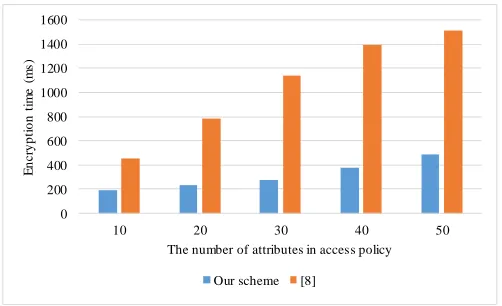
In order to show the performance of this scheme more intuitively, this paper selects scheme [1] and scheme [8] to carry out simulation experiments, and evaluates the ef-fectiveness of the scheme through experiments. The implementation is on a Linux system with CPU i5-6500 at 3.20GHZ and the memory is 8GB. The implementation adopts a 224-bit elliptic curve group from Pairing-Based Cryptography Library [18] and based on the CP-ABE package. It shows the experimental results in Fig. 3 and Fig. 4.
The complexity of the access policy affects computational and communication over-head. We generate the form of the access strategy(A1, A2, ..., An)to simulate the worst
environment, andAi,i∈(1,n)is an attribute. We set distinct access policies in this form and
the number of user’s attributes vary from 10 to 50. It must compare all the attributes of user that can know whether his/her attributes satisfy the access policy or not. The time is given in milliseconds.
0 200 400 600 800 1000 1200 1400 1600
10 20 30 40 50
E
n
c
ry
p
ti
o
n
t
im
e
(
m
s
)
The number of attributes in access policy
Our scheme [8]
Fig. 3.Comparison of encryption time
in-creases. As can be seen from the figure, the encryption time cost of the proposed scheme is obviously less than that of scheme [8]. This is because the encryption phase of the scheme proposed in this paper is divided into two phases: online and offline. Most of the encryption calculations are completed in the offline phase.
0 500 1000 1500 2000 2500 3000 3500 4000
10 20 30 40 50
D
e
c
ry
p
ti
o
n
t
im
e
(
m
s
)
The number of attributes in access policy
Our scheme [1]
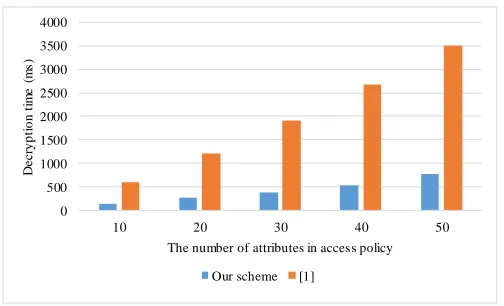
Fig. 4.Comparison of decryption time
As shown in Fig. 4, the comparison of the decryption time consumption for the scheme proposed in this paper and scheme [1]. As can be seen from the figure, the decryption time of the scheme proposed in this paper is less than that of scheme [1], and with the increase of the number of attributes, the advantages of the scheme proposed in this paper become more obvious. This is because in the process of decryption, the amount of calculation of scheme [1] is large, while the scheme proposed in this paper only needs to perform one exponent operation and the efficiency is high.
8.
Conclusions
For the problem of cloud storage security, this paper proposes a hierarchical authority based weighted attribute encryption scheme. Through the introduction of the mechanisms of hierarchical authorities and the weight of attribute. There is a hierarchical relationship among the authorities, different attributes have different importance, a more fine-grained access control is achieved, and the security of the system is enhanced. By performing on-line and offon-line encryption mechanisms, it places most of the tedious calculation processes on the offline stage, greatly reducing the amount of computation in the encryption stage and reducing the computational cost. Compared with other schemes, the decryption cost is also reduced, which improves the operating efficiency of the system. Through security analysis and comparison, it is shown that the scheme proposed in this paper is safe and efficient under the cloud storage environment.
References
1. Ai, Q., Dan, T., Wang, Z., Jianwei, L.: Hierarchical authority attribute-based encryption. Jour-nal of Wuhan University (Natural Science Edition) 60(5), 441–446 (2014)
2. Beimel, A., Tassa, T., Weinreb, E.: Characterizing ideal weighted threshold secret sharing. In: Theory of Cryptography Conference. pp. 600–619. Springer (2005)
3. Bergen, H.A., Hogan, J.M.: A chosen plaintext attack on an adaptive arithmetic coding com-pression algorithm. Computers & Security 12(2), 157–167 (1993)
4. Boneh, D., Franklin, M.: Identity-based encryption from the weil pairing. In: Annual interna-tional cryptology conference. pp. 213–229. Springer (2001)
5. Chase, M.: Multi-authority attribute based encryption. In: Theory of Cryptography Conference. pp. 515–534. Springer (2007)
6. Chase, M., Chow, S.S.: Improving privacy and security in multi-authority attribute-based en-cryption. In: Proceedings of the 16th ACM conference on Computer and communications se-curity. pp. 121–130. ACM (2009)
7. Chattopadhyay, A.K., Nag, A., Majumder, K.: Secure data outsourcing on cloud using secret sharing scheme. IJ Network Security 19(6), 912–921 (2017)
8. Chen, D., Liu, S., Li, Q.: Multi-authority and hierarchical weighted attribute-based encryption scheme. Journal of Nanjing University of Posts and Telecommunications 36(5), 18–23 (2016) 9. Chen, W., Zhang, Y., Zheng, D.: Weighted multi-authority attribute encryption based on
cipher-text policy. Journal of GuiLin University of Electronic Technology 35(5), 386–390 (2015) 10. Cheung, L., Newport, C.: Provably secure ciphertext policy abe. In: Proceedings of the 14th
ACM conference on Computer and communications security. pp. 456–465. ACM (2007) 11. Cui, M., Han, D., Wang, J.: An efficient and safe road condition monitoring authentication
scheme based on fog computing. IEEE Internet of Things Journal (2019)
12. Gorasia, N., Srikanth, R., Doshi, N., Rupareliya, J.: Improving security in multi authority at-tribute based encryption with fast decryption. Procedia Computer Science 79, 632–639 (2016) 13. Han, D., Bi, K., Xie, B., Huang, L., Wang, R.: An anomaly detection on the
application-layer-based qos in the cloud storage system. Comput. Sci. Inf. Syst. 13(2), 659–676 (2016) 14. Huang, Q., Yang, Y., Shen, M.: Secure and efficient data collaboration with hierarchical
attribute-based encryption in cloud computing. Future Generation Computer Systems 72, 239– 249 (2017)
15. Liu, X., Ma, J., Xiong, J., Li, Q., Ma, J.: Ciphertext-policy weighted attribute based encryption for fine-grained access control. In: 2013 5th International Conference On Intelligent Network-ing And Collaborative Systems. pp. 51–57. IEEE (2013)
16. Liu, X., Ma, J., Xiong, J., Li, Q., Zhang, T.: Ciphertext-policy weighted attribute based encryp-tion scheme. Journal of Xi’an Jiaotong University 47(8), 44–48 (2013)
17. Luo, E., Liu, Q., Wang, G.: Hierarchical multi-authority and attribute-based encryption friend discovery scheme in mobile social networks. IEEE Communications Letters 20(9), 1772–1775 (2016)
18. Lynn, B., et al.: Pbc library. Online: http://crypto. stanford. edu/pbc 59, 76–99 (2006) 19. Nag, A., Choudhary, S., Dawn, S., Basu, S.: Secure data outsourcing in the cloud using
multi-secret sharing scheme (msss). In: Proceedings of the First International Conference on Intelli-gent Computing and Communication. pp. 337–343. Springer (2017)
20. Sahai, A., Waters, B.: Fuzzy identity-based encryption. In: Annual International Conference on the Theory and Applications of Cryptographic Techniques. pp. 457–473. Springer (2005) 21. Wan, Z., Liu, J., Deng, R.H.: Hasbe: A hierarchical attribute-based solution for flexible and
scalable access control in cloud computing. IEEE transactions on information forensics and security 7(2), 743–754 (2012)
23. Wang, Y., Zhang, D., Zhong, H.: Multi-authority based weighted attribute encryption scheme in cloud computing. In: 2014 10th International Conference on Natural Computation (ICNC). pp. 1033–1038. IEEE (2014)
24. Yang, K., Jia, X., Ren, K., Zhang, B., Xie, R.: Dac-macs: Effective data access control for mul-tiauthority cloud storage systems. IEEE Transactions on Information Forensics and Security 8(11), 1790–1801 (2013)
25. Yang, L., Deng, Y., Yang, L.T., Lin, R.: Reducing the cooling power of data centers by intelli-gently assigning tasks. IEEE Internet of Things Journal 5(3), 1667–1678 (2018)
26. Zhou, Y., Deng, Y., Xie, J., Yang, L.T.: Epas: A sampling based similarity identification algo-rithm for the cloud. IEEE Transactions on Cloud Computing 6(3), 720–733 (2018)
27. Zou, X.: A hierarchical attribute-based encryption scheme. Wuhan University Journal of Natu-ral Sciences 18(3), 259–264 (2013)
Qiuting Tianis currently a Ph.D. at Shanghai Maritime University. Her research interests include cloud computing, mobile networking security and cloud security.
Dezhi Hanreceived the Ph.D. degree from the Huazhong University of Science and Tech-nology. He is currently a Professor of computer science and engineering with Shanghai Maritime University. His research interests include cloud computing, mobile networking, wireless communication, and cloud security.
Yanmei Jiang is currently a master student of Shanghai Maritime University. Her re-search interests include cloud computing and mobile networking security.