Available online on 15.06.2019 at http://jddtonline.info
Journal of Drug Delivery and Therapeutics
Open Access to Pharmaceutical and Medical Research© 2011-18, publisher and licensee JDDT, This is an Open Access article which permits unrestricted non-commercial use, provided the original work is properly cited
Open Access
Research Article
Formulation and Evaluation of Fluconazole Microsponge using Eudragit L
100 by Quasi Emulsion Solvent Diffusion Method
Hans Mansi
*1, Dua Jagdeep Singh
1, Prasad D.N
2, Monika
1, Sharma Diksha
11Department of Pharmaceutics, Shivalik College of Pharmacy Nangal, Punjab, India
2Department of Pharmaceutical Chemistry, Shivalik College of Pharmacy Nangal, Punjab, India
ABSTRACT
The aim of the present study is to formulate and evaluate the fluconazole microsponge by using Eudragit L 100. Microsponge was made because they provide controlled as well as target specific release of the drug. Thus study the effect of stirring rate on the formation of microsponge. Microsponge containing Fluconazole were prepared by quasi-emulsion solvent diffusion method at different stirring rate i.e 500, 800, 1000, 1200 and 1500 rpm. Particle size of prepared microsponge was observed in the range of 76.2 to 32.5μm. Scanning electron microscopy revealed the porous, spherical nature of the microsponges. The production yield, entrapment efficiency and drug content were found to be 78.24%, 82.76%, 81.36%. The impact of Drug: Polymer ratio and process variables i.e stirring speed and stirring time on the physical features of microsponges like production yield, mean particle size, entrapment efficiency were examined. It was shown that production yield, drug content and entrapment efficiency was found to be increase with increase in drug polymer ratio while drug: polymer ratio has reverse effect on particle size, as drug: polymer ratio increase, particle size decrease. As the polymer concentration increased, more amount of polymer surrounding the drug, thus increasing the thickness of the wall of the polymer matrix which lead to extended diffusion path and ultimately to lesser drug release or more sustained release. The effect of stirring rate on the morphology of microsponge. The formulation with higher drug to polymer ratio 1:8 (i.e F4) was chosen to investigate the effect of stirring rate on the morphology of microsponges. The dispersion of the drug and polymer within the aqueous phase was found to be dependent on the agitation speed. As the speed was increased the size of microsponges was reduced and the microsponges were found to be spherical and uniform.
Keywords: Novel drug delivery system, Microsponges, Eudragit L 100, Fluconazole, Quasi-emulsion solvent diffusion method.
Article Info:Received 01 May 2019; Review Completed 31 May 2019; Accepted 06 June 2019; Available online 15 June 2019
Cite this article as:
Hans H, Dua JS, Prasad DN, Monika, Sharma D, Formulation and Evaluation of Fluconazole Microsponge using Eudragit L
100 by Quasi Emulsion Solvent Diffusion Method, Journal of Drug Delivery and Therapeutics. 2019; 9(3-s):366-373
http://dx.doi.org/10.22270/jddt.v9i3-s.2855 *Address for Correspondence:
Hans Mansi, Department of Pharmaceutics, Shivalik College of Pharmacy, Nangal, Punjab, India (Email: [email protected])
INTRODUCTION
A microsponge delivery system is a uniform, spherical, porous, highly cross-linked polymeric microspheres or tiny sponge-like spherical particles with large porous surface. They enhance stability, reduced side effects and modify drug release. It consists of micro-porous beads, typically 10-25 microns in diameter, loaded with active agents. Besides, they may enhance stability, modify drug release and reduce side effects favourably. Like a true sponge, each microsphere consists of a myriad of interconnecting voids of particles from 5-150μm within a non-collapsible structure, with a large porous surface 1.
Microsponge systems are based on microscopic, polymer- based microspheres that can suspend or entrap a wide variety of substances, and can then be incorporated into a formulated products such as a gel, cream, liquid or powder 2.
major amounts and resulted in a new creation of highly efficacious and well tolerated novel products 2.
It is unique technology for the controlled release of topical agents. Fluconazole is a trizole antifungal agent used for the treatment of systemic and superficial fungal infection. The purpose of the present investigation was to formulate and evaluate fluconazole loaded Microsponges using Eudragit L 100 for the controlled release of drug and study the effect of stirring rate on the formulation of microsponge 4.
MATERIALS AND METHODS
Materials: Fluconazole gift sample obtained from Haustus
Biotech. Pvt. Ltd., Tahliwal (Una), Dibutyl phthalate was procured from SD fine chem. Ltd. Mumbai, Polyvinyl alcohol was procured from Glaxo smith kline pharmaceuticals Ltd. Mumbai, Dichloromethane was procured from RFCL limited Gujrat India, Ethanol and KBr was procured from Central drug house (p) Ltd. New Delhi, and distilled water.
Method of Preparation of Fluconazole Microsponges
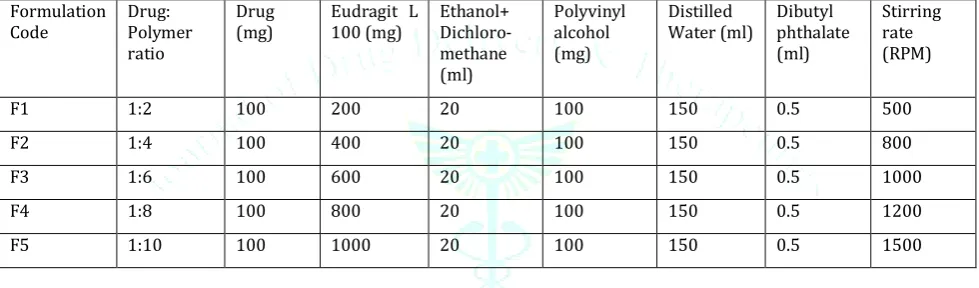
Fluconazole Microsponges were prepared by quasi-emulsion solvent diffusion method. To prepare the internal phase, fluconazole was dissolved in 20 ml of dichloromethane: ethanol (1:1) mixture to dissolve both the drug and the polymer (Eudragit L 100) and to this add 0.5 ml dibutyl phthalate as a plasticizer. The external phase containing 100 mg of PVA in water. The external phase was placed in the vessel with propeller stirrer rotating at different rpm, to this add slowly internal phase. The system was thermally controlled at 25° C in a water bath. Agitations up to 30 min permit the formation of microsponges and continue stirring for 8h to get desired rigid microsponges. After 8h stop stirring filter the rigid micro sponges through the filter paper (Whatmann filter paper 0.45 µm), washed with distilled water and dried at room temperature 5,6. Fluconazole microsponges were prepared using various drug: polymer ratios i.e. 1:2, 1:4, 1:6, 1:8, 1:10 at different stirring rate of 500, 800, 1000, 1200 and 1500 rpm. The formula of various microsponge are shown in table 1.
Table 1 Micro sponge Formulations of Fluconazole Microsponges
Formulation
Code Drug: Polymer ratio
Drug
(mg) Eudragit L 100 (mg) Ethanol+ Dichloro-methane (ml)
Polyvinyl alcohol (mg)
Distilled
Water (ml) Dibutyl phthalate (ml)
Stirring rate (RPM)
F1 1:2 100 200 20 100 150 0.5 500
F2 1:4 100 400 20 100 150 0.5 800
F3 1:6 100 600 20 100 150 0.5 1000
F4 1:8 100 800 20 100 150 0.5 1200
F5 1:10 100 1000 20 100 150 0.5 1500
Evaluation of microsponges
Production/ percentage yield: The dried microsponges of
each batch are weight separately and percentage yield is calculated by using following equation:-
Percentage yield
Entrapment efficiency (EE)/ Loading efficiency and
Actual Drug Content: 100 mg of microsponges were
accurately weighted. They were powdered and extracted with 100 ml of method. Further it was serially diluted with pH 7.4 phosphate buffer 7,8. The resulting solution was analysed for fluconazole drug content by measuring absorbance in a UV spectrophotometer at 260nm using pH 7.4 phosphate buffer as blank. The studies were carried out in triplicate. The actual drug content and entrapment efficiency were deliberate as:
Actual drug content(%)=(Mact/Mms)*100
Entrapment efficiency(%)=Mact/Mthe)*100
Where Mact is the actual amount of fluconazole in weighed quantity of microsponges, Mms is the weighed quantity of microsponges and Mthe is the theoretical amount of fluconazole in microsponges.
Average size of microsponge
Particle size of all the prepared batches of microsponge was determined using optical microscopy at 10X and 40X. The microsponges were placed on glass and observe under optical microscope. The size of 50-100 microsponges was
measured using optical microscope. Then the particle size, shape and surface was calculated.
Scanning electron microscopy
Scanning electron microscopy is an electron optical imaging technology that confers photographic pictures and elemental knowledge. SEM is useful for characterizing the morphology and size of microscopic specimens with particle size as low as nano meter to deca meter, the sample is installed in an evacuated chamber and check in a controlled pattern by an electron beam. Interaction of the electron beam with the sample originate a kind of physical phenomena that when discover are used to form pictures and confer elemental information about the samples 9,10. Microsponge were fixed on aluminium studs and coated with gold using a sputter coater SC 502, under vacuum [0.1 mm Hg]. The microsponge were then analysed by scanning electron microscopy (SEM).
In vitro dissolution studies: The release of fluconazole
Kinetic Modelling
Data obtained from in-vitro release studied was evaluated to check the goodness of fit to various kinetics equations for quantifying the phenomena controlling the release from microspheres. The kinetic models were used like zero order, first order, and Higuchi and Korsmeyer - peppas model. The goodness of fit was evaluated using the correlation coefficient value (R2) 13,14.
The results of in-vitro release profile obtained for all the formulations were plotted in kinetic models as follows, 1. cumulative of drug released versus time (zero order kinetic models).
2. Log cumulative percent drug remaining to be absorbed versus time (First order model)
3. Cumulative amount of drug release versus square root of time (Higuchi model)
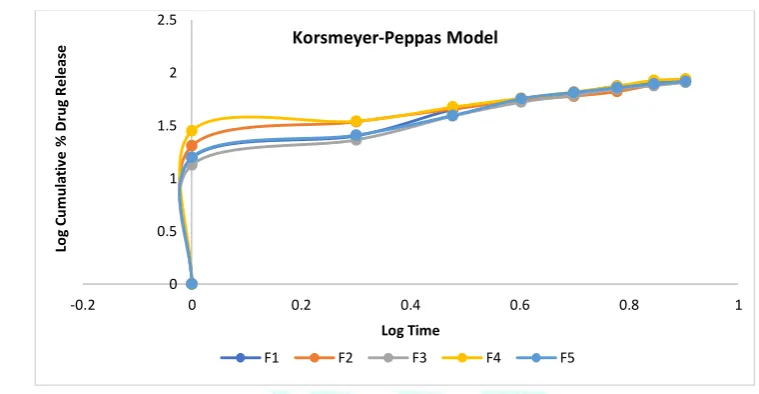
4. Log of cumulative drug release versus log time (Korsmeyer – peppas model)
Zero Order Kinetics: It gives the system in which the drug
release rate is independent on its concentration 15. Qt = Qo+Ko t
Where
Qt=Amount of drug dissolved in time t. Qos= Initial amount of drug in the solution, Ko= zero order release constant.
If the zero order drug release kinetic is obeyed, then a plot of Qt versus t will give a
Straight line with a slope of Ko and an intercept at zero.
First Order Kinetics
It gives the drug release from the systems in which the release rate is dependent on concentration 17.
Log Qt =log Qo + kt/2.303 Where
Qt = released amount of drug in time t.
Qo = initial amount of the drug containing solution k= first order release constant
If the first order drug release kinetic is followed, then a plot of log ( Qo - Qt) versus t will be
Straight line.
With a slope of kt/2.303 and an intercept at t=0 of log Qo
Higuchi Model
It explains the fraction of drug release from a matrix is proportional to square root of time.
Mt/M∞=kt ½ Where
Mt And M∞ = cumulative amounts of drug release at time t and infinite time,
And k = Higuchi dissolution constant reflection formulation characteristics. If the Higuchi model of drug release (i.e. Fickian diffusion) is obeyed, then a plot of Mt / M∞ versus t1/2 will be straight line with slope of k 16.
Korsemeyer- Peppas model (Power Law)
The power law explains the drug release from the polymeric system in which release deviates from Fickian diffusion, as expressed in following equation.
Mt / M∞=ktn
Log [Mt / = M∞ ] logk + n log t
Where Mt and M∞ are cumulative amounts of drug release at time t and infinite time (i.e. fraction of drug release at time t),
k = constant incorporating structural and geometrical characteristics of CR device,
n = diffusion release exponent indicative of the mechanism of release for drug Dissolution.
To characterize the release mechanism,
The dissolution data{ Mt / M∞ <0.6} versus log t will be linear with slope of n and intercept gives the value of log k. Antilog of log k gives the value of k 18.
Table 2 Interpretation of diffusion release mechanisms
n Mechanism
0.45 Fickian diffusion
0.45 < n < 0.89 Anomalous ( Non- Fickian) diffusion 0.89 Case Ⅱ transport
Above 0.89 Super case Ⅱ transport
Effect of Formulation Variables on the Formation of Microsponges
Effect of drug: polymer ratio
In order to evaluate the effect of drug on the formation of microsponge, different Eudragit polymer to Fluconazole ratios (1:2, 1:4, 1:6, 1:8 and 1:10) were used to prepare microsponges. The formed microsponges were evaluated for their appearance, drug content, particle size and entrapment efficiency 19.
Effect of stirring speed on the formation of microsponges
In order to evaluate the effect of stirring speed on the formation of microsponges, were prepared with different RPM of 500, 800, 1000,1200 and 1500, the formed microsponges were evaluated for their drug content and particle size 20,21.
RESULT AND DISCUSSION
Standard curve of fluconazole and absorption maxima
A precise, sensitive and accurate method for estimating fluconazole was developed using UV visible spectrophotometer.
Preparation of standard stock solution
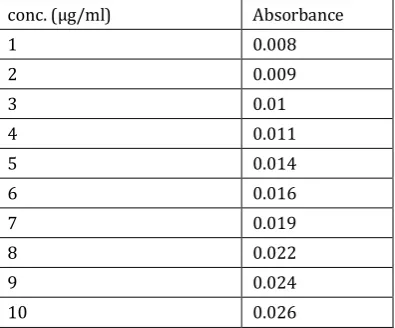
Procedure: From stock solution 1,2,3,4,5,6,7,8,9,10ml were withdrawn separately in different 10ml volumetric flasks and volume made in each case up-to 10ml of 7.4 phosphate buffer to produce the concentration 1,2,3,4,5,6,7,8,9,10μg/ml. Absorbance of these solutions were recorded at λmax 260nm against (distilled water) blank using UV-visible spectrophotometer and standard curve was plotted between concentration v/s absorbance.
DETERMINATION OF ABSORPTION MAXIMA (λmax)
UV scan of fluconazole in phosphate buffer pH 7.4 was done. Analysis by UV spectrophotometer depicted absorption maxima of fluconazole at λmax was 260 nm at pH 7.4 of phosphate buffer.
Fig. 1Absorption spectra of Fluconazole
Fig. 2 Absorption maxima of Fluconazole
CONSTRUCTION OF CALIBRATION CURVE
Table 3 Calibration curve data for Fluconazole
conc. (μg/ml) Absorbance
1 0.008
2 0.009
3 0.01
4 0.011
5 0.014
6 0.016
7 0.019
8 0.022
9 0.024
10 0.026
STANDARD CURVE OF FLUCONAZOLE IN PHOSPHATE BUFFEER pH 7.4
Fig. 3 Calibration curve of Fluconazole Evaluation of microsponges
Production/Percentage yield (%)
The production yields of fluconazole are shown in fig 4. Production yield calculated for all microsponges ranged from 44.17 to 78.24%. The readings are mean of three different measurements ±SD. It was found that production yield increases with increase in drug: polymer ratio.
Table 4 Production yield of Fluconazole microsponges
Formulation Code Percentage Yield
F1 44.17
F2 56.47
F3 64.38
F4 78.24
F5 77.36
Fig. 4 Production yield of Fluconazole microsponges Encapsulation efficiency/Loading efficiency (%)
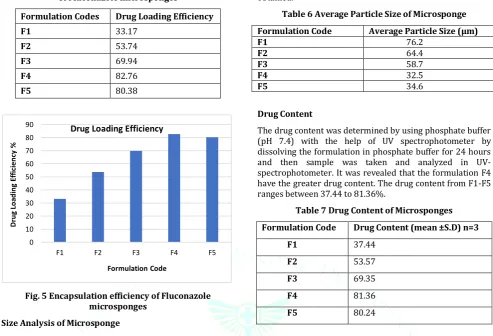
The loading efficiency of fluconazole microsponges formulations are shown in fig. 5. The loading efficiency calculated for all microsponges range from 33.17 to 82.76% - the highest loading efficiency. The was found for the formulation F4 where a greater amount of drug was encapsulated. It is indicated that fluconazole/ Eudragit L 100 ratio (1:8) had the optimum capacity for drug entrapment.
0 0.005 0.01 0.015 0.02 0.025 0.03
0 5 10 15
Ab
so
rb
an
ce
Concentration Absorbance
0 10 20 30 40 50 60 70 80 90
P
ro
d
u
ct
io
n
Y
ie
ld
%
Table 5 Encapsulation efficiency/ loading efficiency (%) of Fluconazole microsponges
Formulation Codes Drug Loading Efficiency
F1 33.17
F2 53.74
F3 69.94
F4 82.76
F5 80.38
Fig. 5 Encapsulation efficiency of Fluconazole microsponges
Size Analysis of Microsponge
The average particle size of Fluconazole microsponge is ranges from 76.2 to 32.5. It was observed that as the ratio of drug to polymer increased, the particle size decreased. This could be due to the reason that in high drug to polymer ratio, the amount of polymer available per microsponge was comparatively less. In high drug: polymer ratio less polymer amount surround the drug and decreasing the thickness of
polymer wall and microsponges with smaller size were obtained.
Table 6 Average Particle Size of Microsponge
Formulation Code Average Particle Size (μm)
F1 76.2
F2 64.4
F3 58.7
F4 32.5
F5 34.6
Drug Content
The drug content was determined by using phosphate buffer (pH 7.4) with the help of UV spectrophotometer by dissolving the formulation in phosphate buffer for 24 hours and then sample was taken and analyzed in UV- spectrophotometer. It was revealed that the formulation F4 have the greater drug content. The drug content from F1-F5 ranges between 37.44 to 81.36%.
Table 7 Drug Content of Microsponges
Formulation Code Drug Content (mean ±S.D) n=3
F1 37.44
F2 53.57
F3 69.35
F4 81.36
F5 80.24
Scanning electron microscopy
The SEM photographs of the microsponges are shown in fig. 6. SEM images showed the microsponges are porous and spherical in shape. No intact drug crystal are seen visually and inner structure was porous with void spaces. The pores were induced by the diffusion of the solvent from the surface of the microsponges.
Fig. 6 Images showing structure and porosity of microsponge
0 10 20 30 40 50 60 70 80 90
F1 F2 F3 F4 F5
D
ru
g
Lo
ad
in
g
Ef
fi
ci
e
n
cy
%
In-vitro dissolution studies
It was observed as the concentration of Eudragit was increased, the percent release of fluconazole decreases. The
increase in Eudragit concentration leads to the increased density of polymer matrix into the microsponges which result in an increased diffusional path length.
Fig. 7 In-Vitro Drug Release of Fluconazole Microsponge Drug release kinetic of Fluconazole microsponges
Zero order release kinetics
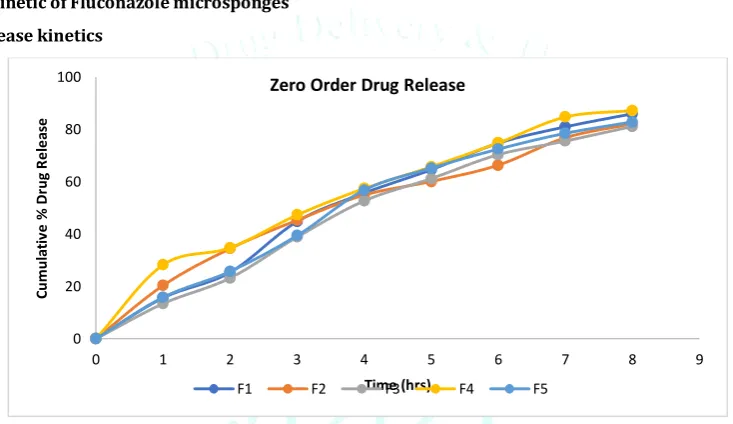
Fig. 8Zero order release kinetic of Fluconazole microcsponges
First order release kinetics
Fig. 9 First order release kinetic of Fluconazole microsponge
0 20 40 60 80 100
0 1 2 3 4 5 6 7 8 9
C
u
m
u
la
ti
ve
%
D
ru
g
R
e
le
as
e
Time (hrs) In-Vitro Drug Release
F1 F2 F3 F4 F5
0 20 40 60 80 100
0 1 2 3 4 5 6 7 8 9
C
u
m
u
la
ti
ve
%
D
ru
g
R
e
le
as
e
Time (hrs) Zero Order Drug Release
F1 F2 F3 F4 F5
0 0.5 1 1.5 2 2.5
0 1 2 3 4 5 6 7 8 9
C
u
m
u
la
ti
ve
%
D
ru
g
R
e
le
as
e
Time(hrs) First Order Drug Release
Higuchi release kinetics
Fig. 10 Higuchi release kinetic of Fluconazole micro sponge Peppas release kinetics
Fig. 11 Peppas release kinetic of fluconazole micro sponge
The mechanism of drug release from the formulation during the dissolution was determined using the zero order, first order, higuchi equation and peppas equation. All formulation were best fitted to zero order and peppas plot. The best formulation F4 follows zero order kinetic.
Effect of Formulation Variables on the Formation of Microsponges
Effect of drug: polymer ratio
Production yield, entrapment efficiency and drug content was analysed to be increase with increase in drug polymer ratio, the drug: polymer ratio has reverse effect on particle size, as drug: polymer ratio increase, particle size decreases.
Effect of stirring rate on the morphology and yield of microsponges
The effect of stirring rate on the morphology of microsponges. The formulation with higher drug to polymer ratio was chosen to investigate the effect of stirring rate on the morphology of microsponges. The stirring rate was varied in the range of 500 to 1500 rpm. The dispersion of the drug and polymer into the aqueous phase was examined to be dependent on the agitation speed. As the speed was increased the size of microsponges was reduced and the
microsponges were found to be spherical and uniform. As increases in the drug: polymer ratio particle size was decreases, which could be correlated with the kinetics of microsponge formation in the presence of comparatively lower concentrations of the polymer. It was also noted that at higher stirring rate, the production yield was increased.
Effect of polymer concentration
As the polymer concentration increased, more amount of polymer surrounding the drug, thus increasing the thickness of the wall of the polymer matrix which lead to extended diffusion path and ultimately to lesser drug release or extended release.
CONCLUSION
The aim of present study was to make the microsponge of fluconazole so that the drug is able to release in a controlled and targeted manner. Fluconazole is formulated as microsponges by quasi-emulsion solvent diffusion method using polymer Eudragit L 100. Varied drug :polymer ratio and stirring rate reflected remarkable effect on the particle size, drug content and encapsulation efficiency. It was observed that as the drug to polymer ratio was increased, the particle size decreased. The mechanism of drug release from 0
10 20 30 40 50 60 70 80 90 100
0 0.5 1 1.5 2 2.5 3
C
u
m
u
la
ti
ve
%
D
ru
g
R
e
le
as
e
Square Root of Time Higuchi Model
F1 F2 F3 F4 F5
0 0.5 1 1.5 2 2.5
-0.2 0 0.2 0.4 0.6 0.8 1
Lo
g
C
u
m
u
la
ti
ve
%
D
ru
g
R
e
le
as
e
Log Time Korsmeyer-Peppas Model
the formulation F4 during the dissolution was determined using the zero order, first order, higuchi equation and peppas equation. All formulation were best fitted to zero order and peppas plot. The best formulation F4 follow zero order.
ACKNOWLEDGEMENT
I myself Mansi Hans wants to firstly thank Almighty God and my parents for their immense support during the research work. I would like to put my gratitude to the co-authors who helped a lot during this research work. Special thanks to our Head of Pharmaceutics Department, Dr. Jagdeep Singh Dua who helped a lot with the understanding of concepts which arises during research work.
REFERENCES
(1) Pradhan SK (2011). Microsponges as the versatile tool for drug delivery system. Int. J. Res. Pharm. Chem. 1(2):243-258 (2) Shivani Nanda, Mandeep Kaur, Nikhil Sood, Sahil Nagpal,
Microsponge drug delivery system: an overview, World Journal of Pharmacy and Pharmaceutical Sciences, Volume 2, Issue 3, 1032-1043.
(3) D’souza J.I., More H.N (2008). Topical Anti-Inflammatory Gels of Fluocinolone Acetonide Entrapped in Eudragit Based Microsponge Delivery System. Res J Pharm Tech 1(4):502-506. (4) Aity, S., et al., Microsponges: A novel strategy for drug delivery
system. J Adv Pharm technol Res, 2010. 1(3): p. 90-283.
(5) Jain V, Singh R. Development and characterization of eudragit RS 100loaded microsponges and its colonic delivery using natural polysaccharides. Acta Poloniae Pharm Drug Res 2010;67:407-15 (6) Jain V, Singh R. Dicyclomine-loaded eudragit based microsponge with potential for colonic delivery: preparation and characterization. Trop J Pharm Res 2010;9:67-72.
(7) Orlu M, Cevher E, Araman A. Design and evaluation of colon specific drug delivery system containing flurbiprofen microsponges. Int J Pharm 2006;318:103-17.
(8) Vyas SP, Khar RK (2002). Targeted and controlled drug delivery: novel carrier systems. CBS Publications, 1st ed., New Delhi, 453 (9) Khopade AJ, Jain S, Jain NK (1996). The Microsponge. Eastern
Pharmacist :49-53.
(10) N, Sharma PK, Banik K (2011). Recent advances on microsponge delivery system. Int. J. Pharm. Sci. Rev. Res. 8:13-23.
(11) Embil K. and Nacht S.J (1996). The microsponge delivery system (MDS): a topical delivery system with reduced irritancy incorporating multiple triggering mechanisms for the release of actives. J. Microencapsul 13(5):575-588.
(12) D souza JI. The Microsponge Drug Delivery System: For Delivering an Active Ingredient by Controlled Time Release. Pharmaoinfo net. 2008;6:3.
(13) Jelvehgari M., Siahi-Shadbad M.R., Azarmi S., Gary P., Martin A., Nokhodchi A (2006). The microsponge delivery system of benzoyl peroxide: Preparation, characterization and release studies. Int J Pharm 308:124-132.
(14) Demuria D, Forrest A, Rich J. Pharmacokinetic and bioavailability of fluconazole in patients with AIDS. Antimicrob Agents Chemother 37(10), 1993, 2187-92.
(15) Pappas PG, Rex JH, Sobel JD. Guidelines for treatment of candidiasis. Clin Infect Dis 346(4), 2004,161-89.
(16) Baddley JW, Patel M, Bhavnani SM. Association of fluconazole pharmacodynamic with mortality in Patients with candidemia. J Antimicrob Chemother 52(9), 2008, 3022-8.
(17) Sohrab Ershad, Sahar Kangari. Preparation of a fluconazole potentiometric sensor and its application to pharmaceutical analysis and to drug recovery from biological fluids. Int J Electrochem Sci 4(2), 2009, 1100-1108.
(18) Marciniec B, Dettlaff K, Joroszkiewicz E, Bafeltowska J. Radiochemical stability of fluconazole in the solid state. J Pharm Biomed Anal 43(5), 2007, 1879-1880.
(19) Koks CHW, Meen horst PL, Hillebrand MJX, Bult A, Beijnen. Pharmacokinetic of fluconazole in saliva and plasma after administration of an oral suspension and capsules. J Antimicrobiol Chemother 9(5), 1996, 19351937.
(20) Sarat Chandra Prasad, Ajay. M, Nagendra Babu. B, Prathyusha.P, Audinarayana.N Microsponge Drug Delivery System: A Review. Int J Pharm Research. 2011; 4: 5.