IJSRSET1732182 | 09 April 2017 | Accepted : 19 April 2017 | March-April-2017 [(2)2: 642-647]
© 2017 IJSRSET | Volume 3 | Issue 2 | Print ISSN: 2395-1990 | Online ISSN : 2394-4099 Themed Section: Engineering and Technology
642
Lung Nodule Detection
Rasika N. Kachore, Kivita Singh
CSE Department, Yeshwantrao Chavan College of Engineering, Nagpur, Maharashtra, India
ABSTRACT
Various image processing and computer vision techniques can be used to determine cancer cells from medical images. Medical image classification plays an important role in medical research field. The patient lung images are classified into either benign (non-cancer) or malignant (cancer). There are many effective algorithms to analyze different salient detection methods. Here salient region is lung nodule, we have to detect nodule by using fast pixel-wise image saliency aggregation (F-PISA). This paper analyzes summarize some of the information about F-PISA framework for the purpose of early detection and diagnosis of lung cancer. This present work proposes a method to detect the cancerous nodule effectively from the CT scan images by reducing the detection error.
Keywords : Visual Saliency, Pixel-Wise Image Saliency, Object Detection, Feature Engineering, Image Filtering.
I.
INTRODUCTION
A lung nodule is small masses of tissue in the lung. Lung cancer is usually visible as small round lesion called „nodules‟ through Medical images like CT. The major problem in identifying the nodules with CT image is that the characteristics of nodules in terms of size, shape and density. Lung nodules are usually about 0.2 inch (5 millimeters) to 1.2 inches (30 millimeters) in size. Human eye is sensitive to certain colors and intensities and objects with such features are considered more salient. Detection of salient image regions is useful for applications like region-based image retrieval, image segmentation etc. It is important to enhance and detect the nodules in CT images in order to identify the lung cancer at early stage. Different methods and algorithms are developed to effectively detect the nodules.
Image segmentation is an important task of image processing. Its main purpose is to detect and diagnose death threatening diseases. The goal of segmentation is to simplify and/or change the image into some patches that is more meaningful and easier to understand. Every pixel in an image is associated with a label and pixels with same label shows similar behavior. The various techniques used are histogram based technique, edge based technique, region based technique, and hybrid
technique. The hybrid technique that combines the features of both edge based and region based methods.
The problem definition of the system is to Detect finding object of interest in image. Additionally improve detection of background as salient in certain images where the background is complex or object is too large. Natural images usually contain rich appearances of salient region but, in case of medical images it is not possible to detect exact location of salient region. By using some shape adaptive volume filter on medical images to detect salient region.
The remaining paper is organized as follows: Section 2 introduces literature survey, Section 3 introduces background knowledge. Salient object detection characteristics and limitation is presented in Section 4. The paper summary and conclusion in Section 5
II.
METHODS AND MATERIAL
1. Literature Survey
technique, etc. Some of the methods are described in the below section.
The authors, T. Zhao, et al., proposed a saliency detection method with spaces of the background distribution (SBD) [14] proposed saliency detection methods considering viz; first, patches from the image borders are used to generate a group of space of the background distribution to compute the saliency map second, bayesian methods to enhance saliency map and the last, get a saliency map using novel up-sampling methods based on geodesic distance.
Later the authors, M. Liu, et al., proposed a novel visual saliency detection model by studying the complex input image [19] also, proposed a general framework combines image complexity locally and globally for visual saliency. Proposed CWS saliency detection model to define more effectiveness result. CWS have a complex mixture of a color with verified intensity.
In 2016 the authors, S. Foolad, A. Maleki introduced the methods can highlight the region effectively. Highlighted regions are known as a salient region [17]. Authors proposed a bottom-up model to detect salient region, later the authors shows an adaptive segmentation technique which shows less error, L. Ma, et al., introduced an efficient and accurate approach known as superficial-to-pixel saliency detection for region-of-interest (ROI) [18]. The input image is down-sample and the image is segmented into super-pixel to reduce the complexity of input image. Later B. Yang, et al., presented patch-wise saliency detection algorithm based on principal component analysis (PCA) [22]. PCA generally uses to convert the color space into patch-wise representation. Compact patch representation is based on global rarity and center surrounded contrast.
V. A. Gajdhane, et al., introduced the image improvement technique is developing for earlier disease detection and treatment stages; the time factor is taken in account to discover the abnormality issues in target images. The CT captured images are processed. The region of interest i.e., tumor is identified accurately from the original image. Gabor filter and watershed segmentation gives best results for pre-processing stage [24]. From the extracted region of interest, three features are extracted i.e., area, perimeter and
eccentricity. These three features help to identify the stage of lung cancer.
Bhavanishankar .K and Dr. M.V.Sudhamani introduced various approaches towards an automated detection of lung nodules, classifications are summarized. It is apparent from the review that the algorithms with multiple detection approaches provided the better results [26].
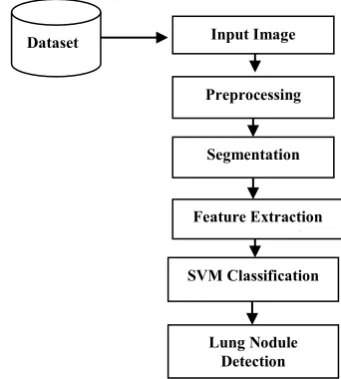
A detailed architecture of the proposed system is shown in Figure1.
Figure 1. Architecture of lung nodule detection system
2. Methodology
[1] Preprocessing
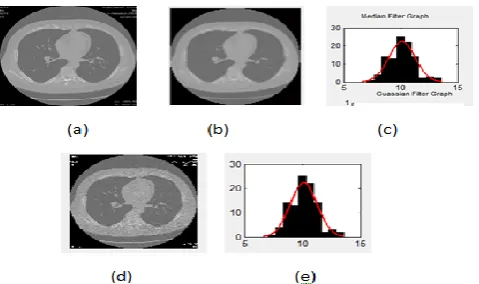
Preprocessing is the method of resizing the image into a number of small patches. The aim of preprocessing is an improvement of the image data that suppresses unwanted distortion or enhances some image feature important for further processing. Median filter and Gaussian filter these techniques are used for noise elimination and lung area identification. These two techniques are worked out simultaneously.
[1] The median filter is a nonlinear digital filtering technique, often used to remove noise. Median filtering is very widely used in digital image processing because it preserves edges while removing noise shown in the figure 3 used histogram equalization to improve the contrast of images by transforming the values in an intensity
Dataset Input Image
Preprocessing
Segmentation
Feature Extraction
eeexextraction
SVM Classificationof an image. So that easily compares median filter and Gaussian filter histogram of the output image. [2] Gaussian filtering G is used to blur images and
remove noise and detail. In one dimension, the Gaussian function is: Where σ is the standard deviation of the distribution. The distribution is
G(x) =
Where σ is the standard deviation of the distribution. The distribution is assumed to have a mean of 0.
[3] Image Segmentation:
Image segmentation is the process of partitioning a image into multiple region. Segmentation divides the image into its constituent regions or objects. The result of image segmentation is a set of region that covers the entire image. Watershed segmentation follows this basic procedure and as shown in figure
1) Image whose dark regions are the objects you are trying to segment. 2) Compute connected blobs of pixels within each of the objects. 3) Compute pixels that are not part of any object. 4) After, modify the segmentation function. 5) Compute the watershed transform of the modified segmentation function.
Figure 3: The image after watershed segmentation.
[4] Feature Extraction:
Feature extraction is an important step that uses algorithms and techniques to detect desired portions or shapes of a given image. When the input data to an algorithm is too large, Feature extraction include reducing the amount of resources required to describe a large set of data. Determining a subset of the initial features is called feature selection. The selected features are containing the relevant information from the input data, so that the relevant task can be performed by using this reduced representation of input image instead of the complete initial data.
The basic characters of feature are convex hull, Centroid, Extrema and eccentricity. These features are defined as follows:
a) Convex hull: The convex hull is defined as the set of all convex combinations of points in X.
K=convexHull(DT) [K,v] = convex Hull(DT)
Where, DT is a delaunay triangulation. K is convex hull vertices. The shape of K depends on 2-D or 3-D image triangulation. and v is Area or volume bounded by the convex hull, returned as a scalar value.
b) Centroid:centroid is the centre position of all the points in all of the coordinate directions.
The centroid of a finite set of K points x1, x2, x3...xk.
This point reduces the sum of square of Euclidean distances between itself and any point in the set.
c) Extrema:Any point whose value of a function is largest (a maximum) or smallest (a minimum). There are both absolute and relative maxima and minima.
d) Eccentricity: The ratio of the distance between the foci and its major axis length. The value is between 0 and 1. E = (distance between foci / length of major axis)
[5] Classification
a particular coordinate. Then, perform classification by finding the hyper-plane that differentiates the two classes very well.
b)
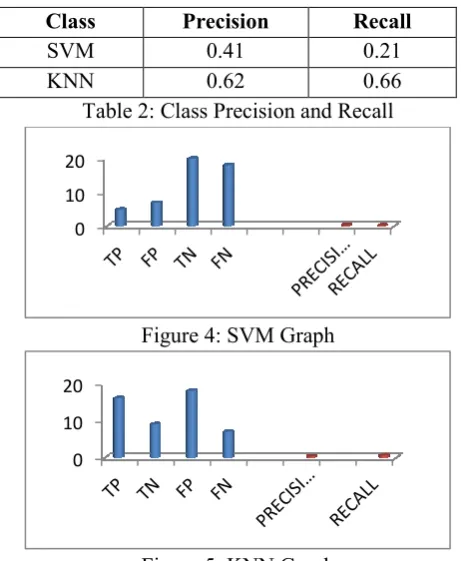
c) In K-NN classification, an object is classified into positive and negative class i.e, cancerous and non- cancerous. It works better than SVM, it indicates that dataset is not easily separable using the decision planes that have SVM use, i.e. the basic SVM uses linear hyper planes to separate classes. KNN can provide good results, it suggests that classes are quite separable shown in table 1.
Following table 1 shows the result of applying SVM classifier and KNN classifier algorithm.
Table 1: Table shows the result of applying SVM classifier and KNN classifier algorithm.
Class Precision Recall
SVM 0.41 0.21
KNN 0.62 0.66
Table 2: Class Precision and Recall
Figure 4: SVM Graph
Figure 5: KNN Graph
[6] DETECTION TECHNIQUE:
The Lung nodule detection is a very difficult step in every detection technique. Actually, In CT lung images, nodules are frequently attached to blood vessels or to the pleura and also the grey tone is so similar to vessel sections that traditional intensity based methods are inappropriate. Various methods have been proposed for the detection of pulmonary nodules on CT images.
a) F-PISA (Fast Pixelwise Image Saliency by Aggregating) technique: Main role of pixelwise observation is feature extraction and fine grained saliency. It helps to improve runtime efficiency and keep comparable performance. Here we have three stages such as Color-contrast measure, Structure-contrast measure, and fusion.
i. Color contrast is a global image context. In color contrast measure, used Histogram based Contrast (HC). A histogram-based contrast (HC) method to define saliency values for image pixels using color statistics of the input image. This focused on three terms as follows: 1. Improve color dissimilarity. 2. Adaptively used for histogram distribution. 3. Re-weight the salient values based on visual similarities. Figure 7 shows the color histogram of an image represent the distribution of colors and relation between a color histogram and luminance histogram. Also shows different types of colors appeared.
ii. Structure-Based Contrast detects only structural saliency regions. In this section first image is resize into 64*64 after using a spectral residual approach. This method is based on the log spectra representation of images. Figure 8 shows the structure based contrast
iii. Fusion of Color-contrast measure and Structure-contrast measure to detect both small and large saliency regions and inhibit repeating patterns. As shown in figure 9.
[7] Data Collection:
The relevant dataset is the records of lung nodule detection. This database was made possible by collaboration between the ELCAP [25] and VIA research groups. This database was first released in December 2003 and is a prototype for web-based image data archives.
0 10 20
Figure 6: Typical CT Images of Lung
Figure 6 depicts total 100 images of same subject from ELCAP database.
III.
RESULTS AND DISCUSSION
Experiments are done on F-PISA framework with the help of real lung images. Original CT Image is preprocessed by different methods of image processing and finally segmented using threat pixel identification and region growing method.
IV.
CONCLUSIONA fast pixelwise saliency aggregation technique has been introduced to detect the suspicious region. This method is highly reliable for efficient detection of lung nodules and to increase accuracy.
V.
FUTURE SCOPEOur future research will focus on the better salient detection model. Existing methods still has difficulties in highlighting entire salient object. To reduce the problems of existing technique we will propose a new technique in future and will produce better results.
For future work, we can implement some techniques on some more images. Increasing the number of images used for the process, can improve the accuracy. Also MRI, X-ray, PET images can be considered for this technique. Comparison can be done for all these images. So one can justify which types of images gives better result for lung cancer detection.
VI.
REFERENCES
[1]. K. Wang, L. Lin, J. Lu, “PISA: Pixelwise Image Saliency by Aggregating Complementary Appearance Contrast Measures With An Edge-Preserving Coherence” IEEE Transactions on Image Processing, Vol. 24, no. 10, pp. 3019-3032 October 2015
[2]. L. Itti, C. Koch, and E. Niebur, “A model of saliency-based visual Attention for rapid scene analysis,” IEEE Transaction, vol. 20, no. 11, pp. 1254–1259, Nov. 2013
[3]. Y. -F. Ma and H. J. Zhang,“Contrast-based image attention analysis by using fuzzy growing,” In Proc. 11th International Conference Multimedia, pp. 374–381,2013
[4]. H. Zheng and S. Susstrunk, ”Salient Region Detection Based on Automatic Feature Selection,” IEEE conference Computer Vision, Pattern Recognition, pp. 416-525, Jun 2015
[5]. Federico Perazzi,“Saliency Filters: Contrast Based Filtering for Salient Region Detection,” IEEE Transaction, Vol. 12, no. 1, pp. 733 -740, May 2012
Transaction Image Process, vol. 22, no. 5, pp. 1689–1698, May 2013
[7]. S. 1Goferman, L. Zelnik-Manor, and A. Tal, “Context-aware saliency detection,” IEEE Transaction, vol. 34, no. 10, pp. 1915–1926, Oct. 2012
[8]. R. Achanta, S. Hemami, F. Estrada, and S. Susstrunk, “Frequency-tuned salient region detection,” In Proc. IEEE Conference Computer Vision Pattern Recognition, Jun. 2009, pp. 1597– 1604
[9]. Z. Liu, Y. Xue, L. Shen, and Z. Zhang, “Nonparametric saliency detection using kernel density estimation,” In Proc. 17th IEEE Conference Image Processing, pp. 253–256, Sep. 2010
[10]. Y. Fang, J. Wang, M. Narwaria, P. Le Callet, and W. Lin, “Saliency detection for stereoscopic images,” IEEE Transaction Image Processing, vol. 23, no. 6, pp. 2625–2636, Jun. 2014
[11]. W. Hu, R. Hu, N. Xie, H. Ling, and S. Maybank, “Image classification using multiscale information fusion based on saliency driven nonlinear diffusion filtering,” IEEE Transaction Image Processing, vol. 23, no. 4, pp. 1513–1526, Apr. 2014
[12]. H. Hadizadeh and I. V. Bajic´, “Saliency-aware video compression,” IEEE Transaction Image Processing, vol. 23, no. 1, pp. 19–33, Jan. 2014. [13]. L. Lin, R. Zhang, and X. Duan, “Adaptive scene
category discovery with generative learning and compositional sampling,” IEEE Transaction image processing, vol. 25, no. 2, pp. 251–260, Feb. 2015
[14]. T. Zhao, L. Li, X. Ding, Y. Huang And D. Zeng," Saliency Detection with Spaces of Background-based Distribution," IEEE Transaction signal processing, vol. 1, Mar. 2016
[15]. L. Qu, S. He, J. Zhang, J. Tian, Y. Tang and Q. Yang,"RGBD Salient Object Detection via Deep Fusion," journal of latex class files, vol.14, no. 8, pp.1-11, August 2015
[16]. T. Liu, Z. Yuan, J. Sun, J. wang, N. Zheng, X. Tang, H.-Y. Shum,"Learning to Detect a Salient Object," IEEE Transactions on pattern analysis and machine intelligence, vol. 33, no. 2, pp. 353-367, Feb.2011
[17]. S. Foolad, A. Maleki," Salient Regions Detection using Background Superpixels," IEEE 24th
Iranian Conference on Electrical Engineering (ICEE), pp. 1342-1346, 2016
[18]. L. Ma, B. Du, H. Chen and N. Q. Soomro,"Region-of-Interest Detection via Superpixel-to-Pixel Saliency Analysis for Remote Sensing Image," IEEE Geoscience and remote sensing letters, vol. 13, no. 12, pp. 1752-1756, December 2016
[19]. M. Liu, K. Gu, G. Zhai and P.L.Callet," visual saliency detection via image complexity feature," IEEE Conference Image Processing, pp. 2777-2781, 2016
[20]. K.shi, K. Wang, J. Lu, L. Lin," PISA: Pixelwise Image Saliency by Aggregating Complementary Appearance Contrast Measures with Spatial Priors," IEEE Conference on Computer Vision and Pattern Recognition, pp.2115-2122, 2013 [21]. L. Zhang, M. H. Tong, T. K. Marks, H. Shan, and
G. W. Cottrell, “SUN: A Bayesian framework for saliency using natural statistics,” Journal of Vision, vol. 8, no. 7, pp. 1–20, 2008
[22]. B. Yang, X. Zhang, L. Chen and Z. Gao,"Principal Component Analysis-Based Visual Saliency Detection," IEEE Transactions on Broadcasting, vol. 62, no. 4, pp. 842-854, December 2016
[23]. N. Beegam, S. Aboobakar ,"PISA: Pixelwise Image Saliency by Aggregating with Binarization," International Journal of Advanced Research in Computer Science and Software Engineering , vol.6, no.1, pp.571-576, Jan 2016 [24]. V. A.Gajdhane ," Detection of Lung Cancer
Stages on CT scan Images by Using Various Image Processing," IOSR Journal of Computer Engineering (IOSR-JCE), vol.16, no.5, pp.28-35, Sep – Oct. 2014
[25]. Henschke CI, McCauley DI, Yankelevitz DF, et al. Early Lung Cancer Action Project (ELCAP): Development of a digital image database overall design and findings from baseline screening. Lancet 1999;354:99-105