UNDERSTANDING THE APPARENT DIFFUSIVITY OF SR-85 ION FOR MX-80 IN DIFFERENT SALINITY CONDITION AT LOW DRY DENSITY
Ahmad Hasnulhadi, C. K.1,2, T. Kozaki1, S. Sato1, Y. Tsuruta1, M. Mizuto1, H. Takiya1 and K. Chiba1
1
Laboratory of Nuclear and Environmental Materials, Faculty of Engineering, Hokkaido University, Sapporo, Japan
2
Waste Technology Development Centre (WasTeC), Waste and Environmental Technology Division,
Malaysian Nuclear Agency, Bangi, 43000 Kajang, Malaysia
Correspondence author: [email protected]
ABSTRACT
The apparent diffusivity of strontium-85 in the compacted MX-80 bentonite under different salinity conditions and dry densities were studied from the viewpoint of activation energy. Through in-diffusions experiments the effect of salinity on diffusion behavior of Sr-85 ions can also can be explained. As we know, Sr-90 is by product of the fission materials of nuclear wastes and should be manage properly. Sr-85 is radioactive isotope with the same chemical properties of Sr-90. Adsorption affects only non-steady-state diffusion while at the steady state (e.g., a constant concentration gradient between a constant source and a constant sink), there is no net uptake or release by adsorption, so adsorption has no effect on diffusion (Drever, 1997). The changes in the basal spacing of bentonite as a function of salinity are needed to be observed by the X-ray diffraction method to understand the microstructure changes in diffusion pathways for Sr-85 in MX-80 bentonite. As we know, there could be three potential pathways for radionuclide diffusion in solution-saturated, compacted montmorillonite, i.e., pore water, external surfaces and the internal surface (interlayer spaces) of montmorillonite aggregates. So, it is important to understand the diffusion processes in term of apparent diffusivity of Sr-85 ions in different salinity concentration at low dry density of MX-80. Several parameters are needed in explaining the process such as dry density, activation energy, temperature dependence and concentration of the salinity solutions.
Keywords: Activation energy, apparent diffusivity, different salinity conditions, dry densities, strontium-85
INTRODUCTION
Establishment of criteria for this study was driven from many references including Chuang et al. (2006), Huang et al. (2006) and Risoluti et al. (1999), as well as understanding environmental setting of the study area based on researcher’s judgment. Study on the diffusion behavior in the compacted bentonite nowadays is an important issue since it can be used as an engineered barrier system for radioactive waste repository and also as a preparation for nuclear power program in many countries.
2
MX-80 bentonite from Wyomint State, United States of America contain approximately of 85% of Na/Ca-montmorillonite mineral (di-octahedral smectite) and 15% of accessory minerals (Montes et al., 2005). Montmorillonite clay is known as a candidate buffer material for a safe geological disposal of radioactive waste which can retard radionuclide from migrating away to the groundwater system. It is because of its physical and chemical properties such as swelling properties and low of hydraulic conductivity, low diffusivity and the high sorption capacity of radioactive waste contaminants.
From previous study, the Da-values for Cs+ ions is reported to uniformly increased with an increase
of ionic strength in both diffusion directions (Sato, 2005). At 298 K, the diffusion coefficients of
22
Na+ were found to increase slightly as the NaCl concentrations increased from 0 to 0.5 M (Kozaki
et al., 2008). The obtained diffusivities of Sr2+ decreased as the density of bentonite increased. The
diffusivity for Sr2+ varied from 4.3 x 10⁻⁷ to 9.0 x 10⁻⁸ cm2/s (Molera et al., 2002). Molera also
reported that the Da value of Sr-85 will be increased with the high NaClO₄ concentration from 0.01
M to 0.5 M. The higher the dry density increases the more significant the surface diffusion as compared with the pore diffusion (Lee, 1996). The migration of Sr ions through the compacted bentonite was found to be dominated by surface diffusion (Kim, 1993).
At the room temperature for MX-80 of dry density 1200 and 1800 kg/m3, the apparent diffusion
coefficient for strontium ions is about 1.69 x 10⁻¹¹ and 5.17 x 10⁻¹² m2/s, respectively (Kim et al.,
1993). Molera (2002) also reported that the apparent diffusion of strontium ions for MX-80 with the
ionic strength of 0.5 M for dry density 1200 and 1800 k/gm3 are 2.5 x 10⁻¹¹ and 1.2 x 10⁻¹¹ m2/s,
respectively.
Activation energy for diffusion of strontium ions in pure montmorillonite as a function of partial
dry density is around 17 kJ/mol at total dry density 1000 and 1200 kg/m3 (Kozaki et al., 1997) and
25.1 kJ/mol at 1700 kg/m3 (Liu et al., 2003). The activation energy for diffusion of sodium ions in
compacted montmorillonite at dry density of 1000 kg/m3 as a function of salinity was found to
increase from 14 kJ/mol (Kozaki et al., 1998) to 23 kJ/molfor 0 to 0.1 M, and decreased from 23
kJ/mol to 17 kJ/molwhen salinity increased from 0.1 M to 0.5 M (Liu et al., 2003).
MATERIALS AND METHODS
Non-steady diffusivity experiments were made in this study for MX-80 bentonite saturated with NaCl solution from different salinity condition of 0 M and 0.5 M NaCl solution. Radionuclide used
in this present study was a carrier-free 85Sr (strontium chloride in 0.5 M hydrochloric acid) which
was obtained from Japan Radioisotope Association. 85Sr has a half-life of 64.85 days. The small
volume of stock solution was diluted by adding small amount of stable carrier SrCl2 solution to have
an appropriate radioactivity before used in the diffusion experiments.
The powdered MX-80 bentonite was compacted in an acrylic resin cell (20 mm in diameters and 20
mm length) to obtain dry densities of 1200 kg/m3 and 1800 k/gm3. In case of dry density of MX-80,
3
contact with deionized water passed through sintered stainless steel filters at room temperature for at least 30 days (Kozaki et al., 2005).
In these diffusion experiments, 1200 kg/m3 and 1800 kg/m3 dry densities and four runs having
temperatures of 288 – 323 K were made. At different salinity conditions, NaCl concentration varies from 0 M and 0.5 M. A small amount of Sr-85 radiotracer (10 - 20 µl) was spiked to one end of a MX-80 cell-sample. Diffusion of tracer was allowed to proceed by placing two montmorillonite speciments in contact. After prescribed period of time for diffusion, each cell was dissembled and montmorillonite specimens will be sectioned into 05-mm-thick slices as the specimen will be extruded progressively from the cell.
The radioactivity measurements of the Sr-85 tracer were carried out using NaI (sodium iodide) scintillation counter.
RESULTS AND DISCUSSION
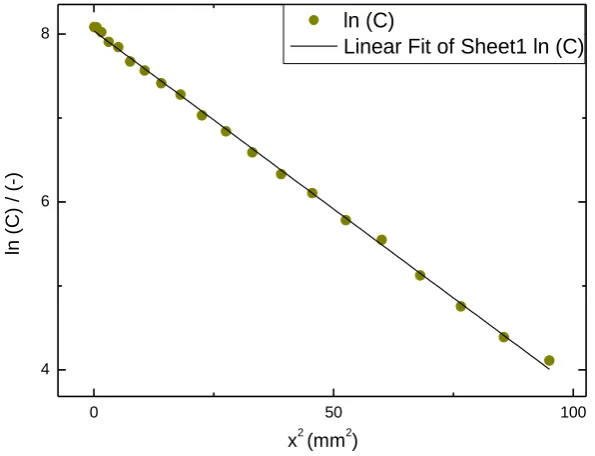
Figure 1 shows the typical concentration profiles of 85Sr2+ obtained in this study and the effect of
diffusion behaviors for the strontium were discussed in the viewpoint of apparent diffusivity and activation energy at different salinity conditions and dry density. The inverse of linear fit
concentration of ln (C) with x2 was obtained at dry density of 1200 kg/m3 with the NaCI
concentration of 0 M and temperature of 313 K for 72 hours period of time.
Figure 1: Typical Concentration profile of 85Sr2+ (ρ = 1200 kg/m3, ionic strength = 0 M, T = 313 K,
t = 72 h)
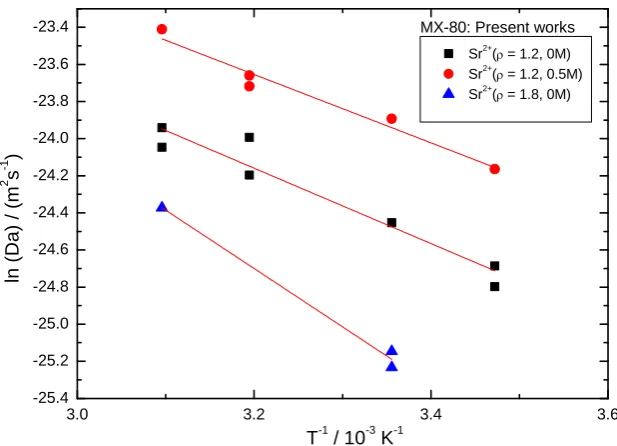
Table 1 lists all the Da values for the compacted MX-80 bentonite which were obtained in the
diffusion experiments. At the dry density of 1200 kg/m3 and 1800 kg/m3 with the NaCl
concentration of 0 M, activation energies of 16.9 and 26.1 kJ/mol respectively were obtained from temperature dependences (288 K – 323 K) of the Da of strontium ions (Arrhenius plots as shows in
0 50 100
4 6
8 ln (C)
Linear Fit of Sheet1 ln (C)
x2 (mm2)
ln
(C
)
/
4
Figure 2) meanwhile 15.3 kJ/mol of the Ea value was obtained at NaCl concentration of 0.5 M at
dry density of 1200 kg/m3.
Table 1: Apparent diffusion coefficients of 85Sr²⁺ ions in compacted MX-80 bentonite and
activation energies for diffusion at a dry density of 1200 kg/m³ (NaCl conc. = 0 M and 0.5 M) and 1800 kg/m³ (NaCl conc. = 0 M)
Fig. 2: Arrhenius plots of the Sr2+ ions for the MX-80 at different salinity and dry density
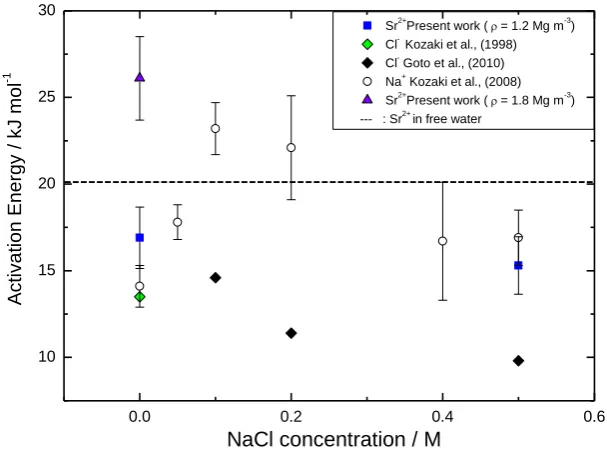
It was found that Da slightly increased as the salt concentration increased at dry density of 1200
kg/m3 from 0 to 0.5 M, and decreased at the higher dry density of 1800 kg/m3 (Figure 3). Lower Ea
for diffusion were found for MX-80 specimens at lower dry density (1200 kg/m3), while the higher
activation energy was at higher dry density (1800 kg/m3) than diffusion of strontium ions in free
water, 20.1 kJ/mol (Robinson and Stokes, 1959). At the higher salinity condition for MX-80 at dry
density of 1200 kg/m3, the activation energy was found to be constant at NaCl concentrations from
0 to 0.5 M. There was small difference of Ea values for Sr2+ which were around 15.3-16.9 kJ/mol
(Figure 4).
3.0 3.2 3.4 3.6
-25.4 -25.2 -25.0 -24.8 -24.6 -24.4 -24.2 -24.0 -23.8 -23.6 -23.4
Sr2+( = 1.2, 0M) Sr2+( = 1.2, 0.5M) Sr2+( = 1.8, 0M)
ln
(D
a
)
/
(m
2 s -1 )
MX-80: Present works
5
Figure 3: Apparent diffusion as a function of salinity
Figure 4: Activation energy as a function of salinity
If the Ea values are constant, Sr2+ diffusion could be explained by a single predominant diffusion
process such as diffusion in the pore water. However, Ea values obtained in this study were lower
than Ea for Sr2+ diffusion in free water. This suggests the presence of other diffusion mechanisms
than the pore water diffusion. Surface diffusion of the compacted MX-80 which was saturated with
distilled water maybe a predominant process for strontium ions at dry density of 1200 kg/m3
0.0 0.5 1.0
10-11
Sr2+: [= 1.2 Mg m-3, 298K], (Present work) Sr2+: [= 1.2 Mg m-3, 0M, 298K], (Kim et. al, 1993) Sr2+: [= 1.8 Mg m-3, 0M, 298K], (Kim et. al, 1993) Sr2+: [= 1.8 Mg m-3, 0M, 298K], (Present work) Sr2+: [= 1.2 Mg m-3, 0.5M, 298K], (Molera et. al, 2003) Sr2+: [= 1.8 Mg m-3, 0.5M, 298K], (Molera et. al, 2003)
Ionic strength / [M]
Ap p a re n t d if fu si o n co e ff ici e n t / [m 2 s -1 ]
Sr2+Present work ( = 1.2 Mg m-3) Cl- Kozaki et al., (1998) Cl- Goto et al., (2010) Na+ Kozaki et al., (2008) Sr2+Present work ( = 1.8 Mg m-3) --- : Sr2+ in free water
0.0 0.2 0.4 0.6
10 15 20 25 30
NaCl concentration / M
---6
because of the existing for electrical double layers (EDL) between the montmorillonite grains. In the Figure 4, the activation energy for the sodium ions at salinity of 0 to 0.1 was found to increase from 14 to 23 kJ/mol and if the changes due to the diminish of EDL and the shrinkage of basal spacing, the interlayer diffusion maybe predominant. As the salinity increased to 0.5 M, the shift of the predominant process for strontium ions in the MX-80 may be changed to the pore water diffusion if we consider the similar trends for sodium ions as shown in Figure 4.
There were some problems arising while conducting the diffusion experiment when the MX-
80 cell samples have some corrosion from the stainless steel plates at the water saturation stage. It could change the pH of the water and if it takes more than 30 days water saturated, the water should be changed periodically to avoid the corrosion occurs in the experiments. Some of the cell samples were also found to be broken and cracked and this is probably because of the way of heavy compaction against the cell samples.
CONCLUSIONS
The diffusion processes for the apparent diffusivity of Sr-85 ions of the compacted MX-80 bentonite were studied at the viewpoint of dry density, temperature dependences, activation energy and different salinity conditions. Da slightly increased as the salt concentration increased at dry
density of 1200 kg/m3 from 0 to 0.5 M, and decreased at the higher dry density of 1800 kg/m3.
Lower Ea for diffusion were found for MX-80 specimens at lower dry density (1200 kg/m3), while
the higher activation energy was at higher dry density (1800 kg/m3) than diffusion of strontium ions
in free water. At the higher salinity condition for MX-80 at dry density of 1200 kg/m3, the
activation energy was found to be constant at NaCl concentrations from 0 to 0.5 M. Ea values
obtained in this study were lower than Ea for Sr2+ diffusion in free water that suggests the presence
of other diffusion mechanisms than pore water diffusion in this study. There is more than one pathway in diffusion processes to explain the diffusivity behavior of the strontium ions in the MX-80 compacted bentonite.
ACKNOWLEDGEMENTS
This work has been partly performed in the Central Institute of Isotope Science, Hokkaido University. I would like to express my gratitude to the Nuclear Researchers Exchange Program which was supported by MEXT and NSRA, also to my supervisor Associate Professor Tamotsu Kozaki for his discussion and guidelines to develop my research skills, taking good care of me during my staying in Sapporo. Lastly, I would like to thanks to the research group of Nuclear and Environmental Materials Laboratory, Engineering Faculty, Hokkaido University for their co-operation
REFERENCES
Crank, J. (1975). The mathematics of diffusion. 2nd ed. Clarendon Press, Oxford, UK.
7
Goto, T., Kozaki, T., and Sato, S. (2010). Effect of dry density and salinity on Cl- diffusion of
compacted Na-montmorillonite. Clays in Natural & Engineered Barriers for Radioactive Waste
Confinement 4th International Meeting, March 2010, Nantes, France, 623-624.
Kass, W. (1998). Tracing Technique in Geohydrology, Radioactive and activable isotopes. A.A.
Belkema, Rotterdam: 176.
Kim, H., et al., (1993). Diffusivities for ions through compacted Na-bentonite with varying dry bulk
density, Waste Management 13: 303-308.
Kozaki, T., Fujishima, A., Sato, S. and Ohashi, H., (1998). Self diffusion of sodium ions in
compacted montmorillonite, Nucl. Technol. 121(1): 63-69.
Kozaki, T., Fujishima, A., Saito, N., Sato, S. and Ohashi, H. (2005). Effect of dry density and exchangeable cations on the diffusion process of sodium ions in compacted montmorillonite,
Engin.Geol. 81: 246-254.
Kozaki, T., Liu J. and Sato S., 2008. Diffusion mechanism of sodium ions in compacted
montmorillonite under different NaCl concentration, Physics and Chemistry of the Earth 33:
957-961.
Kozaki, T., Sato, H., Fujishima, A., Saito, N., Sato, S. and Ohashi, H. (1997). Effect of dry density
on activation energy for diffusion of strontium in compacted sodium montmorillonite, Scientific
Basis for Nuclear Waste Management 20: 893-900.
Kozaki, T., Fujishima, A., Saito, N., Sato, S. and Ohashi, H. (1998). Activation energy for
diffusion mechanism of chloride ions in compacted sodium montmorillonite, J. Contaminant
Hydrology, 35: 67-75.
Kozaki, T., Sawaguchi, T., Fujishima, A. and Sato, S. (2010). Effect of exchangeable cations on
apparent diffusion of Ca2+ ions in Na- and Ca-montmorillonite mixtures, Physics and Chemistry of
the Earth.
Lee, J.O., Cho, W.J., Hahn, P.S. and Lee, K.J. (1996). Effect of dry density on Sr-90 diffusion in a
compacted Ca-bentonite for a backfill of Radioactive Waste Repository, Am. Nucl. Energy 23(9):
121-138.
Liu, J., et al. (2003). Microstructure of montmorillonite/silica sand mixture and its effects on the
diffusion of strontium ions, Applied Clay Science 23: 89-95.
Liu, J., et al. (2003). Effect of silica sand on activation energy for diffusion of sodium ions in
montmorrilonite and silica sand mixture, J. Contam. Hydrol. 61(1-4): 85-93.
Low, P.F. (1992). Interparticle forces in clay suspensions: flocculation, viscous flow, and swelling. In: Clay–Water Interface and its Rheological Implications. Gu¨ven, N., Pollastro, M. _Eds.., CMS Workshop Lectures Vol. 4 The Clay Minerals Society, Boulder, CO, pp. 157–190.
Molera, M. and Eriksen T. (2002). Diffusion of 22Na+, 85Sr2+, 134Cs+ and 57Co2+ in bentonite clay
8
Sato, H. (2005). Effects of the orientation of smectite particles and ionic strength on diffusion and
activation enthalpies of I- and Cs+ ions in compacted smectite, Applied Clay Science 29: 267-281.
Montes, -H., Fritza, B., Clementa, A. and Michau, N. (2005). Modelling of geochemical reactions and experimental cation exchange in MX80 bentonite, J. Environ. Manag. 77: 35-46.