INTRODUCTION
Extensive use of dyes by many industries such as paper, cosmetics, food and textiles poses environmental threat in the form of coloured waste water effluents as these dyes are mostly synthetic organic molecules which are resistant to biodegradation1 and not completely removed by primar y and secondar y conventional water treatment systems2. Colored water is aesthetically displeasing and unacceptable as colour is perceived as being contaminated and it reduces light penetration necessary for photosynthesis by aquatic plants3,4. Some of the synthetic dyes and their metabolites are also well known as carcinogens which are toxic and mutagenic2.
The world production of dyes especially from textile industry has increased in terms of volume, types and complexity. An inefficient dyeing process has resulted in as much as 30% of world production of dyes is lost in wastewater5 and while about 10-15% of unused dyestuff enters the watercourse directly6. The foregoing scenario presents a challenge to colour removal methods
Adsorption of eriochrome black dye from aqueous
solution onto anionic layered double hydroxides
YAMIN YASIN
1*, ABDUL HAFIZ ABDUL MALEK
2AND SITI MARIAM SUMARI
21International Education Centre, Universiti Teknologi MARA, 40450, Shah Alam, Selangor, (Malaysia). 2Faculty of Applied Sciences, Universiti Teknologi MARA, 40450, Shah Alam, Selangor, (Malaysia).
(Received: August 09, 2010; Accepted: September 14, 2010) ABSTRACT
The potential feasibility of anionic clay hydrotalcite for removal of eriochrome black dye from aqueous solution was investigated. The effects of various experimental parameters such as contact time, pH and adsorbent dosage were investigated. The extent of eriochrome black dye removal increased with the increased in contact time, pH and amount of adsorbent used. Adsorption data was fitted to the Langmuir adsorption isotherm. The results in this study indicated that anionic clay layered double hydroxides was an attractive adsorbent for removing eriochrome black dye from aqueous solution.
Key words: Layered double hydroxide, adsorption, optimization.
from wastewater and dye house effluent. There are various conventional methods of water treatment such as coagulation7, chemical precipitation8, ozonation9, membrane filtration10 and reverse osmosis8. However these methods are not widely used due to their high cost and economic disadvantage. Adsorption technique has been regarded by far the most versatile and widely used and has proven successful in removing colour from aqueous solution. This is due to its simplicity in design, relatively low cost and high efficiency11. The search into alternative, relatively cheaper and efficient adsorbents, has paved the way for a host of potential new adsorbents. One of these promising classes of adsorbents is anionic clays belonging to a class of layered materials known as anionic layered hydroxide (LDH).
LDH is a class of anionic clays with high anion exchange capacities, are effective adsorbents for removal of a variety of anionic pollutants12. The chemical composition of hydrotalcite can be described by the formula [M2+
1-x M 3+
x (OH)2] x+(An-)
x/
n.mH2O (1) where M
sites in the hydroxide layers, An- is an exchangeable anion, and x is the ratio M3+ /(M2+ + M3+). Carbonates are the interlayer anions in the naturally occurring mineral hydroxides, which is a member of this class of materials13. It is known that many substances in wastewater, such as humic substances, dye in the effluents carry negative charges. Species that carry negative charges account for a large part of water in the water systems. The LDH’s anion exchange ability, large surface area and regeneration ability ensures that this adsorbent can be effectively utilized in wastewater purification. The removal of organic species from discharge wastewater in order to reuse the water is clearly an important environmental issue therefore the objective of the present investigations was to evaluate the efficiency of removal eriochrome black using anionic layered double hydroxides.
EXPERIMENTAL
Preparation and characterization of layered double hydroxides
Co-precipitation method was adopted to synthesize Mg-Al-NO3 (MAN) in this work. In the preparation of Zn-Al-CO3, an aqueous solution of Mg (NO3)2.6H2O (0.1 M) was added to Al (NO3)3.9H2O (0.025 M) to give Mg2+ / Al3+ ratio, R=4. Aqueous solution of NaOH and Na2CO3 (2.0 M) were then added to the mixture dropwise, with vigorous stirring at room temperature and the pH was adjusted to 10.0 ± 0.2. The precipitate formed was aged at 70°C in an oil bath shaker for 24 hours, cooled, centrifuged, washed several times with deionized water and dried in an oven for 48 hours. The resulting MAN was ground into powder and keep in sample bottles for fur ther use and characterization. X-ray diffraction (XRD) pattern of the sample powder was recorded on a Siemen diffractometer D500 with Ni filtered, CuKα radiation at 40Kv and 20 mA. The sample was mounted on a glass slides and scans at 2°-65° 2θ/min at 0.003° steps. The basal spacing was determined via powder technique.
Adsorption of eriochrome black dye from aqueous solutions
Eriochrome black dye purchased from Merck was used for the adsorption experiment. About 0.25 g of synthesized compounds was put into 25 ml of 50-250 mg/l solutions of the dye. The
amount of dye adsorbed onto the compounds (%) was calculated as:
Where Co is the initial concentration (mM) of the samples (eriochrome black dye) solution and Ct is the concentration at equilibrium at the time, t. The solution is filter through 0.7µm micro fiber filter attached to a micropipette. The concentration of eriochrome black dye in the solution was then measured by using Lambda 20 uv-visible spectrophotometer. All the experiments were conducted in duplicates and controls were simultaneously carried out to ensure sorption was by adsorbents and not by the wall of the glassware. Adsor ption isother m was recorded over the concentration range 50 – 400 mg/l of eriochrome black solutions in a series of 100 ml conical flask containing 50 ml solution of each concentration. A known amount of MAN was then added into the solution and conical flask was agitated using water batch shaker operating at 120 rpm.
RESULTS AND DISCUSSIONS
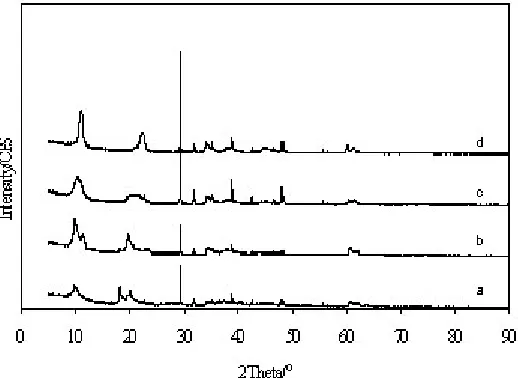
Characterization of layered double hydroxides The XRD pattern of original layered double hydroxide (MAN) synthesized at different ratio are presented in Fig. 1. As shown in the Figure, original layered double hydroxides indicate fairly good crystallinity, with d-spacing 7.9Å which demonstrated general features of layered double hydroxides. The d-spacing show the characteristic values for trigonal structures with symmetrical peaks assigned to the (003) and (006) planes, respectively. The interlayer spacing of the sample corresponding to the 006 plane was found to be 4.5 Å. The result is similar to the study reported previously14, in which the XRD pattern of this white powder corresponds to that of layered double hydroxides; the peaks are sharp signifying high cr ystallinity. Layered double hydroxides (MAN) at ratio 4 (Mg/Al) was subsequently chosen as adsorbent for removal of eriochrome black in this study.
Effect of contact time
Fig. 1: XRD pattern of synthesized hydrotalcite
Fig. 2: The effect of contact time on the removal of eriochrome black dye using layered double Hydroxides
contact time effect on eriochrome black removal by adsorption using layered double hydroxides was carried out ranging from 25 minutes to 7 hours, under the same conditions of 298 K, pH of 6.0 and the concentration of amido black at 150 ppm. The results are presented in Fig. 2. As shown in the Figure, amounts of eriochrome black dye removal increased rapidly within the initial 5 hours and remained almost unchanged after 6 hours indicating an equilibrium state. The adsorption of eriochrome black dye exceeding 80% was obtained. However, the percentage uptake could not improve when
incubation time was further increased. Among the factors that may have contributed to this are as follows; (i) the adsor ption have achieved an equilibrium state (ii) As the adsorption progressed, eriochrome black dye concentration decreased led to a fall in the degree of adsorption15.
Effect of adsorbent dosage
Fig. 3: The effect of adsorbent dosage on the removal of eriochrome black using layered double hydroxides
Fig. 4: The effect of pH on the removal of eriochrome black using layered double hydroxides different eriochrome black concentration. The dose
of adsorbent was varied from 0.01 g to 0.05 g and the results are presented in Fig. 3. As shown in the Figure, the results followed the expected pattern, in which the percentage removal of eriochrome black increased with the increased in dosage. The percentage removal increased rapidly and reached the maximum at 0.04 dosages. These might be due to the increase of adsorbent sites available for the dyes molecules and consequently better adsorption
Fig. 5: Langmuir isotherm plot for removal of eriochrome black using layered double hydroxides
Effect of pH
Generally pH can be considered as an important parameter in controlling the adsorption at water-adsorbent interfaces. Effect of pH on removal of eriochrome black dye was carried out at a fixed initial concentration of eriochrome black (150 ppm) and adsorbent dosage of 0.05 g. The adsorption experiments were carried out at ranging pH from 2 to 12. The results are presented in Fig. 4. As shown in the Figure, it can be observed that the percentage removal of eriochrome black dye decreased with increasing pH and reached the maximum removal at pH 4. Further increased of pH will steadily decreased the percentage removal of eriochrome black. Hence, the weak acid is the ideal condition for eriochrome black dye removal using layered double hydroxides.
Adsorption isotherm
In general, the adsor ption isother m describes how adsorbate interacts with adsorbents and therefore it is critical in optimizing the use of adsorbents. Sorption equilibria provide fundamental physiochemical data for evaluating the applicability of sorption process as a unit operation. In the present investigation the equilibrium data were analyzed using the Langmuir isotherm expression which linearized is given by the equations:
Langmuir:
Ce / qe = 1/Qo * b + Ce / Qo ...(1) Fig. 5 shows the fitted equilibrium data for Langmuir isotherm expressions. From the Figure, it can be seen that the equilibrium data fitted the Langmuir isotherm with high correlation coefficient value for the Langmuir expression of 0.9894 was recorded. The much higher correlation coefficients value for the Langmuir isotherm predicts the monolayer adsorption of eriochrome black on layered double hydroxides. The calculated Langmuir isotherms constant for the maximum sorption capacity of eriochrome black, Qo (mg/g) was 128.2 mg/g.
CONCLUSION
1. C. Namasivayam, M.D. Kumar, K. Selvi, R.A. Begum, T.R.T Vanathi, R.T.Yamuna, Biomass and Bioenergy 21: 477 (2001). 2. Sumanjit, T.P.S Walia, R. Kaur, Online J. of
Health and Allied Sci. 6; 3(3): 1 (2007). 3. B.R Babu, A.K. Parande, S. Raghu, T.P.
Kumar, The J. of Cotton Sci. 11: 141 (2007). 4. S. Hashemian, S. Dadfarnia, M. R. Nateghi, F. Gafoori, African J. of Biotech. 7(5): 600 (2008) .
5. M.S. Secula, G.D. Suditu, C. Cojocaru, I. Cretescu, Chem. Eng. J., (2007).
6. K. Selvam, K. Swaminathan, K. Chae. Bioresource Tech. 88: 115 (2003).
7. N. Dizge, C. Aydiner, E. Demirbas, M. Kobya, S. Kara, J. of Hazard. Mat. 150: 737 (2008). 8. K. Ravikumar, S. Krishnan, S. Ramalingam,
REFERENCES
K. Balu, Dyes and Pigments 72: 66 (2007). 9. M. Muthukumar, D. Sargunamani, N.
Selvakumar, Dyes and Pigments 65: 151 (2005).
10. M.F.R. Pereira, S. F. Soares, J.J.M. Órfaõ, J. L. Figueiredo, Carbon 41: 811 (2003). 11. M. Arami, N.Y. Limaee, N.M. Mahmoodia,
Chem. Eng. J. 139: 2 (2008).
12. S. Amin, G. G. Jayson, Wat. Res. 30(2): 299 (1996).
13. F. Cavani, F. Trifiro and A. Vaccari, Catal. Today, 11: 173 (1991).
14. M. Z. Hussein, Z. Zainal, H. H. Swee, Pertanika J. of Sci. & Tech., 4: 31 (1996). 15. Z. Nor Hanisah, Y. Yamin, F. B. H. Ahmad,