Complex problem solving
—
More than reasoning?
Sascha Wüstenberg, Samuel Greiff
⁎
, Joachim Funke
Department of Psychology, University of Heidelberg, Germany
a r t i c l e i n f o a b s t r a c t
Article history: Received 12 July 2011
Received in revised form 2 November 2011 Accepted 10 November 2011
Available online 3 December 2011
This study investigates the internal structure and construct validity of Complex Problem Solving (CPS), which is measured by aMultiple-Item-Approach. It is tested, if (a) three facets of CPS–rule identification(adequateness of strategies),rule knowledge(generated knowledge) andrule ap-plication(ability to control a system)–can be empirically distinguished, how (b) reasoning is related to these CPS-facets and if (c) CPS shows incremental validity in predicting school grade point average (GPA) beyond reasoning. N=222 university students completed Micro-DYN, a computer-based CPS test and Ravens Advanced Progressive Matrices. Analysis including structural equation models showed that a 2-dimensionsal model of CPS includingrule knowl-edgeandrule applicationfitted the data best. Furthermore, reasoning predicted performance inrule applicationonly indirectly through its influence onrule knowledgeindicating that learn-ing durlearn-ing system exploration is a prerequisite for controlllearn-ing a system successfully. Finally, CPS explained variance in GPA even beyond reasoning, showing incremental validity of CPS. Thus, CPS measures important aspects of academic performance not assessed by reasoning and should be considered when predicting real life criteria such as GPA.
© 2011 Elsevier Inc. All rights reserved. Keywords:
Complex problem solving Intelligence
Dynamic problem solving MicroDYN
Linear structural equations Measurement
General intelligence is one of the most prevalent con-structs among psychologists as well as non-psychologists (Sternberg, Conway, Ketron, & Bernstein, 1981) and fre-quently used as predictor of cognitive performance in many different domains, e.g., in predicting school success (Jensen, 1998a), life satisfaction (Eysenck, 2000; Sternberg, Grigorenko, & Bundy, 2001) or job performance (Schmidt & Hunter, 2004). However, considerable amount of variance in these criteria remains unexplained by general intelligence (Neisser et al., 1996). Therefore,Rigas, Carling, and Brehmer (2002) suggested the use of microworlds (i.e., computer-based complex problem solving scenarios) to increase the predictability of job related success. Within complex problem solving (CPS) tasks, people actively interact with an un-known system consisting of many highly interrelated vari-ables and are asked to actively generate knowledge to achieve certain goals (e.g., managing a Tailorshop; Funke,
2001). In this paper, we argue that previously used measure-ment devices of CPS suffer from a methodological point of view. Using a newly developed approach, we investigate (1) the internal structure of CPS, (2) how CPS is related to rea-soning—which is seen as an excellent marker of general in-telligence (Jensen, 1998b) — and (3) if CPS shows incremental validity even beyond reasoning.
1. Introduction
Reasoning can be broadly defined as the process of draw-ing conclusions in order to achieve goals, thus informdraw-ing problem-solving and decision-making behavior (Leighton, 2004). For instance, reasoning tasks like theCulture Fair Test (CFT-20-R;Weiß, 2006) or RavensAdvanced Progressive Ma-trices (APM; Raven, 1958) require participants to identify and acquire rules, apply them and coordinate two or more rules in order to complete a problem based on visual patterns (Babcock, 2002). Test performance on APM has been sug-gested to be dependent on executive control processes that allow a subject to analyze complex problems, assemble solu-tion strategies, monitor performance and adapt behavior as ⁎ Corresponding author at: Department of Psychology, University of
Hei-delberg, Hauptstraße 47–51, 69117 HeiHei-delberg, Germany. Tel.: +49 6221 547613; fax: +49 547273.
E-mail address:[email protected](S. Greiff).
0160-2896/$–see front matter © 2011 Elsevier Inc. All rights reserved. doi:10.1016/j.intell.2011.11.003
Contents lists available atSciVerse ScienceDirect
testing proceeds (Marshalek, Lohman, & Snow, 1983; Wiley, Jarosz, Cushen, & Colflesh, 2011).
However, the skills linked to executive control processes within reasoning and CPS are often tagged with the same la-bels: Also in CPS, acquiring and applying knowledge and monitoring behavior are seen as important skills in order to solve a problem (Funke, 2001), e.g., while dealing with a new type of mobile phone. For instance, if a person wants to send a text message for the first time, he or she will press buttons in order to navigate through menus and get feedback. Based on the feedback he or she persists in or changes behavior according to how successful the previous actions have been. This type of mobile phone can be seen as a CPS-task: The problem solver does not know how several variables in a given system (e.g., mobile phone) are con-nected with each other. His or her task is to gather informa-tion (e.g., by pressing buttons to toggle between menus) and to generate knowledge about the system's structure (e.g., the functionality of certain buttons) in order to reach a given goal state (e.g., sending a text message). Thus, elabo-rating and using appropriate strategies in order to solve a problem is needed in CPS and as well in reasoning tasks like APM (Babcock, 2002), so that Wiley et al. (2011) name APM a visuospatial reasoning and problem solving task.
However, are the underlying processes while solving sta-tic tasks like APM really idensta-tical to complex and interactive problems, like in the mobile phone example? And does rea-soning assess performance in dealing with such problems? Raven (2000) denies that and points towards different de-mands upon the problem solver while dealing with problem solving tasks as compared to reasoning tasks.
…It [Problem solving] involves initiating, usually on the basis of hunches or feelings, experimental interactions with the environment to clarify the nature of a problem and po-tential solutions. […] In this way they [the problem solvers]
can learn more about the nature of the problem and the ef-fectiveness of their strategies. […] They can then modify their behaviour and launch a further round of experimental interactions with the environment (Raven, 2000, p. 479).
Raven (2000) separates CPS from reasoning assessed by APM. He focuses on dynamic interactions necessary in CPS for revealing and incorporating previously unknown information as well as achieving a goal using subsequent steps which de-pend upon each other. This is in line with Buchner's under-standing (1995) of complex problem solving (CPS) tasks:
Complex problem solving (CPS) is the successful interaction with task environments that are dynamic (i.e., change as a function of user's intervention and/or as a function of time) and in which some, if not all, of the environment's regularities can only be revealed by successful exploration and integration of the infor-mation gained in that process (Buchner, 1995, p. 14).
The main differences between reasoning tasks and CPS tasks are that in the latter case (1) not all information neces-sary to solve the problem is given at the outset, (2) the prob-lem solver is required to actively generate information via applying adequate strategies, and (3) procedural abilities have to be used in order to control a given system, such as
when using feedback in order to persist or change behavior or to counteract unwanted developments initiated by the system (Funke, 2001). Based on these different demands upon the problem solver, Funke (2010) emphasized that CPS requires not only a sequence of simple cognitive opera-tions, but complex cognition, i.e., a series of different cogni-tive operations like action planning, strategic development, knowledge acquisition and evaluation, which all have to be coordinated to reach a certain goal.
In summary, on a conceptual level, reasoning and CPS both assess cognitive abilities necessary to generate and apply rules, which should yield in correlations between both constructs. Nevertheless, according to the different task characteristics and cognitive processes outlined above, CPS should also show divergent validity to reasoning.
1.1. Psychometrical considerations for measuring CPS
Numerous attempts have been made to discover the rela-tionship between CPS and reasoning empirically (for an over-view see, e.g.,Beckmann, 1994; Beckmann & Guthke, 1995; Funke, 1992; Süß, 1996; Wirth, Leutner, & Klieme, 2005). Earlier CPS-research in particular reported zero-correlations (e.g.,Joslyn & Hunt, 1998; Putz-Osterloh, 1981), while more recent studies revealed moderate to high correlations be-tween CPS and reasoning (e.g.,Wittmann & Hattrup, 2004; Wittmann & Süß, 1999). For instance, Gonzalez, Thomas, and Vanyukov (2005)showed that performance in the CPS-scenariosWater Purification Plant(0.333, pb0.05) and Fire-chief(0.605; pb0.05) were moderately to highly correlated with APM.
In order to explain the incongruity observed, Kröner, Plass, and Leutner (2005)summarized criticisms of various authors on CPS research (e.g.,Funke, 1992; Süß, 1996) and stated, that the relationship between CPS and reasoning sce-narios could only be evaluated meaningfully if three general conditions were fulfilled.
1.1.1. Condition (A): Compliance with requirements of test theory
Early CPS work (Putz-Osterloh, 1981) suffered particularly from a lack of reliable CPS-indicators, leading to low correla-tions of CPS and reasoning (Funke, 1992; Süß, 1996). If reliable indicators were used, correlations between reasoning and CPS increased significantly (Süß, Kersting, & Oberauer, 1993) and CPS even predicted supervisor ratings (Danner et al., 2011). Nevertheless, all studies mentioned above used scenarios in which problem solving performance may be confounded with prior knowledge leading to condition (B).
1.1.2. Condition (B): No influence of simulation-specific knowledge acquired under uncontrolled conditions
Prior knowledge may inhibit genuine problem solving processes and, hence, negatively affect the validity of CPS. For instance, this applies to the studies of Wittmann and Süß (1999), who claimed CPS to be a conglomerate of knowl-edge and intelligence. In their study, they assessed reasoning (subscale processing capacity of theBerlin Intelligence Struc-ture Test—BIS-K; Jäger, Süß, & Beauducel, 1997) and
However, correlations vanished when system-specific knowledge and reasoning were partialled out. The authors' conclusion of CPS being only a conglomerate is questionable, because the more prior knowledge is helpful in a CPS task, the more this knowledge will suppress genuine problem solving processes like searching for relevant information, inte-grating knowledge or controlling a system (Funke, 2001). In order to avoid these uncontrolled effects, CPS scenarios which do not rely on domain-specific knowledge ought to be used.
1.1.3. Condition (C): Need for an evaluation-free exploration phase An exploration phase for identifying the causal connec-tions between variables should not contain any target values to be reached in order to allow participants to have an equal opportunity to use their knowledge-acquisition abilities under standardized conditions (Kröner et al., 2005).
Consequently,Kröner et al. (2005)designed a CPS scenar-io based on linear structural equatscenar-ion systems (Funke, 2001) calledMultiFluxand incorporated the three suggestions out-lined. Within MultiFlux, participants first explore the task and their generated knowledge is assessed. Participants then are presented the correct model of the causal structure and asked to reach given target values. Finally, three different facets of CPS are assessed—the use of adequate strategies
(rule identification), the knowledge generated (rule knowl-edge) and the ability to control the system (rule application). Results showed that reasoning (measured by BIS-K) pre-dicted each facet (rule identification: r=0.48;rule knowledge r=0.55;rule applicationr=0.48) and the prediction ofrule applicationby reasoning was even stronger than the predic-tion of rule application by rule knowledge (r=0.37). In a more recent study using MultiFlux, Bühner, Kröner, and Ziegler (2008)extended the findings ofKröner et al. (2005). They showed that in a model containing working memory (measured by a spatial coordination task; Oberauer, Schulze, Wilhelm, & Süß, 2005), CPS and intelligence (mea-sured by Intelligence Structure Test 2000 R; Amthauer, Brocke, Liepmann, & Beauducel, 2001), intelligence predicted each CPS-facet (rule knowledge r= 0.26; rule application r=0.24;rule identificationwas not assessed), while the pre-diction ofrule applicationbyrule knowledgewas not signifi-cant (p>0.05). In both studies, reasoning predicted rule application more strongly than rule knowledge did. Thus, the authors concluded thatMultiFluxcan be used as a mea-surement device for the assessment of intelligence, because each facet of CPS can be directly predicted by intelligence (Kröner et al., 2005).
In summary,Kröner et al. (2005)pointed towards the ne-cessity of measuring CPS in a test-theoretical sound way and developed a promising approach based on three conditions. Nevertheless, some additional methodological issues that may influence the relationship between reasoning and CPS were not sufficiently regarded.
1.2. Prerequisite—Multiple-item-testing
MultiFlux, as well as all other CPS scenarios previously mentioned may be considered One-Item-Tests (Greiff, in press). These scenarios generally consist of one specific sys-tem configuration (i.e., variables as well as relations between them remain the same during test execution). Thus, all
indicators assessingrule knowledgegained during system ex-ploration are related to the very same system structure and consequently depend on each other. This also accounts for in-dicators ofrule application: Although participants work on a series of independentrule applicationtasks with different tar-get goals, these tasks also depend on the very same underly-ing system structure. Consequently, basic test theoretical assumptions are violated making CPS scenarios comparable to an intelligence test with one single item, but with multiple questions on it. The dimensionality of the CPS construct can-not be properly tested, because indicators within each of the dimensionsrule knowledge and rule application are depen-dent on each other. Thus,One-Item-Testing inhibits a sound testing of the dimensionality of CPS.
There are two different ways to assessrule applicationin CPS tasks, either by implementing (a) only one control round or (b) multiple control rounds. Using (a) only one con-trol round enhances the influence of reasoning onrule appli-cation. For instance, within MultiFlux (Bühner et al., 2008; Kröner et al., 2005), rule applicationis assessed by partici-pants' ability to properly set controls in all input variables in order to achieve given target values of output variables within one control round. During these tasks, no feedback is given to participants. Thus, procedural aspects ofrule applica-tionlike using feedback in order to adjust behavior or coun-teract system changes not directly controllable by the problem solver are not assessed. Because of this lack of inter-action between problem solver and problem,rule application inMultiFlux assesses primarily cognitive efforts in applying rules also partly measured in reasoning tasks—and less
pro-cedural aspects genuine to CPS. Additionally, within Multi-Flux,rule knowledgetasks are also similar torule application tasks, because knowledge is assessed by predicting values of a subsequent round given that input variables were in a spe-cific configuration at the round before. This kind of knowl-edge assessment requires not only knowlknowl-edge about rules, but also the ability to apply rules in order to make a predic-tion. Consequently, rule knowledge and rule application as well as reasoning andrule applicationwere strongly correlat-ed (r=0.77 and r=0.51, respectively;Kröner et al., 2005). However, if intelligence was added as a predictor of both rule knowledgeand rule application, the path betweenrule knowledge and rule application was significantly lowered (r=0.37;Kröner et al., 2005) or even insignificant (Bühner et al., 2008). This shows that rule application assessed by one-step control rounds measures similar aspects of CPS as rule knowledge —and these aspects depend on reasoning
to a comparable extent, reducing the validity of the construct CPS. Thus, multiple control rounds have to be used in order to also allow the assessment of CPS abilities like using and in-corporating feedback inrule application.
Thus, the only way to assess CPS properly, enabling direct interaction and inhibiting confounded variables, is by adding a prerequisite (D)–the use of multiple items differing in
sys-tem configuration – to the three conditions (A–C) Kröner et al. (2005)mentioned for a proper assessment of CPS. In a Multiple-Item-Approach, multiple (but limited) control rounds can be used, because additional knowledge that is eventually gained during rule application does not support participants in the following item based on a completely dif-ferent structure.
Besides using aMultiple-Item-Approach, we also want to include external criteria of cognitive performance (e.g., school grade) in order to check construct validity of CPS. Re-search that has done so far mostly tested exclusively the pre-dictive validity of system control, i.e. rule application (e.g., Gonzalez, Vanyukov, & Martin, 2005). This is surprising, be-cause according to Buchner's (1995) definition as well as Raven's (2000), the aspects of actively using information (rule identification) in order to generate knowledge (rule knowledge) also determine the difference between reasoning and CPS—and not only the application of rules. Consequent-ly, predictive and incremental validity of all relevant CPS facets should be investigated.
In summary, the aim of this study is to re-evaluate as well as to extend some questions raised byKröner et al. (2005):
(1) Can the three facets of CPS still be empirically separat-ed within aMultiple-Item-Approach? Thus, the dimen-sionality of the construct CPS will be under study, including a comparison between a multi- and a unidi-mensional (and more parsimonious) model, which has not been done yet.
(2) Is CPS only another measure of reasoning? This ques-tion includes the analysis of which CPS facets can be predicted by reasoning and how they are related. (3) Can CPS be validated by external criteria? This question
targets the predictive and incremental validity of each CPS facet.
1.3. The MicroDYN-approach
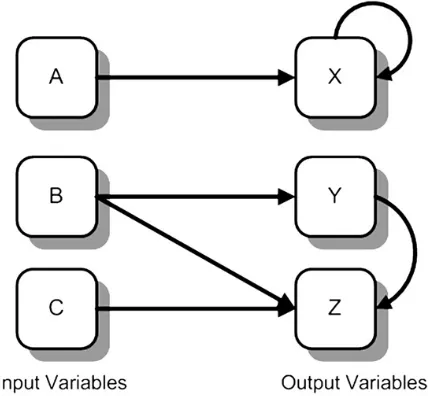
The MicroDYN-approach, aimed at capturing CPS, incor-porates the prerequisites mentioned above (see Greiff, in press). In contrast to other CPS scenarios, MicroDYN uses multiple and independent items to assess CPS ability. A plete test set contains 8 to 10 minimal but sufficiently com-plex items, each lasting about 5 min, in their sum a total testing time of less than 1 h including instruction. MicroDYN-items consist of up to 3 input variables (denoted by A, B and C), which can be related to up to 3 output vari-ables (denoted by X, Y and Z; seeFig. 1).
Input variables influence output variables, where only the former can be actively manipulated by the problem solver. There are two kinds of connections between variables: Input variables which influence output variables and output variables which influence themselves. The latter may occur if different output variables are related (side effect; see Fig. 1: Y to Z) or if an output variable influences itself (auto-regressive process; seeFig. 1: X to X).
MicroDYN-tasks can be fully described by linear structural equations (for an overview see Funke, 2001), which have
been used in CPS research to describe complex systems since the early 1980ies. The number of equations necessary to describe all possible relations is equal to the number of output variables. For the specific example inFig. 1, Eqs.(1) to (3)are needed:
Xðtþ1Þ¼a1%Að Þt þa2%Xð Þt ð1Þ
Yðtþ1Þ¼a3%Bð Þt þYð Þt ð2Þ
Zðtþ1Þ¼a4%Bð Þt þa5%Cð Þt þa6%Yð Þt þZð Þt ð3Þ with t=discrete time steps, ai=path coefficients, ai≠0, and
a2≠1.
Within each MicroDYN-item, the path coefficients are fixed to a certain value (e.g., a1=+1) and participants may
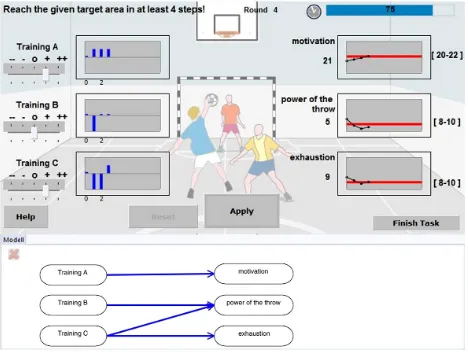
vary variable A, B and C. Although Fig. 1 may look like a path diagram and the linear equations shown above may look like a regression model, both illustrations only show how inputs and outputs are connected within a given system. Different cover stories were implemented for each item in MicroDYN (e.g. feeding a cat, planting pumpkins or driving a moped). In order to avoid uncontrolled influences of prior knowledge, variables were either labeled without deep seman-tic meaning (e.g.,button A) or fictitiously (e.g.,sungrassas name for a flower). For instance, in the item“handball”(seeFig. 2; for
linear structural equations seeAppendix A), different kinds of training labeled training A, B and C served as input variables whereas different team characteristics labeled motivation, power of throw, and exhaustion served as output variables.
While working on MicroDYN, participants face three dif-ferent tasks that are directly related to the three facets of problem solving ability considered byKröner et al. (2005). In the exploration phase, (1) participants freely explore the system and are asked to discover the relationships between the variables involved. Here, the adequateness of their stra-tegies is assessed (facetrule identification). For instance, in the handball training item, participants may vary solely the value of training A in round 1 by manipulating a slider (e.g., from “0” to “++”). After clicking on the “apply”-button,
Fig. 1.Structure of a typical MicroDYN item displaying 3 input (A, B,C) and 3
they will see how the output variables change (e.g., value on motivation increases).
Simultaneously, (2) participants have to draw lines be-tween variables in a causal model as they suppose them to be, indicating the amount of generated knowledge (facet rule knowledge). For instance, participants may draw a line between training A and motivation by merely clicking on both variable names (see model at the bottom ofFig. 2). Af-terwards, in the control phase, (3) participants are asked to reach given target goals in the output variables within 4 steps (facetrule application). For instance, participants have to increase the value of motivation and power of the throw, but minimize exhaustion (not displayed inFig. 2). In order to disentanglerule knowledgeandrule application, the correct model is given to the participants during rule application. Within each item, the exploration phase assessingrule identi-ficationandrule knowledgelasts about 180 s and the control phase lasts about 120 s.
1.4. The present study
1.4.1. Research question (1): Dimensionality
Kröner et al. (2005)showed that three different facets of CPS ability,rule identification,rule knowledgeandrule applica-tioncan be empirically distinguished. However, all indicators derived are based on one single item, leading to dependencies of indicators incompatible with psychometrical standards.
Thus, the dimensionality of CPS has to be tested in a Multiple-Item-Approachwith independent performance indicators.
Hypothesis (1). The indicators of rule identification, rule knowledgeandrule applicationload on three corresponding factors. A good fit of the 3-dimensional model in confirmato-ry factor analysis (CFA) is expected. Comparisons with less dimensional (and more parsimonious) models confirm that these models fit significantly worse.
1.4.2. Research question (2): CPS and reasoning
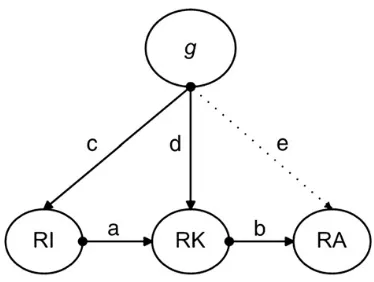
According to the theoretical considerations raised in the Introduction, reasoning and CPS facets should be empirically related. In order to gain more specific insights about this con-nection, we assume that the process oriented model shown inFig. 3is appropriate to describe the relationship between reasoning and different facets of CPS.
predictions that reasoning directly predicts performance in rule application. In their results, the direct path (e) indicated that irrespectively of the amount ofrule knowledgeacquired beforehand, more intelligent persons used the correct model given in the control phase to outperform less intelli-gent ones inrule application. We assume that this result is due to the wayrule applicationwas assessed inMultiFlux. Par-ticipants had to reach certain target values as output vari-ables within one single round. Thus, procedural abilities (e.g., using feedback in order to adjust behavior during sys-tem control) were not necessary and rule applicationsolely captured abilities also assessed by reasoning. This leads to a significant path (e) and reduced the impact of path (b) (Bühner et al., 2008; Kröner et al., 2005). As outlined above, using multiple control rounds within a One-Item-Approach leads to confounded variables of rule knowledge and rule ap-plication. A Multiple-Item-Approach, however, allows multi-ple independent control rounds forcing participants to use procedural abilities (not assessed by reasoning) in order to control the system.
Consequently, learning to handle the system during explo-ration is essential and analysis of the correct model given in the control phase is not sufficient for system control. Thus, more intelligent participants should only be able to outperform less intelligent ones in rule application, because they have gained more system knowledge and have better procedural abilities necessary forrule application. Reasoning should pre-dict performance inrule application, however, only indirectly via its influence onrule identificationandrule knowledge (indi-cated by an insignificant direct effect in path e).
Hypothesis (2). The theoretical process model (shown in Fig. 3) is empirically supported, indicating thatrule identifica-tion and rule knowledge fully mediate the relationship be-tween reasoning andrule application.
1.4.3. Research question (3): Predictive and incremental validity of CPS
Finally, we assume that CPS facets predict performance in important external criteria like school grade point average (GPA) even beyond reasoning indicating the incremental va-lidity of CPS. The ability to identify causal relations and to gain knowledge when confronted with unknown systems is frequently demanded in different school subjects (OECD,
2004). For instance, tasks in physics require analyzing ele-mentary particles and their interactions in order to under-stand the properties of a specific matter or element. However, actively controlling a system by using procedural abilities is less conventional at school. Consequently, a signi-ficant prediction of GPA byrule identificationandrule knowl-edge is expected, whereasrule application should be a less important predictor.
Hypothesis (3). CPS ability measured by the CPS facetsrule identificationandrule knowledgesignificantly predict GPA be-yond reasoning, whereas there is no increment in prediction forrule application.
2. Method
2.1. Participants
Participants were 222 undergraduate and graduate stu-dents (154 female, 66 male, 2 missing sex; age: M=22.8; SD=4.0), mainly from social sciences (69%, thereof 43% studying psychology) followed by natural sciences (14%) and other disciplines (17%). Most of the students were un-dergraduates (n=208). Students received partial course credit for participation and an additional 5 € (approx. 3.5 US $) if they worked conscientious. A problem solver was treated as working not conscientiously, if more than 50% data were missing on APM and if the mean of the explo-ration rounds in MicroDYN was less than three rounds. With-in MicroDYN, at least three rounds are needed to identify all causal relations in an item. We excluded participants from the analyses either because they were not working conscien-tiously (n=4) or because of missing data occurring due to software problems (e.g., data was not saved properly; n=12). Finally, data for 222 students were available for the analyses. The study took place at the Department of Psycho-logy at the University of Heidelberg, Germany.
2.2. Materials
2.2.1. MicroDYN
Testing of CPS was entirely computer-based. Firstly, parti-cipants were provided with a detailed instruction including two items in which they actively explored the surface of the program and were informed about what they were expected to do: gain information about the system structure (rule identi-fication), draw a model (rule knowledge) and finally control the system (rule application). Subsequently, participants dealt with 8 MicroDYN items. The task characteristics (e.g., number of ef-fects) were varied in order to produce items across a broad range of difficulty (Greiff & Funke, 2010; see section on MicroDYN approachand alsoAppendix Afor equations).
2.2.2. Reasoning
Additionally, participants' reasoning ability was assessed using a computer adapted version of theAdvanced Progressive Matrices(APM,Raven, 1958). This test has been extensively standardized for a population of university students and is seen as a valid indicator of fluid intelligence (Raven, Raven, & Court, 1998).
2.2.3. GPA
Participants provided demographical data and their GPA in self-reports.
3. Design
Test execution was divided into two sessions, each lasting approximately 50 min. In session 1, participants worked on MicroDYN. In session 2, APM was administered first and partic-ipants provided demographical data afterwards. Time between sessions varied between 1 and 7 days (M=4.2, SD=3.2).
3.1. Dependent variables
In MicroDYN, ordinal indicators were used for each facet. This is in line withKröner et al. (2005), but not with other re-search on CPS that uses indicators strongly depending on sin-gle system characteristics (Goode & Beckmann, 2011; Klieme, Funke, Leutner, Reimann, & Wirth, 2001). However, ordinal indicators can be used to measure interval-scaled latent vari-ables within structural equation modeling approach (SEM; Bollen, 1989) and also allow analyses of all items within item response theory (IRT;Embretson & Reise, 2000).
Forrule identification,full credit was given if participants showed a consistent use of VOTAT (i.e., vary one thing at a time; Vollmeyer & Rheinberg, 1999) for all variables. The use of VOTAT enables the participants to identify the isolated effect of one input variable on the output variables (Fig. 1). Participants were assumed to have mastered VOTAT when they applied it to each input variable at least once during ex-ploration. VOTAT is seen as the best strategy to identify caus-al relations within linear structurcaus-al equation systems (Tschirgi, 1980) and frequently used in CPS research as indi-cator of an adequate application of strategies (e.g.,Burns & Vollmeyer, 2002; Vollmeyer, Burns, & Holyoak, 1996). Anoth-er possible opAnoth-erationalization of rule identification is to as-sess self-regulation abilities of problem solvers as introduced byWirth (2004) and Wirth and Leutner (2008) using the scenarioSpace Shuttle. Their indicator is based on the relation of generating and integrating information while exploring the system. Generating information means to per-form an action for the first time, whereas integrating infor-mation means to perform the same actions that had previously been done once again to check whether the rela-tionships of input and output variables had been understood correctly. An appropriate self-regulation process is indicated by focussing on generating new information in the first rounds of an exploration phase and by focussing on integrating of in-formation in the latter rounds. However, this kind of operatio-nalization is more efficient in tasks, in which working memory limits the ability to keep all necessary information in mind. Within MicroDYN, participants are allowed to simultaneously track the generated information by drawing a model, rendering the process of integrating information less essential. Thus, we only used VOTAT as an indicator of rule identification.
Forrule knowledge, full credit was given if the model drawn was completely correct and in case ofrule application, if target areas of all variables were reached. A more detailed scoring did not yield any better results on psychometrics. Regarding APM, correct answers in Set II were scored dichotomously, accordingly to the recommendation in the manual (Raven et al., 1998).
3.2. Statistical analysis
To analyze data we ran CFA within the structural equation modeling approach (SEM;Bollen, 1989) and Rasch analysis within item response theory (IRT). We used the software MPlus 5.0 (Muthén & Muthén, 2007a) for SEM calculations and Conquest 3.1 for Rasch analysis (Wu, Adams, & Haldane, 2005). Descriptive statistics and demographical data were analyzed using SPSS 18.
4. Results
4.1. Descriptives
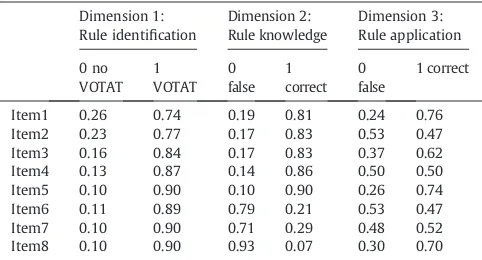
Frequencies for all three dimensions are summarized in Table 1. Analyses for dimension 1,rule identification, showed that a few participants learned the use of VOTAT to a certain degree during the first three items. Such learning or acquisi-tion phases can only be observed if multiple items are used. However, if all items are considered,rule identification was largely constant throughout testing (seeTable 2; SD =0.06). Regarding dimension 2,rule knowledge, items with side ef-fects or autoregressive processes (items 6–8) were much
more difficult to understand than items without such effects (items 1–5) and thus, performance depended strongly on
system structure. However, this classification did not fully ac-count forrule application. Items were generally more difficult if participants had to control side effects or autoregressive processes (items 6–7) or items in which values of some
vari-ables had to be increased while others had to be decreased, respectively (items 2 and 4).
Internal consistencies as well as Rasch reliability esti-mates of MicroDYN were good to acceptable (Table 2). Not surprisingly, these estimates were, due to a Multiple-Item-Approach, somewhat lower than in other CPS scenarios. One-Item-Testing typically leads to dependencies of perfor-mance indicators likely to inflate internal consistencies. Cron-bach'sαof APM (α=0.85) as well as participants' raw score distribution on APM (M= 25.67, s=5.69) were comparable to the original scaling sample of university students (α=0.82; M=25.19, s=5.25; Raven et al., 1998). The range of participants' GPA was restricted, indicating that
Table 1
Relative frequencies for the dimensions rule identification, rule knowledge and rule application (n=222).
Dimension 1: Rule identification
Dimension 2: Rule knowledge
Dimension 3: Rule application
0 no VOTAT
1 VOTAT
0 false
1 correct
0 false
1 correct
Item1 0.26 0.74 0.19 0.81 0.24 0.76 Item2 0.23 0.77 0.17 0.83 0.53 0.47 Item3 0.16 0.84 0.17 0.83 0.37 0.62 Item4 0.13 0.87 0.14 0.86 0.50 0.50 Item5 0.10 0.90 0.10 0.90 0.26 0.74 Item6 0.11 0.89 0.79 0.21 0.53 0.47 Item7 0.10 0.90 0.71 0.29 0.48 0.52 Item8 0.10 0.90 0.93 0.07 0.30 0.70
participants were mostly well above average performance (M=1.7, s=0.7; 1=best performance, 6= insufficient).
4.2. Measurement model for reasoning
To derive a measurement for reasoning, we divided APM scores in three parcels each consisting of 12 APM Set II-items. Using the item-to-construct balance recommended by Little, Cunningham, Shahar, and Widaman (2002), the highest three factor loadings were chosen as anchors of the parcels. Subsequently, we repeatedly added the three items with the next highest factor loadings to the anchors in inverted order, followed by the subsequent three items with highest factor loadings in normal order and so on. Mean difficulty of the three parcels did not differ significantly (M1=0.74; M2=0.67; M3=0.73; F2, 33=0.31; p>0.05).
4.3. Hypothesis 1: Measurement model of CPS
4.3.1. CFA
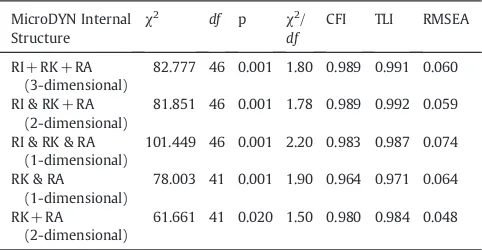
We ran a CFA to determine the internal structure of CPS. The assumed 3-dimensional model showed a good global model fit (Table 3), indicated by a Comparative Fit Index (CFI) and a Tucker Lewis Index (TLI) value above 0.95 and a Root Mean Square Error of Approximation (RMSEA) just within the limit of 0.06 recommended by Hu and Bentler (1999). However,Yu (2002)showed that RMSEA is too con-servative in small samples.
Surprisingly, in the 3-dimensional modelrule identifica-tionand rule knowledge were highly correlated on a latent level (r=0.97). Thus, students who used VOTAT also drew appropriate conclusions, yielding in better rule knowledge scores. A descriptive analyses of the data showed that the probability to build a correct model without using VOTAT was 3.4% on average, excluding the first and easiest item which had a probability of 80%. Thus, the latent correlation betweenrule identificationandrule knowledgebased on em-pirical data was higher than theoretically assumed.
Concerning the internal structure of MicroDYN, a χ2
-difference test carried out subsequently (using Weighted Least Squares Mean and Variance adjusted—WLSMV
estima-tor for ordinal variables,Muthén & Muthén, 2007b) showed that a more parsimonious 2-dimensional model with an ag-gregated facet of rule knowledge and rule identification on one factor andrule applicationon another factor did not fit significantly worse than the presumed 3-dimensional model (χ2=0.821;df=2; p>0.05), but better than a 1-dimensional
model with all indicators combined on one factor (χ2=17.299;
df=1; pb0.001). This indicated that, empirically, there was no difference between the facetsrule identificationandrule knowl-edge. Therefore, we decided to use only indicators ofrule knowl-edgeand not those ofrule identification,becauserule knowledge is more closely related torule applicationin the process model (Kröner et al., 2005) as well as more frequently used in CPS liter-ature as an indicator for generating information thanrule identi-fication(Funke, 2001; Kluge, 2008). It would also have been possible to use a 2-dimensional model with rule identification and rule knowledge combined under one factor and rule appli-cation under the other one. However, this model is less parsimo-nious (more parameters to be estimated) and the global model fit did not significantly increase.
Thus, for further analyses, the 2-dimensional model with only rule knowledgeandrule applicationwas used. This model fit was better than a g-factor model withrule knowledgeandrule appli-cationcombined (χ2-difference test=15.696,df=1, pb0.001),
also showing a good global model fit (Table 3). The communali-ties (h2=0.36–0.84 forrule knowledge; h2=0.08–0.84 forrule
application; see alsoAppendix B) were mostly well above the recommended level of 0.40 (Hair, Anderson, Tatham, & Black, 1998). Only item 6 showed a low communality onrule applica-tion, because it was the first item containing an autoregressive process, and participants underestimated the influence of this kind of effect while trying to reach a given target in the system.
4.3.2. IRT
After evaluating CFA results, we ran a multidimensional Rasch analysis on the 3-dimensional model, thereby forcing factor loadings to be equal, and changing the linear link func-tion in CFA to a logarithmical one in IRT. Comparable to the results on CFA, rule identification and rule knowledge were highly correlated (r= 0.95), supporting the decision to focus on a 2-dimensional model. This model showed a signi-ficantly better fit than a 1-dimensional model including both facets (χ2=34; df=2, pb0.001), when a difference test of
the final deviances as recommended byWu, Adams, Wilson, and Haldane (2007)is used. Item fit indices (MNSQ) were within the endorsed boundaries from 0.75 to 1.33 (Bond & Fox, 2001), except for item 6 concerning rule application. Because item 6 fit well within rule knowledge, however, it was not excluded from further analyses.
Table 2
Item statistics and reliability estimates for rule identification, rule knowledge and rule application (n=222).
Item statistics Reliability estimates
M SD Rasch α
Rule identification 0.85 0.06 0.82 0.86 Rule knowledge 0.60 0.34 0.85 0.73 Rule application 0.60 0.12 0.81 0.79 Note. M=mean; SD =standard deviation; Rasch =EA/PV reliability estimate within the Rasch model (1PL model);α=Cronbach'sα; range for rule identification,rule knowledgeandrule application: 0 to 1.
Table 3
Goodness of Fit indices for measurement models including rule identification (RI), rule knowledge (RK) and rule application (RA) (n=222).
MicroDYN Internal Structure
χ2 df p χ2/
df
CFI TLI RMSEA
RI +RK +RA (3-dimensional)
82.777 46 0.001 1.80 0.989 0.991 0.060
RI & RK +RA (2-dimensional)
81.851 46 0.001 1.78 0.989 0.992 0.059
RI & RK & RA (1-dimensional)
101.449 46 0.001 2.20 0.983 0.987 0.074
RK & RA (1-dimensional)
78.003 41 0.001 1.90 0.964 0.971 0.064
RK +RA (2-dimensional)
61.661 41 0.020 1.50 0.980 0.984 0.048
Note. df=degrees of freedom; CFI =Comparative Fit Index; TLI =Tucker Lewis Index; RMSEA =Root Mean Square Error of Approximation;χ2anddf
Generally, both CFA and IRT results suggested that rule application can be separated from rule knowledge and rule identification while a distinction between the latter two could not be supported empirically. In summary, hypothesis 1 was only partially supported.
4.4. Hypothesis 2: Reasoning and CPS
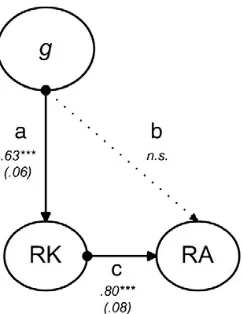
We assumed thatrule knowledgemediated the relation-ship between reasoning and rule application. In order to check mediation, it was expected that reasoning predicted rule knowledge and rule application, whereas prediction of rule application should no longer be significant if a direct path fromrule knowledgetorule applicationwas added.
Although a considerable amount of variance remained unexplained, reasoning predicted both facets as expected (rule knowledge:β=0.63; pb0.001; R2=0.39;rule
applica-tion:β=0.56; pb0.001; R2=0.31), showing a good overall
model fit (model (a) inTable 4). Thus, more intelligent per-sons performed better than less intelligent ones in rule knowledgeandrule application.
However, if a direct path fromrule knowledgetorule appli-cationwas added (see path (c) inFig. 4), the direct prediction ofrule applicationby APM (path b) was no longer significant (p=0.52), shown as an insignificant path (b) inFig. 4. Conse-quently, more intelligent persons outperformed less intelli-gent ones in rule application, because they acquired more rule knowledgebeforehand. Thus, learningrule knowledgeis a prerequisite forrule application.
Results were unchanged if a 3-dimensional model including rule identificationwas used. Thus, Hypothesis 2 was supported.
4.5. Hypothesis 3: Predictive and incremental validity of CPS
We claimed that CPS predicted performance in GPA be-yond reasoning. In order to test this assumption, first we checked predictive validity of each construct separately and then added all constructs combined in another model to test incremental validity (please note: stepwise latent regres-sion is not supported by MPlus;Muthén & Muthén, 2007b). Reasoning significantly predicted GPA (β=0.35, pb0.001) and explained about 12% of variance in a bivariate latent re-gression showing a good model fit (model b in Table 4). If only CPS-facets were included in the analysis,rule knowledge predicted GPA (β=0.31, pb0.001) and explained about 10% of variance, whereas rule application had no influence on GPA. This model also fitted well (model (c) inTable 4). If rea-soning and the CPS-facets were added simultaneously in a model (model (d) in Table 4), 18% of GPA-variance was
explained, indicating that 6% of variance is additionally explained in comparison to the model with only reasoning as predictor of GPA (model b). However, the CPS facets and reasoning were correlated (rAPM/RA= 0.56; rAPM/RK=0.63).
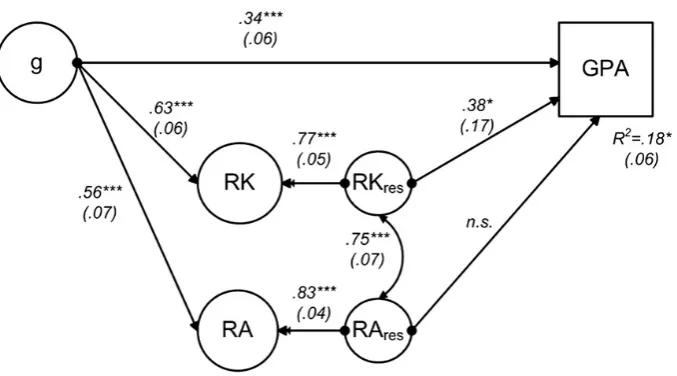
Thus, covariances between reasoning and CPS might also have influenced the estimates of the path coefficient of CPS, so that the influence which is solely attributable to CPS is not evidently shown within this model. Thus, we decided to run another analysis and investigate incremental validity of CPS by using only one single model. Within this model (shown inFig. 5), rule knowledgeandrule applicationwere regressed on reasoning. The residuals of this regression,RKresand RAres, as well as
reason-ing itself, were used to predict performance in GPA.
Results of this final model showed that reasoning pre-dicted GPA, but the residual ofrule knowledge RKresexplained
additional variance in GPA beyond reasoning.RAresyielded no
significant path. Although this model is statistically identical to model (d), the significant path coefficient of RKresshowed
incremental validity of CPS beyond reasoning more evidently, because RKresand RAreswere modeled as independent from
reasoning. In summary, RKres involved aspects of CPS not
measured by reasoning, but could predict performance in GPA beyond it. Thus, hypothesis 3 was supported.
5. Discussion
We extended criticisms byKröner et al. (2005)on CPS re-search and tested aMultiple-Item-Approachto measure CPS. We claimed that (1) three different facets of CPS can be sepa-rated, (2)rule knowledgefully mediates the relationship be-tween reasoning and rule application and (3) CPS shows
Table 4
Goodness of Fit indices for structural models including reasoning, CPS and GPA (n=222).
Hyp. χ2 df p χ2/df CFI TLI RMSEA
(a) Reasoning→CPS 2 79.554 50 0.005 1.59 0.967 0.979 0.052
(b) Reasoning→GPA 3 3.173 2 0.205 1.59 0.996 0.988 0.052
(c) CPS→GPA 3 69.181 46 0.015 1.50 0.977 0.982 0.048
(d) Reasoning & CPS→GPA 3 82.481 54 0.007 1.53 0.969 0.979 0.049
Note. df=degrees of freedom; CFI =Comparative Fit Index; TLI =Tucker Lewis Index; RMSEA=Root Mean Square Error of Approximation;χ2anddfare
estimated by WLSMV.
incremental validity beyond reasoning. Generally, our find-ings suggest that CPS can be established as a valid construct and can be empirically separated from reasoning.
5.1. Ad (1) Internal structure
A three-dimensional model with the facetsrule identifica-tion,rule knowledgeandrule applicationwas not supported (Hy-pothesis 1). Althoughrule identificationandrule knowledgeare theoretically distinguishable processes (Buchner, 1995), empir-ically there was no difference between them (r=0.97). These findings differ considerably from results reported by Kröner et al. (2005), who conducted the only study including the mea-surement ofrule identificationas a CPS-facet in a process model of CPS. They reported a small, but significant path coefficient be-tween both facets (r=0.22) based on a sample of German high school students. However, theirs as well as our results might be influenced by methodological aspects. The low correlation be-tweenrule identificationandrule knowledgefound byKröner et al. (2005)could be a result of assessingrule knowledgeby forcing participants to predict values of a subsequent round and not only to assess mere knowledge about the system struc-ture. Thus,rule knowledgeis more similar torule application(i.e., applying rules in order to reach goals), lowering correlations withrule identification(i.e., implementing appropriate strate-gies in order to identify relationships between variables). In contrast, in MicroDYN, the correlation may be overestimated, because the sample consisted of university students with above average cognitive performance. If these students used adequate strategies, they also drew correct conclusions leading to better performance inrule knowledge. The transfer fromrule identificationto rule knowledgemay be more erroneous in a heterogeneous sample covering a broader range of cognitive ability. This may lead to an empirical separation of the two facets, which would either result if a considerable amount of students using VOTAT failed to draw correct conclusions about the systems' structure or students not using VOTAT suc-ceeded in generating knowledge. Both were not the case in this study. Thus, it has to be tested if rule identificationandrule knowledgecan be empirically separated–as it is theoretically
assumed–by using a representative sample and fully assessing participants' internal representation without forcing them to apply the rules at the same time.
However, results indicated that the operationalization of rule identification(VOTAT) was quite sufficient. According to the model depicted in Fig. 3, high rule identification scores should yield in goodrule knowledge—and a strong relationship between both facets cannot be expected if indicators are not adequately chosen. Consequently, from a developmental point of view, it would be straightforward to teach an appropri-ate use of VOTAT to improve performance inrule knowledge. Within cognitive psychology, Chen and Klahr (1999) have made great endeavors to show that pupils can be trained to ac-quire VOTAT1in order to design unconfounded experiments (i.e., experiments that allow valid, causal inferences). In one ex-periment using hands-on material, pupils had to find out how different characteristics of a spring (e.g., length, width, and wire size) influenced how far it stretched. Trained pupils per-formed better than untrained ones in using VOTAT as well as in generalizing the knowledge gained across various contexts. Triona and Klahr (2003) and Klahr, Triona, and Williams (2007)extended this research and showed that using virtual material is also an effective method to train VOTAT within sci-ence education. Thus, domain unspecific CPS-skills assessed by MicroDYN and the skills taught in science education to discover physical laws experimentally seem to be very similar, so that the developmental implications of using MicroDYN as a train-ing tool for domain-unspecific knowledge acquisition skills in school should be thoroughly investigated. We strongly encour-age a comparison of these research fields in order to generalize contributions of CPS.
In summary, the ability of applying strategies–rule
iden-tification–can be theoretically distinguished from the ability
of derivingrule knowledge. However, based on the results of
1 Chen and Klahr (1999, p.1098)used the termcontrol of variables strategy
(CVS). CVS is a method for creating experiments in which a single contrast is made between experimental conditions and involves VOTAT.
this study, it is unclear ifrule identificationandrule knowl-edgecan be empirically separated, although VOTAT was an appropriate operationalization ofrule identificationfor the items used within linear structural equation systems. If items based on other approaches are used, other indicators for rule identification may be more appropriate. Finally, data suggests a clear distinction betweenrule knowledgeandrule application also supported by previous research, even though within One-Item-Testing(Beckmann & Guthke, 1995; Funke, 2001; Kröner et al., 2005).
5.2. Ad (2) CPS and reasoning
In a bivariate model, reasoning predicted bothrule knowl-edge and rule application. However, 60% of variance inrule knowledge and 69% of variance in rule applicationremained unexplained, suggesting that parts of the facets are determined by other constructs than reasoning. Furthermore, in a process model of CPS, rule knowledgemediated the relationship be-tween reasoning andrule application, whereas the direct influ-ence of reasoning was not significant. The insignificant direct path from reasoning torule applicationindicated that more in-telligent persons showed better rule application performance than less intelligent ones not directly because of their intelli-gence, but because they used their abilities to acquire more rule knowledgebeforehand.
These results are contrary to Kröner et al. (2005), who reported a direct prediction ofrule applicationby reasoning. This indicates that a lack of rule knowledgecould be partly compensated by reasoning abilities (p. 364), which was not the case in the present study, although participants were allowed to use the model showing the correct system struc-ture. However, their result might be due torule application measured as one-step control round without giving feedback. Thus, the ability to counteract unwanted developments based on dynamic system changes as well as using feedback is not assessed and important cognitive operations allocated to CPS tasks like evaluating ones own decisions and adapting ac-tion plans are not measured (Funke, 2001). Consequently,rule applicationdepends significantly more on reasoning (Kröner et al., 2005).
In summary, reasoning is directly related to the CPS-process of generating knowledge. However, a considerable amount of CPS variance remained unexplained. In order to actively reach certain targets in a system, sufficient rule knowledgeis a prerequisite forrule application.
5.3. Ad (3) Construct validity
Using data from the German national extension study in PISA 2000,Wirth et al. (2005)showed that performance in CPS (measured by Space Shuttle) is correlated with PISA-test performance in school subjects like maths, reading and sciences (r = 0.25–0.48). In the present study, this finding
was extended by showing for the first time that CPS predicts performance in GPA even beyond reasoning. This result shows the potential of CPS as a predictor of cognitive perfor-mance. It also emphasizes that it is important to measure dif-ferent problem solving facets, and not rule application exclusively as indicator of CPS performance as occasionally has been done (Gonzalez, Thomas, & Vanyukov, 2005),
because residual parts of rule knowledge RKres, explained
variance in GPA beyond reasoning while RAres did not.
Thus, rule knowledge– the ability to draw conclusions in
order to generate knowledge–was more closely connected to GPA thanrule application—the ability to use knowledge in order to control a system. This is not surprising, because acquir-ing knowledge is more frequently demanded in school subjects than using information in order to actively control a system (Lynch & Macbeth, 1998; OECD, 2009). Forrule application, how-ever, criteria for assessing predictive validity are yet to be found. For instance, measuring employees' abilities in handling ma-chines in a manufactory might be considered, because workers are used to getting feedback about actions immediately (e.g., a machine stops working) and have to incorporate this informa-tion in order to actively control the machine (e.g., take steps to repair it).
Several shortcomings in this study need consideration: (1) The non-representative sample entails a reduced general-izability (Brennan, 1983). A homogenous sample may lead to reduced correlations between facets of CPS, which in turn may result in more factorial solutions in SEM. Consequently, the 2-dimensional model of CPS has to be regarded as a ten-tative result. Additionally, a homogenous sample may lead to lower correlations between reasoning and CPS (Rost, 2009). However, APM was designed for assessing performance in samples with above average performance (Raven, 1958). Par-ticipants' raw score distribution in this study was comparable to the original scaling sample of university students (Raven et al., 1998) and variance in APM and also in MicroDYN was suffi-cient. The selection process of the university itself considered only students' GPA. Thus, variance on GPA was restricted, but even for this restricted criterion CPS showed incremental valid-ity beyond reasoning. Furthermore, in studies using more rep-resentative samples, residual variances of CPS facets likerule applicationalso remained unexplained by reasoning (93% of unexplained variance in Bühner et al., 2008; 64% of unex-plained variance inKröner et al., 2005) indicating the potential increment of CPS beyond reasoning. Nevertheless, an extension of research using a more heterogeneous sample with a broad range of achievement potential is needed.
two decades which have reported correlations between intel-ligence and reliable CPS tests, researchers in the field would probably agree that performance on CPS tasks is influenced by general mental ability (stratum 3). But how exactly is CPS connected to factors on stratum 2 that are usually mea-sured in classical intelligence tests? Is CPS a part of the eight strata mentioned by Carroll (1993), or is it an ability that cannot be subsumed within stratum 2? Considering our results on incremental validity, CPS ability may constitute at least some aspects of general mental ability divergent from reasoning. This assumption is also supported by Danner, Hagemann, Schankin, Hager, and Funke (2011), who showed that CPS (measured by Space Shuttle and Tailorshop) pre-dicted supervisors' ratings even beyond reasoning (measured by subscale processing capacity of the Berlin Intelligence Structure Test and by Advanced Progressive Matrices, APM). Concerning another factor on stratum 2, working memory, Bühner et al. (2008)showed that controlling for it reduced all paths between intelligence (measured by figural subtests ofIntelligence Structure Test 2000 R,Amthauer et al., 2001), rule knowledge, and rule application (both measured by Mul-tiFlux) to insignificance. Thus, they concluded that working memory is important for computer-simulated problem-solving scenarios. However, regardingrule application, working memory is more necessary if problem solvers have only one control round in order to achieve goals as realized within Mul-tiFlux, because they have to incorporate effects of multiple vari-ables (i.e., controls) simultaneously. Contrarily, if CPS tasks consist of multiple control rounds, problem solvers may use the feedback given, which is less demanding for working mem-ory. Consequently, the influence of working memory on CPS tasks may at least partly depend on the operationalization used.
Empirical findings on the relationship of CPS to other fac-tors mentioned on the second stratum byCarroll (2003)are yet to be found. However, all these factors are measured by static tasks that do not assess participants' ability to actively generate and integrate information (Funke, 2001; Greiff, in press), although tests exist, which include feedback that par-ticipants may use in order to adjust behavior. These tests are commonly aimed to measure learning ability (e.g., in reason-ing tasks) as captured in the facet long-term storage and re-trieval (Glr; Carroll, 2003). Participants may either be allowed to use feedback to answer future questions (e.g., Snijders-Oomen non-verbal intelligence test — SON-R, Tellegen, Laros, & Petermann, 2007) or to answer the very same question once again (e.g.,Adaptive Computer supported Intelligence Learning test battery —ACIL; Guthke, Beckmann,
Stein, Rittner, & Vahle, 1995). The latter approach is most similar to CPS. However, Glr is often not included in the
“core set”of traditional intelligence tests and the tasks used do not contain several characteristics of complex problems that are assessed in MicroDYN, e.g., connectedness of vari-ables or intransparency. These characteristics require from the problem solver to actively generate information, to build a mental model and to reach certain goals. Neverthe-less, a comparison of MicroDYN and tests including feedback should be conducted in order to provide more information on how closely CPS and learning tests are related.
In summary, as CPS captures dynamic and interactive as-pects, it can be assumed that it constitutes a part of general
mental ability usually not assessed by classical intelligence tests covering the second stratum factors ofCarroll (2003). Re-search on CPS at a sound psychometrical level started only about a decade ago and, thus, adequate instruments for CPS have not been available for Carrolls' analyses involving factor analysis for a huge amount of studies that were done before the 90s.
Independently of where exactly CPS should be located within Carrolls' 3 strata, as a construct it contributes consider-ably to the prediction of human performance in dealing with unknown situations that people encounter almost anywhere in daily life— a fact that has been partially denied by
re-searchers. It should not be.
Acknowledgments
This research was funded by a grant of the German Re-search Foundation (DFG Fu 173/14-1). We gratefully thank Andreas Fischer and Daniel Danner for their comments.
Appendix A
The 8 items in this study were mainly varied regarding two system attributes proved to have the most influence on item difficulty (seeGreiff, in press): the number of effects between the variables and the quality of effects (i.e., with or without side effects/autoregressive processes). All other vari-ables are held constant (e.g., strength of effects, number of in-puts necessary for optimal solutions, etc.).
Note.Xt, Yt, and Ztdenote the values of the output variables,
and At, Bt, and Ctdenote the values of the input variables during
the present trial, while Xt + 1, Yt + 1, Zt + 1denote the values of the
output variables in the subsequent trial.
Linear structural equations System size
Effects
Item 1
Xt+ 1=1∗Xt +0∗At+2∗Bt 2× 2-System
Only direct Yt+ 1=1∗Yt +0∗At+ 2∗Bt
Item 2
Xt+ 1=1∗Xt +2∗At+2∗Bt+ 0∗Ct 2× 3-System
Only direct Yt+ 1=1∗Yt +0∗At+ 0∗Bt +2∗Ct
Item 3
Xt+ 1=1∗Xt +2∗At+2∗Bt+ 0∗Ct 3× 3-System
Only direct Yt+ 1=1∗Yt +0∗At+ 2∗Bt +0∗Ct
Zt+ 1=1∗Zt + 0∗At +0∗Bt+2∗Ct Item
4
Xt+ 1=1∗Xt +2∗At+0*∗
Bt+0∗Ct 3System×
3-Only direct
Yt+ 1=1∗Yt +0∗At+ 2∗Bt +2∗Ct Zt+ 1=1∗Zt + 0∗At +0∗Bt+2∗Ct Item
5
Xt+ 1=1∗Xt +2∗At+0∗Bt+ 2∗Ct 3× 3-System
Only direct Yt+ 1=1∗Yt +0∗At+ 2∗Bt +0∗Ct
Zt+ 1=1∗Zt + 0∗At +0∗Bt+2∗Ct Item
6 Xt+ 1=1.33∗Xt+ 2Bt+0∗*Ct ∗At +0∗ 2System×
3-Direct and indirect Yt+ 1=1∗Yt +0∗At+ 0∗Bt +2∗Ct
Item 7
Xt+ 1=1∗Xt +0.2∗Yt +2∗At+2∗ Bt+ 0∗Ct
2× 3-System
Direct and indirect Yt+ 1=1∗Yt +0∗At+ 0∗Bt +0∗Ct
Item 8
Xt+ 1=1∗Xt +2∗At+0∗Bt+ 0∗Ct 3× 3-System
Direct and indirect Yt+ 1=1∗Yt +2∗At+ 0∗Bt +0∗Ct
Appendix B
Factor loadings and communalities forrule identification, rule knowledgeandrule application(n=222).
Note. All loadings are significant at pb0.01.
References
Amthauer, R., Brocke, B., Liepmann, D., & Beauducel, A. (2001). Intelligenz-Struktur-Test 2000 R [Intelligence Structure Test 2000 R]. Göttingen: Hogrefe.
Babcock, R. L. (2002). Analysis of age differences in types of errors on the Raven's advanced progressive matrices.Intelligence,30, 485–503. Beckmann, J. F. (1994).Lernen und komplexes Problemlösen: Ein Beitrag zur
Konstruktvalidierung von Lerntests [Learning and complex problem solving: A contribution to the construct validation of tests of learning potential]. Bonn, Germany: Holos.
Beckmann, J. F., & Guthke, J. (1995). Complex problem solving, intelligence, and learning ability. In P. A. Frensch, & J. Funke (Eds.),Complex problem solving: The European perspective(pp. 177–200). Hillsdale, NJ: Erlbaum. Bollen, K. A. (1989).Structural equations with latent variables.New York:
Wiley.
Bond, T. G., & Fox, C. M. (2001).Applying the Rasch model: Fundamental mea-surement in the human sciences.Mahwah, NJ: Erlbaum.
Brennan, R. L. (1983).Elements of generalizability theory.Iowa City, IA: Amer-ican College Testing.
Buchner, A. (1995). Basic topics and approaches to the study of complex problem solving. In P. A. Frensch, & J. Funke (Eds.),Complex problem solv-ing: The European perspective(pp. 27–63). Hillsdale, NJ: Erlbaum. Bühner, M., Kröner, S., & Ziegler, M. (2008). Working memory, visual–spatial
intelligence and their relationship to problem-solving.Intelligence,36 (4), 672–680.
Burns, B. D., & Vollmeyer, R. (2002). Goal specificity effects on hypothesis testing in problem solving.Quarterly Journal of Experimental Psychology, 55A, 241–261.
Carroll, J. B. (1993).Human cognitive abilities: A survey of factor-analytic stud-ies.Cambridge: Cambridge University Press.
Carroll, J. B. (2003). The higher-stratum structure of cognitive abilities: Cur-rent evidence supports g and about ten broad factors. In H. Nyborg (Ed.), Thescientific study of general intelligence: Tribute to Arthur R. Jensen (pp. 5–21). Amsterdam, NL: Pergamon.
Chen, Z., & Klahr, D. (1999). All other things being equal: Acquisition and transfer of the Control of Variables Strategy.Child Development,70(5), 1098–1120.
Danner, D., Hagemann, D., Schankin, A., Hager, M., & Funke, J. (2011). Beyond IQ. A latent state trait analysis of general intelligence, dynamic decision making, and implicit learning.Intelligence,39(5), 323–334.
Danner, D., Hagemann, D., Holt, D. V., Hager, M., Schankin, A., Wüstenberg, S., & Funke, J. (2011). Measuring performance in a complex problem solv-ing task: Reliability and validity of the Tailorshop simulation.Journal of Individual Differences,32, 225–233.
Embretson, S. E., & Reise, S. P. (2000).Item response theory for psychologists. Mahwah, NJ: Erlbaum.
Eysenck, H. J. (2000).Intelligence: A new look. New Brunswick, NJ: USA, Transaction.
Funke, J. (1992). Dealing with dynamic systems: Research strategy, diagnos-tic approach and experimental results.German Journal of Psychology,16 (1), 24–43.
Funke, J. (2001). Dynamic systems as tools for analysing human judgement. Thinking and Reasoning,7, 69–89.
Funke, J. (2010). Complex problem solving: A case for complex cognition? Cognitive Processing,11, 133–142.
Gonzalez, C., Thomas, R. P., & Vanyukov, P. (2005). The relationships be-tween cognitive ability and dynamic decision making.Intelligence,33 (2), 169–186.
Gonzalez, C., Vanyukov, P., & Martin, M. K. (2005). The use of microworlds to study dynamic decision making.Computers in Human Behavior,21(2), 273–286.
Goode, N., & Beckmann, J. (2011). You need to know: There is a causal rela-tionship between structural knowledge and control performance in complex problem solving tasks.Intelligence,38, 345–552.
Greiff, S. (in press).Individualdiagnostik der Problemlösefähigkeit. [Diagnos-tics of problem solving ability on an individual level]. Münster: Waxmann.
Greiff, S., & Funke, J. (2010). Systematische Erforschung komplexer Problem-lösefähigkeit anhand minimal komplexer Systeme [Some systematic re-search on complex problem solving ability by means of minimal complex systems].Zeitschrift für Pädagogik,56, 216–227.
Guthke, J., Beckmann, J. F., Stein, H., Rittner, S., & Vahle, H. (1995).Adaptive Computergestützte Intelligenz-Lerntestbatterie (ACIL) [Adaptive computer supported intelligence learning test battery].: Mödlingen: Schuhfried. Hair, J. F., Anderson, R. E., Tatham, R. L., & Black, W. (1998).Multivariate data
analysis.Upper Saddle River, NJ: Prentice Hall.
Hu, L., & Bentler, P. M. (1999). Cutoff criteria for fit indexes in covariance structure analysis: Conventional criteria versus new alternatives. Struc-tural Equation Modeling,6, 1–55.
Jäger, A. O., Süß, H. M., & Beauducel, A. (1997).Berliner Intelligenzstruktur-Test, Form 4 [Berlin Intelligence Structure Test].Göttingen, Germany: Hogrefe. Jensen, A. R. (1998).The g factor: The science of mental ability.Westport, CT,
US: Praeger Publishers/Greenwood Publishing Group.
Jensen, A. R. (1998). The g factor and the design of education. In R. J. Sternberg, & W. M. Williams (Eds.),Intelligence, instruction, and assessment. Theory into practice(pp. 111–131). Mahwah, NJ, USA: Erlbaum.
Joslyn, S., & Hunt, E. (1998). Evaluating individual differences in response to time–pressure situations.Journal of Experimental Psychology,4, 16–43. Klahr, D., Triona, L. M., & Williams, C. (2007). Hands on what? The relative
ef-fectiveness of physical versus virtual materials in an engineering desing project by middle school children.Journal of Research in Science Teaching, 44, 183–203.
Klieme, E., Funke, J., Leutner, D., Reimann, P., & Wirth, J. (2001). Problemlö-sen als fächerübergreifende Kompetenz. Konzeption und erste Resultate aus einer Schulleistungsstudie [Problem solving as crosscurricular com-petency. Conception and first results out of a school performance study]. Zeitschrift für Pädagogik,47, 179–200.
Kluge, A. (2008). Performance assessment with microworlds and their diffi-culty.Applied Psychological Measurement,32, 156–180.
Kröner, S., Plass, J. L., & Leutner, D. (2005). Intelligence assessment with computer simulations.Intelligence,33(4), 347–368.
Leighton, J. P. (2004). Defining and describing reason. In J. P. Leighton, & R. J. Sternberg (Eds.),The Nature of Reasoning(pp. 3–11). Cambridge: Cam-bridge University Press.
Little, T. D., Cunningham, W. A., Shahar, G., & Widaman, K. F. (2002). To par-cel or not to parpar-cel: Exploring the question, weighing the merits. Struc-tural Equation Modeling,9(2), 151–173.
Lynch, M., & Macbeth, D. (1998). Demonstrating physics lessons. In J. G. Greeno, & S. V. Goldman (Eds.),Thinking practices in mathematics and sci-ence learning(pp. 269–298). Hillsdale, NJ: Erlbaum.
Marshalek, B., Lohman, D. F., & Snow, R. E. (1983). The complexity continuum in the radex and hierarchical models of intelligence. Intelligence, 7, 107–127.
Muthén, B. O., & Muthén, L. K. (2007).MPlus.Los Angeles, CA: Muthén & Muthén.
Muthén, L. K., & Muthén, B. O. (2007).MPlus user's guide.Los Angeles, CA: Muthén & Muthén.
Neisser, U., Boodoo, G., Bouchard, T. J., Jr., Boykin, A. W., Brody, N., Ceci, S. J., et al. (1996). Intelligence: Knowns and unknowns.American Psycholo-gist,51, 77–101.
Oberauer, K., Schulze, R., Wilhelm, O., & Süß, H. M. (2005). Working memory and intelligence— Their correlation and their relation: Comment on Ackerman, Beier, and Boyle (2005).Psychological Bulletin,131, 61–65. OECD (2004).Problem solving for tomorrow's world.First measures of
cross-curricular competencies from PISA 2003. Paris: OECD.
OECD (2009).PISA 2009 assessment framework—Key competencies in reading, mathematics and science.Paris: OECD.
Putz-Osterloh, W. (1981). Über die Beziehung zwischen Testintelligenz und Problemlöseerfolg [On the relationship between test intelligence and success in problem solving].Zeitschrift für Psychologie,189, 79–100. Raven, J. C. (1958).Advanced progressive matrices (2nd ed.). London: Lewis. Raven, J. (2000). Psychometrics, cognitive ability, and occupational
perfor-mance.Review of Psychology,7, 51–74. Rule identification Rule knowledge Rule application
Factor loading
h2 Factor
loading
h2 Factor
loading h2