1600
A Research On Bitcoin Price Prediction Using
Machine Learning Algorithms
Lekkala Sreekanth Reddy, Dr.P. Sriramya
Abstract--In this paper, we proposed to predict the Bitcoin price accurately taking into consideration various parameters that affect the Bitcoin value. By gathering information from different reference papers and applying in real time ,I found the advantages and disadvantages of bitcoin price prediction. Each and every paper has its own set of methodologies of bitcoin price prediction. Many papers has accurate price but some other don’t, but the time complexity is higher in those predictions, so to reduce the time complexity here in this paper we use an algorithm linked to artificial intelligence named LASSO(least absolute shrinkage selection operator. The other papers used different algorithms like SVM(support vector machine),coinmarkupcap, Quandl, GLM, CNN(Convolutional Neural Networks)and RNN(Recurrent neural networks) etc.. which do not have a great time management, but in LASSO finding of the results from a larger database is quick and fast..so for this purpose we draw a comparison between other algorithms and the LASSO algorithm, this survey paper helps the upcoming researchers to make an impact in the their papers. The process happens in the paper is first moment of the research, we aim to understand and find daily trends in the Bitcoin market while gaining insight into optimal features surrounding Bitcoin price. Our data set consists of various features relating to the Bitcoin price and payment network over the course of every years, rec orded daily. By preprocessing the dataset, we apply the some data mining techniques to reduce the noise of data. Then the second moment of our research, using the available information, we will predict the sign of the daily price change with highest possible accuracy.
Index terms:Bitcoin , crypto currency, Decision Tree, K-Means Algorithm, Lasso Algorithm, nave Bayes algorithm, Prediction, Random Forest.
—————————— ——————————
INTRODUCTION
Bitcoin is a cryptographic money which is utilized worldwide for advanced installment or basically for speculation purposes. Bitcoin is decentralized for example it isn't possessed by anybody. Exchanges made by Bitcoins are simple as they are not attached to any nation. Speculation should be possible through different commercial centers known as "bitcoin trades". These enable individuals to sell/purchase Bitcoins utilizing various monetary forms. The biggest Bitcoin trade is Mt Gox. Bitcoins are put away in an advanced wallet which is essentially similar to a virtual financial balance. The record of the considerable number of exchanges, the timestamp information is put away in a spot called Block chain. Each record in a block chain is known as a square. Each square contains a pointer to a past square of information. The information on block chain is scrambled. During exchanges the client's name isn't uncovered, however just their wallet ID is made open. The Bitcoin's worth fluctuates simply like a stock though in an unexpected way. There are various calculations utilized on financial exchange information for value forecast. Notwithstanding, the parameters influencing Bitcoin are extraordinary. In this manner it is important to anticipate the estimation of Bitcoin so right venture choices can be made. The cost of Bitcoin doesn't rely upon the business occasions or mediating government not at all like securities exchange. Hence, to anticipate the worth we feel it is important to use AI innovation to foresee the cost of Bitcoin.
I.
LITERATUREREVIEW
Venture based learning is the strategy wherein ventures drive information and is utilized in devoted subjects without arranging the inclusion of the necessary specialized
material [1]. This paper talks about the plan and conveyance of venture based learning in software engineering designing as significant task which receives undergrad creativities and underlines on genuine world, open-finished activities. These activities cultivate a wide scope of capacities, not just those identified with content information or specialized aptitudes, yet in addition down to earth abilities. [2] The objective for this creative student venture is to show how a prepared machine model can anticipate the cost of a cryptographic money on the off chance that we give the perfect measure of information and computational influence. It shows a chart with the anticipated qualities. The most well known innovation is the sort of mechanical arrangement that could assist humanity with foreseeing future occasions. With tremendous measure of information being created and recorded consistently, we have at long last approached a time where forecasts can be exact and be produced dependent on concrete true information. Besides, with the ascent of the crypto advanced time more heads have turned towards the computerized market for ventures. This offers us the chance to make a model equipped for anticipating digital currencies fundamentally Bitcoin [3]. This can be practiced by utilizing a progression of AI strategies and philosophies. The main aim of this paper is to find the actual Bitcoin price in US dollars can be predicted. The Bitcoin Price should be find in the price index of the dataset [1]. The problem will solved by achieved with level of success through high implementation of a Bayesian regression. To optimized recurrent neural network (RNN) and a Long Short Term Memory (LSTM) network. The LST Achieves the highest classification accuracy of 52% and a RMSE of 8% [6]. The popular ARIMA model for time series forecasting is implemented as a comparison to the deep learning models. As expected, the non-linear deep learning methods outperform the ARIMA forecast which performs very low. So, Finally the both learning models are resulted the outcomes are very low level of accuracy. In this section gives the overview of prediction architecture and survey on Bitcoin Price prediction by using the machine learning algorithm techniques highlighted accordingly to survey papers of price predictions base papers. In the measurable
————————————————
Lekkala Sreekanth Reddy, Department of CSE, Saveetha School of Engineering,SIMATS, Chennai, India,PH-8190060962, E-mail: [email protected].
Dr.P. Sriramya, Associate professor, Department of CSE, Saveetha School of Engineering,SIMATS, Chennai, India,, E-mail:
setting, AI is characterized as a use of computerized reasoning where accessible data is utilized through calculations to process or help the handling of factual information. While AI includes ideas of mechanization, it requires human direction. AI includes a significant level of speculation so as to get a framework that performs well on yet concealed information occasions. AI is a generally new control inside Software engineering that gives an assortment of information examination methods [21]. A portion of these systems depend on entrenched factual strategies (for example strategic relapse and head part investigation) while numerous others are most certainly not. Most measurable procedures pursue the worldview of deciding a specific probabilistic model that best portrays watched information among a class of related models [22]. Likewise, most AI systems are intended to discover models that best fit information (for example they take care of certain improvement issues), then again, actually these AI models are never again limited to probabilistic ones.
II.
PREDICTION TECHNIQUES
A. Linear regression modelIn linear regression is a linear approach to modeling the relationship between a dependent variable and independent variables. The case of linear variable is called simple linear regression [8]. In this paper I am using the linear regression model for relationship between a dependent variable and one or more independent variables.
B. K-Nearest Neighbor
K-means creates k groups from a set of objects so that the members of a group are more similar and based on this data is clustered as normal, stressed or highly stressed. [1] We can compute the distance between two dependent and independent variables using some distance function d(x,y), where x,y are scenarios composed Number of features, such that x={x1,…,xN}, y={y1,…,yN} . Break the principal third of the information into all conceivable back to back interims of sizes 180s, 360s and 720s. Apply k-implies grouping to recover 100 bunch communities for every interim size, and afterward use test Entropy to limit these down to the 20 best/generally fluctuated and ideally best bunches. Utilize the second arrangement of costs to figure the comparing loads of highlights discovered utilizing the Bayesian relapse strategy. The relapse fills in as pursues. At time t, assess three vectors of past costs of various time interims (180s, 360s and 720s). For each time interim, ascertain the comparability between these vectors and our 20 best kmeans designs with their realized value hop, to locate the probabilistic value change dp. Compute the loads, for each component utilizing a Differential Advancement enhancement work. [3]. The third arrangement of costs is utilized to assess the calculation, by running the equivalent Bayesian relapse to assess highlights, and consolidating those with the loads determined in stage 2
C. Naïve Bayes
Naïve Bayes techniques are a great deal of coordinated learning figurings reliant on applying Bayes' speculation with the "honest" supposition of opportunity between each pair of features [2]. Overlooking their plainly over-improved suppositions, guiltless Bayes classifiers have worked very
well in some genuine conditions. They require a limited measure of preparing information to survey the critical parameters. Honest Bayes understudies and classifiers can be unbelievably speedy appeared differently in relation to progressively present day systems. The decoupling of the class prohibitive component dispersals suggests that each movement can be uninhibitedly evaluated as a one dimensional scattering. This along these lines decreases issues originating from the scourge of dimensionality. We used the execution gave by Scikit-make sense of how to this.
D. Random Forests
Random Forests get the outfit learning framework where distinctive weak understudies are merged to make a strong understudy. It is a meta estimator that fits various decision tree classifiers on various sub-primer of the enlightening assortment and use averaging to improve the farsighted accuracy and authority over fitting. The sub-test size is reliably proportional to the rule data test [2]. We used the use gave by Scikit-see how to this.
1) Build three-time arrangement informational indexes for 30, 60, and 120 minutes (180, 360, 720 information focuses individually) going before the present information point at all focuses in time separately.
2) Run GLM/Random Forest on each of the two time series data sets separately.
3) We get two separate linear models: M1, M2 corresponding to each of the data sets. From M1, we can predict the price change at t, denoted ∆P1. Similarly, we have ∆P2 for M2.
E. CoinMarketCap:
CoinMarketCap keeps a track of all the cryptocurrencies available in the market. They keep a record of all the transactions by recording the amount of coins in circulation and the volume of coins traded in the last 24-hours. They continuously update their records as they receive feeds from various cryptocurrency exchanges [1]. CoinMarketCap provides with historical data for Bitcoin price changes. 1) Log Normalization: In this method, the range is compressed and we get the values that were close to zero before normalization. The function is: A'= log(A)/log(max) 2) Standard deviation normalization: Here, we take into consideration the difference of every value with respect to the mean value. The advantage of this technique is that we get the negative values as well due to proper compression of the Y axis. The formula is z = (x – μ) / σ.
3) Z score normalization: This method uses technique similar to standard deviation method by considering the mean value.
5) Boxcox normalization: The function used is:- data(λ)=(data^λ−1)/λ ….λ is not = 0
data(λ)=log(data) …λ is = 0
The sudden changes in data are observed significantly in this type of normalization, so that the data can be processed more accurately.
III.
PROPOSED METHODOLOGY
(i) Algorithm
A. Least Absolute shrinkage selection
1602 In estimations and AI, rope (least absolute shrinkage
selection operator or LASSO) is a lose the faith assessment framework that performs both variable choice and regularization so as to refresh the check exactness and interpretability of the legitimate model it produces [13]. Diverse tie assortments have been made so as to fix certain constraints of the fundamental strategy and to make the system dynamically huge for unequivocal issues [14]. In every practical sense these emphasis on as for or using various sorts of conditions among the co variates. Adaptable net regularization fuses an extra edge lose the faith like order which improves execution when the measure of markers is more noteworthy than the model size, enables the technique to pick ardently related factors together, and improves generally want accuracy [15].
B. Decision Tree
This is one of my preferred calculation and I use it oftentimes. It is a kind of directed learning calculation that is for the most part utilized for order issues. Shockingly, it works for both clear cut and consistent ward factors. In this calculation [8], we split the populace into at least two homogeneous sets. This is done dependent on most huge
properties/autonomous factors to make as particular gatherings as could reasonably be expected.
C. kNN (k- Nearest Neighbors)
It very well may be utilized for both order and relapse issues. Be that as it may, it is all the more generally utilized in characterization issues in the business [10]. K nearest neighbors is a straight forward calculation that stores every single accessible case and arranges new cases by a lion's share vote of its k neighbors. The case being alloted to the class is generally normal among its K closest neighbors estimated by a separation work. These separation capacities can be Euclidean, Manhattan, Minkowski and Hamming separation. Initial three capacities are utilized for constant capacity and fourth one (Hamming) for clear cut factors. On the off chance that K = 1, at that point the case is basically relegated to the class of its closest neighbor. Now and again, picking K ends up being a test while performing kNN displaying.
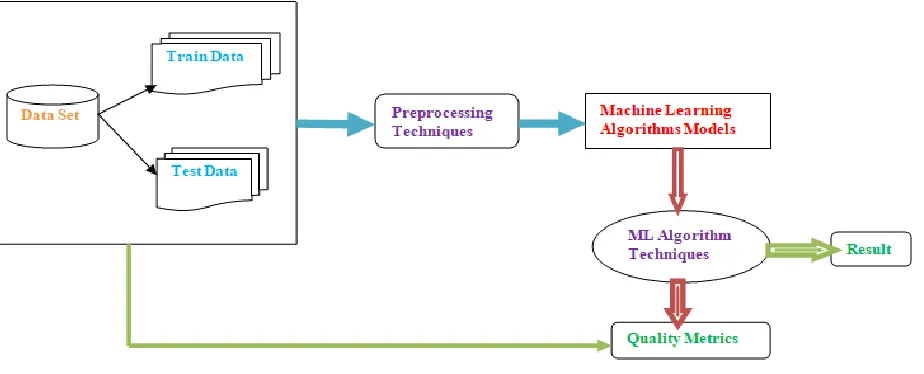
(ii) Block Diagram:
Fig.1.Bitcoin price prediction
IV.
Result and Discussion
Model Test k-NearestNeighbors(KNN) Ridge Regression
Polynomial
Regression Linear Regression Random Forest Training
RSS(Residual Sum of Squares)
92.99% 75.7% 84.2% 94.6% 89.78%
Test(Residual
Sum of Squares) 90.5% 12.4% 79.99% 96.99% 71.56%
Fig 2: Accuracy Graph for Machine Learning Algorithm
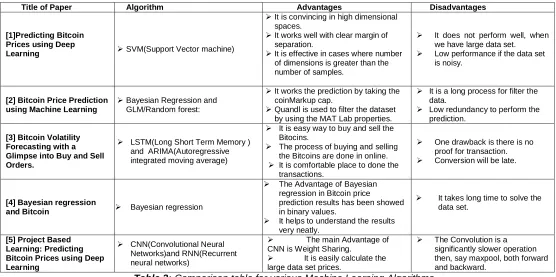
Title of Paper Algorithm Advantages Disadvantages
[1]Predicting Bitcoin Prices using Deep
Learning SVM(Support Vector machine)
It is convincing in high dimensional spaces.
It works well with clear margin of separation.
It is effective in cases where number of dimensions is greater than the number of samples.
It does not perform well, when we have large data set. Low performance if the data set
is noisy.
[2] Bitcoin Price Prediction using Machine Learning
Bayesian Regression and GLM/Random forest:
It works the prediction by taking the coinMarkup cap.
Quandl is used to filter the dataset by using the MAT Lab properties.
It is a long process for filter the data.
Low redundancy to perform the prediction.
[3] Bitcoin Volatility Forecasting with a Glimpse into Buy and Sell Orders.
LSTM(Long Short Term Memory ) and ARIMA(Autoregressive integrated moving average)
It is easy way to buy and sell the Bitocins.
The process of buying and selling the Bitcoins are done in online. It is comfortable place to done the
transactions.
One drawback is there is no proof for transaction. Conversion will be late.
[4] Bayesian regression
and Bitcoin Bayesian regression
The Advantage of Bayesian regression in Bitcoin price
prediction results has been showed in binary values.
It helps to understand the results very neatly.
It takes long time to solve the data set.
[5] Project Based Learning: Predicting Bitcoin Prices using Deep Learning
CNN(Convolutional Neural Networks)and RNN(Recurrent neural networks)
The main Advantage of CNN is Weight Sharing.
It is easily calculate the large data set prices.
The Convolution is a significantly slower operation then, say maxpool, both forward and backward.
Table 2: Comparison table for various Machine Learning Algorithms
VI. CONCLUSION
In this paper we conclude that survey report will be just introducing modules of Bitcoin price prediction and machine algorithms. Hear the Comparison table of ML algorithm model accuracy which tells that the Linear regression model will have most accuracy then the other algorithms. In this paper we conclude that the linear regression algorithm is more efficient then the other algorithms. By taking help from that linear regression algorithm, We can implement the LASSO also. The time complexity reduction in bit coin price prediction using LASSO algorithm is tested by referring all other algorithms and came to a conclusion that LASSO is the best among all. The machine learning algorithms will improves that feature idea of crypto currencies. That will improves the market price of globule investments. In this paper we proposed the new algorithm to find the feature
price accuracy. That helps the customer increments and profits.
REFERENCES
[1] Bitcoin Price Prediction using Machine Learning‖ ,Siddhi Velankar*, Sakshi Valecha*, Shreya Maji* *Department of Electronics & Telecommunication, Pune Institute of Computer Technology, Pune, Maharashtra,India409-415.
[2] D. Shah and K. Zhang, ―Bayesian regression and Bitcoin,‖ in 52nd Annual Allerton Conference on Communication, Control, and Computing (Allerton), 2015, pp.
[3] Huisu Jang and Jaewook Lee, ―An Empirical Study on Modelling and Prediction of Bitcoin Prices with Bayesian Neural Networks based on Blockchain
0.00% 20.00% 40.00% 60.00% 80.00% 100.00% 120.00%
Training RSS(Residual Sum of Squares)
1604 Information,‖ in IEEE Early Access Articles, 2017, vol.
99, pp. 1-1.
[4] ―Project Based Learning: Predicting Bitcoin Prices using Deep Learning‖ S. Yogeshwaran ; PiyushMaheshwari; ManinderJeet Kaur ; Amity University Dubai Dubai, UAE; IEEE 2019
[5] ―Predicting the Price of Bitcoin Using MachineLearning‖ Sean McNally ; Jason Roche ; Simon Caton; Ireland, Dublin , IEEE 2018
[6] ―Bitcoin Volatility Forecasting with a Glimpse into Buy and Sell Orders‖ Tian Guo ; Albert Bifet ; Nino Antulov-Fantulin ; IEEE 2018
[7] F. Andrade de Oliveira, L. Enrique Zárate and M. de Azevedo Reis; C. NeriNobre, ―The use of artificial neural networks in the analysis and prediction of stock prices,‖ in IEEE International Conference on Systems, Man, and Cybernetics, 2011, pp. 2151-2155.
[8] M. Daniela and A. BUTOI, ―Data mining on Romanian stock market using neural networks for price prediction‖. informaticaEconomica, 17,2013.
[9] ―Bitcoin Cost Prediction using Deep Neural Network Technique‖ Kalpanasonika ,Sayasri S , Vinothini , SugaPriya , IEEE 2018
[10]―An improved K-Means clustering algorithm‖ ;Juntao Wang, Xiaolong Su, IEEE 2017
[11]―Application of Random Forest Algorithm on Feature Subset Selection and Classification and Regression‖ ;Jitendra Kumar Jaiswal, Rita Samikannu IEEE 2017 [12]―Improved Random Forest for Classification‖ ;
Angshuman Paul, Dipti Prasad Mukherjee, Senior
Member, IEEE, Prasun Das,
AbhinandanGangopadhyay, Appa Rao Chintha and SaurabhKundu IEEE2018
[13]―Ridge and Lasso Regression Models for Cross-Version Defect Prediction‖ Xiaoxing Yang and Wushao Wen IEEE 2018
[14]Farokhmanesh, F., &Sadeghi, M. T. (2019). Deep Feature Selection using an Enhanced Sparse Group Lasso Algorithm. 2019 27th Iranian Conference on Electrical Engineering (ICEE).
[15]Variable selection using the Lasso-Cox model with Bayesian regularization, Wenxin Lu ; Zhuliang Yu ; ZhenghuiGu ; Jinhong Huang ; Wei Gao ; Haiyu Zhou
[16]―Robust Regression and Lasso‖ HuanXu ; Constantine Caramanis ; ShieMannor IEEE2018
[17]D. Shah and K. Zhang, ―Bayesian regression and Bitcoin,‖ in 52nd Annual Allerton Conference on Communication, Control, and Computing (Allerton), 2015, pp. 409-415. [2]
[18]Huisu Jang and Jaewook Lee, ―An Empirical Study on Modelling and Prediction of Bitcoin Prices with Bayesian Neural Networks based on Blockchain Information,‖ in IEEE Early Access Articles, 2017, vol. 99, pp. 1-1. [3] F.
[19]Andrade de Oliveira, L. Enrique Zárate and M. de Azevedo Reis; C. NeriNobre, ―The use of artificial neural networks in the analysis and prediction of stock prices,‖ in IEEE International Conference on Systems, Man, and Cybernetics, 2011, pp. 2151-2155.
[20]M. Daniela and A. BUTOI, ―Data mining on Romanian