Journal of
Applied Research on Industrial Engineering
Journal of Applied Research on Industrial Engineering
Vol. 1, No. 5/6 (2014) 271-279
Performance Evaluation in Project Based Organization with Agile Project
Management Using DEA: Case study
Elaheh Maghsoudi
1*1, Hadi Shirouyehzad
2, Arash Shahin
31,2 Department of Industrial Engineering, Najafabad Branch, Islamic Azad University, Najafabad, Iran 3Department of Management , Isfahan University, Isfahan, Iran
A B S T R A C T A R T I C L E I N F O
Today’s performance evaluation system is the key factor in organization for evaluates the efficiency then plan for the future. Organization requires the methods that evaluate different aspects of the organization in spite of traditional methods that just consider to financial aspects of organization. Considering agile project management is useful because of the variation of changes in the business world and trying to satisfy the customer then gain the competitive market. Succeed organization are which have more ability, speed and flexibility to answer the marketing changes. So notice agile project management in project based organization with the talent to consult and performing constructional project is so an important object. The purpose of this study is performance evaluation in project based organization with agile project management approach using data envelopment analysis. proposed model perform in 6 project based organization in Isfahan organization with constructional background that end their project in 2011-2014. The results of the study show that with notice to per approach and its effective index, can reach to higher efficiency.
Article history :
Received: 1 September 2014 Received in revised format: 1 December 2014
Accepted: 5 December 2014 Available online:
30 December 2014
Keywords :
Performance Evaluation, Project Based organization, Agile Project Management, Data Envelopment Analysis
1.
Introduction
With the increasing competition in the field of manufacturing and services indices and models are needed to evaluate its performance. Weakness of traditional metrics need to redesign and change the
272
competitive environment of organizations has raised the performance measurement system, but indexfunds are limited, so knowledge of all aspects of an organization's performance is critical for management decision making. Moreover, these measures should be in line with the organization's mission and vision, also should cover all aspects of an organization's short-term goals focus only on the financial aspects and don’t recognize the other aspects (Valhamdy & Firozeh, 2009).
Senior management is always looking for the solution to ensure the implementation of their strategies, so evaluation the performance of their organization as an inevitable necessity in order to achieve their strategic objectives (Tavakoli et al., 2011). In this regard, the project manager's performance evaluation project can be successful in achieving the goals of the project and therefore the project will help. Project-based organizations and the textures are dynamic range and volume of projects is constantly changing, So consider the concept of agile project management, attention to understanding the factors affecting its structural aspects of these organizations is of particular importance agile project management is an iterative process and enhance the project's developers stakeholders together active cooperation in identifying the needs of construction and operational priorities are (Haas, 2007).
Performance evaluation tool for achieving the goals (whether in corporate, individual or project) is system that will measure and measure outcome obtained with the scale of the desired quantity and quality indicators that can accurately.
Because of reaction in project based organization under uncontrolled and unsafe environment and high speed in technology and changing on them acts as a competitive advantage, then performance evaluation of this organization with APM approach has an important effect.
In this study performance evaluation of 6 organizations with constructional background in Isfahan analysis. Inputs of the DEA model calculated with information that fill questioner 35management, expert and boss of organization. The outputs of the model calculate from formulas that show differences between real data and forecasting data.
2.
Background
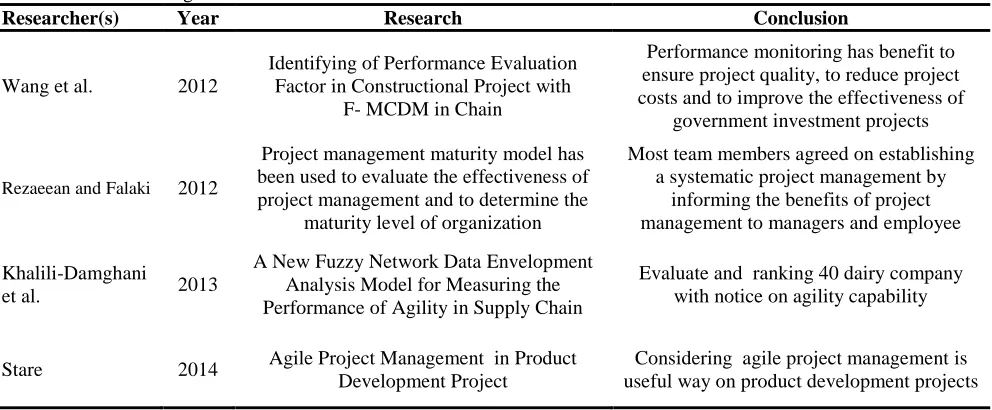
Several researchers have studied abut APM, Performance evaluation, etc. Table 1 expressed some related literature about this subject.
Table 1. background of research
Researcher(s) Year Research Conclusion
Yauch 2010
The agility performance metric was developed by creating a theoretical model and then operationalizing the model through
literature review
The agility performance metric is demonstrated using data from four manufacturing plants, which represent the four possible combinations of success and
turbulence
Ebrahimpour et al. 2012
Relationship between Agility Capabilities and Organizational Performance: a case study among Home Appliance Factories in
Iran
The data analysis reveals that there is a significant positive relationship between agility capabilities and performance of the
company in confidence level of 0.99
De Oliveira et al. 2012
Using Bayesian Network model to analyze the influence of leadership style and factors
associated with organization agility on project performance
It can use combination of leadership style, agility and organization factor to achieve
273
Table 1. background of researchResearcher(s) Year Research Conclusion
Wang et al. 2012
Identifying of Performance Evaluation Factor in Constructional Project with
F- MCDM in Chain
Performance monitoring has benefit to ensure project quality, to reduce project costs and to improve the effectiveness of
government investment projects
Rezaeean and Falaki 2012
Project management maturity model has been used to evaluate the effectiveness of project management and to determine the
maturity level of organization
Most team members agreed on establishing a systematic project management by
informing the benefits of project management to managers and employee
Khalili-Damghani
et al. 2013
A New Fuzzy Network Data Envelopment Analysis Model for Measuring the Performance of Agility in Supply Chain
Evaluate and ranking 40 dairy company with notice on agility capability
Stare 2014 Agile Project Management in Product Development Project
Considering agile project management is useful way on product development projects
3.
Definitions and Concepts
3.1.
Agile Project Management
Agile project management is not new, but it has increased in popularity in the past few years. “Gartner” predicts that by the end of 2012, agile development methods will be used on 80% of all software development projects (Schwalbe, 2012). Different concepts of agile project management have been raised and there is no unique definition of Agile Project Management.
APM is the way of project management which facilitates, revitalizes and allows the project team to deliver the customer requirements swiftly and consistently. This is accomplished through continuous learning and adapting to the changing arena and also by the active involvement of customers in the project (Senthilkumar et al., 2012). Success or failure depends on how Agile Project Management for Business Agility partnership project scope due to limitations of cost, time and quality are (Macherdis, 2009).
3.2.
Critical Success Factor
274
3.3.
Critical Success Factor of APM
There has not been any formal study on CSF’s in the Agile software development project per se, based on recent searches in peer reviewed academic literature or practitioner literature related to this topic. However, there are case studies and research theories on successes or failures problems in agile implementation and agile software development projects. The review of both failures and successes in the literature will be beneficial in identifying the possible success factors in agile software development projects, as failures can contribute to the understanding of how to avoid certain serious pitfalls that are critical to the success of a project (Chaw & Cao, 2008).Chaw and Cao (2008) in their research with study related literature collect success factor of agile project management that shows in Table2.
Table2. critical success factor of APM (Chaw & Cao, 2008)
Dimensions Factors
Organizational
Strong executive support Organizations where agile methodology is universally accepted
Committed sponsor manager Facility with proper agile- style work environment Cooperative organizational culture instead of
hierarchal Collocation of whole team Oral culture placing high value on face to face
communication Reward system appropriate for agile
People
Team members with high competence and
expertise Team members with great motivation
Managers knowledgeable in agile process Managers who have light-touch or adaptive management style
Coherent, self-organizing teamwork Good customer relationship
Process
Following agile-oriented requirement management process
Following agile-oriented configuration management process
Following agile-oriented project management process
Strong communication focus with daily face-to-face meeting
Honoring regular working schedule – no
overtime Strong customer commitment and presence Customer having full authority
Technical
Well-defined coding standards up front Regular delivery of software Pursuing simple design Delivering most important features first Rigorous refactoring activities Correct integration testing Right amount of documentation Appropriate technical training to team
Project
Project nature being non-life-critical Project type being of variable scope with emergent requirement
Projects with dynamic, accelerated schedule Projects with small team
Projects with no multiple independent teams Projects with up-front cost evaluation done Projects with up-front risk analysis done
3.4.
Project Based Organization
275
The project-based organization that its activities are essentially "mix of the project consists of two kinds.A) Organizations that earn them by doing projects for others, such as construction companies and consulting engineers.
B)
Organizations that have chosen project management. Many of these organizations tend to
have management systems to facilitate efficient management of their projects.
3.5.
Performance Evaluation
Performance evaluation is critical and exploring survey of different organization’s activities. Performance evaluation is both preventive and diagnostic. Performance evaluation identify the current situation, determine strengths and weaknesses in the performance of duties and responsibilities, determining training needs, mentoring organizations in improving their work (Farzianpour,1999).
Data Envelopment Analysis (DEA), due to Charnes et al. is a non-parametric linear programming method
For the estimation of the relative efficiency of multiple decision making units (DMU)s. In this study the efficiency of organization calculate with DEA.
3.5.1.
Inputs of model
Inputs of DEA model gather with information of questioner that gives to 35 manager and experts in organization. APM factors rank and their mean in per factor use for inputs of the model.
3.5.2.
Outputs of model
For calculating the outputs of model using some formulas witch analysis information of project that finish 2011 between 2014. This information gathers from some data that record in project office in organization. At first deviance mean of execution time and predicted time, execution cost and predicted cost and execution satisfaction and full satisfaction with 1-3 formulas calculate then their difference with perfect coincidence with 4-6 formulas use as models outputs.
𝑇 =
∑|𝑒𝑥𝑒𝑐𝑢𝑡𝑖𝑜𝑛 𝑡𝑖𝑚𝑒−𝑝𝑟𝑒𝑑𝑖𝑐𝑡𝑒𝑑 𝑡𝑖𝑚𝑒| 𝑀𝑎𝑥{𝑒𝑥𝑒𝑐𝑢𝑡𝑖𝑜𝑛 𝑡𝑖𝑚𝑒 &𝑝𝑟𝑒𝑑𝑖𝑐𝑡𝑒𝑑 𝑡𝑖𝑚𝑒}
𝑛𝑢𝑚𝑏𝑒𝑟 𝑜𝑓 𝑝𝑟𝑜𝑗𝑒𝑐𝑡
(1)
𝐶 =
∑|𝑒𝑥𝑒𝑐𝑢𝑡𝑖𝑜𝑛 𝑐𝑜𝑠𝑡−𝑝𝑟𝑒𝑑𝑖𝑐𝑡𝑒𝑑 𝑐𝑜𝑠𝑡| 𝑀𝑎𝑥{𝑒𝑥𝑒𝑐𝑢𝑡𝑖𝑜𝑛 𝑐𝑜𝑠𝑡 &𝑝𝑟𝑒𝑑𝑖𝑐𝑡𝑒𝑑 𝑐𝑜𝑠𝑡}
𝑛𝑢𝑚𝑏𝑒𝑟 𝑜𝑓 𝑝𝑟𝑜𝑗𝑒𝑐𝑡
(2)
𝑄 =
∑100−𝑐𝑢𝑠𝑡𝑜𝑚𝑒𝑟 𝑠𝑎𝑡𝑖𝑠𝑓𝑎𝑐𝑡𝑖𝑜𝑛 100
𝑛𝑢𝑚𝑏𝑒𝑟 𝑜𝑓 𝑝𝑟𝑜𝑗𝑒𝑐𝑡
(3)
T=1-
T
(4)
C = 1-
C
(5)
276
The model of research was shown in figure 1.Figure 1. Modeling of agile project management with DEA
Result of solving model with CCR show in table 3. For getting better result and identifying efficient organization model solve with supper efficiency method, and the result indicate in table4.
Table 3. Efficiency of project based organization
Organization Efficiency
with APM
Tose Peyman Sepahan 1
Shahr & Sakht Zayanderod 1
Tose Maskan Isfahan 0.95921
Banasazan Sepahan 0.99652
Saman Gostar Isfahan 1
Shams Omran 1
Table 4. Ranking project based organization with APM
Organization Supper efficiency
with APM Rank
Tose Peyman Sepahan 1.09546
3
Shahr & Sakht Zayanderod 1.32066
1
Tose Maskan Isfahan 0.95933
6
Banasazan Sepahan 0.99660
5
Saman Gostar Isfahan 1.10140
2
Shams Omran 1.00482
4
Priorities APM factor in project based organization
Organizational
Process
Technical People
Project Based Organization
Project
Coincidence with forecasted time
Coincidence with forecasted cost
277
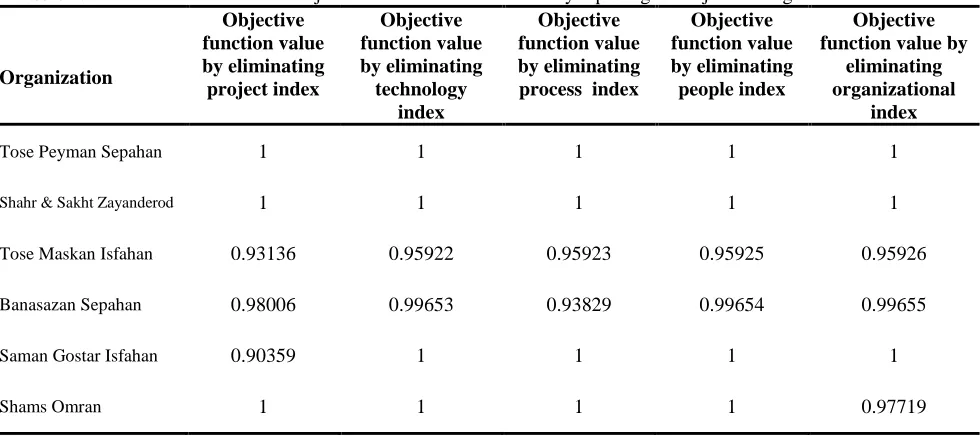
In this section the impact of each input variables on the performance of project based organizations arereviewed by agile project management approach. The gap between efficiency in first mode with efficiency that eliminate each factor calculate with 7 formula and show in table5. The rank of the index indicates in table 6.
√∑
6(𝑥𝑖 − 𝑥𝑗)
2𝑖=1 (7)
Table 5. The value of the objective function with deletes any input Agile Project Management
Organization
Objective function value by eliminating project index
Objective function value by eliminating technology
index
Objective function value by eliminating process index
Objective function value by eliminating people index
Objective function value by
eliminating organizational
index
Tose Peyman Sepahan 1 1 1 1 1
Shahr & Sakht Zayanderod 1 1 1 1 1
Tose Maskan Isfahan 0.93136 0.95922 0.95923 0.95925 0.95926
Banasazan Sepahan 0.98006 0.99653 0.93829 0.99654 0.99655
Saman Gostar Isfahan 0.90359 1 1 1 1
Shams Omran 1 1 1 1 0.97719
Table 6. The gap between the performance and value of the objective function of the CCR method to remove individual variables APM approach
priority Sum of gap with whole
efficiency Eliminated index
3 0.0228 Organizational
4 0.0000447 People
2 0.05823 Process
5 0.0000141 Technology
1 0.10169 Project
4. Conclusions
278
perform in 6 project based organization in Isfahan organization with constructional background that endtheir project in 2011-2014. The results of study show that with notice agile project management the good staff helps to reach better performance. This study perform in organization with constructional background it is better that model perform in some other project based organization. For future research it is recommended that some no sensible factor in organization use as model’s input also using expert though for analysis results.
5.
References
Alazmi, M., Zairi, M.(2003).” Knowledge management critical success factors”, Total Quality Management, Vol. 14, No. 2, pp. 199-204.
Alencar, A. Schmitz, E. Correa, A. Figuaredo, H,(2012), ”Evaluating the efficiency in which risk is managed in Portfilo of IT project: A Data Envelopment Analysis”, Journal of software, Vol.7, No.1, pp. 186-195.
Chaw.T, Cao.D.B, (2008), “A Survey Study of Critical Success Factors in Agile Software Projects”,
The Journal of systems and software. Vol. 81, No. 6, pp. 961-971
De Oliveira, A. M., Dalla,V.Oliveira, L.V, Osmar, P ,(2012), "Forcasting project performance considering the influence of leadership style on organizational agility”. International Journal of Productivity and Performance Management, Vol. 161, No.6, pp 653-671
Drucker P.F. (1973). Management: tasks, responsibilities, practices. Harper Colophon 1985 Ed. New York: Harper Row.
Ebrahimpour. H, Salarifar.M, Asiaei, (2012), " The relationship between Agility Capabilities and Organizational Performance: a case study among Home Appliance Factories in Iran”, European Journal of Business and Management. Vol. 14, No.17, pp 186-195
Khalili-Damghani, K.Tavana, M., (2013), "A New Fuzzy Network Data Envelopment Analysis Model for Measuring the Performance of Agility in Supply Chain”, The Journal of advanced Manufacturing Technology, Vol. 69, No.4, pp 291-318
Macherdis, Nikon.(2009), "Agility in entrepreneurial Projects". Lund Institute of Economic Research Working Paper Series.
Pinto, J. and Slevin, D. (1987). "Critical Factors in Successful Project Implementation". In IEEE Transactions on Engineering Management, Vol.34, No.1, pp. 22-27.
Ranjan J, Bhatnagar V.(2008),” Critical success factors for implementing CRM using data mining”
Journal of Knowledge Management Practice. Vol. 9, No. 3, pp. 18-25.
Rockart, J, (1979). “Chief Executives Define Their Own Information Needs”, Harvard Business Review, March - April, pp. 81-92.
279
Senthilkumar, T. Benruben, R. Sakthirejan, T. Sivarm, N.M. ,(2012), "An Review on Some AgileProject Management Techniques", Proceeding of the 2012 International Conferences on Industrial Engineering and Operation Management ,Istanbul , Turkey , July 3-6.
Stare, Aljaz, (2014), "Agile Project Management in Product Development Project”, Procedia-Social and Behavioral Sciences, Vol. 119, pp. 295-304, 27th IPMA World Congress
Tavakoli, Gh. Bagherzade Niri, M. Shaabani Sichani, M. , (2011),”Design and Performance Evaluation in R&D Center; Compilation BSC and DEA”, Iran Management Researches, Vol. 15, No. 4. Vinod, S. Davadasan, S.R. Vimal, K.E.K, .Kumar, D, (2013), “Design of agile supply chain assessment
model and its case study in an Indian automotive components manufacturing organization”,
Journal of manufacturing system. Vol. 32, No. 4, pp. 620-631.
Wang, W. Wang, Y., Xu, X. and Zhao, D., (2012), “Review of Performance Evaluation Method of Project Management of Residential Construction in China”, International Conference on Convergence Information Technology, Vol. 19, pp. 136-140.