
2017 | VOLUME 13 | 255 © ARCHIVES OF BUDO | SCIENCE OF MARTIAL ARTS
Technical principles of
atemi-waza
in the first
technique of the
itsutsu-no-kata
in judo: from
a viewpoint of jujutsu like
atemi-waza
. A broad
perspective of application in honoured self-defence
training
Fumiaki Shishida
1ABDE, Masanori Sakaguchi
1,2AD, Tadayuki Satoh
3ABD,
Yasuo Kawakami
1ADE1
Faculty of Sport Sciences, Waseda University, Tokyo, Japan
2
ASICS Corporation, Kobe, Japan
3
School of Sport Sciences, Waseda University, Tokyo, Japan
Received:
09 September 2017;
Accepted:
13 September 2017;
Published online:
14 September 2017
AoBID:
11797
Abstract
Background and Study Aim: Conventionally martial arts renaissance can be combined with the creation of jūdō by Jigoro Kano. A symbol -ic date may be the establishment of a Kōdōkan (1882). Further expansion not only of Japanese martial arts is the result of the intellectual effort and physical training of many generations of experts around the world. The purpose of this study is to verify the hypothesis that the true is the opinion of Kenji Tomiki that “atemi-waza (striking technique) is, in principle, an extension of nage-waza (throwing technique)”.
Material and Methods: Verification of the hypothesis was based on three issues: (1) to make a technical analysis of Kotani & Otaki’s study, chosen among the seven previous studies, which describe the teaching of the first technique of the itsutsu-no-kata, advocated by Jigoro Kano; (2) to demonstrate the first technique of the itsutsu-no-kata, based on the interpretation by Kenji Tomiki, who referred to the unique relationship between the first tech -nique of the itsutsu-no-kata and the atemi-waza, and to analyze its video image in terms of tech-nique and biomechanics; (3) to clarify the technical principles of the atemi-waza in jujusu by synthesizing both of the above mentioned.
Results: The previous study reports that the technical principles in which tori (a person who executes a technique), who touches uke (a person to whom a technique is executed) softly with his palm, and walks, defeats uke, who has turned into a solid matter, reveal the concept of “softness controls hardness,” to which Kano attached great importance. The interpretation in terms of biomechanics suggested, in a scene where tori makes ceaseless pushing with his palm, followed by consecutive walking. This is the reason of uke’s retreat becoming difficult gradually, and thus uke is made to walk with much shorter steps, is because tori has delicate controls over the powers on the thumb or little finger. By so doing, uke’s rotation movement on the chest is hindered, and because uke is unable to reflect on inborn movement or walking. In a scene where jizo-tashi occurs, uke is forced to lose his balance backwards, to a great extent, and as the ground reaction force gradually shifts for -ward. The backward moment around the uke’s centre of gravity applied by tori ’s palm, uke is unable to can -cel out the reverse moment from the ground reaction force, and thus we finally observed that uke fell off, his centre of gravity being rotated, and moving backwards. This movement is considered to be jizo-taoshi.
Conclusions: Kano argues that uke will surely fall down if tori pushes ceaselessly in an effective direction, whereas Tomiki analyses this movement precisely, focusing on the palm’s force, changing its direction (angle), working on in one-point-one direction, just like the atemi-waza. The essence of Tomiki’s discovery is in the fact that the unique character of atemi-waza in judo lies in the movement where uke is made to fall down by tori’s movement
Authors’ Contribution: A Study Design
B Data Collection
C Statistical Analysis
D Manuscript Preparation
INTRODUCTION
The original version of this article has been pub -lished in Japanese (then in English), by the same authors, in the journal of Waseda University Sport Science Research [1, 2]. This is an article in the form of revision of our previous publication with the title changed from the original. The main pre -sumptions to make this article available in global science space are inspiring discussions of a sci -ence of martial arts experts during two scientific events in Japan (September 2017).
The intellectual challenge for the first discus -sion was presentation the Editor and Chief of the Archives of Budo (as well as 2 branch titles:
Archives of Budo Science of Martial Arts and
Extreme Sports, Archives of Budo Conference Proceedings): „Trends in international journals
dealing with judo research” within the frame
-work of “Specialist Group Meeting – Judo” dur
-ing 2nd International Budo Conference, Japanese Academy of Budo 50th Anniversary Conference, which held on September 6-8 , 2017, in Osaka (see part one of publication [3, p. 215-220]. Important in this discussion was an opinion of Mike Callan, judo expert from the United Kingdom. Callan emphasised the leading role of the Archives of Budo in promoting health aspects of martial arts (including, e.g. national concepts as Japanese budo; Chinese wushu,tai chi; Korean
taekwondo; Indian kalripayat; Brazilian capoeira).
The second presentation of RM Kalina – „Heritage and the future of East Asian Martial Arts in the development of preventive and
therapeutic agonology” – took place during Waseda University International Conference on East Asian Martial Arts 2017; Future of the East Asian Martial Arts or Budo: The quest for the actual utility and its applicability; which held September 10, 2017 in Tokyo (see second part of publication [3, p. 220-226]. Two seminars in Waseda University the next day: the first one
concerning the methodology of science, the sec
-ond – innovative agonology (prophylactic and
therapeutic agonology) have shown the impor
-tance of atemi-waza in the open concept of hon -oured self-defence [4, 5], or even more extensive formula of the innovative self-defence [6].
As a result, since 2005, in the pages of the
Archives of Budo dialogue of the science of martial arts experts (practitioners with scientific compe -tencies [7]) is a unique in global scale a compro -mise between – as it turns out – only a seemingly competitive system hand-to-hand-fighting. In
fact, the compromise between experts repre
-senting the distant in the motor sense the com
-bat concepts: e.g. judo, kurash, sambo, wrestling (belonging to the throwing and grips of immobili -sation of opponent’s body group) and, e.g. boxing, karate, taekwondo (belonging to the hits group).
On the ground of honoured self-defence or
inno-vative self-defence, these systems complement each other. The vision of Jigoro Kano is fulfilled “judo in mind” [8] according to the main principle
jita-kyoei (mutual prosperity for self and others). The conclusion is true: “Concept of jūdō by Jigoro
Kano and innovativeagonology do not exclude
themselves. They are coherent (…)” [3, p. 223]. Itsutsu-no-kata – An unfinished
work of kata created by Jigoro Kano. Itsutsu means just the numeral “5” [36].
Koshiki-no-kata – “Antique forms”. Jūjutsu techniques from Kitō-ryū were incorporated into the koshiki-no-kata by Kanō Jigorō to preserve the essence of classical schools [34].
Global science space – conventionally, the global science space is associated with the ability to provide the latest scientific knowledge through prestigious electronic scientific journals [7].
Innovative self-defence –
involves using verbal and/ or behavioural methods and means along with available items in counteracting each attack on any good of an individual (honour, dignity, life, health, property, etc.), whereas a defender submits his/her actions to the criteria of prophylactic
and therapeutic agonology, considering the most general directive of efficient leading of any struggles and also universal assumption of self-defence training as absolutely paramount [6].
Biomechanics – noun the study of body movements and of the forces acting on the musculoskeletal system, used in sport for analysing complex movements to improve efficiency and help avoid injury [33].
of soft-touched palm and his manipulation and ceaseless movement of the body. This is interpreted as a se -quence of “touch & push, push & fall down, and touch & fall down.” This leads to the feasibility of realising randori (free practice) with atemi-waza, which has been an ideal task sought by Kano. Atemi-waza fills the honoured self-defence algorithm when the soft means of counteracting are ineffective.
Key words: biomechanics, Hideichi Nagaoka, innovative agonology, Jigoro Kano, Kenji Tomiki, Sumiyuki Kotani
Copyright: © 2017 the Authors. Published by Archives of Budo
Conflict of interest: Authors have declared that no competing interest exists
Ethical approval: Not required
Provenance & peer review: Not commissioned; externally peer reviewed
Source of support: This study was supported by grant from the Waseda University
Conventionally martial arts renaissance can be combined with the creation of judo by Jigoro Kano. A symbolic date may be the establishment of a Kōdōkan [9]. Further expansion not only of Japanese martial arts is the result of the intellec -tual effort and physical training of many genera -tions of experts around the world.
Problem identification (presumptions) and
hypothesis
The three major categories of judo techniques are
nage-waza (throwing techniques), katame- waza
(ground techniques), and atemi-waza (striking techniques), respectively. The previous stud
-ies concerning the relationship between
atemi-waza and nage-waza or between atemi-waza and
katame-waza are difficult to find. One of the rea
-sons is a few studies in which randori-practi
-tioners had a hard time to find its necessity or
importance of studying due to atemi-waza was
excluded in randori (free practice) and in matches from the very beginning of jūdō, to begin with. Jigoro Kano (hereafter called Kano), the founder
of jūdō, however, thought deeply of
atemi-waza and its relationship with nage-waza. When he compiled nage-no-kata or randori-no-kata, he introduced four counter attack techniques against atemi-waza (namely seoi-nage, uki-goshi, ura-nage, and yoko-guruma).
Why was it necessary for Kano to include
atemi-waza that is prohibited in randori, in nage-no-kata
as the basis of randori? As Shishida [10, p. 167-169] stated, it was clear that Kano wanted jūdō to keep its practical character of martial art as well as its nature of physical education.
We picked up the first technique of the itsutsu-no-kata (literally five forms), which has been stud -ied and preserved in the Kodokan, because we focused on a practical study of Kenji Tomiki (here -after called Tomiki) who considered that the itsu-tsu-no-kata has an art which bridges atemi-waza
of jūdō and nage-waza and that characteristics
of atemi-waza lie in the itsutsu-no-kata. Tomiki stated in judo-taiso [11, p. 109] when we exe -cute nage-waza in randori, the dynamics operating on our limbs and/or lower back are in two direc -tions. Meanwhile, in the atemi- waza, the dynam -ics are in one-point-one direction. He added that the above mentioned two, at first glance, seem to be different in nature, but, in fact, if closely exam -ined, there is only one jūdō principle operating, in that the opponent is pushed in the direction of his loss of balance. Thus he summarised that
atemi-waza is, in principle, an extension of nage-waza. He, however, did not refer to the itsutsu-no-kata in this simple statement, nor in his book mentioned above.
Historical context of this study
It was in 1889, seven years after the inaugura
-tion of the Kodokan when Kano’s idea was made clear about introducing atemi-waza into randori.
Kano stated: “Practicing pre-arranged forms only end with mimicking and shows a low level of per -formance, and I think it better to make up for the performance level by introducing a kind of
Randori practice.” [12, p. 468-469]. According to Kano, the purpose of atemi-waza is “to make the opponent’s most susceptible part of the body either painful or faint temporarily or kill com -pletely by thrusting or striking hard, using with any part of one’s limbs or head” [12, p. 468]. He added, “There are many ways to execute it, and the most common ways are to thrust the part between both eyes of the opponent by one’s fist, to thrust the chest, to thrust a bit lower part of the breastbone by one’s fist, or to kick the testi -cles of the opponent by one’s foot tip.”
It was rather hard for Kano to introduce such a dangerous art of atemi-waza into randori prac -tice. His ideas were finalized by introducing an art of technique similar to karate’s strike or kick into solo and dual movement shown in the book
Seiryoku zenyo kokumin taiiku [13] or the national physical education based on the spirit of “maxi -mum efficiency with mini-mum effort”, a sense of exercise designed to develop the physique for the Japanese.
According to Kotani and Otani [14, p. 169-170], this technique is derived from atemi-waza and is
made up to practice defence techniques in phys
-ical education against striking or kicking offence or in unarmed free hand jūdō. It was a long cher -ished wish for Kano to introduce atemi- waza into jūdō.
Aim and hypothesis
The purpose of this study is to verify the hypothe -sis that the true is the opinion of Kenji Tomiki that “atemi-waza (striking technique) is, in principle, an extension of nage-waza (throwing technique)”. Hypothesis by Tomiki (in broader interpretation) states that the first technique of the:
itsutsu-no-kata holds a common art of technique between
atemi-waza and nage-waza of jujutsu and jūdō.
Budo (Budō) – originally a term denoting the “Way of the warrior”, it is now used as a collective appellation for modern martial arts of kendō, jūdō, kyūdo and so on. The primary objective of these “martial ways” is self-perfection (ningen-keisei) [34].
Dan (dan’i) – a term used to denote one’s technical level or grade [34].
Jūdō (judo) – some researchers differentiate spelling: jūdō as not only modern martial art but also as before (according to Jigoro Kano’s conception) it is a consistent system of physical and moral education; judo as modern martial art, sport [3].
Capoeira – noun a martial art and dance form, originally from Brazil that is used to promote physical fitness and grace of movement [33].
Kalripayat – “Although India may have been the cradle of the spiritual martial arts – he adds – contemporary Indian systems of self-defence are not wide-spread and much of the knowledge has died out or is taught only secretly” [35, p. 7].
Riai – the rational relationship of interactive movements between oneself and the opponent [34].
Shihan – a teacher of budō who has reached a high level of technical and spiritual maturity [34].
Technique – noun a way of performing an action [33].
Technique – specific procedures to move one’s body to perform the task that needs to be accomplished [33].
MATERIAL AND METHODS
Verification of the hypothesis was based on tree issues:
(1) to make a technical analysis of Kotani & Otaki’s study, chosen among the seven previous studies, which describe the teaching of the first
technique of the itsutsu-no-kata, advocated by
Jigoro Kano;
(2) to demonstrate the first technique of the itsu-tsu-no-kata, based on the interpretation by Kenji Tomiki, who referred to the unique relationship
between the first technique of the
itsutsu-no-kata and the atemi-waza, and to analyse its video image regarding technique and biomechanics;
(3) to clarify the technical principles of the atemi-waza in jujusu by synthesising both of the above mentioned.
Basic definitions and explanations
According to Kano’s definition, atemi is to hit one’s vital point with a fist or limb and to hurt/ kill the opponent, and thus the opponent is suf -fered, faint or killed. The result of being faint or death is that the opponent collapses [12].
Nage-waza, defined by Kano, is to fall down, drop down, or beat the opponent’s body onto the ground. The most popular technique is to fall down. There are many ways to realise this purpose; he said [12, p. 464]. According to this definition of nage,
the purpose of nage-waza is to fall down (taosu),
drop down (otosu), or to beat down (uchitsukeru). The most popular technique is to fall down. We now consult a most reliable dictionary, Genkai [15],
which was used at the same period when Kano described and had an established reputation, to seek the difference in meaning of the above three verbs in Japanese (taosu, otosu, uchitsukeru).
Taosu is a transitive verb, and it means: “(1) to lay (something that is standing) down, to turn down, to make someone sleep, etc., (2) to kick down, to trip someone up, etc. (3) to chop down and kill, to slay, etc.” [15, p. 619]. When this word taosu
is used as an intransitive verb, it means that “(1) something that is standing lies down, (2) to fall down, to tumble down, (3) to die.” [15, p. 619].
Otosu, when used as a transitive verb, means: “to drop (something which is in a high place) down, fall off” [15, p. 145], when this word is used as an intransitive verb, it means that “something on
a high place comes down, to fall off, to fall down -ward” [15, p. 144].
Uchitsukeru is not found as an entry word in the
Genkai, but a related word utsu can be found. It is a transitive verb, meaning: “(1) to beat, hit hard, strike, knock” and “(14) uchitsuku, nagu, meaning to beat down, to throw, “to throw a stone.” for
example. Thus we can guess that uchitsukeru is
identical to nageru, meaning “to throw,” which is derived from nagu, according to the Genkai, which is a transitive verb, meaning “to throw away, to fling away, to hurl away” [15, p. 742].
To fall down (taosu) is to get something standing to lie down, while the other two Japanese words are referring to drop and beat also suggest that a per -son on a high place is fallen or beaten to lie on the ground. Thus the latter two Japanese verbs also end up with falling down, meaning that atemi-waza and
nage-waza end up with making someone fall down.
If atemi-waza aims to fall someone down, how should we interpret the first technique of
itsutsu-no-kata?
We assumed that a common art of technique exists between atemi-waza and nage-waza in the first technique in particular of the itsutsu-no-kata,
because this first technique is to break balance
by touching softly and by adding power continu
-ously in the direction of one’s dynamically weak -est point, thus moving one’s body as quickly as possible, and finally to make someone fall down.
From this point of view, we presumed a com
-mon art of technique between atemi-waza and
nage-waza exists in the first technique of the
itsutsu-no-kata. Thus our hypothesis is that the first technique of the itsutsu-no-kata has a com -mon principle art of touching and balance break -ing, simply because we see, in a scene of duel of jujutsu, striking and falling down (striking first and then falling down) and/or throwing and fall -ing down (throw-ing first and then fall-ing down).
The biomechanics experiment
Participants
Subject A (acts as tori): height 166 cm, weight 74 kg, has experience of traditional judo train -ing since primary school days, an active member of Judo Club in high school, enrolled in Waseda University and its Aikido Club, where he learned under the late Tomiki, who was studying judo
techniques performed from a distance. He con
and he taught high ranked judoka and kend
-oka in Japan and abroad. He currently holds 7th
dan of the Japan Aikido Association. Subject B (acts as uke): height 162.5 cm, he learned aikido at Waseda University under subject A and holds 2nd dan of Japan Aikido Association.
We selected subject A simply because we judged him to be an excellent performer of the
itsutsu-no-kata.
Instruments and experiment environment
Devices used: a combination of one infrared ray motion capture system (Motion Analysis, USA) and three Ground Reaction Meters (AMTI, USA & Kistler, Switzerland). Both subjects (tori and uke)
execute the technique within the area of Capture Volume or movement analysis area and move on
the Ground Reaction Meters, and uke falls down
on the point where buffer or cushions like blan -kets are placed; date of the experiment: February 15, 2011.
Demonstration methods
Actions analysis is based mainly on the work of Sumiyuki Kotani et al. [14, 16] and Kenji Tomiki [11 and other], which will discuss in the section “Results”.
RESULTS
Previous studies
Kotani & Otaki’s method
According to authors of book Saishin Judo-no-kata, Zen, published in 1971 [14], the itsutsu-no-kata is an expression of principles of jūdō’s offending and defending techniques in a manner of running water in five different forms (Table 1). This kata was added in 1887 to a series of the Kodokan’s techniques. Kotani & Otaki clarified that this kata has no ref -erences and that senior members of the Kodokan make a different explanation of it in some details, and said this book was based on “the explanation by their teacher, Master Hideichi Nagaoka” [14].
Hideichi Nagaoa was admitted to the Kodokan in 1893. Zansei Koga [17, p. 70] reports that at five o’clock in the afternoon of the first day when Kano met Nagaoka at the Kodokan, Kano was making a research practice, together with Yoshiaki Yamashita and other fellow students of jūdō, of the itsutsu-no-kata. Nagaoka received an informal training for ten years under Kano until he was
dispatched to Kansai area in 1902. He was sum
-moned to the Kodokan in 1913 and became an instructor, and then appointed as a professor at Higher Formal School of Tokyo, and later was pro -moted to the 10thdan before Kano’s passing away.
Sanzo Maruyama [18, p. 922] states that the itsutsu-no-kata performed by Nagaoka & Kaichiro Samura was in supreme excellence like a god, while the per -formance by Kano was very profound and made a comment that Nagaoka’s superb performance remains vividly in his memory together with the memory of Kano’s refined performance. Nagaoka’s personality and his high-performance level of tech -niques made a significant influence on the jūdō world, saying that “Among all the men, Nagaoka is the best, among all the techniques, sutemi-waza is the best.” Thus, by reading his profile, we see that one of the best students of Kano was Nagaoka.
Kotani & Otaki, both of whom were directly taught by Nagaoka, studied kata for a long time,
and published a book in 1954, entitled
Judo-no-kata, Ju, Koshiki and Itsutsu [16]. The explanation of the itsutsu-no-kata of 1954 version and that of 1971 (Table 2) are virtually the same, with some minor alterations [14 p. 134-140].
Kyuzo Mifune, et al. published in 1956 Judo Course where simply states an ideal interpreta -tion, saying that “Nothing can object the Right” [19, p.66] and explanation in a simple manner of procedure of the itsutsu-no-kata (Table 3).
Shashin Kaisetsu Kodokan Judo a photo-illustrated manual of Kodokan Judo, published in 1956, which
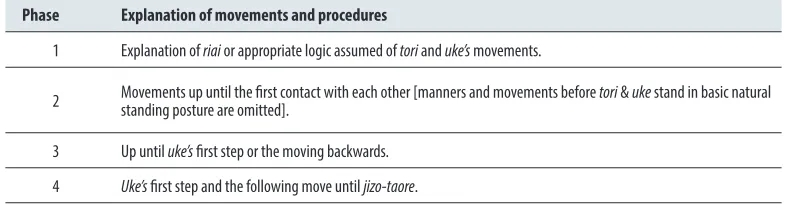
Table 1. General explanations in the previous studies of the first technique of the itsutsu-no-kata.
Phase Explanation of movements and procedures
1 Explanation of riai or appropriate logic assumed of tori and uke’s movements.
2 Movements up until the first contact with each other [manners and movements before tori & uke stand in basic natural standing posture are omitted].
Table 2. Explanations in the studies of the technique of the itsutsu-no-kata by Kotani & Otaki, 1954 [16] and 1971 [14].
Phase Explanation of movements and procedures
1
The movements are compared to running water. The characteristic of a drop of water is very weak, and yet if the water keeps running and if a solid wall is soaked in such water, the wall will be eventually collapsed. This logic applies to about, in that you can beat an opponent, however strong he/she may be, by logically using your power, and by making a constant attack [16, p. 134-135; 14, p. 311].
2
Tori, first, with his right arm bending slowly, opens his right palm, extending all his right-hand fingers upright, raises his palm up to his right shoulder, the palm being faced toward uke. Tori, with his right hand, raised forward enough, steps forward with his left foot first, and walks quietly to the very front of Uke. Both tori & uke come close enough, nearly touching their right shoulders, and here tori, with his basic natural standing posture, touches uke’s central part of chest with his right palm [16, p. 138-139; 14, p. 313-314].
3 Tori, then, with his right foot gradually moving forward, touches uke’s chest with his right-hand palm, (and particularly with his little finger), and keeps pushing without rest. Uke, being pushed, to maintain his balance, retreats his left foot accordingly [16, p.139; 14, p. 314].
4
Tori, then, with his left foot advancing, keeps pushing uke, with his right hand centring around the thumb. Uke, being pushed by tori, tries to keep his balance by retreating his right foot. Tori, without lessening his power, still advances and keeps pushing uke’s chest stronger and quickly, with his right-hand palm, centring around his thumb and little finger alternately. Tori, by so doing, deprives of uke’s chance to recover his balance and keeps pushing without rest. Uke, being pushed continuously, retreats his left foot, and right foot alternately, with short steps. Tori, then, re-balances his posture, and advances his right foot, with a long step, and touches uke’s chest to make a final push. Uke, being unable to recover his balance, falls down supinely in a manner of jizo-taosi [16, p. 139-140; 14, p. 314].
Table 3. Explanations in the studies of the technique of the itsutsu-no-kata by Kyuzo Mifune et al. 1956 [19].
Phase Explanation of movements and procedures
1
Nothing can object the right [p. 66].2 Uke steps forward quietly and stands before tori with a proper distance [p. 66]. 3 Tori, at once, proceed and attacks uke [p. 66].
4 Tori keeps pushing uke, who resists & withstands until uke falls down like a jizo, (a guardian deity of children) which refers to an abrupt fall without any action of safety. Tori resumes initial stance of basic natural standing posture. Uke keeps the posture of “Munen-muso,” or the mental condition of selflessness, free from worldly thoughts [p. 66].
Table 4. Explanations in the studies of the technique of the itsutsu-no-kata by Kodokan, 1966 [20].
Phase Explanation of movements and procedures
1
None. Nothing is mentioned in this book.2
Tori advances quietly and raises his right hand. Tori advances, bending his right arm gradually, for his right-hand palm to touch uke’s chest centre when he comes close enough. Tori advances and comes close enough for his right toes to nearly touch uke’s right toes, and opens his right hand, with all the fingers extending upright, and touches uke’s chest gently [p. 220].
3 Tori, pushes uke, with his right hand, centring around the thumb, by stepping left foot. Uke hardly keeps his balance while retreating his right foot lightly [p. 220].
4
was about the same time as the book by Mifune et al. [19] and revised in 1966 [20] (Table 4), describes how to use palms, saying that tori with the part near his right thumb, push uke forward, with his left foot forward, and uke, who is pushed, softly retreats his right foot [20, p. 220]. This is a different explana -tion to that of Kotani & Otaki [14, 16].
The book by Maruyama, published in 1967 [18], says that tori tries to lose the balance of
uke by using his thumb and four fingers alter
-nately (Table 5). Uke, who is attacked, is unable to keep his balance, because of tori’s fulfilled spirit and action, and finally retreats with his left heel first, with short, quick steps [18, p. 915]. This explanation is the same with that in
the books by Kotani et al. [14, 16] in that uke
retreats with his left foot first, but this book
does not say anything in detail about tori ’s
movement (Table 2).
Itsutsu-no-kata, Koshiki-no-kata, published in 1992 by the Kodokan [21] and published in 2008 [22] (Table 6), follow the same explanation as that of Kotani & Otaki [14, 16].
Tomiki’s method and its significance
Kano passed away without introducing
atemi-waza into randori practice. Tomiki researched this respect. Tomiki [11, p. 108-109] states that there are two aspects in atemi-waza. He continues his study in the 1960s of koshiki-no-kata (traditional Table 6. Explanations in the studies of the technique of the itsutsu-no-kata by Kodokan 1992 [21] and 2008 [22].
Phase Explanation of movements and procedures
1 The logic is that even a man of weak power, attacking logically and continuously, will beat a strong one [p. 1].
2
Tori, after seeing uke taking a stance of basic natural standing posture, advances quietly with his left foot first and approaches uke, and keeps his right hand on his right side, and opens his right-hand palm, showing the palm to uke, and raises his right hand gradually as he approaches uke. At the time when their right shoulders nearly touch each other, tori extends his right-hand fingers and thumb upright, as he touches uke’s chest centre tightly. At this moment, tori’s right foot should be placed on outside of uke’s right toes [21, p. 2; in 22, p. 4: Figure 4, action 1, 2].
3 Tori, then, pushes uke, by putting strength on and around his right-hand thumb and little fingers alternately, and make uke lose his balance [p. 2].
4
Uke, being pushed, retreats and tries to recover his balance, by moving his left foot and right foot alternately [in 22: Figure 5]. Tori, as uke retreats, keep pushing, walking with his right foot first and left foot alternately, with his right-hand palm touched on uke’s chest, without rest [in 22: Figure 6]. As uke loses his balance and leans backwards, Tori makes a final step with his right foot [in 22: Figure 7], thus making uke fall down [in 22: Figure 8]. Uke, being unable to recover, falls down supinely without raising his legs, striking the floor mat with both hands, namely uke makes a break fall in a jizo-taore manner [21, p. 2, 3; in 22, p. 4: Figure 9].
Table 5. Explanations in the studies of the technique of the itsutsu-no-kata by Sanzo Maruyama, 1967 [21].
Phase Explanation of movements and procedures
1
This kata, expressing the natural phenomena, was compiled after the Kodokan Judo started. In this kata, we do not see any technique for offence and defence of judo, and yet we do observe the essence of judo, namely its principles or philosophy of judo.2
Uke stands calmly in a stance of basic natural standing posture. Tori, starting with this stance, advances his left foot, bending his right arm naturally, pulls it backward, and then pushes his right hand forward with the palm opened. The quiet move coupled with the right-hand palm and the first left step touches uke’s chest naturally and softly [p. 914-915].
3 Tori walks and attacks, with his right-hand palm, touched on uke’s chest, putting strength on and around his thumb and four fingers alternately. Uke, being attacked, loses his balance and retreats, staring with his left heel, with quick and short steps.
forms of kito-ryu jujutsu) and itsutsu-no-kata [23].
Tomiki finds in some of those principle tech -niques a prototype of atemi-waza of jujutsu and judo: “A soft force against one point, if it contin -ues, will become strong enough to make someone fall down” [24, p. 125]. In this sense, atemi-waza
functions as nage-waza rather than a striking type of technique. Thus we can find in koshiki-no-kata
and itsutsu-no-kata, a prototype of atemi-waza of jujutsu and its character [25, p. 195]. This means that atemi-waza of jujutsu functions not only as a striking power to make someone fall down but also as a soft touch upon someone, moving in the most effective direction, making him lose his bal -ance, and eventually make him fall down.
We understand that Tomiki found a technical aspect in the characteristic of jujutsu’s atemi-waza, namely to strike and fall down (fall down without killing) besides to strike or thrust with a firm fist. This study tries to clarify, from Tomik’s viewpoint, the principal art of technique in the “push”, or “give weight downward from the upper of the movement, or press”.
Action analysis of the first technique of
the
itsutsu-no-kata
Kotani & Otaki’s method 1971 and our
remarks on it
We chose and examined the 1971 version of Kotani & Otaki (see Table 2), which is based on the explanation by Nagaoka and has the most
detailed explanation. The authors, at the begin
-ning of the book, describe the procedures lead
-ing to the technique as follows; “Uke enters the
dojo or training hall and quietly proceeds to the centre and takes a stance of basic natural stand -ing posture. Tori, bending his right arm, extend -ing the thumb and four f-ingers upright, the palm being faced toward uke, raises the right hand up near his right shoulder.” [14, p. 313-314].
All the movements and procedures described in the left column of Table 7 are numbered 1 through 5 phases in order for us to analyze: phase
1 describes the movements up to the first con
-tact of tori & uke; phase 2 describes the move -ments up to uke’s retreat with his left foot; phase
3 describes the movements up to uke’s retreat
with his right foot; phase 4 describes the move -ments of uke, being pushed, and his weight being on his both heels, nearly falling down; phase 5 describes the movements of tori ’s final push, and
shows the posture of zanshin. The underlined
parts are what we regard important.
The comments worthwhile, which correspond to the underlined parts in the left-hand column (see the right-hand column of Table 7). The movements phase 1 through phase 4 correspond to tsukuri or the act of turning in and fitting into the throw, while phase 5 corresponds to kake or the execu -tion and comple-tion of the throw. In other words, the procedures 1 through phase 4 teach us that Table 7. Kotani & Otaki’s method 1971 [14, p. 314] and our remarks.
Phase Explanation of movements and procedures Shishida et al. remarks
1 Tori, raising his right hand high enough, advances quietly toward uke, starting with his left foot and then right foot alternately. When both tori & uke come close enough to touch their shoulders, tori,
with his stance of basic natural standing posture, touches uke’s chest centre with his right-hand palm. 1. Tori touches uke softly with his palm.
2 Tori, then, advances slowly with his right foot first, keeps pushing uke’s chest continuously with his right-hand palm, putting strength on and around his little finger. Uke, being pushed, retreats slowly with his left foot, resisting to fall down, trying to keep his balance.
2-1: Why does uke try to keep his balance against tori’s push? 2-2: Why does uke retreat with his left foot first, not with his right foot?
3 Tori, this time, advances with his left foot first, keeps pushing uke, with his right-hand palm, putting strength on and around his thumb. Uke retreats with his right foot first, as he is pushed, and tries to keep his balance.
4
Tori still advances, without lessening his power, gains his power to push, walks faster, and keeps pushing uke’s chest, with his right-hand palm, putting strength on and around his thumb and little finger alternately. Tori, by so doing, deprives uke of his recovering chance and keeps pushing continuously. Uke, being pushed and pushed, retreats with his left foot first and then right foot alternately, with shorter steps, losing his balance, and finally becomes unable to recover his balance.
5 Tori, at this moment, keeping his balance, makes a long step with his right foot to give uke’s chest the last push. Uke, being unable to recover his balance, falls down supinely in a manner of jizo-taoshi.
even a soft and little power, if used effectively and continuously, can beat a sturdy matter. The very end of phase 4 shows the ultimate level of
tori’s tsukuri or the act of turning in and fitting into the throw. That is to say that tori urges uke to fall down by himself. Phase 5 shows that tori, being in a situation where least counteraction is expected, extends his arm and makes a final push to make
uke fall down. Here lies an excellent example of utilising one’s power of both soul and body.
Technical analysis of Kotani & Otaki 1971
The reason tori touches softly is that tori intends to keep pushing, though Kotani & Otaki do not mention anything in phase 1. By touching softly,
tori can evade counteraction, which would be
expected when tori touched otherwise. In phase
2 the reason uke, being pushed by tori, tries to keep his balance (our remarks 2-1) is that uke, now materialised, makes efforts to keep his cen -tre of gravity in balance, by moving his legs. A man in a fighting situation will resist falling, but in case it is something solid, the story would be entirely different. Uke, standing straight without bending his knees, is virtually something solid.
Tori, being weak at first glance and relaxed, can beat uke by moving his body. This is exactly what the principle of Judo means, namely “Softness controls hardness.”
As Kotani & Otaki [14, 16] states, uke appears to be standing in a stance of shizen-hontai, but is, in fact, a solid matter. We understand that Kano
tried to show us the principle that uke, being
pushed, tries to resist to fall, and by so doing,
uke’s body becomes harder, making him more
difficult to walk, and falls down at last. In other words, the first technique of the itsutsu-no-kata
shows the importance of basic natural standing posture in tachi-waza, and at the same time, this technique proves to be a refined form, expressing a jujutsu- like principle of atemi-waza. Uke retreats with his left foot (remarks 2-2) because uke is
pushed continuously by tori, who puts strength
on and around his little finger.
Both Kotani & Otaki [16] and [14] do not have any explanation of the procedures of tech -nique between first and second interpretations. Figure 1. The first technique of itsutsu-no-kata [14, p.
139]: tori pushes uke with his right hand, and advances.
Table 8. A demonstration of Tomiki’s method and our remarks.
Explanation of the procedures of the technique Shishida et al. remarks
1 Omitted
2 A touch B’s chest centre put weight on the right-hand palm, and pushes with the right-hand palm, putting strength on and around his little finger. B keeps weight on his right leg and tries to keep his balance by retreating his left foot.
We see that A starts to walk in a stance roughly of right
natural standing posture as he touches B with his right-hand
palm. This is contrary to the teaching of Nagaoka in that
A starts in a stance of right natural standing posture.
3 A, then, pushes B, as he walks with the left foot first, left shoulder forward, and touches B’s chest centre, putting some strength on and around his thumb. B, as his weight goes on to his left leg, tries to keep his balance by retreating his right foot.
4
A pushes, putting strength on and around his little finger and then his thumb, and repeats this process for [three or] four times, and does it quicker as he repeats it. Meanwhile, B begins to lean backward, and his steps become shorter and shorter. [The words underlined are quoted by the current authors].
However the 1971 version carries a Figure, showing that tori is slightly leaning forward, plac -ing weight on his right-hand palm [14, p. 139].
Uke retreats with his left foot, and tori advances with his left foot (Figure 1). As described in phase 2 (Table 7), tori should advance with his right foot, but we see in Figure 1 a different stance.
Tomiki’s method and biomechanical study
The left column of Table 8 describes the proce
-dures and movements of the technique executed by A (tori) and B (uke). Tomiki makes a further explanation of the meaning attributed to each section. Kotani & Otaki’s explanation is that tori
keeps pushing continuously uke, who is stand
-ing in a stance of shizen-hontai, while Tomiki tells us uniquely that tori makes a tactful manoeuvre with his palm and makes weight move by smooth walking, and by so doing, tori keeps pushing exponentially as if uke sucked tori. In the demon -stration, tori’s legs moved faster than his palm. Unexpectedly this demonstration coincided with
the movement shown in Figure 1. The right col
-umn of Table 8 explains the movements seen in the demonstration, which is different from the one mentioned by Kotani et al. in Table 7.
DISCUSSION
Analysis of articles devoted to itsutsu-no-kata
shows that different authors – in spite of many similar interpretations – underline the elements that are important from their point of view. To
the group of universal items belongs biomechan
-ical details (indicators). Biomechan-ical is admit -tedly applied science, however, based on science.
There is no room for any interpretations. To the
greater freedom (although limited by biomechan
-ical criteria) can afford not only itsutsu-no-kata
researchers regarding technical self-defence. In self-defence, there is also a psychological factor in combination with the agonology criteria (e.g.
atemi waza as counterattack or defence by attack ahead of escalation of verbal aggression [4-6]). Such multidimensional analyses are possible
thanks to the dynamic development of the sci
-ence of martial arts [7, 26] and innovative agonol -ogy (at the methodological foundations of this doctrine are mixed assessment basic on ethical and efficiency criteria [27]). Precisely because of this innovative perspective of multidimensional analysis technical and biomechanical aspect of
itsutsu-no-kata (as an example atemi waza) we excluded from the section “Results” in this arti -cle. We found the right place in the “Discussion” section.
Technical and biomechanical discussion
Our discussions are subdivided into the follow -ing three phases.
Initial move (phases 1 and 2)
The initial stance is in basic natural standing pos -ture, where both A and B stand still. A starts, rais -ing his right palm up to his shoulder and bends his arm. Here lies an important aspect from the biomechanical point of view. Suppose B is a rigid
body, standing on a rectangular supporting sur
-face, made up with his heels, A can easily make B lose his balance by pushing softly on the part of B’s body distant enough from his supporting surface (Figure 2).
The essence of the technique is to push and fall down something stable regarding the centre of gravity. Here in the demonstration, A, his elbow is bent at the beginning, extends the arm at the right moment and pushes B. Then A receives counterforce, making him difficult to move his
weight forward. This phenomenon applies seri
-ously when A weighs less than B. In the case, however, A stands on B’s side (not in front), bends his arm, touches B’s chest center with his palm, leans forward, putting strength on his toes, (namely putting weight on the front), B will lose his balance, however, weak A’s power may be,
in that B is pushed backward on the breastbone
in the direction of sagittal plane, and in parallel to the floor, and the pressure on B’s legs go on to his heels. When A puts more strength on and
around his little finger and makes Bturn around
counter-clockwise, B’s weight goes on to his right leg (Figure 3). We understand that a kind of ini -tial balance break by means of ohsotgari or sig -nificant outer reap occurs here. B, then, moves his left leg backward, on which less weight is put, and tries to maintain his balance.
Scene of continuous move (phase 3 and 4)
Subject A, then, pushes, putting strength on and around his thumb, and then the centre of B’s pressure on his left foot goes on to his heel. Likewise, B must step back with his right foot. Thus we see that B has no choice but to step back again. After the initial balance break on B, A still needs to give a continuous move. The point is that uke’s walking back steps become shorter and shorter. It is because A keeps making B put his weight on the foot which is about to retreat, for A makes an effort in manoeuvring his palm, weight move, and gentle walk.
The fact that tori (Kotani), leans forward, on his second step or the left step ahead, proves that he is quick in moving his hands and legs (see Figure 1). Also, this proves that A’s movement is contin
-uous and without rest. This series of A’s move
-ment is achieved because A keeps giving a soft power, making B unable to retreat his foot which B intends to do, rather than that A pushes B, who retreats his foot (the essence of this technique, according to Tomiki, lies in its driving force due to
tori’s shifting his weight, and he named this driv -ing force in his later year, ido-ryoku, or prompt moving force by means of legs).
Subject A, by adjusting to put strength delicately on his thumb or his little finger, disturbs B in B’s rotation around his chest, and consequently, B finds it difficult to step backwards. We assume that B is unable to make a long step backwards simply because B is shut in the reflection of innate movement or walking. Thus B loses his balance.
Scene of
jizo-taoshi
(phase 5)
bent. In this final scene, as Kotani & Otaki [14, p. 315] demonstrate, A does not make a right long step, nor makes “a final push.” Kotani & Otaki [16] and [14] state that “Tori makes a rather long step with his right foot and gives a final push on
Uke’s chest”. They do not precisely state “to make a strong push, ” but simply say “to make a long step,” so that we can assume that it implies to push strongly (Table 2).
According to Kodokan [20]: “Tori makes a rather
long right step, and pushes Uke down strongly,
with his right hand.” A strong push is men -tioned. However, according to Mifune et al. [19] and Kodokan [21] as well, it is shown that “Tori
makes a right foot step (Figure 7), and pushes Uke
down (Figure 8)”. This is specifically referred to in Kodokan [22] in particular. In other words, they do not make any emphasis on making a long step.
As we interpret the video image 1 and 2, which
is based on Tomiki’s teaching (https://www.you
-tube.com/watch?v=uPhG6XA2fL8), according to of biomechanics criteria, B is gradually deprived of his balance, leaning backwards considerably, and as the ground reaction force changes its direction forward. B can no longer cancel the moment. Moreover, at last B’s centre of gravity rolls back, and he falls down backwards. This pro -cess leads to jizo-taoshi.
Video image 1 (http://waseda-sport.jp/
paper/1514/m1.html) is the image of demonstrat
-ing the first technique of the itsutsu-no-kata, in the scene where B steps backwards with his left foot, and then right foot. Due to risk-avoiding behav -iour, at the time when his left heel touched the ground, strong ground reaction force emerged. In an ideal performance, B becomes unable to make his left foot retreat, which he intended to do after the step back with left and then right foot. Moreover, the threshold of B’s rolling backwards is caused by the ground reaction force, at the time when he stomps the floor, and this makes an ele -ment of a couple of forces which will make B’s cen -tre of gravity roll backwards. After the experiment, when we made some trial performances, at the
dojo, including jizo-taoshi, we found and confirmed, as seen in a scene of consecutive moves (phase 3
and 4), the movement which could be expected by the mechanism explained above.
Video image 2 (http://waseda-sport.jp/ paper/1514/m2.html) is the movie of the first technique of the itsutsu-no-kata. As seen in this video image, we were obliged to limit our scope of the experiment due to secure safety, and yet we confirmed a strong ground reaction force
emerged at the time when uke stomped his left
heel. [see the arrow indicating upward] Therefore we can expect a phenomenon leading B to his fall if performed in an ideal setting.
Subject A learned how to fall down in jizo-taoshi
from his father Sato Gohachiro (1909-1970),
who says that uke must not bend his knees, the
body should be kept straight like a log until he touches the floor, and must do his best not to raise his feet above the floor. According to sub -ject A, his father says that he was deeply touched by Nagaoka, who performed excellent skills at the Kodokan, and that his masters were Ikkan Miyakawa (shihan or master, Judo Club Waseda University), Sanbo Toku, and Hideichi Nagaoka (Kodokan).
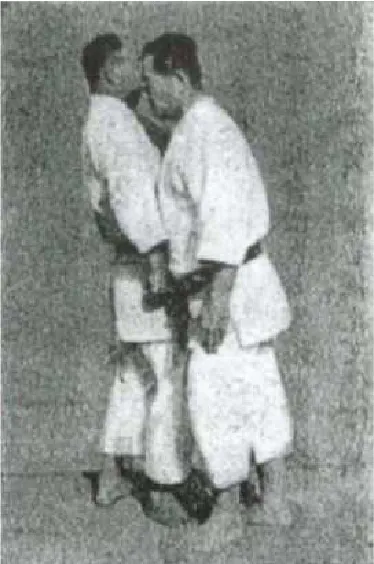
As seen in the movie shot for the experiment and the one shot at the dojo, uke’s performances are not satisfactory in falling down in jizo-taore. As seen in other Figures attached to the six previ -ous studies in Table 1, uke’s posture shows, hips are low, and the knees bent, except for the one Kodokan [22, p. 5] and Mifune et al. [19, p. 66]. This proves that falling down in jizo-taoshi is diffi -cult to perform. In case of back break fall, bending hip joints may result in further rotation of uke’s
centre of gravity. The uke, in Figure 4 keeps his body straight, trying to be a perfect image of jizo.
Tomiki’s theory and feasibility of teaching
Atemi-waza
in randori
Kano compiled the first technique of itsutsu-no-kata, modelling after the state of water in nature, like the other four techniques. He says you can make your opponent fall down by constantly keeping your push in the direction which you can make the best use of your power. Tomiki analysed this form in detail and paid attention to the pro -cess of the move and its meaning. Tomiki paid attention to the fact that the power applied on the palm is working in one-point-one direction, while changing its angle, just like atemi-waza is, though Kano did not specifically state that the first technique of the itsutsu-no-kata is based on the principle of atemi- waza. The reason hidden is in the process of execution of the technique that Kano left behind.
According to Kotani & Otaki [14, 16], who were diligent students of Nagaoka, who was directly taught by Kano. Kano’s teachings tell us that exe -cute the technique it is possible if we meet three conditions: 1) to skillfully use the radial and the ulnar of your palm; 2) to move your legs, shift -ing your weight; 3) to complete the technique by making your opponent fall down in a posture of jizo-taoshi. The details of how to fall down in a posture of jizo-taoshi, according to Maruyama
[18] include the following procedures. First, you need to draw your chin, to fall down, by making your heels as an axis, and try your best to stick your limbs on the floor, without raising your legs. Roughly speaking, conditions 1 and 2 show that Kano was rational in making the opponent fall down. Kotani & Otaki [14] emphasise that based on Kano’s thoughts, the break-fall in condition (phase) 3 is not a normal one, but jizo-taoshi. He must have understood the physical mechanism of
jizo-taoshi, in which a man is standing with a rigid body, by being pushed, tries to retreat naturally with his feet to maintain his balance but falls
down at the very moment when he can no lon
-ger keep his balance.
The books by Kotani & Otaki [14, 16] that include the thoughts of Nagaoka do not carry detailed explanation made by Kano. Therefore we can say that it was Tomiki who found that the characteris -tic of atemi-waza in jujutsu is to make your oppo -nent fall down by using your palm softly touched
on uke, and by manipulating the palm and by
continuing your body move. This move is inter
-preted as “Touch & Push, Push & Balance break, and Push & Fall down” [28]. If the current free
practice of judo should allow blow- like
atemi-waza, judo would certainly change into something MMA (mixed martial arts). Problems may arise in how to avoid injuries or how to secure safety, about which Kano was always anxious. What if
jujutsu-like atemi-waza, which Tomiki clarified, were adopted?
What would be expected then? By comprehensive application of Kano’s transmitted teaching, which is expressed in a phrase, “The techniques are mod -eled after the state of water,” [14, p. 311], and Tomiki’s detailed studies, we may be able to cre -ate a new type of randori, that Kano dreamed of, including not blow-like atemi-waza but jujutsu-like atemi-waza. It is Kano’s dream that takes on partic
-ular significance in the days when brutal fighting for commercial purposes [29] suppresses the tendency to promote martial arts as methods to strengthening all dimensions of health [6]. Jigoro Kano’s close vision are publications Carl’s De Crée [30-32] dedicated to the unknown judo kata.
CONCLUSIONS
Kano argues that uke will surely fall down if
precisely, focusing on the palm’s force, changing its direction (angle), working on in one-point-one direction, just like the atemi-waza. The essence of Tomiki’s discovery is in the fact that the unique character of atemi-waza in judo lies in the move -ment where uke is made to fall down by tori’s
movement of soft-touched palm and his manip
-ulation and ceaseless movement of the body. This is interpreted as a sequence of “touch & push, push & fall down, and touch & fall down.” This leads to the feasibility of realising randori (free
practice) with atemi-waza, which has been an
ideal task sought by Kano. Atemi-waza fills the
honoured self-defence and innovative self-defence
algorithm when the soft means of counteracting are ineffective.
CONTRIBUTORSHIP
Roman Maciej Kalina developed the structure
and arguments of the paper. Expanded the origi
-nal version and had primary responsibility for the discussion of concerns associated with innovative agonology. His contribution gave an original insight, unique theory and inspiring context of preventive and therapeutic agonology. Fumiaki Shishida made critical revisions and approved the final version.
REFERENCES
1. Shishida F, Sakaguchi M, Satoh T et al. Technical principles of “Atemi-waza” in the first tech
-nique of the Itsutsu-no-kata in judo: From a viewpoint of jujutsu-like Atemi-waza. Sport Sci Res 2014; 11: 212-224 [in Japanese] 2. Shishida F, Sakaguchi M, Satoh T et al. Technical
principles of “Atemi-waza” in the first tech
-nique of the “Itsutsu-no-kata” in judo: from a viewpoint of jujutsu like “Atemi-waza”. Sport Sci Res 2015; 12: 121-136
3. Mosler D, Kalina RM. Possibilities and lim
-itations of judo (selected martial arts) and innovative agonology in the therapy of peo
-ple with mental disorders and also in widely understood public health prophylaxis. Arch Budo 2017; 13: 211-226
4. Harasymowicz J, Kalina RM. Training of psy
-chomotor adaptation – a key factor in teach
-ing self-defence. Arch Budo 2005; 1(1): 19-26 5. Harasymowicz J, Kalina RM. Honourable self-defence – the theoretical and methodological basis of training. Płock: Wydawnictwo Novum; 2006 6. Kalina RM. Innovative agonology as a synonym
for prophylactic and therapeutic agonology – the final impulse. Arch Budo 2016; 12: 329-344 7. Barczyński BJ, Kalina RM. Science of martial
arts – Example of the dilemma in classifying new interdisciplinary sciences in the global systems of the science evaluation and the social consequences of courageous decisions. Procedia Manufacturing; 2015; 3:1203-1210 8. Kano J. The Contribution of Judo to Education.
J Health Phys Educ 1932; 58(3): 37-40 9. Bennett A, editor. Jigoro Kano and the Kodokan.
An Innovative Response to Modernisation. Compile by the Kanō Sensei Biographic Editorial Committee. Tokyo: Kōdōkan Judo Institute; 2009 10. Shishida F. Judo’s techniques performed from
a distance: The origin of Jigoro Kano’s concept
and its actualization by Kenji Tomiki. Arch Budo 2010; 6 (4): 165-172
11. Tomiki K. Judo Taiso (Gymnastics of Judo): Practical methodology of the techniques of ‘aiki’ through the principle of Judo. Tokyo: Tomon-do; 1954 [in Japanese]
12. Kano J. Judo in general and its educational val
-ues. Dai-nippon-kyoikukai; 1889 [in Japanese] 13. Kano J. National Physical Education According
to the Principle of Best Use of Energy. Tokyo: Kodokan-bunkakai; 1930 [in Japanese] 14. Kotani S, Otaki T. All the latest katas of judo.
Tokyo: Fumaido Publishing Co.; 1971 [in Japanese]
15. Dictionary. Tokyo: Chikuma Shobo Ltd.; 2004 [in Japanese]
16. Kotani S, Otaki T. Latest katas of judo: Ju, Koshiki, and Itsutsu. Tokyo: Fumaido Publishing Co.; 1954 [in Japanese]
17. Koga Z. Genius Nagaoka-10th dan: Joining
a partner and working on nature. Shunpo-do; 1959 [in Japannese]
18. Maruyama S. Sekai-Judo-shi [The world’s his
-tory of judo], Koyusha; 1967 [in Japannese] 19. Mifune K, Kudo I, Matsumoto Y. Judo-koza [Judo
Course] Vol. 5. Hakusuisha; 1956 [in Japanese] 20. Kodokan. Shashin-kaisetsu Kodokan Judo [Kodokan judo, commented with photographs] (First edition, published in 1956) Revised edi
-tion; 1966 [in Japanese]
21. Kodokan. Itsutsu-no-kata, Koshiki-no- kata. Tokyo: Kodokan Judo Institute; 1992 [in Japanese] 22. Kodokan. Itsutsu-no-kata, Koshiki-no- kat.
Tokyo: Kodokan Judo Institute; 2008 [in Japanese]
23. Tomiki K. A study of Atemi-waza and
Kansetsu-waza in jujutsu: While pursuing the
principle in Koshiki-no-kata and Itsutsu-no-
kata. Health Sport Sci 1973; 24
24. Tomiki K. Classification of the techniques of ancient jujutsu and the practicing method. Tokyo: Taishukan-shoten; 1991 [in Japanese] 25. Tomiki K. The essence of Judo: Master Kano’s
view of judo and the practice. Tokyo: Taishukan-shoten; 1991
26. Kalina RM, Barczyński BJ. Archives of Budo Science of Martial Arts and Extreme Sports – A reason for this new branch journal. Arch Budo Sci Martial Art Extreme Sport. 2013; 9: 1-9 27. Kalina RM, Barczyński BJ. Mixed assessments
as mental and pedagogic basis of innovative self-defence. Arch Budo 2017; 13: 187-194 28. Kano J. National Physical Education According
to the Principle of Best Use of Energy and con
-ventional kata and randori. Tokyo: Judo; 1931 29. Kalina RM, Barczyński BJ. Long way to the Czestochowa Declarations 2015: HMA against MMA. In: Kalina RM, editor. Proceedings of the 1st World Congress on Health and Martial Arts in Interdisciplinary Approach; 2015 Sep 17–19; Czestochowa, Poland. Warsaw: Archives of Budo; 2015: 1-11
30. De Crée C. Kōdōkan Jūdō’s Three Orphaned Forms of Counter Techniques – Part 1: The Gonosen-no-kata – “Forms of Post-Attack Initiative Counter Throws”. Arch Budo 2015; 11: 93-123
31. De Crée C. Kōdōkan Jūdō’s Three Orphaned Forms of Counter Techniques – Part 2: The Nage-waza ura-no-kata – “Forms of Reversing Throwing Techniques”. Arch Budo 2015; 11: 125-154
Reversing Controlling Techniques”. Arch Budo 2015; 11: 155-171
33. Dictionary of Sport and Exercise Science. Over 5,000 Terms Clearly Defined. London: A & B Black; 2006
34. Budō: The Martial Ways of Japan. Tokyo: Nippon Budokan Foundation; 2009 35. Payne P. Martial Arts – the Spiritual Dimension.
New York: Crossroad Publ.; 1961
36. Encyclopedia of Judo. Tokyo: Atene Shobo; 1999: 36 [in Japanese]
EDITORIAL NOTE
The authors are already emphasising in the introduction the timeless modernity and opennessof the
principle rule jūdō jita-kyoei. Understanding this principle releases the experts of the new subdisci -pline the science of martial arts from prejudice, animosity or the desire to demonstrate the suprem -acy of one martial art over another. This confrontational approach is the property of a commercial formula of mix martial arts (MMA)and similar practices of modern gladiatorship [29]. Science pre -cisely determines the place of the atemi-waza inhealth-related trainingas well as – which is rightly
emphasised by the authors of the dedicated publication atemi-waza – honoured self-defence [4, 5]
and innovative self-defence [6].
Fumiaki Shishida, as a scientist and expert in the science of martial arts, has already distanced himself from his confrontational narrative when analysing the values of jūdō and aikido [10, 37, 38]. With ele -gance and attractive appeal we encourage everyone to explore only the seemingly secret art of atemi-waza in the article Why can a little lady throw down a strong man using only a finger? The mechanism of soft
atemi-waza [39].This art, in contrast to the gladiator MMA [29], is not directed against man. Atemi-waza
is a very important element of health education and survival education at the same time. It is entering (however historically atemi-waza is ahead of birth agonology) in innovative self-defence [6] open to any proposal of combat technique to adhere to the principle of rweaching for acute measures of defence as a last resort. Shishida belongs to the leaders of the science of martial arts, which applications of martial arts from different cultures perceive in the broad perspective of honoured self-defence prac -tice and health related-training [40, 41].
RECOMMENDED REFERENCES
37. Shishida F. Counter techniques against Judo: the process of forming Aikido in 1930s. Arch Budo 2008; 4(4): 4-8 38. Shishida F. A Judo that Incorporates Kendo: Jigoro Kano’s Ideas and Their Theoretical Development. Arch Budo
2012; 8(4): 225-233
39. Shishida F. Why can a little lady throw down a strong man using only a finger? The mechanism of soft atemi-waza. In: Kalina RM, editor. Proceedings of the 1st World Congress on Health and Martial Arts in Interdisciplinary Approach; 2015 Sep 17–19; Czestochowa, Poland. Warsaw: Archives of Budo; 2015: 49-58
40. Ikemoto J, Liu Ch, Shishida F. Why Japanese budo enthusiast study foreign martial arts? By the case study of the Chinese martial arts pioneer Ryuichi Matsuda’s works and his thought based on Japanese traditional budo though. In: Kalina RM, editor. Proceedings of the 1st World Congress on Health and Martial Arts in Interdisciplinary Approach; 2015 Sep 17–19; Czestochowa, Poland. Warsaw: Archives of Budo; 2015: 171-174
![Table 2. Explanations in the studies of the technique of the itsutsu-no-kata by Kotani & Otaki, 1954 [16] and 1971 [14].](https://thumb-us.123doks.com/thumbv2/123dok_us/8591316.1721246/6.567.140.519.555.734/table-explanations-studies-technique-itsutsu-kata-kotani-otaki.webp)
![Figure 5]. Tori, as uke retreats, keep pushing, walking with his right foot first and left foot alternately, with his right-hand palm touched on uke’s chest, without rest [in 22: Figure 6]](https://thumb-us.123doks.com/thumbv2/123dok_us/8591316.1721246/7.567.44.429.345.536/figure-retreats-pushing-walking-right-alternately-touched-figure.webp)
![Table 7. Kotani & Otaki’s method 1971 [14, p. 314] and our remarks.](https://thumb-us.123doks.com/thumbv2/123dok_us/8591316.1721246/8.567.35.533.100.354/table-kotani-otaki-s-method-p-remarks.webp)


![Figure 4. Jizo-taoshi [22, p. 5]: tori pushes uke with his right hand, and advances.](https://thumb-us.123doks.com/thumbv2/123dok_us/8591316.1721246/12.567.139.525.85.332/figure-jizo-taoshi-tori-pushes-right-hand-advances.webp)
