http://www.sciencepublishinggroup.com/j/ajaf doi: 10.11648/j.ajaf.20190705.15
ISSN: 2330-8583 (Print); ISSN: 2330-8591 (Online)
An Evolutionary Particularity Principle for Evolutionary
System of Classes of Fructophyta
Da-Li Fu
1, 2, *1Non-timber Forestry Research and Development Center, Chinese Academy of Forestry, Zhengzhou, China
2Key Laboratory of Non-timber Forest Germplasm Enhancement & Utilization of National Forestry and Grassland Administration, Zhengzhou,
China
Email address:
To cite this article:
Da-Li Fu. An Evolutionary Particularity Principle for Evolutionary System of Classes of Fructophyta. American Journal of Agriculture and Forestry. Special Issue: The New Evolutionary Theory & Practice. Vol. 7, No. 5, 2019, pp. 191-199. doi: 10.11648/j.ajaf.20190705.15
Received: August 23, 2019; Accepted: August 28, 2019; Published: September 20, 2019
Abstract:
Fructophyta D. L. Fu & H. Fu, a new division established in 2018, including all fruit or flowering plants, conventionally named as angiosperms, occupy the highest evolutionary phylum taxa and an important position in terrestrial ecosystems and human wellbeing, whose origin and evolution had always been thought as puzzling. To scientifically settle the puzzle and using the evolutionary continuity principle of new science of Evolutionomy, the author proposed that evolutionary taxa should have particularly evolutionary characters to be distinguished to the closer taxa, which could be called evolutionary particularity principle. Based on the principle, the evolutionary system of five classes of Fructophyta D. L. Fu & H. Fu can be affirmed, which is a system of dichotomous evolution. Two new classes, Leguminopsida D. L. Fu and Scutellopsida D. L. Fu, are established based on the common particularity of evolutionary characters, legume and scutellum, respectively. Three old classes are selected as Magnoliopsida Brongn., Rosopsida Batsch and Monocotyledonopsida Benth. et Hook. based on the evolutionary continuity principle, and some evolutionary characters such as flower disks, pseudanthic inflorescences, and syncarpous pistils with serrate leaves were first to be used for the class classification of Rosopsida Batsch, which will make an important advancement in the taxonomy of fruit or flowering plants. The evolutionary particularity principle is a new scientific basis for the new science of Evolutionomy, which can also scientifically overcome the limitations of partiality and subjectivity in the tree of life or phylogenetic system.Keywords:
Evolutionary Particularity Principle, Leguminopsida, Scutellopsida, New Class, Evolutionomy, Fructophyta1. Introduction
Occupying the highest evolutionary phylum taxa and an important position in terrestrial ecosystems and human wellbeing, including all fruit or flowering plants, commonly called angiosperms, Fructophyta D. L. Fu & H. Fu are a new phylum of Regnum Plantae L. emend. D. L. Fu built in 2018 [1]. The origin and phylogeny of fruit plants have puzzled plant systematics for quite some time, just as that Hongda Zhang [2] had pointed out: "because of the long age, it is rare to find the complete fossils of the primitive flowering plants belonging to the Triassic.... at present, that we do not have a rational evolutionary system of primitive flowering plant is understandable." But in fact, the mystery of the origin and evolution of fruit plants is closely related to their unscientifically evolutionary position, which had been called
angiosperms for more than a century. Botanist and taxonomists had always considered the evolution and systematic classification of fruit plants based on the idea of seed plants, and lacked sufficient understanding of the evolutionary continuity and particularity of fruit plants.
taxonomy and modern systematics of fruit plants. But in fact, The number of cotyledons of plants especially that of dicots cannot scientifically reflect the main evolutionary contexts of fruit plants, because there are many gymnosperm plants also having dicotyledon as fruit plants, such as Ginkgo biloba L., Platycladus orientalis Franco and Taxus chinensis (Pilger)
Rehd. Of Ginkgopsida, Cycadopsida and Taxopsida, [11] respectively, see Figure 1. So the taxa of Dicotyledonopsida, Eudicots and Core Eudicots established in taxonomic system or APG system based on the number of cotyledons are really confusable and subjective taxonomic groups.
Figure 1. Dicotyledons of some species of Gymnospermophyta and Fructophyta. (1) Seedling of Ginkgo biloba L., (2) Seedling of Platycladus orientalis Franco, (3) Seedling of Taxus chinensis (Pilger) Rehd. (Gymonospermophyta), (4) Seedling of Sophora japonica L. (Fructophyta)(from NIFI: Atlas of seedlings of main tree species [11]).
Monocotyledonopsida Bentham et Hooker was established in 1862, which made the most important advancement in the taxonomy of fruit plants for an important evolutionary context being found then, because it is objective to call the first leaf of embryo of monocots as monocotyledon to distinguish from the first two-leaves of embryo of dicots, see Figure 2 (1) and Figure 1. But it is also subjective to call the scutellum as
monocotyledon [2, 12] because the cotyledon of
scutello-plants really includes scutellum, epiblast, coleoptile and coleorhiza, obviously differing from the real
monocotyledon of monocots, see Figure 2.
Monocotyledonopsida Bentham et Hooker was renamed as Liliopsida Scop. in Takhtajan system [4], Cronquist system [5] and Wu Zhengyi System [13, 14], which was unfortunately retrogressive of taxonomy of fruit plants, because Lilium L., the type of Liliopsida, cannot represent the evolutionary characters of embryos and caryopsis of scutello-plants. So just changing the name of monocots cannot overcome the limitations of being subjective and partial in traditional taxonomy or modern systematics of fruit plants, which covered up the important evolutionary context. Of course, Dicotyledonopsida Bentham et Hooker being renamed as Magnoliopsida Brongn. in Takhtajan system [4] and Cronquist system [5] is also unscientific because it still cover up other main evolutionary contexts of flowers and fruits of Fructophyta D. L. Fu & H. Fu.
In addition, it must also be acknowledged that monocotyledon usually is regarded as the seed evolution of Spermatophyta in traditional taxonomy or plant systematics but it is really the embryo evolution of Fructophyta. Not clearly understanding this, it’s very easy to regard monocots should be attributed to Spermatophyta as today’s Botany [2], and it is inevitably to resist the new division of Fructophyta scientifically built in 2018.
instead of Picea abies to avoid the partiality and subjectivity with only one species of Gymnospermophyta D. L. Fu & H. Fu as the outgroup. Furthermore it was devoid of the scientific
hiberarchy because the phylogenetic theory itself offers no scientific ideas and methods for understanding the "noise [5]".
Figure 2. Monocotyledon of Monocots. (1) Seedling of Trachycarpus fortunei Wendl. of Monocotyledonopsida (from NIFI: Atlas of seedlings of main tree species [11]), (2) Longitudinal section of embryo of wheat of Scutellopsida D. L. Fu, class. nov. (from Lu et al.,: Botany [12]).
Figure 3. Phylogenetic relationships among Anita, Magnoliids, Eudicots and Monocots. Dated phylogeny for 11 plant species with Picea abies as an outgroup. (from Chen et al. [15]).
The system of Five classes of Reveal [16] and Eight classes of Wu Zhengyi [13, 14] all are poly-class system combined with the bases of DNA phylogenetic relationships as APG
system [6-10], which tried to reveal the
for its eight principal lineages of angiosperms of the Early Cretaceous [13, 14]. Since it is impossible to obtain all the fruit plants of the Early Cretaceous, the eight principal lineages and the genealogical relationships of angiosperms are subjective and partial based on the modern plants. If the lineages and the relationships were comprehensive and real, the eight principal lineages are not limited to the hiberarchy of class, may be that of order or even just that of family. The system failed to clarify the evolutionary significance of classes of eight principal lineages, such as the particularity of Lauropsida, Piperopsida, Caryophyllopsida, Ranunculopsida and Hamameliopsida. Furthermore it is also obviously unscientific for disobeying the evolutionary continuity principle of new science of Evolutionomy that put Monocotyledonopsida (Liliopsida) before Ranunculopsida and Rosopsida of Dicots.
How to overcome and correct the unscientificity of existing system of fruit plants, the author proposed the evolutionary particularity principle based on the evolutionary continuity principle, analyzed the main evolutionary contexts and established the evolutionary system of classes of Fructophyta D. L. Fu & H. Fu.
2. Evolutionary Particularity Principle
Monocotyledonopsida traditionally include the
scutello-plants, which regarded the scutellum as
monocotyledon [2, 12]. But the cotyledons of scutello-plants really include scutellum, epiblast, coleoptile and coleorhiza, which can better complete the nutrient extraction and self-protection of embryos and which all can be called cotyledon and be the highest evolutionary level of embryos of fruit plants, see Figure 2. Obviously differing from the real monocotyledon, the new class of Scutellopsida D. L. Fu, class. nov. can be scientifically established in order to reveal the highest evolutionary level of embryos of fruit plants. The main evolutionary context of Fructophyta, Monocotyledonopsida → Scutellopsida D. L. Fu, class. nov., can be clearly presented.
To avoid the partiality of embryos, it is necessary to consider the evolutions of other organs such as roots, stems, leaves, flowers and fruits of fruit plants. The particular caryopsis of Scutellopsida D. L. Fu, class. nov. usually covered by palea and lemma, healing peels of fruit and seed can also reflect the evolutionary particularity of the new class of Scutellopsida D. L. Fu,. Excluded the scutello-plants, Monocotyledonopsida emendated include the particular monocotyledons with sheath and usually have fibrous root system, closed bundle without cambium and parallel leaf veins, which obviously distinguished from dicots with tap root system, open bundle with cambium and net leaf veins, but their simple flowers and fruits are close to dicots especially
Magnoliopsida. So the new evolutionary context,
Magnoliopsida → Monocotyledonopsida more in line with the
evolutionary continuity principle than that of
Dicotyledonopsida → Monocotyledonopsida generally
accepted today.
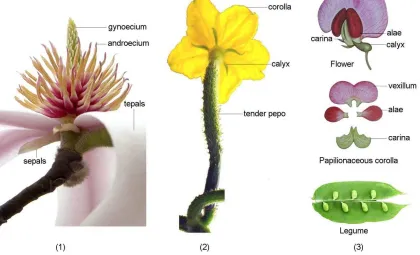
There are another taxa of fruit plants with evolutionary particularity and occupy the other top of another evolutionary contexts, which can be called Leguminopsida D. L. Fu, class. nov.. The plants of the new class all have legumes obviously differing from other fruit types such as follicle, drupe, capsule, hesperidium, pome, pepo, achene, samara, nut, utricle, cremocarp, silique and silicle, and some taxa of the class have the particular papilionaceous corolla with vexillum, alae and carina, the highest evolutionary level of corolla, see Figure 4(3). There are some plants of the new family of Arachaceae D. L. Fu, fam. nov. ined., of the new class with the particular characters of fruit growing in the soil after flowering. So the new class Leguminopsida D. L. Fu can be established and the main evolutionary context is clearly presented as the non-legumes → Leguminopsida D. L. Fu, class. nov.
The new class of Leguminopsida D. L. Fu highlight the papilionaceous corolla with vexillum, alae and carina, which are obviously not evolved from Magnoliopsida, the primitive taxa of fruit plants without the real corolla (Figure 4.). There must are the taxa with diversiform corolla such as apopetalous corolla of Rosaceae Adans. and sympetalous corolla of Rubiaceae Juss., which had been established as Rosopsida Batsch (1802). Since the evolutionary boundary of the tepals and sepals of Magnoliopsida → the corolla and calyxes of
Rosopsida are not clear and the tepals of
Monocotyledonopsida were also called corolla in Hutchinson system [5], it is partial and difficult to classify and demarcate the evolutionary boundary between the class of Magnoliopsida and Rosopsida just based on the perianth evolution. Furthermore, it is more difficult to determine that the families with the simple corolla such as Daphniphyllaceae Müll. Arg., Hamamelidaceae R. Br., Tiliaceae Adans., Euphorbiaceae Juss., etc. (the perianth usually showed just as calyxes [2]) naturally belong to the class of Rosopsida. So some other important evolutionary characters can be applied to the classification based on the evolutionary continuity principle.
leaves, Centrospermae with syncarpous pistils and centrosperms, and Moraceae Link and Myricaceae Blume with syncarpous pistils and collective fruits. Some taxa of Rosopsida have pseudanthic inflorescences such as Cercidiphyllum japonicum Sieb. et Zucc. of Hamamelidaceae R. Br., Castanea mollissima Bl. of Fagaceae Dumort., Casuarina equisetifolia Forst. Of Casuarinaceae R. Br. and so
on, which had been ignored or regarded unscientifically as the original taxa of fruit plants in the previous systems. Of course, it should be attended that some taxa of Rosopsida also have some particular fruits such as hesperidium, pome, pepo, cremocarp, silique and silicle. So the evolutionary contexts, Magnoliopsida → Rosopsida →Leguminopsida, can be clearly presented.
Figure 4. Evolutionary continuity and particularity of Magnoliopsida, Rosopsida and Leguminopsida. (1) Flower of Yulania biondii (Pamp.) D. L. Fu of Magnoliopsida Brongn. (taken by D. L. Fu); (2) Flower of cucumber (Cucumis sativus L.) of Rosopsida Batsch (from Internet); (3) Flower and fruit of pea (Pisum sativum L.) of Leguminopsida D. L. Fu, class. nov. (from Internet).
The legumes of Leguminopsida D. L. Fu, class. nov. (Figure 4(3)), monocotyledons of Monocotyledonopsida (Figure 2(1)) and scutella of Scutellopsida D. L. Fu, class. nov. (Figure 2(2)) can be called common particularity of evolutionary characters because almost all individuals of the taxa have the particular characters. The naturally elongate tori of Magnoliopsida (Figure 4(1)) and the sympetalous corolla and pepos of Rosopsida (Figure 4(2)) can be called non-common particularity of evolutionary characters for only some partial individuals of the taxa having the particular characters. Based on the non-common particularity of evolutionary characters, the evolutionary taxa of the classes of Magnoliopsida and Rosopsida should be demarcated and classified using the principal evolutionary contexts of non-corolla → corolla, branched inflorescences → pseudanthic inflorescences, or other contexts such as apocarpous pistils → syncarpous pistils and entire leaves → serrate leaves based on the evolutionary continuity principle.
In summary, the evolutionary system of classes of Fructophyta should fully reflect the principal evolutionary contexts of fruit plants and the evolutionary taxa should have particularly evolutionary characters to be distinguished to closer taxa, which can be called evolutionary particularity
principle. The principle is a new scientific basis for establishing the evolutionary taxa and the evolutionary system of fruit plants, which can scientifically solve the problems that the current taxonomical systems and plant systematics rely too heavily on some characters not having important evolutionary significance, and the subjective taxa such as dicots of Gymnospermophyta, Dicotyledonopsida, Eudicots and Core Eudicots had caused the confusion or mystery of fruit plant taxonomy and systematics.
3. Evolutionary System of Classes of
Fructophyta
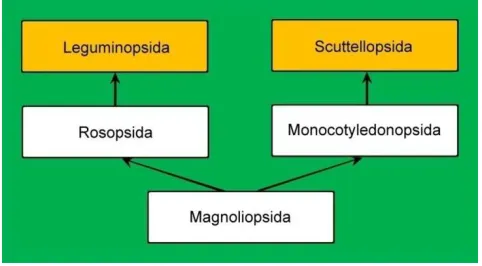
Based on the evolutionary particularity principle and evolutionary continuity principle, the new evolutionary taxonomical system of classes of Fructophyta was established and the evolutionary diagram was drawn as Figure 5. The new system includes five classes and two of those classes are new. These are:
apocarpous pistils. Fruits usually follicle, drupe, capsule, achene, etc. no hesperidium, pome, pepo, cremocarp, silique, silicle and legume. Embryos with dicotyledons. Including five subclasses: I(1) Magnoliidae Novák ex Takht.: Magnoliaceae Juss., Myristicaceae R. Br., Winteraceae R. Br. ex Lindl., Chloranthaceae R. Br. ex Sims, Calycanthaceae Lindl., Cryptocaryaceae D. L. Fu, fam. nov. ined., Lauraceae Juss., Neocinnamomaceae D. L. Fu, fam. nov. ined., Hernandiaceae Blume, Annonaceae Adans., etc.; I(2) Piperidae Reveal: Sarumaceae Rich. ex E. Meyer., Aristolochiaceae Adans., Piperaceae C. Agardh, etc.; I(3) Nymphaeidae J. W. Walker ex Takht.: Illiciaceae A. C. Sm., Schisandraceae Blume,
Amborellaceae Pichon, Ceratophyllaceae Gray,
Nymphaeaceae Salisb., Hydropeltidaceae Dumort.,
Cabombaceae Rich. ex A. Rich., etc.; I(4) Trochodendridae Chang: Eupteleaceae K. Wilh., Lardizabalaceae R. Br.,
Nelumbonaceae A. Rich., Platanaceae T. Lestib.,
Trochodendraceae Eichler, Pachysandraceae D. L. Fu, fam. nov. ined., Buxaceae Dumort., Papaveraceae Adans., Fumariaceae DC., Meliosmaceae Endl., Sabiaceae Blume, Kingdoniaceae A. S. Foster ex Airy-Shaw, Circaeasteraceae Hutch., etc.; I(5) Ranunculidae Takht. ex Reveal: Nandinaceae
Horan., Podophyllaceae DC., Berberidaceae Juss.,
Epimediaceae D. L. Fu, fam. nov. ined., Menispermaceae Juss., Ranunculaceae Adans., etc.
II. Rosopsida Batsch Regni Veg. 1. 1802. class. emend. Based on: Rosaceae Adans., Fam. Pl. 2: 286. 1763. Typus: Rosa L. More advanced Fructophyta usually with corolla or disks or pseudanthic inflorescences, or with syncarpous pistils and, serrate leaves or centrosperms or collective fruits. Ovules numerous opposite or not, or single. Fruits usually follicle, drupe, capsule, hesperidium, pome, pepo, achene, samara, nut, utricle, cremocarp, silique and silicle, no legume. Embryos
with dicotyledons. Including nine subclasses: II(1)
Hamamelididae Takht. ex Chang: Hamamelidaceae R. Br.,
Altingiaceae Lindl., Daphniphyllaceae Müll. Arg.,
Paeoniaceae Raf., Penthoraceae Rydb. ex Britton,
Haloragaceae R. Br., Osyridaceae Martinov, Dilleniaceae Salisb., Mukdeniaceae D. L. Fu, fam. nov. ined., Chrysospleniaceae D. L. Fu, fam. nov. ined., Saxifragaceae Juss., Grossulariaceae DC., Iteaceae J. Agardh, Vitaceae Juss., Crassulaceae J. St.-Hil., Opiliaceae Valeton, Erythropalaceae Pilg. & K. Krause, Santalaceae R. Br., Olacaceae Mirb. ex DC., Tolypanthaceae D. L. Fu, fam. nov. ined., Loranthaceae Juss., Scurrulaceae D. L. Fu, fam. nov. ined., etc.; II(2) Rosidae Takht.: Betulaceae Gray, Myricaceae Blume, Juglandaceae DC. ex Perleb, Fagaceae Dumort., Hemsleyaceae D. L. Fu, fam. nov. ined., Gynostemmaceae D. L. Fu, fam. nov. ined., Cucurbitaceae Juss., Corynocarpaceae Engl., Amygdalaceae Marquis, Malaceae Small, Spiraeaceae D. L. Fu, fam. nov. ined., Rosaceae Adans., Cynomoriaceae Endl. ex Lindl., Ziziphaceae D. L. Fu, fam. nov. ined., Berchemiaceae D. L. Fu, fam. nov. ined., Rhamnaceae Juss., Barbeyaceae Rendle, Elaeagnaceae Adans., Lozanellaceae D. L. Fu, fam. nov. ined., Cannabaceae Martinov, Tremaceae D. L. Fu, fam. nov. ined., Celtaceae D. L. Fu, fam. nov. ined., Moraceae Link, Ficaceae D. L. Fu, fam. nov. ined., Broussonetiaceae D. L. Fu, fam. nov.
ined., Cecropiaceae C. C. Berg, Ulmaceae Mirb., etc.; II(3) Euphorbiidae D. L. Fu, subclass. nov.. Based on: Euphorbiaceae Juss., Gen. Pl.: 384. 4 Aug 1789. Typus: Euphorbia L.. Including: Oxalidaceae R. Br., Celastraceae R. Br., Parnassiaceae Martinov, Heveaceae D. L. Fu, fam. nov. ined., Verniciaceae D. L. Fu, fam. nov. ined., Jatrophaceae D. L. Fu, fam. nov. ined., Ricinaceae D. L. Fu, fam. nov. ined., Crotontaceae D. L. Fu, fam. nov. ined., Euphorbiaceae Juss., Clusiaceae Lindl., Itoaceae D. L. Fu, fam. nov. ined., Flacourtiaceae Rich. ex DC., Salicaceae Mirb., Violaceae Batsch, Passifloraceae Juss. ex Roussel, Malpighiaceae Juss., Bunchosiaceae D. L. Fu, fam. nov. ined., Erythroxylaceae Kunth, Chrysobalanaceae R. Br., Linaceae DC. ex Perleb, Balanophoraceae Rich., etc.; II(4) Malviidae C. Y. Wu et al.: Francoaceae A. Juss., Melianthaceae Handbuch, Vivianiaceae Klotsch, Myrtaceae Adans., Combretaceae R. Br., Punicaceae Horan., Lythraceae J. St.-Hil., Sonneratiaceae Engl., Ludwigiaceae D. L. Fu, fam. nov. ined., Trapaceae Dumort., Epilobiaceae D. L. Fu, fam. nov. ined., Onagraceae Adans., Eriocnemaceae D. L. Fu, fam. nov. ined., Salpingaceae D. L. Fu, fam. nov. ined., Melastomataceae Juss., Nepseraceae D. L. Fu, fam. nov. ined., Rhexiaceae D. L. Fu, fam. nov. ined., Rhynchantheraceae D. L. Fu, fam. nov. ined., Meliaceae Juss., Azadirachtaceae D. L. Fu, fam. nov. ined., Simaroubaceae DC., Leitneriaceae Benth. & Hook. f., Rutaceae Juss., Citraceae D. L. Fu, fam. nov. ined., Spondiadaceae D. L. Fu, fam. nov. ined., Anacardiaceae Lindl., Burseraceae Kunth, Hippocastanaceae A. Rich., Aceraceae Juss., Sapindaceae Juss., Koelreuteriaceae D. L. Fu, fam. nov. ined., Dodonaeaceae Link, Tiliaceae Adans., Malvaceae Adans., Bixaceae Kunth, Dipterocarpaceae Blume, Aquilariaceae D. L. Fu, fam. nov. ined., Pimeleaceae D. L. Fu, fam. nov. ined., Thymelaeaceae Adans., Bretschneideraceae Engl. & Gilg, Moringaceae Martinov, Caricaceae Dumort., Capparaceae Adans., Cardaminaceae D. L. Fu, fam. nov. ined., Arabidopsaceae D. L. Fu, fam. nov. ined., Pugioniaceae D. L. Fu, fam. nov. ined., Lobulariaceae D. L. Fu, fam. nov. ined., Buniadaceae D. L. Fu, fam. nov. ined., Matthiolaceae D. L. Fu, fam. nov. ined., Clausiaceae D. L. Fu, fam. nov. ined., Eutremaceae D. L. Fu, fam. nov. ined., Thlaspaceae D. L. Fu, fam. nov. ined., Sisymbriaceae D. L. Fu, fam. nov. ined., Brassicaceae Burnett, Cochleariaceae D. L. Fu, fam. nov. ined., Alyssaceae D. L. Fu, fam. nov. ined., Aethionemaceae D. L. Fu, fam. nov. ined., etc.; II(5) Geraniidae C. Y. Wu et al.: Hypseocharitaceae Weddel, Californiaceae D. L. Fu, fam. nov. ined., Pelargoniaceae D. L. Fu, fam. nov. ined., Erodiaceae D. L. Fu, fam. nov. ined., Monsoniaceae D. L. Fu, fam. nov. ined., Geraniaceae Adans., Zygophyllaceae R. Br., Tetraenaceae D. L. Fu, fam. nov. ined., etc.; II(6) Caryophyllidae Takht.: Nepenthaceae Dumort., Seguieriaceae, Phytolaccaceae R. Br.,
Monococcaceae D. L. Fu, fam. nov. ined.,
Mesembryanthemaceae Fenzl, Nyctaginaceae Juss.,
Caryophyllaceae Juss., Colobanthaceae D. L. Fu, fam. nov. ined., Muehlenbeckiaceae D. L. Fu, fam. nov. ined., Fagopyraceae D. L. Fu, fam. nov. ined., Polygonaceae Juss., Plumbaginaceae Juss., Droseraceae Salisb., Aldrovandaceae D. L. Fu, fam. nov. ined., Dionaeaceae D. L. Fu, fam. nov. ined., etc.; II(7) Cornidae Frohne et Jensen ex Reveal: Cornaceae Dumort., Alangiaceae DC., Hydrangeaceae Dumort., Deutziaceae D. L. Fu, fam. nov. ined., Eucommiaceae Engl., Nyssaceae Juss. ex Dumort., Aquifoliaceae DC. ex A. Rich., Gonocaryaceae D. L. Fu, fam. nov. ined., Icacinaceae Miers, Picrodendraceae Small, Viburnaceae Rafinesque, Adoxaceae E. Mey., Weigelaceae D. L. Fu, fam. nov. ined., Caprifoliaceae Adans., Valerianaceae Batsch, Dipsacaceae Juss., Pholismaceae D. L. Fu, fam. nov. ined., Lennoaceae Solms, Araliaceae Juss., Hydrocotylaceae N Hylander, Cicutaceae D. L. Fu, fam. nov. ined., Apiaceae Lindl., Bupleuraceae D. L. Fu, fam. nov. ined., Theaceae Mirb., Sladeniaceae Airy-Shaw, Actinidiaceae Gilg & Werderm., Barringtoniaceae F. Rudolphi, Scytopetalaceae Engl., Sapotaceae Juss., Ebenaceae Gürke, Symplocaceae Desf., Sinojackiaceae D. L. Fu, fam. nov. ined., Styracaceae Dumort., Huodendraceae D. L. Fu, fam. nov. ined., Clethraceae Klotzsch, Epacridaceae R. Br., Monotropaceae Nutt., Fouquieriaceae DC., Maesaceae D. L. Fu, fam. nov. ined., Ardisiaceae D. L. Fu, fam. nov. ined., Cortusaceae D. L. Fu, fam. nov. ined., Primulaceae Vent., Pyrolaceae Lindl.,
Vacciniaceae Adans., etc.; II(8) Asteridae Takht.:
Menyanthaceae Dumort., Nymphoidaceae D. L. Fu, fam. nov. ined., Atractylodaceae D. L. Fu, fam. nov. ined., Helianthaceae D. L. Fu, fam. nov. ined., Pericallaceae D. L. Fu, fam. nov. ined., Solivaceae D. L. Fu, fam. nov. ined., Artemisiaceae D. L. Fu, fam. nov. ined., Leontopodiaceae D. L. Fu, fam. nov. ined., Asteraceae Martinov, Cyphiaceae DC., Codonopsaceae D. L. Fu, fam. nov. ined., Platycodaceae D. L. Fu, fam. nov. ined., Echinocodaceae D. L. Fu, fam. nov. ined., Tracheliaceae D. L. Fu, fam. nov. ined., Campanulaceae Adans., Adenophoraceae D. L. Fu, fam. nov. ined., Grammatothecaceae D. L. Fu, fam. nov. ined., Monopsaceae D. L. Fu, fam. nov. ined., Lobeliaceae Juss., Isotomaceae D. L. Fu, fam. nov. ined., Wimmerellaceae D. L. Fu, fam. nov. ined., Legeneraceae D. L. Fu, fam. nov. ined., Porterellaceae D. L. Fu, fam. nov. ined., Downingia D. L. Fu, fam. nov. ined., etc.; II(9) Lamiidae Takht. ex Reveal: Oleaceae Hoffmanns. & Link, Jasminaceae D. L. Fu, fam. nov. ined., Ehretiaceae Mart., Carissaceae D. L. Fu, fam. nov. ined., Catharanthaceae D. L. Fu, fam. nov. ined., Apocynaceae Adans., Hoyaceae D. L. Fu, fam. nov. ined., Asclepiadaceae Borkh., Swertiaceae D. L. Fu, fam. nov. ined., Gentianaceae Juss., Emmenopteryaceae D. L. Fu, fam. nov. ined., Mitragynaceae D. L. Fu, fam. nov. ined., Coffeaceae D. L. Fu, fam. nov. ined., Morindaceae D. L. Fu, fam. nov. ined., Rubiaceae Juss., Solanaceae Adans., Convolvulaceae Juss., Cuscutaceae Dumort., Paulowniaceae Nakai, Pedaliaceae R. Br., Rehmanniaceae D. L. Fu, fam. nov. ined., Scrophulariaceae Juss., Tecomariaceae D. L. Fu, fam. nov. ined., Bignoniaceae Juss., Phrymaceae Schauer, Lindenbergiaceae D. L. Fu, fam. nov. ined., Castillejaceae D. L. Fu, fam. nov. ined., Pedicularaceae D. L. Fu, fam. nov. ined.,
Schwalbeaceae D. L. Fu, fam. nov. ined., Veronicastraceae D. L. Fu, fam. nov. ined., Digitalaceae D. L. Fu, fam. nov. ined., Veronicaceae D. L. Fu, fam. nov. ined., Plantaginaceae Juss., Gesneriaceae Rich. &Juss., Streptocarpaceae D. L. Fu, fam. nov. ined., Boeaceae D. L. Fu, fam. nov. ined., Aphelandraceae D. L. Fu, fam. nov. ined., Clinacanthaceae D. L. Fu, fam. nov. ined., Andrographaceae D. L. Fu, fam. nov. ined., Acanthaceae Juss., Strobilanthaceae D. L. Fu, fam. nov. ined., Verbenaceae Adans., Premnaceae D. L. Fu, fam. nov. ined., Caryopteraceae D. L. Fu, fam. nov. ined., Ajugaceae D. L. Fu, fam. nov. ined., Scutellariaceae D. L. Fu, fam. nov. ined., Lamiaceae Martinov, Perillaceae D. L. Fu, fam. nov. ined., Ocimaceae D. L. Fu, fam. nov. ined., Lavandulaceae D. L. Fu, fam. nov. ined., Dracocephalaceae D. L. Fu, fam. nov. ined., Lentibulariaceae Rich., Lathraeaceae D. L. Fu, fam. nov. ined., Orobanchaceae Vent., Cistanchaceae D. L. Fu, fam. nov. ined., Boulardiaceae D. L. Fu, fam. nov. ined., Epifagaceae D. L. Fu, fam. nov. ined., Phelipanchaceae D. L. Fu, fam. nov. ined., etc..
III. Leguminopsida D. L. Fu, class. nov. Figure 1(4), 4(3), 5. Based on: Fabaceae Lindl., Intr. Nat. Syst. Bot., ed. 2: 148. 1836. Typus: Faba Mill. Fructophyta with papilionaceous or pseudo-papilionaceous corolla. Single pistil or apocarpous pistils usually with alternate ovules. Fruits leguminous.
Dicotyledons bigger and epigaeous. Including:
Caesalpiniaceae Brown, Cercidaceae D. L. Fu, fam. nov. ined., Tamarindaceae D. L. Fu, fam. nov. ined., Adenantheraceae D. L. Fu, fam. nov. ined., Mimosaceae Brown, Indigoferaceae D. L. Fu, fam. nov. ined., Lotaceae D. L. Fu, fam. nov. ined., Lupinaceae D. L. Fu, fam. nov. ined., Arachaceae D. L. Fu, fam. nov. ined., Phaseolaceae D. L. Fu, fam. nov. ined., Wisteriaceae D. L. Fu, fam. nov. ined., Ciceraceae D. L. Fu, fam. nov. ined., Trifoliaceae D. L. Fu, fam. nov. ined., Fabaceae Lindl., Viciaceae D. L. Fu, fam. nov. ined., etc..
Lemnaceae Gray, Symplocarpaceae D. L. Fu, fam. nov. ined.,
Potamogetonaceae Dumort., Zosteraceae Dumort.,
Hydrocharitaceae Juss., Alismataceae Vent., Najadaceae Juss., etc.; IV(6) Orchididae D. L. Fu, subclass. nov.. Based on: Orchidaceae Adans., Fam. Pl. 2: 68. Jul-Aug 1763. Typus: Orchis L.. Including: Elleanthaceae D. L. Fu, fam. nov. ined., Neottiaceae D. L. Fu, fam. nov. ined., Aphyllorchaceae D. L. Fu, fam. nov. ined., Goodyeraceae D. L. Fu, fam. nov. ined., Platantheraceae D. L. Fu, fam. nov. ined., Habenariaceae D. L. Fu, fam. nov. ined., Phragmipediaceae D. L. Fu, fam. nov. ined., Cypripediaceae Lindl., Neuwiediaceae R. Dahlgren ex Reveal & Hoogland, Apostasiaceae Lindl., Vanillaceae D. L. Fu, fam. nov. ined., Orchidaceae Adans., Masdevalliaceae D. L. Fu, fam. nov. ined., Gastrochilaceae D. L. Fu, fam. nov. ined., Phalaenopsaceae D. L. Fu, fam. nov. ined., Corallorhizaceae D. L. Fu, fam. nov. ined., Oncidiaceae D. L. Fu, fam. nov. ined., Oberoniaceae D. L. Fu, fam. nov. ined., Gastrodiaceae D. L. Fu, fam. nov. ined., etc.
V. Scutellopsida D. L. Fu, class. nov. Figure 2(2), 5. Based on: Poaceae Barnhart in Bull. Torrey Bot. Club 22: 7. 1895. Typus: Poa L. Fructophyta usually with narrow and elongate blades. Each blade commonly has a pair of small marginal auricles and a membranous ligule. Floret ordinarily subtended by lemma and palea and flower usually with exiguous tepals as lodicules. Fruits usually caryopsis, rarely berry or nut. Cotyledon with scutellum, epiblast, coleoptile and coleorhiza. Including: Leptaspaceae D. L. Fu, fam. nov. ined., Anomochloaceae D. L. Fu, fam. nov. ined., Bambusaceae D. L. Fu, fam. nov. ined., Lithachnaceae D. L. Fu, fam. nov. ined., Oryzaceae D. L. Fu, fam. nov. ined., Stipaceae D. L. Fu, fam. nov. ined., Brachypodiaceae D. L. Fu, fam. nov. ined., Nardaceae D. L. Fu, fam. nov. ined., Triticaceae D. L. Fu, fam. nov. ined., Avenaceae D. L. Fu, fam. nov. ined., Poaceae Barnhart, Phragmitesaceae D. L. Fu, fam. nov. ined., Centothecaceae D. L. Fu, fam. nov. ined., Danthoniaceae D. L. Fu, fam. nov. ined., Panicaceae D. L. Fu, fam. nov. ined., Zeaceae D. L. Fu, fam. nov. ined., Eragrostaceae D. L. Fu, fam. nov. ined., Centropodiaceae D. L. Fu, fam. nov. ined., Boutelouaceae D. L. Fu, fam. nov. ined., etc.
Figure 5. Evolutionary system of classes of Fructophyta D. L. Fu & H. Fu.
From Figure 5, it can be found that the five classes of Fructophyta evolved in two directions belong to a dichotomous evolution.
4. Conclusion
The evolutionary particularity principle is a new scientific basis for the new science of Evolutionomy, which can also scientifically overcome the limitations of partiality and subjectivity of the tree of life or phylogenetic system. Based on the new principle, five classes of Fructophyta D. L. Fu & H. Fu can be distinguished, which are dichotomous evolution. Two new classes, Leguminopsida D. L. Fu and Scutellopsida D. L. Fu are respectively established based on the common particularity of evolutionary characters, legume and scutellum,, which will make an important advancement in the evolutionary taxonomy of fruit or flowering plants.
Acknowledgements
This work was supported by the Fundamental Research Funds for the Central Non-profit Research Institution of CAF (CAFYBB2016MA009). I am grateful to Prof. Yingping Wang of CSIRO (Commonwealth Scientific and Industrial Research Organization) for his valuable suggestions and corrections in some writing English text.
References
[1] D. L. Fu and H. Fu. “An evolutionary continuity principle for evolutionary system of organism divisions”. American Journal of Agriculture and Forestry, vol. 6, no. 3, pp. 60-64, 2018. DOI: 10.11648/j.ajaf.20180603.14.
[2] H. D. Zhang, Y. H. Huang, R. H. Miao, C. X. Ye, W. B. Liao, and J. H. Jin. “Systematics of Spermatophyta”. Beijing: Science Press. 72-626, 2004. [in Chinese]
[3] J. Hutchinson. “The families of flowering plants”. Oxford: Oxford University Press. 1959.
[4] A. L. Takhtajan. “Outline of the classification of flowering plants (Magnoliophyta)”. Bot. Rev. vol. 46 no. 3. pp. 227-359. 1980.
[5] A. Cronquist. “An integrated system of classification of flowering plants”. New York: Columbia University Press, 1-1262, 1981.
[6] D. Z. Li (translator). “Plant systematic, A phylogenetic approach”. Beijing: Higher Education Press. 001-496, 2012. [in Chinese]
[7] P. S. Soltis, and D. E. Soltis. “The origin and diversification of angiosperms”. American Journal of Botany, vol. 91, no. 10, pp. 1614–1626. 2004.
[8] L. P. Zeng, Q. Zhang, R. R. Sun, H. Z. Kong, N. Zhang, & H. Ma. “Giant viruses coexisted with the cellular ancestors and represent a distinct supergroup along with superkingdoms Archaea, Bacteria and Eukarya”. Nature communications, vol. 5, pp. 4956. 2014. doi: 10.1038/ncomms5956.
[10] T. J. Givnish, G. A. Zuluaga, D. Spalink, M. S. Gomez, V. K. Y. Lam, J. M. Saarela, C. Sass, W. J. D. Iles, D. J. L. Sousa, J. Leebens-Mack, J. C. Pires, W. B. Zomlefer, M. A. Gandolfo, J. I. Davis, D. W. Stevenson, C. Pamphilis, C. D. Specht, S. W. Graham, C. F. Barrett, and C. Ané. “Monocot plastid phylogenomics, timeline, net rates of species diversification, the power of multi - gene analyses, and a functional model for the origin of monocots”. American Journal of Botany, vol. 105, no. 11, pp. 1888-1910, 2018.
[11] NIFI (Nanjing Institute of Forestry Industry). “Atlas of seedlings of main tree species”. Beijing: Agriculture Press, 30-228, 1978. [in Chinese]
[12] S. W. Lu, X. S. Xu, and M. J. Shen. “Botany”. Beijing: Higher Education Press, 67-81, 1991. [in Chinese]
[13] Z. Y. Wu, Y. C. Tang, A. M. Lu, and Z. R. Chen. “On primary subdivisions of the Magnoliophyta---towards a new scheme for an eight-class system of classification of the angiosperms”.
Acta Phytotaxonomica Sinica, vol. 36, no. 5, pp. 385-402, 1998. [in Chinese]
[14] Z. Y. Wu, Y. C. Tang, A. M. Lu, Z. R. Chen, and D. Z. Li. “Synopsis of a new ‘polyphyletic-polychronic-polytopic’ system of the angiosperms”. Acta Phytotaxonomica Sinica, vol. 40, no. 4, pp. 289-322, 2002.
[15] J. H. Chen, Z. H. Hao, X. M. Guang, C. X. Zhao, P. K. Wang, L. J. Xue, Q. H. Zhu, L. F. Yang, Y. Sheng, Y. W. Zhou, H. B. Xu, H. Q. Xie, X. F. Long, J. Zhang, Z. R. Wang, M. M. Shi, Y. Lu, S. Q. Liu, L. H. Guan, Q. H. Zhu, L. M. Yang, G. Song, T. L. Cheng, T. Laux, Q. Gao, Y. Peng, N. Liu, S. H. Yang, and J. S. Shi. “Liriodendron genome sheds light on angiosperm phylogeny and species–pair differentiation”. Nature Plants, vol. 5, pp. 18-25. 2019. https://doi.org/10.1038/s41477-018-0323-6

![Figure 2. Monocotyledon of Monocots. (1) Seedling of Trachycarpus fortunei Wendl. of Monocotyledonopsida (from NIFI: Atlas of seedlings of main tree species [11]), (2) Longitudinal section of embryo of wheat of Scutellopsida D](https://thumb-us.123doks.com/thumbv2/123dok_us/8472654.1711706/3.595.142.456.431.686/monocotyledon-monocots-seedling-trachycarpus-monocotyledonopsida-seedlings-longitudinal-scutellopsida.webp)