Open Access
Methodology article
Multigene expression of protein complexes by iterative
modification of genomic Bacmid DNA
Rob J Noad
1,3, Meredith Stewart
1, Mark Boyce
1, Cristina C Celma
1,
Keith R Willison
2and Polly Roy*
1Address: 1Department of Infectious and Tropical Diseases, London School of Hygiene and Tropical Medicine, Keppel Street, London, WC1E 7HT, UK, 2Section of Cell and Molecular Biology, Institute of Cancer Research, 237 Fulham Road, London SW3 6JB, UK and 3Current address: Department of Pathology and Infectious Diseases, Royal Veterinary College, Hawkshead Lane, Hatfield AL9 7TA, UK
Email: Rob J Noad - [email protected]; Meredith Stewart - [email protected]; Mark Boyce - [email protected]; Cristina C Celma - [email protected]; Keith R Willison - [email protected]; Polly Roy* - [email protected] * Corresponding author
Abstract
Background: Many cellular multi-protein complexes are naturally present in cells at low abundance. Baculovirus expression offers one approach to produce milligram quantities of correctly folded and processed eukaryotic protein complexes. However, current strategies suffer from the need to produce large transfer vectors, and the use of repeated promoter sequences in baculovirus, which itself produces proteins that promote homologous recombination. One possible solution to these problems is to construct baculovirus genomes that express each protein in a complex from a separate locus within the viral DNA. However current methods for selecting such recombinant genomes are too inefficient to routinely modify the virus in this way.
Results: This paper reports a method which combines the lambda red and bacteriophage P1 Cre-recombinase systems to efficiently generate baculoviruses in which protein complexes are expressed from multiple, single-locus insertions of foreign genes. This method is based on an 88 fold improvement in the selection of recombinant viruses generated by red recombination techniques through use of a bipartite selection cassette. Using this system, seven new genetic loci were identified in the AcMNPV genome suitable for the high level expression of recombinant proteins. These loci were used to allow the recovery two recombinant virus-like particles with potential biotechnological applications (influenza A virus HA/M1 particles and bluetongue virus VP2/VP3/VP5/VP7 particles) and the mammalian chaperone and cancer drug target CCT (16 subunits formed from 8 proteins).
Conclusion: 1. Use of bipartite selections can significantly improve selection of modified bacterial artificial chromosomes carrying baculovirus DNA. Furthermore this approach is sufficiently robust to allow routine modification of the virus genome. 2. In addition to the commonly used p10 and polyhedrin loci, the ctx, egt, 39k, orf51, gp37, iap2 and odv-e56 loci in AcMNPV are all suitable for the high level expression of heterologous genes. 3. Two protein, four protein and eight protein complexes including virus-like particles and cellular chaperone complexes can be produced using the new approach.
Published: 2 September 2009
BMC Molecular Biology 2009, 10:87 doi:10.1186/1471-2199-10-87
Received: 27 April 2009 Accepted: 2 September 2009
This article is available from: http://www.biomedcentral.com/1471-2199/10/87
© 2009 Noad et al; licensee BioMed Central Ltd.
Background
The baculovirus Autographa califonica multiple nucleopolyhe-drosis virus (AcMNPV) is routinely used to express proteins in eukaryotic cells for structural, biochemical and vaccine studies [1]. The AcMNPV genome is circular dsDNA (~134 kb) and contains regions of highly repetitive DNA ele-ments and genes in both strands [2]. This genomic DNA can be propagated in Escherichia coli as a bacmid, and genes can be inserted by Tn7 transposase based transposi-tion into the virus DNA [3]. Transfectransposi-tion of the modified bacmid DNA into virus susceptible insect cells results in recovery infectious virus expressing the recombinant pro-tein corresponding to the inserted gene [3]. Alternate approaches in which homologous recombination is car-ried out in insect cells can also be used to generate recom-binant baculoviruses [4,5].
One of the advantages of the baculovirus system is its util-ity for the co-expression of multiple genes that encode protein complexes [6-12]. This is important, as many crit-ical functions of living cells are carried out by multi-subu-nit protein complexes which are naturally present at low abundance. One approach for the baculovirus mediated co-expression of multiple genes is the insertion of expres-sion cassettes as tandem or inverted repeats at the polyhe-drin locus in the viral genomic DNA [6-9,12,13]. This approach ensures that every cell in the culture expresses the genes encoding recombinant proteins in the same ratio and results in consistent yields of recombinant pro-tein complex [14]. However, this approach has two major limitations. Firstly, there is a practical limit to the number of genes that can be inserted into one transfer vector in terms of vector size. In practice, this means that it is rarely possible to express more than four proteins from a single locus. In addition, baculovirus expresses proteins that promote homologous recombination [15-17], therefore viruses that contain large amounts of repeated sequences, such as common promoters and terminators, are prone to rearrangement and recombination [11,18,19]. A potential solution to these problems would be the production of viral genomes in which foreign genes are each expressed from a different genetic locus, removing the need for large transfer vectors with highly repetitive sequences. How-ever, to date, most baculovirus expression experiments have been carried out with one of two loci (polyhedrin and p10). There have also been reports of v-cath [10,11] being used to express heterologous proteins, but the expression of foreign genes from other loci in the genome is largely uncharacterised. Therefore, before any multi-locus approach to express genes for larger complexes could be pursued it would be necessary to characterise for-eign gene expression at alternative loci within the AcM-NPV genome.
Recently baculovirus research has benefited from use of the lambda red recombination [20] approach for selective
knockout of viral genes [21-28]. However, the potential for this technique to engineer high level expression of for-eign genes from different genetic loci within the baculovi-rus genome has not been examined. In this report, we describe high level expression of foreign genes from seven loci within the AcMNPV genome not previously character-ised for this purpose. Furthermore, we demonstrate a functional locus system for the expression of multi-ple foreign genes from a single baculovirus genome. In this system single protein expression cassettes are inserted efficiently at different loci within the viral genome using lambda red recombination. As single-gene insertions are thus distributed throughout the AcMNPV genome, the problems of transfer vector size and highly repetitive inserts are overcome. We demonstrate the utility of this system for the expression of complexes with up to eight subunits using influenza A VLPs (2 proteins), bluetongue VLPs (4 proteins) and the essential mammalian chaper-onin complex CCT (8 proteins) as examples.
Results
A bipartite selection system allows significant increase in the efficiency of recombinant bacmid recovery
Lambda red recombination [20] has been widely used to introduce knockout mutations in AcMNPV [21-28]. In the majority of these experiments a chloramphenicol resist-ance gene has been used as a selectable marker. In our hands, although this system worked, the speed with which experiments could be completed was hampered by the number of false positive colonies arising due to the low levels of antibiotic used in selection of the low copy bacmid. Also, it was not possible to introduce multiple modifications into the virus genome without either accu-mulating antibiotic resistance genes or performing another round of lambda red recombination and select-ing for virus which had lost the selectable marker. To over-come these problems we designed a new bipartite selection cassette based on LacZα fragment and Zeocin resistance gene flanked by modified loxP recombination sites (Fig. 1A). Using this system, sufficient Zeocin was used to reduce, but not eliminate, background colony growth and recombinants were selected based on blue colony phenotype in the presence of IPTG and X-gal.
Bipartite selection provides significant increase in selection efficiency for lambda red Bacmid recombination Figure 1
Bipartite selection provides significant increase in selection efficiency for lambda red Bacmid recombination. A) Two recombination cassettes were designed, both with baculovirus flanking sequences (AcMNPV), p35 promoter (Pp35), Renilla Luciferase (R-luc) and polyhedrin polyadenylation sequences (Tph) and LoxP sites flanking a bacterial selectable marker. For bipartite selection (top) a Zeocin resistance gene (ZeoR) and LacZα marker were incorporated. For single marker selec-tion (bottom) the cat gene, conferring chloramphenicol resistance, was incorporated. B) The number of positive colonies fol-lowing red recombination using 30 ng of each recombination cassette (~12.58 fmol), generated either by PCR amplification or restriction enzyme digestion, and BACmid DNA. Each transformation was carried out in triplicate, error bars indicate the standard deviation of the results. The data for the two different selections were clustered and a t-test used to confirm that the results were statistically significant (p = 0.03). C) PCR confirming recombination and correct target site 12 independent bacmid recombinants (lanes 1-12). One primer annealed to genomic DNA flanking the target insertion site and the other to sequence inside the recombination cassette. Only recombination at the correct genetic locus would produce the PCR product
derived DNA and an 88 fold increase for restriction enzyme released plasmid DNA compared to the single antibiotic selection. These differences were significant (t-test, p = 0.03). To avoid repeated PCR of coding sequences, and to take advantage of the increased effi-ciency of recombination, linear DNA derived by restric-tion digesrestric-tion of plasmid DNA was used for subsequent experiments.
PCR was carried out on bacmid DNA purified from posi-tive colonies from the bipartite selection to confirm cor-rect insertion of the expression construct. Primers complementary to the zeocin resistance gene and the AcMNPV DNA flanking the correct insertion site were used. PCR product was only produced where correctly tar-geted recombination had occurred. DNA for twelve sepa-rate bacmids were tested using this method (Fig. 1C, lanes 1-12), all were positive for the PCR product, indicating correctly targeted recombination. In contrast, neither bac-mid DNA alone, nor plasbac-mid DNA containing the DNA fragment used for recombination was able to act as tem-plate to produce the PCR product (Fig. 1C, lanes 14 and 15 respectively). To test the viability of recombinant bac-ulovirus, the same twelve PCR positive bacmid clones were transfected into Sf9 cells and passaged twice, then Renilla luciferase activity in cells infected with each of the recombinants was assayed at 48 hours post infection. Cells infected with each of the twelve recombinant viruses had Renilla luciferase activities that were 106 fold above
background (Fig. 1D). Based on these data the bipartite selection was used for further studies. The genetic locus used for these initial studies was the p10 locus, which was modified to remove native p10 promoter sequences.
Cre mediated removal of the selectable marker allows multiple rounds of recombination with the same bipartite selection
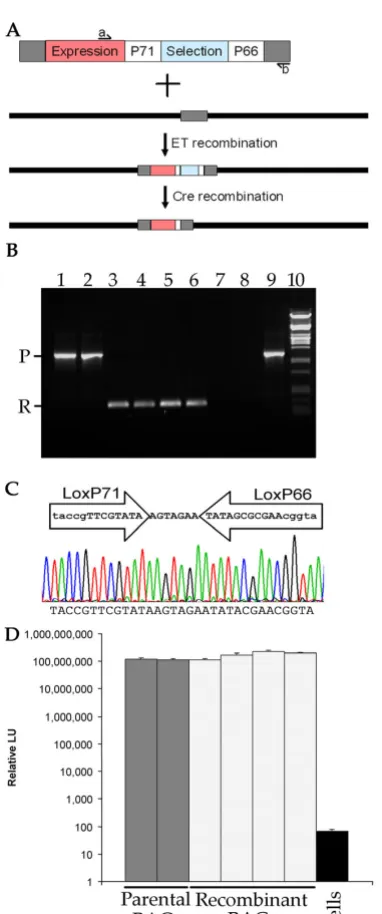
In order to engineer multiple insertions in the AcMNPV genome, the bipartite selection cassette was flanked by modified loxP sites. These sites incorporated both the lox66 and lox71 mutations that limit Cre mediated recom-bination to a single round [29], and a mutation in the spacer reducing homology to the wildtype loxP site. Cre mediated recombination would thus result in the removal of the bipartite selectable marker and inactivation of the lox recombination sites but leave behind the baculovirus expression cassette (Fig. 2A). To confirm this strategy could be used successfully to engineer multiple insertions in the bacmid DNA, Cre recombination was used to remove the bipartite marker from bacmid in which the renilla luciferase reporter had been inserted. Bacmid DNA was purified from four putative recombinants and recom-bination confirmed by PCR using primers flanking the selectable marker (Fig. 2B). All four PCR products were consistent with the size expected for successful Cre recom-bination. This was further confirmed by sequencing across
the modified loxP site of the recombinants (Fig. 2C). To confirm that Cre mediated bacmid recombinants remained viable in insect cells, bacmid DNA was trans-fected into insect cells and luciferase activity assayed after two passages as before. All recombinants had renilla luci-ferase activity that was equivalent to the parental baculo-virus before Cre recombination (Fig. 2D).
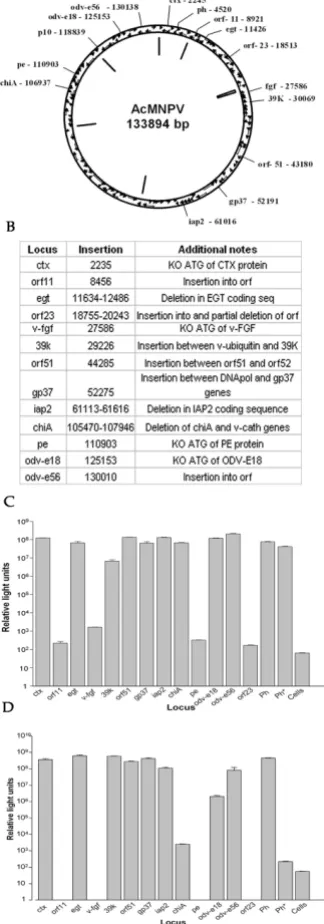
Identification of genetic loci in the baculovirus genome suitable for high level expression of heterologous genes To test whether the new selection could be used efficiently at different baculovirus genetic loci a second round of recombination was carried out using one of the bacmids already containing the renilla luciferase gene. A second reporter, firefly luciferase, under control of the polyhedrin promoter was inserted at a total of thirteen different genetic loci (ctx, orf11, egt, orf23, v-fgf, 39k, orf51, gp37, iap2, chiA, pe, odv-e18 and odv-e56), in each case generat-ing a dual expression baculovirus for Renilla and firefly luciferase (Fig. 3A). Additional changes were made at cer-tain loci to specifically inactivate the expression of the endogenous viral gene (Fig. 3B). Recombinant viruses were passaged twice in Sf9 insect cells and on the third passage cells were harvested at 48 hours post infection, lysed and assayed for both firefly and Renilla luciferase activities. Renilla luciferase activity was used as a reference for virus replication and protein expression as all the recombinants had the same P35 promoter driven Renilla luciferase cassette in the p10 locus. Expression of firefly luciferase at each locus was compared to a virus carrying firefly luciferase gene at the polyhedrin locus. Of the thir-teen loci tested, nine had renilla luciferase activities which were at least 105 fold above background, and of these
eight (ctx, egt, orf51, gp37, iap2, chiA, odv-e18 and odv-e56) had renilla luciferase activity which was equivalent to that of the parental renilla luciferase only control (Fig. 3C). Thus there was no evidence of a general impairment in virus replication or gene expression for these viruses. In contrast, four insertions (orf11, v-fgf, pe and orf23) resulted in virus infections where renilla luciferase activity was within 10 fold of the background and were exluded from further analysis.
Renilla luciferase activity was used as a reference to nor-malise firefly luciferase activity and obtain a measure of relative expression of the firefly luciferase from each locus (Fig. 3D). Seven loci (ctx, egt, 39k, orf51, gp37, iap2 and odv-e56) had firefly luciferase activity which was at least 106 fold higher than background and similar to
Selective removal of marker genes Figure 2
Identification of additional sites for expression of recombinant proteins in the AcMNPV genome Figure 3
There was no clear correlation between the position of a locus within the virus genome and its ability to allow suc-cessful high level expression of the foreign reporter gene (Additional file 1: Figure S1). Nor was there any correla-tion between the level of expression observed for the reporter and that documented for the native gene at the same locus [30].
Simultaneous co-expression of two and four genes to recover virus-like particles
To confirm that the system could successfully express and correctly assemble protein complexes, two well defined virus-like particle (VLP) systems were used as models. VLPs were produced for influenza A virus by co-expressing the M1 and HA proteins of the SC35M strain of influenza [31]. M1 was first inserted at the egt locus and then, fol-lowing removal of the bipartite cassette, the HA gene was inserted into the p10 locus (Fig. 4A). Expression of both proteins was confirmed by SDS-PAGE and Immunoblot analysis (Fig. 4A, left and middle panels) using antibody specific for Influenza A (H7N7). Furthermore, it was pos-sible to purify influenza VLPs from the culture medium of Sf9 cells infected with the recombinant baculovirus. The surface of these VLPs had the characteristic spike appear-ance of an enveloped virus (Fig. 4A, right panel) and it was possible to label these spike structures using immunogold labelling with anti-influenza (H7N7) antibody.
The other VLP made was for the non-enveloped orbivirus, bluetongue virus. VLPs for this virus require the coassem-bly of four proteins (VP2, VP3, VP5 and VP7). Expression of recombinant protein was confirmed by SDS-PAGE analysis (Fig. 4B, left panel) and VLPs with the character-istic morphology of mature BTV particles could be puri-fied from insect cells infected with recombinant baculovirus (Fig. 4B, right panel).
Coexpression of eight genes to recover the mouse CCT complex
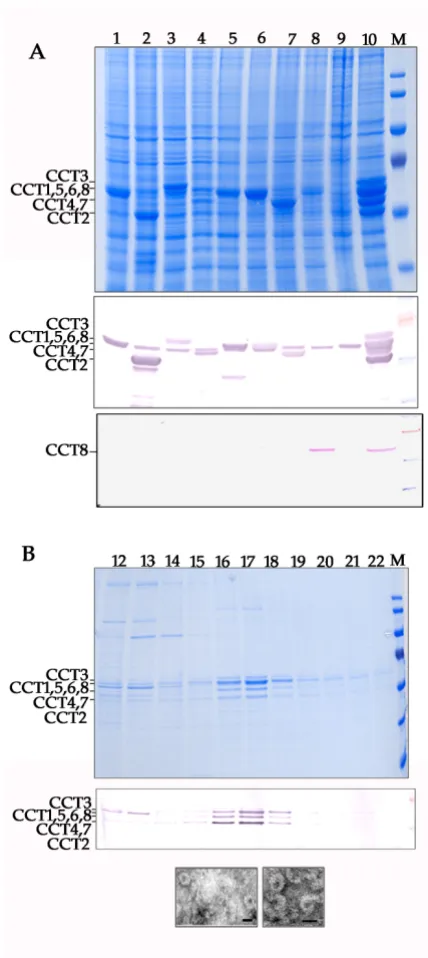
To extend our observations further, and to demonstrate the utility of the muli-locus expression system to the pro-duction of large mammalian protein complexes, the eight subunits of the mouse CCT chaperonin complex (CCT1 to CCT8, respectively) were each expressed from a different locus within the baculovirus genome (Fig. 5A.). All eight subunits were expressed and accumulated in insect cells to detectable levels, although there was a variation in the steady-state levels of protein between subunits. Expressed protein was detected with a polyclonal antibody against a conserved motif of the ATP-binding site of all CCT subu-nits (Fig. 5A middle panel). There was cross reaction between the antibody and some of the subunits of the endogenous insect CCT complex, and it was impossible to confirm the presence of CCT8. To confirm mouse CCT8 was expressed, a duplicate immunoblot was probed with
a monospecific antibody to the CCT8 protein (Fig. 5A bot-tom panel). These data confirmed all eight CCT subunits were expressed using the multi-locus expression approach.
The native CCT chaperone complex consists of a hexa-decamer arranged as two stacked rings of 8 subunits [32,33]. To confirm formation of a complex for the recombinant mouse CCT subunits, we performed rate-zonal centrifugation in 10-40% (w/w) sucrose gradients. The characteristic protein profile for the CCT complex was Expression of virus like particles
Figure 4
Recovery of recombinant mouse CCT complex by co-expression of 8 proteins in the same insect cell Figure 5
detected as a peak following centrifugation (Fig. 5B, top panel lanes 16-17). The identity of these proteins as CCT subunits was confirmed by immunoblotting (Fig. 5B, middle panel). The averaged migration of this complex in the gradient over 3 experiments was consistent with a sed-imentation coefficient of 23.5 +/- 1.1S and was similar to that reported for the native mouse CCT complex[32]. Finally, fractions corresponding with the 23.5S recom-binant mouse CCT complex were visualised by negative staining and electron microscopy (Fig. 5B, bottom panel). It was possible to visualise ring-like structures consistent with those reported with the mouse CCT[32].
Discussion
This report demonstrates that lambda red recombination can be used to efficiently engineer high level expression of recombinant protein and protein complexes from the AcMNPV genome. Using a new bipartite selection system up to 88 fold improvement (p = 0.03) in recovery of recombinants was achieved. All putative recombinants recovered using the bipartite selection were subsequently confirmed to be correctly modified. This is a substantial improvement over the single antibiotic selection [21,28] which in our hands produced a high level of false positive recombinants (recombinants that were apparently chlo-ramphenicol resistant but subsequently did not have the target insertion). Furthermore, there was no requirement to use PCR generated linear DNA for recombination, which avoids potential problems associated with muta-tions introduced by repeated PCR of coding regions. To our knowledge the bipartite selection in this report has not previously been applied to recombination in baculo-virus, although there have been reports of the zeocin resistance gene alone being used for knock out of baculo-virus genes by lambda red recombination[34].
By flanking the ZeoR-LacZα selection with self inactivating
loxP sites it was possible to re-use the selectable markers and carry out iterative selection at multiple loci within the baculovirus genome (Fig. 2). This iterative process itself allows the potential for combining several different subu-nits into the same baculovirus genome in different combi-nations without having to generate a new multi-gene transfer vector for every combination of proteins that is to be expressed.
Despite the extensive protein expression work that has been undertaken in the baculovirus system most expres-sion has focussed on replacement of the polyhedrin or p10 genes. Relatively little literature describes the use of alternative loci for the expression of recombinant protein [10,35-37]. This study identifies seven genetic loci (ctx, egt, 39k, orf51, gp37, iap2 and odv-e56), in addition to pol-yhedrin and p10, suitable for high level expression of for-eign genes.
For the loci that did not give good expression, four (orf11, v-fgf, pe and orf23) also resulted in a reduced expression of a separate marker protein present in all recombinants. This suggests that these insertions resulted in impairment of functions essential for virus replication or gene sion. The low level expression of firefly luciferase expres-sion in the chiA and odv-e18 insertion viruses was unexpected for different reasons. Other reports have recorded insertion of recombinant protein expression cas-settes into the chiA locus [10,11]. It is possible that the reduced level of firefly luciferase expression from this locus in our experiments was due to effects on genes flank-ing the insertion. For odv-e18, recent reports based on deletion within the coding sequence of odv-e18 and the upstream flanking gene have suggested that this protein is essential for budded virus production and cell to cell movement [38,39]. In our experiments, where odv-e18 was inactivated by specific mutation of the start codon and by insertion of the firefly luciferase cassette, there was no evidence from renilla luciferase expression of impair-ment of the ability of this mutant virus to replicate or spread cell to cell. However, given the ~2 log reduction in firefly luciferase levels compared to virus without this insertion, we cannot rule out the possibility that a small population of virus in which the mutation had reverted was complementing the virus expressing the reporter gene.
To confirm the utility of the system for the expression of recombinant protein complexes two-protein and four-protein virus like particles (VLPs) were produced to influ-enza A and bluetongue virus, respectively. VLPs for both these viruses are effective immunogens against the respec-tive pathogen [40-42] and thus represent potential bio-technological applications of the multi-locus expression approach. Both VLPs were formed normally and could be purified from the culture medium (for influenza VLPs), or cells (for BTV), of baculovirus infected cultures. To extend these observations further and to demonstrate the useful-ness of the approach to low abundance mammalian pro-tein complexes we expressed all eight subunits of the mouse CCT complex. This complex is usually purified from testes or by large scale fermentation culture of yeast [32,43,44]. However a reliable source of large quantities of correctly folded recombinant mammalian CCT com-plex was not previously available. It was possible to recover between 1 and 6 mg/L culture of 23.5S CCT com-plex. To our knowledge this is the first report of the suc-cessful expression of mammalian CCT chaperone from a heterologous system, and offers for the first time the pos-sibility of mutational analysis of this essential machinery involved in cytoskeletal protein folding and cell cycle con-trol.
the opportunity to test and manipulate relative expression of each subunit of a complex independently, without any need for recloning into different transfer vectors, and for swapping subunits between complexes, also without need for recloning. Thus, in terms of flexibility, it offers sub-stantial improvement over the current approaches for bac-ulovirus multi-protein complex expression.
Conclusion
1. Use of bipartite selections can significantly improve selection of modified bacterial artificial chromosomes carrying baculovirus DNA. Furthermore this approach is sufficiently robust to allow routine modification of the virus genome. 2. In addition to the commonly used p10 and polyhedrin loci, the ctx, egt, 39k, orf51, gp37, iap2 and odv-e56 loci in AcMNPV are all suitable for the high level expression of heterologous genes. 3. Two protein, four protein and eight protein complexes including virus-like particles and cellular chaperone complexes can be pro-duced using the new approach.
Methods
Cell Lines and Virus
Sf9 and Sf21 cells were cultured at 28°C in Insect-Xpress (Lonza, Basel, Switzerland) and TC100 media (Biochrom AG, Berlin, Germany), respectively. All cells were rou-tinely cultured in the presence of penicillin (100
U)/strep-tomycin (100 μg/ml)/Amphotericin B (250 ng/ml)
(Sigma-Aldrich Chemical Co., St. Louis, Mo.). TC100 medium was supplemented with 10% Foetal bovine serum. Viruses used in this study were based on the cloned AcMNPV genome [3]. For recombinants where protein was expressed from the polyhedrin locus, the BAC10:KO1629 bacmid [28] was used, for all other
expressions a modified version of the bacmid bMON14272 [3] in which the expression of the LacZα fragment had been inactivated was used.
Antibodies
Polyclonal anti influenza H7N7 antibody was a gift from H.D. Klenk (University of Marburg). The pan-CCT anti-body, UM1, and the monospecific CCT8 antibody used were as described [45]. Anti rabbit immunogold antibody was purchased from Sigma-Aldrich. Negative staining was with 2% (w/v) uranyl acetate. All immunoblotting was performed using Immobilon P membrane (Millipore, Billerica, MA) according to the manufacturer's instruc-tions.
Construction of transfer vectors
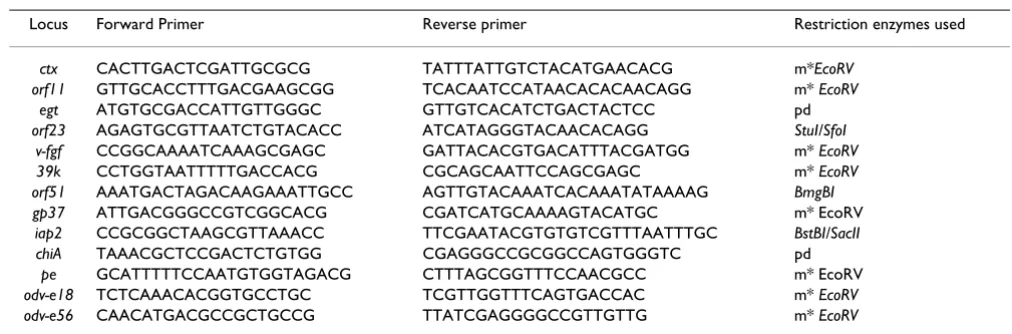
Base expression and selection cassettes with the structure detailed in Fig. 1A, but without flanking AcMNPV were constructed in pBluescript SK (Stratagene, Cedar Creek, Texas). Transfer vectors targeting the different genetic loci within baculovirus were constructed by the general strat-egy of amplification and cloning of the corresponding region of the AcMNPV genome followed either by muta-genesis to introduce a restriction enzyme site, allowing insertion of the base expression and selection cassette, or digestion with restriction enzymes to introduce the same cassette. Details of the primers and restriction enzymes used for each locus are detailed in table 1. All constructs were designed such that a linear DNA fragment contain-ing the AcMNPV flankcontain-ing sequences and the expression and selection cassettes could be released by digestion with BsaI. Where possible, for each locus the expression and selection cassettes were inserted in both orientations and firefly luciferase monitored independently in each
orien-Table 1: Primers used for amplification of sequences for each AcMNPV locus used and restriction enzyme site used for insertion of reporter and expression cassettes.
Locus Forward Primer Reverse primer Restriction enzymes used
ctx CACTTGACTCGATTGCGCG TATTTATTGTCTACATGAACACG m*EcoRV orf11 GTTGCACCTTTGACGAAGCGG TCACAATCCATAACACACAACAGG m* EcoRV
egt ATGTGCGACCATTGTTGGGC GTTGTCACATCTGACTACTCC pd
orf23 AGAGTGCGTTAATCTGTACACC ATCATAGGGTACAACACAGG StuI/SfoI v-fgf CCGGCAAAATCAAAGCGAGC GATTACACGTGACATTTACGATGG m* EcoRV 39k CCTGGTAATTTTTGACCACG CGCAGCAATTCCAGCGAGC m* EcoRV orf51 AAATGACTAGACAAGAAATTGCC AGTTGTACAAATCACAAATATAAAAG BmgBI gp37 ATTGACGGGCCGTCGGCACG CGATCATGCAAAAGTACATGC m* EcoRV
iap2 CCGCGGCTAAGCGTTAAACC TTCGAATACGTGTGTCGTTTAATTTGC BstBI/SacII chiA TAAACGCTCCGACTCTGTGG CGAGGGCCGCGGCCAGTGGGTC pd
pe GCATTTTTCCAATGTGGTAGACG CTTTAGCGGTTTCCAACGCC m* EcoRV
odv-e18 TCTCAAACACGGTGCCTGC TCGTTGGTTTCAGTGACCAC m* EcoRV odv-e56 CAACATGACGCCGCTGCCG TTATCGAGGGGCCGTTGTTG m* EcoRV
tation. For protein expression experiments the coding sequence of each gene was amplified from a cDNA clone of the respective gene and cloned downstream of the pol-yhedrin promoter into the same vectors. For CCT the com-plete set of mouse CCT cDNAs [46] were used.
Luciferase assays
All luciferase assays were completed using the Dual Luci-ferase Reporter Assay system (Promega, Madison, USA) using a Turner Biosciences 20/20 n luminometer accord-ing to the manufacturer's instructions.
Lambda red recombination in E. coli
All bacmids were maintained in the E. coli strain EL350 [47] which was grown at 32°C. Expression of the λbet, exo and gam genes in this lysogen were induced by incubation at 42°C for a 30 minute period immediately harvesting cells for the preparation of batches of cells for electropo-ration. Once prepared, electrocompetent cells were stored at -80°C prior to use. For lambda red recombination 30 ng linear DNA was introduced into recombination com-petent cells by electroporation. Cells were grown for two hours at 32°C and then plated under Kanamycin (50 μg/ ml) Zeocin (15 μg/ml) and IPTG/X-gal (0.2 mM and 40
μg/ml respectively). For modification of BAC10:KO1629 chloramphenicol selection (15 μg/ml) was also included. Plates were incubated at 32°C and blue colonies picked to seed liquid cultures after 24 hours. All preparation of DNA was performed according to standard molecular techniques [48].
Cre recombination in E. coli
Expression of Cre recombinase in EL350 was induced by treatment of mid-log phase cultures with 0.1% Arabinose for 2 hours followed by a change of media and outgrowth for 16 hours at 32°C. Cells were then plated on selective media containing IPTG (0.2 mM), X-Gal (40 μg/m) and kanamycin (50 μg/ml). White colonies were re-streaked onto the same selection after 24 hours and then used to seed liquid cultures.
Purification of VLPs
Bluetongue VLPs were purified from infected Sf9 cells as described [7]. Influenza A (HA/M1) VLPs were purified from the culture medium of infected Sf9 cells at 72 hours post infection. Culture medium was clarified by spinning at 9500 × g for 10 minutes at 4°C before being spun onto a 60% w/v sucrose cushion for 1 hour at 90,000 × g at 4°C in a SW28 rotor to concentrate VLPs. Material on top of the sucrose cushion was then diluted six fold in PBS and loaded onto a 20%-30%-60% (w/w) sucrose step gradient before being spun again for 1 hour at 90,000 × g at 4°C in a SW28 rotor. Material at the 30-60% sucrose interface contained the particles shown in Fig. 5.
Purification of CCT
Sf21 cells were infected with recombinant baculovirus at multiplicity of infection of 3 and harvested at 48-72 hours post infection. Cells were washed in PBS and lysed at room temperature in lysis buffer (50 mM HEPES pH8.0, 100 mM NaCl, 0.05% (v/v) Tergitol NP-9). Nuclei were pelleted at 1000 × g for 5 minutes then cell debris pelleted at 9500 × g for 10 minutes at 4°C. Clarified cell lysate was spun at 100,000 × g at 4°C for 1 hour then serially filtered through 0.5 μm, 0.2 μm and 0.05 μm filters (Pall, East Hills, NY and Spectrum Laboratories, Breda, The Nether-lands). Filtered lysate was concentrated using a centriplus filtration device (Millipore, Billerica, MA) with a 100 kDa cut-off. Concentrated lysate was loaded onto 10-40% (w/ w) continuous sucrose gradients in 50 mM Hepes pH8.0, 100 mM NaCl and spun for 16 hours at 4°C at 30,000 rpm in a SW40 rotor. Following centrifugation 500 μl fractions were collected from the bottom of the tube.
Authors' contributions
RN conceived the project, designed the experiments, car-ried out the research, and wrote the paper. MS, MB and
CC made transfer plasmids for the expression of BTV VP3, VP5 and VP7, respectively. KW provided cDNA and anti-bodies for mouse CCT. He also provided substantial guid-ance on the best purification strategies for this protein complex. PR contributed to the design of experiments, provided expertise for purification of bluetongue VLPs and secured funding for the project. All authors were involved in the revision of the draft manuscript and have agreed the final content.
Additional material
Acknowledgements
This work was supported by the Biotechnology and Biological Sciences Research Council, UK. The authors would like to gratefully acknowledge the gift of cDNA for influenza A SC35M and polyclonal antibody from H.D. Klenk (University of Marburg), the E. coli strain EL350 from C.T. Dolphin (King's College, London), and the bacmid BAC10:KO1629 from I.M. Jones (University of Reading).
References
1. Summers MD: Milestones leading to the genetic engineering of baculoviruses as expression vector systems and viral pesti-cides. Adv Virus Res 2006, 68:3-73.
2. Ayres MD, Howard SC, Kuzio J, Lopez-Ferber M, Possee RD: The complete DNA sequence of Autographa californica nuclear polyhedrosis virus. Virology 1994, 202(2):586-605.
Additional file 1
Figure S1. PDF file containing supplementary figure. Click here for file
3. Luckow VA, Lee SC, Barry GF, Olins PO: Efficient generation of infectious recombinant baculoviruses by site-specific trans-poson-mediated insertion of foreign genes into a baculovirus genome propagated in Escherichia coli. J Virol 1993,
67(8):4566-4579.
4. Smith GE, Summers MD, Fraser MJ: Production of human beta interferon in insect cells infected with a baculovirus expres-sion vector. Mol Cell Biol 1983, 3(12):2156-2165.
5. Kitts PA, Possee RD: A method for producing recombinant baculovirus expression vectors at high frequency. Biotech-niques 1993, 14(5):810-817.
6. Emery VC, Bishop DH: The development of multiple expres-sion vectors for high level synthesis of eukaryotic proteins: expression of LCMV-N and AcNPV polyhedrin protein by a recombinant baculovirus. Protein Eng 1987, 1(4):359-366. 7. French TJ, Marshall JJ, Roy P: Assembly of double-shelled,
virus-like particles of bluetongue virus by the simultaneous expression of four structural proteins. J Virol 1990,
64(12):5695-5700.
8. Latham T, Galarza JM: Formation of wild-type and chimeric influenza virus-like particles following simultaneous expres-sion of only four structural proteins. J Virol 2001,
75(13):6154-6165.
9. Pushko P, Bray M, Ludwig GV, Parker M, Schmaljohn A, Sanchez A, Jahrling PB, Smith JF: Recombinant RNA replicons derived from attenuated Venezuelan equine encephalitis virus protect guinea pigs and mice from Ebola hemorrhagic fever virus. Vaccine 2000, 19(1):142-153.
10. Berger I, Fitzgerald DJ, Richmond TJ: Baculovirus expression sys-tem for heterologous multiprotein complexes. Nat Biotechnol
2004, 22(12):1583-1587.
11. Fitzgerald DJ, Berger P, Schaffitzel C, Yamada K, Richmond TJ, Berger I: Protein complex expression by using multigene baculoviral vectors. Nat Methods 2006, 3(12):1021-1032.
12. French TJ, Roy P: Synthesis of bluetongue virus (BTV) corelike particles by a recombinant baculovirus expressing the two major structural core proteins of BTV. J Virol 1990,
64(4):1530-1536.
13. Weyer U, Possee RD: A baculovirus dual expression vector derived from the Autographa californica nuclear polyhedro-sis virus polyhedrin and p10 promoters: co-expression of two influenza virus genes in insect cells. J Gen Virol 1991, 72(Pt 12):2967-2974.
14. Bertolotti-Ciarlet A, Ciarlet M, Crawford SE, Conner ME, Estes MK:
Immunogenicity and protective efficacy of rotavirus 2/6-virus-like particles produced by a dual baculovirus expres-sion vector and administered intramuscularly, intranasally, or orally to mice. Vaccine 2003, 21(25-26):3885-3900.
15. Kamita SG, Maeda S, Hammock BD: High-frequency homologous recombination between baculoviruses involves DNA replica-tion. J Virol 2003, 77(24):13053-13061.
16. Crouch EA, Passarelli AL: Genetic requirements for homolo-gous recombination in Autographa californica nucleopolyhe-drovirus. J Virol 2002, 76(18):9323-9334.
17. Mikhailov VS, Okano K, Rohrmann GF: Baculovirus alkaline nuclease possesses a 5'-->3' exonuclease activity and associ-ates with the DNA-binding protein LEF-3. J Virol 2003,
77(4):2436-2444.
18. Pijlman GP, Born E van den, Martens DE, Vlak JM: Autographa cal-ifornica baculoviruses with large genomic deletions are rap-idly generated in infected insect cells. Virology 2001,
283(1):132-138.
19. Pijlman GP, van Schijndel JE, Vlak JM: Spontaneous excision of BAC vector sequences from bacmid-derived baculovirus expression vectors upon passage in insect cells. J Gen Virol
2003, 84(Pt 10):2669-2678.
20. Datsenko KA, Wanner BL: One-step inactivation of chromo-somal genes in Escherichia coli K-12 using PCR products. Proc Natl Acad Sci USA 2000, 97(12):6640-6645.
21. Lin G, Blissard GW: Analysis of an Autographa californica nucleopolyhedrovirus lef-11 knockout: LEF-11 is essential for viral DNA replication. J Virol 2002, 76(6):2770-2779.
22. Vanarsdall AL, Pearson MN, Rohrmann GF: Characterization of baculovirus constructs lacking either the Ac 101, Ac 142, or the Ac 144 open reading frame. Virology 2007, 367(1):187-195.
23. Fang M, Dai X, Theilmann DA: Autographa californica multiple nucleopolyhedrovirus EXON0 (ORF141) is required for effi-cient egress of nucleocapsids from the nucleus. J Virol 2007,
81(18):9859-9869.
24. Yamagishi J, Burnett ED, Harwood SH, Blissard GW: The AcMNPV pp31 gene is not essential for productive AcMNPV replica-tion or late gene transcripreplica-tion but appears to increase levels of most viral transcripts. Virology 2007, 365(1):34-47.
25. Stewart TM, Huijskens I, Willis LG, Theilmann DA: The Autographa californica multiple nucleopolyhedrovirus ie0-ie1 gene complex is essential for wild-type virus replication, but either IE0 or IE1 can support virus growth. J Virol 2005,
79(8):4619-4629.
26. Kamita SG, Nagasaka K, Chua JW, Shimada T, Mita K, Kobayashi M, Maeda S, Hammock BD: A baculovirus-encoded protein tyro-sine phosphatase gene induces enhanced locomotory activ-ity in a lepidopteran host. Proc Natl Acad Sci USA 2005,
102(7):2584-2589.
27. Milks ML, Washburn JO, Willis LG, Volkman LE, Theilmann DA:
Deletion of pe38 attenuates AcMNPV genome replication, budded virus production, and virulence in heliothis vires-cens. Virology 2003, 310(2):224-234.
28. Zhao Y, Chapman DA, Jones IM: Improving baculovirus recom-bination. Nucleic Acids Res 2003, 31(2):E6-6.
29. Albert H, Dale EC, Lee E, Ow DW: Site-specific integration of DNA into wild-type and mutant lox sites placed in the plant genome. Plant J 1995, 7(4):649-659.
30. Jiang SS, Chang IS, Huang LW, Chen PC, Wen CC, Liu SC, Chien LC, Lin CY, Hsiung CA, Juang JL: Temporal transcription program of recombinant Autographa californica multiple nucleopolyhe-drosis virus. J Virol 2006, 80(18):8989-8999.
31. Scheiblauer H, Kendal AP, Rott R: Pathogenicity of influenza A/ Seal/Mass/1/80 virus mutants for mammalian species. Arch Virol 1995, 140(2):341-348.
32. Lewis VA, Hynes GM, Zheng D, Saibil H, Willison K: T-complex polypeptide-1 is a subunit of a heteromeric particle in the eukaryotic cytosol. Nature 1992, 358(6383):249-252.
33. Liou AK, Willison KR: Elucidation of the subunit orientation in CCT (chaperonin containing TCP1) from the subunit com-position of CCT micro-complexes. EMBO J 1997,
16(14):4311-4316.
34. Dai X, Stewart TM, Pathakamuri JA, Li Q, Theilmann DA:
Autographa californica multiple nucleopolyhedrovirus exon0 (orf141), which encodes a RING finger protein, is required for efficient production of budded virus. J Virol 2004,
78(18):9633-9644.
35. Belyaev AS, Hails RS, Roy P: High-level expression of five foreign genes by a single recombinant baculovirus. Gene 1995,
156(2):229-233.
36. Vlak JM, Schouten A, Usmany M, Belsham GJ, Klinge-Roode EC, Maule AJ, Van Lent JW, Zuidema D: Expression of cauliflower mosaic virus gene I using a baculovirus vector based upon the p10 gene and a novel selection method. Virology 1990,
179(1):312-320.
37. Braunagel SC, Elton DM, Ma H, Summers MD: Identification and analysis of an Autographa californica nuclear polyhedrosis virus structural protein of the occlusion-derived virus enve-lope: ODV-E56. Virology 1996, 217(1):97-110.
38. McCarthy CB, Dai X, Donly C, Theilmann DA: Autographa califor-nica multiple nucleopolyhedrovirus ac142, a core gene that is essential for BV production and ODV envelopment. Virol-ogy 2008, 372(2):325-339.
39. McCarthy CB, Theilmann DA: AcMNPV ac143 (odv-e18) is essential for mediating budded virus production and is the 30th baculovirus core gene. Virology 2008, 375(1):277-291. 40. Roy P, Bishop DH, LeBlois H, Erasmus BJ: Long-lasting protection
of sheep against bluetongue challenge after vaccination with virus-like particles: evidence for homologous and partial het-erologous protection. Vaccine 1994, 12(9):805-811.
41. Roy P, French T, Erasmus BJ: Protective efficacy of virus-like par-ticles for bluetongue disease. Vaccine 1992, 10(1):28-32. 42. Galarza JM, Latham T, Cupo A: Virus-like particle vaccine
con-ferred complete protection against a lethal influenza virus challenge. Viral Immunol 2005, 18(2):365-372.
Publish with BioMed Central and every scientist can read your work free of charge "BioMed Central will be the most significant development for disseminating the results of biomedical researc h in our lifetime."
Sir Paul Nurse, Cancer Research UK
Your research papers will be:
available free of charge to the entire biomedical community
peer reviewed and published immediately upon acceptance
cited in PubMed and archived on PubMed Central
yours — you keep the copyright
Submit your manuscript here:
http://www.biomedcentral.com/info/publishing_adv.asp
BioMedcentral
complex containing TCP-1 and structurally related subunits. EMBO J 1992, 11(13):4767-4778.
44. Pappenberger G, McCormack EA, Willison KR: Quantitative actin folding reactions using yeast CCT purified via an internal tag in the CCT3/gamma subunit. J Mol Biol 2006, 360(2):484-496. 45. Hynes G, Kubota H, Willison KR: Antibody characterisation of
two distinct conformations of the chaperonin-containing TCP-1 from mouse testis. FEBS Lett 1995, 358(2):129-132. 46. Kubota H, Hynes G, Carne A, Ashworth A, Willison K:
Identifica-tion of six Tcp-1-related genes encoding divergent subunits of the TCP-1-containing chaperonin. Curr Biol 1994, 4(2):89-99. 47. Lee EC, Yu D, Martinez de Velasco J, Tessarollo L, Swing DA, Court DL, Jenkins NA, Copeland NG: A highly efficient Escherichia coli-based chromosome engineering system adapted for recombinogenic targeting and subcloning of BAC DNA. Genomics 2001, 73(1):56-65.