http://www.sciencepublishinggroup.com/j/ajep doi: 10.11648/j.ajep.20170601.13
ISSN: 2328-5680 (Print); ISSN: 2328-5699 (Online)
Validation of Geant4 Physics Models Relevant for Space
Radiation
V. Satya Prakash
Department of Physics, Government Degree College, Medak, India
Email address:
To cite this article:
V. Satya Prakash. Validation of Geant4 Physics Models Relevant for Space Radiation. American Journal of Environmental Protection.
Vol. 6, No. 1, 2017, pp. 18-25. doi: 10.11648/j.ajep.20170601.13
Received: January 20, 2017; Accepted: February 15, 2017; Published: March 6, 2017
Abstract:
In order to use GEANT4 toolkit in the energies relevant to the space radiation it has been tested few of electromagnetic and hadronic models of it by comparing simulated values with NIST data and other experimental data available. For the validation of electromagnetic models energy-loss and electronic stopping powers are considered whereas for the validation of hadronic models, isotope production cross-sections and total fragmentation cross-sections are considered. The stopping power values simulated for protons in Al are agreeing very well with NIST database values. The energy-loss and residual energy values simulated for alpha particles in Si and Al respectively are in good agreement with experimental values at high energies and low-thicknesses of target materials. The stopping power values of alpha particles and Fe ions in Al are also agreeing well with tabulated values at the small thickness of target materials. The proton - proton production cross-section values for liquid hydrogen and polyethylene are within the limits of experimental errors. Although total fragmentation cross-sections for Fe ions in polyethylene and aluminum are not agreeing with the experimental values at low energies, they are agreeing at the peak of GCR spectrum which is around 1 GeV/nucleon. So the selected physics models used in the present simulation work can be used for the space radiation protection studies.Keywords:
Geant4, Space Radiation Protection, Electromagnetic Interactions, Hadronic Interactions1. Introduction
Geant4 – Geometry And Tracking (version 4) is a toolkit for the simulation of particle interactions and transport through the matter [1]. It is modular software written in object oriented frame work. It is capable of dealing with the interactions of leptons, photons, hadrons and ions. It provides a number of physics models to deal with the particle and matter interactions in the wide range of energies corresponding from thermal neutrons to cosmic rays [2, 3, 4, 9, 12]. So it is used in diversified areas like medical physics and space radiation protection etc. apart from detector simulations.
Space radiation is made of Galactic Cosmic Rays (GCR), Solar Particle Events (SPE) and Tapped radiation. The GCR radiation originating from outside the solar system consists of 98% baryons and 2% electrons. The baryonic component in turn consists of 85% protons, 14% helium nuclei and 1% heavier nuclei with typical energies up to 10 eV [7]. However, the number of such high energy particles near the
earth orbit is very small but the typical energies of high intensity particles extend from 100 MeV to 10 GeV [11]. The peak of the GCR spectra is around the 1 GeV/nucleon for all ions [7]. The SPE radiation originating from Coronal Mass Ejections of the Sun consists of the majority of protons and a small fraction of heavier nuclei with energies up to several GeV. The trapped radiation originating from the interactions of GCR and SPE radiation with earth’s geomagnetic field appear in the form of van Allen Belts around the earth. Inner belt of van Allen Belts consists of protons and electrons, whereas the outer belt consists of only electrons. The typical energies of electrons are up to 7 MeV whereas the energies of protons are up to 600 MeV [7].
electromagnetic physics models suitable up to 10 GeV. So it has been tested both Geant4 electromagnetic and hadronic physics models suitable for space radiation interaction and transport in that whole energy range. For the simulation purpose a Dell laptop with configuration- 8 GB RAM, i5 processor, 2.20 GHz clock speed and windows10 Operating System is used in the present work. The Geant4 toolkit Version 4.10.1. p02 software is installed on this laptop to do the simulation work.
2. Physics Models
The electromagnetic and hadronic interactions are simulated separately by using the Physics Models of Geant4 Version 4.10.1. p02. G4DecayPhysics is also used as general physics model in both cases in addition to the respective physics models selected.
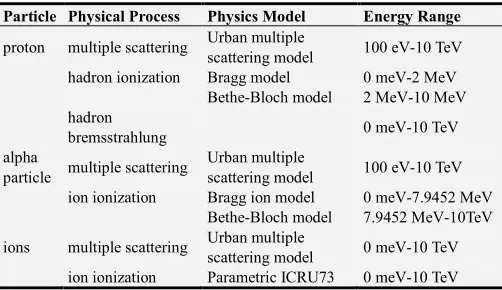
G4EmStandardPhysics_option3 is used for the simulation of electromagnetic interactions. By choosing this physics the following electromagnetic processes are automatically applied for different particles in different energy ranges: (only few important particles and processes are shown)
Table 1. Physical processes applicable for different particles as part of G4EmStandardPhysics_option3.
Particle Physical Process Physics Model Energy Range
proton multiple scattering Urban multiple
scattering model 100 eV-10 TeV
hadron ionization Bragg model 0 meV-2 MeV
Bethe-Bloch model 2 MeV-10 MeV hadron
bremsstrahlung 0 meV-10 TeV
alpha
particle multiple scattering
Urban multiple
scattering model 100 eV-10 TeV
ion ionization Bragg ion model 0 meV-7.9452 MeV
Bethe-Bloch model 7.9452 MeV-10TeV
ions multiple scattering Urban multiple
scattering model 0 meV-10 TeV
ion ionization Parametric ICRU73 0 meV-10 TeV
Hadronic interactions are simulated by using a suitable choice of three physics models: G4HadronElasticPhysics for hadron elastic processes, G4HaronPhysics QGSP_BERT_HP for hadron inelastic processes and G4IonQMDPhysics for generic ions.
By choosing this Physics the following hadronic processes are automatically applied for different particles in different energy ranges: (only few important particles and processes are shown)
Table 2. Physical processes applicable for different particles as a part of G4HaronPhysicsQGSP_BERT_HP and G4IonQMDPhysics.
Particle Physical Process Physical Model Energy Range
proton proton inelastic QGSP model 12 GeV-100 TeV
FTFP model 9.5 GeV-25 GeV
Bertini cascade
model 0 meV-9.9 GeV
alpha
particle / ion alpha inelastic
Binary light ion
cascade model 0 meV-110 MeV
QMD model 100 MeV-10GeV
FTFP model 9.9 GeV - 1TeV
3. Methods
For the validation of Geant4 physics models it has been considered four parameters: energy loss, electronic stopping power, isotopic production cross-section and total fragmentation cross-section.
Energy-loss of charged particle is given by:
Energy- loss = - (in MeV/cm) (1)
where dE is the average energy imparted by the particle (in MeV)
and dx is the distance travelled by the particle (in cm). In simulations dx is considered as the thickness of target material and is chosen to be small so that it is always smaller than the range of incident particle in a given target material.
The stopping power is given by:
Stopping power = energy loss/density of target material (2)
(in MeV cm2/g)
The total proton-proton production cross-sections are calculated by:
Isotope production cross-section
( ) =
(in mb) (3)
where N is the number of isotopic species produced is the number of target atoms per unit volume (in /cm3) t is the thickness of the target (in cm)
and is the number of incident particles
The total fragmentation cross-sections for Fe 26 ions are calculated by:
Total fragmentation cross-section
( )= (!( !"#/!%&')
)* (in mb) (4)
where +, is the mass number of the target material
is the number of incident ions before the target
- is the number of incident ions after the target
ρ is the density of the target material (in g/cm3) t is the thickness of the target (in cm)
and . is the Avagadro Number
In carrying out the simulations - the number of particles, intensity and focusing of beam are considered as factors which play no role in the evaluation of isotopic and total fragmentation cross sections. The number of particles used in the simulation only affects the amount of statistical error which is of order /
√!, where N is the number of particles. So
4. Results
It has been simulated few experiments by using Geant4 toolkit and simulated parameters are compared to the experimental and tabulated values in the present work. For electromagnetic interactions energy-loss and electronic stopping powers are calculated whereas for hadronic interactions isotope production cross-sections and total fragmentation cross-sections are calculated in the simulations.
4.1. Electromagnetic Physics Simulation Results
Aluminum slab of area 10 mx10 m and thickness 20 g/cm2 is constructed and a beam of 10000 protons emerging from a plane of same area as slab made to incident normally on the slab. The energies of protons are chosen from 200 MeV to 10000 MeV and the corresponding stopping powers are calculated. The values calculated in the simulation are compared with the NIST database values [5]. The values are in good agreement with the NIST data for proton energies near 10000 MeV as reported in Figure 1.
Figure 1. Comparison of simulated and tabulated stopping power values of protons in Aluminum.
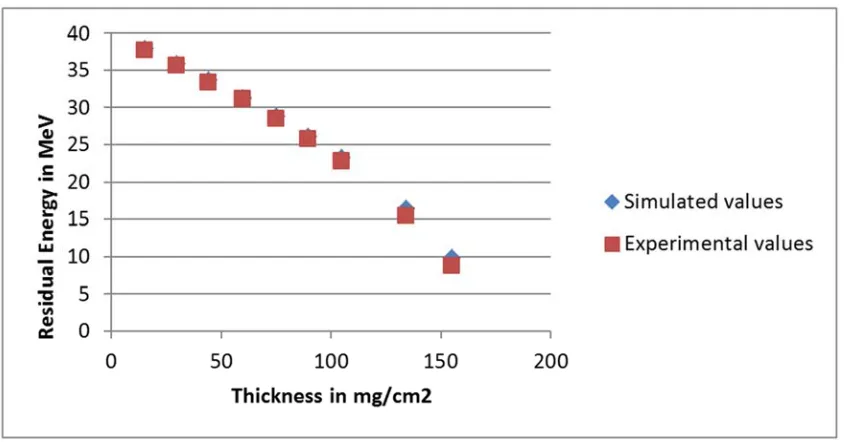
It has been found the residual energy of 40 MeV alpha particles in the aluminum slab of area 10mx10m and thickness varying from 15.2 mg/cm2 to 155.2 mg/cm2. The
simulated values are in good agreement with the experimental values [13] when the thickness of aluminum slab is small as reported in Figure 2.
Figure 2. Comparison of the simulated and experimental values of residual energies of alpha particles in different thicknesses of Al material.
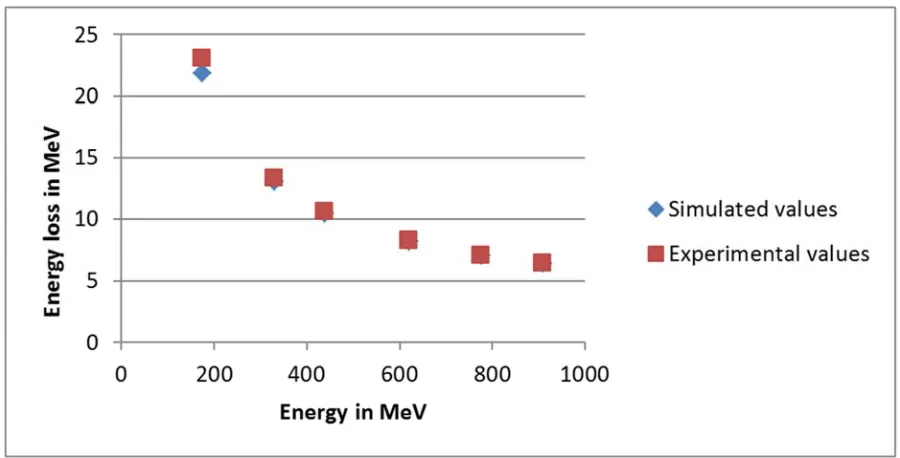
It has also been found the energy-loss of alpha particles in detector material silicon of area 10 mx10 m and thickness 0.48 g/cm2. Alpha particles emerging from plane of same area as Si slab allowed to incident normally on Si slab with
Figure 3. Comparison of simulated and experimental energy-loss values at different energies of alpha particles in Silicon slab.
Stopping power values of alpha particles in aluminum slab of area 10 mx10 m and thickness of 5 g/cm2 are simulated. For this purpose Al slab is made to incident normally by 10000 alpha particles emerging from a plane of same area as aluminum slab and simulated values are compared with the
NIST database vales. The values are in good agreement with the NIST database values as in the case of protons. The values are approaching the NIST data base values when energy increases from 600 MeV to 1000 MeV as reported in Figure 4.
Figure 4. Comparison of simulated and tabulated stopping power values of alpha particles in aluminum slab.
Figure 5. Comparison of simulated and tabulated stopping-power values of Fe in Al.
4.2. Hadronic Physics Simulation Results
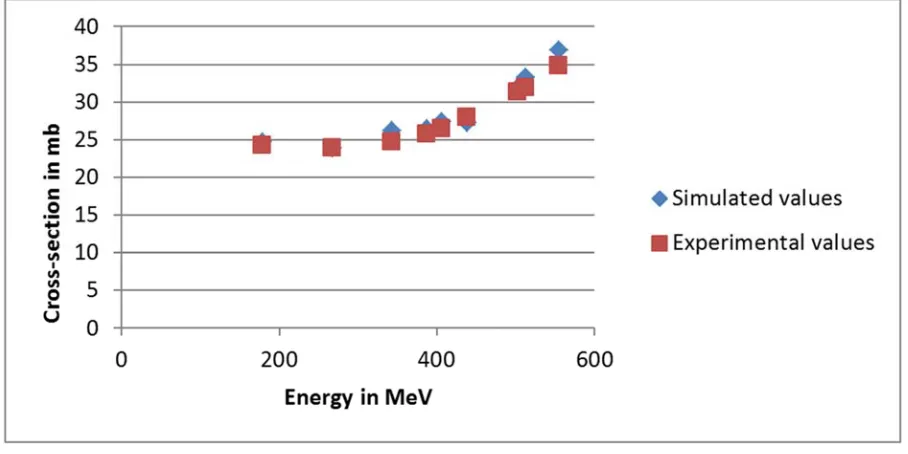
In order to test hadronic physics an experiment [14] is constructed and total proton–proton cross-sections for materials hydrogen and polyethylene are calculated. First a liquid hydrogen cylinder of 16 cm diameter and 75 cm
thickness is constructed and a beam of 10000 protons with different energies made to incident parallel to the length of the cylinder. The simulated proton cross-section values for liquid hydrogen are in good agreement with the experimental values from 179 MeV to 555 MeV as reported in Figure 6.
Figure 6. Comparison of proton-proton production cross-sections at different energies of protons in liquid hydrogen material.
Figure 7. Comparison of proton-proton cross-sections at different energies of protons in polyethylene material.
It has also been simulated an experiment [6] and calculated total fragmentation cross-sections for Fe ions in Al and polyethylene targets in the energy range of 0.3 A GeV to 10 A GeV. For this purpose a polyethylene slab of area 5 m x 5 m and thickness 1 cm is used as target and a beam of 2000 Fe
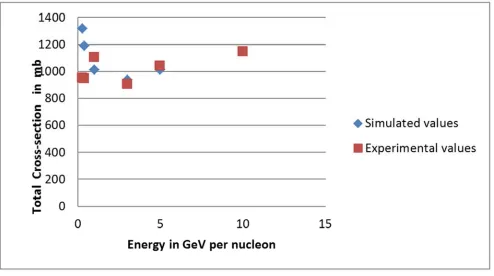
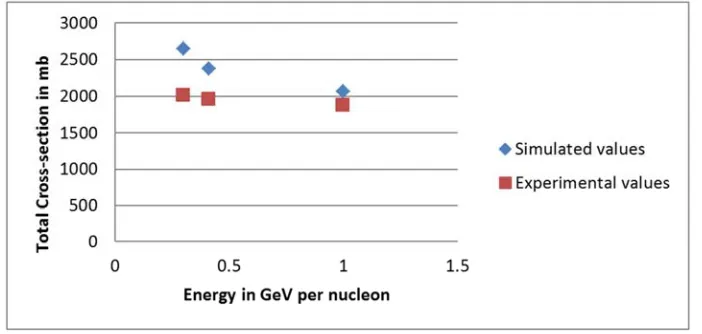
ions is made to incident normally on the target. The calculated total fragmentation cross-section values are in agreement with the experimental values within the experimental error of 10%, except at lower energies as reported in Figure 8.
Figure 8. Comparison of total fragmentation cross-sections at different energies of Fe ions in polyethylene material.
Figure 9. Comparison of total fragmentation cross-sections at different energies of Fe ions in aluminum material.
5. Discussion
The electromagnetic models used in the simulations are well describing the interactions for protons. The simulation results for electronic stopping powers are well agreeing with NIST database values particularly at high energies. In case alpha particles simulated values of energy-loss for Si material are in good agreement with experimental values near 910 MeV. In case of alpha particles of 40 MeV on the aluminum material of various thicknesses the simulated values of residual energy are also in good agreement with experimental values at the lower thickness values of the material. Furthermore simulated values of stopping powers for alpha particles in Al material are also in good agreement with NIST database values as one goes from 600 MeV-1000 MeV. The physical model applied in simulations in this energy range is Bethe-Bloch model with Shell, Barkas, and Bloch and density effect corrections. NIST data tables are also developed based on the same theory in this energy range. So any small discrepancies in results are due to the simulation setup but not due to the physical models. This is true because it is observed in the simulations that by reducing the Al target thickness for alpha particles of given energy the discrepancies are largely reduced.
Simulated values of stopping powers for heavy ion Fe in Al material are also agreeing with the tabulated values from 300 MeV to 500 MeV [10]. In Geant4 simulations parameterized ICRU73 model is used whereas in the tabulated values a new parameterized model is used. But still the results are in good agreement with each other. So in selected energy range of simulation both models are giving equivalent description of electromagnetic interactions of heavy ions like Fe. But the experimental values and their agreement with these values only confirm the validity of each model.
So at high energies and small thickness of materials electromagnetic models are fairly well describing the electromagnetic interactions. The reason for this is, for the small thickness at a given energy or for the given thickness at a relatively high energy matches the conditions of applicability of the energy loss or stopping power formula used in the simulations. So any small discrepancies at lower
energies need not be taken as the flaw in the physical models of the interactions. Hence the models used for the simulation of electromagnetic interactions of space radiation can be used for space radiation protection studies.
The hadronic physics models are very well describing the proton–proton collisions and subsequent proton production cross-sections from 179 MeV to 555 MeV. The proton - proton production cross-section values are within the limits of experimental errors. The physical model used here for protons is Bertini Cascade Model. Even though this model giving good results for protons, it does not work for ions. The simulated total fragmentation cross-section values for Fe ions in polyethylene and aluminum material from 0.30 GeV to 10 GeV are agreeing with experimental values except at low energies. At low energies the values of cross-sections are beyond the experimental errors of about 10%. The physics model used in Geant4 simulations here is the Ion QMD model. Since this is the naïve QMD model which can be applied directly in Geant4, it is not fully describing the ion interactions. This model is giving discrepancies beyond the limits of experimental error at low energies in case of both polyethylene and aluminum. So an improved QMD model can be used to get the more precise results. However, this model can be used for the preliminary analysis of space radiation protection because the results are good at the peak of GCR spectrum which is around 1GeV/nucleon for all ions. So the hadronic interaction models used in present simulations can be used for an approximate analysis of space radiation protection.
In the present simulation work it has been used the Geant4 Reference Physics Lists. Instead of this one can use - for each particle and for each process a specific physics model of Geant4 or its interfaces to other models from other codes. So there is a scope for further optimization of the physics models used in the space radiation protection studies based on the validation results of the present models used in this simulation work.
6. Conclusions
well as hadronic processes of components of space radiation – protons, alpha particles as well as Fe ions are tested and validated. Validation tests indicate that electromagnetic physics models for space radiation protons, alpha particles and Fe ions are agreeing well with the tabulated values. Furthermore, the experimental values of energy loss and residual energy of alpha particles are also in good agreement with simulation results at the small thicknesses target materials or at high energies of alpha particles. Since small discrepancies at large thicknesses or low energies are only the simulation setup issue, the electromagnetic models are well describing the space radiation interactions. The proton – proton production cross-section values are also agreeing well with the experimental results within the given error limit of 1-3% in the tested energy range. The total fragmentation cross-sections for Fe ions are also agreeing with the experimental values within the experimental error of about 10%, except at low energies. Furthermore results at the peak of GCR spectrum which is around 1GeV/nucleon are agreeing well with the experimental values for both polyethylene and aluminum. So hadron physics models are approximately well describing the space radiation interactions. So the electromagnetic and hadronic physics models used in this simulation work can be used for the space radiation protection studies. Furthermore, based on the results of this work, there is the scope for further optimization of physics used in space radiation protection studies.
Acknowledgements
I wish to thank Prof S. R. Hassan, Institute of Mathematical Sciences (I. M. Sc) Chennai, India, for reading the manuscript of the paper and giving valuable suggestions. I also wish to thank the Geant4 collaboration for utilizing their Geant4 toolkit software version 4.10.1.p02 in the simulations.
This work is supported by University Grants Commission (U. G. C) of India under Minor Research Project Grant No. F MRP- 4791/14 (SERO/UGC).
References
[1] Agostinelli, S., Allison, J., Amako, K., et al., 2003, ‘GEANT4- a simulation toolkit’, Nucl. Instr. and Meth. A, vol.506, pp. 250-303.
[2] Allison, J., Amako, K., Apostolakis, J., et al., 2006, ‘Geant4
developments and applications’, IEEE Trans. Nucl. Sci., vol.53, no.1, pp. 270-278.
[3] Apostolakis, J., Asai, M., Bogdanov, A. G., et al., 2009, ‘Geometry and physics of the Geant4 toolkit for high and medium energy applications’,Radiation Physics and Chemistry, vol. 78, pp. 859-873.
[4] Apostolakis, J., Asai, M., Bagulya, A., et al., 2015, ‘Progress in Geant4 Electromagnetic Physics Modelling and Validation’, Journal of Physics: Conference Series, 664072021. doi: 10.1088 / 1742-6596/ 664/7/072021
[5] Berger, M. J., Coursey, J. S., Jucker, M. A., et al., 2005, ‘ESTAR, PSTAR and ASTAR: Computer Programs for Calculating Stopping Power and Range Tables for Electrons, Protons and Helium Ions (version1.2.3)’‹http://www. nist. gov/Star› [29 Dec 2015]
[6] Cecchini, S., Chiarusi T., Giacomelli, G., et al., 2008, ‘Fragmentation cross sections of 12 34, 67/84 and 934 ions of 0.3-10A GeV on polyethylene, CR39 and aluminum targets’, Nuclear Physics A, vol.807, pp. 206-213.
[7] Durante, M., and Francis A. Cucinotta., 2011, ‘Physical basis of radiation protection in space travel’, Rev. Mod. Phys., vol.83, no.4, pp. 1245-1281.
[8] Filomena Loffredo, Mariagabriella Pugliese, Maria Quarto et al., 2015,‘Validation of Electromagnetic Physical Processes with Software SPENVIS’,Vol.4,no.6,pp.275-278. doi:10.11648 / j. ajep.20150406.12
[9] Geant4 Physics Reference Manual
‹www://geant4.web.cern.Ch
/geant4/UserDocumentation/UserGuides/PhysicsReferenceMa nual /fo/PhysicsReferenceManual. pdf› [14 Oct 2015] [10] Hubert, F., Rimbot, R., Gauvin, H., et al., 1990, ‘Range and
Stopping-Power Tables for 2.5 – 500 MeV/nucleon Heavy Ions in Solids’, Atomic Data and Nuclear Data Tables, vol.46, pp. 1-213.
[11] Li-Chun Wang, Dong-Hai Zhang, Shiwei Yan et al., 2012, ‘Fragmentation cross sections of 56<= at 471 A MeV on Al, C and CH2 Targets’, Acta Physica Polonica B, vol.43, no.8, pp. 1769-1782.
[12] Makato Asai, Andrea Dotti., Marc Verderi., et al., 2014, ‘Recent Developments in Geant4’, Ann. Nucl. Energy. ‹http://dx. doi.org /10.1016/j. anucene.2014.08.021›
[13] Mudundi R. Raju, 1965, ‘Heavy particle studies with silicon detectors’, University of California Research Laboratory Report, UCRL- 16354.