Frequent Pattern Mining and Analysis in DNA
Subsequence
Kirti Mirgal Dr. Satishkumar Varma
M.E Student Associate Professor and Head of Department Department of Computer Engineering Department of Information Technology
PIIT, Navi Mumbai, India PIIT, Navi Mumbai, India
Abstract
The Frequent Pattern Mining (FPM) algorithms help to mine sub sequences. The subsequence can be non-contiguous and contiguous patterns. The mining of such patterns is an important problem. The mining of such patterns require efficient mining algorithm. It has various applications like discovery of motifs in DNA sequences, financial industry, the analysis of web log, customer shopping sequences and the investigation of scientific or medical processes etc. A more appropriate algorithm for pattern matching is needed. In this work, the approximate pattern matching algorithm is used for finding approximate subsequence. The proposed method is experimented for matching the frequent approximate sub sequences. This method is used to check whether two or more sequences match or to find the occurrence of such pattern. The method is effective since it will always find the pattern if the pattern exists.
Keywords: Data Mining, Sequence Mining, Frequent Patterns, Suffix Tree
________________________________________________________________________________________________________
I. INTRODUCTION
Sequential pattern mining deals with data in large sequential data sets. Sequence mining has gained popularity in marketing in retail industry, biomedical research, DNA sequence patterns, financial industry. It is most common applications are discovery of motifs in DNA sequences, financial industry use data mining to identify interesting share price movements, the analysis of web log for web usage, customer shopping sequences and the investigation of scientific or medical processes and so on. The results of pattern mining can be used for business management marketing, planning and prediction. The difficulty in discovering frequent patterns is to allow for some noise in the matching process. The most important part of pattern discovery is the definition of a pattern and similarity between two patterns which may vary from one application to another.
Mining of such sequences are important in many applications. The transaction sequences in market-basket analysis have big set of alphabets with small length; on the other hand, biological sequences are composed of small set of alphabets of long length with gap. So the algorithms for finding patterns from these two sequences are different. The repeated occurrence of small patterns in biological sequences is more than in the transaction sequences. These small patterns which occur often are known as Frequent Patterns. The challenging job in pattern finding is to find the frequent patterns in bio-sequences. Frequent pattern helps genetic discovery, functional analysis and also helps to form an entire genome of species.
In this paper we focus on repeated occurrences of short approximate sequences, i.e. occurrences are not always identical such sub sequences is also called as frequently occurring approximate sequences. There are two types of subsequence, non-contiguous subsequence and contiguous subsequence. If sequence A=abcacdbccd and B=abcdb then sequence B is non-contiguous subsequence of A by choosing first, second, third, sixth and seventh element from sequence A. We focus on discovering the contiguous subsequence of fixed length because non-contiguous subsequence mining is not applicable in DNA and protein sequence mining applications. Some algorithms [1] [2] [3] [4] are available to mine contiguous sub sequences. We have presented a method for finding frequently occurring approximate pattern. It uses suffix tree because suffix tree is a data structure that presents the suffixes of a string from sequential dataset that allows for fast implementation. This approach is applicable in many real life and biomedical applications such as bioinformatics for finding patterns in long noisy DNA sequence and protein motif mining. Section II presents related work, section III describes problem definition, section IV describes proposed work and section V describes summaries.
II. RELATED WORK
Frequent Pattern Mining and Analysis in DNA Subsequence (IJSTE/ Volume 3 / Issue 03 / 023)
search space: 1) it create a superset of joint common sequences known as the LS set, and keeps the set in prefix order and 2) then it performs post-pruning to eliminate non-closed sequences. This algorithm performs well for exact pattern matching problems that is not suitable for approximate pattern matching problems. As the dataset size increases, execution time of the algorithm also increases rapidly. Pan J in [3] uses a MacosVSpan algorithm in which it generates the maximum subsequence of fixed-length spanned from each data item and then scans for the maximum frequent contiguous patterns in the suffix tree. This reduces recursive execution for exploring the sequence patterns. It faces the problem of producing and projecting the database. The approach in [4] uses a sorting and joining method to find frequent patterns. It creates a table containing fixed length patterns, with the position information having the sequence id and starting position. It sorts the frequent patterns depending on its last occurring position. This makes the joining process easier. The sorted patterns are joined to generate higher length patterns.
III. PROBLEM DEFINITION
In this paper we have presented a method to efficiently mine all frequently occurring approximate substring. Many challenges arise in sequential mining such as projection and prefix extension techniques need more space. Another challenge is allow some noise in matching process because every substring needs to compare with other substring for checking mismatches. We want to find the instances of the pattern in the presence of noise but we do not want that it matches unrelated subsequences which may have large number of mismatches. The input sequence database is composed of symbols from a finite discrete alphabet set.
Let Σ denote the finite discrete alphabet set. An input sequence S is ordered list of items or events. For example, X is a DNA Sequence over {A, C, G, T}. The i-th item of a sequence X can be denoted as X[i]. Consider two substrings p and q of X having same length n. The hamming distance d(p,q) of two strings p and q is the number of mismatching characters.
d (p, q) = | I | I = { i | pi ≠ qi, 1 ≤ i ≤n}
In this method, two strings are considered approximately the same if and only if they are of equal length and their distance is less than or equal to a user specified distance. Here we are considering the (S, d, c) model for discovering patterns, In this model S denotes the length of the frequent pattern string, d denotes the maximum number of mismatches i.e. hamming distance between pattern string and instance of that string and c denotes the minimum support that is minimum number of instances of pattern in input sequential database. Such model is commonly used for finding DNA motif in computational biology. Proposed approach outputs the model strings that had sufficient support that is the support is greater than or equal to predefined c.
IV. PROPOSED SYSTEM
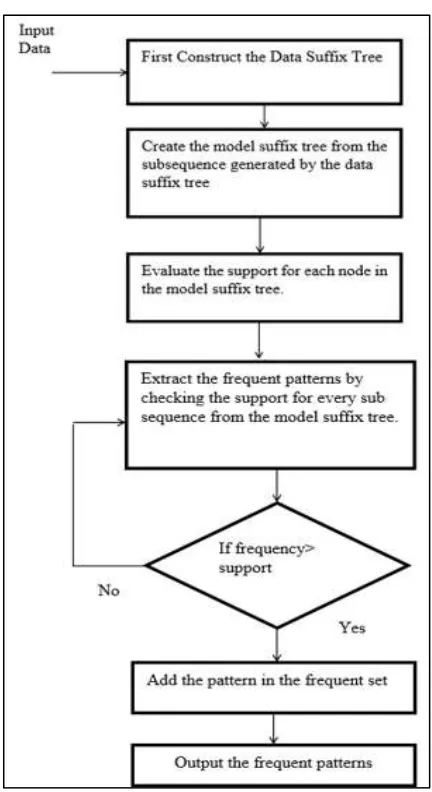
This proposed method uses approximate pattern mining for approximate similar patterns. The proposed algorithm helps to find approximate patterns. The algorithm traverses concurrently along the data and model suffix trees to systematically check all motifs or patterns. The input to the system will be a sequence comprising of characters from a discrete set of alphabets. The Figure 1 shows the flowchart of the proposed method.
We will assume that the input sequence i.e. dataset is composed of symbols from a discrete alphabet set and outputs the model strings that had sufficient support along with its all instances. The proposed method uses (S, d, c) model, S is the length of the pattern, d is the maximum distance within which two strings are considered similar and c is the minimum support or frequency required for valid patterns. In proposed method we are considering only those strings of length S that actually occur in the dataset and compute the support for each of them by scanning the dataset.
The approach is to explore the space of all possible models. For this exploration, first construct the data suffix tree of the actual dataset that stores counts in every node and the model suffix tree for all possible model strings set.
Here the input and the expected output is given below: – Input: Sequence dataset comprising of DNA sequences – Output: Frequently occurring patterns of given length.
There are different steps used in the proposed system. These steps are given as follows.
– Step 1: Generate first suffix tree on the dataset which of counts for each unique node called as the data suffix tree. – Step 2: Generate the model suffix tree for all the strings generated in the first step.
– Step 3: Start traversing the model suffix tree, compute list of matches and find the support (c) at every node in the model suffix tree.
Fig. 1: Algorithmic flowchart of proposed system
V. WORKING OF SYSTEM
Frequent Pattern Mining and Analysis in DNA Subsequence (IJSTE/ Volume 3 / Issue 03 / 023)
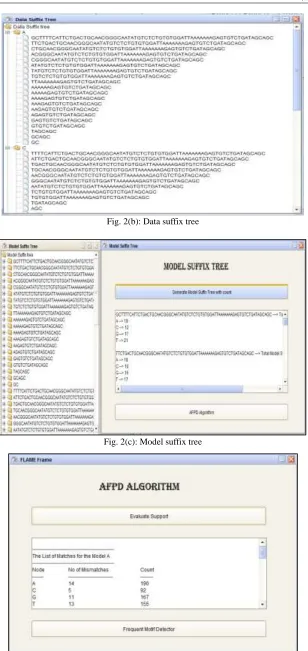
Fig. 2(b): Data suffix tree
Fig. 2(c): Model suffix tree
Fig. 2(e): Output of Proposed system
VI. EXPERIMENTAL RESULTS
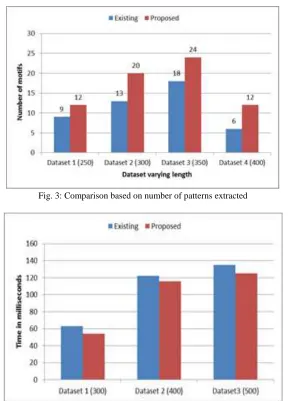
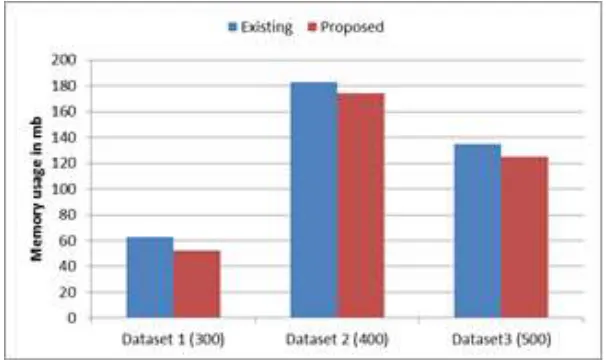
We performed experiments on varying size of datasets and compared the results with the existing approach. The comparison is as shown in Figures below.
Fig. 3: Comparison based on number of patterns extracted
Frequent Pattern Mining and Analysis in DNA Subsequence (IJSTE/ Volume 3 / Issue 03 / 023)
Fig. 5: Comparison based on memory usage
VII. CONCLUSION
In DNA sequence dataset, the objective is to find the motif or pattern which occurs frequently in the dataset. The proposed algorithm uses (S, d, c) model for finding approximate patterns or subsequence in the datasets. This method is effective since it will always find the pattern if the pattern exists. It reduces the search space by pruning the portions not related to the pattern. The performance evaluation parameters used in the experiment are alphabet size (sequence size), number of motifs extracted. The experiment is performed on 3 DNA sequence datasets. The performance of proposed is better than existing in terms of time required and number of pattern extracted. The memory requirement is less as compared to existing. It can be used in a variety of different applications such as finding patterns in medical treatments, mining the real time stock market data to find and evaluate the pattern of ups and downs, credit card transactions, and customers buying patterns.
ACKNOWLEDGMENT
I thank my guide Dr. Satishkumar Varma for his guidance and suggestions during the preparation of this paper. Also I thank my colleagues and other professors for their support and cooperation which helped me to complete this study.
REFERENCES
[1] Md. Mamunur Rashid, Md. Rezaul Karim, Byeong-Soo Jeong, and Ho-Jin Choi, “Efficient Mining of Interesting Patterns in Large Biological Sequences,”
Genomics Informatics, 10(1): 44–50, March 2012.
[2] S. Rajasekaran and L. Arockiam, “Frequent Contiguous Pattern Mining Algorithms for Biological Data Sequences”, International Journal of Computer
Applications (0975 – 8887) Volume 95– No. 14, June 2014.
[3] Pan J, Wang P, Wang W, Shi B, and Yang G., “Efficient algorithms for mining maximal frequent concatenate sequences in biological datasets.,” In: Proceeding of 5th International Conference on Computer and Information Technology CIT, Shanghai, pp.98-104., 2005.
[4] Moin Mahmud Tanvee, Shaikh Jeeshan Kabeer, Tareque Mohmud Chowdhury, Asif Ahmed Sarja, and Md. Tayeb Hasan Shuvo, “Mining Maximal Adjacent
Frequent Patterns from DNA Sequences using Location Information”, International Journal of Computer Applications (0975 – 8887), Volume 76 - No.15, August 2013.
[5] J. Pei, J. Han, B. Mortazavi-Asl, Q. Chen, U. Dayal, and M.C. Hsu, “PrefixSpan: Mining sequential patterns efficiently by prefix-projected pattern growth.”
InICDE‟01, Germany, April 2001.
[6] Pei J, Han J, Mortazavi-Asl B, Pinto H, Chen Q, and Dayal U., “PrefixSpan: mining sequential patterns efficiently by prefix-projected pattern growth. In:
Proceeding of IEEE International Conference on Data Engineering (ICDE’01), Heidelberg, pp. 215-224, April 2001
[7] X. Yan, J. Han, and R. Afshar, “CloSpan: Mining Closed Sequential Patterns in Large Datasets,” Proc. SIAM International Conference on Data Mining