www.pharmascholars.com
132
Original Article
CODEN: IJPNL6
DEVELOPMENT AND VALIDATION OF A RP-HPLC METHOD FOR
ESTIMATION OF LAMOTRIGINE IN A TABLET DOSAGE FORM
Dr M. Paul Richard
*1Dr Kiran Kumar
1P.Govardhan Reddy
1P.Uma Mahesh
21
Unity college of Pharmacy, Raigiri( V), Bhongir( M), Yadadiri Bhongir (Dt), India.
2
OTRI, JNTUA, Ananthapuramu- 517 002, Andhra Pradesh, India.
*Corresponding author e-mail: [email protected]
Received on: 28-05-2017; Revised on: 05-06-2017; Accepted on: 25-06-2017
ABSTRACT
A simple, sensitive, and precise high performance liquid chromatographic method for the analysis of Lamotrigine has been developed and validated for the determination of compound in commercial pharmaceutical products. The compounds were well separated on BDS Hypersil C18 reverse phase column by the use of a mobile phase of mixed phosphate buffer and acetonitrile in a ratio of 40:60 v/v, at a flow rate of 1.0 ml/min with detection wavelength at 248nm. The method was validated in terms of linearity, precision, accuracy, and specificity, robustness and solution stability. The method does require only 10 minutes as runtime for analysis which prove the adoptability of the method for the routine quality control analysis of the drug.
Key words: Lamotrigine , RP-HPLC.
INTRODUCTION
Lamotrigine is chemically 6-(2,3- dichlorophenyl)-1,2,4-triazine-3,5-diamine1. Lamotrigine is an anticonvulsant drug used in the treatment of epilepsy and bipolar disorder2. For epilepsy it is used to treat partial seizures, primary and
secondary tonic-clonic seizures, and seizures
associated with Lennox-Gastaut syndrome chemically unrelated to other anticonvulsants (due to Lamotrigine being a Phenyltriazine). Lamotrigine has relatively few side-effects and does not require blood monitoring in monotherapy.. Lamotrigine also acts as a mood stabilizer. Antiepileptic drug (AED) of the phenyltriazine Class.
MATERIAL AND METHODS
Wavelength selection: Since the detector selected was UV detector, UV scans Lamotrigine to determine the detection wavelength.
Procedure: Weigh accurately 100 mg of standard Lamotrigine and dissolve it in 100 ml of diluent to get a concentration of 1mg/ml. The prepared solutions was scanned in UV region of 200-400nm. The best possible wavelength were chosen as 248nm Lamotrigine by using UV spectrophotometer.
Preparation of analytical solutions
Preparation of mixed phosphate buffer solution:
A weighed quantity of 1.1818 g of potassium dihydrogen-o- phosphate (KH2PO4) and 0.218 g of
dipotassium hydrogen-ortho-phosphate (K2HPO4)
taken in a 500ml volumetric flask. This is added with 500ml of HPLC water and mixed in an ultra sonicator. The solution pH is adjusted to pH - 3 with orthophosphoric acid.
Preparation of mobile phase: Mobile phase was prepared by mixing 400ml of mixed buffer solution with 600ml of acetonitrile (40:60 v/v) ratio.
Preparation of a standard Lamotrigine solution:
International Journal of Pharmacy
www.pharmascholars.com
133
The standard stock solution of Lamotrigine was prepared by taking 15 mg of standard drug and transferred in to a 100ml volumetric flask .To which add 10ml of methanol and shake to dissolve. The final volume is made up to 100ml with mobile phase of mixed phosphate buffer pH-3: acetonitrile (40:60) ratio. The concentration of the above solution was found to be 15µg/ml.
Preparation of test solution (marketed formulation): 20 tablets were weighed and the average weight is calculated. Take the weight equivalent to and 25mg of Lamotrigine in to 100ml volumetric flask .The volume is made up to 100 ml with mobile phase. The concentration of the above solution was 25µg of Lamotrigine HCl. The solution was sonicated for complete solubility.
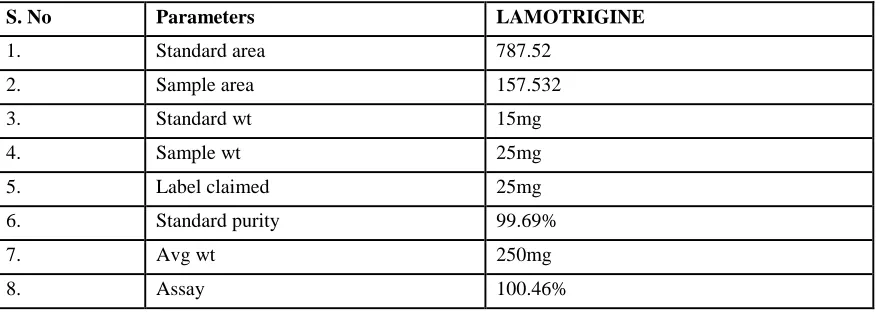
Assay of marketed formulation: By using the optimised RP-HPLC method the analysis of the marketed formulation should be done. The procedure is as follows.
Procedure: The replicate injections of standard were injected in to the system. Then injected test solution in duplicate. The chromatograms were recorded for all injections. From the chromatograms the average area of the peaks was taken for standard and test sample. Then assay percentage can be calculated by using the formula.
Method validation
The method was validated for several parameters like Linearity, Accuracy, Precision, Robustness according to ICH guidelines5,6.
RESULT AND DISCUSSION:
Specificity for an assay ensures that the signal measured comes from the substance of interest, and that there is no interference from excipient and / or degradation products and/or impurities.
The prepared mobile phase and sample solutions were injected in to the system and the obtained chromatograms are as follows.
Linearity is the ability to elicit test results that are directly proportional to analyte concentration within a given range. Linearity is generally reported as the variance of the slope of regression line.
To study the linearity of the drug the test sample was prepared in different concentrations like 3,6,9,12,15 and 18µg/ml for Lamotrigine.
Range: The range of the method is the interval between the upper and lower levels of an analyte that
have been determined with acceptable precision, accuracy and linearity. The range for the Lamotrigine was found to be 80-120µg/ml.
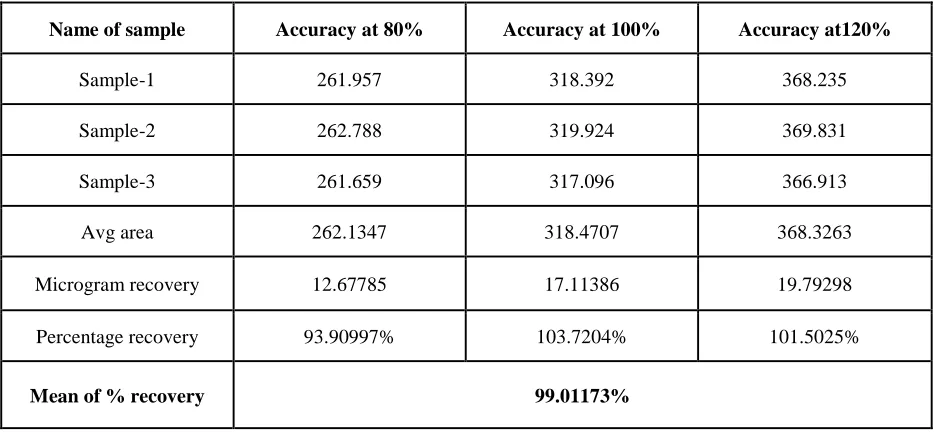
Accuracy: The test for accuracy is intended to demonstrate the closeness of agreement between the value found & the value that is accepted as a conventional true value or as an accepted reference value. Accuracy should be assessed using a minimum of nine determinations at a minimum of three concentration levels covering the specified range. Concentrations containing 80, 100, and 120% solutions were prepared and injected and the
chromatograms were recorded. The prepared
solutions were injected in to the system and the obtained chromatograms were recorded.
Precision of a method is the extent to which individual test results of multiple injections of standards agree the measured standard deviation. It can be divided into 3 categories.
Method precision: 20 tablets were weighed. Take the weight equivalent to 15 mg of Lamotrigine in to 100ml volumetric flask and diluted to get a concentration of 15µg of Inject the solution in 5 times in to the system.
System precision: Take the weight equivalent to 15 mg of Lamotrigine in to 100ml volumetric flask and diluted to get a concentration of 15µg of Lamotrigine. Inject the solution in 5 times in to the system. Ruggedness ( intermediate precision): The ruggedness of an analytical method is the degree of reproducibility of test results obtained by the analysis of the same samples under a variety of conditions such as different laboratories, different analysts, different instruments, different lots of reagents, different elapsed assay times, different assay temperatures, different days, etc.
Limit of Detection: The limit of detection is determined by the analysis with known concentration of analyte and by establishing that minimum level off which the analyte can reliably detected.
Limit of Quantification: Limit of quantification as the lowest concentration of analyte that can be determined with acceptable accuracy and precision by the analytical method.
www.pharmascholars.com
134
wavelength were changed and the obtained results were compared.
System suitability is defined by ICH as the" checking of a system, before or during analysis of unknowns, to ensure system performance”. System suitability criteria may include such factors as plate count, tailing, retention, and/or resolution.
It should also include a determination of
reproducibility when a system suitability sample is run. System suitability testing is an integral part of many analytical procedures.
The six replicate injections of standard solution were injected in to the system. The chromatograms were recorded for all injections.
SUMMARY AND CONCLUSION
The present study having the description of a new RP-HPLC method development and validation for the estimation of Lamotrigine in pharmaceutical tablet dosage form. Literature survey revealed that, the RP-HPLC method was not reported so far for the estimation of Lamotrigine in bulk and its tablet dosage form. Considering the fact, an attempt was made to develop a simple, accurate and precise RP-HPLC method.
A reverse phase assay using a mobile phase of mixed
phosphate buffer & acetonitrile in a ratio of (40:60), a BDS hypersil column (250 x 4.6mm) and ultraviolet detection at 248 nm is employed for the quantization of Lamotrigine in its tablet formulation.
Chromatographic specificity and performance
characteristics for procedures are described.
The quantitative results obtained were subjected to statistical analysis to find out the standard deviation values are below 2%, indicating the precision of methodology and low standard error values show the accuracy of the method. The validation of the proposed RP-HPLC method was further confirmed by recovery studies and validated studies.
From the result of the proposed method it is evident that the developed method was simple, specific, selective, accurate, precise, system suitable, economic and can be employed in the routine analytical for the estimation of Lamotrigine in API and Pharmaceutical tablet dosage form.
ACKNOWLEDGEMENT
I express my most cordial and humble thanks to Director OTRI Prof K B Chandra. And I am immensely thankful to Unity College of Pharmacy Management for providing me the financial support drug as gift sample for my Research work.
Fig 1:UV Spectra of standard Lamotrigine
www.pharmascholars.com
135
Table 1: weights of Lamotrigine
Tab 2 : Linearity results ranging from 3-18 microgram/ml S. No. Conc. (µg) Area
1 3 68.577
2 6 136.152
3 9 189.157
4 12 228.469
5 15 284.891
6 18 332.874
Correlation coefficient 0.997
Fig 3. Assay Chromatograms of Standard and Sample
S. No Parameters LAMOTRIGINE
1. Standard area 787.52
2. Sample area 157.532
3. Standard wt 15mg
4. Sample wt 25mg
5. Label claimed 25mg
6. Standard purity 99.69%
7. Avg wt 250mg
www.pharmascholars.com
136
Table 3: Assay of lamotrigine
Table 4 :List of accuracy of standard lamotrigine
Name of sample Accuracy at 80% Accuracy at 100% Accuracy at120%
Sample-1 261.957 318.392 368.235
Sample-2 262.788 319.924 369.831
Sample-3 261.659 317.096 366.913
Avg area 262.1347 318.4707 368.3263
Microgram recovery 12.67785 17.11386 19.79298
Percentage recovery 93.90997% 103.7204% 101.5025%
Mean of % recovery 99.01173%
Table 5 :List of accuracy results lamotrigine
S.No Retention time Area
1. 2.517 281.641
2. 2.523 281.961
3. 2.517 281.057
4. 2.517 282.752
5. 2.547 281.34
AVG 2.524 281.950
STDEV 0.0052154 7.9134409
%RSD 0.1599216 0.3076973
Name Area 1 Area 2 Area3 Avg area Std V %RSD
Lamotrigine
www.pharmascholars.com
137
Table 6 : List of Precision results of Lamotrigine
S.No Persons Retention time Area
1 Analyst 1 2.115 280.452
2 Analyst 2 2.110 283.624
3 Average 2.52 282.638
4 STDEV 0.0042 2.2429
5 %RSD 0.166 0.735
REFERENCES
1. Gurudeep chatwal, G.R. Anand, Instrumental methods of chemical analysis, ed-5th, Himalaya Publishing house,
New Delhi., PP.2.624-2.629, 2007.
2. Skoog D.A.Holler, F.G.Nieman., Principles of Instrumental Analysis, ed-5th, Thomson Brooks/Cole Asia
Pvt.Ltd., Singapore, PP.4-7, 2004.
3 .Hobort, H.Willard, Instrumental methods analysis, ed-2nd, JP publishers, New Delhi, PP.529-563, 1986.
4. Sethi P.D., High performance liquid chromatography,ed-1st,CBS publishers and distributors, New
Delhi,PP.12-15,2001
5. Anjaneyulu.Y & Marayah, Quality assurance & Quality management in pharmaceutical industry, ed-4th, pharma
book publishers, Hyd, PP.78-108, 2005.
6. Christian G.D., Analytical chemistry, ed-6th, John Wiley and Sons (Asia) Pvt.Ltd, Singapore, PP.623-627, 2003.
7. Vogel, Text book of quantitative chemical analysis,ed-6th, Dorling Kindersley Pvt.Ltd, PP.289-304.
8. Scott,R.W, principle and practice of chromatography, Chrom-ed Book Series.
9. Anjaneyulu Y, Chandrasekhar K, Manikam V, A textbook of Analytical Chemistry, Pharma Book Syndicate
PP.3-10, 2003.