Page | 31
International Journal of Business and Applied Social Science Vol.2, No.8, August, 2016
Strategy of internal audit function based on the IIA1 under COSO2 and COBIT3: A proposed
framework
Assistant Prof. Dr. Fayhaa Abdullah Yaqoob Postgraduate institute of accounting and financial studies
Baghdad University
Iraq-Baghdad
E-mail: [email protected]
Tel: 009647711224404 Iraq
Abstract:
The research problem of this study is the obvious deficient of internal audit work within the Iraqi institutes and firms, and that deficient is the result of the absence of the sponsor organizations for this function and the absent of regulations and laws that identify the responsibilities and authorities and the scope of internal audit work as well as the type of management which is tending to focus on the financial and accounting matters only, so that its required to rebuild this internal audit work in line with the current developments in internal audit activities. In addition to that there is a lack of a framework that defines internal audit strategy. The aim of this research is to find an organizing method to rebuild the internal audit strategy and functions base on the international standards of internal auditors institutes, the study consider the framework of COSO and COBIT, and discussing the views of academics, professionals, accountants and auditors who are currently working in governmental and private sectors in Iraq, and developing a proposed framework of internal audit function based on these views viewed.
Keywords: Internal auditing, Strategy of internal audit function, internal auditor
Introduction:
When the internal auditing function had existed on 1940 the area of the auditing was very simple where it was shorting about checking the validity of the transactions and processes in term of the accounting aspect, and then the auditors submit their reports to the board of director, after that the auditing function has been developed in line with the huge developments that happened to the business world in the beginning of the nineties of the last century until to the current time, especially after the huge falling of the biggest American firms in 2001 the thing that made the American congers issued the law of Sarbanes-Oxley Act, so that the focus on the function of the internal audit become very high and the American association of internal auditors become more active to drag the tension to this job and in developing the standards and criteria of this job to help the firms to meet the organizational demands of the law in order to play their roles effectively. The board directors, stakeholders and the businessmen started to feel the need into soled internal auditing team or committee to protect and insure the stability of the organization. And to reach to the depended basses of building the strategy of the internal auditing function to be constant with the strategy of the economic unit and to determine the main tends to meet the needs and the demands of the higher management and the auditing committee and external auditing, all that will help to protect the capitals of the stockholders and meet the demands of business expanding with the developments of the economic units. The research has been divided into three parts, the first one is the methodology, second is the theoretical aspect, third is the applicable aspects, and finally is the results.
1 IIA:Institute of Internal Auditors
Page | 32
ISSN: 2469:6501(Online) ©Center for Promoting Education and Research (CPER) USA, www.ijbassnet.com
1. Part one: Methodology of research:
1.1 The research problem:
The huge development that happened to the organizations of business and the complications of the activities and transactions within them, as well as the existence of the information technology in all levels of activities, also to keep the level of quality information high and to support the business decisions, and reduce the risk of any manipulation or fraud activity, the higher management intended to find a true and correct policies to ensure the control of the events properly in continues way, the matter that reflected on the job of the internal auditing as it’s the essential base for any organization. The function of internal auditing in Iraq is suffering from obvious fail especially there are no exist for any sponsors organizations for this work as well as there are no any local legalization or law to identify the authorities and the responsibilities of this job area, beside that the higher management are not focusing on internal audit work within the economic unites, but these administrations are focusing on the financial and accounting matters. The research problem represents as the following:
1-Failure with the developments of the outcomes of internal audit on the international level in term of the standards application and the rules of internal audit.
2-The absence of any legal or professional or structural framework to define the objectives, tasks and purposes of the internal auditing work.
3-The internal auditors don’t have the enough knowledge and skills which enable them to give any confirmation in regard to the risk management of the organization with the secured information of the risk automatic system.
1.2 Research significance:
The function of the internal audit is one of the jobs that provides the support to the administration department and stockholders as well as to the external auditors where its demanding from the internal auditor to be prepared to audit all the business and to check their validity, as well as he must to give the right opinion and consultants about the advantages and importance of these businesses. The current development of the job required to rebuild the strategy of the internal auditing function and to meet the needs of all the parties by providing a subjective assurance with consultative services about all the activities within the organization.
1.3 Objectives of the research:
To reach to the dependent bases in building the functional strategy of the internal auditing job to be in line with the strategy of the economical unit, also to define the main tends according to the modern standards which issued by the internal auditors institute to meet the demands and needs of the higher administration and the auditing committee with the external auditing in term of giving a subjective assurance about the risk management according to the frame of COSO and the information technology risks according to the frame of COBIT to protect the capitals of the stockholders and meeting the needs of the business expanding and the developments of the economical units.
1.4 Research hypotheses:
Page | 33
International Journal of Business and Applied Social Science Vol.2, No8, August, 2016
1.5 Sample of research:
All the views of the sample of Academic, members of the stockholders, board of director’s, executive managers and internal auditors, external auditors, offices of auditing and the federal board of supreme audit have been viewed regarding the proposed framework of the internal auditing function, 120 questionnaire forms had been distributed, 105 forms been returned, 5 forms been excluded and 100 forms been adopted.
2. Part two: the modern internal audit according to the modern standards and laws:
In this part will discuss the following issues in order to meet the requirements of the research:
2-1Defining the modern internal audit with the objectives.
2-2The standards of the modern internal audit issued by IIA.
2-1 Defining the modern internal audit with the objectives:
The committee that related to the (IIA) has developed a new definition to the internal audit as “its independent activity and subjective assurance with consultancy nature aims to add value to the organization and improve it processes, the internal audit helps the organization to achieve the objectives by structuring straight and regulate methodology to evaluate and improve the benefits of risk management, also to manage the controlling process” (IIA, 1999a). The modern role of the internal audit is to improve the risk management and auditing the information technology, also organizing the information technology as result to the definition of the modern institute of international auditors (IIA) ,all those who are concern about the internal audit in all over the world must to commit to restructure and rebuild the internal audit function in perfect way ,also must to focus on the supportive procedures with the basic business to help the firms to achieve their objectives where it supposed to include rebuilding the structure and state basic principles for the internal audit function where it represents as the following:
1-Rebuilding the basic vision for the internal audit function within the organization, where it will participate in building the strategy and adding a value to the organization by helping the management to achieve the goals.
2-Redesign the internal audit processes to be in line with the modern role.
3-Rebuild the internal audit department on the basis of the modern role. (Walker
4-Establishing charter for internal audit in the light of the modern role according to the COSO and COBIT frameworks.
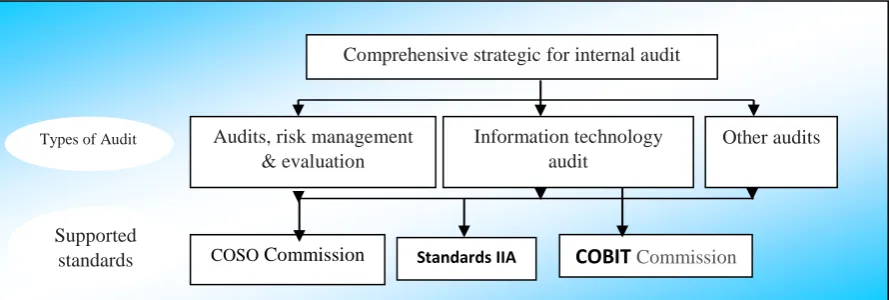
Due to these developments the objectives of the internal audit have been evolved and now become as the following: As in Figure. 1
1-Increasing the value of the organization with improving the processes.
2-Evaluating and improving the activity of the risk management within the organization. 3-Improving and evaluating the activity of controlling within the organization.
4-Improving and evaluating the activity of the institutional control in the organization
5-Improving and evaluating the control regulations for the information technology environment. 6-Improving and evaluating the risks management of information technology.
Page | 34
ISSN: 2469:6501(Online) ©Center for Promoting Education and Research (CPER) USA, www.ijbassnet.com
To clarify the impact of the development that took place on the internal audit function, both (Ratliff & Reding, 2002) referred that the auditors in the twenty-one century should be prepared to audit anything ,including the ongoing operations and control systems (accounting, and administrative) and performance ( strategic and operational) and information (public and private) and information systems (accounting, and administrative) as well as compliance to the laws and regulations, financial and fraud reports as well as to the reports of the quantum and descriptive nature that related to the environment, performance and quality, so that the (IIA) have issued an amendment standards, the researcher also mentioned that evaluating risks management and auditing the secured informationAutomat system is to improve and protect the value of the organization.
Figure 1. Types of internal audit to achieve a comprehensive strategy
Source: PricewaterhouseCoopers, Building a Strategic Internal Audit Function, 2003 Figure 2. The Internal Audit Continuum
The internal audit function has dual strategy roles are as follows: as in Figure .2
-The first role: protecting the stockholder value through the assurance activities that related to the structure of the company's risk control.
Source (Beumer, Hans, drs., Register accountant, Head of Internal Audit and Risk Management, Saurer Management AG; Winterthur/ZH, 2004.) Adapted from researcher
Standards IIA
Comprehensive strategic for internal audit
Other audits Information technology
audit Audits, risk management
& evaluation
COBIT Commission
COSO Commission
Types of Audit
Supported standards
Balanced
Business Process Improvement Internal Control
Processes Value
Protection Value Enhancement
Stakeholder Expectations
Risk Management Transactions
Enterprise-Wide Risk Assessment Product &
Process Knowledge Operational
Auditing Financial
Compliance Auditing
Internal Control Assurance
Relative Risk Coverage
Risk Management
Assurance
Page | 35
International Journal of Business and Applied Social Science Vol.2, No8, August, 2016
-The second role: improving and enhancing the stockholder value through the recommendations and improvements and advisory operations.
The internal audit mission represents by providing risk assessments for future work and provides solutions as well, where it works on adding a value to the risks management in the following areas:
Checking the operations of the risks management, and the internal control within the company.
Identifying the work risks and evaluating the internal control in order to reduce these risks in term of trust, integrity, protection, efficiency, effectiveness, activity.
The culture of the company in relating to the base developments and uses (cost-efficiency) within the process of risk management and promote best applications through the role of internal audit as a variable, and as part of the internal audit methodology, the types of audits that can be accomplish by the internal audit function must be set by the charter or written bond and select suitable standards for that.
2.2 The standards of the modern internal audit issued by IIA:
The activities of the internal audit are usually done within cultural and legal environments within firms which varying in their objectives and organizational structures, and by individuals inside and outside the organization, that differences might effect on the practicing of the activities of the internal audit within the different environments, in spite of all that the commitment to the international standards consider an essential thing where the internal auditors can meet their work commitment, which internal audit standards (IIA) aim to achieve the following:
1- Identifying the basic principles that the internal auditing should practice according to them. 2- Establishing general framework to perform and enhance the activities of the internal auditing. 3- Establishing a base to evaluate the performance of the activities of the internal auditing. 4- Improve and enhance the organizational procedures within the organization.
The Institute of Internal Auditors (IIA) has established modern framework for the internal auditing to be constant with the aims and principles of the governing bases, that happened as results of adopting the governance principles by the majority of the firms, also to perform the internal audit function according to these changes there were some standards of the internal auditing have been issued on (2001) and been amended on December (2003) also been reissued on (01 December 2004), these standards have identified set of modern services that been performed by the internal auditing function represented by (the services of subjective assurance , consulting services) in two sets of standards: (IIA, 2004)
Attribute Standards: represented by the Attribute or the properties of the parties who are performing the activities of the internal auditing.
Performance standards: which describing the nature of the internal audit activities, also setting some measurements to evaluate these activities, the two sets included a secondary standards represented by the executive standards which applicable on some certain types of work.
Page | 36
ISSN: 2469:6501(Online) ©Center for Promoting Education and Research (CPER) USA, www.ijbassnet.com
3. Part three: the applicable aspect-The proposed framework for internal audit function: The main factors to build strategy of internal audit function:
The visions of sample of academics, stockholders, Board members, Executive Management members, internal auditors, external auditors, have been viewed, (100 questionnaires) about the strategy of the internal audit with putting in the consideration the COBIT and COSO frameworks and the standards of the IIA to meet the needs and amendments of the firms that comes as a result of the opening up to the global markets, also the enters of the foreigner investments to Iraq and the dependence on international accounting standards in preparing and presenting the financial statements, therefore it requires to restructure the internal audit function to keep in line with the current developments and advancement similar to what the happened in other countries.
The following questions directed to the sample about the need to re-build strategy to the internal audit function within the Iraqi economic units.
No Items Agree % Neither% Disagree%
1- The current methodology of the internal audit function in Iraq is not meeting the needs of the
work and not satisfying the stockholders 100 0 0
2- the need to restructure the function of internal
audit to be in line with the current developments 100 0 0
3- the need to establish local standards to the internal
audit 90 5 5
4- the need to establish local standards to the internal audit, adopting international standards that been issued by the (IIA) in case there is no local
standards. 95 5 0
5- The need for a sponsor organizations for this
profession 95 5 0
6- the need to adopt guide regulate the function of
internal audit 100 0 0
The average of answered 96.67 2.50 0.83
Page | 37
ISSN: 2469:6501(Online) ©Center for Promoting Education and Research (CPER) USA, www.ijbassnet.com
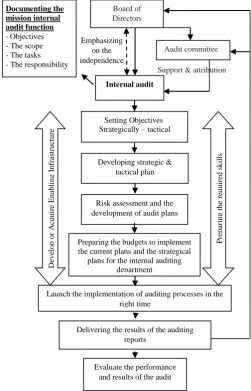
Figure (3) the steps of structuring the strategy of internal audit function
The steps of structuring the strategy of internal audit function the following steps are going to be adopted in structuring the strategy of internal audit function:
First: emphasizing on the independence of the internal audit: the independence factor is important for the
effectiveness and quality of the internal audit, and according to the modern definition the internal audit is (independent activity from the executive management and related to the board of directors only throughout the audit committee that been established by the board, also its submitting the reports to the board of directors after discussing it with the auditing committee, the subjectivity should be presented within performing the missions and not to be tend to any party.
No. Items Agree % Neither% Disagree %
1- The internal audit function is deriving the independence from the
relation to the board of director. 100 0 0
2- The auditing committee should be the authority that supervising
the work and activity of the auditing with the Board of Directors. 95 5 0 3- The approve of appointing and transferring the employees should
be taken by the auditing committee 94 6 0
4- The results of the internal audit function submit to the board of
directors after discussing the results with the auditing committee. 95 5 0 5- Informing the stockholders by the reports of the internal audit
when necessary 85 10 5
The average of answered
93.8 5.2 1.0
Support & attribution
Emphasizing on the independence Board of Directors Internal audit Audit committee
Developing strategic & tactical plan
Risk assessment and the development of audit plans
Preparing the budgets to implement the current plans and the strategical
plans for the internal auditing department P re p ar in g t h e re q u ir ed s k il ls
Launch the implementation of auditing processes in the right time
Delivering the results of the auditing reports
Evaluate the performance and results of the audit Documenting the
mission internal audit function - Objectives - The scope - The tasks - The responsibility
Setting Objectives Strategically – tactical
Page | 38
International Journal of Business and Applied Social Science Vol.2, No8, August, 2016
After checking the results of the sample members views, the results showed that the majority approving the independence of the internal auditor with average of 93.8 % throughout relating the internal audit function with the board of directors with rate of 100% , and the auditing committee should be the authority that supervising the work and activity of the auditing with the Board of Directors with rate of 95%k as well as the results of the internal audit function submit to the board of directors after discussing the results with the auditing committee.
Second: documenting the mission of the internal audit function where the director of the internal audit must work together with the board of directors to state by details the missions of internal audit function in formal chart to identify the objectives in order to provide the bases to evaluate the performance of internal audit, as well as to identify the authorities and responsibilities and reflecting the assigned missions by identifying the work area, with putting in the consideration the priorities and the requirements of the board and the auditing committee, that’s in order to improve the value of the organization and protecting the rights of the stockholders via protecting the value and achieving the organization goals, in the light of the governance and according to the current chart, the auditing committee providing the support to the internal audit function regarding controlling the performance of the organization ,also recommending to appoint a responsible head to internal audit, as well as the internal audit system is responsible about stating the strategies according to the special standards and regulations to support the economic units.
No. Items Agree % Neither
%
Disagree%
The board of directors and the auditing committees must to state a message for the internal audit to identify the following:
1- The nature and type of the relation between the auditing function and the board of directors and auditing committee
100 0 0
2- Objectives 100 0 0
3- The scope of work, the limitations of work 100 0 0
4- The basic tasks (the main activities, assurance and
consulting services). 100 0 0
5- Responsibilities. 100 0 0
6- Authorities (reviewing all the files and the electronic systems, making the contacts with all the employees, checking the deferent parts of the organizations)
100 0 0
7- The job descriptions of the employees (certificates,
experience, skills). 95 5 0
8- The results of the auditing and the beneficiary parties 100 0 0
The average of answered 99.38 0.62 00
Page | 39
ISSN: 2469:6501(Online) ©Center for Promoting Education and Research (CPER) USA, www.ijbassnet.com
Third: Setting objectives the internal audit function:
The Strategic and tactical objectives been identify for the internal audit function by providing the assurance services (the operations aims, objectives of commitments, objectives of the report) as well as giving guarantee to the board of directors about the strength and the solidity of the internal control (Administrational control, accounting control) and assess the risks management with the information technology risks, the objectives of the auditing must consistent with the tactical and Strategic objectives of the organization, as well as providing the consulting services about stating the policies and plans in the future to the board of directors, auditing committee, executive management of stockholders services and the investors, Shareholders.
No. Items Agree % Neither% Disagree%
1- Identifying the tactical and Strategic objectives of the
audit 100 0 0
2- The objectives of the auditing must consistent with the tactical and Strategic objectives of the
organization
100 0 0
3- Providing assurance services about all the activities of
the organization 100 0 0
4- providing the consulting services about stating the
policies and Strategic plans 100 0 0
5- Developing and protecting the integrity and
accountability culture 92 8 0
6- Facilitating the introduction of the risk management
to the daily events 95 5 0
7- Spreading the self-evaluation culture and the
commitment to the high ethical standards 96 4 0
8- Maintain and protect the assets 95 5 0
9- Assessing the information technology management to support the strategies and objectives of the
organization 90 10 0
The average of answered 96.4 3.6 00
From the table above its clear that the majority agreed with points of the objectives with average of 96.4%, the points (4-1) got rate of 100% because they have important role in consisting the objectives of the internal audit with the Strategic objectives of the organization by providing assurance and consulting services to protect and enhance the value of the stockholders and organization, as well as spreading the self-evaluation culture and the commitment to the high ethical standards got rate of 96% , Facilitating the introduction of the risk management to the daily events got rate of 95%.
Fourth: The scope of the internal audit function includes determining if the risks management and the control systems with the governance policy within the unit are effective and suitable to achieve the following:
No. Items Agree % Neither% Disagree %
1- Achieving the objectives of the units with the plans and
programs 100 0 0
2- Ensuring the implementation of the unit procedures according to the legal requirements, political system, regulations and the decisions of the board of directors
100 0 0
3- Protecting the interests and assets of the unit , also
ensuring the proper usage, and not siphoned 100 0 0 4- Verifying that the control systems of the unit are
working properly according to the plans, also maintaining these systems and update them when necessary in order to face any changes within the
Page | 40 operational situations
5- Verifying the resources of the unit and use it effectively 100 0 0 6- Verifying the validity and correction of the operational
and administrational and financial information. 100 0 0
7- Providing suitable policy to evaluate the management
risks 95 2 3
8- Providing suitable policy to evaluate the risks of the
information technology 95 4 1
9- Communicating and coordinating with governance
groups in proper way 85 10 5
10 Ensure that the unit's activities take into account the
qualitative improvement and continuity development 96 2 2
11 Provide feedback to the executive management in order to improve the administrative control, profitability, and
efficiency, and the value of economic unit 97 3 0
The average of answered 97.1 1.9 1
The average of response regarding the area of the internal audit function was agreed with rate of 97.1%, the points (1-6) possessed rate of 100%, the internal audit can provide notes to the higher executive management in order to improve the administrational control, profitability, and efficiency, and the value of economic unit. The higher executive management is taking the responsibility of stating the policies and making the proper procedures as response to these notes.
Fifth: the Tasks of the internal audit function are working within effective and ethical framework to help the managements in protecting and improving the value of the organization by improving and enhancing the performance and the work process in order to accomplish the objective of the organization, as well as to provide the consulting services subjectively and independently, that to serve particularly the development processes of the organization, also it helps in achieving the aims throughout the methodology of the organization to evaluate and develop the effectiveness of the risks management, The investors and the other interested people are considering the internal auditing as an eye inside the organization to ensure providing the services and confirmations for the tasks in the right time.
No. Items Agree
%
Neither %
Disagree % The tasks of internal audit function are focusing on
protecting and improving the value of the organization by:
1- Evaluating and improving the activity of the risks
management processes 90 10 0
2- Submitting the control confirmation of the risks
management 90 10 0
3- Confirming the control on the information technology
risks 85 10 5
4- Evaluating the effectiveness and activity of the internal
control 100 0 0
5- Insuring the organizational and institutional commitment 100 0 0
6- Protecting the assets 100 0 0
7- Insuring the commitment to the ongoing laws 100 0 0 8- Providing strategies and methods of controlling to
protect from the fraud and cheat 100 0 0
9- Confirming that the financial statements prepared
according to the standards 100 0 0
10 The fast response to the events
Page | 41 11 Improving the releasing of risks and the organizational
control 85 10 5
12 Work as consultant to address the complicated issues
(policies and plans) 84 10 6
13 Providing the monitoring about developing the programs
and the new operations and change the controls 90 5 5
14 Source of creativity and the development of management 70 25 5
15 Effective management of auditing fees through
coordinating with the external auditor 50 30 20
The average of answered 88.3 8.3 3.4
From the responses the average of the agreed responses was 88.3%, and there was agreement to the level of 8.3, the points (5-9) have possessed rate of 100% from the response of the sample answers requiring from internal audit evaluating the effectiveness and activity of the internal control, and insuring the organizational and institutional commitment and protecting the assets, also providing strategies and methods of controlling to protect from the fraud and cheat by confirming that the financial statements prepared according to the standards, with confirming the control of the risks management and the risks of information technology, the fast response to the events as well as improving the releasing of risks and the organizational control by the organization in order to develop the management business and coordinating with the external auditor, also to insure that the internal auditor will evaluate the risks and provides the consulting services as well as add a value to the organization and insure protecting the interests of the investors inside the organization, on these bases the internal audit department will establish the Strategic and tactical plans that consistent with the plan of the organization.
Sixth: defining the responsibilities of the internal audit function: the responsibilities of the internal auditing
system include the following:
No. Items Agree % Neither
%
Disagree % 1- Defining the responsibilities depending on the
scope of work and the assigned tasks to achieve the objectives.
100 0 0
2- Preparing annual flexible plan by using a suitable methodology base on the risks and submitting it to the auditing committee to check it, and approval.
100 0 0
3- Giving the assistance in investigating the suspected activities within the economic unit, according to the request of the management, and submitting the results to the auditing committee
100 0 0
4- Implementing any special tasks or projects requested by the executive director or auditing committee.
98 2 0
5- Submitting the reports to the auditing committee about any breaches to the laws or regulations or the policy of the economic unit that might be observed by the internal audit staff, even if it wasn’t in the auditing plan
100 0 0
6- The communication and coordinating with the
auditing committee 100 0 0
7- Communication and coordinating with the external
auditor 95 5 0
The average of answered 99 1 0
Page | 42
International Journal of Business and Applied Social Science Vol.2, No8, August, 2016
to achieve the objectives, also p Preparing annual flexible plan by using a suitable methodology base on the risks and submitting it to the auditing committee to check it and approval, as well as submitting the reports to the auditing committee about any breaches to the laws or regulations or the policy of the economic unit that might be observed by the internal audit staff, even if it wasn’t in the auditing plan. Communication and coordinating with the auditing committee to implement any special tasks or project requested by the executive manager or the auditing committee.
Seventh: Developing strategic tactical plan:The strategic plan will help to develop and direct the job of the
internal auditing, where the plan is more than assessment to the current risks but it identifying legally the value and the position of the new job as well as to the possibility of adding a value to the Stakeholder and the organization as well for the current time and in future, as well as summarizing the executive techniques to achieve the main targets in line with the responsibilities of the technician management. The plan discussed also identifying the financing and the human resource together simultaneously and strategically for three to five years, also stating the assumes and the references that are necessary for the structure of the work where the plans been discussed and assessed by auditing committee. The plan also can discuss the expected cost and benefits resulted by the different uses to achieve the required results, as well as the integration and the improvement with the risks and the other controlling jobs such as the legal control, insurance, market, security and fraud, job of risks management, jobs of information technology management. The auditing department have the authority to have the assistance from external resources in order to have the required skills and efficiencies for the job in case that the abilities and potentials were not available to execute any task, also establishing an assessing program of controlling by processing the plans implementation and state a time table for each task. The strategic plan supposed to discuss the communications issues which they are essentially important for job success, the first and direct contact should be with the auditing committee and the executive management, in order to get the plan successful the predictions of the organization must to be in the consideration in regarding to improve the principle of the internal auditing as well as the predictions in regard to the weak points within the internal control or the issues that been identified by the internal auditing, so that the strategic plans should involve the standards that enable it to measure the future decisions and results, with reviewing the plan every year and put in the consideration the changes and approve them by all the stakeholders in the organization.
No. Items Agree % Neither
%
Disagree % The strategic plan of internal auditing:
1- Integrate the auditing plan with the plan of the
organization 100 0 0
2- Integrate the plane with the controlling systems (legal issues, guarantying the performance, risk
management, information technology management( to monitor the risk.
100 0 0
3- Enhancing the human and financial resources to
develop the efficiency and skills of the auditors 98 2 0 4- Developing control programs and evaluates them. 100 0 0 5- Enhancing the communication with the board of
directors, audit committee, external auditing and executive management.
90 6 4
6- Comparing the plans with comparative plans. 70 20 10 7- Outsourcing to provide the necessary skills and
experience. 60 20 20
8- Providing suitable standard for the purpose of
evaluating the results and performance. 92 6 2 9- The predictions of the organization in supporting the
mission of the internal auditing. 70 20 10
The tactical plan
10- Adjusting the plan according to the Strategic
Page | 43 11- Seeking to achieve secondary objectives. 95 3 2
12- Identifying the scope of the work. 100 0 0
13- Identifying the structure of the risks and evaluate
them. 94 5 1
14- Identifying the information technology and evaluate
them. 87 10 3
15- The preferences of using the auditing resources to
employ them in maximizing the value. 85 10 5
16- Stating time table for the implementation stages of
the auditing programs. 88 10 2
The average of answered 89.06 7.25 3.69
Through the answers above it become clear that all the opinions were consistent about the points of the tactical Strategic plan with an average of (89.06). the points (1,2,4,12) had rate of 100 % were integrate the auditing plan with the plan of the organization and integrate the plane with the controlling systems (legal issues, guarantying the performance, risk management, information technology management ( to monitor the risks as well as developing control programs and evaluate them, Identifying the scope of the work and by enhancing the finance and human resources to develop the efficiency and the skills of the auditors, and adjusting the plan according to the Strategic situation and the structural risks and assess them.
Eighth: Risk assessment and the development of audit plans: one of the internal auditing difficult tasks is
developing the methodology of the organization in order to analyze the risks. The risk is any events that preventing the organization from achieving the objectives, and to make an assessment to the risks the auditor should concern about how to deal with the events that impact on achieving the required targets, the risk assessment process starts by identifying the entity of auditing4 to contain all the operative process and units, the auditor must to understand the mission and the main objectives of the organization by making a conversation with the stakeholders, and stand on the inherent risks to achieve those objectives, the internal auditor must to be aware of different risks and the possibility of these risks to be happen and to which level they might impact on the job objectives through reviewing all the effects resulted by the possibility of main risks happening, also reporting the risks statement to the management and the auditing committee by using the risk map which showing the places of the high, low and average risks, this assessment consider an initial assessment of the risks where identifying accurately the risks of the processes as well as the activities that might cause the highest risks to the organization and accordingly stating auditing program in the first year of the auditing work within the firms where assess the effectiveness of internal control activities and base on that the evaluation of the initial risks will state into the level of the inherent risks within the internal auditing plan, the inherent plan includes “the external risks , the changes into the globalization, the economic national environment as well as the legal , political and technological developments. The inherent risks also involve the internal factors that requiring special attention including the changes within the operative system, also producing new products, entering to the new markets, the organizational and administrational changes and expanding in external processes.
The progress of the basic knowledge about the risk to enhance the effectiveness of the internal control and reviewing the effectiveness and the validity of the controlling and the importance of reducing the possibility of risks occurring. The basic of this knowledge is the reason of reclassifying the risks as well as developing the internal control knowledge and should be involve a periodical test for the main regulation even in the places where assumed that the controlling wouldn’t be effective there in order to guaranty the continuous help to reduce he critical risks, so that the results of the risks evaluation process will enable to develop the internal auditing also developing an alternative plans to fix variety set of risks throughout the organization , the plan of the internal auditing will provide an effective method to classify the risks into levels high , average and low, and once the risks been evaluated the auditing manager should work together with the auditing committee and the higher management to identify the organizational priorities of the risks also assigning the required efficiencies and skills to fix the higher priorities of the risks as well as the needs of the
Page | 44
ISSN: 2469:6501(Online) ©Center for Promoting Education and Research (CPER) USA, www.ijbassnet.com
main stakeholders.
No. Items Agree % Neither% Disagree%
1. Put an evaluation to the initial risks based on the internal control effectiveness evaluation into the level of the potential
risks in the first place within the internal auditing plan. 100 0 0
2. Developing an organized methodology to analyze the risks. 89 8 3
3. The process of evaluating the risks starts by identifying an
audit entity. 90 5 5
4. The auditor has to understand the main commercial objectives of the organization by making a conversation with stakeholders and stands on the potential risks to achieve these objectives.
95 5 0
5. Discussing the different types of risks and the possibility of happening them and their impact on the objectives of work as
well as the effects of the probability of main risks happening. 93 6 1
6, The results of risks evaluation process will enable to develop
the internal auditing and put some alternative plans. 96 2 2
7. The internal auditing plan will provide an effective method to
classify the risks into high, average and low. 98 2 0
8. Put audition program based on the highest level of process
risks and activities. 100 0 0
9. The auditing manager should to work together with the audition committee as well as the higher management to identify the organizational priorities of the risks also assigning the required efficiencies and skills to fix the higher priorities of the risks as well as the needs of the main stakeholders
100 0 0
10 The basic knowledge will develop the effectiveness of the
internal control and evaluate it. 99 1 0
Average answered 96 2.9 1.1
by observing the average of the sample responses on the points of risks assessment and developing the auditing plans were agreed with rate of 96% , while the points(1,8,9) get rate of 100% to put an evaluation to the initial risks based on the internal control effectiveness evaluation into the level of the potential risks in the first place within the internal auditing plan as well as put audition program based on the highest level of risks process and activities and analyzing the risks and assess them according to plan that classify the risks into high, average and low levels, also emphasizing on the auditing manager to work together with the audition committee as well as the higher management to identify the organizational priorities of the risks also assigning the required efficiencies and skills to fix the higher priorities of the risks as well as the needs of the main stakeholders.
Ninth: preparing the budgets to implement the current plans and the Strategic plans for the internal
auditing department after finishing all the previous steps the information will be sufficient and available to
start preparing the long term balances, the source of balances budgets structured on the basis of evaluating the risks rate, also its flexible enough to response to the changes and the business needs.
Page | 45
International Journal of Business and Applied Social Science Vol.2, No8, August, 2016
No. Items Agree % Neither
%
Disagree%
the budget of the internal auditing plan should be structured base on the following:
1- Assessing the risks rates. 88 10 2
2- Implementing the current plans as well as the Strategic
plans. 100 0 0
3 Providing the programs as well as the information
technology. 85 10 5
4 Characteristic by flexibility in order to provide a consistent and high quality plan which able to response to the changes.
90 5 5
5 Identifying the special needs and identifying the required resources and skills to improve the internal auditing plan and the special needs.
90 8 2
6 The budget must to be prepared in order to make the
internal auditing plan works effectively. 100 0 0
The average of answered 92.17 5.5 2.33
Throughout the responses on the points or preparing the budgets to implement the current plans and the Strategic plans, the average of responses was consistent 92.17% points (2,6) to prepare the budget on base Implementing the current plans as well as the Strategic plans, and The budget must to be prepared in order to make the internal auditing plan works effectively, and the plans should to characteristic by flexibility in order to be able to response to the changes to improve the auditing plan.
Tenth: preparing the required skills: the internal auditing administration must to prepare a set of skills to
meet the requirement of the tasks and to achieve the auditing and organization objectives as well as implementing the tactical and Strategic plans.
No. Items Agree % Neither% Disagree%
the employees of the auditing department should characteristic by:
1. The critical and analytical thoughts skills. 100 0 0 2. The ability on meeting all the specialized and tactical needs
also understanding any auditing process related to a person or firm or system.
100 0 0
3. The concepts and the principles of the new methodology of
internal control 100 0 0
4. The full concussions and understanding about the risks, chances and the threatens that relates to the clients and the auditors.
85 10 5
5. The full concussions and understanding about the information
technology and the ability of assessing the risks. 95 5 0 6, Choosing, collecting, evaluating and documenting the auditing
evidences (by using a perfect systems of auditing procedures). 100 0 0 7. Use the auditing technology to prepare several kinds of
auditing reports 87 10 3
8. Using the statistical and non-statistical methods to reach to
facts 80 10 10
9. Understanding the business and the international business
environment 100 0 0
10. The communication with the executive managers in the
executive department 100 0 0
11. Developing the administrational talents within the
organization 80 10 10
Page | 46
ISSN: 2469:6501(Online) ©Center for Promoting Education and Research (CPER) USA, www.ijbassnet.com
The main and essential character of the successful internal auditors as well as the tactical preparing is representing by : ) Moeller &Witt, 1999,P2).
Integrity and justice, humbleness, critical direction, make the sufficient efforts, full attention to the interests of the company, professional preparedness, personal consistence with job, carful in the audit process, working hard to accomplish the auditing work, self-confidence. The ability to judge the things that relate to his work. Courage in giving advice and opinion.
Throughout the responses on the points the average of responses was 93.36% consistent with the points of the preparedness the required skills to do the tactical Strategic auditing plan where the points (1,2,3,6,9,10) got percent of 100% by preparing the analytical critical executive skills, and the ability on meeting the special and tactical needs with understanding any auditing process whither its related to the individuals or the firm or the system as well as understanding the business and the business environment to prepare the budget in order to make the internal auditing plan works effectively, and the plans should to characteristic by flexibility in order to be able to response to the changes to improve the auditing plan with the communication with the executive managers in the executive department.
Eleventh:Develop or Acquire Enabling Infrastructure: (Methodology and Technologies) this step considers
one of the most important steps of the internal auditing department because the availability of the sufficient necessary resources to build and develop the infrastructure that contribute to the achievement of the objectives of the audit and determine the potential risks therefore it must to take into account the following matters:
No. Items Agree % Neither% Disagree%
develop the infrastructure must to take into account the following matters:
1. Strategies. 90 8 2
2. Risk assessment methodologies 88 10 2
3. Auditing plan 94 6 0
4. Documentation 100 0 0
5. Auditing procedures 100 0 0
6, Choose the best practices 100 0 0
7. Quality of auditing 98 2 0
8. Monitoring and follow-up procedures 100 0 0
9. Human Resource Management 98 2 0
10. Information technology used in the organization and
technology uses 95 3 2
The average of answered 96.3 3.1 0.6
the average of responses of the infrastructure was 96.3% the points (4,5,6,8) got percent of 100% to put in the consideration the documentation processes and the auditing and choose the best practices as well as the monitoring and follow-up procedures also the human Resource Management and information technology used in the organization and technology uses where they got 98% and 95% in sequence.
Twelve:Launch the implementation of auditing processes in the right time after preparing the employees
Page | 47
International Journal of Business and Applied Social Science Vol.2, No8, August, 2016
account the following matters:
No. Items Agree % Neither% Disagree%
1. chose the appropriate time to start the implementation, time
should be determined by the Director of Audit 100 0 0 2. identifying the implementation resource of each task
according to the importance and the efforts 100 0 0
3. Prepare the appropriate auditing cadre for each task due to the
potentials and contributions 100 0 0
4. Perform the audit tasks according to the tactical plans and
work priorities 100 0 0
5. Determine the allowed risk ratio to estimate the regulatory
risk for each task according to their importance 100 0 0
6, Studying and evaluating the internal control, risk management, and risk of information technology and diagnose the weaknesses and strengths points
99 1 0
Preparing audit program for each task 98 2 0
8. Identifying the starting and finishing time for each task with a number of auditors and identifying the tasks that assigned to them and the available resources for each auditing task.
100 0 0
9. Identify procedural and analytical methods of the study and evaluation of internal control risk management, and risk of information technology and identifying the strengths and weaknesses points
94 6 0
The average of answered 99 1 0
the average answers were 99% consistent with all the points, and won paragraphs (1-5, 8) the points (1,5,8) got percent of 100% of chose the appropriate time to start the implementation, time should be determined by the Director of Audit, and Prepare the appropriate auditing cadre for each task due to the potentials and contributions as well as identifying the implementation resource of each task according to the importance and the efforts, and perform the audit tasks according to the tactical plans and work priorities by identifying the allowed rate of the risks according to the risks assessment for each task according to the importance , and finally identifying the starting and finishing time for each task with a number of auditors and identifying the tasks that assigned to them and the available resources for each auditing task. The points (6,7,9) they got 99%, 98%, 94% in sequence.
Thirteenth: Delivering the results of the auditing reports: The process of identifying the beneficiaries of the
audit results considered the most important steps that lead to reduce the communication gap between the administration and the Internal audit department, and to identify the beneficiaries of the audit process as well as to strengthen the effectiveness of the communication such as the reports and conclusions the contacts must to be fixed within the internal auditing charter .where the communications should be with :
No. Items Agree % Neither% Disagree%
Activating communication with:
1. All the administrational and executive levels which are
responsible of the auditing plan results 100 0 0
2. The auditing committees and the effective communication in
order to discuss all the terms of the results report 100 0 0
3. The external auditor 100 90 0
4. Stakeholder 90 5 5
5. Create a policy to report about the auditing plan and the results 100 0 0 6, The time of delivering the auditing reports 100 0 0
Page | 48
ISSN: 2469:6501(Online) ©Center for Promoting Education and Research (CPER) USA, www.ijbassnet.com
The communication terms with the benefiting parties from the results of the internal auditor were consistent with the opinion of the sample members of the research with rate of 98.33%, the points (1,2,3,5,6) had perfect rate of agreeing reached to 100% in term of activating the communication with all the administrational and executive levels and the auditing committees and the external auditor as well as creating a policy to report about the auditing plan and the results and the time of delivering the auditing reports to the beneficiary parties in order to meet the needs of the Stakeholder.
Fourteen: evaluate the performance and results of the auditThe results of the internal audit department job
evaluate by the Board of Directors with the Audit Committees well as to the head of Audit Department to check whether the results were consistent with the objectives and plans, also standing on the weakness points and the troubles within the implementing process in order to avoid them and address them in the future, and use the power of performance with the performance evaluation instructions to measure the results of the auditing process and assess the performance level of that process.
No. Items Agree % Neither% Disagree%
Evaluating the performance of the internal audit department, based on:
1. The advantage level of the board of directors from the
submitted reports 100 0 0
2. Confirmatory and advisory services provided by the in
charge authorities 98 2 0
3. The interaction and communication with the executive
managers and executive department 90 5 5
4. The full understanding and meeting the needs of the audit
committee and Executive department 98 2 0
5. The ability to adapt and respond to the risks 98 2 0 6, The ability of adaptation to the changes and developments
that might happen within the organization 94 6 0
The auditing results evaluation should be base to:
7 Achieving the objectives of the organization 95 5 0
8 Achieving the objective of auditing 100 0 0
9 Implementing the tactical Strategic plan with less
mistakes 93 6 1
10 Protecting and enhancing the value of the organization 100 0 0 11 Responding to the expectations of the interests’ holders. 90 10 0 12 The advantage extent of the external auditors 90 10 0
The average of answered 94.67 5.17 0.17
Throughout the answers on the evaluation of the internal auditing job performance and the results it turned out that the majority of the sample members agreed with average rate of 94.67% in term of evaluating the internal auditing department by the advantage of the board of directors from the submitted reports with rate of 100% as well as the confirmatory and advisory services provided by the in charge authorities with rate of 98%. The interaction and communication with the executive managers and executive department 98%. The ability to adapt and respond to the risks 95%. The auditing results evaluation is done base on achieving the objective of auditing and protecting and enhancing the value of the organization 100%.
Page | 49
International Journal of Business and Applied Social Science Vol.2, No8, August, 2016
No. Items Agree % Neither% Disagree%
1. emphasizing on the independence of the internal audit 93.8 5.2 1.0
2. documenting the mission of the internal audit function 99.38 0.6 0
3. Setting objectives the internal audit function 96.4 3.6 0
4. The scope of the internal audit function 97.1 1.9 1
5. the Tasks of the internal audit function 88.3 8.3 3.4
6, defining the responsibilities of the internal audit function: 99 1 0
7 Developing strategic tactical plan 91.4 6 1.9
8 Risk assessment and the development of audit plans 96 2.9 1.1
9 preparing the balances budgets to implement the current plans and the
Strategic plans for the internal auditing department 92.19 5.5 2.33
10 preparing the required skills 93.36 4.09 2.55
11 Develop or Acquire Enabling Infrastructure 96.3 3.1 0.6
12 implementation of auditing processes in the right time 99 1 0
13 Delivering the results of the auditing reports 98.33 0.83 0.83
14 evaluate the performance and results of the audit 94.67 5.17 0.17
The average of answered 95.37 3.51 1.06
From the above we conclude that the sample members agreed with average rate of 95.37% and agreed with rate of 3.51% with all the suggested structural points, hence the adoption of such framework is regulating the audit function to meet the needs and objectives of the stakeholders, particularly interests of the Stakeholder and to protect their money and the money of the organization and meet the demands of the expansion of the business and the development in the economic units.
Results of the research:
1- The traditional method of the internal auditing job hasn’t meet the requirements and the expectations of the stakeholders regarding protecting and improving the value of the organization by giving assurance.
2- Of internal controls and risk management and that what the research sample confirmed where the agreement rate reached to 100%.
3- Restructuring the internal auditing job become a necessary in order to consist with the Iraqi environment and to take part in providing the conformational and consular services to the board of directors and the executive management coordinating with the auditing committee and that’s what the research sample confirmed where the agreement rate reached to 96%.
4- Creating strategy to the internal auditing job to be supportive to COSO and COBIT frames as well as to the standards of IIA where it works to add more value for the risk management environment by revising all the procedures of the risk management and identifying the business risks in order to reduce them, also to evaluate the internal control system and improve them.
5- The need to exist sponsor organizations for the job of the internal auditing, where these organizations will work to put the standards and regulations as well as setting a guide to regulate the profession work and insure the independence of this job to take its rightful role in protecting stakeholders of the organization.
6- Constructing the strategy of the internal auditing job base on the basis that insure implementing the tasks economically efficient.
7- The board of director and the auditing committee with the head of internal auditing should documenting the process of the internal auditing to reflex the aims by identifying the tasks and the extent of the works,
Page | 50
ISSN: 2469:6501(Online) ©Center for Promoting Education and Research (CPER) USA, www.ijbassnet.com
8- Setting objectives to the internal auditing job that consist with the tactical and Strategic objectives of the organization, and to achieve all the objectives the tactical and Strategic objectives of the organization should be integrated with the plans of the organization.
9- Providing a set of skills to meet the requirements of the assigned tasks and achieve the auditing objectives as well as the objectives of the organization, also providing the enough knowledge about the information systems and the possibility of assessing risks, also providing the infrastructure to the internal audit department to work on implementing the audit plan.
10-Creating a protocol of communication to deliver the results of auditing to the parties that have the advantages from the internal auditing reports, those should be identify officially and should be represent by the council of administration and the auditing committee and the executive management and external audit, the Stakeholder also can review the internal auditor report.
11-The internal auditing performance should to evaluate by using the instruction of performance or the power of the balanced marks to identify the extent of the internal auditing commitment by implementing the plan for the questioning purposes in case of any failure happened.
12-The research sample have confirmed with a rate of 95.37% about the suggested Strategic structural points of the internal auditing job.
References:
Beumer, Hans, drs., Register accountant, Head of Internal Audit and Risk Management, Saurer Management AG; Winterthur/ZH, 2004. http://www.saurer.com/file/2/ct_2701_ctDownload1.pdf
IIA, International Standards for the Professional Practice of Internal Auditing, The latest additions and amendments to the Standards were issued in December 2003, and they will be effective January 1, 2004 . www.theiia.org
IIA, The Institute of Internal Auditors, A Vision for the Future: Professional Practices Framework for Internal Auditing, (Altamonte Springs, FL: The Institute of Internal Auditors, 1999a. www.theiia.org/ecm/guidance.cfm?docid=123
Moeller, R. and Witt Brink’s, H. N., Modern Internal Auditing, 5th ED., John Wiley & Sons, Inc., New York, 1999 .
Price water house Coopers, Building a Strategic Internal Audit Function, 2003, www.pwc.com/internalaudit.
Ratliff, R. L. and Reding, K.F., Introduction to Auditing: Logic, Principles, and Techniques, The Institute of internal Auditors, Altamonte Springs, Florida,2002 . www.theiia.org.