Rubel R et al. Volume 3 (2), 2015, Page-616-620
CODEN (USA)-IJPRUR,e-ISSN: 2348-6465
Original Article
Method Development and Its Validation for Estimation of
Sertraline Hydrochloride by Using UV Spectroscopy
Rubel Ratnia1, *, Virendra Yadav1, Amit Kumar2
1
Vinayaka College of Pharmacy, Kullu, HP, India.
2
Abhilashi College of Pharmacy, Mandi, HP, India
A R T I C L E I N F O A B S T R A C T
_______________________________________________________________________________
1. INTRODUCTION
Analytical chemistry may be defined as the science and
art of determining the composition of material in terms
of elements or compounds contained in it. Analytical
chemistry is divided into two branches quantitative and
qualitative. A qualitative analysis provides information
International Journal of Pharma Research and Health Sciences
Available online atwww.pharmahealthsciences.net
Received: 20 Mar 2015
Accepted: 18 Apr 2015 The present study was aimed at developing simple, rapid, specific,reproducible and reliable UV Spectrophotometric method with following objectives. Method Development and its Validation for Estimation of Sertraline HCL by using UV Spectroscopy. To validate the proposed method in accordance with USP and ICH guidelines for the intended analytical application i.e. to apply the method for analysis of the drug in bulk and its dosage form. Literature survey revealed that few methods have been reported Sertraline HCL individually or in Combination with other drugs in pharmaceutical dosage forms or in biological fluids. So far only one Stability Indicating LC method has been reported for in
pharmaceutical dosage form. However no UV method has been reported for the Sertraline HCL in tablet formulation.
Key Words: UV Spectrophotometric, Sertraline, Stability.
Corresponding author *
about the identity of atomic or molecular species or
functional groups in sample. A quantitative analysis is
performed to establish the proportion of the essential
component in the raw material. The final manufactured
product is analyzed to ensure that its essential
component is present within a predetermined range of
composition and impurities do not exceed certain
specified limit.
UV-VIS Spectrophotometer:
Ultraviolet and visible spectrometers have been in
general use for the last 35 years and over this period
have become the most important analytical instrument
in the modern day laboratory. In many applications
other techniques could be employed but none rival
UV-Visible spectrometry for its simplicity, versatility,
speed, accuracy and cost-effectiveness [2,3].
Lambert's (or Bouguer's) Law:
Lambert's law states that each layer of equal thickness
of an absorbing medium absorbs an equal fraction of
the radiant energy that traverses it. The fraction of
radiant energy transmitted by a given thickness of the
absorbing medium is independent of the intensity of
the incident radiation, provided that the radiation does
not alter the physical or chemical state of the medium.
If the intensity of the incident radiation is Io and that of
the transmitted light is I, then the fraction transmitted
is:
I/Io = T
The percentage transmission is:
%T = I/Io x 100
The Beer-Lambert’s Law:
The Beer-Lambert law states that the concentration of a
substance in solution is directly proportional to the
absorbance, A, of the solution.
Absorbance, A = Constant x Concentration x Cell
length
Or,Molar Absorptivity, ε = A/ c l
Where, A= absorbance, c = sample concentration in
moles/liter and l = length of light path through
the sample in cm.
The law is only true for monochromatic light that is
light of a single wavelength or narrow band of
wavelengths, provided that the physical or chemical
state of the substance does not change with
concentration. When monochromatic radiation passes
through a homogeneous solution in a cell, the intensity
of the emitted radiation depends upon the thickness (l)
and the concentration (c) of the solution.
Criteria for selection of UV-Visible spectroscopy:
a) Compounds must fall in absorbance range 200-800
nm.
b) Compound should have a chromophore or the
chromophore should be reactive to some derivatizing
agents.
c) Compound should be unsaturated.
d) Compound should follow Lambert-Beer’s law
e) To follow Lambert-Beer’s law, concentration of the
compound should be very low.
f) All molecules have absorption bands; therefore
solvent taken must be transparent within the
wavelength range being processed [3].
Purpose of validation:
The principal purpose of analytical method validation
is to ensure that test methods, which are used for
assessing compliance of pharmaceutical products with
established specifications, will give accurate, reliable
and reproducible results [6, 9-13].
The real goal of the method validation process is to
challenge the method and determine limits of allowed
variability for the conditions needed to run the
method. It is important to have a well-conceived
validation plan for testing the method and acceptance
criteria before starting the validation
process. Included in this plan should be detailed
Rubel R et al. Volume 3 (2), 2015, Page-616-620
calibration standard and sample preparation,
separation, data handling and calculations) that can
conveniently be executed by others.
Typical validation characteristics which should be
considered are listed below,
(a) Specificity or selectivity (b) Linearity (c)
Range (d) Accuracy (e) Precision
(f) Detection Limit (g) Quantification
Limit ( h) Ruggedness (I) Robustness
(j) System suitability testing
2. EXPERIMENTAL WORK
Weighing balance, Ultrasonic bath, Digital pH meter,
FTIR, UV Visible Spectrophotometer, Sertraline HCL
as Reference Standard Morpan pharma ltd.
IR Spectrum
The IR spectrum of Sertraline HCL was taken using
KBr disc technique and compared with reference
spectrum
Fig 1: FTIR spectrum of Sertraline HCL Standard
Preparation of calibration curve for Sertraline HCL
Stock solutions of Sertraline HCL (1, 2, 3, 4, 5, 6, 7, 8,
9 and 10 ml) were pipetted, into a series of ten
50 ml volumetric flasks. The volume in each
volumetric flask was made up to the mark with 50%v/v
aqueous methanol and the content was mixed so as to
obtain a final concentration in the range of 2 to 20
µg/ml. The absorbances of the solutions were
measured at 273 nm against 50%v/v aqueous methanol
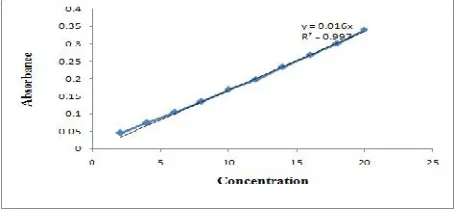
used as blank. The calibration curve data and
calibration curve.
Fig 2: Calibration Curve of Sertraline HCL
The method was found to be linear within the range of
70-130% of the 100% test concentration i.e.10µg/ml.
In the linearity study, regression equation and
correlation coefficient for Sertraline HCL was found to
be y = 0.016x + 0.0002, r=0.997.
Determination of optical parameters
The molecular absorptivity and Sandell’s sensitivity
were calculated as
Molecular absorptivity (ϵ) = AM/ct
A = Absorbance, M = Molecular weight ,C =
Concentration of sample
t = Path length
Sandell’s Sensitivity = M/ϵ
M = Molecular weight,ϵ= Molecular absorptivity
Other optical parameters i.e. Beer’s limit, slope,
intercept and correlation coefficient were calculated
from calibration curve.
Table 1: Optical parameters and regression characteristics of
Sertraline HCL
Table 2: Calculation of overall RSD for precision of method
Day 1 Day 2 Day 3 Mean SD RSD
% Recovery for
conc. no. 1 107 105.8 105 105.9 1.00 0.944
% Recovery for
conc. no. 2 107 108.3 107 107.4 0.751 0.699
% Recovery for
conc. no. 3 108.5 107.8 109.1 108.4 0.655 0.604
Overall RSD 0.749
Parameters Observations
Beers’s law limit (g/ml) 2-20 Molar absorptivity (l mole-1cm-1) 5.5 × 10⁻⁴
Sandell's sensitivity (mg/cm2/0.001absorbance unit)
62.2 × 10⁻³
Regression equation (y= a + bc) slope (b) intercept (a)
The intra-day and inter-day precision studies which
were conducted it showed RSD of 1.856% for
Sertraline HCL for intraday analysis and overall RSD
of 0.749% for Sertraline HCL for inter day analysis.
Thus the data showed that the RSD was below 2%
inferring that the analytical technique had a good
intraday and inter day precision.
3. RESULTS AND DISCUSSION
A UV-spectroscopic method was developed for the
estimation of Sertraline HCL in Pure dosage forms.
Solvent used was 50%v/v aqueous methanol.
Measurement was done at 273 nm. Method was
statistically validated according to ICH guidelines.
From these characteristics of the proposed method,
it was found that Sertraline HCL obeys linearity within
the concentration range 1-20 mcg. Found that % RSD
is less than 2, which indicates that the system &
method has good reproducibility. From the result
shown in accuracy table it was found that the %
recovery value of pure drug from the analyzed
solution of formulation were in that the commonly use
excipients and additives in the pharmaceutical
formulation were not interfering in the proposed
method, inter day, intraday of the samples indicated
shows that the intermediate precision is less than 2 and
instruments and method are precise.
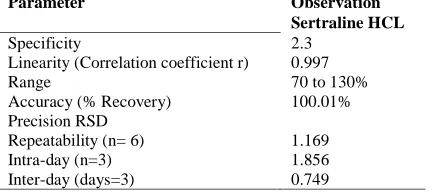
Table 3: Summary of validation parameters for the estimation of Sertraline HCL by UV-Spectroscopy
Parameter Observation
Sertraline HCL
Specificity 2.3
Linearity (Correlation coefficient r) 0.997
Range 70 to 130%
Accuracy (% Recovery) 100.01%
Precision RSD Repeatability (n= 6) Intra-day (n=3) Inter-day (days=3)
1.169 1.856 0.749
4. REFERENCES
1. Sharma BK. Chromatography-High Performance
Liquid Chromatography. In: Instrumental method
of Chemical Analysis (Analytical Chemistry).
Meerut: Goel Publishing House. 20thedition. 2001; 56-84.
2. Swarbrick J and Boylan JC. Encyclopedia of
pharmaceutical technology. Marcel Dekker Inc.,
New York. 1998; 217–224.
3. Beckett AH, Stenlake JB. Practical Pharmaceutical
Chemistry. CBS Publishers and distributors. 4th edition. 1997; 275-337.
4. Sharma YR. Elemantary organic spectroscopy
Principles & chemical application. S. Chand &
company ltd. 1stedition. 1980; 11.
5. Donald PL, Lampan M. Gary. Introduction to
spectroscopy a guide for students of organic
chemistry. 3rdedition. 356-357.
6. Jeffrey, GH. Introduction: Vogel’s Textbook of
Quantitative Chemical Analysis. ELBS, Longman.
5th Edition. 1997; 3-8.
7. In: Guidelines for submitting samples and
analytical data for method validation. Rockville,
MD, Center for Drugs and Biologics Department
of Health and Human Services. US FDA 1987.
8. Willard, Merrit, Dean and Settle. HPLC Methods
and Applications in Instrumental methods of
Analysis. New Delhi: C.B.S. Publishers and
Distributors. 7thedition. 2003; 614.
9. In: Stability testing of existing drug substances and
products. Therapeutic Products Directorate,
Ottawa. TPD 2003.
10. Maryadele JO Neil. The Merck Index Published by
Merck and Co, White House Station, NJ, USA.
edition 14th edition. 5-6.
11. In: Text on Validation of Analytical Procedures.
International conference on harmonization,
Geneva. ICH guidelines Q2A 1994.
12. In: Validation of Analytical
Procedures-Methodology. International conference on
Rubel R et al. Volume 3 (2), 2015, Page-616-620
13. British Pharmacopeia. HMSO Publication London
2009; Vol I and II: 5379.
14. Pinderjit S, Kumar R, Singh H. Sensitive &
Selective spectrophotometric determination of
Sertraline in Pharmaceuticals using picric acid.
IJPRD 2011; 3: 176-9.
15. Walash MI, Belal F, Enany N-EI. The
Spectrophotometric determination of the
antidepressants Sertraline & Paroxetine HCL using
2,4- Dinitrofluorobenzene. Int Biomed Science
2010; 6.
16. Warrier D, Zagade A, Shaikh A. An in- vitro
evaluationfor the effect of β-cyclodextrin PVP- K
30 on drug release pattern of Sertraline HCL.
International Journals of Pharmaceutical and
Chemical Sciences 2012; 1(1): 407-413.
17. Zhang M, Zhang Y. Development and Validation
of an Improved Method for the Quantitation of
Sertraline in Human Plasma using LC–MS–MS. J.
Chemistry Science 2011; 49: 89-93.
18. Devan CL, Liston HL, Markowitz JS. Clinical
pharmacokinetics of sertraline Clinical
pharmacokinetic 2002; 41: 1247-1266.
19. Walash MI, Belal F et al. Development &
validation of stability indicating method for
determination of sertraline following ICH
guidelines &its determination in pharmaceuticals
& biology fluids chemistry. Central Journal 2011;
5 (61): 1-11.
20. Sivaiah S, Rao BM, et al. Validated normal phase
chiral LC method for the enantiomeric separation
of sertraline & its Cis (1R,4R) enantiomers on
amylase based stationary phase rasayan. J.
Chemistry 2009; 42-48.
21. Farshchia A, Ghiasi G. High Performance Liquid
Chromatography Determination of sertraline in
human. Iranian J. Pharmaceutical sciences 2009; 5: