e
-ISSN: 2278-067X,
p
-ISSN: 2278-800X, www.ijerd.com
Volume 7, Issue 5 (June 2013), PP.35-39
Optimization of Injection Moulding Process Parameters in
the Moulding of Low Density Polyethylene (LDPE)
Sajjan Kumar Lal
1, Dr. Hari Vasudevan
2 1 Assistant Professor, Thakur College of Engg. & Tech, Mumbai (India)2 Principal, D.J. Sanghvi College of Engg., Mumbai (India)
Abstract:- Injection moulding is one of the most popular polymer processing methods due to its high production rate as well as its ability to produce very intricate geometries at very cheaper cost and within few seconds. There are several flaws which occur while producing plastic parts by Injection moulding, like warpage, shrinkage, flash, sink marks etc. Shrinkage is one of the most critical problems which causes dimensional changes in the parts during the moulding process. Shrinkage can be minimized by setting optimal process parameters on injection moulding machine. In this study, optimal injection moulding conditions for minimum shrinkage during moulding are found by DOE technique (Taguchi method). Different observations were taken for a material namely Low Density Polyethylene (LDPE). Taguchi method is used to investigate the effects of melting temperature, injection pressure, refilling pressure and cooling time on the shrinkage of LDPE. Taguchi method has two main instruments, which are signal-to-noise (S/N) ratio and orthogonal arrays. S/N ratios were used for determining the optimum combinations of the process conditions for shrinkage. The S/N ratio takes both the average and the variability of the quality characteristics into consideration. The results showed that the cooling time was the most effective factor for LDPE followed by refilling pressure and injection pressure was found to be the least effective factor.
Keywords:- Injection pressure, melting temperature, refilling pressure, cooling time, shrinkage, S/N ratio, Taguchi method.
I. INTRODUCTION
Injection moulding is a manufacturing process for producing parts by injecting material into a mould. Injection moulding can be performed with a host of materials, including metals, glasses, elastomers, confections, and most commonly thermoplastic and thermosetting polymers. Material for the part is fed into a heated barrel, mixed, and forced into a mould cavity where it cools and hardens to the configuration of the cavity. After a product is designed, usually by an industrial designer or an engineer, moulds are made by a mouldmaker (or toolmaker) from metal, usually either steel or aluminum, and precision-machined to form the features of the desired part. Injection moulding is widely used for manufacturing a variety of parts, from the smallest components to entire body panels of cars.
Parts to be injection moulded must be very carefully designed to facilitate the moulding process.The material used for the part, the desired shape & features of the part, the material of the mould and the properties of the moulding machine must all be taken into account. The versatility of injection moulding is facilitated by the breadth of design considerations and possibilities. Shrinkage is one of the most important reasons that causes dimensional changes in the part and it can be minimized by setting optimal process parameters on injection moulding machine.
Vaatainen et al. [10] investigated the effect of the injection moulding parameters on the visual quality of mouldings using the Taguchi method. They focused on the shrinkage with three more Quality characteristics: weight, weld lines and sink marks. They were able to optimize many quality characteristics with very few experiments , which could lead to cost saving. Mohd. Muktar Alam, Deepak Kumar [11] ,in his paper determined optimal injection moulding condition for minimum shrinkage by the DOE technique of Taguchi methods. Packing pressure was found the most effective factor for PP followed by packing time, injection pressure and melt temperature. Gang XU, Fangbao DENG [12] in his study presented an innovative neural network-based quality prediction system for a plastic injection moulding process. The particle swarm optimization algorithm (PSO) is analyzed and an adaptive parameter-adjusting PSO algorithm based on velocity information (APSO-VI) is put forward. Experimental results show that APSO-VINN can better predict the product quality (volume shrinkage and weight) and can likely be used for various practical applications.
From the literature review, it can be concluded that, in order to minimize such defects in plastic injection moulding, design of experiment by Taguchi method can be applied and is considered suitable by many researchers. In experimental design, there are many variable factors that affect the functional characteristics of the product. Design parameter values that minimize the effect of noise factors on the product’s quality are to be determined. In order to find optimum levels, fractional factorial designs using orthogonal arrays are used. In this way, an optimal set of process conditions can be obtained from very few experiments.
Optimization of Injection Moulding Process Parameters for LDPE
II. TAGUCHI TECHNIQUE
Taguchi technique [13] recommends to use orthogonal array experiments. It is used to optimize the performance characteristics within the combination of design parameters.
In the product/process design of Taguchi, there are basically three steps involved:- i) System Design: selection of a system for a given objective function.
ii) Parameter Design: to find the optimum combinations of the process conditions for improving performance characteristics.
iii)Tolerance Design: determination of tolerance around each parameter level.
Taguchi method uses signal-to-noise (S/N) ratio which reflects both the average and the variation of the quality characteristics. It is a measure of performance aimed at developing products and processes insensitive to noise factors.
Types of S/N ratio: Larger- the- better :
S/N = -10 log 10(1/n Σ 1/yi2 )
where, i=1 to n , n = no. of replications applied to the problems where maximization of quality characteristics of interest is needed.
Smaller- the- better : S/N = -10 log 10(1/n Σ yi2 )
It is used where minimization of the characteristics is intended Nominal-the-best :
S/N = -10 log 10 [µ 2
/ σ2 ]
where µ = mean , σ = standard deviation
It is used where one tries to minimize the mean squared error around a specific target value. Adjusting the mean to the target by any method renders the problem to a constrained optimization problem.
III. EXPERIMENTAL STUDY
A. Materials:
The input parameters selected are meting temperature, injection pressure, refilling pressure and cooling time. Shrinkage is selected as output.
Table 1: Properties of LDPE
Property Unit Typical Value
Density (23 oC) g/cm3 0.918
Melt flow index g /10 min 30
Tensile strength at Yield MPa 10
Elongation at Yield % 40
Flexural Modulus MPa 140
B. Injection Moulding Process:-
The part was injection moulded using a 100-ton injection moulding machine (Polyplast).
C. Experimental
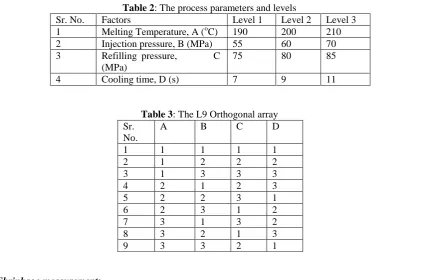
Three levels of processing parameters and L9 orthogonal array are selected. The process parameters and levels are shown in table 2 and L9 orthogonal array is shown in table 3.
Table 2: The process parameters and levels
Sr. No. Factors Level 1 Level 2 Level 3 1 Melting Temperature, A (oC) 190 200 210 2 Injection pressure, B (MPa) 55 60 70 3 Refilling pressure, C
(MPa)
75 80 85
4 Cooling time, D (s) 7 9 11
Table 3: The L9 Orthogonal array Sr.
No.
A B C D
1 1 1 1 1
2 1 2 2 2
3 1 3 3 3
4 2 1 2 3
5 2 2 3 1
6 2 3 1 2
7 3 1 3 2
8 3 2 1 3
9 3 3 2 1
D. Shrinkage measurement:-
It is the difference between the size of mould cavity and size of finished part divided by size of the mould. S = (Dm-Dp ) / Dm X 100
Here, Dm is mould dimension , Dp is part dimension and S is the shrinkage
IV. RESULTS AND DISCUSSION
Table 4: Shrinkage values for LDPE Melting
Temperature, (oC)
Injection pressure, (MPa)
Refilling pressure, (MPa)
Cooling time, (s)
Shrinkage (%) LDPE
190 55 75 7 1.575
190 60 80 9 1.50
190 70 85 11 1.25
200 55 80 11 1.437
200 60 85 7 1.50
200 70 75 9 1.625
210 55 85 9 1.375
210 60 75 11 1.40
210 70 80 7 1.78
Table 5: The response table for S/N ratio for LDPE Sr. No. Melting
Temperature, A ( oC)
Injection pressure, B (MPa)
Refilling pressure, C (MPa)
Cooling time, D (s)
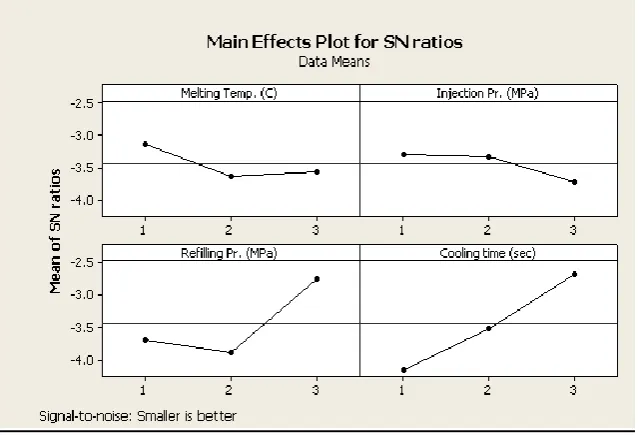
Level 1 -3.135 -3.287 -3.695 -4.159
Level 2 -3.629 -3.322 -3.893 -3.502
Level 3 -3.566 -3.721 -2.742 -2.670
Delta 0.494 0.434 1.151 1.489
Rank 3 4 2 1
The response table of the S/N ratio is given in table 5. The best set of combination parameter can be determined by selecting the level with highest value for each factor. The optimal process parameter combination for LDPE is A1, B1, C3, D3.
The Delta value given in the table 5 denotes as to which factor is the most significant for shrinkage of LDPE moulding. Cooling time was found to be most effective factor for LDPE followed by refilling pressure. Injection pressure was found to be the least effective factor.
V. CONCLUSION
Taguchi method is used to investigate the effects of melting temperature, injection pressure, refilling pressure and cooling time on the shrinkage of LDPE. S/N ratios were used for determining the optimum combinations of the process conditions for shrinkage. The result showed that melting temperature of 190 oC, injection pressure of 55 MPa, refilling pressure of 85 MPa and cooling time of 11 sec. gave minimum shrinkage for LDPE. Cooling time was found to be most effective factor for LDPE followed by refilling pressure. Injection pressure was found to be the least effective factor. From the findings, it can be stated that Taguchi method is a powerful tool for evaluating the defect of shrinkage in the plastic injection moulding.
REFERENCES
[1]. G. Pötsch and W. Michaeli, “Injection moulding: An introduction”, Munich: Hanser Publishers, 1995. [2]. J.A. Brydson, “Plastic materials”, Butterworth-Heinmann: Oxford,1995.
[3]. D.V. Rosato, M.G. Rosato, “Injection moulding handbook” Massachusetts: Kluwer Academic Publishers, 2000.
[4]. M.C. Huang and C.C. Tai , “The effective factors in the warpage problem of an injection-moulded part with a thin shell feature”, J. Mat. Proc. Tech., vol. 110, 2001, pp. 1–9.
[5]. M. Altan, “Reducing Shrinkage in Injection Mouldings via the Taguchi,ANOVA and Neural Network Methods”, j. Mat. & Design, vol. 31,2010, pp. 599–604
[6]. Neeraj Singh Chauhan and Shahzad Ahmad “ Optimization of Cycle Time of DVD-R Injection Moulding Machine” by International Journal of Engineering and Technology (IJEST)
[7]. C.R. Kothari “Research Methodology” – New Age Publication
[8]. Alireza Akbarzadeh andMohammad Sadeghi “Parameter Study in Plastic Injection Moulding Process using Statistical Methods and IWO Algorithm”, International Journal of Modeling and Optimization, Vol. 1,No. 2, June 2011
[9]. James Anderson, Aaronn K. Ball “Cycle Time Reduction for Optimization of Injection Moulding Machine parameters for Process Improvements” in Session 105-039
[10]. Vaatainen O, Pentti J. “ Effect of processing parameters on the quality of injection moulded parts by using the Taguchi Parameter design method”, Plast Rubber Compos 1994;21:2117
[11]. Mohd. Muktar Alam, Deepak Kumar “Reducing Shrinkage in Plastic Injection Moulding using Taguchi Method in Tata Magic Head Light” International Journal of Science and Research (IJSR), India Online ISSN: 2319-7064
[12]. Gang XU1, Fangbao DENG2, Yihong XU “Adaptive Particle Swarm Optimization-Based Neural Network in Quality Prediction for Plastic Injection Moulding ” Journal of Computational Information Systems 7:2 (2011) 462-470