R E S E A R C H
Open Access
Evaluation of a smartwatch-based
intervention providing feedback of daily
activity within a research-naive stroke ward:
a pilot randomised controlled trial
Sophie Lawrie
1*†, Yun Dong
2†, Dax Steins
1, Zhidao Xia
1, Patrick Esser
1, Shanbin Sun
2, Fei Li
2, James D Amor
3,
Christopher James
3, Hooshang Izadi
1, Yi Cao
2*, Derick Wade
1, Nancy Mayo
4, Helen Dawes
1and Smart Watch
Activity Feedback Trial Committee (SWAFT)
Abstract
Background:The majority of stroke patients are inactive outside formal therapy sessions. Tailored activity feedback via a smartwatch has the potential to increase inpatient activity. The aim of the study was to identify the challenges and support needed by ward staff and researchers and to examine the feasibility of conducting a randomised controlled trial (RCT) using smartwatch activity monitors in research-naive rehabilitation wards. Objectives (Phase 1 and 2) were to report any challenges and support needed and determine the recruitment and retention rate, completion of outcome measures, smartwatch adherence rate, (Phase 2 only) readiness to randomise, adherence to protocol (intervention fidelity) and potential for effect.
Methods:First admission, stroke patients (onset < 4 months) aged 40–75, able to walk 10 m prior to stroke and follow a two-stage command with sufficient cognition and vision (clinically judged) were recruited within the Second Affiliated Hospital of Anhui University of Traditional Chinese Medicine. Phase 1: a non-randomised
observation phase (to allow practice of protocol)—patients received no activity feedback. Phase 2: a parallel single-blind pilot RCT. Patients were randomised into one of two groups: to receive daily activity feedback over a 9-h period or to receive no activity feedback. EQ-5D-5L, WHODAS and RMI were conducted at baseline, discharge and 3 months post-discharge. Descriptive statistics were performed on recruitment, retention, completion and activity counts as well as adherence to protocol.
Results:Out of 470 ward admissions, 11% were recruited across the two phases, over a 30-week period. Retention rate at 3 months post-discharge was 48%. Twenty-two percent of patients dropped out post-baseline assessment, 78% completed baseline and discharge admissions, from which 62% were assessed 3 months post-discharge. Smartwatch data were received from all patients. Patients were correctly randomised into each RCT group. RCT adherence rate to wearing the smartwatch was 80%. Baseline activity was exceeded for 65% of days in the feedback group compared to 55% of days in the no feedback group.
(Continued on next page)
* Correspondence:[email protected];[email protected] †Sophie Lawrie and Yun Dong contributed equally to this work. 1Centre for Movement, Occupational and Rehabilitation Sciences (MOReS),
Department of Sport, Health Sciences and Social Work, Oxford Brookes University, Headington Campus, Headington Road, Gipsy Lane, Oxford OX3 0BP, UK
2Rehabilitation Centre, the Second Affiliated Hospital of Anhui University of
Traditional Chinese Medicine, Hefei, Anhui Province, China Full list of author information is available at the end of the article
(Continued from previous page)
Conclusions:Delivery of a smartwatch RCT is feasible in a research-naive rehabilitation ward. However, frequent support and guidance of research-naive staff are required to ensure completeness of clinical assessment data and protocol adherence.
Trials registration:ClinicalTrials.gov Identifier,NCT02587585–30th September 2015
Keywords:Stroke, Physical activity, Activity feedback, Feasibility, Research naive, Rehabilitation
Background
Exercise has an important role in the recovery of stroke, increasing cognition, arm function, balance and gait, in addition to reducing the risk of subsequent cardiovascu-lar events [1,2]. Despite the importance of general phys-ical activity in recovery, the majority of stroke survivors receiving rehabilitation in hospital are inactive outside formal therapy sessions [3, 4]. In order to encourage long-term exercise adherence, it is recommended that physical activity goals are customised to the individual tolerance of the stroke patient [2].
Modern electronic activity monitors are able to provide a wide range of behavioural monitoring tools and are therefore emerging as a possible method to provide custo-mised activity goals and feedback to promote exercise [5]. Coinciding with the technological developments in activity monitoring, there is evidence to suggest that activity feed-back of exercise may increase motivation to exercise. The provision of activity feedback has been found to be more effective in increasing physical activity levels than provid-ing activity goals alone, in healthy controls [6–8] and in older adults undergoing rehabilitation [9]. Interventions providing feedback and monitoring of activity have shown positive outcomes in relation to exercise adherence amongst older individuals [10]. However, personalised ac-tivity feedback has also found to have no effect on actual or intended activity levels amongst controls [11]. Despite studies suggesting a positive effect, more evidence is needed before such activity feedback interventions can be recommended to be used in treatment.
The literature has shown that remote monitoring of physical activity is feasible after stroke [12]; however, the impact of activity feedback on exercise levels within this population is less clear. A systematic review of studies investigating augmented feedback on motor activities after stroke concluded that findings were inconsistent due to the combination of multiple aspects and types of
augmented feedback used [13]. One study found that
feedback of physical activity provided three times a week had no significant effect on the daily walking time of stroke inpatients [14]. Little research to date has investi-gated the use of periodic feedback of daily activity amongst stroke patients undergoing rehabilitation. It is of interest to see whether increasing the frequency of ac-tivity feedback will elicit greater physical acac-tivity levels.
The provision of daily activity feedback (via a
smart-watch), relative to activity at fixed time points
through-out the previous day, may have the potential to motivate stroke rehabilitation patients to be more active. Conducting clinical trials within research-naive set-tings are commonly accompanied with ethical, cultural and organisational challenges [15]. The present study will evaluate the feasibility of conducting the smartwatch intervention mentioned above within a research-naive stroke rehabilitation centre in Hefei, China (whereby no rehabilitation research has previously been conducted).
The aim of this feasibility study was to identify the challenges and support needed by ward staff and re-searchers and to examine the feasibility of conducting an
RCT using smartwatch activity monitors in
research-naive rehabilitation wards. The objectives were to report any challenges and support needed and deter-mine the recruitment and retention rate, completion of outcome measures, adherence to wearing the smart-watch, readiness to randomise, adherence to protocol (intervention fidelity) and potential for effect.
Method Research design
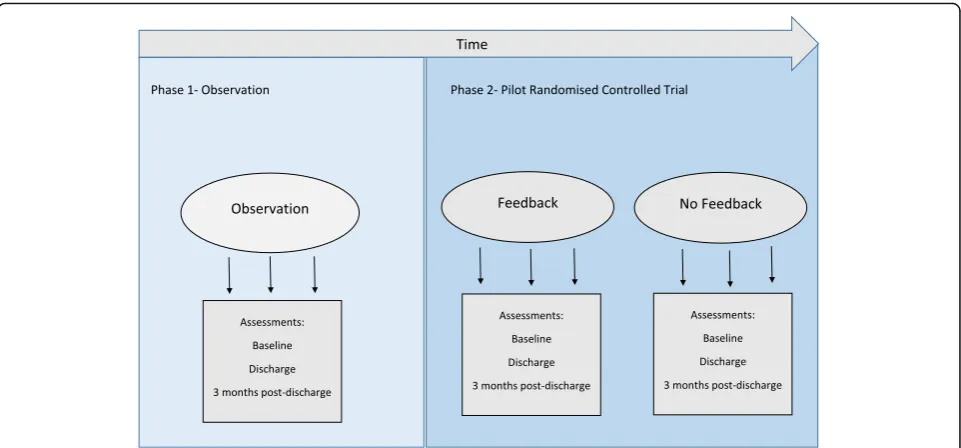
The research design included two experimental phases,
an observational phase and a pilot RCT (see Fig. 1).
Criteria for participant recruitment and selection
were identical between the two phases (observation and pilot RCT). Group allocation into either phase was de-termined by the time from study onset. In keeping with the allocated period of funding and to allow the max-imum time for the pilot RCT phase, patients were re-cruited into the observation phase 1 month from trial onset and the pilot RCT from 2 to 6 months from trial onset.
Phase 1: Observation phase
provided with a smartwatch that recorded their activity but provided no feedback about the physical activity levels during a 3-week intervention period.
Phase 2: Pilot randomised controlled trial phase
Phase two was a single-blind, pilot randomised con-trolled trial; with the research assessor blinded to the group allocation (it was not possible to blind the ward staff and patients). Group allocation was performed by an independent researcher using a 1:1 allocation ratio. A computer-generated random sequence was generated in Microsoft Excel to allocate groups and generate numbers of which was then used to assign participants. The pa-tients recruited into the pilot RCT phase were randomly assigned using concealed allocation in envelopes held centrally, into one of two groups:
To receive feedback on the amount of physical activity (movement) undertaken, two hourly for the first 8 h and then for the last 1 to 2 hours
(dependent on the battery life) or
To receive no feedback about the physical activity levels during a 3-week intervention period.
Once recruited, the research office (unblinded) was in-formed by the recruiting doctor and the research office then registered the patient, opened the next envelope and notified the ward (unblinded) about the patient’s group by phone. The researcher assessors performing all pre- and post-assessments remain blinded to group as-signment throughout the duration of the study.
Aims and objectives
The study consisted of two phases, an initial observa-tion phase (phase 1) and a pilot randomised con-trolled trial (phase 2). Each phase shared the same overall aim: to identify the challenges and support needed by ward staff and researchers and examine the feasibility of conducting an RCT trial using
smart-watch activity monitors in stroke survivors in
research-naive rehabilitation wards. The objectives per phase were as follows:
Phases 1 and 2: to report any challenges and support needed and determine the recruitment and retention rate, completion of outcome measures and adherence rate to wearing the smartwatch
Phase 2 only: determine the readiness to randomise, adherence to protocol (intervention fidelity) and potential for effect.
Patients that received activity feedback (pilot RCT-feedback group) were expected to exhibit increased activity levels than patients who did not receive activ-ity feedback (observation group and pilot RCT no feedback group). It would also be expected that in-creased activity will result in improved mobility, and possibly cognition, arm function, independence in daily activities and health-related quality of life within the feedback group. However, no significant differ-ences between groups in activity or clinical assess-ment outcomes are expected in this trial as this is a feasibility study and thus underpowered.
Research process
The study involved multiple clinical research groups within the Second Affiliated Hospital of Anhui Univer-sity of Traditional Chinese Medicine (ward staff (doctors and nurses), research assessors, the Smart Watch Activ-ity Feedback Trial Committee (SWAFT) and research officers) and those of the Oxford Brookes Centre for
Movement, Occupational and Rehabilitation Sciences’
(MOReS) and Warwick Biomedical Engineering group. The SWAFT team members are listed in the title page and met weekly to resolve any local practical problems involving the study. The ward staff conducted the smart-watch intervention and screening of participants, and the research assessors conducted the clinical assess-ments and oversaw the maintenance of research data-bases and transfer of research data.
Before this study started, the Oxford (UK) research team visited the host hospital in Hefei twice to develop the re-search ideas, design and governance with the local Chinese clinical and research group. Then, specific proto-cols (standard operating procedures) were written, ethical applications sought in local institutional settings, and a 2-week formal training in the execution and governance of the protocols, procedures for data collection and re-cruitment was given to the ward staff and the research as-sessors. The full protocol can be accessed online [16].
Specific roles within the study were as follows:
Ward staff:
Identify and record new ward admissions Assess and record eligibility
Recruit patients onto the study (recruiting doctor) Inform the research office of the above
Obtain informed consent (day 0)
Re-checking eligibility on patients who were failing the initial clinical eligibility test (day 3)
Initiating trial—providing smartwatch and explaining its function (day 1)
Preparation, distribution and collection of smartwatches and download of data
Checking patient after first 8 h of intervention—one working day (day 1)
Daily review of patients receiving intervention for adverse events—both groups
Inform research office of any adverse events Record any patient feedback
Unblinded members of the research office: Register new patients onto trial database
Notify the ward about a patients group allocation Fortnightly teleconference calls and email data
transfer with the Oxford research team Receive and file consent forms
Record ineligible patients Collation of data
Research assessors:
Conduct clinical assessments and record outcome data (in ward and via telephone at 3 months) Record adverse events
Oxford and Warwick research teams: Receiving and securing data Data analysis
Technical support regarding gait sensor and smartwatch
To monitor and provide support to increase fidelity with the research protocol, a further visit after 3 months was undertaken and then regular video-conferencing calls were made every 2 weeks, and data were sent via protected email every 2 weeks to Oxford for storage and analysis. When required, the Warwick group provided technical support for the smartwatch by email and video-conferencing calls which helped to eliminate some early issues with the smartwatch application and the way it was being used. In these ways, as much support and help as possible was delivered and the quality and com-pleteness of data were monitored.
Participant selection and recruitment
Patients admitted across four rehabilitation wards in the Second Affiliated Hospital of Anhui University of Trad-itional Chinese Medicine, Hefei, Anhui Province, China were recruited by a recruiting doctor that is based on the ward. Recruitment numbers were subject to the number of admissions to the wards within the allocated 6-month completion period of the study. All patients in-cluded in this paper were recruited onto the study before 30th April 2016. Criteria for participant recruitment and selection are identical between the two phases (observa-tion and pilot RCT). Recruitment into the pilot RCT
oc-curred after the observation phase had stopped
recruiting patients.
Patients were eligible for screening if admitted after a recent stroke (less than 4 months), and the following questions were answered positively:
1. Can the patient follow a two-stage command, judged clinically?
2. Was the patient walking without help from another person before this stroke?
Recruitment was dependant on whether the patient satisfied demographic and performance-based inclusion criteria.
Demographic inclusion criteria are as follows:
a) are aged 40–75 years
d) were able to walk at least 10 m prior to stroke, without help of another person; use of equipment allowed
Performance-based inclusion criteria are as follows:
e) have sufficient cognition to participate in study and testing procedures (clinically judged, because there are no valid short cognitive measures to assess ability to consent and participate)
f ) can follow a two-stage command (e.g. pick up an object, put it on the table)
g) has sufficient visual function to see watch feedback (clinically judged)
h) have the capacity to consent and do give consent to the study
If a subject matched all other inclusion criteria but was unable to follow a two-stage command, they would be reassessed at a 3-day follow-up and included if the criteria were then met during this time. Only first-time admis-sions into the stroke ward were accepted, but the stroke could be a second or subsequent stroke provided the pa-tient met the inclusion criteria. A member of the ward staff responsible for recruiting explained the consent form to eligible patients allowing ample time for full compre-hension and to answer any questions. All patients were given 24 h to decide if they wanted to participate in the study. Fully informed written consent was then obtained from willing participants in the form of a signature.
Intervention
Clinical assessments
Upon admission to rehabilitation, the standard demo-graphic data collected on each patient as part of routine care included age, gender, weight, height and grip strength in the unaffected arm (left or right). Routine hospital data were used to record total the number of patients admitted after stroke and the dates of stroke onset. All patients re-ceived a local routine that includes drug treatments, acu-puncture (with additional Moxibustion, cupping and Tui Na (Massotherapy)) and rehabilitation. The drug and acu-puncture treatment are performed in the morning be-tween 9:00 and 11:00 am prior to rehabilitation performed in the afternoon and included the following:
Drug treatment: routine neuron stimulation and nutritional therapy (Cerebrolysin, Vinpocetine or Ganglioside) and herb medicine for‘promoting blood circulation by removing blood stasis’, and other associated symptoms or complications were administered to all cases included in the study. Acupuncture treatment: acupuncture treatments
were performed according to patients’condition
based on traditional medical diagnosis, with additional Moxibustion, cupping or Tui Na therapy if needed.
Rehabilitation: Following functional evaluation of each patient, a rehabilitation treatment plan was established accordingly. The treatment will include physiotherapy, occupational therapy and physical factor therapy—including low frequency,
intermediate frequency, magnetic heat and transcranial magnetic.
Patients with stroke within the Second Affiliated Hospital of Anhui University of Traditional Chinese Medicine are typically discharged from in-patient rehabili-tation between 2 to 3 weeks, and thus the length of inter-vention differed between subjects. All patients entered into the research study were assessed at baseline (0 weeks) and at discharge from the ward (≤3 weeks) by a research assessor, who did not know their group allocation, on:
Cognition, using the Montreal Cognitive Assessment (MoCA) [17]—Mandarin version [18,19]
Activities of daily living, using the Barthel ADL index [20] and the World Health Organization Disability Assessment Scale (WHODAS) 12 item version [21]
Fatigue, using the Fatigue Severity Scale [22,23] and a visual analogue scale with anchor points of‘no experience of fatigue’(= 0 mm) and‘worst fatigue imaginable’(= 100 mm)
Quality of life, using the EuroQol 5D-5L (EQ-5D-5L) and its visual analogue scale with anchor points of ‘best state of health you can imagine’(100) and ‘worst state of health you can imagine’(0) [24,25] Measures of mobility; Rivermead Mobility Index
(RMI) [26] and a 10-m walk test (10MWT) time [27] Grip strength [28]; that provides a quantitative and
objective measure of isometric muscular strength of the hand and forearm
Spatio-temporal gait features at self-selected walking speed measured during the 10MWT using an inertial sensor on the lower trunk [29]. Participants were instructed to walk twice along a 10-m walkway at their normal pace with a walking aid or support of a re-searcher. Walking speed, cadence, step length and sym-metry of spatio-temporal measures were calculated.
translated into Mandarin: ‘We would like to know how good or bad your health is TODAY. On a scale numbered from 0 to 100, where 100 means the best health you can imagine and 0 means the worst health you can imagine, what would you rate your health today?’
Smartwatch activity recording
The smartwatch was instructed to be worn throughout the day (08:00–17:00) in the rehabilitation ward from Monday to Friday for up to 15 days (21 days elapsed in total) or until discharge if sooner. A member of the ward
staff provided each patient with a ZGPAX S8 Android™
[30] smartwatch each morning, to wear on the
un-affected side. The watch divides elapsed time into four periods of 2 h and one period of 1 h (to match the dur-ation of battery life). The first day served as a baseline measure for each time period, where none of the pa-tients in any phase received feedback on their levels of activity. Ward staff were instructed to explain to patients in the feedback group that over a 2-h period, the watch would indicate progress towards the activity goal for those 2 h. For patients in the observation phase and the no feedback (control) group, ward staff were required to explain that activity scores were recorded on the watch but otherwise provided no feedback or motivating com-ments. Each day after baseline, the smartwatch would automatically set the goal based on a 5% increase in the total activity recorded in the comparable 2-h epoch the preceding day (Friday was used for the Monday goals). In the no feedback group, the activity level is simply re-corded and no further processing or action occurs. The research doctors were instructed to ask the patients about any problems with the watch and to look out for any observable adverse effects such as a skin rash. Each evening at about 17:00, a member of the ward staff re-moved the watch, downloaded the data into a computer through a USB connection and recharged the watch
battery overnight using the same USB connector. Encrypted smartwatch and assessment data were sent from Anhui research office by protected email to the Oxford research team upon completion.
The ZGPAX S8 Android™ smartwatch runs a
custom-built activity monitoring and user feedback ap-plication established from previous work investigating physical activity in the elderly [31, 32]. The smartwatch specifications are shown in Additional file 1. Data from the ZGPAX S8 tri-axial accelerometer is processed to extract a measure of overall body movement, the activity score, alongside an estimate of whether the watch was or was not worn [33]. Activity score has been shown to correlate highly (p< .001) with energy expenditure ob-tained from whole room calorimetry [34]. The intention of the watch is to compare relative levels of activity from day to day rather than a specific measurement of actual activity. A higher activity score can be achieved by either very intense short bursts or very low intensity yet con-tinuous movement. Activity was not summated into standardised thresholds of passive, moderate or vigorous exercise as this has been shown to be inappropriate for individuals with stroke [35].
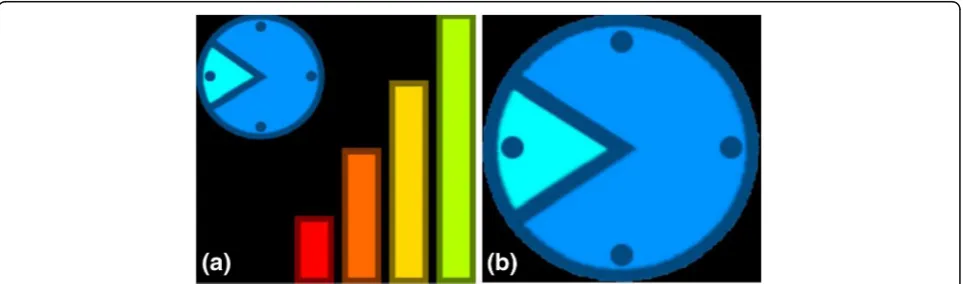
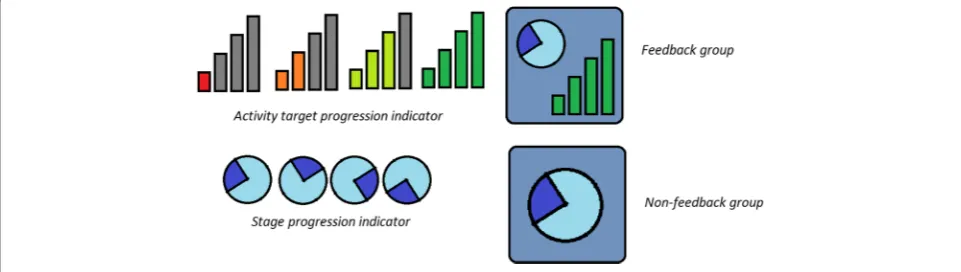
As there is little research using feedback in this manner, no previously validated feedback icons were available. The feedback icons used in the smartwatch software were de-veloped in collaboration between Warwick and Oxford Brookes with the aim of providing feedback on both activ-ity levels and the current daily time period. Feedback was displayed visually in the form of four progressive bars (see Fig. 2). The bars act as an activity tracker to indicate the amount of activity completed relative to their goal. The bars differ in size and colour from red to green, depending on how close the patient is to completing their activity goal. Bar 1 is highlighted red as default, signifying little or no activity. Bars 2, 3 and 4 correspond to completion of 1/ 3 (orange), 2/3 (yellow) and 3/3 (green) of the activity goal respectively. The clock icon shows the patient which of
the five time periods (between 08:00 and 17:00) they are in and therefore roughly the current time. Visual presenta-tion of the smartwatch within the control (no feedback) group consisted of the clock icon only. Visual compari-sons of the icons displayed by the smartwatch within the feedback and control group are shown in Fig.3.
Data analysis
Data analysis involved descriptive statistics performed on recruitment, retention and completion, activity counts as well as adherence to protocol. All data analysis was conducted by the Oxford and Warwick research teams. The current study is an external pilot, and there-fore, the data collected will not form part of a subse-quent main trial. The data collected in both phases included the following:
Challenges and support needed by ward staff and researchers (office and assessors)
Recruitment rate (percentage of patients who were recruited out of total patients admitted for rehabilitation after stroke)
Retention rate (percentage of patients that completed assessments at baseline, discharge and follow-up out of the total number of patients recruited)
Duration in days between stroke event and admission and from admission to trial registration Duration in days from the start of the intervention
to discharge and admission to discharge Range of data completion per outcome
Process for acquiring, recording, transferring and quality control of original trial data
Adherence rate to wearing the smartwatch (days the smartwatch was worn/total days of data received)
Adherence to protocol by research assessors and ward staff (standard operating procedures) Readiness to randomise (number of patients
randomised and recorded as per the protocol)
Potential for effect (number of days that patients exceeded their baseline activity level per group) Any feedback from patients, ward staff and research
team
Self-reported and observed adverse events (from patients and ward staff ).
A patient’s activity was considered to have exceeded baseline activity if the total daily activity score recorded was greater (n> baseline) than the activity score re-corded at baseline (day 1 of the intervention).
Ethics
This study was sponsored by the Second Affiliated Hos-pital of Anhui University of Traditional Chinese Medicine. The study was approved by the Chinese Ethics Committee of Registering Clinical Trials (ChiECRCT-20150034), West China Hospital, Sichuan University, 37 Guoxuexiang, Chengdu, Sichuan, China. The study was registered at the Chinese Clinical Trial Registry on 08 August 2015, num-ber ChiCTR-IOR-15007179 and on clinical trials.gov (NCT02587585; 30 September 2015).
All research was in compliance with the Helsinki Declarations and the Research Governance Framework for Health and Social Care. Informed written consent was obtained by a recruiting doctor based on the wards, whereby sufficient mental capacity (through clinical judgement) and understanding of anonymity and the in-clusion of their data was ensured by verbal confirmation.
Results
Research challenges and support needed by ward staff and researchers
The major challenges when conducting this research in-cluded the following:
Maintaining consistent recording and transfer of data Maintaining communication between the research
and ward teams to avoid loss of participants (to
notify when patients are to be discharged and thus require assessment)
Ensuring clear understanding of specific roles within the research office, assessors and ward staff
Language barriers between the English and Chinese teams that made it difficult to explain fine details of data collection/transfer.
Specific support needed by the research office, re-search assessors and ward staff included the following:
More clarity in individual roles
More emphasis/understanding on the importance of complete data both from research assessors and patients
A bilingual individual overseeing the transfer of data proficient in Mandarin and English to ensure full comprehension
Email reminders to send over the research data files Regular surveillance of the data collected to ensure
consistent data collection.
Recruitment and retention
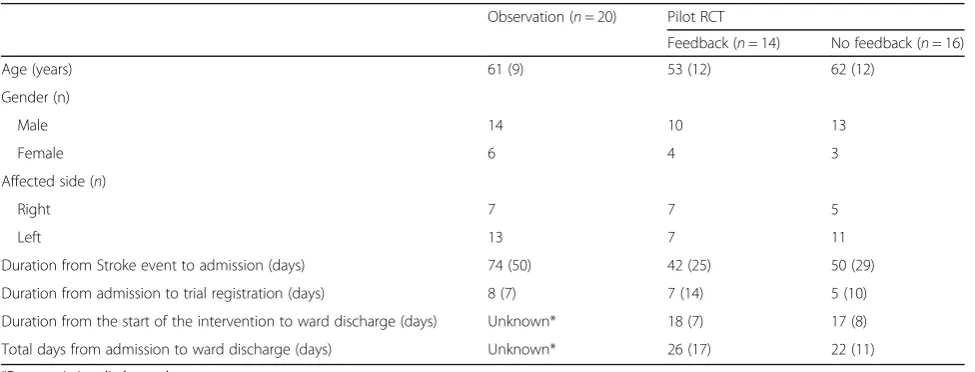
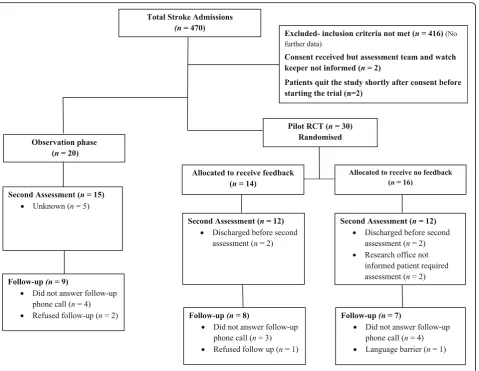
Between September 22, 2015, and April 19, 2016, the hospital admitted 470 patients for rehabilitation after stroke and 51 (11%) were recruited into the two phases. One patient was registered accidentally (they did not meet the inclusion criteria of sufficient cognition), leav-ing 50 valid patients. Patients in the observation phase started the intervention between October 15, 2015, and November 11, 2015. Patients in pilot RCT started the intervention from November 11, 2015 until April 22, 2015. Demographics are shown in Table1.
The percentage of participants retained at discharge was 78% (39 out of 50 patients) and at 3 months
post-discharge was 48% (24 out of a total 50
patients).The last of the 3-month follow-up telephone
calls occurred on August 24, 2016. Figure 4 shows the
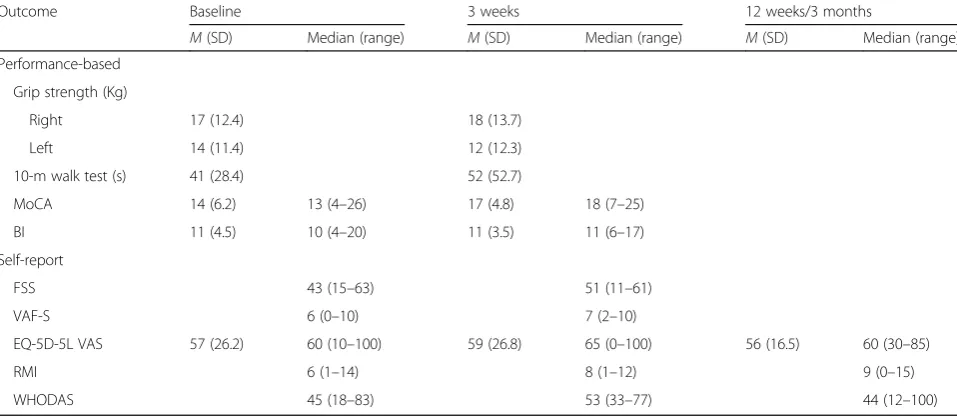
flow of patients in both phases of the study. Due to in-consistent recording of excluded patients, the number of patients that did not match each inclusion criterion is unknown. Recruitment ended in April 2016 due to com-pletion of the allocated funding period. Measurement data from patients in the observation group and the pilot RCT are shown in Tables2and3respectively.
Completeness of data
It is obvious that few patients across both phases had complete clinical assessment data across all measures even at discharge (see Table4). Lost data were greater at 3 months follow-up. Eleven patients across both phases did not receive a second assessment and 3 months follow-up due to reduced communication between the ward and research office. One patient in the pilot RCT phase completed the intervention without completion of clinical assessments at any stage. Incomplete data at baseline (for example weight, height, 10MWT data and grip strength) can be partly explained by patients being unable to stand and weakness in their affected side. Thirteen patients (five in the observation phase and eight in the pilot RCT phase) were unable to walk. Seven patients in the observation phase were unable to complete the grip strength assessment due to weakness on their left side. Detailed reasons for in-complete baseline data for the FSS, VAF-S and WHO-DAS were not recorded. Discharge dates were not recorded for the majority of patients in the observa-tion group (n= 16), although this was collected for all RCT patients.
Despite the loss of patients, the data quality for the pa-tients that were assessed at discharge and 3 months post-discharge follow-up was good. Complete data were
Table 1Patient demographics per group (mean (SD))
Observation (n= 20) Pilot RCT
Feedback (n= 14) No feedback (n= 16)
Age (years) 61 (9) 53 (12) 62 (12)
Gender (n)
Male 14 10 13
Female 6 4 3
Affected side (n)
Right 7 7 5
Left 13 7 11
Duration from Stroke event to admission (days) 74 (50) 42 (25) 50 (29)
Duration from admission to trial registration (days) 8 (7) 7 (14) 5 (10)
Duration from the start of the intervention to ward discharge (days) Unknown* 18 (7) 17 (8)
Total days from admission to ward discharge (days) Unknown* 26 (17) 22 (11)
collected on WHODAS, MOCA, Barthel ADL Index, RMI and EQ-5D-5L measures from all 39 patients assessed at discharge. One patient did not cooperate on the additional measures. Similar to baseline, seven pa-tients could not complete the 10-m walk test at dis-charge due to an inability to walk. At 3 months post-discharge follow-up, the majority of patients that were contactable completed all three assessments (RMI, WHODAS and EQ-5D-5L measures), 21 out of 24 pa-tients recorded.
The majority of patients in the observation phase
(see Table 4) were not recorded in the smartwatch
log leading to no record of distribution or functioning of each smartwatch. Duplicate and mislabelled data may be partly explained by poor understanding of the protocol for downloading smartwatch data in the ini-tial phase of the study, for example, how to customise the watch with the patient ID. Smartwatch data were consistently recorded and collated after the study pro-gressed into the pilot RCT phase. Completeness of smartwatch data also improved from the observation
phase to RCT. Only eight weekdays of activity data were lost in the RCT compared to 83 weekdays in the observation phase.
No valid gait data were recorded due to initial problems with the functioning of the sensor (faulty Bluetooth connection) and inconsistent recordings of leg length and shoe size. Oxford Brookes visited the hospital to help rectify these problems which have now been amended to allow gait data to be recorded for any future large-scale RCT. Activity data were
returned from all 50 patients (n= 20 observation
phase and n= 30 RCT pilot phase).
During the observation phase, duplicate data files
were common (see methods) with data files from
cer-tain days not correctly labelled with the patient iden-tification number (ID); in response to this, the initial process for downloading and transferring smartwatch data was altered. Each patient’s smartwatch data were downloaded daily (as a precaution against loss of data in the watch), but data were not removed from the watch until the end of the intervention. Thus, the last
download gave one complete smartwatch data file per patient covering the whole intervention (instead of a data file for each day of the intervention). This allowed for easier collection and understanding of the data when arriving in Oxford.
Adherence rate to wearing the smartwatch
Patients often forgot to wear their smartwatch, but this problem was improved during the pilot phase by ward staff providing regular reminders. Adherence rates for wearing the watch (for all four periods) improved from
Table 3Values on measures amongst participants in the pilot randomised controlled phase at each time point
Outcome Baseline 3 weeks 12 weeks/3 months
Feedback No Feedback Feedback No feedback Feedback No feedback
M(SD) Median
(range)
M(SD) Median (range)
M(SD) Median (range)
M(SD) Median (range)
M(SD) Median (range)
M(SD) Median (range)
Performance-based
Grip strength (Kg)
Right 21 (13.2) 24 (13.1) 20 (13.7) 25 (13.6)
Left 19 (11.7) 17 (11.2) 23 (9.3) 15 (10.1)
10-m walk test (s)
43 (31.8) 40 (32.3) 37 (34.5) 48 (41.8)
MoCA 17 (5.6) 18 (9–28) 17 (6.4) 21 (7–26) 19 (7.4) 22 (6–28) 18 (6.4) 21 (7–26)
BI 9 (4.0) 8 (5–18) 11 (4.2) 11 (5–21) 12 (3.7) 12 (6–19) 12 (4.4) 13 (7–20)
Self-report
FSS 39 (9–50) 48 (9–60) 40 (33–55) 52 (20–63)
VAF-S 6 (0–10) 8 (0–10) 5 (3–10) 7 (5–10)
EQ-5D-5L VAS 47.9 (24.9) 52 (10–90) 55 (29.6) 60 (0–100) 52 (24.5) 57 (0–80) 61 (26.0) 70 (20–100) 55 (24.2) 50 (30–90) 60 (10.2) 60 (50–75)
RMI 4 (1–13) 6 (2–15) 8 (1–14) 6 (3–15) 8 (3–15) 9 (0–14)
WHODAS 48 (12–85) 54 (16–87) 46 (4–79) 44 (20–95) 39 (2–60) 45 (4–79)
Data were included only if the patient successfully completed assessment.
Abbreviations:MoCA, Montreal Cognitive Assessment (Mandarin version);BI, Barthel ADL Index;FSS, Fatigue Severity Scale;VAF-S, Visual Analog Fatigue Scale;
EQ-5D-5L, EuroQol Health Questionnaire, including the EQ VAS (Visual Analogue Scale);RMI, Rivermead Mobility Index;WHODAS, World Health Organization Disability Assessment Schedule (12-item);M, mean;SD, standard deviation. WHODAS scores represent a percentage of the maximum disability score (the total score, between 0 and 48, is divided by 48 and multiplied by 100)
Table 2Values on measures amongst participants in the observation phase at each time point
Outcome Baseline 3 weeks 12 weeks/3 months
M(SD) Median (range) M(SD) Median (range) M(SD) Median (range)
Performance-based
Grip strength (Kg)
Right 17 (12.4) 18 (13.7)
Left 14 (11.4) 12 (12.3)
10-m walk test (s) 41 (28.4) 52 (52.7)
MoCA 14 (6.2) 13 (4–26) 17 (4.8) 18 (7–25)
BI 11 (4.5) 10 (4–20) 11 (3.5) 11 (6–17)
Self-report
FSS 43 (15–63) 51 (11–61)
VAF-S 6 (0–10) 7 (2–10)
EQ-5D-5L VAS 57 (26.2) 60 (10–100) 59 (26.8) 65 (0–100) 56 (16.5) 60 (30–85)
RMI 6 (1–14) 8 (1–12) 9 (0–15)
WHODAS 45 (18–83) 53 (33–77) 44 (12–100)
Data were included only if the patient successfully completed assessment.
14% during the observation phase to that of 74% in the feedback and 86% in the no feedback group. Patient ad-herence to wearing the watch is summarised in Table5.
Adherence to protocol
Ward staff actively took part in both phases of the study despite no financial reward. Overall, in both phases, re-cruitment adhered to the inclusion criteria, apart from age, whereby individuals under the age of 45 and over the age of 75 were recruited, and stroke onset, whereby five patients in the observation phase and one in the feedback group were recruited with a stroke onset of more than 4 months. In addition, grip strength in both the unaffected and affected arm was measured.
In addition to weekdays, activity was also recorded on weekends leading to an increase in data than originally expected. The total number of days of activity data re-corded per group, including and excluding weekends, is summarised in Table4. The range of intervention length was greatest in the observation group (5–45 days) but
matched between the feedback (2–29 days) and the no
feedback group (3–23). The length of stay in the
observation group was estimated from the smartwatch data as minimal discharge dates were given.
During the pilot RCT phase, patients were randomised into the feedback or no feedback group effectively.
How-ever, during the 3-month observation visit (see
methods), it was apparent that the functioning and feed-back system of the smartwatch was not consistently ex-plained to patients. It is therefore possible that patients within the feedback group will not have fully understood or been aware of the function of their smartwatch in re-lation to their activity.
Readiness to randomise
All patients in the pilot RCT phase were correctly rando-mised into each group (see Fig.4) and provided with the correct smartwatch (that provides feedback or does not provide feedback) as validated in the smartwatch log.
Potential for effect
Only activity recorded during time periods of 1 to 4
(representing the time period between 08:00–16:00)
were included in analysis due to the limited battery life
Table 4Completion rates of measures amongst participants in the observation and pilot randomised controlled trial phase
Completion Observational
phase (n= 20)
Pilot RCT Phase (n= 30)
Feedback (n= 14) No feedback (n= 16)
Full (100%) Completion range
Full (100%) Completion range
Full (100%) Completion range
Performance-based outcomes (n= 5)*
Baseline n= 3 n= 2 65–75% n= 2 n= 3 57–78% n= 0 n= 5 75–93%
3 weeks n= 0 n= 5 55–70% n= 0 n= 5 50–85% n= 0 n= 5 62–75%
12 weeks
Self-report outcomes (n= 5)^
Baseline n= 2 n= 3 90–95% n= 2 n= 3 85–92% n= 0 n= 5 87–93%
3 weeks n= 0 n= 5 65–70% n= 0 n= 5 78–85% n= 0 n= 5 75%
12 weeks (n= 3) n= 0 n= 3 35–45% n= 0 n= 3 42–50% n= 0 n= 3 50%
Smartwatch activity data
Patient data recorded by watch and downloaded by ward staff n= 20 100% n= 14 100% n= 16 100%
Smartwatch data recorded in log n= 4 20% n= 14 100% n= 16 100%
Completion range refers to the percentage of recruited patients whom successfully completed assessment across measures *Grip strength left, grip strength right, 10-m walk test;MoCA, Montreal Cognitive Assessment (Mandarin version);BI, Barthel ADL Index
^FSS, Fatigue Severity Scale;VAF-S, Visual Analog Fatigue Scale;EQ-5D-5L, EuroQol Health Questionnaire, including the EQ VAS (Visual Analogue Scale); RMI, Rivermead Mobility Index;WHODAS, World Health Organization Disability Assessment Schedule (12-item)
Table 5Patient adherence to wearing the smartwatch monitor
Trial Daysa Periods worn for in days (percentage)b
4 (All periods) 3 2 1 ≥1
Observation 450 (328) 49 (14.9%) 145 (44.2%) 34 (10%) 17 (5.2%) 245 (74.7%)
Pilot RCT-feedback 240 (175) 131 (74.4%) 38 (21.6%) 6 (3.4%) 1 (0.6%) 176 (100.6%)
Pilot RCT-no feedback 216 (152) 131 (86.2%) 23 (15.1%) 4 (2.6%) 1 (0.7%) 159 (104.6%)
a
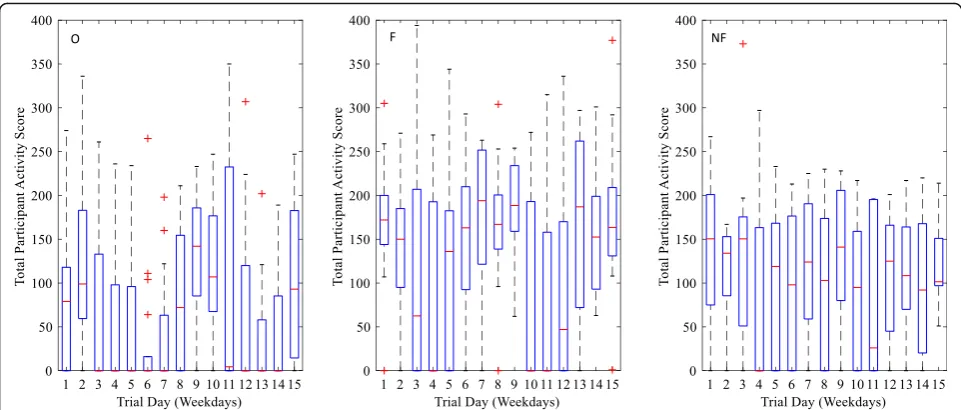
and thus variance in duration of time period 5. When comparing daily activity levels, the feedback group were more active on average; however, there was more vari-ability in the control (no feedback) group at baseline (see
Table 6). A summary of activity levels per group per
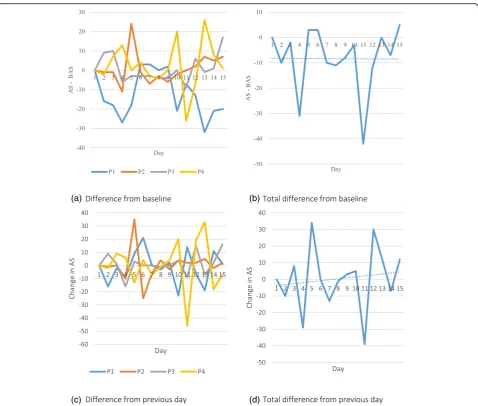
time point is shown in Table 7 (and visually in Fig. 5). Analysis metrics of activity scores across the intervention for an individual patient within the control and feedback group are shown in Figs.6and7retrospectively.
The results from the smartwatch activity data are clearly very preliminary and show that it is feasible to obtain the data, but due to the high inter-personal variability (as would be expected), these results do not show any differences and therefore any further statistical analysis would be misleading at this stage. Due to an incomplete and extremely variable dataset (see Fig.5 and Additional file2), no further statis-tical analyses were conducted as the data is underpowered.
The shortcomings and issues reported in the discussion which resulted in this dataset can be addressed; after which, a full study would be able to answer the clinical questions with a significant expansion in sample size.
No feedback was reported by the ward staff or re-search team despite prompts. One participant refused to wear the watch; however, no adverse effects or side ef-fects of wearing the watch were reported.
Discussion
This pilot study identified the challenges and support needed by ward staff and researchers and examined the feasibility of conducting an RCT using smartwatch activ-ity monitors in research-naive rehabilitation wards. The main challenges when conducting this research were ac-quiring research data on a consistent sustainable basis, maintaining effective communication between the re-search and ward teams, ensuring clear understanding of
roles and language barriers between the Chinese and UK teams. Frequent support was required in the form of email reminders to transfer assessment data, fortnightly teleconference calls and regular surveillance of incoming data. Delivery of a smartwatch RCT is feasible in a research-naive rehabilitation ward (in terms of recruit-ment rate, retention, adherence to wearing the watch, readiness to randomise and potential for effect); how-ever, frequent support and guidance of research-naive staffs are required to ensure completeness of clinical as-sessment data and protocol adherence (specifically watch instructions). Recommendations for a follow-on RCT in-clude an increase in the number of wards to aid recruit-ment, increasing the number of attempts to conduct 3 months post-discharge follow-up, weekly surveillance of incoming data to ensure data quality and the addition of a UK-based bilingual (English and Mandarin) research member to aid communication.
As in a number of trials, we found that although there are many patients admitted to the busy general hospital for stroke rehabilitation and despite the simple broad re-cruitment criteria, it proved difficult to recruit many pa-tients. Retention rates were adequate at discharge despite the lost patients; however, telephone follow-up rates were low. Despite these difficulties, the ward staff did participate actively in recruitment and in delivery of the intervention undertaken as part of their daily work (they were not employed as or paid for being re-searchers), and over time, the quality of data improved. Patients exhibited high adherence to wearing the smart-watch, and activity data were collected and transferred effectively. On average, patients that received feedback did exceed their baseline activity level on more days than those that did not receive feedback, indicating a poten-tial for effect.
Table 6Activity recorded per group in comparison to baseline
Collected data daysa Number of days that activity exceeded baseline Rate of increased activity (%)b
Observation 328 (245) 207 63.1 (84.5)
Pilot RCT-feedback 175 (176) 115 65.7 (65.3)
Pilot RCT-no feedback 152 (159) 87 57.2 (54.7)
a
Expected (actual). Expected day refers to the total number of weekdays from when a patient started the trial and when they left the trial. This is then summed over the group. Actual refers to the actual number of weekdays that data were collected
b
Total number of days that activity levels exceeded baseline divided by total expected and actual (in brackets) days; multiplied by 100 to get percentage
Table 7Activity score across the intervention per experimental phase (median < quartile 2–quartile 3 > [N])
Observation Pilot RCT
Feedback No feedback
Baseline 79 < 0–118 > [20] 172 < 144–200 > [14] 150.5 < 75–201 > [16]
Day 5 0 < 0–96 > [17] 136 < 0–182.5 > [11] 119 < 0–168.25 > [15]
Day 10 107 < 67.5–176.75 > [17] 0 < 0–193 > [10] 95 < 0–159 > [12]
Assessment data at baseline were well executed with minimal data loss, but completeness of data was much less at discharge or at the end of the intervention due to lost patients. The research staffs were capable of con-ducting the clinical assessments to a good standard; however, difficulties were shown in the recording and transferring of the data itself. The majority of missing data from the second assessment can be accounted for by patients being discharged from the ward before as-sessments could take place or without the research team being notified. Practice of procedures during the obser-vation phase of the study alongside the simplicity of the protocol will have helped maintain data loss. The obser-vation phase also allowed time to solve or highlight un-foreseen problems prior to the RCT (e.g. the specific method of how to download smartwatch data and errors with the Bluetooth on the gait sensor). Despite this, a greater emphasis on the importance of collecting all re-quired data and full comprehension of the patient on their role in the study could discourage such gaps in data. A better system of notifying research staff of planned and actual discharges should help. The presence of a qualified and experienced member of staff with re-sponsibility for ensuring the collection of all assessments would better support data collection fidelity.
The outcome measures utilised could feasibly be imple-mented in the research setting in follow on studies as de-tailed below. Compliance to collecting the smartwatch data and wearing the watch was high, suggesting that it is a feasible method to record patient activity. There were missing data on outcome measures; however, this was mostly due to lost patients from poor communication ra-ther than the ability to complete/conduct the assessments.
Complete measures of cognition, independence in daily activities and health-related quality of life were collected for all of the 39 patients that were assessed
at discharge. Some loss in arm function (grip
strength) and mobility (10MWT) data were due to weakness or an inability to walk. Despite missing walk data, the other measure of mobility, Rivermead Mobility Index, had complete recorded data for all patients assessed at baseline, discharge and 3 months post-discharge follow-up, indicating that it is feasible to calculate mobility in a follow-on trial using this measure if the problem of lost patients is resolved. At 3 months post-discharge follow-up, the majority of patients that were contactable completed all three as-sessments (RMI, WHODAS and EQ-5D-5L measures). Therefore, the measures used seem to be appropriate for the aims of the study, and rather, the issue that needs to be addressed for a follow-on main trial is the likelihood of contact at the 3-month follow-up ra-ther than suitability of measures.
The follow-up at 3 months had to be by (mobile) tele-phone, because patients do not routinely attend an out-patient clinic and to travel back specially would not be easy, especially as costs could not be reimbursed. This explains the lower rate of data collection. However, with better planning such as:
Specifically mentioning the fact of a phone call at discharge, with a written note and verbally to patient and family
Sending a reminder text 1 week beforehand, also offering a number to phone
it might be possible to acquire more data. Other means in-clude online forms; post is not sufficiently reliable to be an option. To encourage larger follow-up rates, these changes are recommended for any future large-scale RCT.
To achieve minimal loss of data, a greater emphasis on the importance of feedback between the ward staff and the research assessors about patient progress through the trial, protocol deviation and the effective-ness of data collection procedures is recommended. For example, uploading the assessment and smartwatch data collected in China onto a secure, interactive online web space that could be assessed daily by the UK team would allow the data to be checked as it is updated in real-time. Previous multi-centre research has used inter-active platforms allowing access to up-to-date data, as well as information regarding design, consent and
verification of trial events to reduce the time taken to identify and resolve data-related queries and errors [36].
The lack of collected data regarding recruitment num-bers and specifically the numnum-bers of patients that did not match the inclusion criteria is a major limitation of this study. Patients in the study were confirmed to have met the eligibility criteria as recorded in the data collec-tion forms; however, no informacollec-tion was recorded on the number of patients that were ineligible and the rea-sons why. The current study has therefore not informed a follow-on main trial on the reason behind the low-recruitment numbers, and thus the potential of re-cruitment bias cannot be assessed. An additional limita-tion of the study was that any occurrences of research assessors becoming unblinded to the patients group (be it feedback or no feedback) were not recorded, and
(a) (b)
(c) (d)
therefore it is unknown whether this unblinding could have biased the clinical assessments. For a follow-on trial, the importance of the eligibility/screening log should be reinforced to all staff involved in the study and also during each fortnightly teleconference call.
Effective communication between the Chinese re-search team and the Chinese ward teams on the one hand and the English research teams (Oxford Brookes and Warwick) on the other hand were one of the main challenges within this study. As an international study, the challenges included language barriers, time differ-ences which affected scheduling of Skype meetings and practical difficulties as direct face-to-face research input and explanation was not possible at short notice or on a regular basis. Nonetheless, regular Skype meetings were effective in raising concerns and queries, although time consuming due to the need for frequent translations. For
a follow-on trial, a bilingual (English and Mandarin) re-search member is advised to aid comprehension during the meetings and during data transfer.
The ward staff initially did not adhere to the protocol concerning the smartwatch. During an observation visit by the UK teams, ward staff provided smartwatches to each group but they did not consistently explain the function and purpose of the watch. One reason may be that daily schedules of ward staff and time restraints meant that many staff were involved, often not really knowing what to do. The communication of complex re-search protocols across languages may have led to lack of clarity in the implementation of procedures. Despite this, smartwatch data were collected to a high standard with data collected from all patients.
One consideration when evaluating this intervention is the possible impact of the Hawthorne effect (also
referred to as observer effects); the alteration of a partic-ipant’s behaviour caused by their awareness of being ob-served (for a review see [37]). All patients are likely to have exhibited increased levels of activity than if they were not provided with smartwatches monitoring their activity, regardless of whether feedback was provided. The aim of the smartwatch is to evoke a change in be-haviour, specifically an increase in movement, due to the monitoring and provision of activity feedback. Therefore, any observer effects are expected and can be seen as a result of the research design rather than a bias that would hinder the effectiveness of the intervention. As monitoring and thus possible observation effects oc-curred in both experimental groups, the impact of feed-back specifically can still be determined by comparing the feedback and no feedback groups. However, it ap-peared that the ward staff did not appear to consistently explain the monitoring system of the smartwatch to pa-tients which may have led to a different understanding of the purpose of the smartwatch and thus different ob-server effects between patients and/or groups.
The lack of an independent measure to monitor whether the watch was worn was a major limitation of the model of smartwatch used. The smartwatch pro-duces only an arbitrary measure of whether the watch was being worn; using an algorithm based on movement and probably underestimates the time worn, for ex-ample, if the patient was lying quietly in bed. The addition of a temperature sensor or pulse rate monitor could overcome this, increasing the validity of the activ-ity measure. In addition, the smartwatch only produces processed data, due to its limited storage capacity. A lar-ger storage capacity would allow direct access to raw ac-tivity data after its collection, and thus open wider opportunities of data analysis, for example, producing movement graphs [31].
The time-frame with which the activity is recorded
(08:00–17:00) may also bias the activity levels
re-corded. The local ward routine alongside medical and rehabilitation schedules limits the time available for patients to alter their activity levels. Indeed, it is precisely the evenings and weekends that offer the biggest opportunities for increased patient activity. A smartwatch with a battery life able to record from morning to night and over 2 or 3 days would provide a richer account of activity changes and much more likelihood of targeted feedback altering behaviour. One possibility to increase the amount of activity re-corded is for patients to wear and charge their own smartwatch over the weekend. Future research would need to investigate whether charging of the smart-watch by patients is feasible, for example, in terms of data loss, protocol compliance and maintaining ran-domisation of groups.
Whilst the authors recognise that the smartwatch does have some shortcomings, it must be noted that it is the best device for meeting the requirements of the project, when compared to commercial activity monitors or paired-to-smartphone smartwatches. That is, that it pro-vides the sensing capacity, on-board processing, and user interaction capabilities to monitor and provide real-time feedback as a single standalone device. These capabilities are not otherwise available, and if the limitations were overcome, the smartwatch performance would be greatly enhanced. The use of accelerometers as a measurement of activity within stroke patients is a widely used method, generating valid and reliable insights into activ-ity levels [38–40]. Nevertheless, it has yet to be shown that feedback from accelerometers leads to actual long-term change in behaviour amongst this population.
Despite the reported difficulties in data collection and recruitment, conducting clinical trials within developing/ research-naive settings, such as many hospitals in China, is becoming more prevalent. In comparison to Europe and North America, research in developing countries offer smaller running costs and large numbers of pa-tients, often due to higher rates of disease as well as lar-ger populations, allowing for large scale clinical trials [41]. Conducting the present trial within Anhui hospital in China did indeed provide a large pool of stroke pa-tients from which to recruit, but final recruitment num-bers were in comparison small. An increase in the number of recruitment wards (eight wards in total) is recommended for a follow-on RCT.
Conclusion
Activity levels of stroke survivors undergoing rehabilita-tion are commonly below the recommended levels for optimal recovery. Tailored feedback of physical activity is a possible method to encourage greater levels of activ-ity and thus positive clinical outcomes post-stroke. The aim of this feasibility study was to identify the challenges and support needed by ward staff and researchers and to examine the feasibility of conducting an RCT using smartwatch activity monitors in research-naive rehabili-tation wards. Delivery of a smartwatch RCT is feasible in a research-naive rehabilitation ward; however, frequent support and guidance of research-naive staff is required to ensure completeness of clinical assessment data and
protocol adherence. Adjustments required for a
follow-up RCT include increasing the number of wards to aid recruitment, increasing the number of attempts to conduct 3 months post-discharge follow-up, weekly sur-veillance of incoming data to ensure data quality and the addition of a UK-based bilingual (English and Mandarin) research member to aid communication.
Additional files
Additional file 1:ZGPAX S8 Android Smartwatch Specifications.
(DOCX 12 kb)
Additional file 2:Distribution plots showing distribution of total daily activity scores for Feedback group (A), No Feedback (control) group (B), observation group (C) and all groups (D). Table7shows a summary of this data at days 1, 5, 10 and 15. Red crosses indicate the mean and green squares the median. (DOCX 96 kb)
Abbreviations
RCT:Randomised controlled trial; SWAFT: Smart Watch Activity Feedback Trial Committee
Acknowledgements
Thank you to the Anhui hospital ward staff and research members for their support and active participation in this research.
SWAFT: Lingzhi Wu, Peifang Li, Ying Wang, Chong Chen, Peiyang Sun, Jinji Wang, Feifei Wang, Panfu Hao, Weiwei Wu, Yubao Gao, Xiaoli Sun, Haiyang Wu, Yujie Yang, Yuanfeng Peng, Jingjing Xue, Xiaoli Guo, Xuesong Xie, Na Zuo, Xinkui Gao.
Funding
This work was supported by the Oxford International Rehabilitation Foundation (OIRF2015040102) with general support to the hospital provided by Development Research Institute of the Development Research Center of Anhui Provincial Government, China. HD and PE are funded by the Elizabeth Casson Trust. HD receives support from the National Institute for Health Research Oxford Biomedical Research Centre.
Authors’contributions
All authors reviewed and edited the manuscript and approved the final version of the manuscript. SL contributed to the writing of the paper, quality control of data, managing the transfer of data and data analysis. YD initiated the project, provided resources from the rehabilitation centre, applied for research ethics approval, registered the clinical trial and assisted in obtaining hospital funding. DS contributed to the development of standard operating procedures, implementation of project locally and teaching of researchers. ZX assisted with the design and coordinated the communication between team members. PE assisted with the design, implementation of gait sensor
software, communication between team members and writing of the paper. SS and FL are directors of the rehabilitation wards and supervisors of the project, contributed to study conception and communication of results. JA and CJ contributed to the development and implementation of smartwatch, writing of the paper and data analysis. HD and DW contributed to the initiation and development of the project and its design and writing of the paper. HI advised on design and specifically upon statistical analysis. YC initiated the project, coordinated the process at the hospital and helped to provide funding for this study. NM contributed to the writing of the paper and presentation of data.
Ethics approval and consent to participate
The study was approved by the Chinese Ethics Committee of Registering Clinical Trials (ChiECRCT-20150034), West China Hospital, Sichuan University, 37 Guoxuexiang, Chengdu, Sichuan, China. All research was in compliance with the Helsinki Declarations and the Research Governance Framework for Health and Social Care. Informed written consent was obtained by a recruiting doctor based on the wards whereby sufficient mental capacity (based on clinical judgement) and understanding of anonymity and the inclusion of their data was ensured.
Consent for publication
Not applicable.
Competing interests
The gait measurement system and the smartwatch software were developed by the research team (HD, PE and DW) and (CJ and JA) respectively, and both systems are in the process of being commercialised by the universities concerned.
Publisher’s Note
Springer Nature remains neutral with regard to jurisdictional claims in published maps and institutional affiliations.
Author details
1
Centre for Movement, Occupational and Rehabilitation Sciences (MOReS), Department of Sport, Health Sciences and Social Work, Oxford Brookes University, Headington Campus, Headington Road, Gipsy Lane, Oxford OX3 0BP, UK.2Rehabilitation Centre, the Second Affiliated Hospital of Anhui University of Traditional Chinese Medicine, Hefei, Anhui Province, China. 3School of Engineering, University of Warwick, Coventry CV4 7AL, UK.4School
of Physical and Occupational Therapy, McGill University, 3654 Prom Sir-William-Osler, Montréal, Québec H3G 1Y5, Canada.
Received: 26 March 2018 Accepted: 17 September 2018
References
1. Billinger SA, Arena R, Bernhardt J, Eng JJ, Franklin BA, Johnson CM, et al. Physical activity and exercise recommendations for stroke survivors: a statement for healthcare professionals from the American Heart Association/American Stroke Association. Stroke. 2014;45:2532–53. 2. Saunders DH, Greig CA, Mead GE. Physical activity and exercise after stroke:
review of multiple meaningful benefits. Stroke. 2014;45:3742–7. 3. Janssen H, Ada L, Bernhardt J, McElduff P, Pollack M, Nilsson M, et al. Physical,
cognitive and social activity levels of stroke patients undergoing rehabilitation within a mixed rehabilitation unit. Clin Rehabil. 2014;28:91–101.
4. West T, Bernhardt J. Physical activity in hospitalised stroke patients. Stroke Res Treat. 2012.https://doi.org/10.1155/2012/813765.
5. Lyons EJ, Lewis ZH, Mayrsohn BG, Rowland JL. Behavior change techniques implemented in electronic lifestyle activity monitors: a systematic content analysis. J Med Internet Res. 2014.https://doi.org/10.2196/jmir.3469. 6. Prestwich A, Conner M, Hurling R, Ayres K, Morris B. An experimental test of
control theory-based interventions for physical activity. Br J Health Psychol. 2016;21:812–26.
7. Strath SJ, Swartz AM, Parker SJ, Miller NE, Grimm EK, Cashin SE. A pilot randomized controlled trial evaluating motivationally matched pedometer feedback to increase physical activity behavior in older adults. J Phys Act Health. 2011;8:S267–S74.
a randomized controlled trial in Finnish young men. Prev Med. 2015. https://doi.org/10.1016/j.pmedr.2015.07.005.
9. Peel NM, Paul SK, Cameron ID, Crotty M, Kurrle SE, Gray LC. Promoting activity in geriatric rehabilitation: a randomized controlled trial of accelerometry. PLoS One. 2016;11:e0160906.
10. Room J, Hannink E, Dawes H, Barker K. What interventions are used to improve exercise adherence in older people and what behavioural techniques are they based on? A systematic review. BMJ Open. 2017. https://doi.org/10.1136/bmjopen-2017-019221.
11. Godino JG, Watkinson C, Corder K, Marteau TM, Sutton S, Sharp SJ, et al. Impact of personalised feedback about physical activity on change in objectively measured physical activity (the FAB study): a randomised controlled trial. PLoS One. 2013;8:e75398.
12. Block VA, Pitsch E, Tahir P, Cree BA, Allen DD, Gelfand JM. Remote physical activity monitoring in neurological disease: a systematic review. PLoS One. 2016;11:e0154335.
13. Molier BI, Van Asseldonk EH, Hermens HJ, Jannink MJ. Nature, timing, frequency and type of augmented feedback; does it influence motor relearning of the hemiparetic arm after stroke? A systematic review. Disabil Rehabil. 2010;32:1799–809.
14. Dorsch AK, Thomas S, Xu X, Kaiser W, Dobkin BH. SIRRACT: an international randomized clinical trial of activity feedback during inpatient stroke rehabilitation enabled by wireless sensing. Neurorehabil Neural Repair. 2015; 29:407–15.
15. Mbuagbaw L, Thabane L, Ongolo-Zogo P, Lang T. The challenges and opportunities of conducting a clinical trial in a low resource setting: the case of the Cameroon mobile phone SMS (CAMPS) trial, an investigator initiated trial. Trials. 2011;12:145.
16. Dong Y, Steins D, Sun S, Li F, Amor JD, James CJ, et al. Does feedback on daily activity level from a smart watch during inpatient stroke rehabilitation increase physical activity levels? Study protocol for a randomized controlled trial. Trials. 2018;19:177.
17. Koski L. Validity and applications of the Montreal cognitive assessment for the assessment of vascular cognitive impairment. Cerebrovasc Dis. 2013;36:6–18. 18. Hu J-B, Zhou W-H, Hu S-H, Huang M-L, Wei N, Qi H-L, et al. Cross-cultural
difference and validation of the Chinese version of Montreal Cognitive Assessment in older adults residing in Eastern China: preliminary findings. Arch Gerontol Geriatr. 2013;56:38–43.
19. Nie K, Zhang Y, Wang L, Zhao J, Huang Z, Gan R, et al. A pilot study of psychometric properties of the Beijing version of Montreal Cognitive Assessment in patients with idiopathic Parkinson’s disease in China. J Clin Neurosci. 2012;19:1497–500.
20. Wade D, Collin C. The Barthel ADL Index: a standard measure of physical disability? Int Disabil Stud. 1988;10:64–7.
21. Üstün TB, editor. Measuring health and disability: manual for WHO disability assessment schedule WHODAS 2.0. Geneva: World Health Organization; 2010. 22. Krupp LB, LaRocca NG, Muir-Nash J, Steinberg AD. The fatigue severity scale:
application to patients with multiple sclerosis and systemic lupus erythematosus. Arch Neurol. 1989;46:1121–3.
23. Tang WK, Lu JY, Chen YK, Mok VC, Ungvari GS, Wong KS. Is fatigue associated with short-term health-related quality of life in stroke? Arch Phys Med Rehabil. 2010;91:1511–5.
24. Herdman M, Gudex C, Lloyd A, Janssen M, Kind P, Parkin D, et al. Development and preliminary testing of the new five-level version of EQ-5D (EQ-5D-5L). Qual Life Res. 2011;20:1727–36.
25. Lee CF, Ng R, Luo N, Wong NS, Yap YS, Lo SK, et al. The English and Chinese versions of the five-level EuroQoL group's five-dimension questionnaire (EQ-5D) were valid and reliable and provided comparable scores in Asian breast cancer patients. Support Care Cancer. 2013;21: 201–9.
26. Collen FM, Wade DT, Robb G, Bradshaw C. The Rivermead mobility index: a further development of the Rivermead motor assessment. Int Disabil Stud. 1991;13:50–4.
27. Wade D, Wood V, Heller A, Maggs J, Langton HR. Walking after stroke. Measurement and recovery over the first 3 months. Scand J Rehabil Med. 1987;19(1):25–30.
28. Bertrand AM, Fournier K, Brasey M-GW, Kaiser M-L, Frischknecht R, Diserens K. Reliability of maximal grip strength measurements and grip strength recovery following a stroke. Hand Ther. 2015;28:356–63.
29. Esser P, Dawes H, Collett J, Feltham MG, Howells K. Assessment of spatio-temporal gait parameters using inertial measurement units in neurological populations. Gait Posture. 2011;34:558–60.
30. ZGPax Website; S8 Techincal Specification. Available athttp://www.zgpax. com/androidwatch/41-36.html. Assessed 1 Jun 2018.
31. Ahanathapillai V, Amor J, James C. Assistive technology to monitor activity, health and wellbeing in old age: the wrist wearable unit in the USEFIL project. Technol Disabil. 2015;27:17–29.
32. Amor JD, Ahanathapillai V, James CJ. Detecting and analyzing activity levels for the wrist wearable unit in the USEFIL project. In: XIII Mediterranean Conference on Medical and Biological Engineering and Computing 2013 IFMBE Proceedings, vol. 41; 2014. p. 1201–4.
33. Ahanathapillai V, Amor JD, Goodwin Z, James CJ. Preliminary study on activity monitoring using an android smart-watch. Healthc Technol Lett. 2015;2:34–9.
34. Amor JD, Hattersley JG, Barber TM, James CJ. Characterization of wrist-wearable activity measurement using whole body calorimetry in semi-free living conditions. In: Engineering in Medicine and Biology Society (EMBC), 2015 37th Annual International Conference of the IEEE; 2015. p. 3735–8. 35. Serra MC, Balraj E, DiSanzo BL, Ivey FM, Hafer-Macko CE, Treuth MS, et al.
Validating accelerometry as a measure of physical activity and energy expenditure in chronic stroke. Top Stroke Rehabil. 2017;24:18–23. 36. Wallace S, Myles P. Solving the challenges of large multicenter trials in
anesthesia. HSR Proc Intensive Care Cardiovasc Anesth. 2009;1(3):46. 37. McCambridge J, Witton J, Elbourne DR. Systematic review of the Hawthorne
effect: new concepts are needed to study research participation effects. J Clin Epidemiol. 2014;67:267–77.
38. Hayward KS, Eng JJ, Boyd LA, Lakhani B, Bernhardt J, Lang CE. Exploring the role of accelerometers in the measurement of real world upper-limb use after stroke. Brain Impair. 2016.https://doi.org/10.1017/BrImp.2015.21. 39. Noorkõiv M, Rodgers H, Price CI. Accelerometer measurement of upper
extremity movement after stroke: a systematic review of clinical studies. J Neuroengin Rehabil. 2014;11(1):144.
40. Gebruers N, Vanroy C, Truijen S, Engelborghs S, De Deyn PP. Monitoring of physical activity after stroke: a systematic review of accelerometry-based measures. Arch Phys Med Rehabil. 2010;91:288–97.

![Table 7 Activity score across the intervention per experimental phase (median < quartile 2–quartile 3 > [N])](https://thumb-us.123doks.com/thumbv2/123dok_us/761537.1573009/12.595.55.539.649.732/table-activity-score-intervention-experimental-median-quartile-quartile.webp)