R E S E A R C H
Open Access
Taking the next step: supporting postdocs
to develop an independent path in
academia
Aman Yadav
1*and Christopher Seals
2Abstract
Background:In the USA, 28.5% of the population is considered underrepresented minority (URM) population; however, fewer than 8 % of US’research faculty in science, technology, engineering, and mathematics (STEM) disciplines are minorities (National Research Council, Expanding underrepresented minority participation: America’s science and technology talent at the crossroads, 2011). In order to diversify the faculty, Big Ten Academic Alliance’s Professorial Advancement Initiative (PAI) provided high-quality professional development for URM postdocs across multiple institutions. This study is part of the larger PAI project and examined the goals and experiences of URM postdoctoral fellows in science, technology, engineering, and mathematics (STEM) disciplines. In addition, we investigated the influence of a professional development workshop on postdocs’self-efficacy to pursue grants, improve relationship with their mentor, and apply for academic jobs.
Results:Our findings suggest that URM postdocs face a number of challenges in their position and lack the confidence, knowledge, and skills to pursue a career in academia. Our professional development workshops focused on developing postdocs’skills to pursue faculty positions significantly increased their self-efficacy in grant writing, improving relationship with their mentor, and applying for academic jobs.
Conclusion:Our findings have important implications for postdoctoral training and providing professional
development opportunities for minority postdocs in order to diversify the faculty in STEM disciplines. Future research should examine the long-term influence of workshops to prepare postdocs to pursue and be successful in academia.
Keywords:Underrepresented minorities, Postdoctoral fellows, STEM, Career goal attainment, Self-efficacy
Introduction
Students from African, Chicano/Latino, and Native American heritages make up underrepresented ethnic mi-nority students (URMs) in the USA (Syed, Azmitia, & Cooper,2011), and it is estimated that they will become the majority in the USA by the year 2050 (Bernstein & Ed-wards,2008). Even though minorities represent 28.5% of the total population in the USA, they only form 9.1% of science and engineering jobs held by college-educated Americans and hold only 7.9% of STEM faculty positions at universities and four-year colleges (National Research Council,2011). In general, higher education faculty do not mirror racial and ethnic backgrounds of the students
served at the undergraduate and graduate level (Denecke, Frasier, & Redd, 2009). As a part of a large effort to in-crease STEM URM faculty at Big Ten universities, this study examined the needs of a particular group, postdoc-toral fellows, who often use the position to pursue faculty careers (Åkerlind, 2005). This study was part of a large National Science Foundation-funded project titled, “Big Ten Academic Alliance Professorial Advancement Initia-tive (PAI) Program,” a multi-institution effort to provide high-quality professional development for URM postdocs to pursue a career in academia. In this study, we investi-gated URM postdoctoral fellows, to better understand their experiences and how to support them to pursue STEM faculty positions. Below, we discuss social cognitive theory, challenges that URM students face, and present findings from the current study.
© The Author(s). 2019Open AccessThis article is distributed under the terms of the Creative Commons Attribution 4.0 International License (http://creativecommons.org/licenses/by/4.0/), which permits unrestricted use, distribution, and reproduction in any medium, provided you give appropriate credit to the original author(s) and the source, provide a link to the Creative Commons license, and indicate if changes were made.
* Correspondence:[email protected]
1Michigan State University, 620 Farm Lane, East Lansing, MI 48824, USA
Background
Social Cognitive Theory
Bandura’s (1986) social cognitive theory (SCT) serves as a basis of our conceptual framework. The social cognitive theory explains how individuals acquire and maintain cer-tain behaviors as a result of interactions between personal, behavioral, and environmental elements. Specifically, Ban-dura (1986) asserted that people’s thoughts and beliefs affect how they behave and the social environment shapes those beliefs and expectations. Furthermore, most tasks, especially successful learning opportunities, require social interactions, such that when an individual interacts with people in a social environment, it awakens a variety of in-ternal processes that support learning (Coser, 1970; Vygotsky,1978; Weedman,1999).
Building upon the role of environment, Lave and Wen-ger (1991) argued that people learn by participation in sociocultural activities when they are afforded legitimate peripheral participation in communities of practices. Communities of practice are learning sites formed by a group of people with shared domains of interest that lead participants to develop their identities (Lave & Wenger,
1991). Legitimate peripheral participation involves spon-sorship from experienced members of the community, who engage newcomers in increasingly complex activities and develop their (newcomers) identities as members of that community (Lave & Wenger,1991). Hence, legitimate participation provides a framework for implementing mentoring networks that allow individuals to participate in activities that are more central to the core activities of that community (Morrell, 2003). Being a member of a community not only allows novices to gain knowledge that is embedded in the community, but it also allows them to learn to operate within that community (Wasko & Faraj,2000). Lesser and Strock (2001) further suggested that the“social capital resident in communities of practice leads to behavioral change—change that results in greater knowledge sharing.”
Learning as a participant of a community directly con-nects to social cognitive theory construct of self-efficacy and how learners make decisions as well as choose and pursue goals. Self-efficacy is defined as the“beliefs in one’s capabil-ities to organize and execute the courses of action required to produce given attainments” (Bandura,1977, p. 3). One’s self-efficacy is determined by four constructs, two of which are (a) learning from the experiences of those around you and (b) learning from verbal persuasion of people that you socialize with (Bandura, 2001). This illustrates the import-ance of community to self-efficacy. Additionally, one’s be-havior is “motivated and directed by projected goals and anticipated outcomes”(Bandura, p. 7). One of the most im-portant constructs for behavior change includes one’s belief that they can carry out or complete a task and has been found to be predictive of performances more than
predictions based on ability alone (Chemers, Zurbriggen, Syed, Goza, & Bearman,2011; Schunk & Pajares,2005). Re-searchers have argued that self-efficacy and esteem are im-portant predictors of persistence on a particular task as “individuals with high self-esteem will perform effectively in order to maintain their positive self-image”(Judge & Bono,
2001, p. 82). In one study, Chemers et al. examined how psychological factors, such as self-efficacy and identity, me-diate relationships between science support activities (such as, research experience and mentoring) and desirable out-comes (such as commitment to a career in scientific re-search) for URM graduate/postdoctoral students. The authors found that for graduate post/doctoral students, their science self-efficacy, leadership and teamwork self-efficacy (LTSE), and identity each independently predict their commitment to a career in science. In addition, the ef-fects of science support activities on their commitment were also mediated by science self-efficacy and identity as a scientist.
With self-efficacy playing a role in predicting behav-ioral outcomes, some have argued that when individuals do not feel they can perform up to their expectations, they either exert additional effort, lower their aspira-tions, or withdraw from a task entirely (Judge & Bono,
2001). This is relevant to our work with postdocs as the lack of professional development opportunities for post-docs could lead them to feel that they are not prepared to pursue a career in academia (Yadav, Soto, Clark, Dixon, & Smith,2016). Given that efficacy beliefs medi-ate whether or not particular behaviors will be initimedi-ated and how long it will be sustained in the face of obstacles and adverse experiences, especially for minority popula-tion (Hackett & Betz, 1981), we need to better under-stand what support URM postdocs believe would be important for their academic careers.
Challenges for minority students
Diversity at all levels of STEM education is important to the progression of URM students from college to graduate school to postdoc positions and finally into the university faculty ranks. As stated above, social cognitive theory (SCT) spotlights the importance of social environment when understanding behavior. The composition of univer-sity faculty, as the experienced community member, plays a significant role in diversifying the faculty as they influence career choices made by undergrads, graduate students, and postdocs. URM faculty serves as role models to minority students, which helps them persist in completing their de-gree programs (Jayakumar, Howard, Allen, & Han,2009). If a minority student sees a faculty with their ethnic and cul-tural background in successful positions, it signals that they too can be successful (Hagedorn et al.,2007; Plata,1996).
there are additional factors that contribute to URM pursuit in/of STEM fields. Brown and Lent (2005) suggested that the complex interplay between individual variables (such as ethnicity and self-efficacy) and the environment influences career choice. Some of the multifaceted and often inter-twined factors that influence URM students’self-efficacy in doctoral and career goal attainment in the STEM fields in-clude experiences of bias, stereotype threats, career identity formation, and a lack of belongingness (Hernandez & Lopez, 2004; Malone & Barabino, 2009; Tine & Gotlieb,
2013; Turner, 2002). Prior research has indicated that stu-dents of color in STEM disciplines often face negative per-ceptions and stereotypes about their academic capabilities that are solely based on race or ethnicity (Strayhorn,2010). The bias is especially prominent when a student has an
“African-American-sounding” name (Bertrand &
Mullai-nathan, 2004). Bertrand and Mullainathan found that similar resumes with White-sounding names receive 50% more callbacks for interviews than African-American-sounding names. Research has also found that even faculty members perceive traditionally underrepresented groups in STEM, such as females to be less competent than males with comparable experience (Moss-Racusin, Dovidio, Brescoll, Graham, & Handelsman,2012). These social and systemic barriers could negatively influence minority students’self-efficacy beliefs and expectations to pursue a career in academia.
Federally funded programs, such as the National Sci-ence Foundation’s Alliances for Graduate Education and the Professoriate (AGEP), and universities have been ad-dressing the issue of diversifying STEM faculty and alter the social environment through the implementation of diversity and inclusion programs. Majority of such pro-grams focus on increasing number of minority students pursuing and completing STEM doctoral degrees, but less attention has been given to understanding URM postdocs, their experiences, and self-efficacy in pursuing faculty positions.
Postdoc challenges
While there is a well-recognized need of postdocs being an important part of research in STEM fields (Gibbs, McGready, & Griffin,2015), they often feel exploited for the low-cost labor they can provide (Rohn, 2011; Times Higher Education,2012). In particular, postdocs feel they are invisible as they fall in the ignored space between graduate students and faculty, which is exacerbated by the lack of quality institutional infrastructure to uni-formly and comprehensively support postdocs and pro-vide mentoring. While universities are accountable to various accreditation agencies and review processes to monitor program quality and academic progress of graduate students, similar oversight protection is largely absent for postdoc training and education. As such,
postdocs receive minimal career development resources and end up in a system that is not necessarily supportive of their career goals (Institute of Medicine, 2014). In order for postdocs to pursue faculty positions, institu-tions need to provide social and structural supports.
There is some research emerging on the postdoc experi-ence, including how to support and prepare them to tran-sition into a faculty potran-sition. For example, Yadav et al. (2016) found that postdocs face a number of challenges including the lack of professional development for a career advancement, lack of confidence in securing funding and publishing, and lack of belonging. In another study, Rybarczyk, Lerea, Whittington, and Dykstra (2016) found that postdocs who participated in a mentoring program focused on research and teaching were three times more likely to transition into the professoriate. Researchers have also found that as postdocs matriculate into the profes-soriate, they encounter difficulties in creating career goals, networking with peers, and writing grants to support their research (Kohan,2014).
While many of these challenges apply to all postdocs, dif-ferent layers of complexity and systemic challenges exist for URMs, which makes them less likely to transition into the professoriate (American Institutes for Research,2009). The racial and ethnic biases that URM postdocs face trying to navigate the gap between graduate school and the profes-soriate is just one of the barriers (Yadav et al.,2016). Fur-thermore, minority scholars receive significantly less mentoring than their non-minority peers (Beech et al.,
2013). If we want to increase the faculty diversity in STEM disciplines, a first step might be to better understand the needs of URM postdoctoral fellows and how we can sup-port postdoc self-efficacy given that self-efficacy is one of the predictors of career commitment for URM postdocs (Chemers et al.,2011). The goal of this study was to better understand the aspirations of URM postdocs, the skills needed to reach their goals, their self-efficacy, and confi-dence level in attaining their goals. Specifically, the follow-ing research questions guided our study:
1. What are URM postdoc experiences in STEM fields and what do they perceive to be the important aspects of their training in order to achieve their career goals?
2. What is the influence of professional development on postdoctoral fellows’self-efficacy in grantsman-ship and career development?
Methodology
Participants
American and Latino/Hispanic postdocs formed the second largest group (N= 9). Other racial groups included Native American (N= 2), multiracial (n= 2), and Asian (N= 1). Participants’ ages ranged from 28 to 49 years old (M= 35.7). The participants were part of the National Science Foundation (NSF)-funded project to improve faculty diver-sity within Big Ten Academic Alliance (formerly known as the Committee on Institutional Cooperation or CIC). The project, Professorial Advancement Initiative (PAI), had a goal of doubling the rate at which the alliance hired URM STEM faculty by creating a pool of well-prepared URM postdocs who could be recruited into tenure track faculty positions.
Data collection and procedure
Participants were invited to a 2-day professional develop-ment workshop focused on building skills in areas that were pertinent for postdocs to pursue a tenure-track aca-demic career in STEM fields. This workshop included topics to support their grant writing and academic job search process. On day 1, postdocs had an opportunity to participate in workshops focused on topics related to their professional development such as networking, applying for an academic job, sharing research at a job interview, collaborating effectively with others, developing independ-ent research goals, and developing a research team. On the second day, postdocs participated in all-day grants-manship and worked with coaches and peers in small groups. Two weeks prior to the workshop, postdocs were asked to complete a survey to measure what they believed to be important aspects of a successful postdoc experi-ence, their long-term career goals, and importance of vari-ous academic tasks (such as publishing and teaching) in achieving the career goal. In addition, the survey also in-cluded items that measured their confidence in grants-manship. Following the workshop, postdocs completed a post survey to examine the influence of professional devel-opment activities on their grantsmanship confidence. The survey also included items on their confidence in under-standing and applying for the job market. The survey items were adapted from a number of prior efforts to examine the needs of postdocs (National Postdoc Survey) and impact of mentoring on minority postdocs (Fleming et al., 2013). In addition, we also developed items based upon our prior work on examining challenges postdocs face in STEM fields (Yadav et al.,2016).
We acknowledge the limitations that come with using self-report survey data, which assumes that the respon-dents are willing to answer the questions accurately ra-ther than believing that a particular response would be seen as favorable by the researchers (Lavrakas, 2008). However, we took steps to address this limitation by having the postdocs complete the survey anonymously so researchers would not know how they responded.
This helped us overcome the limits of survey data as anonymity allows individuals to willingly “report socially embarrassing attitudes, beliefs, and behaviors when their reports are anonymous”(Lavrakas, p. 3).
Data analysis
We used descriptive statistics to analyze the survey data and see patterns that emerged about postdoctoral fel-lows’ experiences. In order to evaluate the influence of the workshop on postdoc self-efficacy in grantsmanship, increasing effectiveness of their mentoring relationship, and job application, we use a paired samplettest. Indi-vidual survey items for each of the three workshop topics were combined to create a composite self-efficacy score in grantsmanship, increasing effectiveness of their mentoring relationship, and job application, which were then used in the pairedttest.
Results and discussion
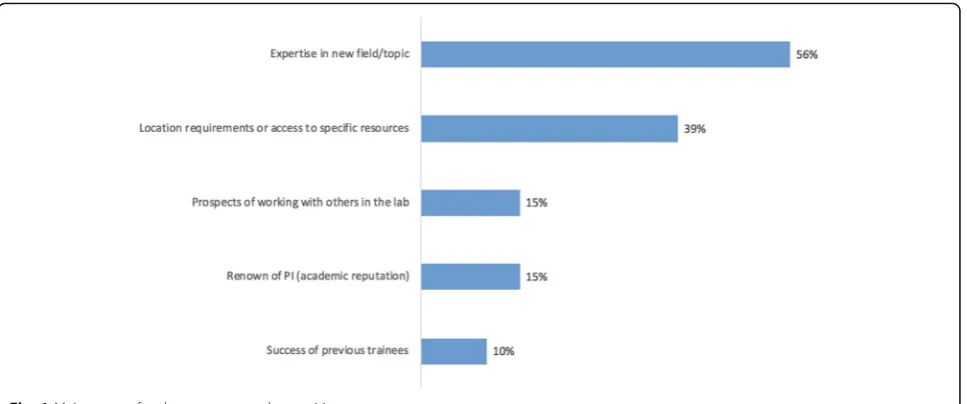
Results on why participants chose their current postdoc suggested that developing expertise on a newer topic as well as access to specific resources (in the mentor’s lab) to help develop that expertise were the two main rea-sons. In addition, participants were also attracted to the position due to the prospect of working with others, reputation of PI, and success of previous trainees. Fig-ure 1 shows the percentage of postdocs that mentioned each of these reasons.
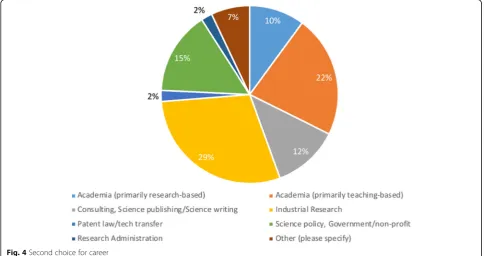
science policy (N= 6), and science publishing (N= 5). Figure 4 shows the distribution of postdoctoral fellows’
second career choice.
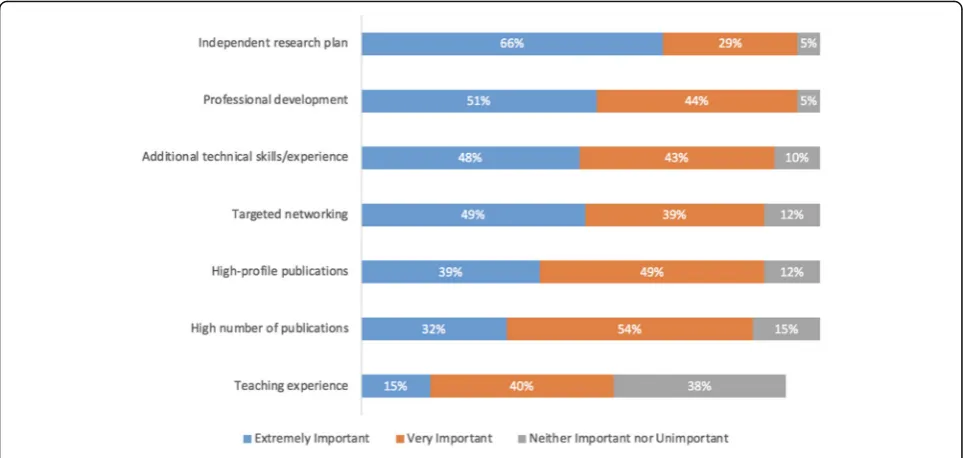
We also asked participants what experiences during their postdoc would be important in helping them achieve their career goals. Developing an independent research plan emerged as one of the biggest factors with 66% of the participants (N= 27) considered it extremely important and 29% (N= 12) considering it very import-ant. Having professional development (in grant writing, applying for academic jobs, etc.) was also considered an important need by postdocs with 51% (N= 21) seeing it as an extremely important skill and 44% (N= 18) seeing it as a very important skill. Participants also viewed
additional technical experience and targeted networking as being key to them achieving a career goal. It was sur-prising to see that while high profile publications and high number of publications were considered important, they were not considered as important as other things. Not surprisingly, teaching experience was not very high on postdocs list given that majority of them wanted to pursue research-based academic positions, which typic-ally do not require teaching as an important skill.
Fig-ure 5 shows the importance of different factors in
achieving a career goal.
We also examined URM experiences in their postdoc positions, in particular looking at whether they faced any stereotypes. We found that about 26.9% of the postdocs
Fig. 1Main reason for the current postdoc position
had experienced stereotypes in their current position while almost 70.7% of the postdocs had experienced stereotype at some point in their careers. In addition, 82.9% of the postdocs reported that they had to con-stantly prove themselves worthy of the position. These findings are concurrent with our previous qualitative findings that suggest URM postdocs face racial stereo-type biases, experience microaggressions, and have to prove that they belong in STEM fields (Yadav et al.,
2016). An example of what stereotypes and microaggres-sions look like comes from the work of Solórzano (1998), who documented examples of microaggressions
against scholars of color, such as: “When I talk about those Blacks, I really wasn’t talking about you. You’re not like the rest of them. You’re different.”(p. 125).
Majority of the postdocs (60.9%) also reported that they often struggled to find peers and colleagues with similar life experiences. Our prior work has suggested that URM postdocs often have to juggle competing pri-orities balancing family and work as they often are first from their families to get an advanced degree, if not the first to go to college (Yadav et al.,2015). Our results sug-gested that majority of postdocs (68.3%) have to juggle between personal and professional priorities and a
Fig. 3Confidence in achieving career goal
number of them (53.6%) also reported having to prioritize family over work. While URM postdocs re-ported some challenges, majority of them (68.3%) felt they could be themselves in their current position. Fig-ure6shows postdoc experiences in their positions.
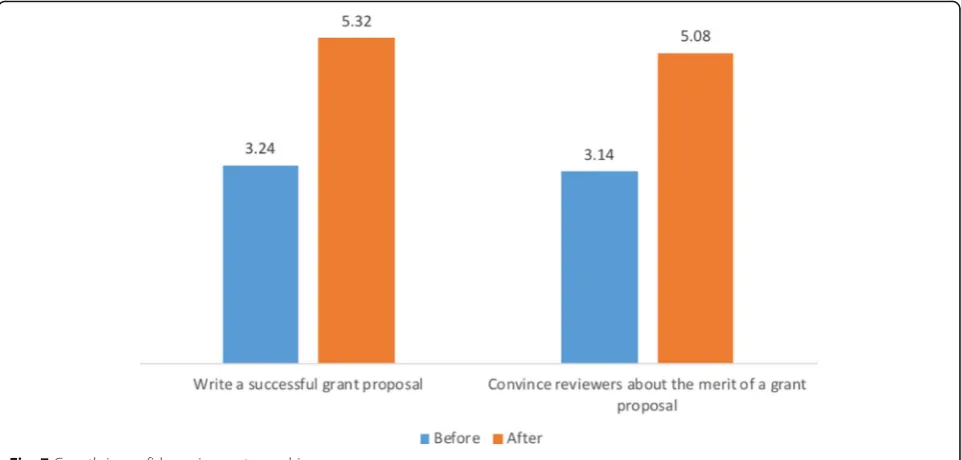
Our results suggested that postdocs came in with a high self-efficacy in their ability to conduct research, including selecting suitable areas of study, developing rationale for a research study, and how to measure variables. So, our pro-fessional development focused on postdoc self-efficacy in having a better mentoring relationship, grant writing, and
applying for academic jobs. The results suggested that on average, postdocs were more confident in their grant writ-ing skills after the workshops (M= 10.40, SD = 1.95) than before the workshop (M= 6.37, SD = 2.30). This gain in confidence was significant, t(36) =−12.65, p< 0.05. Figure 7 shows the charts for individual item confidence in grantsmanship.
We also found that the workshop gave postdocs more confidence in increasing the effectiveness of their men-toring relationship with their principal investigator. On average, postdocs were more confident in increasing the
Fig. 5Importance of different factors in achieving career goal
effectiveness of their mentoring relationship after the workshops (M= 16.00, SD = 3.35) than before the work-shop (M= 11.08, SD = 3.89). This gain in confidence was significant, t(36) =−7.12, p< 0.05. Figure 8 shows the charts for postdoc confidence in the effectiveness of mentoring relationship.
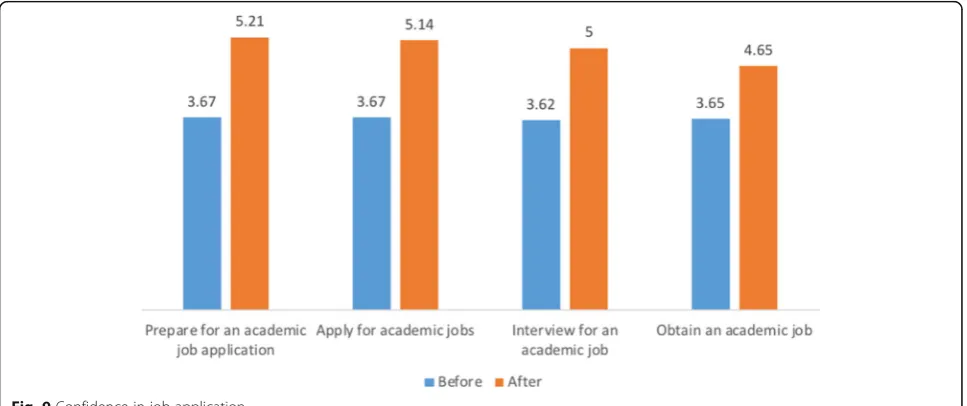
We also found that postdocs were more confident in the job application process as a result of the workshop. On average, postdocs were more confident applying for aca-demic jobs after the workshops (M= 20.00, SD = 3.58) than before the workshop (M= 14.62, SD = 4.29). This gain in confidence was significant,t(36) =−10.76,p< 0.05. Figure9
shows the charts for postdoc confidence in job application. Our findings suggest that majority of URM postdocs in STEM disciplines had a research-based academic position as their primary career goal, but did not feel confident in achieving it. As a result, their goals shifted towards either teaching-oriented academic positions, industrial research, or pursuing science policy in government/non-profit orga-nizations. When asked what our participants thought were important factors in helping them achieve their primary career goal, developing an independent research plan and receiving professional development were identified as be-ing extremely important. Minority postdocs also reported that while they felt they could be themselves in their posi-tions, they struggled to find peers with similar life experi-ences, experienced being stereotyped, and wrestled to juggle personal and professional commitments.
The professional development activities provided as a part of our work significantly impacted URM postdocs self-efficacy in grantsmanship as well as increasing their relationship with mentors related to communication and
aligning expectations. They also reported feeling more confident in applying and interviewing for academic jobs and in their ability to obtain a job after the workshop. The workshop not only helped the postdocs gain ability and knowledge in communicating and in the job search process, it was also effective in building postdoctoral fel-lows’confidence to compete for grants and finding funds to back their future research. Hence, to promote URM postdocs’success and build their confidence to success-fully pursue their career goals, our professional develop-ment workshop was effective.
Given that self-efficacy has been found to predict per-sistence on tasks (Bandura, 1977; Schunk, 1981) in con-junction with postdocs’ feeling of being exploited, our findings that the workshop improved URM postdoctoral fellows’(a) perceived competence in grant writing, (b) im-proving mentoring relationship, and (c) applying for aca-demic job are important. These are significant steps to having more postdocs of color pursue faculty positions. However, providing professional development opportun-ities for URM postdocs is just one step to diversify STEM faculty. We also found that URM postdocs face unique challenges such as experiencing stereotypes and struggling to find peers with similar life experiences. As has been shown before, racial stereotypes and microaggressions can cause stress for minority students, who “must decipher the insult and then decide whether and how to respond. If they confront their assailants, victims of microaggressions often expend additional energy and time defending them-selves against accusations of being‘too sensitive.’”(Yosso, Smith, Ceja, & Solórzano,2009, p. 661). Thus, in order to make progress on increasing diversity in faculty ranks, we
need to implement wide-ranging strategies to create a climate where students from minority populations can pursue academic positions.
By 2050, it is projected that the present majority popula-tion will be in the minority (Bernstein & Edwards,2008), which means that the scientists and engineers needed to maintain the US STEM workforce will have to come from the groups that are currently in the minority. We realize that while postdocs are increasingly indispensable to research in STEM fields, URM postdocs face additional
challenges as they think about transitioning from a gradu-ate student to a faculty (Rybarczyk et al., 2016). Results from our study could help future researchers have a clearer picture of what URM postdoctoral fellows’career goals are and what perceived skills they need to success-fully pursue their career goals. Academic career-focused workshops could play an important role by building the skills and competencies of URM postdocs to matriculate into future faculty positions and succeed in academia.
Fig. 8Growth in confidence in effectiveness of mentoring relationship
We believe our results are not just applicable to URM postdocs but could also inform professional development program for all postdocs. In particular, we believe that our results could be applicable to international fellows or visit-ing scholars because the challenges that URM students mentioned about facing microaggression and being ste-reotyped are also of concern for international students and scholars, who tend to face stereotypes about their lan-guage and communication abilities as well as their motiv-ation to learn (Heng, 2018). Furthermore, given that international students are often not able to develop deep cross-cultural friendships, they might also need social sup-port networks (Mallinckrodt & Leong, 1992). Future re-search in this area should examine the needs of international scholars, which could inform how to train faculty to meet the unique needs of these populations.
Our study had a few limitations, which should be con-sidered when drawing conclusions. Given that there are few minority postdocs in STEM fields where this study was conducted, we did not collect identifying informa-tion (such as contact informainforma-tion and specific STEM discipline) in order to maintain confidentiality and ano-nymity. Since we did not have identifying information from participants, we could not examine the long-term impact of workshop on participant confidence as post-docs are a transient population and many of them moved institutions in a year or two. Future work should conduct a longitudinal study to examine how the work-shops help prepare postdocs for life in academia. We also used a broad definition of STEM field (including life sciences and social sciences) as suggested by the Na-tional Science Foundation (2014) when selecting partici-pants for the study to maintain the anonymity of participants. There could be cultures within each of the subdisciplines, which should be examined in more detail and how they impact URM postdoc experiences.
Conclusion
As discussed previously, increasing faculty diversity in the STEM field is important to recruiting and retaining minor-ity students into college. Given that path towards universminor-ity faculty typically involves first being a postdoctoral fellow, who often feel neglected in the ignored space between graduate students and faculty, we need to do a better job at providing effective mentoring and professional develop-ment opportunities for them. Findings from our study sug-gest that professional development can positively influence minority postdocs’self-efficacy in developing skills neces-sary to be successful in academia (such as grantsmanship) and also increase their confidence in pursuing academic po-sitions. This suggests that higher education institutions need to provide targeted workshops that help postdocs de-velop skills and confidence to see that they could be suc-cessful in faculty positions and pursue them.
Abbreviations
AGEP:Alliances for Graduate Education and the Professoriate; LTSE: Leadership and teamwork self-efficacy; NSF: National Science Foundation; PAI: Professorial Advancement Initiative; SCT: Social cognitive theory; STEM: Science, technology, engineering, and mathematics; URMs: Underrepresented ethnic minority students
Acknowledgements
We would like to thank all the participants who participated in this study.
Funding
This work was funded by the National Science Foundation (NSF) under grants 1309028 and 1309173. The opinions expressed are those of the authors and do not necessarily reflect those of NSF.
Availability of data and materials
Please contact the author for data requests.
Authors’contributions
Both authors read and approved the final manuscript.
Ethics approval and consent to participate
The study was approved and determined exempt by the Institutional Review Board at Michigan State University.
Consent for publication
Not applicable.
Competing interests
The authors declare that they have no competing interests.
Publisher’s Note
Springer Nature remains neutral with regard to jurisdictional claims in published maps and institutional affiliations.
Author details
1Michigan State University, 620 Farm Lane, East Lansing, MI 48824, USA. 2University of Illinois, 2001 S. Lincoln Avenue, Urbana, IL 61802, USA.
Received: 10 July 2018 Accepted: 5 April 2019
References
Åkerlind, G. (2005). Postdoctoral researchers: roles, functions and career prospects. Higher Education Research & Development, 24, 21–40.https://doi.org/10.1080/ 0729436052000318550.
American Institutes for Research. (2009). The road to the STEM professoriate for underrepresented minorities: a review of the literature. AIR: October. Bandura, A. (1977). Self-efficacy: toward a unifying theory of behavioral change.
Psychological Review, 84, 191–215.
Bandura, A. (1986).Social foundations of thought and action: A social cognitive theory. Englewood Cliffs, NJ: Prentice-Hall.
Bandura, A. (2001). Social cognitive theory: an agentic perspective.Annual Review of Psychology, 52, 1–26.
Beech, B. M., Calles-Escandon, J., Hairston, K. G., Langdon, S. E., Latham-Sadler, B. A., & Bell, R. A. (2013). Mentoring programs for underrepresented minority faculty in academic medical centers: a systematic review of the literature. Academic Medicine: Journal of the Association of American Medical Colleges, 88(4).https://doi.org/10.1097/ACM.0b013e31828589e3.
Bernstein, R., & Edwards, T. (2008).An older and more diverse nation by midcentury. US Census Bureau Newsroom, Aug. 14, 2008.
Bertrand, M., & Mullainathan, S. (2004). Are Emily and Greg more employable than Lakisha and Jamal? A field experiment on labor market discrimination. The American Economic Review, 94(4), 991–1013.
Brown, S. D., & Lent, R. W. (Eds.). (2005).Career development and counseling: Putting theory and research to work. New York: Wiley.
Denecke, D. D., Frasier, H. S., & Redd, K. E. (2009). The council of graduate schools’ PhD completion project. In R. G. Ehrenberg & C. V. Kuh (Eds.),Doctoral education and the faculty of the future(pp. 35–52). Ithaca: Cornell University Press. Fleming, M., House, S., Shewakramani, V., Yu, L., Garbutt, J., McGee, R., et al. (2013).
The mentoring competency assessment: validation of a new instrument to evaluate skills of research mentors.Academic Medicine : Journal of the Association of American Medical Colleges, 88(7), 1002–1008.https://doi.org/10. 1097/ACM.0b013e318295e298.
Gibbs, K. D., McGready, J., & Griffin, K. (2015). Career development among American biomedical postdocs.CBE-Life Sciences Education, 14(4), 1–12. Hackett, G., & Betz, N. E. (1981). A self-efficacy approach to the career
development of women.Journal of Vocational Behavior, 18(3), 326–339.
https://doi.org/10.1016/0001-8791(81)90019-1.
Hagedorn, L. S., Chi, W. Y., Cepeda, R. M., & McLain, M. (2007). An investigation of critical mass: The role of Latino representation in the success of urban community college students.Research in Higher Education, 48(1), 73–91.
https://doi.org/10.1007/s11162-006-9024-5.
Heng, T. T. (2018). Different is not deficient: contradicting stereotypes of Chinese international students in US higher education.Studies in Higher Education, 43(1), 22–36.https://doi.org/10.1080/03075079.2016.1152466.
Hernandez, J. C., & Lopez, M. A. (2004). Leaking pipeline: Issues impacting Latino/ a college student retention.Journal of College Student Retention, 6(1), 37–60. Institute of Medicine. (2014).The postdoctoral experience revisited. Washington,
DC: The National Academies Press.https://doi.org/10.17226/18982. Jayakumar, U. M., Howard, T. C., Allen, W. R., & Han, J. C. (2009). Racial privilege in
the professoriate: an exploration of campus climate, retention, and satisfaction.The Journal of Higher Education, 80(5), 538–563.
Judge, T. A., & Bono, J. E. (2001). Relationship of core evaluation traits self-esteem, generalized self-efficacy, locus of control, and emotional stability to job satisfaction and job performance: a meta-analysis.Journal of Applied Psychology, 86, 80–92.
Kohan, D. E. (2014). Moving from trainee to junior faculty: a brief guide.The Physiologist, 57(1), 3.
Lave, J., & Wenger, E. (1991).Situated learning: legitimate peripheral participation. Cambridge: Cambridge University Press.
Lavrakas, P. J. (2008).Encyclopedia of survey research methods. Thousand Oaks: Sage Publications, Inc..https://doi.org/10.4135/9781412963947. Lesser, E. L., & Strock, J. (2001). Communities of practice and organizational
performance.IBM Systems Journal, 40(4), 831–841.
Mallinckrodt, B., & Leong, F. T. L. (1992). International graduate students, stress, and social support.Journal of College Student Development, 33(1), 71–78. Malone, K. R., & Barabino, G. (2009). Narrations of race in STEM research settings:
identity formation and its discontents.Science Education, 93(3), 485–510. Morrell, E. (2003). Legitimate peripheral participation as professional
development: Lessons from a summer research seminar.Teacher Education Quarterly, 30(2), 89–99.
Moss-Racusin, C. A., Dovidio, J. F., Brescoll, V. L., Graham, M. J., & Handelsman, J. (2012). Science faculty’s subtle gender biases favor male students. Proceedings of the National Academy of Sciences of the United States of American, 109(41), 16474–16479.
National Research Council. (2011).Expanding underrepresented minority participation: America’s science and technology talent at the crossroads. Washington, DC: The National Academies Press.
National Science Foundation. (2014). NSF approved STEM fields. Retrieved from
https://www.btaa.org/docs/default-source/diversity/nsf-approved-fields-of-study.pdf?sfvrsn=2
Plata, M. (1996). Retaining ethnic minority faculty at institutions of higher education.Journal of Instructional Psychology, 23(3), 221–227. Rohn, J. (2011). Give postdocs a career, not empty promises.Nature News,
471(7336), 7.
Rybarczyk, B. J., Lerea, L., Whittington, D., & Dykstra, L. (2016). Analysis of postdoctoral training outcomes that broaden participation in science careers. CBE-Life Sciences Education, 15(3), 1–11.
Schunk, D. H. (1981). Modeling and attributional feedback effects on children’s achievement: a self-efficacy analysis.Journal of Educational Psychology, 74, 93–105. Schunk, D. H., & Pajares, F. (2005). Competence perceptions and academic
functioning. In A. J. Elliot & C. S. Dweck (Eds.),Handbook of competence and motivation(pp. 85–104). New York: Guilford Press.
Solórzano, D. G. (1998). Critical race theory, race and gender microaggressions, and the experience of Chicana and Chicano scholars.International Journal of Qualitative Studies in Education, 11(1), 121–136.
Strayhorn, T. L. (2010). Work in progress-social barriers and supports to underrepresented minorities’success in STEM fields. In Proceedings of the frontiers in education conference, Washington, D.C(pp. S1H-1–SS1H5). Syed, M., Azmitia, M., & Cooper, C. R. (2011). Identity and academic success
among underrepresented ethnic minorities: an interdisciplinary review and integration.Journal of Social Issues, 67(3), 442–468.
Times Higher Education (2012). Making other plans.
Tine, M., & Gotlieb, R. (2013). Gender-, race-, and income-based stereotype threat: the effects of multiple stigmatized aspects of identity on math performance and working memory function.Social Psychology of Education, 16, 353–376. Turner, C. S. V. (2002). Women of color in academe: living with multiple
marginality.The Journal of Higher Education, 73(1), 74–93. Vygotsky, L. S. (1978).Mind and society: The development of higher mental
processes. Cambridge, MA: Harvard University Press.
Wasko, M. M., & Faraj, S. (2000).“It is what one does”: why people participate and help others in electronic communities of practice.Journal of Strategic Information Systems, 9, 155–173.
Weedman, J. (1999). Conversation and community: the potential of electronic conferences for creating intellectual proximity in distributed learning environments.Journal of the American Society for Information Science, 50(10), 907–928.
Yadav, A., Soto, C., Clark, Q., Dixon, K., & Smith, M. (2016). Examining challenges for underrepresented minority (URM) postdoc into the professoriate in STEM disciplines. In Paper presented at the annual meeting of American educational research association, Washington, DC.
Yadav, A., Soto, C., Smith, M., Marks, A., & Dixon, K. (2015, May).CIC AGEP Professorial Advancement Initiative. Paper presented at Understanding Interventions. San Diego, CA.