Open Access
Review
Emergency laparoscopy – current best practice
Oliver Warren, James Kinross, Paraskevas Paraskeva* and Ara Darzi
Address: Department of BioSurgery and Surgical Technology, Imperial College of Science, Technology and Medicine, St. Mary's Hospital, London, UK
Email: Oliver Warren - [email protected]; James Kinross - [email protected]; Paraskevas Paraskeva* - [email protected]; Ara Darzi - [email protected] * Corresponding author
Abstract
Emergency laparoscopic surgery allows both the evaluation of acute abdominal pain and the treatment of many common acute abdominal disorders. This review critically evaluates the current evidence base for the use of laparoscopy, both diagnostic and interventional, in the emergency abdomen, and provides guidance for surgeons as to current best practise. Laparoscopic surgery is firmly established as the best intervention in acute appendicitis, acute cholecystitis and most gynaecological emergencies but requires further randomised controlled trials to definitively establish its role in other conditions.
Background
The emergence of laparoscopy in the late 1980's as a cred-ible therapeutic intervention heralded a new surgical age. Demonstrable reduction of wound complications, post-operative pain, hospital stay and costs in treating gallblad-der disease [1] and gynaecological conditions such as laparoscopic sterilisation [2] and hysterectomy [3] led to the expansion of its use in other abdominal organ pathol-ogy, such as the colon [4], stomach [5] and oesophagus [6]. Initially laparoscopy was limited to elective surgery but as technology and surgical experience expanded so did the application of laparoscopy into the emergency set-ting [7]. Laparoscopic surgery has now been described in many abdominal emergencies, such as acute appendicitis [8], blunt and penetrating trauma [9], perforated peptic ulcer disease [10] and acute pancreatitis [11], and this variety of conditions seems set to expand further.
When considering the role of emergency laparoscopy there are two distinct clinical scenarios that need to be considered. The first is that a specific pathology is
assumed following diagnostic workup and thus a specific procedure is planned, the second is that abdominal pathology of uncertain causation or severity is present, and thus the primary aim of laparoscopy will be diagnos-tic. Over the last twenty years or more, a number of large cohort studies have reported high definitive diagnosis rates of between 86–100% in unselected patients [12-14], and as surgical experience and technology have improved so have the number of patients who are subsequently managed exclusively with laparoscopic surgery [15,16]. Emergency diagnostic laparoscopy is not without distract-ing arguments; missed diagnoses, procedure related com-plications and delay to definitive open surgical procedure are all potential negatives.
This review aims to critically evaluate and summarise the current evidence base for the use of laparoscopy, both diagnostic and interventional, in the emergency abdo-men, and to guide surgeons as to current best practise. We wish to emphasise that any endorsement for a
laparo-Published: 31 August 2006
World Journal of Emergency Surgery 2006, 1:24 doi:10.1186/1749-7922-1-24
Received: 21 August 2006 Accepted: 31 August 2006
This article is available from: http://www.wjes.org/content/1/1/24 © 2006 Warren et al; licensee BioMed Central Ltd.
scopic approach is only valid for surgical units with expe-rience and sufficient expertise in minimal access surgery.
Trauma
Prior to modern day ultrasonography (US) and computed tomography (CT) scanning, laparotomy for abdominal trauma was negative and non-therapeutic in approxi-mately one-third of cases [17], leading to increased mor-bidity and cost [18]. However the use of abdominal helical and/or triple-contrast CT to evaluate abdominal injuries have substantially reduced this figure to around 6% [19]. Despite being first reported in the mid-1970's [20,21] laparoscopy for the diagnosis and treatment of traumatic abdominal injuries remains a relatively ill-defined concept. Only two randomized studies have reported on laparoscopy in trauma [22,23] but despite this paucity of data some recommendations can be made. It would appear that laparoscopy in trauma has a role in well-selected patients, who, primarily, must be haemody-namically stable, because in unstable patients emergency surgical exploration of the abdomen may be life saving.
Diagnostic laparoscopy
A significant number of patients who sustain penetrating trauma to the anterior abdominal wall do not suffer a peritoneal breach [24]. Proving that penetration has not occurred negates the need for laparotomy, but current diagnostic modalities, including US and CT scanning are unable to do this due to high false – negative rates. Lapar-oscopy has been shown to be highly effective at determin-ing peritoneal penetration [25,26], resultdetermin-ing in decreased laparotomy rates [23], length of stay [27] and cost [28].
Laparoscopy is an excellent modality in the evaluation of the diaphragm in penetrating thoracoabdominal injuries. Current imaging modalities are limited because of low sensitivity [29], as is DPL. Laparoscopy provides direct vis-ualisation of the left diaphragm and more limited visual-ization of the right diaphragm, and if found to be intact, laparotomy may be avoided [9]. Both of the randomized control trials assessing laparoscopy in trauma patients focused on its diagnostic properties.
Whilst stable patients with blunt abdominal trauma may undergo diagnostic laparoscopy to exclude relevant injury, it's utility in this sub-group of patients is still rela-tively unproven [30].
Therapeutic laparoscopy
The use of therapeutic laparoscopy remains controversial, with the majority of the literature compromising case reports or series. Laparoscopic repair of perforating inju-ries to the diaphragm represents the most frequently described therapeutic application [31-33] but there are increasing reports of laparoscopic haemostasis of minor
injuries to the liver or spleen [34,35] and therapeutic use of laparoscopy to repair limited gastrointestinal injuries [36]. Some surgeons advocate interval washout of intra-peritoneal blood [37] or bile [38] following visceral injury to decrease ileus and peritoneal symptoms, and in two isolated reports to cell-salvage blood for autologous trans-fusion [37,39]. Despite promising results in these reports, the paucity of clear trial-based data prohibits specific rec-ommendations regarding the therapeutic use of laparos-copy in trauma victims.
Perforated peptic ulcer disease
Peptic ulcer perforation is the second most frequent abdominal perforation requiring surgery [40] and accounts for 5% of abdominal emergencies [41]. Laparo-scopic repair of a perforated peptic ulcer was first reported in 1990 [42] but the technique has yet to be universally accepted. Two large high quality randomized studies have been performed comparing laparoscopic to open surgical repair [43,44], involving in total 214 patients (111 in the laparoscopy group and 103 in the open group). The first study found no benefits in the laparoscopic group in terms of total hospital stay, time to resume normal diet, morbidity, reoperation or mortality rates [43]. The second reported patients in the laparoscopic group to suffer sig-nificantly less postoperative pain and have a shorter oper-ating time [44]. A recent meta-analysis of these two studies concluded that there is also a trend to a decrease in septic abdominal complications with laparoscopic sur-gery [40]. Further comparative studies have described a reduction in postoperative complication rates after lapar-oscopic surgery, but may be biased by patient selection [45-49]. Laparoscopic patients did however experience less post operative pain in the medium to long term, which may account for the shorter hospital stay, and ear-lier return to normal activities. Mortality may also be mar-ginally lower in those treated laparoscopically [50]. Laparoscopic repair has a conversion-to-open rate of 10– 20% and furthermore, revision surgery is more frequently required after laparoscopic surgery than in open cases [51,52]. There is currently no comparative evidence from a systematic review to suggest whether a primary, patch repair or fibrin sealing is the most effective method of repair when administered laparoscopically. Although the recent European Association of Endoscopic Surgeons' Consensus Statement states that laparoscopy is 'clearly superior' for patients with perforated peptic ulcer disease [30], we believe that more randomised control trials are required before this statement can be fully supported.
Acute cholecystitis
10/L or a CRP >100 mg/dL [53]. Over 48,000 cholecystec-tomies were performed in the UK in 2004–05 [54] and a laparoscopic approach is now generally considered to be the gold standard for this procedure. Several published studies have compared open cholecystectomy to laparo-scopic cholecystectomy for acute cholecystitis [55-59]. However only two of these were randomised [55,56]. All demonstrated a faster recovery, and a shorter hospital stay in the laparoscopic treated group.
The key question in current practice regarding laparo-scopic cholecystectomy is not 'if' but 'when'? Initially a delayed approach was favoured, due to fear of complica-tions in the immediate setting, a longer operation time and a higher conversion rate. However with greater expe-rience and an improvement in surgical skills [60-62], recent randomised control trials have suggested this is not necessarily the case [63,64]. A recent meta-analysis of RCT data by Lau reported reduced conversion-to-open rates (16% vs. 23%), blood loss, cost and length of hospital stay in the early group [65]. However operation time and complication rates were comparable for the two groups and there was significantly less bile leakage after delayed laparoscopic surgery. Furthermore we feel the conversion-to-open rates to be unacceptably high in both groups. One convincing argument for immediate intervention appears to be the failure of initially conservative management, where up to one fifth of patients fail to improve and ulti-mately require acute surgery [66,67]. Of the remaining 80%, 29% were subsequently readmitted with recurrent episodes before their planned surgery, adding to cost and morbidity.
In conclusion, we believe all patients with acute cholecys-titis should be offered a laparoscopic cholecystectomy within 72 hours of the initial diagnosis, if economic and local workforce restrictions allow.
Appendicectomy
Appendicitis is a common diagnosis, with approximately 8% of the US population undergoing appendicectomy during their lifetime [68]. Due to the non-specific nature of its presentation negative appendicectomies are still a common occurrence. This suggests a potential role for laparoscopy, as both a diagnostic tool that allows good visualisation of the right iliac fossa, and a route for thera-peutic intervention.
The laparoscopic appendicectomy (LA) versus open appendicectomy (OA) question is one that has been extensively investigated. Over fifty randomised studies exist in the literature, and numerous systematic reviews have been undertaken [69-72]. The most recent systematic review examined 54 randomised studies with a total pop-ulation of 5000 patients. Whilst heterogeneity was high
between some studies, it seems wound infection rates are about half as likely in LA but a post-operative intra-abdominal collection is nearly three times more likely [70]. This study reported a reduction of 1.1 days in hospi-tal stay which is similar to a database review of over 40,000 cases that demonstrated a reduction of 0.8 days [73].
Among the many randomised studies comparing LA and OA, only a few studies have explicitly used the findings of a diagnostic laparoscopy to guide the subsequent surgery. Most are in female patients of fertile age, and document significant reductions in the numbers of negative appen-dicectomies, and rate of unestablished diagnoses [74,75]. The diagnostic advantages in men and children are less clear due to the relative ease of diagnosis in these sub-groups.
In cases where a separate pathology is found, there is good evidence to suggest a normal appendix should be left in-situ [76]. What remains unclear is whether to remove a normal appendix in patients with an otherwise unremark-able laparoscopy. Contributory to this is the reliability of the macroscopic diagnosis of appendicitis [77,78] and the potential morbidity associated with three port sites is greater. There is not enough evidence currently to rule for or against removing the normal appendix in this scenario.
When compared to the traditional OA, laparoscopy is more expensive and it requires specific expertise [70]. However, the EAES advise that patients with symptoms and signs of acute appendicitis should undergo a diagnos-tic laparoscopy and appendicectomy [30] and we feel that there is enough evidence to support this statement in the setting of appropriate surgical expertise.
Finally the usage of emergency laparoscopy in the paedi-atric arena has been limited both by local experience and modification and availability of paediatric equipment. The area where there is evidence is the emergency manage-ment of appendicitis in children. A recent meta-analysis by Aziz et al compared laparoscopic with open appendi-cectomy, looking at endpoints such as post-operative ileus, wound infection, post operative pyrexia, and intra-abdominal abscess formation [79]. In addition, parame-ters such as operative time and length of stay were exam-ined. The study suggested that the laparoscopic approach to appendicectomy was associated with reduced compli-cations however higher quality randomised trials would be required to confirm this. Also this approach in children is not as widely accepted as it has been in adults.
Gynaecological disorders
emer-gencies CT scanning is rarely helpful, and usually a com-bination of pregnancy testing, clinical acumen and trans-vaginal (TV) and trans-abdominal (TA) US scanning are utilised to formulate a differential diagnosis. Following these conventional investigations, diagnostic laparoscopy is highly effective [80] and recommended [81].
There is a significant amount of high quality evidence regarding the role of laparoscopic surgery in ectopic preg-nancy (EP). In confirmed EP, laparoscopy should be per-formed unless haemodynamic instability is present. It is fast, cheaper [82], and fertility outcome is comparable to laparotomy [83]. Furthermore, hospitalization and sick leave times are shorter, and adhesion development reduced when compared to laparotomy [84]. If tubal rup-ture has occurred, a laparoscopic salpingectomy should be performed. However, in cases of unruptured tubal preg-nancy, a tube preserving operation should be considered [85].
Ovarian cyst torsion is an organ threatening condition that causes patients to present with acute lower abdomi-nal pain. Initially, pregnancy must be excluded, and a TV US scan performed to exclude ovarian cyst formation. If pain fails to settle, a laparoscopy must be performed to exclude adnexal torsion [30]. Any ovarian cysts found dur-ing laparoscopy can be treated laparoscopically [86]. Laparoscopic surgery to repair ovarian torsion is superior to open [87] and is suitable even in pregnancy.
Salpingo-oophoritis commonly causes acute pelvic and lower abdominal pain, and can mimic other surgical diag-noses. Diagnostic laparoscopy can be useful to exclude other common pathologies. If the diagnosis is correct, microbiological samples can be taken to target anti-micro-bial therapy, and in pyosalpinx, pus can be drained lapar-oscopically [88].
In conclusion, if gynaecological disorders are the sus-pected cause of pain, diagnostic laparoscopy should be performed, as frequently simultaneous therapy will be possible.
Mesenteric ischemia
Acute mesenteric ischemia is due to arterial occlusion (approximately 50% of cases), venous occlusion (15%) and non-occlusive mesenteric ischemia (35%). Clinical diagnosis is usually confirmed by the use of selective mesenteric angiography or CT scanning [89,90]. One of the most important factors determining the prognosis of these patients is early and prompt diagnosis [91]. Depending on the duration and extent of ischemia treat-ment consists of embolectomy, or laparotomy with resec-tion of infarcted bowel segments in cases where the patient develops signs of peritonitis. The potential role of
emergency laparoscopy therefore in this condition relates to it diagnostic rather than its therapeutic opportunities.
Certain benefits of diagnostic laparoscopy are suggested. These patients are frequently severely dehydrated and aci-dotic, with significant co-morbidity, and as such are at sig-nificant risk from contrast-dependent angiography. Conversely diagnostic laparoscopy is relatively quick and well tolerated and if necessary can be performed at the bedside in the Intensive Care Unit or Emergency room [92,93]. At laparoscopy the small and large bowel can be visualised and other conditions causing an acute abdo-men may be diagnosed enabling correct manageabdo-ment. However, the rate of mesenteric ischemia among patients with an acute abdomen is only 1% [94], and laparoscopy does not guarantee correct recognition of mesenteric ischemia particularly in early cases. Nor does it allow pal-pation of the small bowel mesentery to detect arterial pul-sation. Despite therefore a few published case reports advocating its use [95,96], we suggest that in cases of sus-pected mesenteric ischemia, clinical assessment com-bined with conventional imaging remains the best way to assess the need for intervention.
Acute pancreatitis
There are many causes of acute pancreatitis but gallstones and excess alcohol consumption are by far the common-est [97]. Similarly, there is a large spectrum of clinical presentation and thus assessment of severity is key to suc-cessful management. However, laparoscopy for diagnostic or prognostic reasons is unnecessary, as this is obtainable through clinical presentation, appropriate imaging [98,99], and severity scores such as the Imrie score, the APACHE II score [100] and Ranson's Criteria [101].
indicated 6 weeks after the first documentation of a pseu-docyst and this can be performed laparoscopically. Lapar-oscopic pseudocyst gastrostomy, cyst jejunostomy, or cyst duodenostomy may all be indicated, depending on the size and location of the lesion [11].
In gallstone pancreatitis, bile duct clearance and cholecys-tectomy are essential to prevent disease recurrence. Thus all patients with biliary pancreatitis should undergo defin-itive management of their gallstones during the same hos-pital admission or at the very least, within two weeks [30,112]. In mild cases, the best approach to this is lapar-oscopic cholecystectomy with intraoperative cholangiog-raphy, as opposed to postoperative Endoscopic Retrograde CholangioPancreatography (ERCP) [113]. However, intraoperative laparoscopic bile duct explora-tion requires a significant amount of surgical expertise, and if this is not available pre-operative bile duct clear-ance must be ensured, either by ERCP or Magnetic Reso-nance CholangioPancreatography (MRCP). MRCP allows detection of choledocholithiasis with sensitivity and spe-cificity bother over 90% [114], and thus in most patients a clear preoperative MRCP is enough to avert intra-opera-tive bile duct exploration.
Finally, in patients with predicted or actual severe gall-stone pancreatitis, or when there is cholangitis, jaundice, or a dilated common bile duct, surgery is contraindicated. In this situation an urgent ERCP with endoscopic sphinc-terotomy should be performed, followed by interval laparoscopic cholecystectomy when the patient is fitter [115-117].
Acute diverticulitis
Acute diverticulitis is easily diagnosed with a combination of clinical evidence, blood count, inflammatory markers and CT scanning. CT scanning is an excellent modality for the assessment of severity and perforation [118], and as such there is no role for diagnostic laparoscopy in this condition.
Laparoscopic resection of the diseased portion of colon should be avoided in the emergency setting, since the rate of conversion to open and rate of primary re-anastamosis depend on the presence and severity of acute inflamma-tion. The value of elective laparoscopic surgery for diver-ticular disease is promising, but requires further randomized control trials to fully evaluate its potential [119]. Laparoscopic surgery has been utilised in the set-ting of diverticular perforation with associated peritonitis (Hinchey Classification III and IV). In patients who are high risk, a laparoscopic approach may be used for explo-ration and peritoneal lavage [120], or the placement of an omental patch [121]. Associated abscesses can be drained laparoscopically [122]. However, expert centres have
reported these cases, and generally it is too early to recom-mend laparoscopic emergency surgery in diverticular dis-ease.
Incarcerated hernia
The evidence for the use of laparoscopic surgery in herni-orrhaphy (inguinal, incisional and others) is excellent, but the majority of studies exclude emergency cases. It is not safe practise to simply transfer the impressive results from the elective setting and presume they support the use of laparoscopic surgery in the management of incarcer-ated herniae. To our knowledge there are no randomised control trials comparing open versus laparoscopic surgery for emergency herniorrhaphy. The largest case series reported by Leibl et al showed similar results to elective groin hernia repairs, but the authors were all highly expe-rienced laparoscopic surgeons [123]. In the absence of any comparative studies investigating open versus laparo-scopic repair of incarcerated herniae, the open approach must remain the standard treatment.
Small bowel obstruction
Emergency surgery is a necessity when small bowel obstruction fails to resolve after a period of conservative management, or where urgent decompression of the bowel is required. Laparoscopic treatment of acute bowel obstruction was first reported in 1991 [124], but except for one retrospective matched-pair analysis [125] there are no comparative studies to assess the potential benefits of laparoscopic surgery. Furthermore, this study found a sig-nificantly higher rate of iatrogenic bowel perforation in the study group compared to conventional open surgery. Purported benefits of the laparoscopic approach include faster recovery of bowel motility and shorter hospital stay.
Many series have reported that complete laparoscopic treatment appears possible only in around 50% of cases [126-128], patients frequently being converted to open so as to deal with malignancy, bowel perforation and other problems. This has led some groups to attempt to define predictive factors for conversion; a history of two or more surgical abdominal operations, late operation (> 24 hours post-onset), and a bowel diameter exceeding 4 cm have all been reported [129,130].
In conclusion, whilst initial diagnosis and cautious adhe-siolysis can be performed at laparoscopy, this must be per-formed using an open access technique [30], and in most patients, and for most surgeons, open surgery remains the most appropriate intervention.
Non-specific abdominal pain
equivocal. In these patients, depending on the severity of their symptoms, laparoscopy plays a role. If patient's symptoms and laboratory findings are relatively less con-cerning, then a period of observation may allow clarifica-tion of a diagnosis or simply cessaclarifica-tion of the pain. However in those where observation is not safe, due to the severity of the clinical findings, we advocate diagnostic laparoscopy. The reasons for this are two fold. Firstly, con-verted-to-open cases have a similar outcome to primary laparotomy, thus minimising potential negative effects of laparoscopy [131]. Secondly, as discussed above, many common pathologies, which may be the underlying cause of the non-specific abdominal pain, are now best man-aged laparoscopically.
Discussion
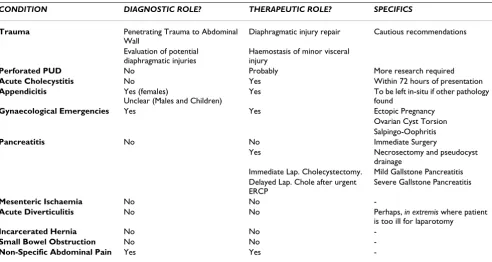
As we have outlined above, the available evidence demon-strates a clear advantage to diagnostic and therapeutic laparoscopy in certain common conditions. However, laparoscopy cannot currently be justified in other scenar-ios until further research (in the form of large randomised trials if possible) is carried out. Our current recommenda-tions are summarised in Table 1.
One limitation of our review is that we have not discussed the use of emergency laparoscopy in the paediatric popu-lation. This is for two reasons. Firstly the pathological
spectrum in the young is significantly different to the adult population and we feel should be addressed in a separate article. Secondly, we are not a paediatric unit, and have significantly less experience in this patient demo-graphic. We are aware however that emergency laparos-copy can be a useful tool in older children and adolescents [69,132].
Future research must concentrate on those pathologies in which only limited evidence currently exists, and must be multi-centred, not just based in highly specialised units. This will become easier as laparoscopic expertise becomes more mainstream.
Laparoscopic surgery has improved our management of surgical emergencies and in certain conditions is now an essential part of our armamentarium. What is clear is that as surgical expertise and technology both continue to improve, so the remit for laparoscopic surgery will expand, to the benefit of our patients.
Authors' contributions
OW and JK performed the literature search and extracted the data. OW, JK and PP all wrote different subsections of the review. AD conceived of the review, and edited the manuscript. All authors read and approved the final man-uscript.
Table 1: Summary of our recommendations regarding the emergency use of laparoscopy.
CONDITION DIAGNOSTIC ROLE? THERAPEUTIC ROLE? SPECIFICS
Trauma Penetrating Trauma to Abdominal
Wall
Diaphragmatic injury repair Cautious recommendations
Evaluation of potential diaphragmatic injuries
Haemostasis of minor visceral injury
Perforated PUD No Probably More research required
Acute Cholecystitis No Yes Within 72 hours of presentation
Appendicitis Yes (females)
Unclear (Males and Children)
Yes To be left in-situ if other pathology
found
Gynaecological Emergencies Yes Yes Ectopic Pregnancy
Ovarian Cyst Torsion Salpingo-Oophritis
Pancreatitis No No Immediate Surgery
Yes Necrosectomy and pseudocyst
drainage
Immediate Lap. Cholecystectomy. Mild Gallstone Pancreatitis Delayed Lap. Chole after urgent
ERCP
Severe Gallstone Pancreatitis
Mesenteric Ischaemia No No
-Acute Diverticulitis No No Perhaps, in extremis where patient
is too ill for laparotomy
Incarcerated Hernia No No
-Small Bowel Obstruction No No
-References
1. Gadacz TR: Update on laparoscopic cholecystectomy, includ-ing a clinical pathway. Surg Clin North Am 2000, 80(4):1127-1149. 2. Filshie M: Laparoscopic sterilization. Semin Laparosc Surg 1999,
6(2):112-117.
3. Johnson N, Barlow D, Lethaby A, Tavender E, Curr L, Garry R: Meth-ods of hysterectomy: systematic review and meta-analysis of randomised controlled trials. Bmj 2005, 330(7506):1478. 4. Kienle P, Weitz J, Koch M, Buchler MW: Laparoscopic surgery for
colorectal cancer. Colorectal Dis 2006, 8 Suppl 3:33-36. 5. Catarci M, Gentileschi P, Papi C, Carrara A, Marrese R, Gaspari AL,
Grassi GB: Evidence-based appraisal of antireflux fundoplica-tion. Ann Surg 2004, 239(3):325-337.
6. Avital S, Zundel N, Szomstein S, Rosenthal R: Laparoscopic tran-shiatal esophagectomy for esophageal cancer. Am J Surg 2005,
190(1):69-74.
7. Berci G, Sackier JM, Paz-Partlow M: Emergency laparoscopy. Am J Surg 1991, 161(3):332-335.
8. Valla JS, Limonne B, Valla V, Montupet P, Daoud N, Grinda A, Cha-vrier Y: Laparoscopic appendectomy in children: report of 465 cases. Surg Laparosc Endosc 1991, 1(3):166-172.
9. Goettler CE, Bard MR, Toschlog EA: Laparoscopy in trauma. Curr Surg 2004, 61(6):554-559.
10. Kirshtein B, Bayme M, Mayer T, Lantsberg L, Avinoach E, Mizrahi S:
Laparoscopic treatment of gastroduodenal perforations: comparison with conventional surgery. Surg Endosc 2005,
19(11):1487-1490.
11. Mori T, Abe N, Sugiyama M, Atomi Y: Laparoscopic pancreatic surgery. J Hepatobiliary Pancreat Surg 2005, 12(6):451-455. 12. Golash V, Willson PD: Early laparoscopy as a routine procedure
in the management of acute abdominal pain: a review of 1,320 patients. Surg Endosc 2005, 19(7):882-885.
13. Reiertsen O, Rosseland AR, Hoivik B, Solheim K: Laparoscopy in patients admitted for acute abdominal pain. Acta Chir Scand
1985, 151(6):521-524.
14. Majewski WD: Long-term outcome, adhesions, and quality of life after laparoscopic and open surgical therapies for acute abdomen: follow-up of a prospective trial. Surg Endosc 2005,
19(1):81-90.
15. Geis WP, Kim HC: Use of laparoscopy in the diagnosis and treatment of patients with surgical abdominal sepsis. Surg Endosc 1995, 9(2):178-182.
16. Salky BA, Edye MB: The role of laparoscopy in the diagnosis and treatment of abdominal pain syndromes. Surg Endosc 1998,
12(7):911-914.
17. Renz BM, Feliciano DV: Unnecessary laparotomies for trauma: a prospective study of morbidity. J Trauma 1995, 38(3):350-356. 18. Renz BM, Feliciano DV: The length of hospital stay after an unnecessary laparotomy for trauma: a prospective study. J Trauma 1996, 40(2):187-190.
19. Haan J, Kole K, Brunetti A, Kramer M, Scalea TM: Nontherapeutic laparotomies revisited. Am Surg 2003, 69(7):562-565.
20. Carnevale N, Baron N, Delany HM: Peritoneoscopy as an aid in the diagnosis of abdominal trauma: a preliminary report. J Trauma 1977, 17(8):634-641.
21. Gazzaniga AB, Stanton WW, Bartlett RH: Laparoscopy in the diagnosis of blunt and penetrating injuries to the abdomen. Am J Surg 1976, 131(3):315-318.
22. Cuschieri A, Hennessy TP, Stephens RB, Berci G: Diagnosis of sig-nificant abdominal trauma after road traffic accidents: pre-liminary results of a multicentre clinical trial comparing minilaparoscopy with peritoneal lavage. Ann R Coll Surg Engl
1988, 70(3):153-155.
23. Leppaniemi A, Haapiainen R: Diagnostic laparoscopy in abdomi-nal stab wounds: a prospective, randomized study. J Trauma
2003, 55(4):636-645.
24. Zantut LF, Ivatury RR, Smith RS, Kawahara NT, Porter JM, Fry WR, Poggetti R, Birolini D, Organ CHJ: Diagnostic and therapeutic laparoscopy for penetrating abdominal trauma: a multi-center experience. J Trauma 1997, 42(5):825-9; discussion 829-31.
25. Guth AA, Pachter HL: Laparoscopy for penetrating thoracoab-dominal trauma: pitfalls and promises. Jsls 1998, 2(2):123-127. 26. Ivatury RR, Simon RJ, Weksler B, Bayard V, Stahl WM: Laparoscopy in the evaluation of the intrathoracic abdomen after pene-trating injury. J Trauma 1992, 33(1):101-8; discussion 109.
27. Sosa JL, Baker M, Puente I, Sims D, Sleeman D, Ginzburg E, Martin L:
Negative laparotomy in abdominal gunshot wounds: poten-tial impact of laparoscopy. J Trauma 1995, 38(2):194-197. 28. Marks JM, Youngelman DF, Berk T: Cost analysis of diagnostic
laparoscopy vs laparotomy in the evaluation of penetrating abdominal trauma. Surg Endosc 1997, 11(3):272-276.
29. Shah R, Sabanathan S, Mearns AJ, Choudhury AK: Traumatic rup-ture of diaphragm. Ann Thorac Surg 1995, 60(5):1444-1449. 30. Sauerland S, Agresta F, Bergamaschi R, Borzellino G, Budzynski A,
Champault G, Fingerhut A, Isla A, Johansson M, Lundorff P, Navez B, Saad S, Neugebauer EA: Laparoscopy for abdominal emergen-cies: evidence-based guidelines of the European Association for Endoscopic Surgery. Surg Endosc 2006, 20(1):14-29. 31. Smith CH, Novick TL, Jacobs DG, Thomason MH: Laparoscopic
repair of a ruptured diaphragm secondary to blunt trauma. Surg Endosc 2000, 14(5):501-502.
32. Smith RS, Fry WR, Morabito DJ, Koehler RH, Organ CHJ: Thera-peutic laparoscopy in trauma. Am J Surg 1995, 170(6):632-6; dis-cussion 636-7.
33. Matthews BD, Bui H, Harold KL, Kercher KW, Adrales G, Park A, Sing RF, Heniford BT: Laparoscopic repair of traumatic dia-phragmatic injuries. Surg Endosc 2003, 17(2):254-258.
34. Chen RJ, Fang JF, Lin BC, Hsu YB, Kao JL, Kao YC, Chen MF: Selec-tive application of laparoscopy and fibrin glue in the failure of nonoperative management of blunt hepatic trauma. J Trauma
1998, 44(4):691-695.
35. Chol YB, Lim KS: Therapeutic laparoscopy for abdominal trauma. Surg Endosc 2003, 17(3):421-427.
36. Mathonnet M, Peyrou P, Gainant A, Bouvier S, Cubertafond P: Role of laparoscopy in blunt perforations of the small bowel. Surg Endosc 2003, 17(4):641-645.
37. Smith RS, Meister RK, Tsoi EK, Bohman HR: Laparoscopically guided blood salvage and autotransfusion in splenic trauma: a case report. J Trauma 1993, 34(2):313-314.
38. Carrillo EH, Reed DNJ, Gordon L, Spain DA, Richardson JD:
Delayed laparoscopy facilitates the management of biliary peritonitis in patients with complex liver injuries. Surg Endosc
2001, 15(3):319-322.
39. Collin GR, Bianchi JD: Laparoscopic examination of the trau-matized spleen with blood salvage for autotransfusion. Am Surg 1997, 63(6):478-480.
40. Sanabria AE, Morales CH, Villegas MI: Laparoscopic repair for perforated peptic ulcer disease. Cochrane Database Syst Rev
2005:CD004778.
41. Paimela H, Oksala NK, Kivilaakso E: Surgery for peptic ulcer today. A study on the incidence, methods and mortality in surgery for peptic ulcer in Finland between 1987 and 1999. Dig Surg 2004, 21(3):185-191.
42. Mouret P, Francois Y, Vignal J, Barth X, Lombard-Platet R: Laparo-scopic treatment of perforated peptic ulcer. Br J Surg 1990,
77(9):1006.
43. Lau WY, Leung KL, Kwong KH, Davey IC, Robertson C, Dawson JJ, Chung SC, Li AK: A randomized study comparing laparoscopic versus open repair of perforated peptic ulcer using suture or sutureless technique. Ann Surg 1996, 224(2):131-138.
44. Siu WT, Leong HT, Law BK, Chau CH, Li AC, Fung KH, Tai YP, Li MK:
Laparoscopic repair for perforated peptic ulcer: a rand-omized controlled trial. Ann Surg 2002, 235(3):313-319. 45. Seelig MH, Seelig SK, Behr C, Schonleben K: Comparison between
open and laparoscopic technique in the management of per-forated gastroduodenal ulcers. J Clin Gastroenterol 2003,
37(3):226-229.
46. Mehendale VG, Shenoy SN, Joshi AM, Chaudhari NC: Laparoscopic versus open surgical closure of perforated duodenal ulcers: a comparative study. Indian J Gastroenterol 2002, 21(6):222-224. 47. Robertson GS, Wemyss-Holden SA, Maddern GJ: Laparoscopic
repair of perforated peptic ulcers. The role of laparoscopy in generalised peritonitis. Ann R Coll Surg Engl 2000, 82(1):6-10. 48. Lam CM, Yuen AW, Chik B, Wai AC, Fan ST: Laparoscopic
sur-gery for common surgical emergencies: a population-based study. Surg Endosc 2005, 19(6):774-779.
49. Tsumura H, Ichikawa T, Hiyama E, Murakami Y: Laparoscopic and open approach in perforated peptic ulcer. Hepatogastroenterol-ogy 2004, 51(59):1536-1539.
51. Cougard P, Barrat C, Gayral F, Cadiere GB, Meyer C, Fagniez L, Bouil-lot JL, Boissel P, Samama G, Champault G: [Laparoscopic treat-ment of perforated duodenal ulcers. Results of a retrospective multicentric study. French Society of Laparo-scopic Surgery]. Ann Chir 2000, 125(8):726-731.
52. Druart ML, Van Hee R, Etienne J, Cadiere GB, Gigot JF, Legrand M, Limbosch JM, Navez B, Tugilimana M, Van Vyve E, Vereecken L, Wibin E, Yvergneaux JP: Laparoscopic repair of perforated duodenal ulcer. A prospective multicenter clinical trial. Surg Endosc
1997, 11(10):1017-1020.
53. Trowbridge RL, Rutkowski NK, Shojania KG: Does this patient have acute cholecystitis? Jama 2003, 289(1):80-86.
54.
http://www.hesonline.nhs.uk/Ease/servlet/Content-Server?siteID=1937&categoryID=537: Hospital Episode Statis-tics. 2004.
55. Johansson M, Thune A, Blomqvist A, Nelvin L, Lundell L: Impact of choice of therapeutic strategy for acute cholecystitis on patient's health-related quality of life. Results of a rand-omized, controlled clinical trial. Dig Surg 2004, 21(5-6):359-362.
56. Kiviluoto T, Siren J, Luukkonen P, Kivilaakso E: Randomised trial of laparoscopic versus open cholecystectomy for acute and gangrenous cholecystitis. Lancet 1998, 351(9099):321-325. 57. Glavic Z, Begic L, Simlesa D, Rukavina A: Treatment of acute
cholecystitis. A comparison of open vs laparoscopic chole-cystectomy. Surg Endosc 2001, 15(4):398-401.
58. Kum CK, Goh PM, Isaac JR, Tekant Y, Ngoi SS: Laparoscopic chole-cystectomy for acute cholecystitis. Br J Surg 1994,
81(11):1651-1654.
59. Lam CM, Yuen AW, Chik B, Wai AC, Fan ST: Variation in the use of laparoscopic cholecystectomy for acute cholecystitis: a population-based study. Arch Surg 2005, 140(11):1084-1088. 60. Kolla SB, Aggarwal S, Kumar A, Kumar R, Chumber S, Parshad R,
Seenu V: Early versus delayed laparoscopic cholecystectomy for acute cholecystitis: a prospective randomized trial. Surg Endosc 2004, 18(9):1323-1327.
61. Greenwald JA, McMullen HF, Coppa GF, Newman RM: Standardi-zation of surgeon-controlled variables: impact on outcome in patients with acute cholecystitis. Ann Surg 2000,
231(3):339-344.
62. Navez B, Mutter D, Russier Y, Vix M, Jamali F, Lipski D, Cambier E, Guiot P, Leroy J, Marescaux J: Safety of laparoscopic approach for acute cholecystitis: retrospective study of 609 cases. World J Surg 2001, 25(10):1352-1356.
63. Johansson M, Thune A, Blomqvist A, Nelvin L, Lundell L: Manage-ment of acute cholecystitis in the laparoscopic era: results of a prospective, randomized clinical trial. J Gastrointest Surg 2003,
7(5):642-645.
64. Serralta AS, Bueno JL, Planells MR, Rodero DR: Prospective evalu-ation of emergency versus delayed laparoscopic cholecystec-tomy for early cholecystitis. Surg Laparosc Endosc Percutan Tech
2003, 13(2):71-75.
65. Lau H, Lo CY, Patil NG, Yuen WK: Early versus delayed-interval laparoscopic cholecystectomy for acute cholecystitis: a metaanalysis. Surg Endosc 2006, 20(1):82-87.
66. Mercer SJ, Knight JS, Toh SK, Walters AM, Sadek SA, Somers SS:
Implementation of a specialist-led service for the manage-ment of acute gallstone disease. Br J Surg 2004, 91(4):504-508. 67. Senapati PS, Bhattarcharya D, Harinath G, Ammori BJ: A survey of the timing and approach to the surgical management of cholelithiasis in patients with acute biliary pancreatitis and acute cholecystitis in the UK. Ann R Coll Surg Engl 2003,
85(5):306-312.
68. Addiss DG, Shaffer N, Fowler BS, Tauxe RV: The epidemiology of appendicitis and appendectomy in the United States. Am J Epidemiol 1990, 132(5):910-925.
69. Aziz O, Athanasiou T, Tekkis PP, Purkayastha S, Haddow J, Malinovski V, Paraskeva P, Darzi A: Laparoscopic versus open appendec-tomy in children: a meta-analysis. Ann Surg 2006, 243(1):17-27. 70. Sauerland S, Lefering R, Neugebauer EA: Laparoscopic versus open surgery for suspected appendicitis. Cochrane Database Syst Rev 2004:CD001546.
71. Fingerhut A, Millat B, Borrie F: Laparoscopic versus open appen-dectomy: time to decide. World J Surg 1999, 23(8):835-845. 72. Garbutt JM, Soper NJ, Shannon WD, Botero A, Littenberg B:
Meta-analysis of randomized controlled trials comparing
laparo-scopic and open appendectomy. Surg Laparosc Endosc 1999,
9(1):17-26.
73. Guller U, Hervey S, Purves H, Muhlbaier LH, Peterson ED, Eubanks S, Pietrobon R: Laparoscopic versus open appendectomy: out-comes comparison based on a large administrative database. Ann Surg 2004, 239(1):43-52.
74. Larsson PG, Henriksson G, Olsson M, Boris J, Stroberg P, Tronstad SE, Skullman S: Laparoscopy reduces unnecessary appendicec-tomies and improves diagnosis in fertile women. A rand-omized study. Surg Endosc 2001, 15(2):200-202.
75. Jadallah FA, Abdul-Ghani AA, Tibblin S: Diagnostic laparoscopy reduces unnecessary appendicectomy in fertile women. Eur J Surg 1994, 160(1):41-45.
76. van den Broek WT, Bijnen AB, de Ruiter P, Gouma DJ: A normal appendix found during diagnostic laparoscopy should not be removed. Br J Surg 2001, 88(2):251-254.
77. Teh SH, O'Ceallaigh S, McKeon JG, O'Donohoe MK, Tanner WA, Keane FB: Should an appendix that looks 'normal' be removed at diagnostic laparoscopy for acute right iliac fossa pain? Eur J Surg 2000, 166(5):388-389.
78. Grunewald B, Keating J: Should the 'normal' appendix be removed at operation for appendicitis? J R Coll Surg Edinb 1993,
38(3):158-160.
79. Magos AL, Baumann R, Turnbull AC: Managing gynaecological emergencies with laparoscopy. Bmj 1989, 299(6695):371-374. 80. Mikkelsen AL, Felding C: Laparoscopy and ultrasound
examina-tion in women with acute pelvic pain. Gynecol Obstet Invest 1990,
30(3):162-164.
81. Taylor EW, Kennedy CA, Dunham RH, Bloch JH: Diagnostic lapar-oscopy in women with acute abdominal pain. Surg Laparosc Endosc 1995, 5(2):125-128.
82. Gray DT, Thorburn J, Lundorff P, Strandell A, Lindblom B: A cost-effectiveness study of a randomised trial of laparoscopy ver-sus laparotomy for ectopic pregnancy. Lancet 1995,
345(8958):1139-1143.
83. Lundorff P, Thorburn J, Lindblom B: Fertility outcome after con-servative surgical treatment of ectopic pregnancy evaluated in a randomized trial. Fertil Steril 1992, 57(5):998-1002. 84. Lundorff P, Thorburn J, Hahlin M, Kallfelt B, Lindblom B:
Laparo-scopic surgery in ectopic pregnancy. A randomized trial ver-sus laparotomy. Acta Obstet Gynecol Scand 1991, 70(4-5):343-348. 85. Vermesh M, Silva PD, Rosen GF, Stein AL, Fossum GT, Sauer MV:
Management of unruptured ectopic gestation by linear salp-ingostomy: a prospective, randomized clinical trial of lapar-oscopy versus laparotomy. Obstet Gynecol 1989, 73(3 Pt 1):400-404.
86. Mais V, Ajossa S, Piras B, Marongiu D, Guerriero S, Melis GB: Treat-ment of nonendometriotic benign adnexal cysts: a rand-omized comparison of laparoscopy and laparotomy. Obstet Gynecol 1995, 86(5):770-774.
87. Yuen PM, Yu KM, Yip SK, Lau WC, Rogers MS, Chang A: A rand-omized prospective study of laparoscopy and laparotomy in the management of benign ovarian masses. Am J Obstet Gynecol
1997, 177(1):109-114.
88. Teisala K, Heinonen PK, Punnonen R: Laparoscopic diagnosis and treatment of acute pyosalpinx. J Reprod Med 1990, 35(1):19-21. 89. Klein HM, Lensing R, Klosterhalfen B, Tons C, Gunther RW: Diag-nostic imaging of mesenteric infarction. Radiology 1995,
197(1):79-82.
90. Nordback I, Sisto T: Ultrasonography and computed tomogra-phy in the diagnosis of portomesenteric vein thrombosis. Int Surg 1991, 76(3):179-182.
91. Zamir G, Reissman P: Diagnostic laparoscopy in mesenteric ischemia. Surg Endosc 1998, 12(5):390-393.
92. Iberti TJ, Salky BA, Onofrey D: Use of bedside laparoscopy to identify intestinal ischemia in postoperative cases of aortic reconstruction. Surgery 1989, 105(5):686-689.
93. Sackier J: Diagnostic laparoscopy in nonmalignant disease. Surg Clin North Am 1992, 72(5):1033-1043.
94. Irvin TT: Abdominal pain: a surgical audit of 1190 emergency admissions. Br J Surg 1989, 76(11):1121-1125.
95. Cho YP, Jung SM, Han MS, Jang HJ, Kim JS, Kim YH, Lee SG: Role of diagnostic laparoscopy in managing acute mesenteric venous thrombosis. Surg Laparosc Endosc Percutan Tech 2003,
Publish with BioMed Central and every scientist can read your work free of charge
"BioMed Central will be the most significant development for disseminating the results of biomedical researc h in our lifetime."
Sir Paul Nurse, Cancer Research UK
Your research papers will be:
available free of charge to the entire biomedical community
peer reviewed and published immediately upon acceptance
cited in PubMed and archived on PubMed Central
yours — you keep the copyright
Submit your manuscript here:
http://www.biomedcentral.com/info/publishing_adv.asp
BioMedcentral
96. Chong AK, So JB, Ti TK: Use of laparoscopy in the management of mesenteric venous thrombosis. Surg Endosc 2001,
15(9):1042.
97. Ranson JH: Etiological and prognostic factors in human acute pancreatitis: a review. Am J Gastroenterol 1982, 77(9):633-638. 98. Kwon RS, Brugge WR: New advances in pancreatic imaging.
Curr Opin Gastroenterol 2005, 21(5):561-567.
99. Shankar S, vanSonnenberg E, Silverman SG, Tuncali K, Banks PA:
Imaging and percutaneous management of acute compli-cated pancreatitis. Cardiovasc Intervent Radiol 2004,
27(6):567-580.
100. Chatzicostas C, Roussomoustakaki M, Vlachonikolis IG, Notas G, Mouzas I, Samonakis D, Kouroumalis EA: Comparison of Ranson, APACHE II and APACHE III scoring systems in acute pan-creatitis. Pancreas 2002, 25(4):331-335.
101. Ranson JH, Pasternack BS: Statistical methods for quantifying the severity of clinical acute pancreatitis. J Surg Res 1977,
22(2):79-91.
102. Kelly TR, Wagner DS: Gallstone pancreatitis: a prospective randomized trial of the timing of surgery. Surgery 1988,
104(4):600-605.
103. Mier J, Leon EL, Castillo A, Robledo F, Blanco R: Early versus late necrosectomy in severe necrotizing pancreatitis. Am J Surg
1997, 173(2):71-75.
104. Hamad GG, Broderick TJ: Laparoscopic pancreatic necrosec-tomy. J Laparoendosc Adv Surg Tech A 2000, 10(2):115-118. 105. Zhu JF, Fan XH, Zhang XH: Laparoscopic treatment of severe
acute pancreatitis. Surg Endosc 2001, 15(2):146-148.
106. Pamoukian VN, Gagner M: Laparoscopic necrosectomy for acute necrotizing pancreatitis. J Hepatobiliary Pancreat Surg 2001,
8(3):221-223.
107. Nathens AB, Curtis JR, Beale RJ, Cook DJ, Moreno RP, Romand JA, Skerrett SJ, Stapleton RD, Ware LB, Waldmann CS: Management of the critically ill patient with severe acute pancreatitis. Crit Care Med 2004, 32(12):2524-2536.
108. Adamson GD, Cuschieri A: Multimedia article. Laparoscopic infracolic necrosectomy for infected pancreatic necrosis. Surg Endosc 2003, 17(10):1675.
109. Horvath KD, Kao LS, Wherry KL, Pellegrini CA, Sinanan MN: A technique for laparoscopic-assisted percutaneous drainage of infected pancreatic necrosis and pancreatic abscess. Surg Endosc 2001, 15(10):1221-1225.
110. Ammori BJ: Laparoscopic transgastric pancreatic necrosec-tomy for infected pancreatic necrosis. Surg Endosc 2002,
16(9):1362.
111. Cuschieri SA, Jakimowicz JJ, Stultiens G: Laparoscopic infracolic approach for complications of acute pancreatitis. Semin Lapar-osc Surg 1998, 5(3):189-194.
112. UK guidelines for the management of acute pancreatitis. Gut
2005, 54 Suppl 3:iii1-9.
113. Rhodes M, Sussman L, Cohen L, Lewis MP: Randomised trial of laparoscopic exploration of common bile duct versus post-operative endoscopic retrograde cholangiography for com-mon bile duct stones. Lancet 1998, 351(9097):159-161. 114. Kaltenthaler E, Vergel YB, Chilcott J, Thomas S, Blakeborough T,
Wal-ters SJ, Bouchier H: A systematic review and economic evalua-tion of magnetic resonance cholangiopancreatography compared with diagnostic endoscopic retrograde cholangio-pancreatography. Health Technol Assess 2004, 8(10):iii, 1-89. 115. Ayub K, Imada R, Slavin J: Endoscopic retrograde
cholangiopan-creatography in gallstone-associated acute pancreatitis. Cochrane Database Syst Rev 2004:CD003630.
116. Neoptolemos JP, Carr-Locke DL, London NJ, Bailey IA, James D, Fos-sard DP: Controlled trial of urgent endoscopic retrograde cholangiopancreatography and endoscopic sphincterotomy versus conservative treatment for acute pancreatitis due to gallstones. Lancet 1988, 2(8618):979-983.
117. Fan ST, Lai EC, Mok FP, Lo CM, Zheng SS, Wong J: Early treatment of acute biliary pancreatitis by endoscopic papillotomy. N Engl J Med 1993, 328(4):228-232.
118. Buckley O, Geoghegan T, O'Riordain DS, Lyburn ID, Torreggiani WC: Computed tomography in the imaging of colonic diver-ticulitis. Clin Radiol 2004, 59(11):977-983.
119. Purkayastha S, Constantinides VA, Tekkis PP, Athanasiou T, Aziz O, Tilney H, Darzi AW, Heriot AG: Laparoscopic vs. open surgery
for diverticular disease: a meta-analysis of nonrandomized studies. Dis Colon Rectum 2006, 49(4):446-463.
120. Faranda C, Barrat C, Catheline JM, Champault GG: Two-stage laparoscopic management of generalized peritonitis due to perforated sigmoid diverticula: eighteen cases. Surg Laparosc Endosc Percutan Tech 2000, 10(3):135-8; discussion 139-41. 121. Franklin MEJ, Dorman JP, Jacobs M, Plasencia G: Is laparoscopic
surgery applicable to complicated colonic diverticular dis-ease? Surg Endosc 1997, 11(10):1021-1025.
122. Da Rold AR, Guerriero S, Fiamingo P, Pariset S, Veroux M, Pilon F, Tosato S, Ruffolo C, Tedeschi U: Laparoscopic colorrhaphy, irri-gation and drainage in the treatment of complicated acute diverticulitis: initial experience. Chir Ital 2004, 56(1):95-98. 123. Leibl BJ, Schmedt CG, Kraft K, Kraft B, Bittner R: Laparoscopic
transperitoneal hernia repair of incarcerated hernias: Is it feasible? Results of a prospective study. Surg Endosc 2001,
15(10):1179-1183.
124. Bastug DF, Trammell SW, Boland JP, Mantz EP, Tiley EH: Laparo-scopic adhesiolysis for small bowel obstruction. Surg Laparosc Endosc 1991, 1(4):259-262.
125. Wullstein C, Gross E: Laparoscopic compared with conven-tional treatment of acute adhesive small bowel obstruction. Br J Surg 2003, 90(9):1147-1151.
126. Chosidow D, Johanet H, Montariol T, Kielt R, Manceau C, Marmuse JP, Benhamou G: Laparoscopy for acute small-bowel obstruc-tion secondary to adhesions. J Laparoendosc Adv Surg Tech A 2000,
10(3):155-159.
127. Leon EL, Metzger A, Tsiotos GG, Schlinkert RT, Sarr MG: Laparo-scopic management of small bowel obstruction: indications and outcome. J Gastrointest Surg 1998, 2(2):132-140.
128. Agresta F, Piazza A, Michelet I, Bedin N, Sartori CA: Small bowel obstruction. Laparoscopic approach. Surg Endosc 2000,
14(2):154-156.
129. Levard H, Boudet MJ, Msika S, Molkhou JM, Hay JM, Laborde Y, Gillet M, Fingerhut A: Laparoscopic treatment of acute small bowel obstruction: a multicentre retrospective study. ANZ J Surg
2001, 71(11):641-646.
130. Suter M, Zermatten P, Halkic N, Martinet O, Bettschart V: Laparo-scopic management of mechanical small bowel obstruction: are there predictors of success or failure? Surg Endosc 2000,
14(5):478-483.
131. Chung RS, Diaz JJ, Chari V: Efficacy of routine laparoscopy for the acute abdomen. Surg Endosc 1998, 12(3):219-222.