R E S E A R C H
Open Access
Platform heterogeneity, platform governance
and complementors
’
product performance:
an empirical study of the mobile application
industry
Jingtao Yi
1, Jinqiu He
1*and Lihong Yang
2* Correspondence:hismarck@163.
com
1Business School, Renmin University
of China, Beijing 100872, China Full list of author information is available at the end of the article
Abstract
The platform economy is becoming an important engine for industrial innovation and economic growth. However, empirical research on how platform governance affects product performance through network externalities remains limited. Leveraging the perspective of platform ecosystems, this paper intends to empirically investigate the impact of platform governance on the product performance of complementors in the mobile application industry, based on firstly released apps on Apple’s App Store and Google Play. Our study shows that complementors of free mobile applications on the weakly regulated platform, Google Play, perform much better than those on the strictly regulated platform, Apple’s App Store, due to the larger size of the installed base. However, complementors on the strictly regulated platform, Apple’s App Store, can take advantage of highly valued end-users on the demand side and higher degrees of product differentiation on the supply side to enhance their product performance. This is likely due to higher entry barriers for complementors, and better user communities for end-users. We suggest that higher competition efficiency and performance levels are linked to the platforms associated with strict governance.
Keywords:Platform heterogeneity, Network externality, Platform governance, Complementor’s product performance, Competition, Product differentiation, Digital technology
Introduction
Over the past few decades, the revolution in information and digital technologies has been reshaping the global business environment. There are large numbers of digital platforms in different industries. Platform owners and their complementors provide
end-consumers with a variety of services or products. Gawer and Cusumano (2014)
classify digital platforms into two forms according to the properties of service or prod-uct suppliers on the platforms: internal or company-specific platforms and external or
industry-wide platforms. Gawer (2014) further defines industry platforms which are
governed by platform enterprises as complementary goods or services supplied by more enterprises. On the foundation of technical architectures, industry platforms or-chestrate business ecosystems which encompass platform owners, platform providers,
complementors and consumers (Adner and Kapoor 2010; Ceccagnoli et al. 2012;
Kapoor and Agarwal 2017; van Alstyne et al. 2016). As the leaders in digital innova-tions, technology firms such as Microsoft, Apple and Google have already developed their own digital platforms to set rules for all participants in platform ecosystems. In order to adapt to consumer preferences, complementors are granted technological in-terfaces and modular components by platform owners to develop, display and debug their digital products. Based on value-added innovations generated from the iterative interactions of complementors and end-users (i.e., network externalities), platform enterprises may promote a great leap for the platform ecosystems (Boudreau and
Jeppesen 2015; Kapoor and Agarwal 2017; Yonatany 2017). Technical architectures,
regulations and network externalities are increasingly transforming the way platform enterprises, complementors and end-users interact, as well as improving the growth and core competitiveness of platforms (Parker et al.2016).1
Existing studies emphasize that platforms play the role of intermediaries in two-sided or
multi-sided markets (e.g., Armstrong 2006; Rochet and Tirole 2003, 2006). However,
platform enterprises find it difficult to adopt an effective and solid governance strategy to improve the two-sided matching efficiency through a platform-mediated network (Tiwana 2013; Tiwana et al.2010). Based on network externalities, i.e., the number of end-users/com-plementors of the platform will increase/decrease when the value attached to the platform is higher/ lower, platform enterprises need to be very cautious when they set the rules for the platform ecosystem participants to make the whole platform grow (Cennamo and Santalo 2013). Quality concerns about products on platforms often arise from the process when plat-form governance is ineffective (Hagiu and Spulber2013). For instance, the large quantities of fakes on Taobao and security issues arising from car-hailing platforms and short rental service platforms have garnered public attention in China and in the rest of the world.
Moreover, previous research on platform governance has assumed homogeneous platforms which do not completely account for the behavior of platform participants in
the real world (e.g., Anderson and Coate2005; Armstrong2006; Cennamo and Santalo
2013; Gawer and Henderson2007; Ghazawneh and Henfridsson2013; Rochet and
Tir-ole2003,2006). As Gawer (2014) suggests, the combination of the perspectives of eco-nomic theory and engineering design will help clarify how platforms operate in reality. Existing studies which focus on platform heterogeneity incorporate the view of engin-eering design to classify digital platforms into proprietary platforms and open source
platforms (e.g., Boudreau 2010; Cheng and Liu 2012; Economides and Katsamakas
2006; West2003). Therefore, we intend to account for heterogeneous platform
govern-ance through the openness of operating systems. Digital platforms can control the platform through proprietary techniques or totally grant access to independent
comple-mentors, which implies heterogeneous platform governance strategies (Boudreau2010).
Therefore, we classify heterogeneous digital platforms into strictly regulated platforms and weakly regulated platforms. Leveraging a sample of two heterogeneous mobile
ap-plication platforms, Apple’s App Store and Google Play where complementors’
compe-tition and innovation are heavily reliant on the differentiated technical architectures of the platforms, our study intends to analyze heterogeneous platform governance
strat-egies and their impacts on complementors’ product performance to cultivate the
growth of the platform ecosystem.
revenue that developers make from their own end-users.2Faced with intense competi-tion, many developers on technological platforms supply end-users with free digital products so as to enlarge the size of the installed base and hence quickly break into the market. Free digital product developers set in-app purchase choices and seek to cooper-ate with external partners (i.e., advertising, organizing online activities and collecting
data through their digital products) to yield profits (Carare 2012; Garg and Telang
2013; Parker and van Alstyne2005).
In the case of mobile application industry platforms, 90% of downloads from the two
major mobile application markets, Apple’s App Store and Google Play, are free.3
Ap-ple’s App Store, with a closed, proprietary operating system, sets strict rules to govern
complementors’ use of the platform, while Google Play’s rules appear more flexible
owing to its open operating system. We argue that different platform governance strat-egies influence the ways in which platform enterprises leverage network externalities. Google Play regulates its platform ecosystem flexibly to take advantage of the size effect
of network externalities, while Apple’s App Store regulates its platform ecosystem
strictly to take advantage of the quality effect of network externalities.
Although the business strategies of Apple’s App Store and Google Play are different, to what extent they help complementors leverage network externalities and enhance competitive advantages of the two heterogeneous platforms remains underexplored (Armstrong2006; Caillaud and Jullien2003; Hagiu2006; Rochet and Tirole2003; Weyl
2010). Emphasizing platform enterprises’governance strategies and network
external-ities, we elucidate the economic behavior and dynamic interactive mechanism of plat-form complementors and end-users, yielding new insights into the governance strategies and network externalities of heterogeneous platforms. We further explore
how platform governance drives the network externalities and complementors’
per-formance on heterogeneous platforms using free digital products’micro-level data. Our study makes three contributions. First, we enhance the understanding of the im-pacts of platform governance on network externalities from the perspective of platform ecosystems. Our study elucidates how platform enterprises govern the whole platform ecosystem through technological standards and how value is created and flows through iterative interactions between platform ecosystem participants by embedding all com-ponents in the relationship networks based on technical architectures.
Second, our study sheds light on the role of platform heterogeneity arising from plat-form governance strategies. Previous research on two-sided or multi-sided markets have always been limited to homogeneous platforms or a single platform, but know-ledge about how platform heterogeneity affects platform participants’strategies and be-havior is limited. Our study enriches the analyses of network externalities on heterogeneous digital platforms by utilizing platform-level and application-level data from Apple’s App Store and Google Play.
Third, we further demonstrate how platform complementors respond to and benefit from platform governance strategies by making use of the network externalities efficiently. Due to the degree of openness of platforms, complementors may set different pricing and
innovative strategies to attract end-users (Bhargava and Choudhary 2008). Our study
Theoretical framework and hypotheses
Setup
Based on Rochet and Tirole (2003, 2006), we define the digital platforms as the two-sided markets or intermediate platforms which charge supplier and consumer groups a fixed entry price on a lump-sum basis. In addition, both groups can exert externalities
on each other (Armstrong2006). We build a theoretical model to explain the
determi-nants of free digital products’performance on technological platforms. We denote the
group of consumers as group-1 and the group of suppliers as group-2. Suppose there are ni
1 members in group-1 on platformi and they are willing to pay
for the product at a price of no more thanαi
1 (that means consumers will buy the
prod-uct when its price isPi1≤αi1). Then we define Pi2 as the platform’s price to group-2 and
bi2 as the platform’s entry barriers (i.e., sunk costs, including the expenses on dedicated devices, research and development, etc.). If a developer in group-2 wants to launch its digital products on platform i, it needs to pay Ti2¼Pi2þbi2. For each supplier in
group-2, the unknown αi
2 measures the benefit it gets from every end-user. The
dis-counted factor νi measures the discounted future returns of the free digital product
based on its technological level, diverse revenue models and expectations of the
indus-try. When αi2
νini1≥Ti2, the platform complementor will enter the platform. We define αi2 as independently and identically drawn from a distribution function Fðαi
2Þ. Addition-ally, Fðαi
2Þis an increasing function ofαi2. Therefore, the functionϕ i
which defines the sizeni
2 of members in group-2 is as follow:
ϕi ni
1;νi;Ti2
¼1−F νiTi
2=ni1
¼1−F νi Pi
2þb
i
2
=ni1
: ð1Þ
Equation (1) clarifies that the number of complementors on platformiis decided by the discounted factor, entry price and other barriers, and the size of users.
Entry cost and platform choice
In order to enlarge the size of the installed base, technological platforms usually grant end-users access to digital products without charge and even provide subsidies. To
sim-plify our theoretical model, we postulate each complementor on platform i only
pro-duces one free digital product and the platform will share a proportion of the revenue it earns. The profits of platformiare given as:
πi¼Ri
2 ϕi þs∙pi1 ci1;γi1;ϕi
∙ni
1− Fiþfi1ni1þfi2ni2
;
where Ri
2 is platformi’s entry cost and pi1 is the expected returns from each consumer
for a unit product. pi
1is related to consumers’characteristic parameterci1, the unit
rev-enue γi
1 earned from ads or other online activities, and the size of complementors ϕ
i
on platform i. s is the fixed revenue proportion that platform i shares which is set by the industry. Fi is the fixed costs of platform i’s daily operation while fi1 and fi2 are platformi’s expenses for serving each end-user and complementor. Thepi
2which
Pi
2¼ f
i
2−
∂Pi
2
∂ni
2
ni
2−s∙
∂pi1ci1;γi1;ϕi
∂ni
2
ni
1: ð2Þ
Complementors’competition
Given that consumers can download the digital product without charge, we suppose the size of productj’s installed base on platformiismi
j,djis the dummy variable which
measures whether the developer provides in-app purchase choices and pi
j is the price
for in-app purchases. We propose the probability ofpi
j≤α1 isδ
i
(θi), whereδiis decided
by the degree of product differentiationθiof complementors on platformi. The degree of product differentiation reflects the product diversity on platform iand hence affects
consumers’comments and willingness to pay. Considering complementors’ revenues
from external partners, we define the revenue function of each complementor as:
Rij¼ djδi θi pijþγ i
1
mij: ð3Þ
Then the profits of each complementor on platformiare:
πi
j¼
δi θi
pijþγi1
mij− Ti2þfijmij
; dj¼1
γi
1mij− Ti2þfijmij
; dj¼0 ; 8
< :
where fij is the cost for the free product developer to serve each end-user and γi
1 is
given by external partners. Given the specification in equation (3), the revenue function of each complementor who chooses to set the in-app purchase choice is:
Rij¼ fij−δi θi ∂p
i j ∂mi j
mij
!
mij¼αijmij: ð4Þ
Equations (3) and (4) suggest that each complementor’s revenue is positively core-lated with the size of the installed base regardless of the in-app purchase choice. If
product differentiation and innovation speed can promote consumers’ willingness to
pay, free digital products’ performance will be improved. Moreover, digital platforms’
marginal costs of serving end-users are insignificant. To be more precise, dj depends
on the market positioning of developers whileθidepends on the business models of de-velopers and governance strategies of platform enterprises on heterogeneous platforms,
ni
2, on platform i. According to equation (1), ni2 is given by the size consumers, ni1, attracted by platformibased on its technological standards. Meanwhile,mijis restricted
byni
1.αijandmijwill vary on heterogeneous digital platforms.
Platform heterogeneity and network externalities
Platform enterprises manipulate the matching process of platform complementors and end-users. The direct/indirect network effects and iterative interactions between plat-form complementors and end-users on platplat-forms dominate the process of value
cre-ation (van Alstyne et al. 2016). As our theoretical model indicates, the size of the
The business model of free digital products heavily depends on the scale of the demand side. The direct network effects on the demand side, i.e., that the number of end-users will increase when the value attached to the group of end-users is higher, help platform com-plementors attain profit from economies of scale and the efficiency enhancement in
de-mand aggregation (Gawer2014; Parker and van Alstyne2005). With the development of
the Internet, platform enterprises and complementors can save the costs of resource allo-cation constrained by physical space-time and grant users free digital interfaces to expand the installed base (Feng and Chen2016). Since weakly regulated platforms based on open operating systems set much lower entry barriers, the size of the installed base on such platforms is much larger than the one on strictly regulated platforms. Due to the competi-tive advantage of the larger size of the installed base, it is easier for complementors on weakly regulated platforms to earn more revenue relying on the size effect.
The governance of complementors on digital platforms mainly includes the control of complementors’accessibility and the whole input and output process (Benlian et al. 2015; Ghazawneh and Henfridsson2013; Tiwana et al.2010). Since the larger group of end-users is based on low transaction costs, complementors on weakly regulated plat-forms allow target customers to make use of the functions for free and directly take ad-vantage of the size effect of network externalities. In contrast, complementors on strictly regulated platforms have to rely on the quality effect of network externalities to lock in the target customers who prefer high-quality products regardless of transaction costs. Due to the difference in the size of the installed base and target customers’ sensi-tivity of transaction costs, complementors on weakly regulated platforms tend to strengthen the size effect from demand aggregation while those on strictly regulated platforms focus more on acquiring extra consumer surplus from end-users. However, consumers on weakly regulated platforms are prone to sacrifice some time/space (i.e., reading ads, doing questionnaires, and participating in online activities) to enjoy the functions of digital products without monetary costs. Therefore, for free digital prod-ucts, the size effect can be significantly enhanced for complementors on weakly regu-lated platforms. The discussion leads to:
Hypothesis 1: Complementors of free digital products on strictly regulated platforms perform worse than those on weakly regulated platforms.
The relationship networks in platform ecosystems and complementors’performance
Based on platform resources, the iterative interactions due to network externalities be-tween complementors, end-users, platform enterprises and external traders provide complementors with opportunities to innovate and attach more value to their digital
products in the platform ecosystem (Adner and Kapoor 2010; Gawer and Cusumano
2014; Rochet and Tirole2006). Complementors exploit network externalities differently on heterogeneous platforms due to consumer heterogeneity on the demand side and product differentiation on the supply side. Meanwhile, network externalities are the
es-sential motives for platform growth (Gawer and Cusumano2014). From the perspective
of platform ecosystems, platform enterprises intend to implement effective governance strategies to cultivate positive interactions between platform ecosystem participants
and thus promote the value creation of the whole ecosystem (Adner and Kapoor 2010;
Although open platforms can attract large quantities of complementors and accelerate the innovative speed of technologies and products, the lack of strict platform governance can cause devastating disorders inside the platform ecosystem (Gawer2014; West2003), including efficiency loss driven by business-stealing effects (i.e., product imitation and
in-fringement) (Economides and Katsamakas 2006; Hagiu 2006). In view of platform
en-velopment strategy, the vertical integration of operating systems and terminal devices can help technological platform enterprises develop a closed technology chain and thus exert strict governance on the whole ecosystem (Eisenmann et al.2011). This can enhance the quality of complementary products or services as well as the degree of differentiation, leading to higher competition efficiency. In the real world, video websites such as Youku, iQiyi, and LeTV, who have expanded their business in the field of TV boxes, and game platforms such as Microsoft’s Xbox, Sony’s Play Station and Nintedo, who have also ex-panded their business in the downstream console industry, spare no effort to capture their target customers by exploiting technology chains. Technical architecture substantially promotes the virtuous cycle of the components inside the platform ecosystem.
End-users also play an important role in product innovation and co-production. The
value accruing to platform complementors arises from end-users’ preferences and
ef-fective feedback (Katz and Shapiro 1985). Platform complementors need to develop
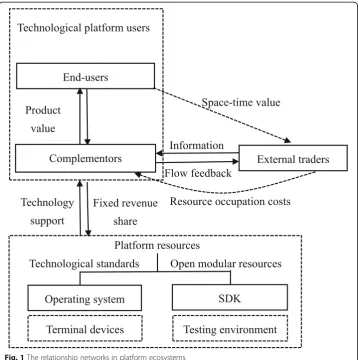
good relationships with other participants in the platform ecosystem if they want to capture value from in-app purchases or from cooperating with external partners. Spe-cifically, they should adjust the characteristics of digital products to match customers’ preferences and pay attention to innovative strategies and competitive pressures on the supply side in order to maintain their core competitiveness. The relationship networks
inside the platform ecosystem are shown in Fig. 1. The interactions between platform
ecosystem participants are heavily reliant on the degree of platform openness. On ac-count of the rigorous quality control system along the value chain, Apple indeed im-proves much the quality of products and services it offers.
The heterogeneity in the consumer group
Consumers pay for certain product or service to get value. The realization of
consumers’ personal values partly depends on the satisfaction of epistemic values
(Sheth et al.1991; Vinson et al.1977).
Consumers’expectation of getting higher surplus value raises concerns over transac-tion costs and the value in use. Platform complementors have to unearth more value in end-users so as to create more added value and improve their performance. Free digital product developers exploit “threshold effects” to attract target customers, aiming at achieving better performance. They expect to satisfy the end-users’anticipating value at first and continuously explore the end-users’potential value, which will gradually lead
to the improvement in customers’personal values.4In diverse target market segments
products (Min et al. 2014; Roma et al. 2016). Hence, end-users on strictly regulated platforms have higher brand loyalty and are willing to pay more for their chosen prod-ucts than those on weakly regulated platforms. Ascribing the difference in assessment
of digital products’ time and monetary value, complementors on strictly regulated
platforms tend to unearth end-users’ potential value while those on weakly regulated
platforms tend to benefit directly from the installed base by cooperating with external traders. Therefore, we hypothesize that:
Hypothesis 2: The strategy of in-app purchases enables complementors of free digital products on strictly regulated platforms to perform better than those on weakly regu-lated platforms.
The heterogeneity in the supplier group
Depending on direct/indirect network effects, a growth in the size and purchasing power of end-users will affect the growth in the number of developers positively
(McIntyre and Srinivasan2017). The intense competition among platform
complemen-tors can lead to technology spillovers as well as crowding out inferior developers. It can also stimulate leaders to update their technologies more frequently and thus drive the learning motives of imitators in the supplier group. During this process, less
competitive developers will be crowded out and it may make competitive developers keener to improve their performance.
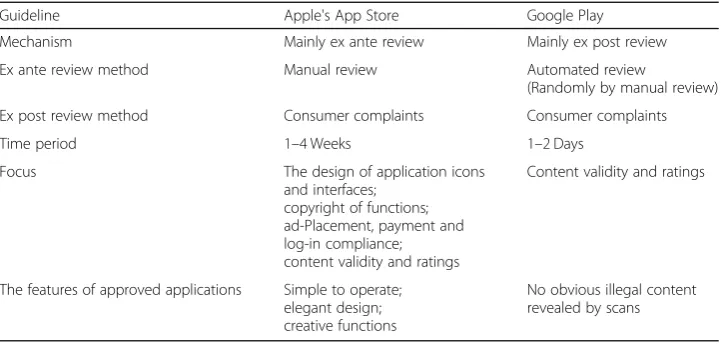
The competition levels of free digital products are mainly driven by differentiation of functions and services. The heterogeneity in the supplier group results from the differ-entiated governance rules of technological platforms. Table1displays the differentiated review guidelines of new applications on Apple’s App Store and Google Play. Apple’s App Store expels potential imitators by raising innovation barriers of entry. In fact,
Ap-ple’s App Store developers introduce more differentiated applications under the same
subcategory. Although Google Play publishes application distribution rules to protect intellectual property rights, many infringing applications in disguise can enter the mar-ket by exploiting gaps in the automated review process.
Technological platforms establish technology standards based on the layered modular-ized architecture of information integration. The open modular resources owned by plat-form enterprises help the participants on the supply side customize the functions of their digital products and hence determine the competition order (Kazan et al.2018; van Alstyne et al.2016). Platform enterprises can enhance the trust among participants by implement-ing effective governance (e.g., the protection of intellectual property). In this way, platform complementors are motivated to create more valuable intellectual property. As a result, the competitive edge of the platform ecosystem can be significantly strengthened (Nambisan 2013; van Alstyne et al.2016). As for less innovative complementors on weakly regulated platforms, they can imitate leading innovators at low cost and thus weaken the positive ex-ternalities induced by product differentiation. In contrast, more innovative complementors on strictly regulated platforms can leverage positive externalities much better due to the ef-fective protection of intellectual property. Therefore, we hypothesize that:
Hypothesis 3: An increase in the degree of product differentiation on the supply side enables complementors of free digital products on strictly regulated platforms to perform better than those on weakly regulated platforms.
Methodology
Data
In order to track the performance of free digital products and the characteristics of complementors on strictly and weakly regulated platforms, we select samples from the
Table 1Review guidelines for new applications on Apple’s App Store and Google Play
Guideline Apple's App Store Google Play
Mechanism Mainly ex ante review Mainly ex post review
Ex ante review method Manual review Automated review
(Randomly by manual review)
Ex post review method Consumer complaints Consumer complaints
Time period 1–4 Weeks 1–2 Days
Focus The design of application icons
and interfaces; copyright of functions; ad-Placement, payment and log-in compliance; content validity and ratings
Content validity and ratings
The features of approved applications Simple to operate;
elegant design; creative functions
mobile application industry. We have acquired a proprietary dataset which accounts for
over 90% of the downloads and revenue earned by the iOS applications (on Apple’s
App Store) and Android applications (on Google Play), in the Health & Fitness category to establish our research sample. The dataset provides us with detailed information
about the applications’ daily downloads, revenues and rankings. The time period is
from October 2014 to December 2015. In order to assure the reliability of the data, we randomly picked 50 applications and compare the information with the data obtained from two different channels. There are no noticeable differences between the datasets. To account for left-censored issues in our data, we focus on all applications launched in the last quarter of 2014.
In addition, we employ several Java programs to transform the mobile application daily data into monthly data, and hence establish the panel data which includes the mo-bile application rankings, developer information, downloads and revenues. The developer-level and platform-level data in our sample are derived from three applica-tion search engines (App Annie, Apptopia and Sensor Tower), including the size, in-app purchase choices, experience level of the application developer and update frequencies of those applications. Our final sample consists of 118 free mobile applica-tions on Apple’s App Store and 48 free mobile applications on Google Play.
Variables and measures
Dependent variable
Our dependent variable is the logarithm of monthlytotal revenueearned by free mobile
applications. Free mobile application publishers can obtain revenues from in-app pur-chases or external traders through in-app ads, online activities or data collection.
Independent variables
Since platforms are heterogeneous in our theoretical framework, we set a platform-level
dummy variable store to distinguish the mobile applications on Apple’s App Store and
Google Play, which equals to one for the applications on Apple’s App Store and zero other-wise. Platforms are described as strictly regulated and weakly regulated. We define Apple’s App Store as the strictly regulated platform in line with its control system and treat Google Play as the weakly regulated platform due to its openness and weak supervision.
Moderators
We set the dummy variable in-app to measure whether the developer chooses to use
an in-app purchase strategy or not, which equals to one for adopting the in-app pur-chase strategy and zero otherwise (Roma et al. 2016). It is the first moderator used to
test Hypothesis 2, and we also observe the interaction term between in-app and store.
We use the Herfindahl-Hirschman Index (HHI) as the second moderator to test
Hy-pothesis 3. According to previous research (e.g., Nelson and Winter1982; Winter et al. 2003), the increase in the degree of product differentiation will weaken the competition
intensity in a market segment. Thus we useHHIto proxy the degree of product
differ-entiation in a market segment on the two platforms where an increase in HHI implies
calculated by revenue. We can also observe the interaction term betweenHHIandstore
in the model.
Control variables
We control developer-level and app-level variables to account for their possible effects on our main findings.
The developer-level control variables
First of all, we control for the variable appswhich indicates the number of applications that the developers published before the observed mobile application is launched on the platform. The effect of learning by doing indicates that experience matter in the technology-intensive mobile application industry. Application developers can achieve
comparative advantages including technologies and “word-of-mouth” recommendation
from previous experience (Li et al. 2013). We also control for the typeof developers. Enterprise developers have access to abundant technical and human resources and thus can comprehensively develop the functions of mobile applications. They will test and closely track the effect of such functions to satisfy the changing needs of end-users (Roma et al.2016). We definetypeas a dummy variable, assigned to one for enterprise developer and zero otherwise.
The app-level control variables
Since the performance of free digital products is heavily dependent on the size of the installed base as shown in our theoretical model and existing studies (e.g., Boudreau and Jeppesen2015; Gawer2014), we firstly control for the variabledownloads.We also
control for the variable size which indicates the size of the mobile applications. All
functions and interfaces of applications are saved in the storage space. In general, the larger the application size, the more functions and more complicated interfaces are
em-bedded to meet end-users’diversified demands (Askalidis2015; Ghose and Han2014).
In addition, we control for the variable languagesthat captures the different language versions. More language versions of the applications will help the application devel-opers enlarge the size of the installed base of their own digital products across oversea
markets. We also takeupdateinto account. The more frequently the developer updates
its application, the more sensitive it is to end-users’ demands and competitors’
innovation. We present the definitions of dependent variables, independent variables, moderators and control variables in Table2.
Statistical approach
Our empirical work intends to test whether the performance of platform
complemen-tors of mobile applications on Apple’s App Store is different from those on Google
Play, owing to heterogeneous platform governance strategies and technical architec-tures. Our model is set up as follows:
total revenueit ¼β0þβ1storeþβ2in−appitþβ3HHItþβ4storein−appiþβ5store
HHItþB∙App ControlsitþΓ∙Developer Controlsitþεit:
implement the PSM method to select comparable mobile applications on the two het-erogeneous platforms to account for sample selection bias. The first issue to address is how developers determine the choice of publishing platforms for their digital products. The single-homing (publishing their applications on a single platform) and multi-homing choice of developers are likely driven by their marketing strategies, technical capabilities and prior experience.
To account for the self-selection of mobile application developers, we exploit
propen-sity scores to match samples on the two platforms (Hirano and Imbens 2004;
Rosenbaum and Rubin 1985). We choose the variables, in-app, apps, type, downloads,
size, languages and updates which account for the business model and characteristics of applications to calculate the propensity scores. Then we use the matched samples to conduct the GLS regressions.
According to the principle of matching, we set mobile applications on Google Play as
the control group and those on Apple’s App Store as the treatment group. We adopt a
Nearest Neighbor Matching (NNM) method with calipers to match samples as recom-mended by Abadie et al. (2004). After calculation, we define the caliper scope as 0.06, and then match the samples where the propensity score difference is less than 6%. The results for treatment effect are shown in Table3.
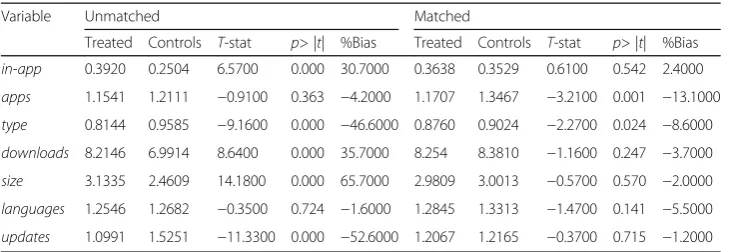
Next, we continue to test whether the data is well balanced. The results in Table 4
show that the bias degree of most variables decreases significantly. Additionally, the
p-value of most variables suggest that the matched samples do not reject the null
hy-pothesis that there are no significant differences between samples in the treatment group and control group.
Table 2The definition of variables
Variable group Variable Definition
Dependent variable total revenue The logarithmic form of monthly total revenue
Independent variable store =1 if the application is published on Apple’s App Store; =0 otherwise
Moderators in-app = 1 if the developer adopts in-app purchase strategy; =0 otherwise
HHI The Herfindahl-Hirschman Index multiplied by 10,000
Control variable apps The logarithmic form of the number of applications the same developer
has previously published
type =1 if the application is published by an enterprise developer; =0
otherwise
downloads The logarithmic form of monthly downloads
size The logarithmic form of app size in MB
languages The logarithmic form of the number of language versions of the application
updates The logarithmic form of the monthly number of accumulated updates
Table 3Nearest neighbor matching by caliper results
Variable Sample Treated Controls Difference S.E. T-stat
Total revenue Unmatched 2.327 3.932 −1.606 0.157 −10.23
ATT 2.187 4.390 −2.203 0.238 −9.27
ATU 4.189 1.474 −2.715
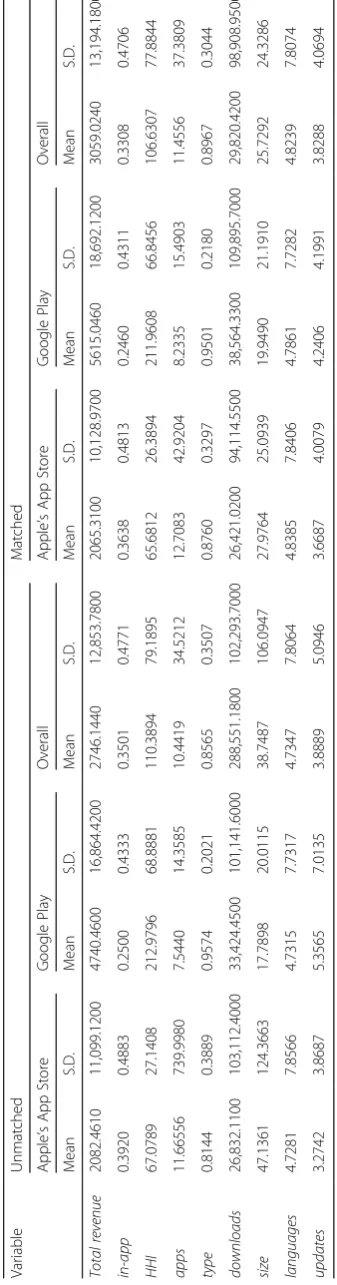
After matching the samples, we only lose 114 observations in the control group and 238 observations in the treatment group. More than 85% of the observations are kept in the dataset. The descriptive statistics of unmatched and matched samples on the two platforms are shown in Table5.
Table 6 reports the Pearson correlation matrix of the variables. The matrix shows
that there is weak correlation between any two variables apart fromHHIandstore. The market structure of platform complementors is likely driven by the technical architec-tures as expected.
Results
Main results
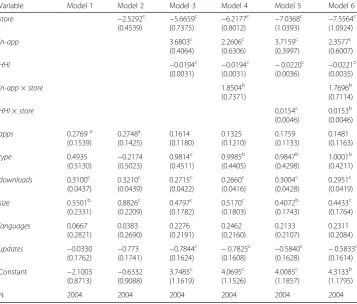
We conduct GLS regression on the matched samples. Table7 shows the results of the
hierarchical regression.
The results for the control variables are shown in Model 1. We find statistically sig-nificant effects of the experience, type, size, and updating speed of matched applica-tions on their performance.
To test Hypothesis 1, we establish Model 2 by adding the dummy variable store. The
results support Hypothesis 1. Compared to that complementors of free applications on
Google Play, the revenue earned by complementors on Apple’s App Store is lower by
252.9%. The results also show that product performance of complementors on strictly regulated platforms is indeed different from that on weakly regulated platforms. This is likely due to different business models implied by platform governance. After adding the two moderators in Model 3, we find that the in-app purchase strategy and the de-gree of product differentiation significantly influence the product performance of complementors.
To test Hypothesis 2, we establish Model 4 by adding the interaction term between the in-app purchase strategy and store dummy. We find a positive and significant effect
(p= 0.013), supporting Hypothesis 2. Given the strict developer selection process
guided by Apple’s App Store, the qualified free mobile applications on the platform can
attract highly valued end-users. The platform complementors on Apple’s App Store can
develop innovative and high-quality mobile applications to extract consumer surplus depending on the closed technology chain and technical architectures of the platform.
To test Hypothesis 3, we establish Model 5 by adding the interaction term between market concentration and store dummy. We also find a positive and significant effect
Table 4Effect of matching variables
Variable Unmatched Matched
Treated Controls T-stat p> |t| %Bias Treated Controls T-stat p> |t| %Bias
in-app 0.3920 0.2504 6.5700 0.000 30.7000 0.3638 0.3529 0.6100 0.542 2.4000
apps 1.1541 1.2111 −0.9100 0.363 −4.2000 1.1707 1.3467 −3.2100 0.001 −13.1000
type 0.8144 0.9585 −9.1600 0.000 −46.6000 0.8760 0.9024 −2.2700 0.024 −8.6000
downloads 8.2146 6.9914 8.6400 0.000 35.7000 8.254 8.3810 −1.1600 0.247 −3.7000
size 3.1335 2.4609 14.1800 0.000 65.7000 2.9809 3.0013 −0.5700 0.570 −2.0000
languages 1.2546 1.2682 −0.3500 0.724 −1.6000 1.2845 1.3313 −1.4700 0.141 −5.5000
(p= 0.000), supporting Hypothesis 3. The results demonstrate that application
devel-opers are capable of meeting consumers’ demands by engaging in diversified
competi-tion on Apple’s App Store. Application developers may develop a better self-control
system under strict governance and compete efficiently with rivals.
Moreover, we add all variables and interaction terms in Model 6 and find that all coefficients of independent variables and interaction terms are qualitatively consistent.
Table 6Correlation matrix
Variable (1) (2) (3) (4) (5) (6) (7) (8) (9)
(1)total revenue
(2)store −0.2519c (3)in-app 0.4468c 0.1124c
(4)HHI 0.0887c −0.8434c −0.0984c
(5)apps 0.1132c −0.0157 0.0072 0.0139
(6)type 0.0948c −0.1094c −0.1586c 0.0975c 0.0146
(7)downloads 0.3592c 0.0725c −0.0103 −0.2023c 0.0374a 0.1388c
(8)size 0.2012c 0.1884c 0.2721c −0.1725c −0.0374a 0.2042c 0.1798c
(9)languages 0.0984c 0.0156 −0.0399a −0.0134 0.1239c −0.012 0.2223c 0.107c (10)updates 0.2236c −0.1136c 0.0872c −0.0827c −0.1811c 0.0699c 0.4228c 0.341c 0.0438b
Notes.a
,b
,c
indicate statistical significance at the 10%, 5% and 1% levels, respectively (using a two-tailed test)
Table 7Platform governance and product performance of complementors
Variable Model 1 Model 2 Model 3 Model 4 Model 5 Model 6
store −2.5292c
(0.4539) − 5.6659c (0.7375) − 6.2177c (0.8012) − 7.0368c (1.0393) − 7.5564c (1.0924)
in-app 3.6803c
(0.4064) 2.2606c (0.6306) 3.7159c (0.3997) 2.3577c (0.6007)
HHI −0.0194c
(0.0031) − 0.0194c (0.0031) − 0.0220c (0.0036) − 0.0221c (0.0035)
in-app×store 1.8504b
(0.7371)
1.7696b
(0.7114)
HHI×store 0.0154c
(0.0046)
0.0153b
(0.0046)
apps 0.2769a
(0.1539) 0.2748a (0.1425) 0.1614 (0.1180) 0.1325 (0.1210) 0.1759 (0.1133) 0.1481 (0.1163) type 0.4935 (0.5130) − 0.2174 (0.5023) 0.9814c (0.4511) 0.9985b (0.4405) 0.9847b (0.4298) 1.0001b (0.4211)
downloads 0.3100c (0.0437) 0.3210c (0.0439) 0.2715c (0.0422) 0.2660c (0.0416) 0.3004c (0.0428) 0.2951c (0.0419)
size 0.5501b
(0.2331) 0.8826c (0.2209) 0.4797c (0.1782) 0.5170c (0.1803) 0.4072b (0.1743) 0.4433c (0.1764) languages 0.0667 (0.2821) 0.0383 (0.2690) 0.2276 (0.2191) 0.2462 (0.2160) 0.2133 (0.2107) 0.2311 (0.2084)
updates −0.0330
(0.1762) − 0.773 (0.1741) − 0.7844c (0.1624) − 0.7825c (0.1608) − 0.5840c (0.1628) − 0.5833c (0.1614)
Constant −2.1003
(0.8713) − 0.6332 (0.9088) 3.7485c (1.1619) 4.0695c (1.1526) 4.0085c (1.1857) 4.3133b (1.1795)
N 2004 2004 2004 2004 2004 2004
Notes.The values in brackets indicate the standard error of the estimated coefficient.a
,b
,c
Robustness tests
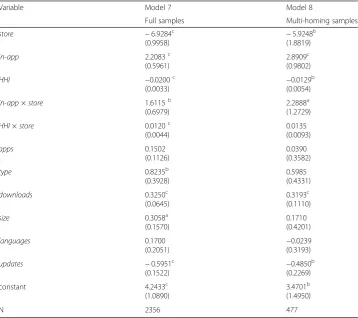
To assure our estimates are robust to any potential sampling bias, we use the unmatched full samples and multi-homing samples to run regressions. The unmatched full samples are likely to account for heterogeneous free mobile applications while the multi-homing samples consider the same free mobile applications in the two platforms. We can test whether plat-form governance will still exert different impacts on product perplat-formance of complementors in the two platforms. Even if only a small proportion of the developers published their appli-cations on the two platforms, we can compare the characteristics and performance of those applications on the two platforms. Table 8reports the results by conducting random effect regressions. The results are consistent with the results of Model 6 in Table7.
Discussion and conclusion
Using a dataset of mobile applications from Apple’s App Store and Google Play, we find that different platform governance strategies shape differentiated market structures and
complementors’product performance through direct/indirect network effects. Our study
leverages the perspective of platform ecosystems to analyze the interactions among plat-form enterprises, complementors and end-users within heterogeneous platplat-form ecosys-tems and their effects on complementors’product performance.
Table 8Robustness tests using unmatched samples
Variable Model 7 Model 8
Full samples Multi-homing samples
store −6.9284c
(0.9958) −
5.9248b
(1.8819)
in-app 2.2083c
(0.5961)
2.8909c
(0.9802)
HHI −0.0200c
(0.0033) −
0.0129b
(0.0054)
in-app×store 1.6115b (0.6979)
2.2888a
(1.2729)
HHI×store 0.0120c
(0.0044)
0.0135 (0.0093)
apps 0.1502
(0.1126)
0.0390 (0.3582)
type 0.8235b
(0.3928)
0.5985 (0.4331)
downloads 0.3250c
(0.0645)
0.3193c
(0.1110)
size 0.3058a
(0.1570)
0.1710 (0.4201)
languages 0.1700
(0.2051) −
0.0239 (0.3193)
updates −0.5951c
(0.1522) −
0.4850b
(0.2269)
constant 4.2433c
(1.0890)
3.4701b
(1.4950)
N 2356 477
Notes. The values in brackets indicate the standard error of the estimated coefficient.a
,b
,c
Theoretical implications
Our study contributes to research on platform ecosystems, platform governance, and complementors’ business strategies. First, our study of Apple’s App Store and Google Play shows that platform ecosystems based on differentiated technical architectures can align interdependent participants to exchange, co-create, and enhance value and enable them to consistently benefit from positive network externalities. The study integrates the perspective of network externalities based on two-sided market theory with the per-spective of platform ecosystems, and thus illustrates how network externalities and value co-creation drive the growth of the whole platform ecosystem.
Second, platform enterprises play an important role in the process of matching sup-ply with demand within the platform ecosystem through appropriate governance
strat-egies. Apple’s App Store, the proprietary platform, regulates the platform system
strictly and complementors are motivated to innovate and satisfy the needs of end-consumers by providing high-quality products/services. In contrast, Google Play, the open resource platform, regulates the platform system flexibly and complementors can enlarge the size of the installed base benefitting from cooperation with external traders (e.g., advertisement revenue). Thus, under an oligopolistic market structure, platform enterprises are expected to have effective governance strategies to guide complementor behavior and improve the competition efficiency within the ecosystem.
Third, platform heterogeneity arises from different governance strategies, which has significant implications for complementors in implementing different business
strat-egies. Our study shows that complementors on Apple’s App Store and Google Play
de-sign different business models to respond to platform governance strategies by leveraging direct/indirect network effects more efficiently. Embedded in the platform-mediated networks, complementors adopt differentiated business strategies to cooper-ate with external traders in line with consumer preferences to crecooper-ate more value and thus cultivate a benign cycle among all ecosystem participants.
Managerial implications
Our study also yields insights into business practices. As an important form of industry organization, platform enterprises are indispensable intermediaries in our daily lives. However, quality and safety issues emerge from the lack of effective platform governance (i.e., in Google Play). Platform enterprises should set feasible technology standards and entry barriers to promote diversified competition among complementors, which will also benefit the growth of the whole platform ecosystem. Effective platform governance forces platform complementors to focus on the latest technical developments and end-users’ de-mands and thus improve product quality. The complementors are therefore more capable of integrating and updating resources to compete efficiently with rivals.
Our study also has implications for different business models and complementors’
product performance on heterogeneous platforms. The business models of free digital products are heavily reliant upon the size of the installed base. The size effect of the
consumer group on Google Play is larger than that for Apple’s App Store. However,
consumers on Apple’s App Store are more willing to pay high prices for quality
prod-ucts/services because Apple’s App Store has established a unique brand reputation
intensive owing to high consumer surplus and high entry barriers on Apple’s App Store. Thus, complementors need to invest more in research and development to es-tablish customer loyalty on Apple’s App Store. Due to positive network externalities, complementor-leading innovations are likely to be beneficial for the whole platform ecosystem.
Limitations and future research
Our study entails several limitations to be addressed by further research. We classify technological industry platforms into two groups, weakly regulated platforms and strictly regulated platforms in line with open/closed operating systems. Although our study illustrates differentiated governance strategies on two heterogeneous platforms in this context, future research may explore more ways to investigate platform heterogen-eity by leveraging the perspective of platform ecosystems and assess the effectiveness of governance strategies in more complex contexts. Additionally, due to the availability of data, our sample is limited to one category, Health & Fitness, on Apple’s App Store and Google Play. In the future, samples from more categories of mobile applications or other digital platforms can be used to test the generalizability of our study.
Endnotes 1
The term“network externalities”mentioned in Armstrong (2006) and Rochet and Tirole (2006) is also widely expressed as“network effects”including direct network effects and in-direct network effects (cross-group network externalities) in later literature (e.g., Adner and Kapoor2010; Eisenmann et al.2006; Gawer and Henderson2007; Gawer2014etc.).
2
For example, individual developers and enterprise developers on Apple’s App Store
are charged $99 a year to publish their applications. All types developers on Google Play are charged $25, which is valid for life. In 2016, both platforms shifted their share of developers’total revenue from 30% to 15%.
3
See:“Gartner says mobile app stores will see annual downloads reach 102 billion in 2013”http://www.gartner.com/newsroom/id/2592315.
4
Two-part tariff is the mainstream pricing strategy of free digital products on technological platforms. End-users need not pay for getting access to the digital product while they have to pay when they want to use certain function embedded in the product (Oi1971). For ex-ample, video and audio websites such as NetEase Cloud Music and QQ Music offer free tri-als for music but audiences still need to pay when they want to download.
Acknowledgements
This study was funded by the National Natural Science Foundation of China (Grant No. 71873136).
Authors’contributions
JY conceived of the study, and participated in its design and coordination and helped to draft the manuscript. JH participated in the design of the study, performed the statistical analysis, and drafted the manuscript. LY participated in the design of the study and helped to draft the manuscript, All authors read and approved the final manuscript.
Funding
This study was funded by the National Natural Science Foundation of China (Grant No. 71873136).
Availability of data and materials
Please contact author for data requests.
Competing interests
Author details
1
Business School, Renmin University of China, Beijing 100872, China.2Institute of Urban Development, Nanjing Audit
University, Nanjing 211815, China.
Received: 25 October 2018 Accepted: 11 June 2019
References
Abadie, A., Drukker, D., Herr, J. L., & Imbens, G. W. (2004). Implementing matching estimators for average treatment effects in
Stata.The Stata Journal, 4(3), 290–311.
Adner, R., & Kapoor, R. (2010). Value creation in innovation ecosystems: How the structure of technological interdependence
affects firm performance in new technology generations.Strategic Management Journal, 31(3), 306–333.
Anderson, S. P., & Coate, S. (2005). Market provision of broadcasting: A welfare analysis.The Review of Economic Studies, 72(4),
947–972.
Armstrong, M. (2006). Competition in two-sided markets.The Rand Journal of Economics, 37(3), 668–691.
Askalidis, G. (2015).The impact of large scale promotions on the sales and ratings of mobile apps: Evidence from Apple’s app
store arXiv preprint arXiv:1506.06857.
Benlian, A., Hilkert, D., & Hess, T. (2015). How open is this platform? The meaning and measurement of platform openness
from the complementors’perspective.Journal of Information Technology, 30(3), 209–228.
Bhargava, H. K., & Choudhary, V. (2008). Research note—When is versioning optimal for information goods?Management
Science, 54(5), 1029–1035.
Boudreau, K. J. (2010). Open platform strategies and innovation: Granting access vs. devolving control.Management Science,
56(10), 1849–1872.
Boudreau, K. J., & Jeppesen, L. B. (2015). Unpaid crowd complementors: The platform network effect mirage.Strategic
Management Journal, 36(12), 1761–1777.
Caillaud, B., & Jullien, B. (2003). Chicken & egg: competition among intermediation service providers.RAND Journal of
Economics, 34(2), 309–328.
Carare, O. (2012). The impact of bestseller rank on demand: evidence from the app market.International Economic Review,
53(3), 717–742.
Ceccagnoli, M., Forman, C., Huang, P., & Wu, D. J. (2012). Cocreation of value in a platform ecosystem! The case of enterprise
software.MIS Quarterly, 36(1), 263–290.
Cennamo, C., & Santalo, J. (2013). Platform competition: strategic trade-offs in platform markets.Strategic Management
Journal, 34(11), 1331–1350.
Cheng, H. K., & Liu, Y. (2012). Optimal software free trial strategy: The impact of network externalities and consumer
uncertainty.Information Systems Research, 23(2), 488–504.
Economides, N., & Katsamakas, E. (2006). Two-sided competition of proprietary vs. open source technology platforms and the
implications for the software industry.Management Science, 52(7), 1057–1071.
Eisenmann, T., Parker, G., & van Alstyne, M. W. (2006). Strategies for Two Sided Markets.Harvard Business Review,84(10), 92–101.
Eisenmann, T., Parker, G., & van Alstyne, M. W. (2011). Platform envelopment.Strategic Management Journal, 32(12), 1270–1285.
Feng, H., & Chen, Y. Q. (2016). Research on platform business model innovation-based on a time-spatial correspond analysis
under internet environment.China Industrial Economics, 16(3), 99–113.
Garg, R., & Telang, R. (2013). Inferring app demand from publicly available data.MIS Quarterly, 37(4), 1253–1264.
Gawer, A. (2014). Bridging differing perspectives on technological platforms: Toward an integrative framework.Research
Policy, 43(7), 1239–1249.
Gawer, A., & Cusumano, M. A. (2014). Industry platforms and ecosystem innovation.Journal of Product Innovation
Management, 31(3), 417–433.
Gawer, A., & Henderson, R. (2007). Platform owner entry and innovation in complementary markets: Evidence from Intel.
Journal of Economics & Management Strategy, 16(1), 1–34.
Ghazawneh, A., & Henfridsson, O. (2013). Balancing platform control and external contribution in third-party development:
The boundary resources model.Information Systems Journal, 23(2), 173–192.
Ghose, A., & Han, S. P. (2014). Estimating demand for mobile applications in the new economy.Management Science, 60(6),
1470–1488.
Hagiu, A. (2006). Pricing and commitment by two-sided platforms.The Rand Journal of Economics, 37(3), 720–737.
Hagiu, A., & Spulber, D. (2013). First-party content and coordination in two–sided markets.Management Science, 59(4), 933–949.
Hirano, K., & Imbens, G. W. (2004). The propensity score with continuous treatments. In Applied Bayesian modeling and causal
inference from incomplete-data perspectives: An essential journey with Donald Rubin’s statistical familyNo. 226164. Kapoor, R., & Agarwal, S. (2017). Sustaining superior performance in business ecosystems: evidence from application software
developers in the iOS and android smartphone ecosystems.Organization Science, 28(3), 531–551.
Kapoor, R., & Lee, J. M. (2013). Coordinating and competing in ecosystems: How organizational forms shape new technology
investments.Strategic Management Journal, 34(3), 274–296.
Katz, M. L., & Shapiro, C. (1985). Network externalities, competition, and compatibility.American Economic Review, 75(3),
424–440.
Kazan, E., Tan, C. W., Lim, E. T., Sørensen, C., & Damsgaard, J. (2018). Disentangling digital platform competition: The case of
UK mobile payment platforms.Journal of Management Information Systems, 35(1), 180–219.
Li, M., Goh, K. Y., & Cavusoglu, H. (2013). Mobile app portfolio management and developers’performance: An empirical study
of the apple iOS platform.Agribusiness, 27(27), 360–378.
McIntyre, D. P., & Srinivasan, A. (2017). Networks, platforms, and strategy: Emerging views and next steps.Strategic
Management Journal, 38(1), 141–160.
Min, H. R., Kim, J., & Kim, S. (2014). Factors affecting application developers’loyalty to mobile platforms.Computers in Human
Nambisan, S. (2013). Information technology and product/service innovation: A brief assessment and some suggestions for
future research.Journal of the Association for Information Systems, 14(4), 215–226.
Nelson, R. R., & Winter, S. G. (1982).An evolutionary theory of economic change. Cambridge: The Belknap Press of Harvard
University.
Oi, W. Y. (1971). A Disneyland dilemma: Two-part tariffs for a Mickey mouse monopoly.The Quarterly Journal of Economics, 85,
77–96.
Parker, G. G., & van Alstyne, M. W. (2005). Two-sided network effects: A theory of information product design.Management
Science, 51(10), 1494–1504.
Parker, G. G., van Alstyne, M. W., & Choudary, S. P. (2016).Platform revolution. New York, NY: W.W. Norton.
Rochet, J. C., & Tirole, J. (2003). Platform competition in two-sided markets.Journal of the European Economic Association, 1(4),
990–1029.
Rochet, J. C., & Tirole, J. (2006). Two-sided markets: A progress report.The Rand Journal of Economics, 37(3), 645–667.
Roma, P., Zambuto, F., & Perrone, G. (2016). The role of the distribution platform in price formation of paid apps.Decision
Support Systems, 91, 13–24.
Rosenbaum, P. R., & Rubin, D. B. (1985). Constructing a control group using multivariate matched sampling methods that
incorporate the propensity score.The American Statistician, 39(1), 33–38.
Sheth, J. N., Newman, B. I., & Gross, B. L. (1991). Why we buy what we buy: A theory of consumption values.Journal of
Business Research, 22(2), 159–170.
Tiwana, A. (2013).Platform ecosystems: Aligning architecture, governance, and strategy. Waltham, MA: Elsevier.
Tiwana, A., Konsynski, B., & Bush, A. A. (2010). Research commentary—Platform evolution: Coevolution of platform
architecture, governance, and environmental dynamics.Information Systems Research, 21(4), 675–687.
van Alstyne, M. W., Parker, G. G., & Choudary, S. P. (2016). Pipelines, platforms, and the new rules of strategy.Harvard Business
Review, 94(4), 54–62.
Vinson, D. E., Scott, J. E., & Lamont, L. M. (1977). The role of personal values in marketing and consumer behavior.The Journal
of Marketing, 41(2), 44–50.
West, J. (2003). How open is open enough?: Melding proprietary and open source platform strategies.Research Policy, 32(7),
1259–1285.
Weyl, E. G. (2010). A price theory of multi-sided platforms.American Economic Review, 100(4), 1642–1672.
Winter, S. G., Kaniovski, Y. M., & Dosi, G. (2003). A baseline model of industry evolution.Journal of Evolutionary Economics,
13(4), 355–383.
Yonatany, M. (2017). Platforms, ecosystems, and the internationalization of highly digitized organizations.Journal of
Organization Design, 6(1), 1–5. Publisher’s Note