Statistical independence for the evaluation of classifier-based
diagnosis
Emanuele Olivetti•Susanne Greiner• Paolo Avesani
Received: 31 May 2014 / Accepted: 19 November 2014 / Published online: 11 December 2014 ÓThe Author(s) 2014. This article is published with open access at Springerlink.com
Abstract Machine learning techniques are increasingly adopted in computer-aided diagnosis. Evaluation methods for classification results that are based on the study of one or more metrics can be unable to distinguish between cases in which the classifier is discriminating the classes from cases in which it is not. In the binary setting, such cir-cumstances can be encountered when data are unbalanced with respect to the diagnostic groups. Having more healthy controls than pathological subjects, datasets meant for diagnosis frequently show a certain degree of unbalanc-edness. In this work, we propose to recast the evaluation of classification results as a test of statistical independence between the predicted and the actual diagnostic groups. We address the problem within the Bayesian hypothesis testing framework. Different from the standard metrics, the pro-posed method is able to handle unbalanced data and takes into account the size of the available data. We show experimental evidence of the efficacy of the approach both on simulated data and on real data about the diagnosis of the Attention Deficit Hyperactivity Disorder (ADHD).
1 Introduction
Classification-based machine learning techniques are increasingly adopted in computer-aided diagnosis because they have limited need for a pathophysiological model of the disease under investigation. The efficacy of such model-free approaches depends on many factors, like the size of the available training sample. A bigger sample size allows for the training of a more robust classifier and might improve the prediction accuracy (PA) on the test set. However, even an enormous amount of data does not guarantee the correct diagnosis of a disease via classifier.
Once a suitable classification algorithm has been trained, its efficacy has to be assessed by predicting the diagnostic groups of subjects in a test set and comparing them against the true values. It is common practice to calculate one or more metrics such as the PA, F1-Score, Matthews Correlation Coefficient,j-statistic [6,11,12] or AUC/ROC [3,13] to decide whether the classifier is able to discriminate between healthy controls and one or more stages/types of the pathology of interest. Each of those metrics has different strengths and drawbacks. For exam-ple, PA is not able to properly handle datasets where the number of available examples per class is not equal, a setting referred to as unbalanced. More importantly, common metrics for evaluating classifiers do not depend on the actual test set size, i.e. they do not measure the amount of evidence the results of prediction provide.
Through an example, we illustrate how a metric, in this case the PA, can be influenced by the characteristics of the dataset, e.g. unbalancedness. Given a test set of 100 sub-jects where 90 are healthy controls (H) and 10 are patients (P), a classifier that obtains 90 % of PA could be either highly accurate in discriminating the two classes, and therefore diagnosing the disease, or not able at all. These E. OlivettiS. GreinerP. Avesani (&)
NeuroInformatics Laboratory (NILab), Fondazione Bruno Kessler, Trento, Italy
e-mail: [email protected] E. Olivetti
e-mail: [email protected] S. Greiner
e-mail: [email protected]
E. OlivettiS. GreinerP. Avesani
Centro Interdipartimentale Mente e Cervello (CIMeC), Universita` di Trento, Trento, Italy
two extreme cases are illustrated in Fig.1 by means of their confusion matrices.A confusion matrix reports the joint results of the predicted and the true diagnostic groups. The table on the left shows a classifier that always predicts the most frequent diagnostic group, i.e classH, which is a typical issue of classifiers that are not able to discriminate the two classes. The table on the right shows a classifier that correctly discriminates the two diagnostic groups and incurs in only 10 errors over 90 examples in the most frequent classH.
The confusion matrix is a convenient way to represent results of a classifier because all the metrics used to eval-uate classifiers can be computed from it. In the same way, the method that we propose in this work is based on the analysis of the confusion matrix. Specifically, we propose to quantify the evidence between two alternative hypoth-eses about the underlying generation mechanism of the observed confusion matrix. The first hypothesis is that the predicted class labels are statisticallyindependentfrom the true class labels. This is the case were the classifier is not able to discriminate the classes. The second hypothesis is that the predicted class labels are statisticallydependenton the true class labels. In this case, the classifier predicted according to the true class labels. The degree of evidence in favour of one hypothesis or of the other is the measure that we propose for evaluating the classifier.
In order to implement the proposed method, we draw from the statistics literature and adopt a recent Bayesian test of independence for contingency tables [2], which was proposed in a context different from that of classification. The proposed method is able to handle imbalancedness, takes the sample size of the test set into account and pro-vides the correct answer in cases in which standard metrics are misleading. Furthermore, this kind of approach can be extended to the multi-class setting, while traditional eval-uation methods are often tailored and limited to the binary setting. We defer the presentation of the multi-class case to future work.
In the following, we describe the standard classification task for diagnosis in medical image analysis and define where the problem concerning result evaluation lies. Sub-sequently, we introduce the Bayesian test of independence and show its efficacy on a simulated toy example and on
real data concerning the computer-aided diagnosis of the attention deficit hyperactivity disorder (ADHD).
2 Methods
The first part of this section formally defines the notation and framework of classification-based diagnosis. The sec-ond part introduces the Bayesian hypothesis testing framework and the proposed solution to the problem of evaluating the classification result.
2.1 Classification-based diagnosis
Let X ¼Rd be the multidimensional feature space under
investigation, e.g. medical image data, and let Y ¼ f1;. . .;cgbe the set of classes that represents the possible values of the variable of interest.
Each training example is then a vector X2 X, e.g. the data from one subject of the study, with class labelY 2 Y, e.g. the subject’s pathology. LetPXY be the unknown joint
distribution overX Y. We are given a previously trained classifier f :X ! Y that predicts the variable of interest given the data about which the performance is to be determined. We call¼EXY½fðXÞ 6¼Ythe generalization
error off.
In practical cases, the test set is of finite sizem, therefore we do not know the actual joint distributionPXY andcan
only be estimated. Let S¼ fðx1;y1Þ;. . .;ðxm;ymÞg be the
test set which is assumed to be an i.i.d. set of observations, i.e. examples, drawn fromPXY. The standard estimator of
is ^¼e
m; where e is the total number of misclassified
examples.
The set of true class labels and predicted class labels can be summarized by the confusion matrix Z, which is a contingency table (see Fig.1) that reports the number of occurrenceszijof each possible pair of outcomes. The sum
P
zij¼mequals the test set size and the diagonal contains
all correctly classified examples Pizii¼me. The
esti-mated PA is defined as PA¼me
m ¼1^.
For the binary case, the two values on the diagonal ofZ are defined as true positive (TP) and true negative (TN), respectively, and Type I error as false positive (FP) as well as Type II error as false negative (FN). The sensitivity or true positive rate TPR, the false positive rate (FPR) and specificity (SPC) are defined as
TPR¼ TP
TPþFN FPR¼ FP FPþTN
SPC¼ TN
FPþTN ð1Þ
and the Matthews correlation coefficient (MCC), the F 1-score [11,12] and the j-Statistic [6] as
prediction
H P
true diagnosisH 90 0
P 10 0
prediction
H P
true diagnosisH 80 10
P 0 10
Fig. 1 Two simulated examples of confusion matrices, true class labels on the rows and predicted class labels on the columns. Both confusion matrices have the same prediction accuracy (PA), i.e.
PA¼1^¼0þ90
100 ¼80100þ10¼90%. Nevertheless, in the first case,
MCC¼ ffiffiffiffiffiffiffiffiffiffiffiffiffiffiffiffiffiffiffiffiffiffiffiffiffiffiffiffiffiffiffiffiffiffiffiffiffiffiffiffiffiffiffiffiffiffiffiffiffiffiffiffiffiffiffiffiffiffiffiffiffiffiffiffiffiffiffiffiffiffiffiffiffiffiffiffiffiffiffiffiffiffiffiffiffiffiffiTPTNFPFN ðTPþFPÞðTPþFNÞðTNþFPÞðTNþFNÞ p
ð2Þ
F1¼2 TP
2TPþFPþFN ð3Þ
j¼PArPA
1rPA ; ð4Þ
where
rPA¼ðTNþFPÞðTNþFNÞ þ ðFNþTPÞðFPþTPÞ
m2 :
The receiver operating characteristic (ROC) analysis is the study of the curve ofFPRversusTPRwhile a sensitivity or threshold parameter is varied [3]. In our case, classification has already been performed, meaning that there is no such parameter variation and the ratio between both rates is fixed. Nonetheless, the intercept of the ROC point with the line at 90 degrees to the no-discrimination line, also known as Youden’sJ statistic [13], can be used as a measure for the evaluation of performance:
J¼TPRþSPC1: ð5Þ
2.2 Evaluation by the Bayesian test of independence
As noted in [8], when data are unbalanced with respect to the class-label distribution, the PA (or the misclassification error rate) of a classifier can be a misleading statistic to assess whether the classifier actually discriminated the classes or not. An alternative solution to the issue of evaluating classifiers through the error rate/accuracy is testing the full confusion matrix.
The literature answering the question ‘‘did the classifier learn to discriminate the classes?’’ was recently reviewed in [8], and a novel approach based on the analysis of the statistical independence between predicted and true class labels was proposed based on the work of [2]. In this work we adopt a similar approach that we summarise here. The intuitive idea is that, following the definition of statistical independence between random variables, in the case of a classifier predicting at random, the predicted class labels are statistically independent of the true class labels. Con-versely, the more the predictions match the true class labels, the stronger is the statistical dependence between them. We propose the use of the Bayesian test of inde-pendence in contingency tables described in [2] to compute the ratio of the posterior probabilities of the following two hypotheses:
– H0: the predictions are statisticallyindependent of the true class labels.
– H1: the predictions are statistically dependent on the true class labels.
According to the Bayesian hypothesis testing framework [5], the comparison of two hypotheses can be quantified by the ratio of their posterior probabilities. That ratio can be rewritten as
PðH1jZÞ
PðH0jZÞ
¼PðH1Þ PðH0Þ
PðZjH1Þ
PðZjH0Þ
¼PðH1Þ PðH0Þ
B10; ð6Þ
whereB10is calledBayes factorand measures the evidence of the data in favour of H1 with respect to H0. When
B10o1 the evidence is in favour of H1 against H0. Guidelines for the interpretation of the strength of evidence are presented in [5] and reported here in Table1.
In order to computeB10for the hypotheses of interest of this work, it is necessary to define a sampling model for the confusion matrix Z under each hypothesis. Notice that while evaluating the classification results, the total number of examples per class in the test set can be assumed as known. This assumption is usually known as one margin fixed and it means that the row marginals ofZare known and then that the sampling model for each row of the confusion matrix is Binðzijni;piÞ, whereziis one of the two
values of the i-th row (the other being nizi), ni is the
knowni-th row marginal andpithe unknown probability of
predicting that class when the true class isi.
The sampling model under H0 is that p1 and p2 are identical and drawn from one distribution, while, under H1;p1 and p2 are drawn independently from their own distributions. The exact form of these distributions, called prior distributionspðp1;p2jHiÞ, is a matter of debate and,
in this work, we follow a recent result presented in [2] which is based on the use of a standard prior for
pðp1;p2jH0Þand theintrinsic prior[1] forpðp1;p2jH1Þ. In this context, the idea of the intrinsic prior is that
pðp1;p2jH1Þ should concentrate its mass around pðp1;p2jH0Þ to ensure that the inference process distin-guishes between H0 and close alternatives and gives less weight to extremely unlikely models. In [2], the degree of concentration is parametrised by the non-negative integer parameterst1andt2, one for each row. From the definition of intrinsic prior and considering a uniform standard prior for H0, i.e pðp1¼p;p2¼pjH0Þ ¼Uð0;1ÞðpÞ, we get [2]:
Table 1 Guidelines for the interpretation of the logarithm of the Bayes factorlogðB10Þin terms of the strength of evidence in favour of H1 and againstH0, from [5]
logðB10Þ \0 0 to 1 1 to 3 3 to 5 [5
pðp1;p2jt1;t2Þ ¼ Xt1
i¼0 Xt2
j¼0
t1
i t2
j
Cðiþjþ1ÞCðt1þt2ijþ1Þ
Cðt1þt2þ2Þ Betaðp1jiþ1;t1iþ1Þ
Betaðp2jjþ1;t2jþ1Þ
ð7Þ
Then, the Bayes factor B10 measuring the ratio of the evidence ofH1 againstH0 is
B10ðz1;z2;t1;t2Þ ¼ R
Pðz1;z2jp1;p2;H1Þpðp1;p2jH1Þdp1dp2 R
Pðz1;z2jp1;p2;H0Þpðp1;p2jH0Þdp1dp2
¼ n1þn2þ1 ðn1þt1þ1Þðn2þt2þ1Þ
ð
t1þ1Þðt2þ1Þ t1þt2þ1
n1þn2
z1þz2
Xt1
i¼0 Xt2
j¼0 t1
i 2 t2
j
2
t1þt2 iþj
n1þt1 z1þi
n2þt2 z2þj
:
ð8Þ
The detailed derivation can be found in [2]. Notice that B10ðz1;z2;t1;t2Þis parametric int1andt2, which means that different degrees of concentration of pðp1;p2jH1Þ around pðp1;p2jH0Þ will lead to a different amount of evidence supportingH1 againstH0. In [2], it is claimed that robust inference can be obtained only whenB10ðz1;z2;t1;t2Þis stable w.r.t. variations oft1andt2. Here we propose a conservative approach and define B10ðz1;z2Þ ¼mint1;t22f0...mgB10ðz1;z2;
t1;t2Þ. This means that when stability is an issue, we may not be able to claim that the classifier is able to discriminate among the classes.
In [2], it is shown how to extend Eq.8to the multi-class case, which we do not present here.
3 Materials: the ADHD dataset
Our study refers to the ADHD-200 Initiative and dataset which is dedicated to support the scientific community in studying and understanding the neural basis of ADHD. The aim of the initiative is also meant to support the clinical community with the advance of objective tools for computer-aided diagnosis. Eight institutions collected neuroimaging datasets from almost one thousand young subjects (age 7–26) with and without ADHD. For each subject, multiple types of data were collected: phe-notypic data, structural (T1) magnetic resonance imaging (MRI) data and functional MRI (fMRI) resting-state data. Accompanying phenotypic information included: age, gender, handedness and IQ measure. The ADHD-200 dataset is publicly available and freely distributed with
the support of the International Neuroimaging Data-shar-ing Initiative.1
Even though the ADHD-200 dataset comprised three different levels of the ADHD disorder and the healthy controls, in this work, we restrict our analysis to the dis-crimination between two diagnostic categories, i.e. healthy controls and ADHD patients, by aggregating patients into one class. In the following, we refer to the whole dataset comprising the data of 1339 recordings from 923 subjects, where the diagnostic classes are distributed as follows: 62 % typically developing control and 38 % ADHD. For a few subjects, data were only partially available or cor-rupted. These subjects were excluded from our study.
In this work, we analyse the confusion matrices pre-sented in [7]. We report a brief summary of the prepro-cessing and classification steps because a detailed presentation is beyond the scope of this paper and it can be found in [7]. The preprocessed data were retrieved from the NeuroBureau initiative2and specifically from the Athena and Bruner pipelines managed by C. Craddock and C. Chu. Both structural (T1) volumes and statistical volume from fMRI resting-state recordings were transformed into vec-tors through the dissimilarity representation [9]. The clas-sification algorithm adopted was theextremely randomized tree [4] with different cross-validation schemes.
In Sect.4,we use the confusion matrices obtained in [7] from phenotypic data (denoted as PHEN) and fMRI rest-ing-state data preprocessed according to the spatial multi-ple regression proposed in [10] (denoted as SMR0-9).
4 Experiments
We compared the efficacy of the proposed test of inde-pendence against multiple standard metrics introduced in Sect.2. Experiments were conducted on data from a sim-ulated toy example and on real data concerning the com-puter-aided diagnosis of ADHD brain disease. The code of the experiments is freely available fromhttps://github.com/ FBK-NILab/brin2014.
4.1 Simulated toy example
We expand the example introduced in Fig.1 in order to clearly explain the differences between the proposed method and the standard metrics frequently used when evaluating classification results. In Table2, we report the estimated PA, the Matthew correlation coefficient (MCC), the F1-score, thej-statistic (j) and Youden’sJ-statistic (J) together with the proposed logðB10Þfor both the extreme
cases introduced in Sect.1 and two additional cases. The first of them refers to perfect prediction of all available examples and the second one to random prediction without considering the prior distribution of the diagnostic groups. In Table3, we report the results from confusion matrices analogous to those in Table2, but with exactly 1/5 of the examples. This second table aims at showing that only the proposed method is able to quantify the evidence in the data taking into account the test set size.
In Table2, we observed that perfect prediction, i.e. (c), produces the highest scores for all the metrics considered, i.e. 1.0. The score of the proposed method, i.e. logðB10Þ ¼19:61, meansdecisive evidencein favour ofH1, according to the interpretation guidelines in Table1. So it agrees with all other metrics. The case of perfectly random prediction irrespective of the prior distribution, i.e. (d), is again correctly detected by all methods by scoring 0:0, with the exception of the F1 score. The score of the
proposed method, i.e. logðB10Þ ¼ 0:94, is negative evi-dence for H1 3 in agreement with most of the standard metrics.
The comparison of the cases (a) and (b) of Table2 shows that prediction accuracy (PA) andF1 score are not reliable for unbalanced datasets. The related confusion matrices represent opposite situations but those scores do not significantly change. For the confusion matrices in (a), the Matthews Correlation Coefficient (MCC) and Youden’s J score are undefined and only the j-statistic correctly detects the difference between (a) and (b). In agreement with the j-statistic, the proposed method reports negative evidence forH1 for case (a) anddecisiveevidence for H0 for case (b).4
Table 2 Confusion matrices on a test set of 100 examples, logðB10Þ,
prediction accuracy (PA), Matthews Correlation Coefficient (MCC), F1-Score (F1), j-Statistic and Youden’s statistic (J) for different
settings. (a) always predicting the dominant class, (b) errors only in the dominant class, (c) perfect prediction, (d) random prediction
a)
H P
H
90 0
P
10 0
log(
B
10)
-2.29
P A
0.90
MCC
n.d.
F
1
0.95
κ
0.00
J
n.d.
b)
H P
H
80 10
P
0 10
log(
B
10)
10.67
P A
0.90
MCC
0.67
F
1
0.94
κ
0.62
J
0.50
c)
H P
H
90 0
P
0 10
log(
B
10)
19.61
P A
1.00
MCC
1.00
F
1
1.00
κ
1.00
J
1.00
d)
H P
H
45 45
P
5 5
log(
B
10)
-0.94
P A
0.50
MCC
0.00
F
1
0.64
κ
0.00
J
0.00
Table 3 Confusion matrices on a test set of 20 examples obtained by dividing the values of the confusion matrices in Table2by a factor of 5. Accordingly, logðB10Þ, prediction accuracy (PA), Matthews
Correlation Coefficient (MCC), F1-Score (F1), j-Statistic and Youden’s statistic (J) are reported
a)
H P
H
18 0
P
2 0
log(
B
10)
-0.99
P A
0.90
MCC
n.d.
F
1
0.95
κ
0.00
J
n.d.
b)
H P
H
16 2
P
0 2
log(
B
10)
1.84
P A
0.90
MCC
0.67
F
1
0.94
κ
0.62
J
0.50
c)
H P
H
18 0
P
0 5
log(
B
10)
3.37
P A
1.00
MCC
1.00
F
1
1.00
κ
1.00
J
1.00
d)
H P
H
9 9
P
1 1
log(
B
10)
-0.35
P A
0.50
MCC
0.00
F
1
0.64
κ
0.00
J
0.00
3 SinceB
01¼B110, this corresponds topositiveevidence forH0. 4 Those correspond topositive(a) andnegative(b) evidence forH
In Table3the confusion matrices represent the same sit-uations of those in Table2 but with a reduced number of examples. This means that their interpretation in terms of scores must go in the same direction but the amount of evi-dence provided in Table3is much lower than that of Table2 and the evaluation has to take that into account. In other words, we cannot draw the same conclusions from a test set of 20 examples with respect to a test set of 100 examples and this should be represented in the scores. As it can be seen from the comparison of the scores in Table3with respect to those in Table2, all the standard metrics provide the same exact scores despite having 1=5 of the data. Different from them, the proposed method shows a great reduction in value, correctly reflecting the reduced size of the test set. For example, in case (b), the amount of evidence in favour ofH1 isdecisivein Table2(logB10¼10:67) but only worthy of abare mention in Table3(logB10¼1:84).
4.2 Real-data application
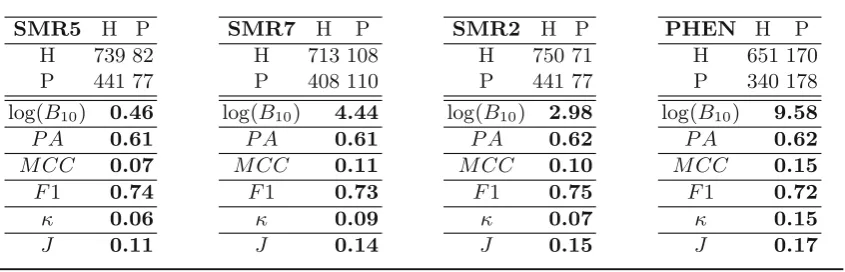
A standard 10-fold stratified cross-validation scheme was used to create the aggregated confusion matrices associated to the dataset described in Sect.3. Table 4 presents them (SMR5, SMR7, SMR2 and PHEN) together with logðB10Þ of H1 overH0, estimated accuracy, and the other metrics introduced in Sect.2. Each aggregated confusion matrix was computed as the sum of the confusion matrices of each cross-validation fold. The accuracies obtained for all single source dataset varied between 60 and 66 %. We focused on four cases that had a significantly different Bayes factor, but marginal differences in prediction accuracy.
The results shown in Table4 about SMR5 and SMR7 have prediction accuracy of 61 % in both cases. The analysis of the confusion matrix by means of the test of independence reveals that SMR5 does not provide relevant information about ADHD diagnosis, while SMR7 provides strong
evidence in support ofH1. The predictions in the latter case are therefore statistically dependent on the true class labels and a positive answer to the question, whether the classifier learned to discriminate the classes, can be given. Notice that MCC;j andJ show little increase from SMR5 to SMR7, making it difficult to detect such difference.
A substantially similar result can be obtained on SMR2 vs. PHEN, in Table4. The prediction accuracy is again at the same level in both cases: while the SMR2 is found to obtain positive evidence, PHEN has a logðB10Þ ¼9:58, which is
decisive evidence for statistical dependence between pre-dicted and true class labels. Other standard metrics, i.e. MCC;jandJ, shows a small increase in value but the absence of interpretation guidelines, as those in Table1, makes it difficult to understand the practical meaning of those changes. Furthermore, the comparison of SMR7 vs. SMR2 shows another example for how the prediction accuracy may be misleading. The former has the lower prediction accuracy, but strong evidence (logðB10Þ ¼4:44) that the classifier might have learned to discriminate the classes, while the latter has a slightly higher prediction accuracy, but only positiveevidence (logðB10Þ ¼2:98).
As a general comment, the ranking of relevance for diag-nosis of the four different data sources is in agreement when considering the proposed method based on Bayesian inference and the Matthews correlation coefficient or thej-statistic. The main difference is that the result of the proposed method has a direct interpretation in terms of evidence, while the signifi-cance of the differences in the values of the standard metrics across the confusion matrices remains to be determined.
5 Discussion
In this work, we propose a novel method for the evaluation of classification results that overcome the limitations of Table 4 Confusion matrices and the related values of logðBF10Þand
of different standard metrics for ADHD classification. The confusion matrices considered here are from phenotypic data (PHEN) and from the spatial multiple regression of fMRI resting state (SMR2, SMR5,
SMR7). See Sect.3 and [7] for additional details. The standard metrics are the prediction accuracy (PA), Matthews correlation coefficient (MCC), F1-Score (F1), j-Statistic and the Youden’s statistic (J)
SMR5 H P
H 739 82
P 441 77
log(B10) 0.46 P A 0.61 MCC 0.07 F1 0.74 κ 0.06 J 0.11
SMR7 H P
H 713 108
P 408 110
log(B10) 4.44 P A 0.61 MCC 0.11 F1 0.73 κ 0.09 J 0.14
SMR2 H P
H 750 71
P 441 77
log(B10) 2.98 P A 0.62 MCC 0.10 F1 0.75 κ 0.07 J 0.15
PHEN H P
H 651 170
P 340 178
commonly adopted metrics. The proposed method is based on the Bayesian inference framework and provides a measure of evidence in the data that can be easily inter-preted by means of standard guidelines. This differs from standard metrics where guidelines for interpretation are not available due to the lack of a statistical foundation.
Additionally, in Sect.4.1, we show that the proposed method agrees with standard metrics in many cases. But it is the only one able to provide the correct answer in more extreme cases, where standard metrics are either undefined or misleading.
In Sect.4.2, on real data, we show that the proposed method distinguishes between data sources that are of importance for the discrimination between the diagnostic groups of ADHD from those who are not. This is some-times in contrast with prediction accuracy that may lead to incorrect conclusions (see SMR7 vs SMR2).
The accurate detection of data sources which are irrel-evant to diagnosis can lead to their exclusion from diag-nosis protocols and therefore to improve the cost-benefit trade-off. The proposed Bayesian test of independence is an effective tool for such task.
Acknowledgments The authors are grateful to the ADHD-200 Initiative for providing the ADHD-200 data and setting up the Global Competition. We would like to thank the NeuroBureau Initiative for providing the preprocessed version of the ADHD-200 data and spe-cifically Cameron Craddock for the Athena pipeline and Carlton Chu for the Burner pipeline.
Open Access This article is distributed under the terms of the Creative Commons Attribution License which permits any use, dis-tribution, and reproduction in any medium, provided the original author(s) and the source are credited.
References
1. Berger JO, Pericchi LR (1996) The intrinsic Bayes factor for model selection and prediction. J Am Stat Assoc 91(433):109–122 2. Casella George, Moreno Elias (2009) Assessing robustness of
intrinsic tests of independence in two-way contingency tables. J Am Stat Assoc 104(487):1261–1271
3. Fawcett T (2006) An introduction to ROC analysis. Pattern Recognit Lett 27(8):861–874
4. Geurts P, Ernst D, Wehenkel L (2006) Extremely randomized trees. Mach Learn 63(1):3–42
5. Kass RE, Raftery AE (1995) Bayes factors. J Am Stat Assoc 90(430):773–795
6. Landis RJ, Koch GG (1977) The measurement of observer agreement for categorical data. Biometrics 33(1):159–174 7. Olivetti E, Greiner S, Avesani P (2012) ADHD diagnosis from
multiple data sources with batch effects. Front Neurosci 6 (70) 8. Olivetti E, Greiner S, Avesani P (2012) Induction in neuroscience
with classification: issues and solutions. Springer, Berlin (Lecture Notes in Compuer Science)
9. Pekalska E, Paclik P (2002) A generalized kernel approach to dissimilarity-based classification. J Mach Learn Res 2:175–211 10. Smith SM, Fox PT, Miller KL, Glahn DC, Fox MM, Mackay CE,
Filippini N, Watkins KE, Toro R, Laird AR, Beckmann CF (2009) Correspondence of the brain’s functional architecture during acti-vation and rest. Proc Natl Acad Sci USA 106(31):13040–13045 11. Okeh UM, Okoro CN (2012) Evaluating measures of indicators
of diagnostic test performance: fundamental meanings and formulars. J Biom Biostat 3(1):2
12. Van Rijsbergen CJ (1979) Information retrieval, vol 30. Butter-worths, London
13. Youden WJ (1950) Index for rating diagnostic tests. Cancer 3(1):32–35
Emanuele Olivettireceived his master’s degree in physics and his Ph.D. in computer science from the University of Trento, Italy. He is a researcher at the Bruno Kessler Foundation since 2008, working on machine learning for neuroimaging experiments jointly with the Center for Mind and Brain Sciences (CIMeC) within the University of Trento. His research interests lie at the intersection of machine learning and statistics and include decoding of brain signals, learning algorithms for diffusion MRI data and Bayesian inference.
Susanne Greinerreceived her master’s degree in physics from the Friedrich Alexander University of Erlangen, Germany and her Ph.D. in computer science from the University of Trento, Italy. She is working on machine learning for neuroimaging experiments jointly with the Center for Mind and Brain Sciences (CIMeC). She also has a background in programming due to a study accompanying working experience at Siemens Medical Forchheim, Germany. Her research interest includes how statistics and machine learning can be used to further explore and understand neuroimaging data.

![Table 1 Guidelines for the interpretation of the logarithm of theBayes factor logðB10Þ in terms of the strength of evidence in favour ofH1 and against H0, from [5]](https://thumb-us.123doks.com/thumbv2/123dok_us/817584.1579209/3.595.307.546.661.694/table-guidelines-interpretation-logarithm-thebayes-factor-strength-evidence.webp)