Reflections on the incentive structures at African universities and their impact on the
direction and performance of the continent’s development
CARL ERIK SCHOU LARSEN
Nordre Fasanvej 46 3.tv., DK-2000, Frederiksberg, Denmark Corresponding author: [email protected] African Journal of Rural Development, Vol. 1(2): 2016: pp. 127 - 137
This article is lincenced under a Creative Commons license, Attribution 4.0 International (CC BY 4.0) ABSTRACT
Research has proven that there is a clear positive correlation between the level of education in a country and its economic development. The Asian tiger economies invested heavily in higher education as one of the precursor for their rapid economic development. Africa is trying to do the same: in the past 20 years African universities have gone from elite to mass education institutions. However, while societies develop rapidly, especially in urban areas, the African graduates are to a large degree getting the same kind of education as their grandfathers. While the universities as institutions had to adapt to changing conditions there has been little change in the learning paradigm, making African graduates ill equipped to address 21st
century challenges. The current skills gap is diminishing the ability both at aggregate (continental) as well as national level to use the full potential of their educated elite to boost societal and economic development. In past decades there have been many initiatives and projects trying to update the academic learning paradigm within African Universities but with limited impact. Based on extensive recent visits to universities in Africa hypotheses are proposed that this might partly be related to the fact that many of the existing incentive structures governing higher education are poorly aligned to the quality and local relevance of training and research programs; and by implication the graduates being chunned out. Furthermore, relevant policies and existing structures for securing quality higher education are often also poorly enforced so they do not have the intended effect on the behaviour of faculty and management behaviour. Key words: Africa, behavioural change, Higher Education, incentives
RÉSUMÉ
La recherche a prouvé qu’il existe une corrélation positive entre le niveau d’éducation dans un pays et son développement économique. Les économies de tigres asiatiques ont massivement investi dans l’enseignement supérieur comme l’un des précurseurs de leur développement économique rapide. L’Afrique tente à faire la même chose ; au cours des 20 dernières années, les universités africaines sont passées d’institutions d’élites à des institutions d’éducation de masse. Toutefois, alors que les sociétés se développent rapidement, en particulier dans les zones urbaines, les diplômés africains dans une large mesure sont en train de recevoir le même genre d’éducation que leurs grands-pères. Alors que les universités en tant qu’institutions devraient s’adapter aux conditions changeantes, il y a eu peu de changement dans le paradigme de l’apprentissage, ce qui rend les diplômés africains mal équipés pour relever les défis du 21ème siècle. Le manque de compétences diminue à la fois au niveau global (Continental) que national la capacité à utiliser la totalité du potentiel des élites instruits pour stimuler le développement social et économique. Au cours des dernières décennies, il y a eu beaucoup d’initiatives et de projets qui tentent de mettre à jour le paradigme de l’éducation dans les universités africaines, mais avec un impact limité. Sur la base de nombreuses visites récentes dans les universités d’Afrique, des hypothèses stipulent que cela pourrait être en partie dû au fait que la plupart des structures de motivations existantes régissant l’enseignement supérieur allouent peu d’efforts à la qualité et la pertinence locale de l’enseignement et de la recherche, et pour conséquence les diplômés sortent en masse des universités avec peu de compétences. En outre, les politiques pertinentes et les structures existantes pour la sécurisation de l’Enseignement supérieur sont aussi souvent peu respectées. Ainsi ils ne produisent pas l’effet escompté sur le comportement des facultés et de la gestion des comportements.
Mots clés: Afrique, changement de comportement, Enseignement supérieur, Motivations
Date received: 16 February, 2016 Date accepted: 17 March, 2016
INTRODUCTION
Africa is growing economically and demographically. If Africa as Asia is going to benefit from its youth dividend it needs to invest more strategically in higher education. This is more so as there seems to be an increasing causality between how much countries invest in research and education and how well a given economy compete at the globalized market. In 2012 the US Government wrote a report on ‘The Economics of Higher Education’, stating: “Higher education is a critical mechanism for socioeconomic advancement among aspiring individuals and an important driver of economic mobility in our society. Moreover, a well-educated workforce is vital to our nation’s future economic growth”. This is not only true for the US but for the global knowledge economy. That education is key to economic development and social mobility should be proven by the simple fact that countries, corporate and families invest heavily in upgrading human skills through training and education. However the economic imperative between development and higher education has for long been debated and was intensively investigated around the millennium. World Bank (2002) and Varghese (2013) found that knowledge has been the single most important engine of growth. Weber (2005) and Bloom et al. (2006) found that higher education even has a positive spill over so that less educated people are better off if they live in societies with a high proportion of well-educated people, probably due to the causality between level of education and wealth. A more recent study by Teal (2011) confirms that the returns to education, measured both by macro production functions and by micro earning functions, are highest for those with higher levels of education. This was quite a different discourse from the one presented by especially the World Bank (1986) during the neo liberal structural adjustment era in the 1980’s in Africa, where higher education was seen as egalitarian and providing lower returns to investment than primary and secondary education. The consequences of this view on higher education has been devastating for African universities (Varghese, 2013).
Change in the global discourse is just one of many factors that have influenced African universities (Mok, 2007; Singh, 2010). They have since their foundation had to adapt to different national policies and global trends. Jowi (2012) is concerned about African universities capacity to meaningfully utilize the opportunities to compete in the global knowledge economy while at the same time respond meaningful to the local challenges. Glewwe et al. (2014) shows evidence that education quality in Africa is indeed much lower than in other developing countries. This lowers the impact on the continents development compared to what is seen in other parts of the developing world.
The Varghese (2013) report on Governance reforms in higher education: A study of selected countries in Africa provides a nice overview of the roller-coaster that most African higher education institutions has been through since independence. The 1960’s and 1970’s were optimistic with a lot of institution building, national revitalization and relatively affluent resource endowment, the 1980’s and 1990’s were depressing with severe budget cuts resulting in deteriorating infrastructure and human capital. The late 1990’s and early 2000’s were a bit introvert focusing on restructuring, revitalizing and emerging privatization of higher education. While the end 2000’s and early 2010’s has been hectic with explosion in uptake of undergraduates, ICT revolution increased international collaboration and renewed government attention to the sector.
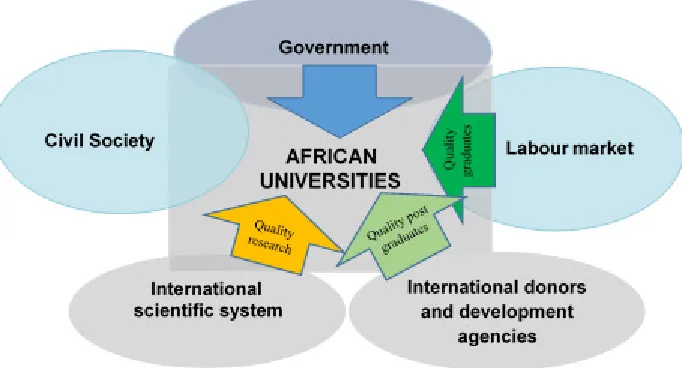
Today more than ever before African universities find themselves in a crossfire between different demands (Figure 1). The general public is pushing for access to good relevant studies as education is seen as the primary route out of poverty. The private sector are increasingly vocal about the need for adequately skilled and trained labour. Governments are severely budget constrained and sensitive to public pressure, so they try to do more with less by requesting the already overburdened, under-resourced, under-staffed and run down educational system to absorb a larger proportion of the youth. The international academic society looks predominantly at universities’ research performance and continues to rank African universities as some of the poorest performing in the world. In this environment the donor community are reinvesting in higher education in Africa and require universities to improve educational quality mainly at postgraduate level in order to develop the next generation of African scholars and leaders.
CARL ERIK SCHOU LARSEN
African universities ability to be a catalyst for development depends on its ability to meet the dual demand of substantially higher numbers of graduates with significantly improved capabilities and entrepreneurial mind-sets’. This paper reflects on the experience of the author in recent visits to universities throughout Africa. It focuses on the incentive structures governing higher education, assessing their intended and unintended impact on direction and performance of the university system in Africa. METHODOLOGY
This paper draws on the process analysis of a number donor financed projects aiming at enhancing African universities’ ability to produce scientific knowledge, graduates and services (outreach) relevant to the societies they serve. Data were collected predominantly by longitudinal participant observation (Atkinson and Hammersly, 1998) over a period of 25 years, completing several full project cycles. It covers numerous universities in several countries across the continent. It is biased towards the Anglophone part of the continent, though the few observations in Francophone and Lusophone Africa showed similar trends. The majority of the projects this analysis is based upon focused on institutional capacity building or performance enhancement rather than research or education per se. It is an outsider’s look at the system with the in-built limitations and advantages this gives. To limit the risk of bias, findings from these process analyses has been presented to relevant stakeholder groups in written form and at workshops/meetings. Thus, there has been a deliberate method of data verification through triangulation.
When looking at intended and unintended effects of incentive and disincentive systems it is important to shed light on issues normally not discussed openly:
either because they are ignored or because they are perceived too sensitive/controversial to talk about. However, not including them in the problem analysis might lead to inadequate conclusions. This again could lead to sets of solutions that mainly are symptom treatment rather than addressing the underlying causes to the problems. The paper focuses on unfolding the barriers and challenges slowing the transformation of higher education systems in African Universities through analysing current incentive systems for universities and their staff. The underlying research questions for this analysis are: (1) what incentive/ disincentive systems facilitate/constrains transformation of education systems in African universities? (2) what are the intended and unintended consequences of current incentive/ disincentive systems? and (3) could incentive systems be modified in a way that would facilitate educational transformations?
to level of activity and kind of activity, as well as their ways of dealing with risk. This paper’s underlining assumption is that the incentive system functions as the principal variable affecting organizational behaviour (Clark and Wilson, 1961). Based on this assumption and second one is that if incentive systems are altered they can optimize institutional performance by stimulating behavioural change among staff provided that alteration of incentive systems is based on a good understanding of the egotistical motives of the staff. This tends to change over time and is not homogeneous, but linked to factors like age, gender, religion, culture, social status, income level and the like.
ANALYSIS
The paper looks at incentive structures at three different but interrelated levels, the continental, the national and the institutional as illustrated in Figure 1, is that the incentive systems that governs the individual university to a large extent is determined by external stakeholders. The executives at the university (senior management) have therefore limited ability to alter the system. INCENTIVE AND DISINCENTIVE
STRUCTURE
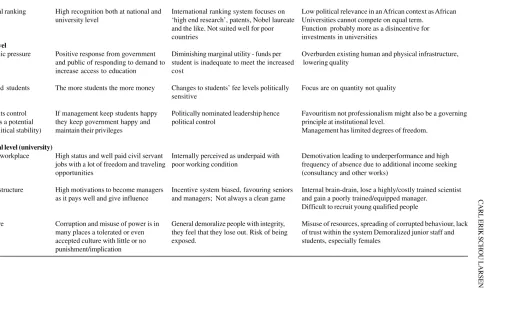
Despite increased recognition of the challenges with African universities’ ability to contribute efficiently to the continent’s development over the past decades, the apparent lack of significant impact in the form of change in quality and relevance of higher education seems to be due to a combination of three inhibiting factors: 1) The university system is not designed to produce graduates of relevance; 2) The current incentive structures and funding mechanisms are ineffective and at times counterproductive, 3) Universities do not have sufficient autonomy to address the current shortcomings. Table 1 gives an overview of prevailing incentive mechanisms at the three different levels. The table is not comprehensive but lists the ones that seem to have most impact on individual and institutional behaviour. For each mechanism is listed how they might work as incentive and disincentive respectively and how this might impact the universities and their stakeholders.
CONTINENTAL LEVEL International ranking system
The university system in Africa is part of the global family of academia and is therefore to some degree governed by the international university ranking system. With the exception of South Africa, not a single university in Sub Saharan Africa reaches the top 500 globally. While politicians and donor agencies are preoccupied with how universities can contribute to society and to Africa’s development, the inner logic of academia is not designed to foster relevance, one could almost say – on the contrary. The more prestigious
the ranking system is, the more it focuses on ‘high end research’, patents, Nobel laureates and the like. This is to some degree related to the circumstance that “modern” western universities emerged as an alternative to the Catholic Church’s dominance on knowledge and “truth”. Universities glorify science for the sake of science and are very sensitive to external influence on their freedom of thought. All scientists subscribe to the core value: Freedom to research in what the scientist finds interesting and not what society finds relevant. This is therefore also a core criterion in the international ranking system and spells out in the merits that are given to performance within ‘high end research’. Mok (2007) is from an Asian perspective worried that the international ranking system defined by the Anglo-Saxon standards and ideologies creates a new dependency culture that reinforce an American-dominated hegemony and thereby suppress other knowledge generation cultures. The objective here is not to challenge that system but simply to state the concern that it might not be instrumental to use it as the only or dominant yardstick to measure performance of universities in poor countries. High end basic research is very costly which is why there is a clear link between an institutions resource endowment and its position on the international ranking lists.
Nobel Laureates can be used as a crude indicator. Most awards go to the richest countries with United States, the United Kingdom, Germany, France and Sweden topping the rankings. There are also Nobel Laureates from poor countries but the majority of these did their research in prestigious Western universities which are credited and thereby help them, not their home university, in climbing the international ranking. Why is this important in an African context?
131
CARL ERIK SCHOU LARSEN
Table 1: Incentive systems in African Universities
System mechanism Incentive Disincentives Consequences of existing practices
Continental level
International ranking High recognition both at national and International ranking system focuses on Low political relevance in an African context as African
university level ‘high end research’, patents, Nobel laureate Universities cannot compete on equal term.
and the like. Not suited well for poor Function probably more as a disincentive for
countries investments in universities
National level
Demographic pressure Positive response from government Diminishing marginal utility - funds per Overburden existing human and physical infrastructure,
and public of responding to demand to student is inadequate to meet the increased lowering quality
increase access to education cost
State funded students The more students the more money Changes to students’ fee levels politically Focus are on quantity not quality
sensitive
Governments control If management keep students happy Politically nominated leadership hence Favouritism not professionalism might also be a governing
(universities a potential they keep government happy and political control principle at institutional level.
threat to political stability) maintain their privileges Management has limited degrees of freedom.
Institutional level (university)
Prestigious workplace High status and well paid civil servant Internally perceived as underpaid with Demotivation leading to underperformance and high
jobs with a lot of freedom and traveling poor working condition frequency of absence due to additional income seeking
opportunities (consultancy and other works)
Promotion structure High motivations to become managers Incentive system biased, favouring seniors Internal brain-drain, lose a highly/costly trained scientist
as it pays well and give influence and managers; Not always a clean game and gain a poorly trained/equipped manager.
Difficult to recruit young qualified people
Work culture Corruption and misuse of power is in General demoralize people with integrity, Misuse of resources, spreading of corrupted behaviour, lack
many places a tolerated or even they feel that they lose out. Risk of being of trust within the system Demoralized junior staff and
accepted culture with little or no exposed. students, especially females
if any relevance for the international university ranking and is therefore considered by most faculty as “wasted time”.
It is based on this that there is a sense that the international university ranking system functions more as a disincentive than an incentive for African universities. Moreover, the indirect pressure that such ranking puts on all universities does not really help African governments in their efforts to use scarce public resources allocated for universities to meet the needs of society. But it is not all negative, international ranking do have an effect as peer competition within countries and among countries tends to be a very strong motivator that not only gets university management attention but also that of ministries, parliaments, students and their parents. For many universities around the world the indicators that they are measured against in such ranking systems function as behavioural regulators, they influence management attention, budget allocations and incentive structures.
NATIONAL LEVEL PRESSURE ON UNIVERSITIES
Demographic pressure
Pushing a higher number of students through the system is a necessity given the demographic development of the continent and it does satisfy a short term goal of responding to public and political pressure for greater access to higher education. University management has strong incentives to respond to this pressure as it gives them social and political credibility. But it tends to have a negative bearing on the capacity of the universities to deliver quality outputs in terms of graduates, research, outreach and in its other capacities. The explosion in private universities in many African countries is another way of responding to the huge demand for university access and indicates that there are untapped opportunities in the sector.
State funded students
The challenge with the current stipend systems is that government funding is linked to uptake, meaning that quantity is the incentive indicator not quality of the output. The incentive for universities is clear - their main source of income is student fees supported by government. The more students they have the greater the income and if they are not being measured on quality, or at least on graduation, then it is in the short-term interest of the university to take in as many students as possible. For example in Kenya enrolments to public universities rose seven times faster than funding from 2012 – 2014 (Nganga, 2014). With incentives solely linked to quantity it becomes like the Soviet industrial system, where government industries/ institutions had fixed targets, they needed to produce
a certain number of products or services within a given time. They did so the cheapest way possible, because that was the most rational thing to do, which resulted in very poor quality products/services. The system functioned because there was no free market and therefore little competition. This is the same with education in Africa - until recently. The students and their families can either purchase an inferior quality education or have none at all. As demand for university seats far exceeds the supply of seats even admission to a university with poor standards is better than no admission at all. So there is so far less push for quality than quantity as Figure 1 illustrates.
A relevant question to ask in such a situation is: Does it make sense to use scarce resources to improve quality and relevance of education when the main demand and concern is access? Or is the most rational political response for governments to such a situation is indeed to be opportunistic and just let the university be flooded with students and care less about quality and staff satisfaction? This would address the strong political pressures exerted by a rapidly growing population graduating from high school.
Control from government
An important factor to remember when trying to understand how governments see universities is that their interest is not entirely related to the functions of universities. It is no big secret that education and cognitive emancipation are some of the precursors for accountable democracy. Enlightened and emancipated students and an active faculty are more likely to question the competence, legitimacy and moral habits of their leadership at all levels of society. Many African governments see universities as a threat to political stability and as a potential birthplace of political unrest. As a consequence governments often enforce substantial direct/official and indirect/unofficial political influence on university management. Keeping students content and pacifying critics can be significantly more important to university management than ensuring relevance and quality of research and educations. They have a clear incentive to do so as their lucrative position in society depends mainly on their goodwill in government. The Rector/Vice Chancellor is accountable to government, not the institution.
CARL ERIK SCHOU LARSEN UNIVERSITY LEVEL
Prestigious workplace
The key determinant for university performance is members of faculty. As discussed earlier under incentives it is important to understand contributors’ motives, whatever those motives may be, as motivation in essence is about self-gratification. Material incentives are important, as with all wage workers, but it is not the only motivation for working at a university. Faculty everywhere has devotion to science and are interested in producing public goods for the benefit of their society. But in an African context it seems relevant to see this in historical perspective for the simple reason that most senior faculty does that. What seems to a quite common cultural denominator for members of faculty in Africa is the perception that they are underpaid. For sure this was true during the 1970s to 1990s during which most members of faculty found their real income dwindling year by year, in many cases to a level where they were paid symbolic public salaries, way below the cost of living. During those years it became an acceptable norm to do ‘out of office’ work during working hours. However, in recent decades faculty in most – but not all – African countries has seen substantial increase in actual salary. Today, in most places, university faculty ranks in the top 5% in terms of public income in their countries. Still the feeling of being underpaid lingers on and the habit of ‘out of office’ work continues to be culturally and institutionally acceptable. This is partly because there seems to be a tendency that members of faculty do not compare themselves to their fellow citizens but with peers within their global community. This also links to the institutions history as many senior members of faculty got their degrees outside Africa. Compared to US and Europe they find their salary and working conditions unfavourable.
The above leads to a situation of over emphasizing on material incentives. Income-maximization becomes the prime driver and tends to skew peoples view of what is reasonable. Members of faculty often expect to be ‘paid extra’ for attending their civil job as a professor or senior lecturer. From a self-gratification point of view they see themselves as losing opportunities for alternative income when going to work at the university. This has contributed to the widespread habit of ‘out of office’ work an institutional rather than an individual problem because it results in a substantial and partly hidden internal brain drain (e.g. there are in principle 20 members of a given faculty but in reality 1/3 at any given time are absent). Moreover, it is often the most gifted, efficient and proactive professors that have opportunities for consultancies, which further aggravates the problem as they are most needed by the institution. The intriguing question is: Would donor funded initiatives within the university sector get more
value for money if they accepted to use direct financial incentives rather indirect material or intangible incentives?
Promotion structures
Another incentive system that tends to result in internal brain drain in university systems (not only in Africa) is the tradition that university managers mainly are recruited from within faculty. As logical such a culture might seem it is important to recognize that being a good scientist and being a good manager are two distinct and partly contradictory qualifications. As it is often from among the best scientists that leaders are recruited the institutions often lose a gifted scientist/ teacher and in return gain a mediocre bureaucrat. This is a loose-loose strategy for the institution, especially as there is a scarcity of good scientists. The incentive to become a manager is clear; it carries material benefits, prestige, power and access to resources. The disincentive is that it removes scientist from their academic passion and politicizes their work, which not all are interested in. Such hierarchical structures result in access to incentives closely linked to positions and favours the senior professors and managers. Junior members of faculty do not have many possibilities or privileges. This system tends to create jealousy and seems to lead to repetition of unhealthy cultures, where young staff inherit the mentality ‘when my chance comes I will also have my share of the cake’. The implication is that the healthy and natural self-gratification urge to rise in the ranks might lead to unethical behaviour.
Work culture
Parallel to the official incentive systems might exist illicit incentives which serve the same purpose of self-gratification. An important distinction between official and illicit incentive systems is that official systems are third party regulated while illicit systems tend to be self or closed circle “regulated”. This kind of incentives can be material, services and/or privileges. Some beneficiaries are only gaining marginal benefits from such illicit incentive systems, others enrich themselves. To what degree these are part of a given work culture varies between institutions, within institutions and among individuals. In some places they are almost non-existant, in others they are quite common. Discussions with faculty around the continent, indicates that the issue of unethical behaviour as part of the work culture within higher education is a typical ‘tip of the iceberg’ problem. It is in many places so deeply embedded in the national/institutional culture that it becomes almost acceptable and invisible.
activities is one of these illicit incentive systems which are almost institutionally acceptable but there are many other less acceptable and less legal ways of supplementing income. According to Transparency Internationals (2013) ‘Global Corruption Report – Education’ the list includes taking bribes or services (including sexual) from students and/or junior staff who want to advance, requesting a share of staff or students’ scholarships as part of the approval process (especially if foreign-financed), making deals with kickback arrangements for procurement, inventing none existing activities and making fake receipts to get reimbursed for the cost, charging obscure fees for use of university facilities, and claiming per diem for going on unnecessary field trips or attend irrelevant meetings/conferences. Because of the very close link between actions and rewards these are very powerful, if illicit, incentives. Ironically fraud and corruption is actually an area where a lot of people show outstanding devotion, creativity and innovation capacity. This reflects how if the incentives are clear and strong enough they spark a proactive culture.
As there is no third party control on illicit incentive systems they are diverged incentives not linked to the objectives of the institution. They are often extremely counterproductive as they lower work morale, reliability and quality of outputs/products, efficiency and effectiveness of institutions. They basically drain financial and human capital from institutions that are already severely resource-constrained.
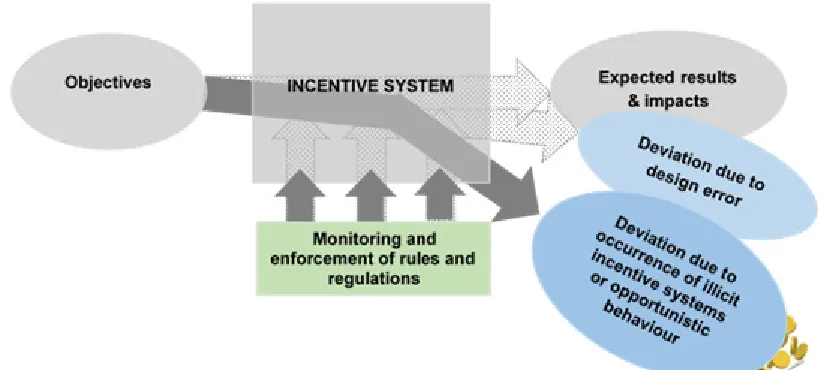
Figure 2 illustrates the current problem with incentive systems in and around African universities. When the incentive system is well designed it assists in enforcing the objectives so investments lead to expected results and impact is achieved (the horizontal dotted arrow). But even in well-designed systems it is important that implementation is monitored and rules and regulations are enforced (the vertical arrows need to be strong
enough to keep the system on track) as incentive systems, especially material, are prone to opportunistic behaviour and abuse. One could say that human greed functions as gravitation pulling the system off track if not kept at bay by inbuilt checks and balances systems. Deviations happen either due to poor design, or poor control, or a combination of the two. The more deviation the more leakages and the less a given investment into the system will result in desired results and impact. The argument is that within African higher education systems there are challenges both with the design of incentive systems and with the enforcement of rules and regulations which again can lead the occurrence of illicit incentive systems.
DISCUSSION
Many of the issues on incentive systems discussed above need to be addressed at continental or national level in order to establish a conducive environment for improvements at the institutional level. They are outside the domain of the individual university. However, this does not remove responsibility from leadership at the individual institutions; on the contrary, even in a difficult working environment, things can be optimized. There are many things that could be improved at the individual institutions without external financial or political support. It requires firm leadership and commitment rather than additional funding. If indeed incentive systems as claimed by Clark et al. (1961) is the principal variable affecting organizational behaviour university leadership should adjust and enforce them strategically to facilitate the changes they would like to happen within their institution.
CONTINENTAL
Liefner (2003), Stilwell (2003) and Varghese (2013) all find that university ranking systems have an effect on public and private resource allocation to universities, on universities’ priorities within their budget and thereby on staff and students’ behaviour. That means
CARL ERIK SCHOU LARSEN that if indicators used within the ranking system are
changed so will universities priorities and if university priorities change, incentive systems normally follow and that will – if relevant and enforced – eventually lead to behavioural change among staff and students and thereby institutional changes (Liefner, 2003). What if African leaders decided to design a more balanced and Africa relevant University Ranking System with additional indicators like: Employability of graduates; uptake of innovations; Public Private Partnership (PPP) within research; business start-ups; number of public disseminated research findings and number of policy advice papers; ratio of female graduates; ratio of graduates from poor households; and so on. This should not substitute international ranking but supplement it. Needless to say it would require strong political endorsement, continental recognition, and trustworthy implementation which is probably the biggest challenge. It could be further reinforced through built-in material incentive structures to stimulate peer competition (e.g. awarding the top 50 universities in Africa with an annual amount equal to USD 20.000 for each step towards the top (so number 50 gets USD 20.000 while number 1 gets USD 1.000.000). Being among the top 50 in Africa (rather than way down the international ranking list) would probably boost country and institutional self-confidence as well as ability to mobilize resources. It would therefore most likely also over time have a positive spill over effect on the leading African institutions’ global ranking. Such an African University Ranking System would have to be endorsed by the African Union and executed through an appropriate continental body.
NATIONAL
A proven and extensively used instrument that governments in recent years under the ‘New Public Management’ era have used to induce behavioural change in higher education institutions is the financial instrument (Bloom et al., 2006), the so-called ‘carrot’ and ‘stick’ instruments. How healthy mercantile and cooperate thinking are for public good institutions like universities are being debated (Stilwell, 2003). Nobody seems to question that they do have an effect but if they have the intended effect can of course be questioned (op sit). The efficiency of incentives in causing desired behavioural changes relies to a high degree on how smart they have been designed and if they can be effectively enforced. What has been a relatively effective instrument in a number of countries is to gradually convert public funding from being linked to student admissions (quantity) to instead be linked to graduates completion of studies and employability (quality and relevance). To what degree such instrument would work in an African context is a relevant question, the point here is however not the specific example but that the way government funds
universities has a bearing on what they get for that money. The current incentive system is serving the purpose of ensuring student uptake but is not related to completion rates, nor to completion time, educational quality, or societal relevance.
African universities cannot substantially upgrade the quality and relevance of sciences based educations without additional resource allocations. Science based education requires that faculty actually have resources to conduct research. Moreover, the educational costs per student increase significantly when moving from a monolithic/encyclopaedic approach to a more holistic experiential type of learning paradigm (Johnstone, 2004). Government will have to consider the trade-off between getting fewer more valuable graduates that are better equipped to render service to society compared to mass education that produces large cohorts of graduates less capable of being useful to society and less likely to find or create relevant and productive jobs. This is no easy choice.
UNIVERSITIES
All improvements at institutional level starts and ends with management. In discussions with faculty about the many difficulties African universities face and what to do about it, topping the list is almost unanimously better leadership. Faculty is very sensitive towards being managed by non-academics (Stilwell, 2003), the most acceptable solution would probably be to institutionalize compulsory management/leadership training and performance evaluation of all managers within the individual institutions. Enforcement of results from performance evaluation is essential. Measuring performance and not acting on it is much more harmful to institutions morale than not measuring it at all.
Working with African universities has shown that there is also room for internal improvements in institutional performance and in transparency in terms of fiduciary and financial management. Existing resources could in most places be used more efficiently and effectively if management and administration were trimmed, and if rules and regulations were updated and enforced. Increased transparency is at the same time a way to limit the windows of opportunity for deviation and a way to build trust within and towards the system. Currently the incentive to improve internal resource allocation seems not always sufficiently strong, probably because senior management is more accountable to the political establishment than to the institution they serve and its constituency of staff and students.
enforcement of rules and regulations on financial accountability and transparency could over time be an effective mechanism to increase institutional performance. It however only works if management leads the way and builds a culture of fair and efficient enforcement of rules and regulations. Transparency is also crucial as trust takes time to establish but is easily lost if management start to bend rules to their own advantages. Staff not willing or able to comply with tighter enforcement of rules and regulation should after due diligence be free to leave their public job.
CONCLUSIONS
The underlining assumption is that the incentive system functions as the principal variable affecting organizational behaviour and that staff, students and management adjust their behaviour to the inner logic of higher education institutions administered through their incentive systems - provided that the incentive systems are well designed, aligned to people’s self-gratification objectives, and are well enforced. If not, opportunistic behaviour and occurrence of illicit incentive systems seems to occur. Moreover, any attempts to change behaviour among university staff that are not synchronised with the personal motives of the faculty involved and/or the inner logic of the formal incentive systems, seems to have little chance of having lasting behavioural and thereby institutional impact. Lastly the impact of incentive systems on universities direction and performance are not well-researched, especially not in an Africa context and more rigorous research into this subject area is recommended. STATEMENT OF NO CONFLICT OF INTEREST
The author of this paper hereby declares that there are no competing interests in this publication.
REFERENCES
Atkinson, P. and Hammersly, M. 1998. Ethnography and participant observation. In: Denzin, N.K. and Lincoln, Y.S. (Eds.), Strategies of Qualitative Inquiry. pp. 110–136. Thousand Oaks, California: Sage Publications. http://www.uky.edu/~tmute2/ geography_methods/readingPDFs/atkinson-hammersley.pdf
Barnard, C. 1938. The Function of the Executive. Harvard University Press. pp. 384.
Bloom, D.E., Canning, D. and Chan, K. 2006. Higher education and economic development in Africa. In Vol. 102. Washington, DC: World Bank. http:// www.uhasselt.be/Documents/UHasselt_EN/ I n t e r n a t i o n a l / L e z i n g % 2 0 N - Z % 2 0 2 0 1 3 / Higher_Education_and_Economic_Development_in_ Africa.pdf
Clark, P.B. and Wilson, J.Q. 1961. Incentive systems: A theory of organizations. Administrative Science
Quarterly 6:129-166. http://www.joe.org/joe/ 1996june/rb1.php
Glewwe, P., Maiga, E. and Zheng, H. 2014. The contribution of education to economic growth: A review of the evidence, with special attention and an application to Sub-Saharan Africa. World Development 59 :379–393. https://experts.umn.edu/ en/publications/the-contribution-of-education-to- economic-growth(7e225d1a-f8c3-4842-9e09-0303fe29d744).html
Johnstone, D.B. 2004. The economics and politics of cost sharing in higher education: Comparative perspectives. Economics of EducationReview 23: 403-410. https://experts.umn.edu/en/publications/ the-contribution-of-education-to-economic-growth (7e225d1a-f8c3-4842-9e09-0303fe29d744).html Jowi, J.O. 2012. African universities in the global
knowledge economy: The good and ugly of internationalization. Journal of Marketing for Higher Education 22 (1):153-165. https:// www.researchgate.net/journal/1540-7144_Journal_ of_Marketing_for_HIGHER_EDUCATION Liefner, I. 2003. Funding, resource allocation, and
performance in higher education systems. Higher Education 46:469-489. http://link.springer.com/ article/10.1023%2FA%3A1027381906977
Mehrotra, A., Sorbero, M.E.S. and Damberg, C.L. 2010. Using the lessons of behavioral economics to design more effective pay-for-performance programs. The American Journal of Management Care 16(7):497 - 503.
Mok, K.H. 2007. Questing for internationalization of universities in Asia: Critical reflections. Journal of Studies in International Education 11 :433-454. http://jsi.sagepub.com/content/11/3-4/433.abstract Nganga, G. 2014. Student numbers soar by 35%, university funding lags. Issue No: 319. University World News. http://www.universityworldnews .com/article.php?story=20140508075050866 Singh, M. 2010. Re-orientating internationalisation in
African higher education. Globalisation,Societies and Education 8(2):269-282. http://www.tandf online.com/doi/abs/10.1080/147677210037 80439?journalCode=cgse20
Siva, I. 2010. Using the lessons of behavioral economics to design more effective pay-for-performance programs. The American Journal of Managed Care 16(7):497-503. http://www.ncbi. nlm.nih.gov/pmc/articles/PMC3303871/
Stilwell, F. 2003. Higher education, commercial criteria and economic incentives. Journal of Higher Education Policy and Management 25 (1):51-61. http://www.tandfonline.com/doi/abs/10.1080/ 13600800305741
CARL ERIK SCHOU LARSEN AERC Supplement 3, pp. iii50–iii79. http://
jae.oxfordjournals.org/content/20/suppl_3/ iii50.abstract
Transparency Internationals Global Corruption Report – Education. 2013. Routledge 2 Park Square, Milton Park, Abingdon, Oxon OX14 4RN. pp 418. http:/ /www.transparency.org/gcr_education
US Government. 2012. The economics of higher education. A report prepared by the Department of the Treasury with the Department of Education pp 43. https://www.treasury.gov/connect/blog/ Documents/20121212_Economics%20of%20 Higher%20Ed_vFINAL.pdf
Varghese, N.V. 2013. Governance reforms in higher education: a study of selected countries in Africa. IIEP/SEM334/Theme paper, April 2013, pp. 28. http://www.iiep.unesco.org/sites/default/files/ governance_reforms_in_he_paper_pf.pdf
Weber, L. 2005. Nature and scope of public responsibility for higher education and research. In: Weber, L. and Bergan, S. (Eds.). The public responsibility for higher education and research. Strasbourg, Council of Europe Publishing. pp. 29-45. http://www.coe.int/t/dg4/highereducation/ Resources/Public-responsibility-for-higher-education-and-research_webversion.pdf
World Bank. 1986. Financing of education in developing countries. Washington DC: World Bank. 1818 H Street, NW, Washington DC. pp.57 http:// eric.ed.gov/?id=ED281800