V.R. Mohan et al. J Sci Res Pharm, 2018;7(11):145-149
World Inventia Publishers
J
ournal of
S
cientific
R
esearch in
P
harmacy
http://www.jsrponline.com/
Vol. 7, Issue 11, 2018 ISSN: 2277-9469
USA CODEN: JSRPCJResearch Article
ASSESSMENT OF THE ANTIOXIDANT POTENTIAL OF
BARLERIA COURTRALLICA
NEES (ACANTHACEAE)
A. Ponmathi Sujatha 1, A. Doss 2, S. Muthukumarasamy 3, V.R. Mohan 2 *
1 Research Scholar (Reg. No: 12319), PG & Research Department of Botany, V.O.Chidambaram College, Tuticorin, Tamilnadu, INDIA. 2 Ethnopharmacology Unit, PG & Research Department of Botany, V.O.Chidambaram College, Tuticorin, Tamilnadu, INDIA.
3 Department of Botany, Sri K.G.S. Arts College, Srivaikundam, Tamilnadu,
Affiliated to Manonmaniam Sundaranar University, Abishekapatti, Tirunelveli, Tamilnadu, INDIA.
Received on: 08-10-2018; Revised and Accepted on: 27-11-2018
ABSTRACT
E
xtracts of stem of Barleria courtrallica Nees (Acanthaceae) was assessed for its antioxidant activity by in vitro methods. Antioxidant activity was studied using 1, 1- Diphenyl-2-Picrylhydrazyl (DPPH), Superoxide scavenging activity, Hydroxyl scavenging activity, ABTS radical scavenging and reducing power assay. Antioxidant activities compared with ascorbic acid as standard antioxidant. Results showed that the crude extracts exhibited significant DPPH, superoxide, hydroxyl, ABTS and reducing power assay. From the results, it is concluded that the ethanol extract is the most potent antioxidant. This holds great promise for the use of as a source of strong antioxidant compounds.KEYWORDS: Free radicals, ROS, Oxidative stress, Antioxidant activity, Medicinal plant.
INTRODUCTION
N
atural resources have been an important source of medicine for thousands of years. Even today, the World Health Organization reports shows that up to 80 % of people still rely on traditional remedies such as medicinal plants for their medicines. Medicinal plants constitute one of the major sources for development of new phyto-pharmaceuticals and healthcare products. A whole range of plant-derived nutritional food, phytochemicals and pro-vitamins that support in maintaining human health and combating disease are now being described as functional ingredients and nutraceuticals. The role of medicinal plants in disease prevention or control has been attributed to antioxidant properties of their constituents, usually associated to a wide range of amphipathic molecules, broadly termed polyphenolic compounds [1].Reactive oxygen species (ROS) have been projected as significant causative agents for some radical-mediated conditions including aging, cancer and cardiovascular disease. The search for potent natural antioxidants, especially from plant sources, as nutritional supplements, health food, and/or phytomedicine has become an important research issue at a world-wide level. Plants containing low molecular group compounds have been successively used to treat various ailments since ancient times, as reactive oxygen species are involved in several diseases. It has been supported that many naturally occurring species possess remarkable activity as radical scavengers and lipid per oxidation inhibitors [2]. Besides plant extracts, abundant
naturally occurring compounds are helpful as antioxidant, ranging from alpha tocopherol and beta carotene to plant antioxidants for example phenolic compounds (tannins, flavonoids, chalcones, xanthones,
*Corresponding author:
V.R. Mohan
Ethnopharmacology Unit,
PG & Research Department of Botany,
V.O.Chidambaram College, Tuticorin, Tamilnadu, INDIA. * E-Mail: [email protected]
DOI:https://doi.org/10.5281/zenodo.2084553
anthrocyanins, liganans, depsides, and depsidones), terpenes (sesquterpens and diterpines), alkaloids, and organic sulfur compounds
[3].
Genus Barleria fits into the family Acanthaceae. The whole plant extract of Barleria contains a number of active compound like alkaloids, flavonoids, glycosides, terpenes, lignins, phenolics etc., which have publicized potent therapeutic activities in opposition to several diseases [4-7].Barleria also shows various pharmacological effects such as
antimicrobial, anthelminthic, antifertility, antioxidant, antidiabteic, antiarthritic, hepatoprotective, diuretic, cytoprotective, antidiarrhoeal, analgesic, antileukemic, anti-inflammatory and hypoglycemic properties without any toxic efferts [8, 9]. The current study, the crude extracts of B.
courtrallicawere investigated for their antioxidant properties of super oxide radical scavenging activity, ABTS radical scavenging activity, DPPH scavenging activity, Hydroxyl radical & reducing power assays.
MATERIALS AND METHODS
Collection of plants:
The fresh plant parts of Barleria courtrallica(stem) were collected from Agasthiar malai biosphere reserved, Western Ghtas, Tirunelveli District, Tamil Nadu, India. The gathered samples were cut into small pieces and shade dried until the fracture is identical and even. The dried plant material was crushed or grinded by using a blender and separated to get uniform particles by using sieve No. 60. The final uniform powder was used for the extraction of active constituents of the plant material.
Preparation of extract:
Antioxidant activity:
DPPH radical scavenging activity:
The DPPH is a constant free radical and is extensively used to measure the radical scavenging activity of antioxidant component. This process is based on the reduction of DPPH in methanol solution in the company of a hydrogen donating antioxidant due to the arrangement of the non-radical form DPPH [10]. Using 1, 1- diphenyl-2-picryl-hydrazyl
(DPPH) as per the previously reported process (Blois, 1958) the free radical scavenging activity of all the extracts was assessed. 0.1 mM solution of DPPH in methanol was arranged. 1 ml of this solution was poured into 3 ml of the solution at different concentrations (50, 100, 200, 400 and 800μg/ml). The mixtures were shaken vigorously. This set up is allowed to stand at room temperature for 30minutes. After that the absorbance was measured at 517nm using a UV-VIS spectrophotometer (Genesys 10s UV: Thermo electron corporation). Ascorbic acid was employed as the reference. The lesser absorbance values of reaction mixture specify higher free radical scavenging action. Using the subsequent formula the capability to scavenge the DPPH radical was found out.
DPPH scavenging effect (% inhibition) = (A0 - A1) / A0 X 100
Where, A0 is the absorbance of the control and A1 is the absorbance of the test samples and reference. All the tests were carried out in triplicates and the outcomes were averaged.
Hydroxyl radical scavenging activity:
The scavenging ability for hydroxyl radical was estimated according to the modified method of Halliwell et al [11]. Stock answers of
FeCl3 (10 mM), Ascorbic Acid (1 mM), EDTA (1 mM), H2O2 (10 mM) and
Deoxyribose (10 mM) were put in distilled deionized water. The assay was completed by adding 0.1 ml EDTA, 0.01 ml of FeCl3, 0.1 ml H2O2,
0.36 ml of deoxyribose, 1.0 ml of the extract of dissimilar concentration (50, 100, 200, 400 & 800 μg/ml) dissolved in distilled water, 0.33 ml of phosphate buffer (50 mM, pH 7.9), 0.1 ml of ascorbic acid in sequence. The mixture was then incubated at 37oC for 1 hour. 1.0 ml of the
incubated mixture was mixed with 1.0 ml of 10% TCA and 1.0 ml of 0.5% TBA (in 0.025 M NaOH containing 0.025% BHA) to develop the pink chromogen measured at 532 nm. The hydroxyl radical scavenging action of the extract is accounted as % inhibition of deoxyribose. The degradation is calculated by using the subsequent equation
Hydroxyl radical scavenging activity = (A0 - A1) / A0 X 100
where, A0 is the absorbance of the control and A1 is the absorbance of the test samples and reference. All the tests were carried out in triplicates and the results were averaged.
Superoxide radical scavenging activity:
The superoxide anion scavenging activity was calculated as explained by Srinivasan et al [12]. The superoxide anion radicals were
created in 3.0 ml of Tris - HCl buffer (16 mM, pH 8.0) containing 0.5 ml of NBT (0.3 mM), 0.5 ml NADH (0.936 mM) solution, 1.0 ml extract of different concentrations (50, 100, 200, 400 & 800 μg/ml) and 0.5 ml Tris - HCl buffer (16 mM, pH 8.0). By adding 0.5 ml PMS solution (0.12 mM) to the mixture, the reaction was set off and incubated at 25oC for 5
min. The absorbance was calculated at 560nm against a blank sample, ascorbic acid. The percentage inhibition was calculated by using the following equation
Superoxide radical scavenging activity = (A0 - A1) / A0 X 100
where, A0 is the absorbance of the control and A1 is the absorbance of the test samples and reference. All the tests were performed in triplicates and the results were averaged.
Antioxidant Activity by Radical Cation (ABTS+):
ABTS assay was based on the slightly modified method of Huang et al [13]. By reacting 7 mM ABTS solution with 2.45 mM
potassium persulphate, ABTS radical cation (ABTS+) was prepared. This mixture is permitted to be in the dark at room temperature for 12-16 hrs previous to use. With ethanol to an absorbance of 0.70 + 0.02 at 734
ml of diluted ABTS+ solution or addition of 100 μL of sample, absorbance was calculated at 734 nm by Genesys 10S UV-VIS (Thermo scientific) accurately after 6 minutes. Results were expressed as trolox equivalent antioxidant capacity (TEAC).
ABTS radical cation activity = (A0 - A1) / A0 X 100
where, A0 is the absorbance of the control and A1 is the absorbance of the test samples and reference. All the tests were repeated thrice and the end results were averaged.
Reducing Power:
The reducing power of the extract was calculated by the method of Kumar and Hemalatha [14] 1.0 ml of solution containing 50,
100, 200, 400 & 800 μg/ml of extract was mixed up with sodium phosphate buffer (5.0 ml, 0.2 M, pH 6.6) and potassium ferricyanide (5.0 ml, 1.0%). The mixture was hatched at 50o C for 20 minutes. Then 5ml of
10% trichloroacetic acid was added and centrifuged at 980 g (10 minutes at 5oC) in a refrigerated centrifuge. The upper layer of the
solution (5.0 ml) was diluted with 5.0 ml of distilled water and ferric chloride and absorbance read at 700 nm. The experiment was performed thrice and results were averaged.
Statistical analysis:
Antioxidant activities like DPPH radical scavenging activity, hydroxyl radical scavenging activity, superoxide radical activity, ABTS radical cation scavenging activity and reducing powers were estimated in triplicate determinations. Data were analyzed using the statistical analysis system SPSS (SPSS software for windows release 17.5; SPSS Inc., Chicago IL, USA) Estimates of mean, standard error for aforesaid parameters were calculated.
RESULTS AND DISCUSSION
M
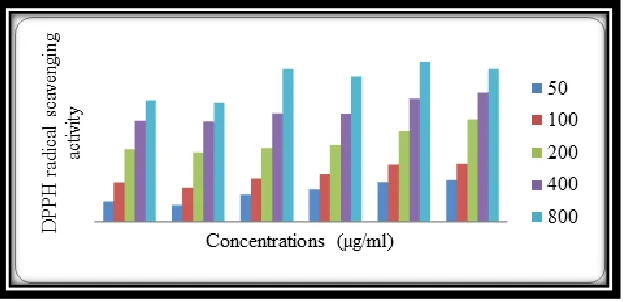
edicinal plants are of great importance for both individual and community health. It is well known that medicinal and aromatic plants production is challenging and involves a wide variety of issues, including agricultural, commercial, ecological, pharmacological, as well as social. Being a stable free radical, DPPH is frequently used to determine radical scavenging activity of natural compounds. In its radical form, DPPH attracts at 517 nm, but upon reduction with an antioxidant, its absorption reduces due to the formation of its non‐radical form, DPPH[10] Thus, the radical scavenging action in thepresence of a hydrogen donating antioxidant can be checked as a reduce in absorbance of DPPH solution. Figure 1 shows free radical scavenging activity of the crude extracts at different concentrations. The radical scavenging activity of ethanol extract increased with increasing concentrations, with 26.88% ±0.93, 38.54%±0.54, 61.16% ±0.31, 83.18% ±0.27 and 108.16% ± 0.31 scavenging activity for 50, 100,200,400 & 800 mg/ml extract, respectively (Figure 1). The IC50
value was found to be 23.56 µg/ml (Table 1). These results indicated that the ethanol extract exhibited the ability to quench the DPPH radical, which indicated that extract was good antioxidant with radical scavenging activity.
Hydroxyl radical scavenging revealed that the ethanol extract of B. courtrallica (IC50: 27.22 µg/ml) scavenged free radicals compared
to other extracts. Ascorbic acid (IC50: 28.23 mg/ml) (Table 1) however
exhibited strong antioxidant activity compared to the extracts (figure 2). Hydroxyl radical is extremely reactive oxygen centered radical created from the reaction of various hydro-peroxides with transition metal ions. It affects macromolecules like proteins, DNA, fatty acid in membranes and most biological molecules also [15] and is known to be capable of
abstracting hydrogen atoms from membrane lipids [16] and brings about
peroxidic reaction of lipids. In the current study a noteworthy correlation existed between the concentration and hydroxyl radical scavenging capability of the extract.
ABTS assay is an exceptional tool for formating the antioxidant activity of hydrogen‐donating antioxidants and of chain‐breaking antioxidants [17]. The extract scavenged ABTS radicals
50‐800 mg/ml of ethanol extract. The ethanol extract exhibited an IC50
value of 29.48 µg/ml (Table 1). Consequently, the ABTS radical scavenging activity of ethanol extract points out its ability to scavenge free radicals. Thereby preventing lipid oxidation via a chain‐breaking reaction.
The result revealed for superoxide radical scavenging assay is figure 4. Superoxide scavenging activity of B. courtrallica stem was increased markedly with increased concentrations of the extract. Thus, higher inhibitory effects of the extract on superoxide anion formation noted here in possibly rendered its promising antioxidant potential. The half inhibition concentration IC50 value of leaf extract of B. courtrallica
was 36.84µg/ml (Table 1).
The reducing power of a compound is related to its electron transfer ability and may serve up as a noteworthy indicator of its
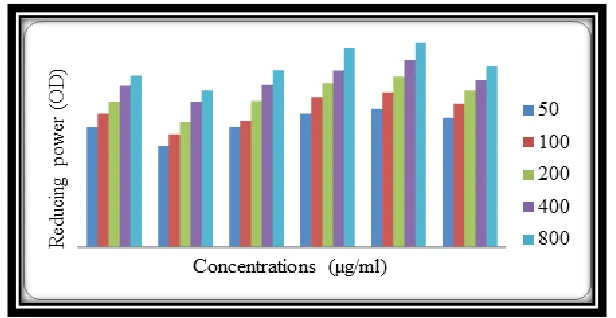
potential antioxidant activity. In this assay, the yellow color of the test solution changes to green and blue depending on the reducing power of test specimen. Greater absorbance at 700 nm indicated greater reducing power. Figure 5 presents the reductive capabilities of the ethanol extract of B. courtrallica. In the concentration range investigated, all the extracts demonstrated reducing power that increased linearly with concentration. At 50, 100,200,400 & 800 mg/ml, reducing power of ethanol extract were found to be 0.329 ±0.027, 0.368±0.016, 0.406±0.018, 0.446±0.027 & 0.486 ±0.018 respectively. The reducing power of the extract might be due to their hydrogen‐donating ability. Possibly, ethanol extract contain high amounts of reductone, which could react with radicals to stabilize and terminate radical chain reactions.
Fig. 1: Effect of different solvent extract of B. courtrallica stem on DPPH assay
Fig. 2: Effect of different solvent extract of B. courtrallica stem on Hydroxyl assay
Fig. 4: Effect of different solvent extract of B. courtrallica stem on Superoxide anion assay
Fig. 5: Effect of different solvent extract of B. courtrallica stem on reducing power assay
Table No. 1: IC50 values of different solvent extracts of the stem extracts of B. courtrallica
Solvents DPPH Hydroxyl IC50 (μg/ml) ABTS Superoxide anion
P. Ether 18.37 19.48 19.45 30.18
Benzene 18.03 20.38 17.39 23.65
Ethyl acetate 22.78 27.78 19.88 32.34
Methanol 20.11 26.16 20.45 36.84
Ethanol 23.56 27.22 29.48 34.12
Ascorbic acid 21.59 28.23 - 29.65
Trolox - - 23.29 -
CONCLUSION
T
he results obtained in the present study indicated that B. courtrallica stem extract exhibited free radical scavenging activity against DPPH, ABTS. hydroxyl, superoxide and reducing power. The findings of the present study suggested B. courtrallica stem could be a potential source of natural antioxidant that would have great importance as therapeutic agents in preventing or slowing the progress of reactive oxygen species and associated oxidative stress related degenerative diseases.REFERENCES:
1. Ivanova D, Gerova D, Chervenkov T, Yankova T. Polyphenols and antioxidant capacity of Bulgarian medicinal plants. J Ethnopharmacol 2005;97(1-2):145-150.
2. Wagner NR, Fransworth H. Economic and Medicinal Plant Research, Academic Press Limited, London 1994; pp. 82-83, 92-93.
3. Marzouk Mohamed SA, Marzouk Fatma A. Moharram, Mona A. Mohamed, Amira M. Gamal-Eldeen, Elsayed A. Aboutabl. Anticancer and Antioxidant Tannins from Pimenta Dioica Leaves. Z Naturforsch 2006;62(7-8):526-536.
4. Agrawal B, Das S, Pandey A. Boerhaavia diffusa Linn. A review on its phytochemical and pharmacological profile. Asian J Appl Sci
2011;4:663-684.
5. Gantait A, Maji A, Barman T, Banerji P, Venkatesh P, Mukherjee PK. Estimation of capsaicin through scanning densitometry and evaluation of different varieties of Capsicium In India. Nat Prod Res 2011;26:216-222.
6. Singh B, Chandan BK, Prabhakar A, Taneja SC, Singh J, Qazi GN. Chemistry and hepatoprotective activity of an active fraction from Barleria prionitis Linn. In experimental animals. Phytothe Res 2005;19(5):391– 404.
7. Amoo SO, Finnie JF, Van Staden J. In vitro pharmacological evaluation of three Barleria species. J Ethnopharmacol
2009b;121:274-277.
9. OECD (Organization for Economic Cooperation and Development): OECD guidelines for the testing of chemicals/ section 4: Health Effects Test No. 423: Acute Oral Toxicity – Acute Toxic Class Method, OECD, 2002.
10. Blois MS. Antioxidant determination by the use of a stable free radical. Nat 1958;181:1199-1200.
11. Halliwell B, Gutteridge JMC, Aruoma OI. The deoxyribose method: a simple test to be assay for determination of rate constants for reaction of hydroxyl radicals. Anals of Biochem
1987;165:215-219.
12. Srinivasan R, Chandrasekar MJN, Nanjan MJ, Suresh B. Antioxidant activity of Caesalpinia digyna root. J
Ethnopharmacol 2007;113:284-291.
13. Huang MH, Huang SS, Wang BS, Wu CH, Sheu MJ, Hou WC, Lin SS, Huang GJ. Antioxidant and antiinflammatory properties of
Cardiospermum halicacabum and its reference compounds ex vivo and in vivo. JEthnopharmacol 2011;133:743-750.
14. Kumar RS, Hemalatha S. In vitro antioxidant activity of alcoholic leaf extract and subfractions of Alangium lamarckii Thwaites. J ChemPharmaRes 2011;3:259-267.
15. Aruoma OI. Free radicals, antioxidants and international nutrition. Asia Pacific J Cli Nut 1999;8:53-63
16. Yen GC, Duh PD. Scavenging effect of methanolic extracts of peanut hulls on freeradical and active-oxygen species. J Agri Food Chem 1994;42:629-632.
17. Leong LP, Shui G. An investigation of antioxidant capacity of fruits in Singapore markets. Food Chem 2002;76:69‐75.
How to cite this article:
V.R. Mohan et al. ASSESSMENT OF THE ANTIOXIDANT POTENTIAL OF BARLERIA COURTRALLICA NEES (ACANTHACEAE). J Sci Res
Pharm 2018;7(11):145-149. DOI:https://doi.org/10.5281/zenodo.2084553
Conflict of interest: The authors have declared that no conflict of interest exists.