Research Article
Genetic variability for biochemical traits
among advanced lines of Brassica
Naseeb Ullah
1, Junaid Khan
2, Mohammad Wasiullah Khan
1, Haneef
Raza
2, Mukhtar Alam
2, Hidayat Ullah
2, Izhar Hussain
3,Ibad Ullah Jan
2,
Ziaur Rahman
2and Fawad Ali
11. Department of Plant Breeding and Genetics, The University of Agriculture, Peshawar, 25130, Khyber Pakhtunkhwa-Pakistan
2. Department of Agriculture, The University of Swabi, Swabi, Khyber Pakhtunkhwa-Pakistan 3. Department of Agriculture, The University of Haripur, Haripur, Khyber Pakhtunkhwa-Pakistan
*Corresponding author’s email: [email protected]
Citation
Naseeb Ullah, Junaid Khan, Mohammad Wasiullah Khan,Haneef Raza, Mukhtar Alam, Hidayat Ullah, Izhar Hussain, Ibad Ullah Jan, Ziaur Rahman and Fawad Ali. Genetic variability for biochemical traits among advanced
lines of Brassica. Pure and Applied Biology. Vol. 6, Issue 1, pp1-8. http://dx.doi.org/10.19045/bspab.2016.50156 Received: 08/07/2016 Revised: 16/11/2016 Accepted: 26/11/2016 Online First: 19/12/2016
Abstract
To investigate genetic variability, heritability and correlation among different biochemical traits, six advanced lines (F10:11) of Brassica rapa were studied at New Developmental Research farm,
Faculty of Agriculture, Peshawar university during 2012-13. The experiment was carried out in randomized complete block design with three replications. Significant differences were observed for glucosinolate, oil content, protein content, oleic acid, linolenic acid and erucic acid. The advanced line, AUP-05 produced the maximum gluconsinolates (75.35 µmol g-1), protein content (24.56%). Advanced line AUP-04 had the highest erucic acid (50.31) and linolenic acid (10.60%). Advanced line AUP-06 produced the high oil content (48.83%). Genotypic variances were greater than the environmental variances for majority of the traits. Ranges for genotypic and phenotypic coefficient of variation were 2.01 to 96.92% and 2.99 to 33.22%, respectively. Majority of the traits exhibited high heritability. The maximum heritability was recorded for erucic acid (0.78), protein content (0.77), glucosinolate (0.76), oleic acid (0.70). Oil content and linolenic acid exhibited moderate heritability with a value of 0.58 and 0.45, respectively. Overall the studied parameters indicate significantly varied results among the advanced lines. AUP-05 and AUP-06 showed promising results for maximum traits. Due to the presence of high genetic variability for glucosinolate content, protein content, oleic and erucic acid, these lines could be used in future breeding programs for the improvement of the biochemical attributes.
Keywords: Heritability; Brassica advanced lines; genotypic variances; Phenotypic coefficient of variances
Introduction
The genus Brassica L. is the most economically important genera in the tribe Brassiceae, belonging to the family Brassicaceae [1], which is further divided into 338 genera and 3709 species [2].
which have great genetic and morphological diversity [5]. Both Mustard and Rapeseed are widely grown as a rich source of edible oil [6]. In Pakistani rapeseed-mustard are economically important and high yielding oil seed varieties grown from long time that is why it is needed to produce improved oilseed brassica varieties for successful expansion of cultivation of oilseed crops [7]. In Pakistan rapeseed was cultivated over an area of 219 thousand hectare and produced 158 thousand tons seeds which in turn produced 51 thousand tons of edible oil during 2012-13 [8]. Cost price of oil is the 2ndlargest imported commodity of Pakistan after the petroleum and is the single largest cost price imported commodity in food products [9]. Due to provision of energy, delicious taste and palatability of Oil and fats are key items in human diet. Pakistan is continuously facing deficiency in the production of edible oils and increasing continuously because of fast growth in population and rise in people’s living standards. Classical breeding and genetic techniques are the sources of modifying the quality traits in brassica e.g., oil, protein and glucosinolates content. Production of high quality edible oil for humans and high quality protein meals for feeding animals was made possible by the genetic improvement in the seed quality of oilseed rape. Detergents, lubricants, cosmetics, hydraulic oils or biodiesel accounts for non-edible products of seed [10, 11]. Beside the direct consumption of humans and animals, brassica biomass is also used for production of bio energy [12]. A sulphur compound is present in glucosinolate, a sulphur containing compounds, makes the brassica species unfit for food and feed purposes
[13]. Presence of 2% erucic acid and 30 µmol g-1glucosinolatein brassica oil are
known as double zero or double low cultivars, which are good for both humans and animals use [14]. Future edible oil
requirement can only be achieved through the improvement of seed quality by breeding brassica [15, 16]. Estimation of the relationship between two variables is known as correlation. Measurable association alludes to a quantifiable relationship between two variables. Moreover, it is a quality's measure between two variables. For plant breeders it is necessary to concentrate on the relationship between sets of characters keeping in mind the end goal to settle on the proper determination criteria for a breeding program [17]. Therefore, the main objective of this study was to evaluate potential lines in agro-climatic conditions of Peshawar on the basis of biochemical attributes and to quantify the heritability and association of biochemical attributes in brassica.
Materials and methods
During 2012-13 six advanced lines (F10:11families) of brassica were evaluated
for Genetic variability of biochemical attributes at New Developmental form (NDF), The University of Agriculture, Peshawar Khyber Pakhtunkhwa.
Oil quality analysis
Quality of brassica is assessed on the basis of low percentage of glucosinolates (GSL), erucic acid and linolenic acid with a high percentage of oleic acid, oil, and protein. Near Infrared Reflectance Spectroscopy (NIRS) was used for screening the genotypes against these traits. The screening procedure was carried out at Nuclear Institute for Food and Agriculture (NIFA), Tarnab, Peshawar.
Estimation of genetic parameters
Vg = GMS - EMS r
Where
Vg= Genetic variance
GMS= Genotypic mean square EMS= Error mean squares r=Number of replication
EMS squares mean Error = Ve iance al
Evironment var ( ) ( )
Vp = Vg + Ve
Heritability broad sense (H2) on entry mean basis was calculated as:
Heritability = vg / vp
The expected response to selection (Re) for each trait was calculated as under:
H vp k
= 2
Re Where
k= 1.40 at 20% selection intensity for a trait VP= Phenotypic variance for a trait.
H2 = Broad sense Heritability for a trait.
Genotypic coefficient of variation (GCV) = √Vg /GM × 100
Phenotypic coefficient of variation (PCV) = √VP /GM × 100
Where
Vg= Genotypic variance
VP= phenotypic variance
GM= Grand mean of the trait
Results and discussions
Glucosinolates is the 2nd major unwanted
constituent of brassica which have adverse effects on human beings as well as animals. Therefore, preference is given to low contents of glucosinolate (GSL), for this purpose breeders are trying to develop such varieties possessing low content of glucosinolates. Brassica genotypes showed highly significant differences (p≤0.01) for glucosinolates (µmole g-1) among the
brassica genotypes (Table 1), exhibiting similar significant status in brassica napus
studied by [22, 9]. Maximum of 75.35 (µmole g-1) glucosinolates were recorded for
genotype AUP-05, while minimum of 48.96 (µmole g-1) for AUP-03 with an average of 66.75 (µmole g-1) in advanced lines (Table
2). Variances for both the Environment and
genotypes were 24.71 and 79.39 for glucosinolates content and phenotypic coefficient of variation (11.99%) was lower than genotypic coefficient of variation (96.92%). Glucosinolates exhibited high broad sense heritability of 0.75 (Table 3). F2:3 introgressed population of brassica
exhibited high heritability [23]. B. napus
genotypes and Inter specific brassica population manifested high heritability for GLS contents [24, 25] whereas, low heritability for GSL in winter oil seed rape
[26]. Glucosinolates revealed positive significant correlation with protein (0.56*) and positive non-significant with erucic acid (r=0.35NS) and linolenic acid (r=0.43NS).
However, glucosinolates established negative but significant association with oil percent (r=-0.52*) and oleic acid (r=-0.52*) (Table 4). These results were supported by
[9, 27]. They also postulated positive significant correlation of glucosinolate with protein, linolenic acid and erucic acid and negative association with oleic acid.
Data pertaining to oil content showed highly significant (p≤0.01) differences for genotypes among the advance lines (Table 1). The interspecific hybrids of brassica had 21.27% protein content [28], whereas lower protein content of 18%was observed in rapeseed genotypes [29]. Minimum oil content of 45.62% was recorded for genotype AUP-01, while maximum of 49.52% for genotype (AUP-03) with an overall mean of 47.78% in advanced lines (Table 2). Variances for genotypes (Vg),
environment (Ve) were 1.58 and 5.93,
significant correlation of Oil content with protein content (r=-0.64**) and glucosinolates (r=-0.52*). However, negative and non-significant correlation with linoleic acid (r=-0.19) (Table 4).Similar findings were also reported by [32, 31,
9].
Results regarding protein content were highly significant (p≤0.01) which coincide with the results of [33], who also recorded highly significant results in Brassica napus
for protein contents (Table 1). Maximum oil content (24.56%) was recorded for genotypeAUP-05, while minimum of 19.71% for AUP-06with an average of 22.93% in advanced lines (Table 2). Environmental and genotype variance was 1.06 and 4.61, respectively. Similarly, genotypic coefficients of variation (9.36%), phenotypic coefficients of variation (10.40%) and broad sense heritability (0.77) were recorded for protein content, respectively (Table 3). [33] reported medium heritability for protein content in brassica, in contrast [30] recorded high heritability in rapeseed genotypes. Positive significant correlation was observed between protein content and glucosinolates (r=0.56*) these findings are at par with the results of [27, 31, 9]. Positive and non-significant correlation of protein content with linoleic acid (r=0.31NS) and erucic acid (r=0.06NS) was observed, whereas negative
significant with oil content (r=-0.64**) and negative non-significant with oleic acid (r=-0.28NS) (Table 4). These results show similarity with the previous results documented by [34].
Highly significant differences (p≤0.01) were observed among the advance lines of brassica for oleic acid (Table 1). [24] have also found confirming results for oleic acid. Maximum (55.53%) oleic acid was recorded for genotype AUP-03, while minimum of 46.89% for AUP-02 with an average of 50.63% in advanced lines (Table 2).
Phenotypic and genotypic coefficients of variation were 12.95% and 6.29%, respectively. High heritability of 0.70 was estimated which indicates the genetic control of the trait (Table 3). Higher heritability estimates for the said attribute tally with the results of [26]. Positive and non-significant correlation of oleic acid with oil content (r=0.29NS) and linoleic acid (r=0.39NS). However, negative but non-significant association with protein content (r=0.28NS) and erucic acid (r=-0.42NS).However, significant negative
correlation with glucosinolates (r=-0.52*) (Table 4). The findings of [35, 9] are in close conformity, who reported positive association between oleic acid and linolenic acid contents in brassica genotypes. Similarly, some other findings were in close agreement with our results, showing strong negative correlation between linolenic acid and oleic acid [36].
Brassica genotypes exhibited significant values (p≤0.05) for linolenic acid (Table 1), exhibiting similarity with the findings of
[24, 9]. Maximum linolenic acid (10.60%) was recorded for genotype AUP-04, while minimum (7.35%) AUP-03 with an average of 9.19% in advanced lines (Table 2). Genotypic variance (1.03),environmental variance (1.27),genotypic (2.01%) and phenotypic coefficients of variation (2.99%)was observed for linolenic acid with a moderate heritability (0.45) (Table 3), the existing findings for heritability are in line with the results observed [33] and in contrast with the high heritability for linolenic acid reported by [24, 30]. Positive and non-significant correlation of linoleic acid with protein content (r=0.31NS),
erucic acid exhibited negative non-significant correlation [9, 24], while [36]
observed highly significant between linolenic acid and oleic acid.
Erucic acid is a problematic and unwanted constituent of oil seed brassica. Prime focus of this study was the assessment of promising genotypes for low erucic acid among the advance lines. Erucic acid manifested highly significant differences
(p≤0.01) in these genotypes [24, 9] (Table 1). Maximum erucic acid 50.31% was recorded for genotype AUP-04, while minimum of 30.15% for AUP-03 with an average of 40.01% in advanced lines (Table 2). Environmental and genotypic variance was 12.52 and 45.51, respectively. Whereas genotypic coefficient of variation and
phenotypic coefficient of variation 29.41% and 33.22%, respectively. Similarly, high broad sense (0.78) was observed indicating sufficient genetic control on the mentioned trait (Table 3). These high estimates for the genetic components are in line with those of
[9]. Erucic acid showed positive significant association with linolenic acid (r=0.72**), and positive but non-significant with oil content (r=0.30NS), protein content (r=0.06NS) and glucosinolate (r=0.35NS). However, erucic acid established negative correlation with oleic acid (r=-0.42) (Table 4). Our findings are in contrast with the results of [24, 9], who recorded a negatively non-significant association of linolenic acid with erucic acid.
Table 1. Mean Squares for various biochemical attributes among advance lines of brassica, during 2012-13
Traits Glucosinolate Oil
content
Protein content
Oleic acid
Linoleni c acid
Erucic acid
Replications 39.461 0.351 0.822 1.047 0.583 1.491
Genotypes 262.838** 5.929* 14.888** 31.035** 4.362* 149.049**
Error 24.706 1.166 1.064 3.907 1.269 12.524
CV % 7.451 2.27 4.501 3.901 12.251 8.841
Table 2. Mean values for various biochemical attributes among brassica advanced lines, during 2012-13.
Genotypes Glucosinolate (µmol g-1)
Oil Content (%)
Protein Content (%)
Oleic acid (%)
Linolenic acid (%)
Erucic acid (%)
AUP-01 68.02 45.62 24.55 47.85 9.89 36.73
AUP-02 72.62 47.56 24.30 46.89 8.16 39.84
AUP-03 48.96 48.73 20.41 55.53 7.35 30.15
AUP-04 65.60 48.76 23.90 51.85 10.60 50.31
AUP-05 75.35 46.25 24.56 52.31 9.69 37.67
AUP-06 69.95 48.83 19.71 49.34 9.46 45.38
Mean 66.75 47.62 22.91 50.63 9.19 40.01
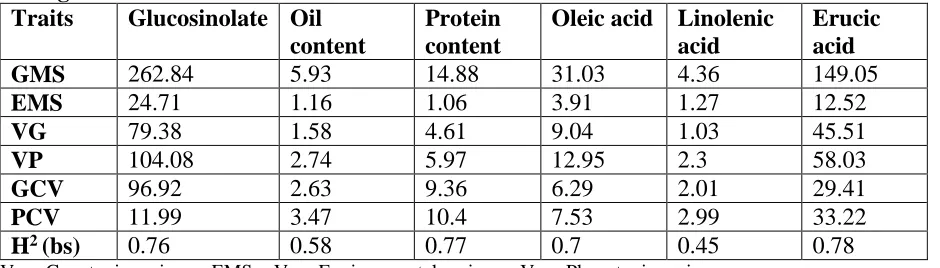
Table 3. Genetic components for various biochemical traits of advanced lines of brassica, during 2012-13
Traits Glucosinolate Oil
content
Protein content
Oleic acid Linolenic acid
Erucic acid GMS 262.84 5.93 14.88 31.03 4.36 149.05
EMS 24.71 1.16 1.06 3.91 1.27 12.52
VG 79.38 1.58 4.61 9.04 1.03 45.51
VP 104.08 2.74 5.97 12.95 2.3 58.03
GCV 96.92 2.63 9.36 6.29 2.01 29.41
PCV 11.99 3.47 10.4 7.53 2.99 33.22
H2 (bs) 0.76 0.58 0.77 0.7 0.45 0.78
Vg = Genotypic variance, EMS = Ve = Environmental variance, Vp = Phenotypic variance
Table 4. Phenotypic correlations among biochemical traits in advance lines of brassica, during 2012-13
Traits OIL PRO GSL OLEIC LINO ERUCIC
OIL -- -0.64** -0.52* 0.29 -0.19 0.30
PRO -- 0.56* -0.28 0.31 0.06
GSL -- -0.52* 0.43 0.35
OLEIC -- 0.39 -0.42
LINO -- 0.72**
ERUCIC --
OIL: Oil Contents, PRO: Protein contents, GSL: Glucosinolates, OLEIC: Oleic acid, LINO: Linolenic acid and EURCIC: Erucic acid
Conclusion
The aim of the breeders is to enhance oil content of a variety to meet the need of end users. Overall the studied parameters indicate significantly varied results among the advanced lines. AUP-05 and AUP-06 showed promising results for maximum traits. Due to the presence of high genetic variability for glucosinolate content, protein content, oleic and erucic acid, these lines could be used in future breeding programs for the improvement of the biochemical attributes.
Authors’ contributions
Conceived and designed the experiments: N Ullah, IU Jan, Z Rahman & F Ali, Performed the experiments: J Khan & MW Khan, Analyzed the data: H Ullah & I Hussain, Contributed reagents/ materials/
analysis tools: M Alam, Wrote the paper: H Raza.
References
1.Rakow G (2004). Species origin and economic importance of Brassica. In Pua EC, Douglas CJ, editors.
Biotechnology in Agriculture and Forestry (54): 3-11.
2. Warwick SI, Francis A & Al-Shehbaz IA (2006). Brassicaceae species checklist and database on CD-Rom. Plant Systematics and Evolution (259): 249-258.
3. Rich, T.C.G. 1991. Crucifers of Great Britain and Ireland. Botanical Society of the British Isles (BSBI), London. 336.
Brassica ASTRA: an integrated database for Brassica genomic research.
Nucleic Acids Research 33(2): 656-659. 5. Shah S, Molla MR, Chandra D &
Rahman L (2008). Assessment of genetic variation and relationships within the varieties of four Brassica species by RAPD markers. Australian Journal of crop science 2(3): 105-114. 6. Downey RK & Rakow GF (1987).
Rapeseed and mustard in principles of cultivar developments. W .R. Fehr (ed.) Macmillan Publishing Co, New York. (2): 437-486.
7. Khatri A, Khan IA, Siddiqui MA, Raza S & Nizamani GS (2005). Evaluation of high yielding mutants of (Brassica juncea L.) cv. S-9 developed through Gamma rays and EMS. Pakistan journal of botany 37(2): 279-284. 8. PBS (2013). Pakistan oilseed
development board. Pakistan Bureau of Statistics 22-23.
9.Ahmad, B., S. Mohammad, F. Azam, I. Ali, J. Ali and S.U. Rehman. 2013. Studies of genetic variability, heritability and phenotypic correlations of some qualitative traits in advance mutant lines of winter rapeseed (Brassica napus L.) American-Eurasian J. Agric. Environ. Sci., 13(4): 531-538. 10. Shahidi F (1990). Canola and
Rapeseed: Production, Chemistry, Nutrition and processing technology.
Van Nostrand Reinhold. New York. 355.
11. Kimber DS & McGregor DI (1995). The species and their origin, cultivation and world production. In: Brassica Oilseed; Production and Utilization. (Eds.): D.S. Kimber and D.I. McGregor. Centre for Agriculture and Biosciences International, University Press, Cambridge. 1-7.
12. Ofori A & Becker HC (2008). Breeding of Brassica rapa for biogas production:
heterosis and combining ability of biomass yield. Bioenergy Research (1): 98-104.
13. Schung E & Hanekluas S (1988). Theoretical principles for the indirect determination of the total glucosinolates content in the rapeseed meal quantifying the sulfur concentration via X-ray florescence (XRF method).
Journal of the Science of Food and Agriculture 45: 243-254.
14. Codex (1999). Codex Standard for Named Vegetable Oils. CODEX-STAN 210: 1- 16.
15. Becker HC, Löptien H & Röbbelen G (1999). Breeding: An overview. In: Biology of Brassica Coenospecies. (Ed.): C. Gòmez-Campo, Elsevier, Amsterdam pp. 413-460.
16. Shengwu HU, Ovesna J, Kucera L, Kucera V & Vyvadilová M (2003). Evaluation of genetic diversity of
Brassica napus germplasm from China and Europe assessed by RAPD markers.
Plant Soil and Environment 49(3): 106-113.
17. Engqvist MG & Becker HC (1993). Correlation studies for agronomic characters in segregating families of spring oilseed rape (Brassica rapa L.).
Heredity 118: 211-216.
18. Steel RGD & Torrie JH (1997). Principles and procedures of statistics, a biological approach, 2nd ed. Mc Graw Hill, Inc. New York, Toronto, London. 19. Burton GW & Devane EW (1953).
Estimating heritability in tall Fescue (Festuca arundinacea) from replicated clonal material. Agronomy Journal
(45): 478-481.
21. Singh RK & Chaudhary BD (1985). Biometrical methods in quantitative genetic analysis. Kalyani Publishers Ludhiana New Delhi.
22. Islam MSL, Rahman & Alam MS (2009). Correlation and path coefficient analysis in fat and fatty acids of rapeseed and mustard.
Bangladesh Journal of agriculture research 34(2): 247-253.
23. Iqbal S, Farhatullah, Nasim A, Kanwal M & Fayyaz L (2014). Heritability studies for seed quality traits in introgressed Segregating populations of brassica. Pakistan journal of botany
46(1): 239-243.
24. Khan S, Farhatullah, Khalil IH, Munir I, Khan MY & Ali N (2008). Genetic variability for morphological traits in F3:4 brassica populations. Sarhad Journal of Agriculture 24 (2): 217-222. 25. Bradshaw JE & Wilson RN (1998). In
bred line versus F1 hybrid breeding in
sweeds (Brassica napus L. var. Napo brassica Peterm). Plant Breeding 113(3): 206-216.
26. Schierholt A & Becker HC (2001). Environmental variability and heritability of high oleic acid content in winter oilseed rape. Plant Breeding
120(1): 63-66.
27. Tahir MHN, Bashir S & Bibi A (2006). Genetic potential of canola (Brassica napus L.) varieties under water stress conditions. Caderno de Pesquisa Sér. Biology 18(2): 127-135.
28. Laila F, Farhatullah, Shah S, Iqbal S, Kanwal M & Ali S (2014). Genetic variability studies in Brassica F2
populations developed through inter and intra-specific hybridization.
Pakistan J of Botany 46(1): 265-269. 29. Mahasi MJ & Kamundia JW (2007).
Cluster analysis in rapeseed (Brassica
napus L.). African Journal of
Agricultural Research 2(9): 409-411. 30. Aytac Z & Kinaci G (2009). Genetic
variability and association studies of some quantitative characters in winter rapeseed (Brassica napus L.). African Journal of Biotechnology 8(15): 3547-3554.
31. Zebarjadil A, Kakae M & Mostafaie A (2011). Genetic variability of some traits in Rapeseed (Brassica napus L.). Biharean Journal of Biology 5(2): 127-131.
32. Gangapur DR, Prakash BG, Salimath PM, Ravikumar RL & Rao MSL (2009). Correlation and path analysis in Indian mustard (Brassica juncea L. Czern and Coss). Karnataka Journal of Agriculture Science 22(5): 971-977. 33. Shaukat SR, Fahim UK & Ibni AK
(2014). Genetic variation and heritability estimates of quality traits in
Brassica napus L. Journal of Biology & Agriculture and Healthcare 4(20): 1-4. 34. Abideen SNU, Nadeem F & Abideen
SA (2013). Genetic variability and correlation studies in Brassica napus L. genotypes. International Journal of Innovation and Applied Studies 2(4): 574-581.
35. Alemayehu N, Becker & Heiko (2005). Quantitative genetic analysis of total GSL, oil and protein contents in Ethiopian mustard (B. carinata L.).
Ethiopian Journal of Education and Sciences 28(2): 141-150.