DESIGN OF COMPREHENSIVE FRAMEWORK
ON OPTIMIZATION METHODS IN DISTRIBUTED
CLUSTERS
Dr. Kiran Kumar Pulamolu
1,*, Dr. D.Venkata Subramanian
2, Dr Krishnaraj
3 1,32
Professor, Sasi Institute of Technology and Engineering
Professor, School of Computer Science, Hindustan Institute of Technology & Science, Chennai
Abstract
Keywords: Distributed Cluster, Resource Fairness, Resource Sharing, Hierarchical Cluster, MapReduce.
Received on 06 July 2018, accepted on 21 August 2018,published on 12 September 2018
Copyright © 2018 Dr. Kiran Kumar Pulamoluet al., licensed to EAI. This is an open access article distributed under the terms of the Creative Commons Attribution licence (http://creativecommons.org/licenses/by/3.0/), which permits unlimited use, distribution and reproduction in any medium so long as the original work is properly cited.
3rd International Conference on Green, Intelligent Computing and Communication Systems - ICGICCS 2018, 18.5 - 19.5.2018, Hindusthan College of Engineering and Technology, India
doi: 10.4108/eai.12-9-2018.155745
1.
Introduction
Nowadays, the growing demand for the functionalization of technology has been found in a wide spectrum of modern technology. In recent years, research is progressing in the areas of Cloud, and Big data, especially in distributed
clusters. Resource Scheduling and utilization play a prominent role in getting numerous benefits in a big data environment. Many of the organizations are equipped with technological infrastructure through scattered and limited MapReduce is a popular, open source programming paradigm to handle big data which is an industry standard large scale data processing system used by many companies like Yahoo, Google, Face book, etc. The YARN framework uses low resource fairness algorithms such as FIFO, Capacity, Fair, DRF scheduler, whereas these schedulers are not suitable for heterogeneous Hadoop clusters. Therefore, an Enhanced Combined Regression Ranking (eCRRYARN) algorithm was proposed to enhance resource fairness. The proposed algorithm uses linear regression model to estimate the expected resources to be availed by the tenants. The order ranking is given to the estimated resource and the resources shared as per the ranking provided.Hence, the Hierarchical Hadoop Cluster Resource Sharing (HHCRS) algorithm has been adopted for hierarchical distributed cluster aiming to design a cost effective cluster for organization which is spread across the globe.
servers, storage devices, networking capability and computer systems. But the processing and storage capabilities of desktops and servers are too limited to support big data applications and distributed clusters. Redundant data in multiple desktops may lead to confusion and wastage of resources primarily in storage.
Very often, the high-end servers are idle and sometimes the servers are running under high peak load. A similar kind of problem does exist in distributed and storage cluster. Many corporate companies and government agencies are spending a lot of money to migrate from a non-cloud to a cloud based environment. The main challenge lies in determining the impact of investments in the light of infrastructure and resource usage for high availability and higher performance. There exists a need to move from proprietary software to open source technologies. The popular open source technologies include Linux, Hadoop and MongoDB, etc. which are used in supporting the migration from non-cloud to cloud based application and data.
A scalable Linux based distributed cluster is one of the low-cost methodologies to address these issues and to keep track of the usage of the resources, applications and Web services. A distributed hierarchical cluster helps in connecting different nodes and locations across the globe at multiple levels. However, some of the major challenges in the Hierarchical distributed clusters are Resource Fairness, Tenants’ Truthfulness, Poor Resource Utilization, and Unfair Scheduling. This research work is carried out to address these key challenges and to avoid resource contention, and scarcity through scalable and fair resource sharing optimization frameworks and algorithms.
2. REVIEW OF LITERATURE
Cheng-Zhong Xu et al. (2015) studied a structure called CoTuner, to coordinate the configurations of VMs and resident applications for resource sharing and tuning. Georgios L. Stavrinides et al. (2017) recommended two synchronization models to establish communication through networks and files, required for synchronizing the nodes. Yanfei Guo et al. (2015) Suggested FT-MRMPI, fault tolerant MapReduce framework for HPC Clusters. The experimental results generated by applying the proposed model on a 256-nodes HPC cluster determined that FT-MRMPI succeeded in detecting the faults and in reducing the job completion time by 39%. This is a good base line for any performance measure but may not be directly applicable for a big data Hadoop cluster. There are differences in terms of performance and scalability between an open source and proprietary architecture. Yanfei Guo et al. (2014) presented a mechanism Flex slot, to identify the map stragglers automatically and alter the size of the corresponding slots to speed up the execution time. This technique change the memory size of slots of a slave node and resulted in 46% reduction in the completion time of a job over stock Hadoop and 22% over Skew Tune techniques.
Dazhao Cheng et al. (2013) proposed an approach Ant, to search the individual tasks’ optimal configurations running over multiple nodes automatically. This method achieves
this by dividing the nodes into a number of homogeneous sub-clusters and applies a self-tuning algorithm on individual sub-clusters. The experimental results by Dazhao Cheng et al. (2017) show that their flex slot technique reduces the job completion time by 46% compared to the stock Hadoop cluster and by 22% compared to Skew Tune. Shanjiang Tang et al. (2016) proposed a new fair resource allocation mechanism, the Long-Term Resource Fairness (LTRF). LTRF allows one to share the unused resources among other clients. It ensures that the clients should pay only for the resources they used. Though there are many research works carried out in optimal resource utilization in the Hadoop cluster, there exists a need to further improve fairness and thereby decrease the job completion time and improve the performance of CPU and Memory.
2.1 Research Gap
Based on the extensive literature review on the issues, challenges and opportunities, the research gap is summarized as below:
• Unpredictable truthfulness in resource sharing among tenants with non-trivial workloads.
• Lack of efficiency in resource sharing among tenants in heterogeneous distributed clusters. • The resources like CPU, Memory and Disk IO are
underutilized and more than one resource were not shared effectively in the distributed cluster.
• There is a lack guarantee for the reversal of shared resources in inter tenant and intra tenant clusters.
3.
OBJECTIVE
The design and implementation of a cost effective multi-level distributed cluster, is primarily based on the study and analysis of various frameworks and schedulers. The most popular schedulers such as the First in First out (FIFO), Fair, DRF, LTYARN, and others are considered for the comparative study and benchmarking. The objective of the present research is to ensure the performance and fairness that could be achieved in the Heterogeneous distributed cluster for all the tenants. The research objective is summarized as below:
• To incorporate ranking and linear regression with multi variables to improve performance and fairness in both intra and inter node clusters. • To develop a hybrid algorithm to include heuristics
and Weighted Arithmetic Mean (WAM) in Yet Another Resource Negotiator (YARN) to improve utilization and performance including resource fairness.
• To build a Scalable and Comprehensive Hierarchical Distributed Cluster with the proposed algorithms for inter and intra node clusters
4. MATERIALS AND METHODS
Many recent research studies highlighted the gaps in the problems of addressing resource management and issues in cloud based servers. The present research work was framed basing on the evaluation of the Performance and Fairness of Distributed clusters by adopting different methodologies like experimental evaluation, comparative study and load testing. Multiple environments with existing algorithms have been simulated in an open source platform with a test bed which includes inter-tenant and intra-tenant users. In most cases, low resource utilization was due to the existing design and resource allocation policies in Distributed Cluster configurations and pluggable schedulers.
Therefore, the resource utilization and performance of YARN, the pluggable schedulers should be analyzed and updated properly. In this study, the proposed algorithms have been tested in the distributed cluster environment for validating the behavior and performance with different workloads and the results were evaluated along with comparisons of its performance. The regression and ranking techniques were adopted to predict and rank the expected resources to be reserved. Depending on the order ranking of these workloads, resource sharing among tenants is done.
To further enhance the accuracy and precision of resource fairness, both Heuristics and a popular statistical technique WAM based resource sharing with fairness was implemented. In order to collect more performance data, a Scalable and Hierarchical Distributed cluster with heuristics is constructed as part of the case study for educational institutions. A quantitative analysis was done over the performance metrics to find the correlation between the key parameters and improvements in CPU and Memory usage with the proposed algorithms compared to the existing ones through multiple experiments with varying loads.
4.1 Establishment of YARN Framework
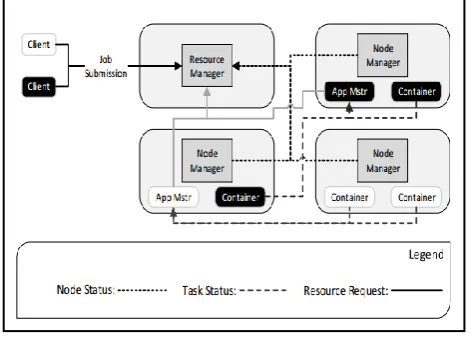
The architecture of YARN is shown in figure 1. The different daemon processes of YARN are described as follows, suppose two clients submitted their jobs at the same time: then these are assigned to the Resource Manager (RM). The RM, depending upon on the assignments
Figure 1: YARN Framework
negotiates the available resource information from the node manager and then submitted it to the AM. In turn, each AM submits a request to containers which allocate the job to the available resources depending on the NM analysis.
The container retains its vouch by sending continuous reports to the AM about the progress of the job assigned to it. The node managers monitor the application manager for utilization of the resource and execution of job status, reflecting to the RM about the status of the job, by sending periodic reports. Similarly, in runtime, the Application Master uses the interface RPC to request containers from the resource manager and to request the Node Managers to launch the scheduling algorithm.
4.2 Dynamic
Heterogeneous
Priority
Based Flow Shop(DHPFS) Algorithm
The allocation of resources is referred to as scheduling, which means that the resource (for example, CPU of a server) is used to perform a particular task (for example, sorting job), giving a guarantee for the completion of the task within a specified time. The appropriate scheduling job is selected by following different kinds of approaches. The main task is to recognize the optimal solution for the scheduling job on different processors or machines. It is critical to note that the number of jobs or processors may differ from job to job. In this work Dynamic Heterogeneity Priority based Flow shop scheduling algorithm (DHPFS) has been proposed with all the key considerations such as scheduling job’s work location used to perform different types of jobs.
DHPFS is a special case of scheduling process and client job operations have to be performed in some strict order. The DHPFS enables the flow control in a specific sequence for each job through the set of resources 1,2,….m and other sets of machines. This process can maintain the process’s constant flow, with minimum waiting time and minimum idle time.
4.2.1 DHFSS ALGORITHM
The allocation of resources is referred to as scheduling, which means that the resource (for example, CPU of a server) is used to perform a particular task (for example, sorting job), giving a guarantee for the completion of the task within a specified time. The appropriate scheduling job is selected by following different kinds of approaches. The main task is to recognize the optimal solution for the scheduling job on different processors or machines. It is critical to note that the number of jobs or processors may differ from job to job. In this work Dynamic Heterogeneity Priority based Flow shop scheduling algorithm (DHPFS) has been proposed with all the key considerations such as scheduling job’s work location used to perform different types of jobs. The flow shop process is as shown in Fig. 2.
sets of machines. This process can maintain the process’s constant flow, with minimum waiting time and minimum idle time.
Figure 2.Flow Shop Process
This proposed DHPFS is taken into account by considering the following assumptions and are summarized as
The particular operation of jobs in any kind of machine may not be preempted. Similarly, each and every machine processes on only one job; in turn each and every job is processed on only one machine.
Set-up time is contained both the time of processing and self-regulating job position in the job sequence.
The process time regarding the scheduling operation is defined on the machine as fixed, but in case of no work on machine it is zero.
Scheduling is the method by which processes or data flows are given access to system resources (e.g. processor time, communications bandwidth).The need of a scheduling algorithm is essentially generated as a requirement for most modern systems to perform multitasking (execute more than one process at a time) and multiplexing (transmit multiple flows simultaneously).
The scheduler is mainly governed by the following performance metrics concerning the above assumptions:
Throughput – is a metric of efficiency that the total No. of processes could be completed in the time of execution per unit.
Processor Utilization or CPU: The scheduler has to keep the CPU or processor utilization as busy as possible, specifically in Latency
Response time –The total time taken from the initial action (submitted user request) to the generation of the first response.
Turnaround time – The total time needed from submission to completion of user process. Alternatively, it is the sum of time periods waiting to get into memory.
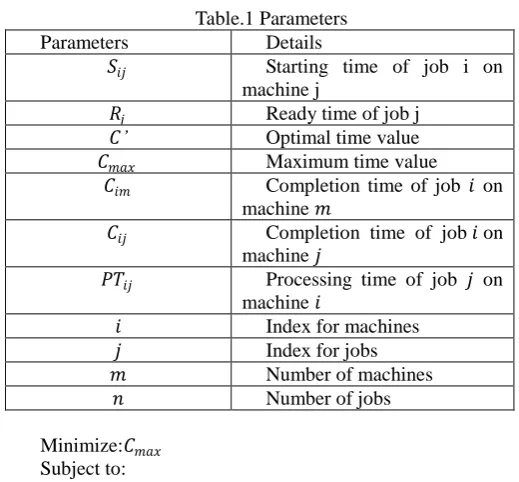
The following parameters are consider for minimize the processing time to avoid the memory less, resource contention, scarcity of resources, over-provisioning and resource fragmentation
Table.1 Parameters
Parameters Details
𝑆𝑖𝑗 Starting time of job i on
machine j
𝑅𝑗 Ready time of job j
𝐶’ Optimal time value
𝐶𝑚𝑎𝑥 Maximum time value
𝐶𝑖𝑚 Completion time of job 𝑖 on
machine 𝑚
𝐶𝑖𝑗 Completion time of job 𝑖 on
machine 𝑗
𝑃𝑇𝑖𝑗 Processing time of job 𝑗 on
machine 𝑖
𝑖 Index for machines
𝑗 Index for jobs
𝑚 Number of machines
𝑛 Number of jobs
Minimize:𝐶𝑚𝑎𝑥
Subject to:
𝐶𝑚𝑎𝑥 ≥ 𝐶𝑖𝑚 𝑓𝑜𝑟 𝑎𝑙𝑙 𝑖,
𝐶 𝑖𝑗 = 𝑆𝑖𝑗 + 𝑃𝑇𝑖𝑗 𝑓𝑜𝑟 𝑎𝑙𝑙 𝑖 𝑎𝑛𝑑 𝑗
𝑆𝑖𝑗 ≥ 𝑅𝑗 𝑓𝑜𝑟 𝑎𝑙𝑙 𝑖
𝐶𝑖𝑗 ≥ 𝐶𝑖, 𝑗 − 1 + 𝑃𝑇𝑖𝑗 𝑓𝑜𝑟 𝑎𝑙𝑙 𝑖,
𝐶𝑖𝑗 ≥ 0 𝑓𝑜𝑟 𝑎𝑙𝑙 𝑖, 𝑗
In the YARN infrastructure based Hadoop framework use the DHPFS process to avoid some of issue. The final schedule depends on their order in all two-machine problems implanted in the problem statement
Let three finite sets 𝐽, 𝑀, 𝑂 where
𝐽is defined as a set of jobs 1, … , 𝑛,
𝑀is defined as a set of machines 1, … , 𝑚, and O is defined as a set of operations 1, … , m. Denote
𝐽𝑖the𝑖 − 𝑡ℎ 𝑗𝑜𝑏 in the permutation of jobs
𝑝𝑖𝑘Processing time of the job 𝐽𝑖 ∈ 𝐽 on machine 𝑘.
(∀𝑖 ∈ 𝐽) (∀𝑘 ∈ 𝑀): 𝑣𝑖𝑘 = 𝑤𝑎𝑖𝑡𝑖𝑛𝑔 𝑡𝑖𝑚𝑒 (𝑖𝑑𝑙𝑒 𝑡𝑖𝑚𝑒) on
machine 𝑘before the start of the 𝑗𝑜𝑏 𝐽
(∀𝑖 ∈ 𝐽) (∀𝑘 ∈ 𝑀): 𝑤𝑖𝑘 = 𝑤𝑎𝑖𝑡𝑖𝑛𝑔 𝑡𝑖𝑚𝑒 (𝑖𝑑𝑙𝑒 𝑡𝑖𝑚𝑒) of
the job 𝐽𝑖after ruining processing on 𝑚𝑎𝑐ℎ𝑖𝑛𝑒 𝑘, while
waiting for machine 𝑘 + 1 to become free Define the decision variables is as following
∀𝑖, 𝑗 ∈ 𝐽: 𝑥𝑖𝑗 =
1 0
𝑖𝑓 𝑗𝑜𝑏 𝑗 𝑖𝑠 𝑎𝑙𝑙𝑜𝑐𝑎𝑡𝑒𝑑 𝑡𝑜 𝑗𝑡ℎ 𝑝𝑜𝑠𝑖𝑡𝑖𝑜𝑛 𝑖𝑛 𝑡ℎ𝑒 𝑝𝑒𝑟𝑚𝑢𝑡𝑎𝑡𝑖𝑜𝑛 𝑖.𝑒 𝑗𝑖=𝑗 𝑜𝑡ℎ𝑒𝑟𝑤𝑖𝑠𝑒
(1)
The following for mutation use the permutation DHPFS scheduling process
∀𝑖
∈ 𝐽: 𝑥𝑖𝑗 = 1 𝑛
𝑗 =1
(2) ∀𝑗 ∈ 𝐽: 𝑥𝑖𝑗 = 1
𝑛
𝑗 =1
(3) ∀𝑘 ∈ 𝑀 − 𝑚 : 𝑤1𝑘
= 0 (4) ∀𝑘 ∈ 𝑀 − 1 : 𝑣1𝑘
= 𝑝𝑖,𝑟𝑥1,𝑖 𝑛
𝑖=1 𝑘−1
𝑟=1
(5) ∀𝑖 ∈ 𝐽 − 𝑛 ∀𝑘 ∈ 𝑀 − 𝑚 : 𝑣𝑖+1+ 𝑛𝑗 =1𝑃𝑗𝑘𝑥𝑖+1,𝑗 +
𝑤𝑖+1,𝑘= 𝑤𝑖𝑘 + 𝑛𝑗 =1𝑃𝑗, 𝑘 + 1𝑥𝑖𝑗 + 𝑣𝑗 +1,𝑘+1(6)
𝐶𝑚𝑎𝑥 = (𝑣𝑖,𝑚+ 𝑝𝑗𝑚𝑥𝑖𝑗 𝑛
𝑗 =1
)
𝑛
𝑖=1
(7)
less, resource contention, scarcity of resources, over-provisioning and resource fragmentation in term of using Heterogeneity Priority based Flow shop scheduling algorithm (DHPFS) in YARN infrastructure based Hadoop framework.
4.3 eCRR-YARN to share resources in
YARN
A novel resource sharing model, enhanced Combined Regression and Ranking (eCRR) in YARN is implemented to bring resource fairness in sharing among multiple tenants, based on the rank assigned to them. The eCRR-YARN scheduler enables tenants to share multiple resources with fairness in fully distributed cloud clusters. The main goal of the implemented system is to share resources among multi tenants based on the ranking given to workloads by considering the resources preempted by tenants early. The Multiple Regression model gives you the expected resource reserved, based on the resources demanded, resources allocated, and resources preempted.
With the help of the expected resources reserved, the Order Rankings algorithm is used to assign ranks to the workloads submitted. In turn, these rankings were used to calculate the accurate resource reservation. This model shares resources with good fairness among tenants. To predict estimated resources required, a simple linear equation has been adopted, which is given below:
y = a + b1x1 + b2x2+ ……….bnxn (4.1)
In the equation 4.1, y represents the estimated resources reserved. a,b1, b2.. are constants, x1 represents the resources allocated, x2 represents the resources demanded and x3 represents the resources preempted. By taking the y value of all the tenants into consideration, ranks will be assigned to each tenant. Finally, the ranks thus generated are used to calculate the actual resources to be allocated to each tenant using the formula.
Rri = Rdi –(R-1)*C (4.2)
In the equation 4.2, R represents the Rank of the given job. Rdi represents resource demanded by the tenant and Rri is the resource reserved for that tenant and C is the constant, which can be fixed based on the average resource for tenants.
4.3.1 PSEUDO CODE
Enhanced Combined Regression Ranking algorithm
Ra: Available Resources in Cluster.
Ra= (Ra1 ...Ran) Resources Allocation. Rai denotes resource allocation for client i.
Rd = (Rd1...Rdn) resources demanded by tenants. Rdi denotes resources demanded by client i.
if Rdi less than Rai then
Uai <- Rdi #Allocate demanded resources Upi <- Rai – Rdi #Resources Preempted Else
Reg <- LinearRegression(Rai,Rdi) R <- Rank(Reg )
Rri <- Rdi –R*C Update Client i. End
Let’s consider that 50 shares are allocated to each tenant among the four tenants designed as A, B, C and D. For suppose A demands for 30 shares, immediately the request will be processed as the demand is less than the allocated resources. Following that, if B requests for 70, C for 60 and D for 80 resources, then the number of resources to be allocated to these three tenants will be calculated using eCRRYARN algorithm. The order of ranking was given basing expected demand of the resource requirement, for example consider the case of B,C and D order ranks were given as 2, 1 and 3 respectively. Then the actual resources to be allocated is calculated using Rri = Rdi –(R-1)*C, Where C is a constant depends on Standard Deviation of resources allocation to tenants.
A) Rrb = 70 –(2-1)*10
Rrb =40, so 40 resources will be allocated to tenant A
B) Rrb = 60 –(1-1)*10
Rrb =60, so 60 resources will be allocated to tenant B
C) Rrd= 80 –(3-1)*10
Rrb =60, so 60 resources will be allocated to tenant C
D) Rrd= 100 –(4-1)*10
Rrb =60, so 60 resources will be allocated to tenant D
4.4 Heuristics based Resource Sharing
YARN: HRS-YARN
The HRS-YARN scheduler enables the tenants to share resources with fairness in Multi node cloud clusters. The primary advantage of the newly implemented system is to share resources between multi tenants based on the resources available in the cluster by updating the heuristic table to efficient fairness. The heuristic table maintains the information regarding the resources that a tenant lent and borrowed to and from other tenants. This interest free loan lending model helps in attracting tenants towards sharing resources. The WAM is used to calculate the average resource requirement of all the individual tenants belonging to a cluster before sharing the resources among them. WAM is a measure of the fundamental affinity of a set of quantitative observations with different degrees of importance for these observations. Each observation is weighted depending on its importance relative to other observations. The weighted arithmetic mean is calculated by dividing the summation of the products of observations and their weights with the total weight.
table to efficient fairness. The heuristic table maintains the information regarding the resources that a tenant lent and borrowed to and from other tenants. This interest free loan lending model helps in attracting tenants towards sharing resources. The WAM is used to calculate the average resource requirement of all the individual tenants belonging to a cluster before sharing the resources among them. WAM is a measure of the fundamental affinity of a set of quantitative observations with different degrees of importance for these observations. Each observation is weighted depending on its importance relative to other observations. The weighted arithmetic mean is calculated by dividing the summation of the products of observations and their weights with the total weight.
4.4.1 WEIGHTED ARITHMETIC MEAN:
The weighted arithmetic mean is a measure of fundamental affinity of a set of quantitative observations with different importance for these observations. Each observation is weighted depending on its importance relative to other observations. The weighted arithmetic mean is calculated by dividing the summation of the products of observations and their weights with total weight.
Mathematical Definition:
Formally, the weighted mean of a non-empty set of data which means:
4.4.2 HRSYARN Pseudo code
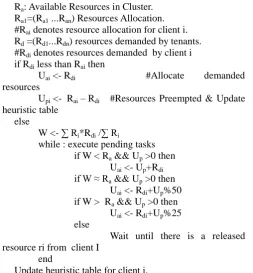
Ra: Available Resources in Cluster. Ra1=(Ra1 ...Ran) Resources Allocation. #Rai denotes resource allocation for client i. Rd =(Rd1...Rdn) resources demanded by tenants. #Rdi denotes resources demanded by client i if Rdi less than Rai then
Uai <- Rdi #Allocate demanded resources
Upi <- Rai – Rdi #Resources Preempted & Update heuristic table
else
W <- ∑ Ri*Rdi /∑ Ri
while : execute pending tasks if W < Ra && Up >0 then
Uai <- Up+Rdi if W ≈ Ra && Up >0 then
Uai <- Rdi+Up%50 if W > Ra && Up >0 then Uai <- Rdi+Up%25 else
Wait until there is a released resource ri from client I
end
Update heuristic table for client i.
4.4.3
RESOURCE SHARING IN HRSYARN
The above algorithm demonstrates the Pseudo code of HRSYARN. In this, Ra represents the set of resources available with the cluster and Rai denotes the resources allocated to tenant i. Let Rd be the resources demanded by the tenants at time t whereas, Rdi represents the resources demanded by Tenant i. The main aim of HRSYARN is to share resources with fairness among multiple tenants of a cluster. This technique uses the Weighted Arithmetic Mean (WAM) to bring out fairness in resource sharing. To understand the working of the algorithm, let’s consider case of two Tenants A and B having 50 shares each and at time t0, if A requires only 20shares whereas B requires 70. Then B will borrow the unused shares from A. Later on, if A requires excess resources than its share, in turn it will take resources back from B. At this moment, unused resources available with B will be return to A. Under circumstances of insufficient shares at B, it calculates the number of resources to be returned to A based on Weighted Arithmetic Mean (WAM) and UP value (UP: Resources preempted by a resource or tenant). Weighed arithmetic mean (WAM) is calculated by dividing the summation of product of each individual tenant’s weights and resources demanded with summation of weights of all the tenants. Total resources demanded by A will be allocated to it if WAM calculated is less than available resources and UP is greater than zero. Durable extract of the resources demanded will be assigned to A if WAM is nearly equal to available resources and UP is greater than zero. Minimum resources from demanded resources will be allocated to A if WAM is greater than available resources and UP is greater than zero. If Zero resources are available, then the tenant has to wait till some tenant preempt its resources. Heuristic tale should be updated with every transition done.
4.5
Hierarchical
Hadoop
Cluster
Resource Sharing (HHCRS)
4.5.1 ED-MEDIA USING COST EFFECTIVE
HIERARCHICAL HADOOP CLUSTER
The hierarchical Hadoop cluster can be found its use to process big data stored in multiple levels in an organization shown in Figure 3. The structural design of the hierarchical methodology is as shown in Figure.4. The architecture shows a master-slave relationship between global name node and data nodes which are coined as master node and slave node. Every intermediate node also acts as name node. Global name node is the vital node which processes user requests. It splits the user tasks into sub-tasks and share out them to the corresponding name nodes. Global node also takes care about the metadata stored in global name node which is used to process user queries. The function of global name node is also includes to manage the metadata of all the files available in every data node. The data node is installed on each cluster and is enabled to run sub-jobs allocated by parent name node. Hierarchical Hadoop cluster provides a global view of all files stored at different clusters(26).
Fig. 3: Block diagram Hierarchical Hadoop Cluster
Fig. 4: Hierarchical Hadoop Distributed File System
4.5.2 ALGORITHM
1: HHC RESOURCE SHARING PSEUDO CODE
Ca : (ca1; ca2; : : : ; can) Child clusters available
cai : choosen cluster from available clusters to process Ra: Available Resources in Cluster.
Ra1= (Ra1 ...Ran) Resources Allocation. Rai denotes
resource allocation for client i.
Rd =(Rd1...Rdn) resources demanded by tenants. #Rdi denotes resources demanded by client i
if Rdi less than Rai then
Uai <- Rdi #Allocate demanded resources
Upi <- Rai – Rdi #Resources Preempted & Update heuristic table
else
WAM <- ∑ Ri*Rdi /∑ Ri while : execute pending tasks
if WAM < Ra && Up >0 then Uai <- Rdi
if WAM ≈ Ra && Up >0 then Uai <- Rdi%50 if WAM > Ra && Up >0 then
Uai <- Rdi%25 else
Wait until there is a released resource ri from client I Update heuristic table for client i.
tenant should be updated in heuristic table. An efficient Hierarchical Hadoop cluster can be designed using HCC resource sharing algorithm adopted. Hierarchical Hadoop cluster framework can be employed to empower educational institutions to alter the way of using Information Communication Technology (ICT).
5.
RESULT AND DISCUSSION
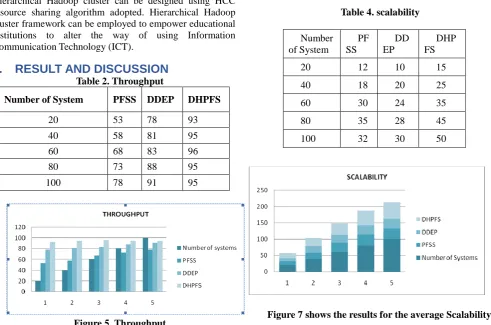
Table 2. Throughput
Number of System PFSS DDEP DHPFS
20 53 78 93
40 58 81 95
60 68 83 96
80 73 88 95
100 78 91 95
Figure 5. Throughput
Figure 5 shows the comparative results for the average throughput time. According to the contrast analysis of the experimental results, the performance of DHPFS is high and it increases the throughput by 20% compared to the remaining two algorithms.
Table 3. Completion Time
Number of System PFSS DDEP DHPFS
20 10.56 12.67 2.5
40 30.67 50.56 7.5
60 32.89 60.75 10.54
80 50.9 90.87 30.56
100 50.78 92.54 40.67
Figure 6. - Completion Time
Table 4. scalability
Number of System
PF SS
DD EP
DHP FS
20 12 10 15
40 18 20 25
60 30 24 35
80 35 28 45
100 32 30 50
Figure 7 shows the results for the average Scalability.
Manager Services to communicate with the slave clusters. Five different Java Based Map Reduce workloads have been submitted to Seven Tenants to Test the performance of the Capacity, Fair, LTYARN and HHCRS Algorithms. The experimental results show that the HHCRS Algorithm has succeeded in using the resources effectively and sharing the resources with fairness. The Performance measures for CPU utilization is shown in Tables 5, 6 and the figures 8, 9 represents the comparison of CPU and Memory utilization between the existing and the proposed fair scheduling algorithms.
Table 5: Performance Measure - CPU Utilization
SCHEDUL ING ALGORIT HM T 1 T 2 T 3 T 4 T 5 T 6 T 7 T 8 Average Time CPU Time Capacity Scheduler 2 2 9 7 2 5 7 6 0 1 6 8 5 2 3 4 4 7 0 1 6 8 5 3 3 4 4 7 0 5 7 6 0 1 9 9 1
2 157047
Fair Scheduler 2 1 5 5 5 4 3 4 3 1 5 4 3 5 3 3 0 5 3 1 5 4 3 5 3 3 0 5 3 4 3 4 3 1 8 4 9
5 145710
LTYARN Scheduler 2 0 8 3 5 3 6 2 3 1 4 7 1 5 3 2 3 3 3 1 4 7 1 5 3 2 3 3 3 3 6 2 3 1 7 7 7
5 139950
HHCRS Scheduler 2 0 4 9 8 3 2 8 5 1 4 3 7 8 3 1 9 9 5 1 4 3 7 8 3 1 9 9 5 3 2 8 5 1 7 4 3
8 137250
Table 6: Performance Measure - Memory Utilization
SCHEDULI NG ALGORITH M T 1 T 2 T 3 T 4 T 5 T 6 T 7 T 8 Average Memory Usage Capacity Scheduler 8 5 4 6 8 5 4 6 3 4 1 6 3 4 1 6 3 4 1 6 3 4 1 6 8 5 4 6 3 4 8
3 42782
Fair Scheduler 8 0 3 3 8 0 3 3 2 9 0 3 2 9 0 3 2 9 0 3 2 9 0 3 8 0 3 3 2 9 7
0 38678
LTYARN Scheduler 7 1 6 9 7 1 6 9 2 0 3 9 2 0 3 9 2 0 3 9 2 0 3 9 7 1 6 9 2 1 0
6 31766
HHCRS Scheduler 6 2 2 4 6 2 2 4 1 0 9 4 1 0 9 4 1 0 9 4 1 0 9 4 6 2 2 4 1 1 6
1 24206
Fig 8: Comparison of Scheduling Algorithms – CPU Utilization
Fig 9: Comparison of Scheduling Algorithms – Memory Utilization
6.
SUMMARY
On the basis of heuristic and WAM information, resources are reserved for the tenants. In this model, 30% improvement in the performance of the cluster is observed, compared to the existing models. The experimental results demonstrate the improved performance of the HHCRS algorithm over other scheduling algorithms with respect to CPU and memory utilization. It improves the resource utilization by 30% and succeeded in acquiring resource fairness in cloud based clusters. Whenever the fairness percentage increases in terms of resource sharing the performance gradually improves. Therefore, this work confirms that there exists a strong correlation between performance and resource fairness is accepted. The experiments also proved that there are very marginal differences in CPU response and memory utilization in intra and inter tenants’ resource utilization.
7. FUTURE DIRECTIONS
The HDFS stores data using the n-fold technique. The n value can be configured by the administrators. In the name of replication, a large volume of storage is wasted and therefore, the performance of the storage system decreases and also the amount of bandwidth used is increased. Another issue with the distributed Cluster is the name node which is a single point of failure. Though the Secondary name node exists in the cluster, this Secondary name node and name node are configured in the Active-Passive mode. The distributed cluster may be studied further with commodity hardware with multiple name nodes in active-active configurations. Future studies are required to include Security, Privacy and Confidentiality in the e-Learning deployed over the Hierarchical distributed Cluster. The e-learning framework and appropriate data mining tools can be integrated to further enhance the proposed algorithms.
8.
REFERENCES
1. K. Govindarajan, T. S. Somasundaram, V. S. Kumar, et al., Continuous clustering in big data learning analytics, in: Technology for Education (T4E), 2013 IEEE Fifth International Conference on, IEEE, 2013, pp. 61–64. 2. Di Jian and Yanfeng Peng, Research of performance of
distributed platforms based on clustering algorithm., JCP 11 (2016), no. 3, 195–200.
3. X. Bu, J. Rao, C.-Z. Xu, Coordinated self-configuration of virtual machines and appliances using a model-free learning approach, IEEE transactions on parallel and distributed systems 24 (4) (2013) 681–690.
4. G. L. Stavrinides, F. R. Duro, H. D. Karatza, J. G. Blas, J. Carretero, Different aspects of workflow scheduling in large-scale distributed systems, Simulation Modelling Practice and Theory 70 (2017) 120–134. 5. Y. Guo, W. Bland, P. Balaji, X. Zhou, Fault tolerant
mapreduce - mpi for hpc clusters, in: Proceedings of the International Conference for High Performance Computing, Networking, Storage and Analysis, ACM, 2015, p. 34.
6. Y. Guo, J. Rao, C. Jiang, X. Zhou, Flexslot: Moving
hadoop into the cloud with flexible slot management, in: High Performance Computing, Networking, Storage and Analysis, SC14: International Conference for, IEEE, 2014, pp. 959–969.
7. D. Cheng, J. Rao,Y. Guo, C. Jiang, X. Zhou, Improving performance of heterogeneous mapreduce clusters with adaptive task tuning, IEEE Transactions on Parallel and Distributed Systems 28 (3) (2017) 774–786.
8. S. Tang, B.-S. Lee, B. He, H. Liu, Long-term resource fairness: Towards economic fairness on pay-as-you-use computing systems, in: Proceedings of the 28th ACM international conference on Supercomputing, ACM, 2014, pp. 251–260.
9. J. Lin, F. Liang, X. Lu, L. Zha, Z. Xu, Modeling and designing fault-tolerance mechanisms for mpi-based mapreduce data computing framework, in: Big Data Computing Service and Applications (Big Data Service), 2015 IEEE First International Conference on, IEEE, 2015, pp. 176–183.
10. I. A. Moschakis, H. D. Karatza, Multi-criteria scheduling of bag-of-tasks applications on heterogeneous interlinked clouds with simulated annealing, Journal of Systems and Software 101 (2015) 1–14.
11. K.Wang, N. Liu, I. Sadooghi, X. Yang, X. Zhou, T. Li, M. Lang, X.-H. Sun, I. Raicu, Overcoming hadoop scaling limitations through distributed task execution, in: Cluster Computing (CLUSTER), 2015 IEEE International Conference on, IEEE, 2015, pp.236–245. 12. D. E. Difallah, G. Demartini, P. Cudré-Mauroux,
Scheduling human intelligence tasks in multi-tenant crowd-powered systems, in: Proceedings of the 25th International Conference on World Wide Web, International World Wide Web Conferences Steering Committee, 2016, pp. 855–865.
13. G. L. Stavrinides, H. D. Karatza, Scheduling real-time parallel applications in SaaS clouds in the presence of transient software failures, in: Performance Evaluation of Computer and Telecommunication Systems (SPECTS), 2016 International Symposium on, IEEE, 2016, pp. 1–8.
14. Y. Yao, J. Wang, B. Sheng, C. C. Tan, N. Mi, Self-adjusting slot configurations for homogeneous and heterogeneous hadoop clusters, IEEE Transactions on Cloud Computing 5 (2) (2017) 344–357.
15. D. Cheng,Y. Guo, X. Zhou, Self-tuning batching with dvfs for improving performance and energy efficiency in servers, in: Modeling, Analysis and Simulation of Computer and Telecommunication Systems (MASCOTS), 2013 IEEE 21st International Symposium on, IEEE, 2013, pp. 40–49.
16. F. Zhou, H. Pham, J. Yue, H. Zou, W. Yu, Sfmapreduce: An optimized mapreduce framework for small files, in: Networking, Architecture and Storage (NAS), 2015 IEEE International Conference on, IEEE, 2015, pp. 23– 32.
18. B. Sharma, T. Wood, C. R. Das, Hybridmr: A hierarchical mapreduce scheduler for hybrid data centers, in: Distributed Computing Systems (ICDCS), 2013 IEEE 33rd International Conference on, IEEE, 2013, pp. 102–111.
19. S. Nair, J. Mehta, Clustering with apache hadoop, in: Proceedings of the International Conference & Workshop on Emerging Trends in Technology, ACM, 2011, pp. 505– 509.
20. D. V. Subramanian, K. P. Kumar, Fuzzy based modeling for an effective it security policy management, in: SAI Computing Conference (SAI), 2016, IEEE, 2016, pp. 173–181.
21. A. H. Ibrahim, H. E.-D. M. Faheem, Y. B. Mahdy, A.-R. Hedar, Resource allocation algorithm for gpus in a private cloud, International Journal of Cloud Computing 5 (1-2) (2016) 45–56.
22. M. Al-Ayyoub, M. Daraghmeh, Y. Jararweh, Q. Althebyan, Towards improving resource management in cloud systems using a multi-agent framework, International Journal of Cloud Computing 5 (1-2) (2016) 112–133.
23. G. L. Stavrinides, H. D. Karatza, Scheduling different types of applications in a saas cloud, in: Proceedings of the 6th International Symposium on Business Modeling and Software Design (BMSD16), 2016, pp. 144–151. 24. Bhavin J Mathiya and Vinodkumar L Desai, Apache
hadoop yarn mapreduce job classifi- cation based on cpu utilization and performance evaluation on multi-cluster heterogeneous environment, Proceedings of International Conference on ICT for Sustainable Development, Springer, 2016, pp. 35–44.