_____________________________________________________________________________________________________ *Corresponding author: E-mail: [email protected];
(Past name: American Chemical Science Journal, Past ISSN: 2249-0205)
Extraction, Characterization and Application of
Cashew Nut Shell Liquid from Cashew Nut Shells
Sampson Kofi Kyei
1,2*, Onyewuchi Akaranta
1, Godfred Darko
3and Uche J. Chukwu
11Africa Centre of Excellence in Oilfield Chemicals Research, Department of Pure and Industrial
Chemistry, University of Port Harcourt, Nigeria.
2Department of Chemical Engineering, Kumasi Technical University, Kumasi, Ghana. 3
Department of Chemistry, Kwame Nkrumah University of Science and Technology, Kumasi, Ghana.
Authors’ contributions
This work was carried out in collaboration among all authors. Authors SKK and OA gave concept of the study. Author SKK designed the study, analyzed and interpreted the data and drafted the article. Authors OA, GD and UJC administrated and supervised the project and final approval of the version to be submitted.
Article Information
DOI: 10.9734/CSJI/2019/v28i330143 Editor(s): (1) Prof. Dimitrios P. Nikolelis, Department of Chemistry, Athens University, Panepistimiopolis-Kouponia, 15771-Athens, Greece. Reviewers: (1)H. Y. He, Shaanxi University of Science and Technology, China. (2)Then Yoon Yee, International Medical University, Malaysia. Complete Peer review History:http://www.sdiarticle4.com/review-history/53190
Received 25 September 2019 Accepted 30 November 2019 Published 11 December 2019
ABSTRACT
In this study, cashew nut shell liquid has been extracted from cashew nut shells using an accelerated solvent extraction technique and was employed as a precursor for the synthesis of cashew nut shell liquid resin. The extract was a dark brown viscous liquid with an average yield of 30.61±0.200%. Results of the physical analysis showed a moisture content of 4.45±0.020% and a density of 0.95±0.300 gcm-3. The percentage brix and refractive index were 76.20±0.001 and 1.47 ±0.010 respectively. Chemical characterization showed a pH of 5.65±0.003; acid value of 8.25± 0.200 mg KOH/g; ash content of 1.80±0.6%; free fatty acid of 4.12±0.400 mg KOH/g; ester value of 247.01±0.100 mg KOH/g and a saponification value of 255.26±0.800 mg KOH/g. The FTIR spectra revealed that cashew nut shell liquid is polymeric. These findings confirm that higher phenolic compounds which can be used as potential precursors in industrial applications could be obtained from agro wastes.
Practical Applications: Cashew nut shell liquid, an extract from cashew nut shell, an agro waste has a wide range of functional products. A practical application is synthesis of a high viscous, flexible cashew nut shell liquid resin with physical properties that are consistent with literature and could also be further used in other industrial applications. Further processing of cashew nut shell for the development of value added products like resin can be a better option.
Keywords: Cashew; food processing; accelerated solvent extraction; resin; phenolic compounds.
1. INTRODUCTION
Nature is endowed with many resources which can be exploited for diverse gains – some of which are water, wind, solar energy, plants and animals. Majority of our foodstuffs are generated from processing of plant produce which are, either eaten raw or further processed into other edible products. Cashew (Anarcadium occidentale L.), a plant with versatile benefits is produced majorly in Asia and Africa [1]. The cashew apple is processed into many value enhanced products like cashew apple fruit drinks, confectionery, juice, jelly, jam, syrup, chutney and beverage which provides consumers with vitamins A and C [2,3,1]. The processing and application of plant and food resources result in generation of waste materials, which must be effectively managed via recycling, reuse and/or improved design to enable us achieve the targets of the United Nation’s Sustainable Development Goals 11 and 12 [4].
Cashew nut shell, an agro waste from the food processing and agro-based industries, necessitates proper disposal so it does not contribute to sanitation challenges which may result in environmental pollution. Of late, scientists have been exploring the use of agro-wastes as a source of raw materials (precursors) in synthesizing a number of benign functional products, value-added chemicals, sustainable energy research areas [5] and into upgraded products [6]. Thus, the cashew tree aside its several phytochemical benefits could offer consumers not only the foodstuffs from industry but also the waste generated through processing could be valorized or processed into other products. The challenge of agro-waste generation from cashew nuts shell can be addressed by employing the extracted liquid for other applications. Abreu et al. [7] employed extracts from cashew nut shell as a diet additive for layers and discovered that cashew nut shell liquid reduces lipid oxidation in fresh and spray dried egg yolks. This is attributable to the medicinal, anti-oxidant and anti-microbial
characteristics of cashew nut shell liquid [8]. Kanehashi et al. [9] developed a bio-based polymer from cashew nut shell liquid and 2-methylcardol for health care applications which unraveled antimicrobial activities against both E. coli and S. aureus.
The cashew nut shell, an agro-waste, has now become a raw material for polymer synthesis [10], a source of petrochemical phenolic compounds [11,12] and also an intermediates or precursors for other chemical synthesis. Subsequent to the availability of cashew nut shell in the food processing industry, the liquid can be extracted and deployed for other industrial applications, which is a novel approach of adding value to agro-waste in the context of sustainable development.
The current scientific research is directed towards concerted efforts to employ economic, time-saving and efficient methods that would accomplish desired results. Literature on the application of methods that overcome extraction challenges like expensive costs of reagents and solvents, low yield, contamination of final product and cost effectiveness of energy employed is scanty. Traditional methods of extraction e.g. soxhlet apparatus has some shortcomings; the major one being “lower yields” of extracts. Accelerated solvent extraction, which is superior to soxhlet extraction, is an automated extraction technique that uses less solvents, elevated temperatures and pressures to achieve extractions in very short periods of time. For example, 10 g of sample can be extracted in less than 15 minutes, using less than 15 mL of solvent.
2. MATERIALS AND METHODS
2.1 Chemicals and Reagents
The acetone, diatomaceous earth, buffer tablets, ethyl alcohol, phenolphthalein indicator solution, potassium hydroxide solution (KOH), alcoholic potassium hydroxide, hydrochloric acid, formaldehyde, sodium hydroxide pellets (NaOH), were obtained from Loba Chemie (Mumbai, India). All chemicals were of analytical grade and were used as received.
2.2 Cashew Nut Collection and
Pretreatment
Large quantities of cashew nuts were obtained from Kintampo (GPS 8º02’60.00N-1º42’59.99”W) market in the Bono East Region of Ghana. The nuts were sorted, washed thoroughly with distilled water and dried in the sun for 24 hours. With the aid of a knife, the cashew nuts were removed from the apple and the shells were dried in the sun for 24 hours. The dried shells were crushed using mortar and pestle and, the remaining moisture removed by drying in an oven at a temperature of 60ºC for 96 hours [13].
2.3 Extraction of Cashew Nut Shell Liquid
The extraction was performed using an accelerated solvent extractor (Thermo Scientific Dionex ASE 350 Waltham, USA). The dried and crushed shell (180 g) was mixed with diatomaceous earth (1:2) drying agent. Aliquots (20 g) of each were transferred into 9 sample cells and the end caps (each containing a frit) and tightened into the cells. The filled sample cells and collection vessels were loaded onto the cell and collection trays respectively. The samples were extracted with acetone using these accelerated solvent extraction conditions: 1000 psi, 80ºC, 5 minute heat up, three 5-minute static cycles, 100% rinse, 60-second purge, and nine 20 mL cell containing nine cellulose filter.
The concentration of the cashew nut shell liquid was done under vacuum at 50ºC in a rotary evaporator (Cole - Parmer). The concentrate in a beaker, was wrapped in aluminium foil and stored at room temperature.
2.4 Oil Yield Determination
The percentage yield of the cashew nut shell liquid was determined at the end of the extraction. It was computed by simple
determination of the mass extracted, expressed as a percentage of the mass of cashew nut shell sample [14]. Mathematically, the % yield was calculated using the Equation 1.
% = /
( ) × 100 (1)
2.5 Characterization of Cashew Nut Shell Liquid
2.5.1 Physical analysis
The moisture content was determined using a moisture analyzer (Sartorius MA 35 Hamburg, Germany). The analyzer was calibrated using the operator’s manual. After calibration, a filter pad was put in the moisture pan and tarred. A syringe was used to fetch 1 mL of the sample into the pan and the door was closed. The start button was pressed for the reading to begin. A beep indicated the end of the task with a display of the percentage moisture content on the screen. Two other replicate determinations were made.
Density was measured with the aid of a density meter (A. KRÜSS Optronic GmBH – DS7800, Hamburg USA). The analyzer was first calibrated using the operator’s manual. Afterwards, an aliquot of 0.9 mL CNSL was taken using a syringe into the density meter. Viewing from the window, the filling was done carefully to ensure there were no air bubbles in the sample. The density of the sample was determined in triplicates.
The refractive index of the cashew nut shell liquid was determined in a refractometer (A. KRÜSS Optronic GmBH – DR6300-TF, Hamburg USA). The analyzer was first calibrated and a syringe was used to sample 0.9 mL of CNSL into the port. Afterwards, the system was started and the result noted. The percentage brix was taken simultaneously on the same analyzer. In both cases, replicate measurements were determined.
2.5.2 Chemical analysis
Standard methods as described by the Association of Official Analytical Chemists (AOAC) was followed in all determinations. Chemical parameters determined are pH, acid value, free fatty acid, saponification value, ester value, percentage glycerin and ash content.
2.5.2.1 Potential hydrogen (pH) determination
pH meter was calibrated with buffer solutions of pH 4.0, 7.0 and 9.0 prepared from tablets of BDH buffer. About 2 mL of the sample was put in a container and the electrode inserted into it. The start button of the pH meter was pressed and the pH read and recorded. In this case also, replicate measurements were determined.
2.5.2.2 Acid value and free fatty acid determination
The acid value was measured using the standard method described by AOAC International [15] with slight modification. Exactly 0.25 g of the sample was weighed in a 250 mL Erlenmeyer flask and 75 mL of freshly neutralized hot ethyl alcohol was added. Afterwards, 1 mL of phenolphthalein indicator solution was added to the mixture. The mixture was then boiled for about 5 minutes. The hot mixture was titrated against 1 M KOH solution with vigorous shaking until a pink colour appeared. Titration was done in triplicate and the average titre value was recorded. The acid value (AV) and free fatty acid (%FFA) were calculated using the Equations 2 and 3 respectively.
= × × = (2)
=
% ( ) = × 0.53 (3)
2.5.2.3 Determination of saponification value
This was determined according to the method described by AOAC International [15]. The sample was filtered to get rid of all impurities and 2 g was weighed into a 250 mL Erlenmeyer flask. Then 25 mL of 0.5 N alcoholic potassium hydroxide solution was pipetted into the flask. A reflux condenser was attached and the contents heated on a boiling water bath for 1 hour after which saponification was completed. This was confirmed by clarity of the solution. After 10 minutes of cooling, 3 drops of phenolphthalein indicator was added and the excess potassium hydroxide was titrated with 0.5 N hydrochloric acid. The volume of acid used was recorded as mL of HCl required by sample. A blank determination was conducted by repeating the procedure but without the sample. The volume of acid used was recorded as mL of HCl required by blank. The saponification value (SV) was calculated using Equation 4.
= 56.1 ( − ) × (4)
where
SV = saponification value
B = volume of HCl required by blank S = volume of HCl required by sample N = normality of standard HCl
2.5.2.4 Determination of ester value
This was calculated from the saponification and acid values using Equation 5.
( ) = ( )
− ( ) (5)
2.5.2.5 Ash content determination
A porcelain crucible was heated, cooled and weighed. Exactly 1.5 g of the sample was weighed and placed in the crucible. The crucible containing the sample was placed in a muffle furnace (Thermo Scientific Thermolyne FB1310M-33 Mumbai, India) and incinerated at a temperature of 600ºC for 2 hours. Afterwards, the crucible with the content was removed, cooled in a desiccator and weighed. The percentage ash content (%Ash) was calculated using Equation 6.
% ℎ = ℎ + ℎ − ℎ
ℎ × 100%
(6)
2.6 Fourier Transform Infrared
Spectroscopy (FTIR)
The cashew nut shell liquid was subjected to Fourier transform infrared spectroscopic (FTIR) analysis to ascertain the various functional groups using a Bruker Alpha Platinum ATR in the wavelength range of 500–4000 cm-1. The diamond was cleaned with isopropanol and a background scan was taken. The sample was then placed directly on the crystal and the pressure gauge was applied to ensure maximum contact. The sample was then scanned and the spectrum generated.
2.7 Conversion of Cashew Nut Shell Liquid into Cardanol
The cashew nut shell liquid extract was kept on the shelf for 2 to 3 days for
2.8Synthesis of Cashew Nut Shell Liquid Resin
The resin was synthesized using a modified protocols developed by Akaranta and Aloko [17] and Keetasombat and Soykeabkaew [18]. The following reagents were mixed in a beaker: 10 mL of cashew nut shell liquid (cardanol), 15 mL of formaldehyde and 5 mL of 1M NaOH using a magnetic stirrer. The contents were heated at a temperature range of 75–85ºC and stirred simultaneously for one hour. The temperature and curing times were varied until a high viscous good surface finish product was obtained. The formation of the resin was evidenced by the appearance of a brownish colour. This is an alkali catalyzed reaction. Physical properties of the resin were determined in duplicate and recorded.
3. RESULTS AND DISCUSSION
3.1 Physicochemical Properties of
Cashew Nut Shell Liquid
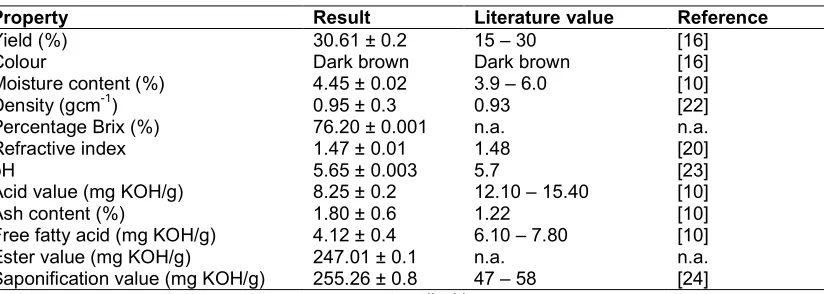
A summary of the physical and chemical characteristics of the cashew nut shell liquid are presented in Table 1. Extraction of cashew nut shell liquid from the shell material with less volume of acetone gave a dark brown coloured liquid with a high yield of 30.61%. The yield obtained in this work is higher than the yields obtained in a similar work by Gandhi et al. [19] and Gandhi et al. [20] which may be attributable to the accelerated solvent extraction technique and the ketonic solvent used in the extraction. In their work, Lochab et al. [16] reported that higher yields of cashew nut shell liquids are accomplished by employing polar organic solvents at high temperature and pressure.
The low moisture content (4.45%) recorded is comparable to literature and could be an indication that the liquid has a longer shelf life since the rate of microbial growth has a positive correlation with water content. A density (specific gravity) of 0.95 gcm-1 at 30ºC agrees with literature [21] and indicates that the liquid is less dense than water. The %brix which is the percentage of soluble solids content of the cashew nut shell liquid is 76.2%. The value suggests that the sum/percentage of total solids such as carbohydrates, protein, etc. that are dissolved in the liquid. Moreover, the refractive index, which is the level of optical clarity of the cashew nut shell liquid relative to water is 1.47. This could mean that the liquid is denser than water and other oils with lower refractive indices. The optimal refractive index might confirm the presence of unsaturation and side chains of fatty acid in the liquid [15]. The value of this property is comparable to what exists in literature [13,2].
The pH value of 5.65 indicates the cashew nut shell liquid is acidic. The acidity could be attributable to the presence of anacardic acid in technical grade cashew nut shell liquid [9]. The acid value of cashew nut shell liquid is 8.25 mg KOH/g which is below the range 12.10 – 15.40, reported by Balgude and Sabnis [10]. Although the acid value is below the standard limit, it could be an indication that the liquid has not been degraded or oxidized and would be a good precursor for the synthesis of resins for anticorrosion coatings [25].
The ash content, which is 1.8% was considerably higher than 1.2% and 1.53% reported by Balgude and Sabnis [10] and Taiwo [22] respectively. This may be an indication of a high slagging and inorganic matter tendency of the cashew nut shell liquid. Moreover, it gives
Table 1.Physicochemical properties of cashew nut shell liquid
Property Result Literature value Reference
Yield (%) 30.61 ± 0.2 15 – 30 [16]
Colour Dark brown Dark brown [16]
Moisture content (%) 4.45 ± 0.02 3.9 – 6.0 [10]
Density (gcm-1) 0.95 ± 0.3 0.93 [22]
Percentage Brix (%) 76.20 ± 0.001 n.a. n.a.
Refractive index 1.47 ± 0.01 1.48 [20]
pH 5.65 ± 0.003 5.7 [23]
Acid value (mg KOH/g) 8.25 ± 0.2 12.10 – 15.40 [10]
Ash content (%) 1.80 ± 0.6 1.22 [10]
Free fatty acid (mg KOH/g) 4.12 ± 0.4 6.10 – 7.80 [10]
Ester value (mg KOH/g) 247.01 ± 0.1 n.a. n.a.
Saponification value (mg KOH/g) 255.26 ± 0.8 47 – 58 [24]
credence to the moisture content of 4.45% since a higher ash content means higher concentration of minerals/inorganics and a lower moisture content.
The free fatty acid of the liquid is 4.12 mg KOH/g and is lower than the previously reported range of 6.10 – 7.80 mg KOH/g by Balgude and Sabnis [10]. The free fatty acid content of an oil is an index of its quality and hence the cashew nut shell liquid is likely of a good quality with a lower level of enzymatic hydrolysis or degeneration [26]. The ester value of the cashew nut shell, which is the difference between the saponification and acid values is 247.01 mg KOH/g. This high ester value is due to the low free fatty acid of 4.12 mg KOH/g. A high ester value is an indication of the presence of high ester and a corresponding low molecular weight fatty acid content and vice versa [27].
The saponification value of the oil is 255.26 mg KOH/g. This is higher than the range of 47-58 mg KOH/g reported by Balgude and Sabnis [11] and 53 mg KOH/g in an earlier study [24]. This means that the cashew nut shell liquid may be used as a starting material for the synthesis of soap, candles and other lubricants [26] due to the lower molecular weight of fatty acids.
3.2 FT-IR Spectrum of Cashew Nut Shell Liquid
The FTIR spectra of cashew nut shell liquid is presented in Fig 1. The broad peak at 3407 cm-1 is characteristic of normal “polymeric” –OH stretch while the absorption band at 3078 cm-1 corresponds to aromatic C–H stretch. Other notable peaks at 3008, 2924 and 2853 cm-1 may be attributed to unsaturated hydrocarbon moiety, C–H asymmetric and symmetric stretching vibrations of the alkyl side chains. There are also C=C aromatic stretching bands at 1604 and 1450 cm-1. The sharp C–H vibration peaks at 993
and 911 cm-1 could be ascribed to conjugated
cis-trans double bond and terminal vinyl group in polycardanol respectively. The absorption peak at 644 cm-1 was revealed also in other literature studies as for the vinyl peak [16]. The spectra indicates that cashew nut shell liquid is polymeric and possesses carboxylic and hydroxy groups substituted on the phenolic constructions as confirmed in literature [24,10,28].
3.3 Physical Properties of Cashew Nut Shell Liquid Resin
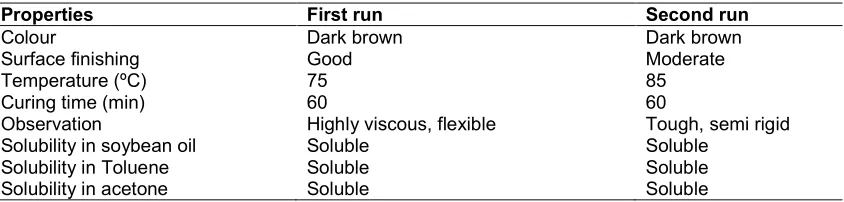
Table 2 displays the physical properties of the synthesized cashew nut shell liquid resin.
The alkali catalyzed resin was synthesized with a good surface finish at an optimal heating temperature of 75ºC, the point at which the separation between the CNSL-resin and water has occurred as seen in Table 2. This is comparable to results obtained by Ikeda, et al. [29] who worked on the curing behavior of crosslinkable polymers from cashew nut shell liquid. It could be suggested that at this temperature, the resin was having a low viscosity and the curing time informed the differences in viscosity [30]. The low optimal curing temperature may be due to the fact that a supposed lighter molecule is being polymerized in this reaction and hence a lower energy would be required for the breaking of the phenolic moieties during the crosslinking [31]. We can, therefore, confirm that the conditions in the first run could be used to synthesize CNSL-resins for industrial applications.
The CNSL-resin was found to be soluble in raw soybean oil, toluene and acetone (Table 2). Solubility in soybean oil could be attributable to the presence of long side chains in the phenolic construction of the cashew nut shell liquid. Similar chemical properties of these chains might have informed the solubility of the resins [17].
Table 2. The physical properties of the cashew nut shell liquid resin
Properties First run Second run
Colour Dark brown Dark brown
Surface finishing Good Moderate
Temperature (ºC) 75 85
Curing time (min) 60 60
Observation Highly viscous, flexible Tough, semi rigid
Solubility in soybean oil Soluble Soluble
Solubility in Toluene Soluble Soluble
Fig. 1. FTIR spectrum of cashew nut shell liquid
OH
R +
H H
O
NaOH Heat
OH O
R
OH O
R
OH
R +
OH
R OH
R
OH
C H2
R
OH
R C H2
R
H2C
HO
C C
H H
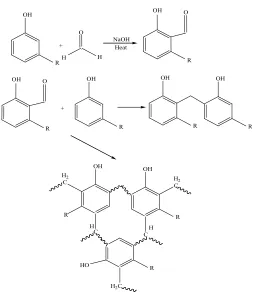
Scheme 1. Proposed crosslinked structure of CNSL-formaldehyde resin
The co-polymerization of cashew nut shell liquid (cardanol) with formaldehyde in the presence of alkali yields condensation polymers formed via electrophilic substitution reaction. The reaction then continues yielding a relatively high molecular mass structure of crosslinked CNSL-formaldehyde resin [18] as shown in Scheme 1. The resin synthesized in the second run was
tough and semi rigid which suggests that hardness is often dependent on the extent of crosslinking [31].
coatings, friction materials, surfactants and as intermediates for the synthesis of other resins [32].
4. CONCLUSION
Extraction of cashew nut shell liquid from cashew nuts shells gave a higher yield with the use of less volume of acetone as the extracting solvent via accelerated solvent extraction technique. Physicochemical parameters mostly were consistent with literature values and FTIR characterization of the extract has confirmed that the liquid is polymeric and possesses carboxylic and hydroxyl groups substituted on the phenolic constructions. The optimum heating temperature for the synthesis of CNSL-resin is 75ºC at a curing period of 60 minutes. A comprehensive study of the chemistry of the CNSL-resin would require further physicochemical and thermal characterization which is currently underway.
HIGHLIGHTS
Cashew nut shell liquid has been extracted from cashew nut shell, an agro waste.
Accelerated solvent extraction (ASE) is a great tool which requires lower volumes of solvent to produce higher yields of extracts.
Physicochemical analysis showed the liquid/oil is of an acceptable quality.
Cashew nut shells can be converted to a precursor for the synthesis of resin for industrial applications.
ACKNOWLEDGEMENT
The authors are grateful to the Africa Centre of Excellence in Oilfield Chemicals Research, Department of Pure and Industrial Chemistry, University of Port Harcourt, Nigeria for providing the funding graduate studies. Comments from all reviewers is highly appreciated.
COMPETING INTERESTS
Authors have declared that no competing interests exist.
REFERENCES
1. Swain MR, Ray RC. Fermentation of cashew (Anarcadium occidentale L.) “Apple” into wine. Journal of Food Processing and Preservation. 2006; 30(2006):314–322.
2. Idah PA, Imologie SI, Mohammed MA. Extraction and characterization of cashew nut (Anacardium occidentale) oil and cashew shell liquid oil. Academic Research International. 2014;5(3):50–54. (Available:www.savap.org.pk%5Cnwww.jo urnals.savap.org.pk
3. Oyeyinka AT, Odukoya JO, Adebayo YS. Nutritional composition and consumer acceptability of cheese analog from soy and cashew nut milk. Journal of Food Processing and Preservation. 2019;1–6. Available:https://doi.org/10.1111/jfpp.1428 5
4. Uinited Nations. Transforming our World: The 2030 Agenda for Sustainable Development; 2016.
Available:https://doi.org/10.1201/b20466-7 5. Agwu OE, Akpabio JU. Using agro-waste
materials as possible filter loss control agents in drilling muds: A review. Journal of Petroleum Science and Engineering. 2018;163:185–198.
Available:https://doi.org/10.1016/j.petrol.20 18.01.009
6. Jan K, Riar C, Saxena C. Value addition to agro industrial by-products: Effect of temperature and plasticizer on various properties of pellets developed using extrusion technology. Journal of Food Processing and Preservation; 2017. Available:https://doi.org/10.1111/jfpp.1325 7
7. Abreu V, Pereira A, De Freitas E, Trevisan M, Da Costa J, Braz N. Cashew nut shell liquid supplementation and the effect on lipid oxidation and color in fresh and spray-dried eggs. Journal of Food Processing and Preservation. 2016;1–9.
Available:https://doi.org/10.1111/jfpp.1300 1
8. Quirino RL, Garrison TF, Kessler MR. Matrices from vegetable oils, cashew nut shell liquid, and other relevant systems for biocomposite applications. Green Chemistry. 2014;16(4):1700–1715.
Available:https://doi.org/10.1039/c3gc4181 1a
9. Kanehashi S, Masuda R, Yokoyama K, Kanamoto T, Nakashima H, Miyakoshi T. Development of a cashew nut shell liquid (CNSL)-based polymer for antibacterial activity. Journal of Applied Polymer Science. 2015;132(45):1–9.
10. Balgude D, Sabnis AS. CNSL: An environment friendly alternative for the modern coating industry. Journal of Coatings Technology and Research. 2014; 11(2):169–183.
Available:https://doi.org/10.1007/s11998-013-9521-3
11. Andrews SGJ, Rama V, Mythili CV. Synthesis and characterization of polymer resins from renewable resource. International Journal of Plastics Technology. 2017;21(2):427–443.
Available:https://doi.org/10.1007/s12588-017-9195-2
12. Jaillet F, Darroman E, Ratsimihety A, Auvergne R, Boutevin B, Caillol S. New biobased epoxy materials from cardanol. European Journal of Lipid Science and Technology. 2014;116(1):63–73.
Available:https://doi.org/10.1002/ejlt.20130 0193
13. Edoga MO, Fadipa L, Edoga RN. Extraction of polyphenols from cashew nut shell. Leonardo Electronic Journal of Practices and Technologies. 2006;5(9): 107–112.
14. Offurum JC, Nwakaudu MS, Ndukwe OC, Kamalu CIO, Dike MC. Extraction and characterization of castor seed oil. Continental Journal of Engineering Sciences. 2017;12(2):1–9.
Available:https://doi.org/10.5281/zenodo.5 83159
15. AOAC International. AOAC: Official Methods of Analysis (18th Editi; W. Horwitz & G. W. J. Latimer, Eds.). Rockville: Association of Official Analytical Chemists Inc; 2005.
16. Lochab B, Shukla S, Varma IK. Naturally occurring phenolic sources: Monomers and polymers. RSC Advances. 2014;4(42): 21712–21752.
Available:https://doi.org/10.1039/c4ra0018 1h
17. Akaranta O, Aloko AO. Articles Bituminous coating: Effects of cashew nut shell liquid-tannin resins. Pigment & Resin Technology. 1999;28(6):336–340.
18. Keetasombat K, Soykeabkaew N. Coating based on cashew nut shell liquid resin. 26th Annual Meeting of Thai Society for
Biotechnology and International
Conference. 2014;145–153.
19. Gandhi T, Patel M, Dholakiya BK. Studies on effect of various solvents on extraction of cashew nut shell liquid (CNSL) and isolation of major phenolic constituents
from extracted CNSL. Natural Products and Plant Resources. 2012;2(1):135– 142.
Available:http://scholarsresearchlibrary.co m/archive.html
20. Gandhi TS, Dholakiya BZ, Patel MR. Extraction protocol for isolation of CNSL by using protic and aprotic solvents from cashew nut and study of their physico-chemical parameter. Polish Journal of Chemical Technology. 2013;15(4):24–27. Available:https://doi.org/10.2478/pjct-2013-0062
21. Lubi MC, Thachil ET. Cashew nut shell liquid (CNSL) - A versatile monomer for polymer synthesis. Designed Monomers and Polymers. 2000;3(2):123–153.
Available:https://doi.org/10.1163/15685550 0300142834
22. Taiwo EA. Cashew nut shell oil — A renewable and reliable petrochemical feedstock. Advances in Petrochemicals. 2015;3–26.
Available:https://doi.org/10.5772/61096 23. Sengar SH, Mohod GA, Khandetod PY.
Performance evaluation of kiln for cashew nut shell carbonization and liquid. International Journal of Energy and Engineering. 2012;2(3):78–85.
Available:https://doi.org/10.5923/j.ijee.201 20203.04
24. Achi SS, Myina OM. Preliminary investigation of kaduna-grown cashew nutshell liquid as a natural precursor for dyestuffs, pigments and binders for leather finishing. Nigerian Journal of Chemical Research. 2011;16:9–14.
25. Sharma S, Jain VK. Acid value of various domestic uses oil. Research J. Science and Tech. 2015;7(2):109–110.
Available:https://doi.org/10.5958/2349-2988.2015.00012.1
26. Japir AAW, Salimon J, Derawi D, Bahadi
M, Al-Shuja’AS, Yusop MR.
Physicochemical characteristics of high free fatty acid crude palm oil. OCL - Oilseeds and Fats, Crops and Lipids, 2017;24(5).
Available:https://doi.org/10.1051/ocl/20170 33
27. Belsare GW, Badne SG. Study on physico-chemical characterization of edible oils from agencies of Buldhana district. International Journal of Research in Pharmacy and Chemistry. 2017;7(4):525– 529.
28. Srivastava R, Srivastava D. Mechanical, chemical, and curing characteristics of cardanol – furfural-based novolac resin for application in green coatings. Journal of Coatings Technology and Research. 2015; 12(2):303–311.
Available:https://doi.org/10.1007/s11998-014-9630-7
29. Ikeda R, Tanaka H, Uyama H, Kobayashi S. Synthesis and curing behaviors of a cross linkable polymer from cashew nut shell liquid. Polymer. 2002;43(12):3475– 3481.
Available:https://doi.org/10.1016/S0032-3861(02)00062-9
30. Krishnan P. Synthesis and characterization of Cashew Nut Shell Liquid (CNSL) matrix
compositions for composites applications. International Conference on Natural Polymers. 2015;1–5.
31. Wazarkar K, Sabnis A. Cardanol based anhydride curing agent for epoxy coatings. Progress in Organic Coatings. 2018;118: 9–21.
Available:https://doi.org/10.1016/j.porgcoat .2018.01.018
32. Lomonaco D, Giuseppe M, Mazzetto S. Cashew nut shell liquid: A goldfield for functional materials. In P. Anilkumar (Ed.), Cashew Nut Shell Liquid: A Goldfield for Functional Materials. 2017;1–230.
Available:https://doi.org/10.1007/978-3-319-47455-7
_________________________________________________________________________________
© 2019 Kyei et al.; This is an Open Access article distributed under the terms of the Creative Commons Attribution License (http://creativecommons.org/licenses/by/4.0), which permits unrestricted use, distribution, and reproduction in any medium, provided the original work is properly cited.
Peer-review history: