AT CORINTH
(PLATE
2)
N THE excavations of Corinth in 1907 there was found an inscribed block of
dark gray limestone, complete except for the left front corner, whose text indi-
cated that the block had once been part of a monument erected to commemorate a
victory by the Corinthian general Timoleon.' Since the most recent publication of
the inscription, a second block from the same monument has been recovered; this
block consists of four adjoining fragments, of which three preserve parts of the
inscribed face and the fourth preserves the back. The left portion of the inscribed
surface (Corinth Inventory Number 1896: two fragments) was found in the South
Stoa, north of Shop XXVIII, in October, 1937, while the small fragment of text from
the right half of the block (Corinth Inventory Number 2150) was found in St. John's
Church in May, 1938. The discovery of the backer is not recorded, but it probably
comes from the excavations of
1907.2Both blocks bear evidence of re-use. Their original function, to be discussed
below, was to serve as part of a base that supported a bronze statue; they were set up
and inscribed in the latter half of the fourth century
B.C. At some later time, in all
likelihood during the destruction of Corinth in 146
B. C.,the statue and its base were
overthrown, and up to the present time only these two blocks of the original base have
been identified. They were re-used early in the Roman period at Corinth, probably not
long after the founding of the Roman colony in 44 B. C., but it was found that their
height (vertical thickness) was slightly greater than was required; consequently, most
of their original top surfaces was chiselled down two centimeters, and their height
reduced to 0.29
m.3In addition to the two inscribed blocks from the statue base
(Block A and Block B), there have been found in the Corinthian excavations nine
other blocks of the same dark gray limestone which were used in the Roman con-
1 This was pointed out in the first study and publication of the block by K. K. Smith (A. J. A.,
XXIII, 1919, pp. 362-372), whose conclusions were later approved by B. D. Meritt (Corinth, VIII, i, no. 23). The dimensions of the block are: height (vertical thickness), 0.31 m. (original); width, 0.91 m. (original); thickness (horizontal depth from inscribed face), 0.905 m. Height of letters, 0.025 m. This block is referred to throughout this paper as " Block A."
2The dimensions of this block, referred to as "Block B," are: height (vertical thickness), 0.31 m. (original); width, 0.95 m. (original); thickness (horizontal depth from inscribed face), 0.905 m. Height of letters, 0.025 m.
3 Of the original top surface (height 0.31 m.) there survives only a narrow strip along the
top front edge of both blocks and a small rectangular area near the inscribed face of Block A. Cf. Smith, op. cit., p. 363, fig. 14 and below, Fig. 2.
American School of Classical Studies at Athens is collaborating with JSTOR to digitize, preserve, and extend access to Hesperia
10 JOHN H. KENT
struction of ca. 44
B. C.Later in the Roman Imperial period, perhaps after the earth-
quake of
A. D.77,4 it was decided to rebuild the earlier Roman construction, and the
blocks were numbered on their rear vertical surfaces in order that their relative
positions might be maintained in the new structure. This re-use of the eleven blocks
(a second re-use in the case of Blocks A and -B) is assured by the double sets of
clamp and dowel cuttings that remain in some of the blocks, while in one case (Block
number I) the stone was inverted at the time of its second use. The following Roman
numerals survive on the rear surfaces of the individual blocks (P1. 2a): I, II, IIII,
VII, VIII (Block B), VIIII (Block A), X, XII, and XIII.5
The top course of the Greek monument consisted originally of four blocks of dark
gray limestone: (1) an end block to the left of Block A, (2) Block A, (3) Block B,
and (4) an end block to the right of Block B. That there were not more than four is
shown by the text of the inscription and by the position of the bronze statue, which
rested on both central blocks.6 The letters preserved on the front vertical face of the
central blocks are as follows (P1. 2 b):
4 Cf. Corinth, VIII, ii, pp. 19-20.
5 Of these, numerals I, II, and IIII are found on blocks whose height (vertical thickness) is
0.25 m.; the rest of the numerals occur on blocks whose height is 0.29 m. (except for the original top surface of Blocks A and B, as noted above). Two other blocks (III? and V?) are also 0.25 m. in height, but their backs are broken and the numerals are lost. Blocks I and XIII (bearing the least and the greatest numerals extant) seem to have been used as corner blocks. The original
widths of the blocks are as follows: I, 0.70m.; II, greater than 0.745m.; III?, 1.125 m.; IIII, greater than 0.75 m.; V?, greater than 0.63 m.; VII, 0.77 m.; VIII (Block B), 0.95 m.; VIIII (Block A), 0.91 m.; X, greater than 0.74 m.; XII, greater than 0.852 m.; XIII, 1.145 m. It seems
probable that in the Roman construction the blocks were laid in two courses, numbers I-VI in a course 0.25 m. in height, numbers VII-XIII in a course 0.29 m. in height. Blocks I and II contain foot cuttings for bronze statues, thus showing that they too antedate Roman construction.
While none of the blocks of the Roman course 0.25 m. in height preserves the complete thickness (horizontal depth), the thickness of the course 0.29 m. high seems to have been 0.905 m. throughout: Blocks VIII, VIIII, and XII, which preserve both front and rear vertical surfaces, all agree in the above measurement. However, since the back surface of Blocks B and A, on which the numerals VIII and VIIII are engraved, is finely picked, whereas their front and top surfaces were smooth, it is possible that their back surfaces were re-worked in Roman times, and that their original thickness (horizontal depth) was greater than 0.905 m. Blocks A and B were twice re-used in the same relative position they originally had had in the Greek base, namely, side by side in the same course. It would appear likely, therefore, that had the Romans re-used a third block from the Greek base, it too would have been located in its original relationship, adjacent to either Block A or to Block B, and its Roman numeral would have been either X or VII. Hence the discovery in the Corinthian excavations of both block VII and block X, neither of which belongs to the Greek
base (their original vertical thickness is 0.29 in., not 0.31 m.) probably means that A and B were
the only two blocks from the Greek base which were re-used in the Roman structure.
6 If the pedestal supported more than one statue, the minimum number of the blocks possible
IQTAIKO. . .PAIO. .1TO
.A
Q
1TOAEMIQNA.
EOHKAN vac.
KTITHPAKOPINOON vac.
XPH7AMENAI vac.
5
E)EPIA7IE]TEBHXAN
vac.
TAAE vac.
The text is classified by Austin as stoichedon badly executed,7 but a close scrutiny of
the spacing of the letters shows that while the engraver made some attempt to place
his letters in vertical alignment, he was almost completely unfamiliar with the
stoichedon technique. Although he used horizontal guide lines, drawn 0.036 m. apart,
he failed to space letters properly, both horizontally and vertically, and it is plain that
he knew nothing of the checker.8 He evidently failed also to calculate the length of
surface at his disposal, for even in the first line the letters are not equidistant, but
tend to become more widely spaced as he proceeded to the right.9
Fig. 1). Again, had there been two blocks to the right of Block B, the words which were in fact engraved in the second line of the text would surely have been inscribed in the top line, on the fifth and sixth blocks.
Excavations at Corinth have so far uncovered only two structures that seem to be suitable for the original location of the monument from which the blocks have come. The first is the groove on the top of the Triglyph Wall, where Blocks A and B are at present located: the width of this groove is exactly the width required (0.905 m.) in which to fit the blocks. During the excavation of the Wall, the gray limestone base containing the signature of Lysippos (Corinth, VIII, i, no. 34; see below, note 25) was discovered in this groove, but it was not in situ (cf. Richardson, A. J. A., VI, 1902, p. 316). If it were certain that the groove marks the original location of Blocks A and B, not only would the Triglyph Wall have served as the lower pedestal of the monument, but it would be possible to identify the sacred area enclosed by the Triglyph Wall with the sanctuary of Poseidon mentioned in Diodorus XVI, 80, 6 (see below, note 22). There are, however, two objections to the location: first, the original thickness (horizontal depth) of Blocks A and B may have been greater than 0.905 m. (see above, note 5); second, the groove as it is preserved at present is not long enough to have supported four contiguous blocks, which would require approxi- mately 4 m. (0.91 m. plus 0.95 m. plus two end blocks).
The second possibility, pointed out to me by Mr. B. H. Hill, is a foundation of squared poros blocks set in bed-rock in the northwest area of the Corinthian Agora where excavations have been carried down to the Greek level. The foundation measures 5 m. by 1.62 m.; its superstructure was completely removed in ancient times, and until 1907 it was covered by Roman pavement. Its dimensions and proportions correspond very well with what is required for the substructure of a pedestal whose top area was approximately 4 m. by 1 m., and a more conspicuous place in the Corinthian Agora for a monument could scarcely be found, for it is very close to the spot where the road from Sikyon entered the market-place. In Roman times the sanctuary of Poseidon was located about thirty meters southwest of this foundation (Corinth, I, iii, pp. 36-52).
7R. P. Austin, The Stoichedon Style in Greek Inscriptions, Oxford, 1938, p. 66.
8 This is shown most clearly by the misplaced omega in line 2 and by the hasta of epsilon in
line 6, which is engraved, not to the left of the iota of line 5, but directly below it.
I K A
P A M E
N:
E' A E" E P~~~~~ A I A N
K A P )"-..1-4 ,N i rL 11% I'll.. E.H. A A~~~~~~~~~~~~ - EI
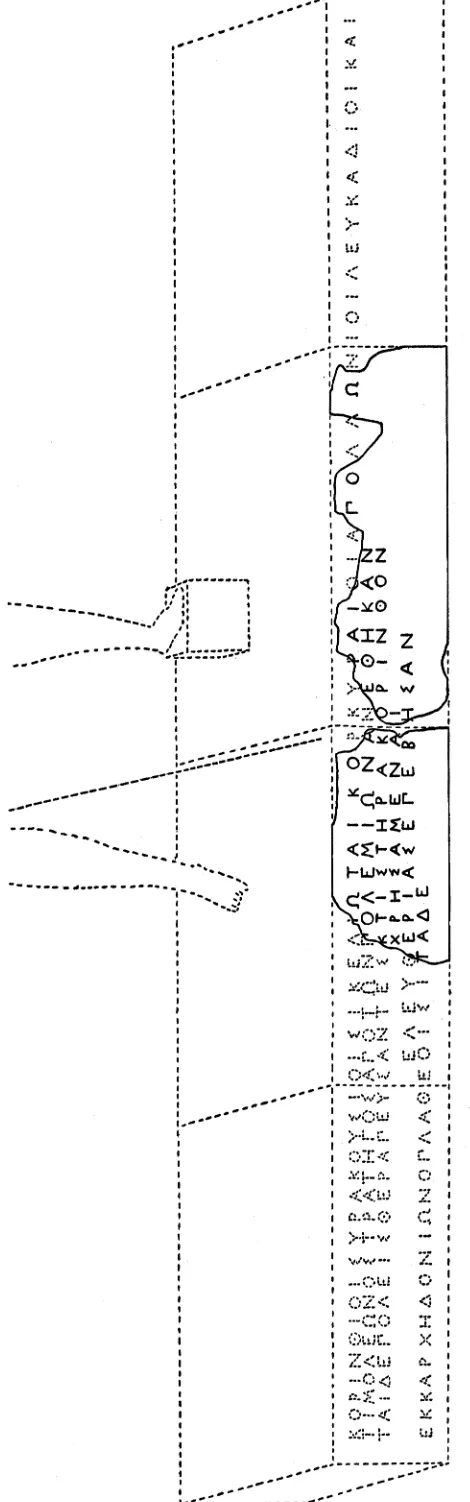
The text may be restored as follows (Fig. 1 ):
[Kopi'vOLot, 5vpaKov'Oiot, ICKEX] &rat, Ko [pKV] paiZo [ t, 'A]io [A] vco[v AEVKd&8o, Kac]
[T/oLXECWv o oT(rparJTy6)O CLTON r7(0v] roXEVdCt a[v] EO'?Kav.
[Tatd& 71XEvt 0EpacTEvccavwE] KTto-rqpa Ko'ptvOov
[
24 XP"~V241
[ 0 0 ]... .. .. aplrEvat
5
[
.. 19.. Ev].EXEV OEPai EITE3cav
[EK KapXY,8ovtc;v o'TXa 0EOtcT] Tac8E.
Line 1. The conclusion of K. K. Smith that the inscription refers to the exploits
of Timoleon in Sicily is confirmed by the new text, for it is now clear that the first
line contained the names of the allies who took part in the victory at the river Krimesos
in 341
B. C.10In Plutarch's account of the battle the only Greek participants men-
tioned by name are the
Koptv6hot,the
lvpaKoVioLoL,and the
ICKEXut)rat;" these were
doubtless the most important Greek forces, and it is therefore to be expected that in
a victory inscription these three names would be placed first. Of the three, only the
last half of [jtKEXA] cirat is preserved. We are further informed by Plutarch 12 that
Timoleon's original force when he first set out on his Sicilian expedition consisted of
seven ships from Corinth, two from Corcyra, and one from Leukas; the reading
Ko[pKv]paZto[t]
shows that some of the Corcyreans and probably also Leukadians
were still in his forces when the battle of the Krimesos took place. To them we can
now add a contingent of Apollonians, whose presence at the battle was not hitherto
known. Some time previous to the victory at the Krimesos Timoleon had expelled
the tyrant Leptines from Apollonia;
13it now appears that after the tyrant's expulsion
I ? T A I K 0 [P] [K] [Y] P A I 0 [I] [A] UT 0 [A] A Q
53 65 55 65 70 80 [65] [65] [65] [66] 70 58 60 [66] [66] [66] 80 [74] [74] 77
TT 0 A E M I Q N A [N] E 9 H K A N
50 50 63 60 60 58 95 65 [60] [60] 70 66 63 60 70
K T I I T H P A K O P I N 0 0 N
54 46 60 60 62 59 79 70 65 60 69 69 69 60 70
X P H E A M E N A I
57 49 60 55 65 61 77 69 65
e E P I A EE l E B H I A N
49 47 49 55 64 59 64 70 69 69 63 57 70
T A A E.
50 53 56
10 For the date, cf. Beloch, Griechische Geschichte, 2 ed., III, 2, p. 383; R. Hackforth, C. A. H.,
VI, p. 295; Glotz-Cohen, Histoire grecque, III, p. 415.
" Plutarch, Tinmoleon, 25-29, especially 27, 4. The expression of Diodorus (XVI, 78, 2) is TOVS rE ttoLOoOOpOVS Kal TOVS aXXovs o-v/u,iaXov3.
12 Timoleon, 8, 3.
14 JOHN H. KENT
a number of Apollonians took service under Timoleon's command. The location
of their name in the list, between the Corcyreans and the Leukadians, shows that
their number cannot have been very large.
Line 2. The restoration of this line is suggested by Plutarch's account of the
dedication at Corinth of part of the victor's spoils.1" After the battle, he says,
Timoleon sent back to Corinth the best specimens of captured Carthaginian arms:
/3apj/aptKa O-KvXcL KaXXA TaTc ELtypa4avg rXoi0vra FLETa
nrj
aV8pEts Tarc VVEVtK1KKOTWV TY)V&LKato(TTvlqv, o'Tt Kopt'vhOt Kat TtjuoXE'wv 6 (cTpaTrqyog E-XEV0EpEc6aVTE TOVs ItKEXLav O6KOVlV-
ras s'EX?rvas &iiw KapX-q8ovtdv Xapto-Pr-qptaOEO1 'cL 'EOqKav.
The wording of the passage
is significant: neither Corinthians nor Carthaginians nor gods have a definite article,
and the position of
avE'OYKavat the end of the sentence is customary epigraphic
practice. Indeed, it is found at the end of the prose portion of our inscription. The
expression
KaXXto-rats E ypa4atssurely refers to verses, and the last four lines of our
text are metrical (see below) ; and Plutarch's
word EXEV0Ep&%aVTE9 echoes [EXEv] OEpt'asof line 5. It thus appears that Plutarch's source, Timaeus, saw the original inscription
at Corinth, and that either he or Plutarch has epitomized its contents."5 Since the
names of the victorious states have been assigned to the first line of the inscription,
it becomes very probable in the light of Plutarch's statement that the name of Timoleon
was engraved in the second line. It will be noted that Plutarch's expression,
TpoAXE'WVo (rTpavqyag,
has precisely the number of letters required to restore the line
completely."6
Lines 3-6. It was pointed out by K. K. Smith
17and A. M. Woodward
18that
the last four lines probably consisted of two elegiac distichs; the recovery of the
ends of lines
3-5now confirms their
inference. In line 6 Plutarch's xapuTrpta, whilemaking excellent sense with
rta8, ismetrically impossible in elegiacs. The restoration
suggested above does, however, make use of two other words in Plutarch, KapXq-
8ovtwov and OEoZ9. In line 4, the form xp-qa,auEvat may be construed either as dative
singular with, for example,
[TptvaKptat],or as a nominative plural. Since the expres-
14 Timoleon, 29, 3. Cf. below, note 22.
15 An analysis of the sources of Plutarch's Life of Tirnoleon by H. D. Westlake (Class. Quart.,
XXXII, 1938, pp. 65-74) reveals that Plutarch's two principal sources were Timaeus and, in all probability, a Peripatetic Life of Timoleon. Westlake (p. 72) ascribes Plutarch's account of the battle of the Krimesos (chapters 25-29) to Timaeus, and Timaeus is known to have resided for
fifty years at Athens (Polybius, XII, 25, d, 1; 25, ah, 1 [Loeb]). During this time he would
have had many opportunities to visit Corinth, so that it was probably he who saw the inscription (see also below, note 22). It could not, of course, have been Plutarch himself who saw it.
16 This means that Kat should be restored at the end of line 1. An alternate restoration is to
end line 1 with [AEvKa8to] instead of [AevKa8tOt, xad]-there is no control to the precise length of
the line-and to supply in line 2 [KaL TtLoXE'Wv o 'y,E/Wv]; this, however, departs from Plutarch's
wording and gives Timoleon's name a less prominent position in line 2.
17 A. J. A., XXIII, 1919, p. 372.
sion xcncmripa Koptv0ov in line 3 probably refers to the fact that Syracuse, Corcyra,
Apollonia, and Leukas were all originally colonies of Corinth, I have preferred to take
Xp,crd'a,Evat
as nominative, and to suggest in line 3
[Tacd& 1roXte Oepavevo-ravTefl.It
should be emphasized, however, that, while the restoration of lines 1-2 seems more
or less assured, the restorations offered for lines 3 and 6 are presented merely as two
out of many possibilities.
I~~~~~~~~~~~~~~~~~~~~~~~~~~~~~~~~~~~~~~~~~~~~~~~~~~~~~~~I
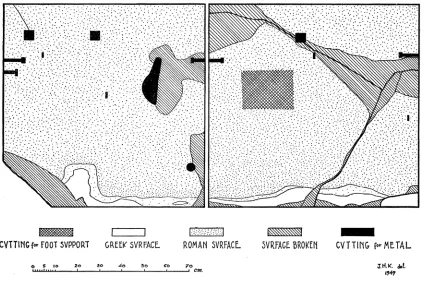
CYTTUtiGfor FOOT 5VPPOPT GREEK SVRFACE. ROMAN SVRFACL 3VRFACE BROKEN CVTTING for METAL
to 20 so 4o
0 5t
311(. le.
. " Ct { St
Fig.
2.Top surface of Inscribed
Blocks with cuttings for Statue
The statue base is of interest not only for its inscription but also for the cuttings
that remain on the top surfaces of Blocks A and B (Fig. 2). Block A contains two
cuttings; the first, 0.233 m. in length, is a foot socket for the right foot of a bronze
statue the second is a circular hole, 0.035 m. in diameter, set at the right edge of the
block near the
front."0On the top surface of Block B, set back from the inscribed
front face almost, but not quite, as far as the foot socket in Block A is set, .there
19 For the form
Ta& (= at8E) in the Corinthian dialect, cf. Bechtel, Die grech sche Dialekte, I1 1, Berlin, 1923, p. 256; Buck, Greek Dialects, 2 ed., Boston, 1928, pp. 92, 141. For the form
16
JOHN H. KENT
are faint remains of a shallow rectangular cutting, 0.23 m. by 0.18 m., which the
Roman chiselling has not gone quite deep enough to remove.2"
On the basis of these three cuttings two reconstructions of the statue are possible.
First, we may think with Smith that the right foot of the statue was set in the
foot socket and that the circular hole was for the toe of the left foot. In that case,
the rectangular cutting of Block B, which had not been found at the time Smith
studied the monument, would presumably have been for a pillar which supported the
left arm or hand. However, not only is a supporting pillar for a bronze statue unneces-
sary and implausible, but the position suggested by Smith results in an extremely
unhappy posture; we should be forced to imagine a figure with the weight falling
mostly on the right foot, with the right knee bent, the left leg extended well in front
of the body, and the left foot pointed so that only one toe rested on the base. Such a
figure would appear to be in the undignified process of falling over backwards; and
while this is not an impossible figure to visualize (for example, it might conceivably
have been a stricken Carthaginian), it would seem to be out of keeping with the
spirit of pre-Hellenistic sculpture. A far more satisfactory alternative is to suppose
that the right foot of the statue fitted in the foot socket of Block A and that the
rectangular cutting of Block B once contained a support of some sort for the left foot.
If so, the small circular cutting in front was made for the butt end of some kind of
shaft. We thus obtain for our bronze statue a standing figure, somewhat greater
than life size, with its right foot set on the plinth, its left foot supported by a foot
rest, and in front of the figure a slender shaft, presumably grasped above and held
in place by one or both of the hands (Fig. 1). Such a figure can scarcely have been
other than a bronze Poseidon, standing with his left foot slightly elevated and holding
his trident in the pose familiar in reverse in the famous Lateran Poseidon. Diodorus
states that some of the spoils of the Krimesos were sent by Timoleon to Corinth,
to be set up in the sanctuary of Poseidon.
22It seems plausible that, in addition to
21 The foot socket, circular cutting, and the remains of the rectangular cutting form the points
of a triangle of which the length between points is as follows (measurements from centers): foot socket to circular cutting, 0.44m.; foot socket to rectangular cutting, 0.50m.; circular socket to rectangular cutting, 0.51 m.
Diodorus XVI, 80, 6: TrV 8' 6?irwV Tra 7roXXa ?EV VO ioviE0ap TOV' 7 EO4 -qp rLt 8C TnV TOVi TLtjOoX`OVTO9 aK)VqV XAXLOL FLEV OwpaKEs, aULMSE8E & 7tEWoVs Tv /AVptU'V a7V`X\crav. TOVTV S' VaTEpOV Ta /LEV EV TOLS E'v YvpaKOVooatIS vaotS aVETE'O ,a O? TO8LS cvjtaiXovg t&q pArG?q a o 8'S Ko'pwov TqyoXeuv
aTETXE, 7'rpOOrTaceaS dE LS Tro TOV r 1oa00UvLo LEpo.v a6alOEvat.
The expression cbg Ko'ptvLOov - E- - sTO TOV' roooctIovos Epo\v clearly refers to a sanctuary of
Poseidon within the city of Corinth, not to the sanctuary of Poseidon at the Isthmus. Plutarch's account shows that the spoils were intended to be displayed in Corinth itself (Timoleon, 29, 2-3):
aJLa 8E TD Mi r' Vl'KTS O TqkowX'v Cbg Ko'ptvGov rqoeIE Ta KX XtrTa T'V
aix,
T(OV 5rAv, ftovAo'pEvos avrov T77v 7raTpt8a 7raoLtv ad'Vpw0t7rots CqXwTr\V EClval, OO/AE'VOEl' EVK EW /LOV T'V EXXT)vtKWv ITOXV TOVS ETLLavEcT1TOv7vaovsg ovX 'EXXqVtKoZ9 zKEKOLflEl'uEvovq Xcafvpotg ov8' a7ro o-vyyElyVwJV 0o6OV Kat o,tovXkwv dava6rla'TWv ,wvnIaq
a display of captured enemy arms in Poseidon's sanctuary, a bronze figure of the
god, presumably financed from the sale of booty, was set up as one of the reminders
of victory.23
Who was the sculptor of the bronze Poseidon? It is not possible, of course, to
answer with finality, but there is some evidence, rather slight perhaps, which suggests
that it may have been Lysippos of Sikyon. A passage in Lucian shows that the
Corinthians once commissioned Lysippos to make for them a bronze Poseidon which
later became famous.24 A Corinthian statue base with sockets for both feet, of the
same dark gray limestone as that of the Timoleon inscription and engraved with the
same style of lettering, reads
AV'TtwTO EIT [oqo-E].25The date of the erection of the
Timoleon monument, presumably not long after the victory at the Krimesos river
and therefore not long after 341
B. C.,falls well within the period of Lysippos'
the disposition of the Carthaginian spoils was obtained from a common source, the historian Timaeus
(Diodorus = Tinzaeus: E. Schwartz, Pauly-Wissowa, R. E., s. v. Diodorus 38, cols. 686-687;
Plutarch= Timaeus: H. D. Westlake, op. cit., p. 72; see also above, note 15), there is no doubt that the city of Corinth, not the Isthmian sanctuary (cf. note 24), is intended.
23 See the cogent remarks of Smith (op. cit., p. 367). It is not impossible that on either side of the Poseidon statue there rose from the top surface of each of the two missing end blocks a vertical support on which could be hung shields and other trophies of the Krimesos victory (for the general appearance of a support of this kind, cf. G. P. Stevens, Hesperia, V, 1936, p. 494). If such were the case, the end blocks either would have been of irregular shape (assuming that support and block were fashioned from a single stone) or would have been weakened by the cuttings into which the supports were set. In either event we should have an explanation of why the two central blocks were re-used by the Romans, but the two end blocks rejected (cf. notes 5 and 6).
24 Lucian, Zeus Tragoedus, 9: lO]EIAQN: KaEL 7roVi TOVTO, (D 'Epyq, 8LKaLOV, TOV KVVO7rpOTW7)OV
TroTrov 7rpoKaGLgEv Wov Trov Atyv'rrtov, KaL TaVTa HoocEL&VoS OvrOV; EPMH,: YEL' aAAa a v vvooaycue,
XaXKOVV O Av'017r7ros KatL 7rT(XOV V7rOL7arEv OVK EXOVMWV TOTE TWV KoptvtO'wv xpvoro'v.
This passage has sometimes been used to support the view that the original bronze Poseidon of Lysippos stood, not in the city of Corinth, but in the Isthmian sanctuary. This hypothesis was first advanced by K. Lange (Das Motiv des alsgestiitzen Fusses in der antike Kunst, Leipzig, 1879, pp. 31-52) and has since been stated as a fact in several handbooks on Greek sculpture. It is difficult to see, however, how Lucian's words furnish any evidence, for the precise location of the statue, and indeed the natural inference would seem to be that if the Corinthians paid for the statue, the statue was set up in Corinth. Lange's other evidence to support his opinion consists of certain passages in Pausanias (II, 1, 7-9; 2, 1) which tell of at least four bronze Poseidons in the Isthmian sanctuary-in no case is the sculptor named-and certain coins of Demetrios Polior- ketes which show a standing Poseidon with one foot raised on a rock (cf. C. Seltman, Greek Coins, plate L, no. 5). While this seems very weak evidence on which to base the conclusion that Lysippos' Poseidon stood in the Isthmian sanctuary and not in Corinth, Lange sums up his view with great confidence (p. 45): " The Corinthians had the original statue of Poseidon with the raised foot-- that is to say, the bronze statue of Poseidon Isthmios-made at their expense by Lysippos and had it set up in the temple of Poseidon on the Isthmus." For further discussion of the problem, see F. P. Johnson, Lysippos, Durham, 1927, p. 142.
25 Corinth, VIII, i, no. 34. B. Powell (A. J. A., VII, 1903, p. 30) has suggested that the date
18 JOHN H. KENT
creative activity.26 Finally, the lost original of the Poseidon type that is exemplified
by the Lateran Poseidon has been ascribed by many critics on stylistic grounds to
Lysippos.27 Taken singly, none of these considerations can bear very great weight,
but taken together they indicate a possibility that the base of Lysippos' original bronze
Poseidon has now been found.
JOHN H. KENT
UNIVERSITY OF VERMONT
26 Johnson, op. cit., pp. 72-73; cf. Hesperia, Suppl. VIII, p. 229.
27 The critics who ascribe the Poseidon type to Lysippos include K. Lange (op. cit., pp. 31-52),
'~~~~~~~~~~~~~~~~~~te
I~
~ ~~~~~~~~a
rerfc-o
The
lc
,S -e;~-4 I
D~~~~~~~~~~~~~~~~~~~~~~~A
a. The rear face of blodck B
b. The inscribed face of blocks A and B