EXCAVATIONS IN KEOS, 1960-1961
(FRONTISPIECE, PLATES 92-102)
S TUDY of the Bronze Age in the Cyclades has moved less rapidly during the past W half century than in most other parts of the Aegean area, chiefly because there is a lack of reliably correlated material from stratified sites. Phylakopi and the cemeteries excavated by Tsountas still provide the chief body of information; more recent work, though good and valuable, has been limited. Perhaps the very excellence and thoroughness of the early researches in the islands made it appear that attention could be directed more profitably toward other, less well known, regions of the pre- classical Greek world. A further reason undoubtedly is the rarity of Cycladic sites that have survived erosion. The terrain is stony and precipitous in most places; walls built all of stone (for clay is scarce) were dispersed over the slopes when they fell, and debris of habitation was not held in place. A few early settlements are known, however, and others can be found. They offer a singularly interesting array of problems, to the solution of which a new series of excavations, conducted in the light of accumulated experience, may reasonably be expected to contribute.
With this aim in view an expedition of the University of Cincinnati * undertook explorations in the summer of 1960, making soundings in the island of Keos. These yielded promising results, and a full campaign of excavation was conducted there in 1961.1 Assistance given by many people is gratefully acknowledged. Permission to excavate was granted by the Greek Archaeological Service through the American School of Classical Studies, which sponsored the undertaking and furnished innumner- able facilities. Thanks are due to Dr. Papadimitriou, Director General of the Service, to Mr. Zapheiropoulos and Mr. Doumas, Ephor and Epimelete of Antiquities in the Cyclades, and to Professor H. S. Robinson, Director of the School. Professor
* Grateful acknowledgment is made by the Committee on Publications to the Department of Classics of the University of Cincinnati for a contribution toward this publication.
1 The exploration in 1960 was conducted by J. L. Caskey and E. G. Caskey with a few work- men between July 25 and August 5. In 1961 seven others joined the staff: William Kittredge, Mrs. Kittredge (in charge of records), Mrs. Aliki Bikaki, Elizabeth Milburn, Lloyd E. Cotsen (architect), Philip H. Auerbach, and Eric G. Carlson. Demetrios Papaioannou of Old Corinth was foreman in both years. The campaign of 1961 was of two months' duration in all; digging began on June 12 and continued with a force of about 25 men until July 22, a few being retained for another week. Six boys carried water and washed pottery. Soterios Maras of Old Corinth, on leave from military service, worked steadily for 19 days as vase mender. A carpenter and a boattmian were employed throughout the season.
Brief preliminary reports and notices about the campaigns have appeared in Archaeology, XIII, 1960, p. 290; Archaeological Reports for 1960-61, Hellenic Society and Brit. School Athens, 1961, p. 20; B.C.H., LXXXV, 1961, pp. 837-839; 'Ererqpts T') MEratpelas' KVKXa8tK'v MeXErV, II, 1962, pp. 15-23; I.L.N., May 19, 1962, pp. 801-803.
American School of Classical Studies at Athens is collaborating with JSTOR to digitize, preserve, and extend access to
Hesperia
Kontoleon's advice and practical guidance were of greatest value. The expedition is indebted to Mr. N. Michalos and the directors of the Michalinos Company for permission to dig in land belonging to them and for the use of their buildings as living and working quarters. Mr. V. Psyllas, President of the Community of Koressia, assisted the staff at all times, and many people of the island, including Mr. K. Chartophylakides and Mr. S. Restis, showed their friendly interest.
The activities of 1960 were made possible by a grant from the Taft Memorial Fund of the University of Cincinnati. In 1961 financial support was provided by the University's newly established Archaeological Research Fund, made up of liberal contributions from private donors and additional grants from the American Philo- sophical Society and the Wenner-Gren Foundation for Anthropological Research. Other expenses since the autumn of 1961 have been met by a munificent bequest of the late Mrs. Louise Semple, devoted friend and patroness of classical studies in Cincinnati, whose generous foresight has furnished means with which researches in this field may be continued effectively hereafter.
Attention has been directed principally to the site called Ayia Irini ('Ayia Elprfrm) in the great harbor on the northwestern coast. A second place of habitation, on the headland of Kephala some twenty minutes' walk northeast of the harbor, has also been examined. It is the earlier of the two and may be described first in this report.
KEPHALA
The promontory, like many others along the coasts of Keos, is a rocky ridge. It is aligned east and west and is joined to the body of the island by a short neck of lower ground at its eastern end. A cove is thus formed, open on the west and pro- tected on all other sides (P1. 92, a). A sandy beach on the neck provides a good landing for small craft. The ground is barren but a little ravine coming down from the south collects what moisture there is, and even in summer the sheep and goats find water in a pit that has been dug for them in the sands.
The barren side of the headland above the sandy neck is strewn with blades and chips of obsidian. Remains of stone walls are discernible, running along the contours, and near the foot of the hill traces of a few graves were seen when the region was examined in 1960. In that year only a little probing was done, but several tests were made in parts of the area during the campaign of 1961, when P. H. Auerbacch and E. G. Carlson supervised the digging. Mr. Doumas assisted in this operation.
EXCAVATIONS IN KEOS, 1960-1961 265
little protection from the north wind. Segments of walls were cleared in a few places (P1. 92, b). They are made of flat pieces of local limestone, which splits easily. None are thick. Only the lower courses are in place, the rest having been dispersed down the hillside. Like other buildings in places where earth and clay is scarce, these were probably made all of stone, and not very high. The rooms were long and narrow, arranged on stepped terraces. Floors were chiefly on the native rock, which was roughly levelled by a little cutting on the upper side and filling on the lower. Not much earth was found in place within the rooms. It contained considerable quantities of broken pottery, however: bowls and jars in coarse, poorly fired, reddish brown ware that crumbles easily. The sherds have not yet been studied in detail but can be assigned tentatively to the Early Cycladic Period, and quite possibly to a very early stage.
Twelve graves were examined in the cemetery below the houses. One, exposed and damaged by erosion, consisted of a fragmentary wide-mouthed jar, some 0.50 tn. in height, lying on its side, with a slab of stone set upright against the mouth. Pieces of bones and a few teeth were found in it. The other graves were walled cists with cover slabs. A few of these too had been exposed and lost in large part as the steeply sloping ground was denuded, but some proved to be intact. As excavation proceeded it became evident that the graves had been built successively one above another in a large pocket or open cave, gradually filling it.
The chambers are of various shapes, nearly rectangular, rounded, or oval in plan, enclosed by walls of small stones, occasionally with larger slabs set upright. The space inside is generally a little more than a meter in length, the walls 0.40 m. to 0.50 m. high. The chamber is covered with slabs laid parallel to each other. These are heavy stones, which one might think would suffice, but in several instances there was further construction above them, other stones being laid in two or three courses to make up a rounded or quite neatly rectangular platform over the grave (P1. 92, c).
In at least one grave there was a single burial; others, used as ossuaries, con- tained jumbled masses of bones. Rough floors of pebbles were found in some. The bones were in bad condition and many of the smaller ones had dissolved completely. There were few offerings. Grave V held a tapering marble vase2 (P1. 92, d). Among the bones in Grave X were fragments of a remarkable handle in red-brown ware
(P1. 92, f). The rear face is a broad flat panel bearing an incised pattern; at the front this branches into two cylindrical struts. The body of the pot was not in the grave and has not been found, but there can be little doubt that it opened laterally, the whole vessel very closely resembling one found by Tsountas at Sesklo.4 In Grave XII
2Inv. Kph.1.1. H. 0.168; D. 0.068. , Inv. Kph.2. H. 0.159.
4 Tsountas, Dimini and Ses'klo, cols. 206-207, pl. 16,3. Found on the side of the mound and
there was a small bowl' (P1. 92, e). Its sides taper slightly toward the upright rim and a vertical lug, horizontally pierced, is attached to the side. Bowls of approximately this shape are found at Neolithic sites on the mainland.
It was a modest settlement at Kephala, maintained presumably by fishermen and traders. Spectacular discoveries are not to be expected, but the few objects found in 1961 are of types that may yield chronological information and the observable sequence of the graves is of unusual value. Both the house and the cemetery require further investigation.
AYIA IRINI
One of the principal routes of navigation passes close along the north coast of Keos. Ships from Piraeus, the Saronic Gulf, and northeastern Peloponnesos round the cape of Sounion and move through the channel on their way to the Euripos or out into the northern Aegean. Others, small craft particularly, find shelter on a southward passage by hugging the shores of the western Cyclades from Keos to Melos. It is therefore not surprising that ships should have anchored in the great natural harbor of this island and that settlements should have been built on its shores since early times.
Entering the narrow mouth of the bay one has the ancient acropolis of Koressos (Kop'qao'g) on the right. At its foot is the small village named Koressia (until recently Livadi), with a landing that is protected from all but the northerly winds. A road and a shorter path wind upward an hour's walk southeastward to the principal town, Chora, the ancient Ioulis where Simonides and Bacchylides were born. When the north wind blows hard, ships of all sizes find shelter at the inner, eastern, end of the harbor, which is called Vourkari. A settlement of the same name, made up of 30 to 40 houses, is situated here on the south shore. From Vourkari the north shore runs irregularly westward to the long rocky promontory of Ayios Nikolaos, at the tip of which stand a chapel and a lighthouse beside the harbor mouth. Buildings and depots of the Michalinos coaling station occupy most of the land on this northern side. Near the inner end, opposite the village of Vourkari, a small peninsula juts out into the bay (P1. 93, a). A church of Ayia Irini stands conspicuous upon it, and the sur- rounding region is named after the saint. Local people remember that an older chapel was there, in ruinous condition when the present one was built a generation ago.
The banks of the peninsula have been eroded, especially on the western and southeastern sides, and in the vertical scarps one sees the broken- ends of ancient walls. Similar sections appear also in the banks of a roadway that cuts through the northern part of the site (Fig. 1). Therefore the place has been known for many years
EXCAVATIONS IN KEOS, 1960-1961 267
ROAD
t..J
0 5
,,, ,, ,, ,,, +,
.I C. X sr m ' , *
\ ~ ~~ ~ ~ ~
~~~~ ~ ~~~~~~~~~~~~~~~~~~~~
CD < 1
%
FIG. 1. The peninsula of Ayia Irini, with location of areas excavated in 1960 and 1961.
and has been mentioned occasionally in archaeological surveys; G but excavation had
not been undertaken until 1960. Trial trenches opened in that year revealed walls almost everywhere, immediately below the surface (as seen, e.g., in Plate 95, d). The campaign of 1961 was devoted to clearing several larger areas (A, B, C) and to further exploration through pits and trenches (D, J, L, N, etc.). All these are indi- cated on the general plan.
EARLY AND MIDDLE BRONZE AGES
Deposits of the Early Bronze Age have not yet been found, but a few objects from disturbed areas suggest that the site may have been occupied in the third millen- nium. These include half a dozen sherds of pottery resembling wares of Early Helladic II and pieces of characteristic female figurines in marble: the body of one in Area A, the legs of another in Area C. A better preserved example that is said to have been found at Ayia Irini is now in the small collection of local antiquities in Chora. These figurines are of the standing type, naturalistic but stylized, which occurs very widely in Early Cycladic settlements and cemeteries. Whether it con- tinued to be made later is not yet known with certainty.
The promontory of Ayia Irini was inhabited in the Middle Bronze Age. Walls and floors of successive houses have been discovered in deep soundings at three places in Area C (one seen in P1. 95, a) and below the long building in Area B. Deposits on the floors contain gray Minyan and Matt-painted pottery and burnished bowls with. rims turned inward, objects of stone and bone, and bits of obsidian. These strata will be examined thoroughly in future campaigns of excavation when the superposedI houses of the Late Bronze Age have been fully investigated.
AREA A
Work in this area was supervised by Mrs. Caskey in both years. The first soundings came upon stone floors in Rooms III and IV (Fig. 2). As excavation proceeded, an irregular complex of rooms was discovered, bounded on the south and southeast by narrow streets. Passages on the west (V) and northeast may also prove to be streets. It is not yet clear just how the building was organized, but certain facts are evident: many if not most of the rooms now visible were cellars, the main apart- ments having been at levels higher than the present surface of the ground; the ruins represent a succession of constructions that span a period of nmore than two centuries in the Late Bronze Age; there was at least one violent earthquake in this time and probably two or even three, creating damage that required major repairs (P1. 94, d).
6 I. N. Psyllas, Ia7l-opa'a i Ntfaov Ke'as, Athens, 1921, p. 303; G. Welter, Arch. Anz., 1954, cols. 50-52; K. Scholes, " The Cyclades in the Later Bronze Age: A Synopsis," B.S.A., LI, 1956, p. 11.
7 Museum number 91. Head and lower legs missing. H. preserved ca. 0.095. The abdomen
Much of the western part of this area had been disturbed to a depth of about one meter in late Roman times,8 and three graves of that period or later were found above the walls of the Late Bronze Age in the eastern part.
Rooms III and IV were originally one. They are paved with big flagstones, which run under the partition wall. The latter is pierced by two small passages, one in the thick part of the west, the other near the center. At the southwest corner of Room III a similar passage leads out through the external wall and into a covered drain in the street. Blocks of stone are set on the floor in the northwest corner of each room. A score or more of coarse conical cups, like those that occur in profusion throughout the site (Pls. 98, a, b; 99, b) were found on the floor and wedged between the flags and against the walls.
The careful provisions for drainage indicate that these were probably bath rooms of some kind. It is possible, however, that the space served at one time as a light well. The common east wall of the two little chambers seems once to have had narrow openings giving into the area of Room XIII, and there may have been others in the wall on the north side of Room IV.
Room XIV is similar, paved with big slabs at ground level (P1. 94, c). In the northwestern part the slabs are shaped to leave two circular openings where jars may have been set into the floor. On the east there is a big stone with a deep groove which served as a sluice leading through the wall and into the drain in the street.
All the streets are small, averaging about 0.90 m. in width. They are lined with stones throughout. The drainage channels, 0.20 m. to 0.40 m. wide and varying con- siderably in depth, run along the center. Some of their cover slabs are in place (P1. 94, b). Near the southeast corner of the big building in Area A there are small stones in the channel, perhaps deliberately placed there to break the rapid flow of the water. The eastern street runs gently downward toward Area B. At the corner its drain is carried around to the right and steeply downward under a stepped paving that descends to the shore,
A carefully built stairway is situated just north of Room XIV (P1. 94, a). The landing, at ground level, is next to the outer wall. From this a flight rose westward over the small storage room marked XVI. Only one step is in place, but it suffices to prove that there was an upper storey. The other flight, XVII, leads down from the landing to the basement. It has eleven steps and is well preserved. Room XVI, which opens off the lower steps, was a dark cupboard of the sort that appears almost inevi- tably when returning staircases are built.
At the foot of the stairs, about 2.10 m. below the floor level of Room XIV, a corridor gives access to Rooms XV and XIII. The walls to the west are badly damaged; they rest partly on the native rock and partly on earth, the worst sort of
EXCAVATIONS IN KEOS, 1960-1961 271
bedding when earthquakes strike. There are two depressions in the clay floor on the east side of Room XV. The debris here showed signs of burning; Room XI also had burnt debris, but in general there was little evidence of fire in this building. Fallen stones block the doorway toward Room XIII and have been left there temporarily to support the walls on either side.
Room XIII is large and deep (P1. 94, e). Excavation was slow, since the space was full of stones and debris that had fallen when the upper storeys collapsed. The floor was reached about 2.40 m. below the level of the paving in Room III. A rect- angular pier of masonry stands in the basement, east of the center, so placed as not to be opposite the door. There was a special reason for this arrangement: XIII was a storeroom for big objects like the pithoi that stand in the northwest and southwest corners, and space was needed when they were to be moved. Next to the walls are rounded depressions, ringed with stones, where other pithoi or smaller vessels could be held upright.
The pier is built of irregular stones topped by a flat slab. It is square, 0.68 m. on a side, and nearly 1 m. high. Presumably it held a wooden post that supported the floor above. A ledge high on the south wall of the room may have taken the ends of cross beams, as may a similar ledge in the east wall of Room XV. The surfaces of these basement walls were plain, but it is clear that the rooms upstairs were plastered and decorated. Fragments of lime stucco are found in the fallen debris, here and in other parts of the settlement. It is of good quality, well smoothed and painted. Most of the pieces are coated with deep red, which was evidently the principal color, but blue, green, yellow-brown, and black occur, sometimes solid and sometimes in geometrical patterns. A few small fragments suggest that there was also some figured decoration. Rooms II and XVIII seem not to have been reached by permanent stairways. Wooden steps or ladders may have led down to them. Both are deep, and their walls are badly cracked by earthquake shocks. On the western side of the building there is a row of basement rooms, VIII, XII, and XI. These are not quite so deep as some of the others, bedrock being higher here than elsewhere. They show signs of alteration and repair. A pithos stands next to the north wall of Room XII.
A preliminary survey of the architectural evidence in this building-the excava- tion of which is far from complete-suggests that there were two serious earthquakes in the period under consideration. Much of the debris in the rooms comes obviously from the second of these destructions.
common, as are the larger household vessels of ordinary types. Incense burners like the one illustrated on Plate 98, c,9 are surprisingly plentiful, as are scoops with straight cylindrical handles (P1. 98, d). Surfaces of the locally made pots are rarely even smoothed, and decoration is unusual. Bands of thin yellowish or grayish white are seen on a few pieces, e.g. a pedestalled cup or goblet '" of a shape derived
apparently from an earlier tradition (P1. 97, d).
Minoan influence is strikingly evident. Pots imported from Crete include jars and jugs with patterns of double axes (P1. 96, f)'2 and grasses (P1. 96, d)'3; a sprinkler with a single perforation at the bottom, decorated on the sides with figure- of-eight shields 14 (P1. 96, a); and a stirrup-jar of squat form with characteristically
Minoan triple handle 15 (P1. 96, b). In addition to these and many others that were
certainly imported there are numerous pieces in which an imitation of Cretan styles is clearly recognizable. Typologically they are assignable to Late Minoan IA and IB. Pottery fromn the mainland is also represented plentifully. A particularly fine example is the open bowl,'6 Plate 97, a, b, with patterns of crocuses on the exterior and in a reserved tondo at the center of the interior. A three-handled jar is decorated with double axes of mainland type in three zones '7 (P1. 97, c).
Fine wares of Cycladic character are not lacking. Some came probably fromi Melos; in biscuit and decoration the vases are indistinguishable from those of Phylakopi. One must suppose that trade was maintained with other islands also, anld it is not impossible that some of the finer pottery was manufactured in Keos itself. although the mass of domestic wares at Ayia Irini suggests that the local clay was not of good quality.
Fragments of several stone vases have been found. The rooms in Area A pro- duced a tall fluted cup (incomplete and not yet restored), part of a plain deep vessel in dark red stone, and pieces of a quatrefoil pyxis in gray and white streaked marble. The forms in general suggest Minoan origins, but it is most probable that these were products of a local industry. Variegated marble is to be seen in outcrops near the site, and cores, bored presumably in the process of hollowing the vessels, are found in considerable nunmbers. These cylindrical cores were sometimes used later as pestles.
9 Inv. K.27. H. 0.049; D. pres. 0.097. From Area C.
0 Inv. K.882. H. 0.068; W. 0.156. Found at foot of NW pithos in Room XIII. 1Inv. K.1041. H. 0.126; D. 0.125. From Room XVI.
12 Not inventoried. From Room XIII.
18 Not inventoried. From Room XVIII. Cf. the famous jug with almost identical pattern fr3om
Phaistos (Marinatos and Hirmer, Crete and Mycenae, fig. 79). L.M.IA.
14 Inv. K.1059. H. 0.125; D. 0.161. From Room II.
1 Inv. K.1058. H. body 0.17; D. 0.265. From Room XIII.
16 Inv. K.1055. H. 0.11; D. 0.31. From Room XIII.
EXCAVATIONS IN KEOS, 1960-1961 273
Not a few of them are crescent-shaped in section, showing that the circle of one drilling overlapped another. Two examples, found in Area B, are shown in Plate 98, g and h.18 Metal working appears to have been another local industry. Disks of lead in a variety of sizes have been found in most of the areas tested (P1. 98, j). Some are stamped with distinguishing marks. One has a section of bronze rod imbedded at the center. Disks of this sort, used undoubtedly as weights, are common in Crete.19 The discovery of a great many lumps of litharge (PbO) at Ayia Irini indicates that sm-elting was done here and possibly that there may have been mines in the vicinity.20 Indeed one may speculate that objects of lead and perhaps of silver, as well as those of colored stone, were exported from Keos in exchange for fine pottery and other commodities from abroad.
The material surveyed above in brief and preliminary fashion indicates that the buildings in Area A, and probably those of the town in general, flourished in the period corresponding with Late Minoan IA and IB in Crete (Late Helladic I and II on the mainland), being rebuilt in part after disasters that were caused by earthquakes. This phase appears to have ended in a final destruction more serious than the others, probably in the latter part of the fifteenth century B.C. Dates can be assigned only
tentatively at present, but the extent of the material remains warrants belief that the chronology, relative if not absolute, can ultimately be established with accuracy and in detail.
After the great catastrophe there was a marked change in the character of the settlement. The people may have been exhausted economically, and political changes nmay well have taken place. Over this we can only speculate. But it is clear that the site was not abandoned altogether. Near the present surface of the ground in Area A and elsewhere there are parts of walls that belonged to later structures which can be dated approximately by a scattering of sherds and other objects. The imported pottery is assignable to Late Helladic III, and a stone-lined pit or bothros above Room XIII yielded interesting fragments of contemporary figurines, a chariot group 21 (P1. 99, c)
and the prow or stern of a ship 22 (P1. 99, f). These remains are tantalizing; denu-
dation, in this area at least, has left little from which we may hope to recover more detailed knowledge.
18 G: Inv. K1.61. L. 0.048; D. 0.05. From Area B, Room I. H: Inv. Kl.118. L. 0.05; D. 0.041. From Area B, Room II.
Note that here and elsewhere throughout the article the figure in inventory numbers after .the K is a figure one, not the letter ell.
19 A comment of Mr. Platon, who is making a comprehensive study of the Minoan examples.
20 Samples were examined and analysed by Mr. Robert H. Brill, Administrator of Scientific
Research at the Corning Museum of Glass.
21 Inv. Kl.146. L. pres. 0.08.
AREA B. THE LONG HOUSE.
A series of rooms, which appear to make up a single long narrow building, lie to the east of Area A, across the street that runs toward Room B.IV (Fig. 2). These were excavated by Mrs. Bikaki in 1961 as part of Area B. The building originally was at some distance from the shore but through gradual encroachment the sea has taken away everything on the southeast and destroyed most of the south room (which is hypothetically restored on the plan). The long wall on the inner side is preserved to the same elevation as the street (+-3.30m. at the SW., +2.20m. at the NE.), whereas the floor and most of the opposite wall are scarcely higher than sea level.
Fragments of wall plaster in the debris indicate that an upper storey once existed, but no part of it now remains. The basement was entered from the northeast, where three steps lead down through the doorway into Room I. An inner door between spurs gave access to Room II, in the western corner of which there was a high structure of solid masonry. The small narrow chamber beyond Room II may have been a kitchen. Part of a wall preserved above the debris in Room II belonged to a late rebuilding. Excavation beneath the floor disclosed walls of the Middle Bronze Age, two of which are sketched stone-for-stone on the plan (Fig. 2) in the space of Rooms I and II respectively. The floors associated with these early walls are now below sea level. We extracted some gray Minyan and Matt-painted sherds from the mud.
The chief period of occupation was that which has been seen in Area A, namely the initial stages of the Late Bronze Age. Local and imported pottery was found in the floor deposits and among the stones that had fallen in from above. From the floor in Room II came a small Minoan sealstone with a design of two lions antithetically opposed, moving clockwise.28
AREA C
The region immediately north of the church was tested by means of a trench in 1960 and was excavated extensively under the supervision of Elizabeth Milburn in 1961. Walls appeared almost everywhere when a thin layer of surface earth had been removed (P1. 95, d). Three deep soundings, mentioned above, reached levels of the Middle Bronze Age settlement. Attention was focussed principally, however, upon one large building in the southern part of the area (Fig. 3).
Whether this was an ordinary house, more elegant than most, or served some other purpose is not yet known. The remaining parts are below the ancient and modern ground level; what we have is a basement or crypt, like those in Area A but still
23 Inv. Kl.159. D. 0.015. The design is found frequently on gems of the later palatial period
EXCAVATIONS IN KEOS, 1960-1961 275
more carefully constructed. Its main axis runs northwest and southeast. In plan it is simple but somewhat irregular, narrowing from one end to the other.
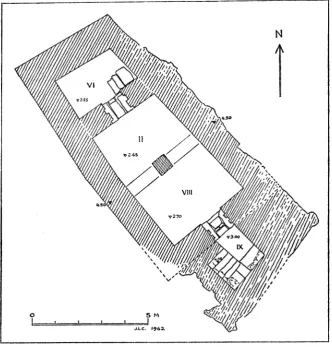
The principal entrance was at the southeast, where a returning staircase and passage, IX, lead to a doorway. This gives onto a large hall, about 5.70 m. long, contracting in width from 3.90 m. to 3.30 m. A square pillar stands near the middle, and here a barrier wall was added, dividing the hall into two roughly equal parts that
FIG. 3. Simplified plan of large building in Area C.
are labelled II and VIII on the plan. A massive crosswall at the far end is broken by a second doorway which leads into a small room, VI. In this there are three stone steps, belonging to another stairway.
finished to a slight depth on the southwest and northwest, not at all on the northeast (P1. 95, a). Inside, however, the masonry is clean and neat, incorporating many big stones with smooth faces (P1. 95, b, e). No stucco was found adhering to these walls, but pieces had fallen into the subterranean rooms from above.
The staircase at the southeast comprises five broad steps descending away from the building (P1. 95, c), then two narrower steps northeastward, and finally another to the passage, completing the return. Masonry outside the stair well is rough and irregular, having been set below ground. Northeast of IX there is a partially open space in the stonework (not shown in Fig. 3), the significance of which is not clear. The doorway is carefully made, having a raised stone threshold and vertical chases in the jambs to hold a wooden frame.
Rooms VIII and II had earthen floors. The stone pier is like the one in Room XIII of Area A, being nearly 0.70 m. square and 0.40 m. high, constructed of small stones with a large flat slab on top (P1. 95, b). The position of the barrier wall, which was built in two stages, is indicated only approximately in Figure 3. It was not parl of the original scheme. The doorway leading to Room VI is similar to the one at the southeast entrance, having a raised threshold and vertical chases (P1. 95, e).
The steps in Room VI (visible on Plate 95, b, at lower left) rise toward the wall and stop. From them a ladder might have led steeply up, but it is more probable that a flight of low steps or a cleated ramp of timbers turned back along the end wall to a landing at the western corner of the room. This staircase looks like a makeshift, installed probably to provide access when the barrier was built dividing Room II from Room VIII.
Debris and deposits on the floors held pottery of the same date as the rooms in Area A, not later than L.M.IB-L.H.II. Among the miscellaneous objects loomweights are very numerous. The upper part of the filling was disturbed and some of it may have been removed when a second wall was built across the hall, over the stone pier. From this higher level came some Mycenaean ware (L.H.III) and the fragments of two figurines shown on Plate 99, d and e.24
Elsewhere in Area C the excavation has not advanced far enough to giive a clear picture of the rooms and passageways. More than one period of construction is represented, and masses of broken pottery are concentrated in several places. Hun- dreds of conical cups were removed in 1961. Two Cretan vases merit special attention: a so-called " flower pot 25 (P1. 96, c) and a fine cup with a more delicate pattern of
grasses 2 assignable to L.M. IA (P1. 96, e).
24 D: Inv. K1.43. H. pres. 0.035; W. 0.057.
E: Inv. K1.37. H. pres. 0.074; W. 0.043.
25 Inv. K.852. H. 0.108; D. 0.175. From Room XVII.
EXCAVATIONS IN KEOS, 1960-1961 277 SOUNDINGS IN AREAS
J,
L, AND N.As indicated on the general plan, Figure 1, the ground in the northwestern and north-central part of the site has been tested by means of numerous trial pits. Walls and objects of familiar types were found in most of these. A cup of the Vaphio shape with running spirals 27 (L.H.I, P1. 97, e) came from one of the soundings in Area J.
In Trench L, where P. H. Auerbach was in charge, another cup of closely related type was found28 (P1. 97, f). Here also were evidences of metal-working, burnt matter with bits of corroded bronze and one side of a small soapstone mould for casting a ring " (P1. 98, e). This has a pour-channel at the top, a hole through the middle for centering the two halves of the mould, and grooves around the outside to hold the cord that bound them together. A crucible for melting and pouring bronze 3 (P1.
98, f) was found not far from Trench L, and others like it have come to light in various parts of the site. Across the modern road in Area N, E. G. Carlson opened a trial trench and disclosed part of a winding passage, possibly within a storehouse, where there was a concentrated mass of conical cups and other local pottery (P1. 99, b).
FORTIFICATIONS
A row of very large stones projecting from the bank on the west side of the peninsula drew our attention in 1960 (Fig. 1, Area D). Soundings quickly showed that they were part of a massive wall with cyclopean masonry on the north face and a backing of rubble on the inner side. A big opening in the wall proved to be the mouth of a drain (P1. 93, b). Five to ten meters off shore some other large blocks could be seen lying in order under water.
Investigation of these remains was undertaken in 1961 by William Kittredge. Area D was extended and trenches were dug at intervals across the contours of a scarp which ran in a curving line eastward and northward to the modern road (P1. 99, a). The outer face of the wall was found in each of these. No sign of an inner face was discovered, but at several places behind the wall there was a maze of smaller structures; these are too complex to be understood until wider areas can be opened. In the space marked J on the plan heavy walls were observed in positions that sug,gest the presence of a gateway near by, but this question has been left for future investigation.
The line of the fortification wall had been cut by the modern roadway north of Area J but big stones visible on the far side, in the area called N, were next cleaned
27 Inv. K. 1053. H. 0.08; D. 0.111. 28 Inv. K.1278. H. 0.088; D. 0.115.
29 Inv. KI.228. L. 0.027; W. 0.025; D. of ring 0.017.
and examined. The wall turned westward, bedded here on native rock, and cuttings show another corner where it ran northward. Presumably it then followed the crest of the slight natural elevation, as indicated by a broken line in Figure 1. Further east the course of the wall was picked up again. There is heavy masonry at the outer corner, perhaps near a gate or a tower. Running southward for a few meters, the line turns again to the east and passes out into the modern road, where several big stones suggest that it may still be found. Not far from here it presumably turned southward and ran along the eastern edge of the peninsula.
It is not yet known whether this wall of defense was carried around the town on the seaward sides. The structure now under water off Area D was perhaps a bastion or tower. South of it, again in shallow water, some further construction was examined by L. E. Cotsen and indicated on the plan. The tip of the headland southwest and south of the church is almost wholly denuded. On the southeast, off Areas A and B, where the settlement certainly extended further outward, there may be a possibility of tracing some lines of foundations in the bay.
Although parts of the peninsula itself have been lost to the sea, it appears probable that the land around its neck has been built up by silting. We would guess that in ancient times the bay came further in on both sides and that the wall was built close to the shore. Quite possibly the promontory was almost wholly surrounded, being connected to the body of the island only by a narrow causeway at the north.
About the date of the fortifications little may be said at present. Close study of the pottery and further stratigraphical analysis are needed. It is certain in any case that the wall was built in the Late Bronze Age. Pottery found immediately inside the wall appears to belong to the time of the big buildings of Areas A, B, and C, but it may prove to come from deposits that were laid down before the town was fortified. From soundings outside the wall some later Mycenaean sherds have been collected. This important question will receive careful attention.
AREA B. THE TEMPLE.
A building devoted to religious purposes in Late Mycenaean times was discovered and partly excavated in 1961 under the supervision of Mrs. Bikaki, deep soundings of the previous year in the same region having encountered walls and objects that seemed to promise something of interest. That the building was indeed a temple is scarcely open to doubt.
EXCAVATIONS IN KEOS, 1960-1961 279
IV, lies beyond a partition wall with a doorway near its center, and its clear width is reduced by the presence of an internal wall and corridor, VII, on its northeast side. The far end of IV and VII has not been excavated but the top of a crosswall, appar- ently unbroken, has been exposed. The side walls seem to continue northwestward.
The wall that forms the southwest side of the temple appears to be an integral part of the architectural system of the westward region, the streets, the long house, and so forth, which are securely dated by early L.M. and L.H. pottery. Pottery within the temple, on the other hand, is that of an appreciably later period. Provisionally one must assume, therefore, that the religious building was placed here deliberately in order that existing walls might be incorporated in its structure.
The original stone threshold of the doorway between Rooms IV and V lies some 0.10 m. below the present level of the sea. It could be examined only momentarily after vigorous bailing; excavation of the associated floors, which are not paved, was carried on under water. Apparently contemporary with these earliest floors of the temple are the Tj -shaped structures adjoining the crosswall on either side of the door- way (closely hatched in the drawing, Fig. 2) and possibly also the rectangular podium of masonry (ca. 4.10 m. by 2.25 m.) in the axis of Room V.
The second main period of use is marked by the rebuilding of the doorway. A new threshold was laid 0.50 m. higher than the first and the space was narrowed by insertion of vertical jambs made of single slabs (P1. 100, a, c). When found the doorway was full of debris and the lintel was also in place; being badly cracked it had to be removed, but it will be put back into position when it has been repaired. So framed, the opening is very small. Associated with the doorway in its new form are the benches along either side of Room V, straight on the northeast, L-shaped on the southwest (the latter seen on Plate 100, d; both are crosshatched in Figure 2). The podium mentioned above may have been built at this time rather than in the preceding phase. In the northern corner of Room V there was a mass of clay, filling roughly a quadrant of a circle; it was put there for a purpose, but we have not been able to explain it.
1. Head, Inv. Kl.459. P1. 100, e. Height preserved 0.08 m. Eyes apparently slanting; nose delicately rendered, with narrow bridge; chin firm and pointed. 2. Arm, Inv. KO.30. P1. 101, a. Length of fragment 0.24 m. Raised band along under side of arm and encircling it; vertical ridge on shoulder. Im- pression of wooden armature.
3-4. Parts of two arms, Inv. KO.32, Kl.462, probably a pair; comparable to No. 2. 5. Arm, Inv. KO.31. Surface moderately smooth, lighter in color than the
preceding fragments; clearly from another statue.
6. Right breast, Inv. KI.460. P1. 101, c. Height of fragment 0.22 m. Surface moderately smooth, light colored. Impressions of wooden armature in broken interior face of fragment.
7. Pan-shaped fragment, possibly from crown of a head, Inv. Kl.463.
8-10. Fragments probably from body of large figure, Inv. Kl.465-467. One preserves part of a horizontal double coil above a plain vertical surface, possibly from the waist and skirt of a statue like the M.M. II Statuette from Piskokephalon, Sitia, in east Crete (Marinatos and Hirmer, Crete and Mycenae, fig. 17).
11. Part of a base or stand( ?), Inv. KI.469.
In what we take to be the early strata, with the pieces listed above, were a fine little terracotta figure of a dolphin 31 (P1. 101, e), and a large seal stone with a repre-
sentation of a lion and a tree 32 (P1. 101, f). The pottery has not been studied. Among
the sherds are some that may be assigned to Mycenaean III B, but at present they may not be taken as fixing the date of the deposit.
Fragments of terracotta sculpture found above the level of the second threshold are as follows:
12. Head, Inv. Kl.458. Frontispiece; P1. 100, b (as found); P1. 101, b, d. Height preserved 0.192 m. Open shaft through vertical axis. The crown or headdress, the ears (probably large), and much of the surface are miss- ing. The nose appears short and the mouth small, but both are damaged. The big round eyes are alert and lively, the whole expression humane. 13. Pan-shaped object, Inv. Kl.464. 0.20 m. by 0.21 m. Flat with raised edges
on either side.
14. Part of a base or stand (?), Inv. Kl.468.
In debris at the same general level as the pieces numbered 12-14 was found a small figure of a crouching lion in solid bronze, the head badly corroded but the
31 Inv. KI.443. L. pres. 0.13.
32 Inv. Ki. 76. D. 0.027. Cf. A. Xenaki-Sakellariou, op. cit. (note 23), pl. XXV, 263; V. E. G.
EXCAVATIONS IN KEOS, 1960-1961 281
hindquarters in fairly sound condition, showing the tail curled across the back " (P1. 102, c). A large krater " lay broken on the floor near the southwest bench in Room V (Pls. 100, d; 102, a). Its shape and its pattern of dry, semi-mechanical, running spirals with crosses in the open centers (one overlooked) point to a late date, probably Mycenaean III C. This dating is confirmed by other pieces of pottery in the stratum, for example small krater-bowls (P1. 102, d).
One concludes that the temple was standing in the first part of the twelfth century B.C., perhaps with statues on the big podium in Room V and offerings on the
lateral benches. Up to now we have no valid parallels for a building of this kind in the Minoan-Mycenaean world. Speculation about its significance would be premature. The " Goddess with Raised Arms " 3 is presumably Cretan, and the statues in Keos,
whether cult images or figures of worshippers or both, are almost certainly related to 'her. There are marked differences, however: No. 6, the full breast, realistically
modelled, is in sharp contrast to the small perfunctory knobs on the corresponding Late Minoan figures, e.g. those from Gazi."6 This fragment indicates furthermore that the island statue was very much larger in scale than any yet known in Crete or else- where in the Aegean area.37
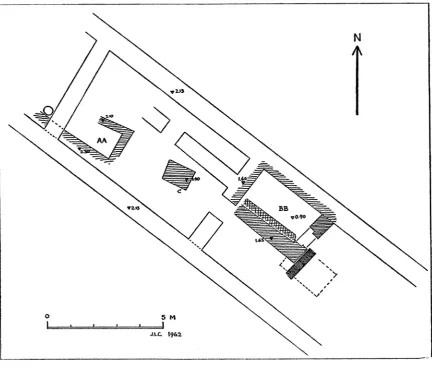
The temple was destroyed, its northeast side wall falling into Rooms IV and V. Soon after, a very small shrine was installed above the ruins (Room BB in Figure 4). This too had a bench along one side. The small doorway faced the sea. In the little rooin there was a stone " blossom bowl " and some broken pottery from which a late Mycenaean kylix (P1. 102, b) could be put together. Here too was one further frag- ment of a statue, possibly out of place:
15. Large neck or small torso, Inv. Kl.461. Height 0.20 m. Battered and worn.
SACRED AREA ABOVE THE TEMPLE.
All the ground above the ruins of the temple and shrine was disturbed to some extent, but enough evidence survived to suggest strongly that the area continued to be revered. Traces of small structures remained (Fig. 4): an enclosure, AA, a rectangular pier (or altar?), C, and some stones casually heaped. In the earth were found sherds of Protogeometric, Geometric, and Cycladic Orientalizing wares. Mini- ature Corinthian kotylai (P1. 102, e-g) 3 and several small votive pots in black-glazed
33 Not yet inventoried; deposited in the National Museum in Athens for cleaning and con- servation. L. 0.075.
34Inv. K.1315. H. 0.318; D. 0.38.
35 Studied by S. Alexiou, 'H lv@woK? OEa' tx&' v EVv Herakleion, 1958. 36 Marinatos and Hirmer, Crete and Mycenae, figs. 128-131.
8 Nearest to it perhaps is the head of the so-called sphinx in stucco, from Mycenae, a wonderful
and terrifying creature, but technically and spiritually far removed from the Keian sculpture.
ware of the fourth century (P1. 102, h, j) were found among the stones. With them were a few beads, a head of a diminutive terracotta figurine, and a remarkable flat terracotta button 3 (shown at twice natural size on Plate 102, k). A loop of wire is
embedded in the reverse side, providing a ring by which the button could be sewn onto
0 5 M
hA t962
FIG. 4. Small structures over the ruins of the temple in Area B.
a garment. The obverse is beaded around the rim and bears a representation of Athena Parthenos, facing, wearing the triple-crested helmet, with her owl perched on the raised cheek-piece at the right. A small winged figure appears over each shoulder. The button is a rare object in itself, and the portrayal of the goddess with
EXCAVATIONS IN KEOS, 1960-1961 283
the owl in this position is most uncommon. Close parallels of the whole composition are seen in two gold medallions from Kertch in the Hermitage.40
At the end of the campaign in 1961 some of the deep pits were refilled, walls were reinforced, and the excavated areas were enclosed with low stone barriers or wire fences. A storehouse, with tables for examination of the objects found, was con- structed in the disused coal depot near the site, and most of the material was placed in it. The inventory completed during the two seasons numbers 1318 pots and frag- ments (1164 being plain conical cups) and 503 miscellaneous objects from Ayia Irini, four pieces of pottery and six miscellaneous objects from Kephala.
Under pressure of other academic duties and obligations we decided, regretfully, not to excavate in 1962, but we intend to resume the work in 1963. The site holds promise of further interesting revelations and clearly deserves thorough investigation.
JOHN L. CASKEY UNIVERSITY OF CINCINNATI
a. Promontory from Southwest.
d. Marble Vase from Grave V.
_~~~~~~~~~~
U
e. Bowl from Grave XII. b. Walls of Houses. Early Cycladic.
c. Early Cycladic Graves. f. Handle from Grave X.
PLATE 93
xhzL
a. Promontory of Ayia Irini and Bay of Vourkari from Northwest.
. .7-
b. Face of Fortification Wall and Mouth of Large Drain, in Area D.
_~~~~~~~~~~~~~~~~~~~~~~~~~~1
_ L
-7 i4
c. Floor of Bath Room XIV.
a. Stairway XVII.
x,~~~~~~~~~~~~~~W
d. Earthquake Debris in Room XVIII.
b. Drain in Street South of Room III. e. Room XIII from Southeast.
AREA A
PLATE 95
- f _- i i. __
N'~~~~~~~~~~J -?
A-
a. Early Wall in Sounding.
b. Basement of Large Building.
c. Stairway IX.
d. Walls North of Large Building. . e. Chases for Wooden Doorframe.
AREA C
a. Area A. Sprinkler.
b. Area A. Stirrup Jar.
c. Area C. "Flower Pot." L.M.I.
d. Area A. Fragment of Jug or Jar. L.M.IA.
PLATE 97
c. Area A. Jar. L.H. I-IIA.
a. Area A. Tondo of Shallow Bowl.
b. Area A. Shallow Bowl. L.H. I-IIA.
d. Area A. Local Goblet.
e. Area J. Cup. L.H. I. f. Area L. Cup. L.H. I.
a., b. Conical Cups.
c. Incense Burner.
d. Area A. Scoop.
e. Area L. Mould for casting Ring.
f. Area J. Crucible.
g., h. Marble Cores, Used as Pestles. j. Lead Weights.
PLATE 99
a. Area J. Trial Trenches over Fortification Wall.
00#0~ ~ - d. Area C. Figurine; Front and Back.
L.H. III.
b. Deposit of Conical Cups.
e. Area C. Figurine. L.H. III.
c. Area A. Chariot Group. L.H. III. f. Area A. Fragment of Miniature Ship.
a. The Temple from Northwest.
b. The Larger Terracotta Head as Found. c. Doorway in Crosswall of Temple.
1
~~~~~~~~~~~~~~~~~~~~~~~~~~~~~~~~~~~~~~~~~~~~~~~~~~~~~~~~~~~~~~~~~~~~~~~~~~~~~~~~~~~~~~~4d. Krater on F;loor beside Bench in Temple. e. The Smaller Terracotta Head.
AREA B
PLATE 101
a. Arm of Terracotta Statue.
b. The Larger Head, in Profile.
c. Right Breast of Terracotta Statue.
d. The Larger Head, Seen from above.
e. Terracotta Dolphin from the Temple. . .. f. Seal Stone from the Temple and Impression.
AREA B
b. Kylix from Room BB. L.H. IIIC. a. Krater from the Temple. L.H. IIIC.
c. Bronze Lion from the Temple. (1:1) d. Fragment of Krater Bowl from the Temple.
e., f., g. Miniature Corinthian Skyphoi from Sacred Area above the Temple.
h.,~
j.
Blc-Gae ~~~~~ Gu-kpo ~F an kpo rmSce ra. TraotBuonfmScedAa. ',. ~ ~ (21AREA B