ISSN: 2393-8366
686
Cognitive Image Processing for Determination of
Skin Disease using Raspberry Pi3
G.P. Ramesh1, C.K. Kishore2 1
Professor, Department of Electrical and Electronics Engineering, St.Peter’s University, Chennai, Email:[email protected]
2
Research Scholar, Department of Electrical and Electronics Engineering, St.Peter’s University, Chennai, Email:[email protected]
Abstract --In ancient and older times, Cognitive Science proves to be most vital solutions for the various problems in terms of the medical science. Our Human Body has peculiar feature that every problem inside body will be reflected as the diseases in the skins .But the recognition of that skin diseases is really nightmare. Hence we proposed the new technique called CIP (Cognitive Image Processing) for the reorganization of Image Segmentation. This biomedical Image processing is integrated in SOC using new algorithm called BIEE for the Power, Area and Rich Performance Characteristics. In recent times, usage of SOC is becoming so popular in the modern technology. These cores have been utilized for the different diagnosis systems which will be useful to the common man. As the applications and the number of cores increases, the energy and life time of the devices remains to be dark light. To design the High Performance and Energy Efficient Algorithms for Bio Medical Image Processing Systems for pre-detection of the skin diseases with the High end Architectures using Raspberry Pi 3.
Index Terms--Cognitive Image Processing (CIP), Bio-Intelligent Energy Efficiency (BIEE), System on Chip (SOC), Field Programmable Gate Array (FPGA), Camera Serial Interface (CSI), Bluetooth Classic & Low Energy (BLE).
I. INTRODUCTION
ISSN: 2393-8366
687
an image or a sequence of images (e.g., videos or 3D full-body magnetic resonance scans). In modern sciences and technologies, images also gain much broader scopes due to the ever growing importance of scientific visualization (of often large-scale complex scientific/experimental data). Examples include microarray data in genetic research, or real-time multi-asset portfolio trading in finance. A system on a chip or system on chip (SOC) is an integrated circuit (IC) that integrates all components of a computer or other electronic system into a single chip. It may contain digital, analogy, mixed-signal, and often radio-frequency functions—all on a single chip substrate.
II. IMAGE FILTERING
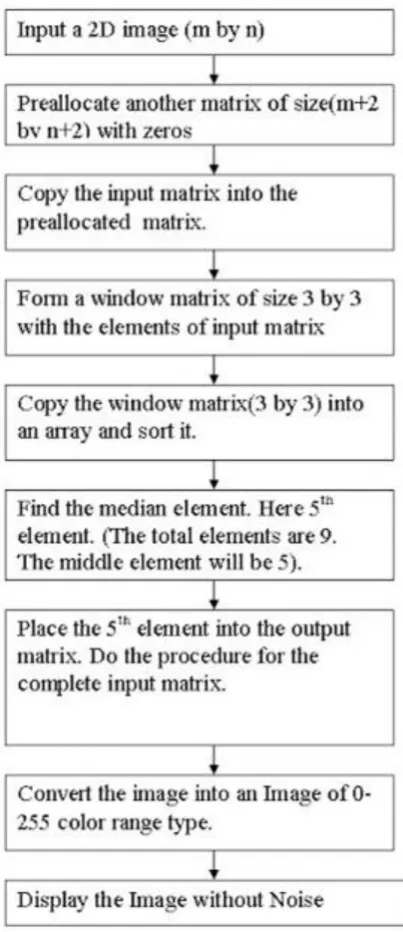
Fig 1.Median Filtering
ISSN: 2393-8366
688
the values of the pixels in the neighbourhood of the corresponding input pixel. A pixel's neighbourhood is some set of pixels, defined by their locations relative to that pixel. The median filter is a nonlinear digital filtering technique, often used to remove noise. Such noise reduction is a typical pre-processing step to improve the results of later processing (for example, edge detection on an image).
2-D median filtering Syntax:
B = medfilt2(A) Example
B = medfilt2(A, [m n]) B = medfilt2(___,padopt)
gpuarrayB = medfilt2(gpuarrayA,___)
III
.IMAGE SEGMENTATION BASED ON THRESHOLDINGThresholding is the simplest method of segmentation. From a grey scale image thresholding can be used to create binary image .Image segmentation where thresholds are automatically determined according to areas with varied content in the picture. The result of image segmentation is a set of segments that collectively cover the entire image, or a set of contours extracted from the image (see edge detection). Each of the pixels in a region is similar with respect to some characteristic or computed property, such as colour, intensity, or texture.
IV
.WORKING MECHANISMSOur earliest work on image processing of computer screens did not focus explicitly on cognitive modelling. Rather, we speculated that if an agent could observe and interpret all of the information seen by the user in interacting with a software application, the agent could provide better assistance, by providing advice or even offering to carry out tasks for the user.
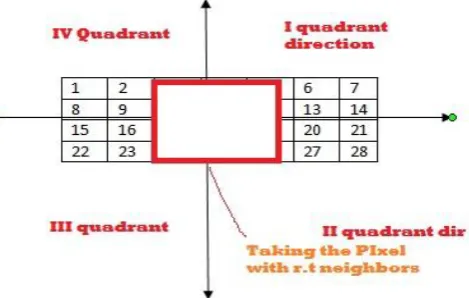
Fig.2.Pixel based working
ISSN: 2393-8366
689
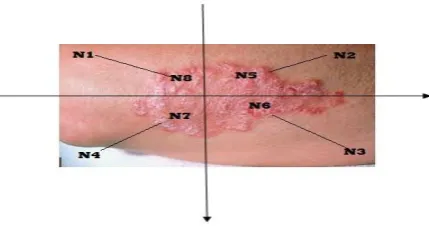
Feature is being extracted with the calculation of the neighbors i.e pixel neighbors Feature to be extracted is being given to the Cognitive Model which compares with the features to be extracted. Thus the required feature can be extracted and fed into the SET principles.
Fig 4.Cognitive Neighbour Calculation:
SET mechanism is used for the formulation of the cognitive rules. This rule uses the Segmented Adaptive Threshold techniques. Different Threshold will be selected depends after the training to find the diabetes level.
V
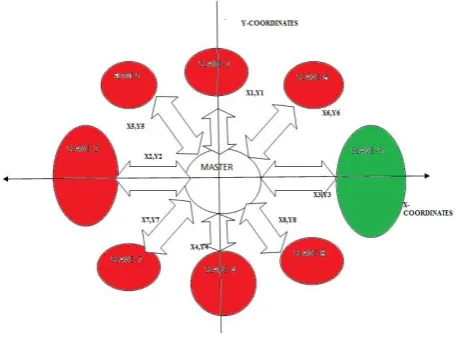
. BIEE ALGORITHM (BIO Intelligent Energy Efficiency Mechanisms)BIEE phase represents the placement of the designed algorithms in the SOC.The SOC to be used is Heterogeneous Architecture with the Dual Cortex with the programmable FPGA Schemes. Cores communication will take place with the principle of energy consumption logics. The algorithm has been designed as the IP Core and placed in the Programmable FPGA in SOC. The main unit of the design is placed as the Master and all other are placed as the slaves. The Main core is communicating with the other cores making the logics of Switching Energy Principles. Even though the master is connected with the different IP Slaves master is connected with the Slave with an energy consumed based on the mappings. This makes the logic to be done when the Energy is consumed based on the Mapping co-ordinates between the master and slave.
ISSN: 2393-8366
690
Rank is decided based on the mapping of the Slave IP Cores placed in the Programmable FPGA
with the principle of Highest Rank -- Shortest Mapping Only 3 Ranks are decided. All other
cores remain to be OFF State.
FIG 7.Communication
VI. ENERGY CALCULATION USING BIEE
Et=Em +Es1+Es2+Es3+………Esn Where Et – Total Energy
Em –Energy Consumed by the master Es1-Energy Consumed by the Slaves1 Es2=Energy Consumed by the Slaves2 Em-Master Energy Core
Now the Energy of the cores has been selected based on the following mechanisms : Rank 1 core-Shortest Mapping
rank 1 consumes the energy which is given by Ers1<Es1 …Ersn<Esn
Now the total energy consumed in the core is given by Etr=Em+Ers1+…
Now Etr < ET which clearly states that the energy consumed is less than the actual core.
ISSN: 2393-8366
691
Fig 8.Hardware setup
Raspberry Pi3 is the third generation Raspberry Pi, compared to the Raspberry Pi 2 it has:
A 1.2 GHz 64-bit quad-core Broadcom BCM ARMv8 CPU
802.11n wireless LAN
Bluetooth 4.1
Bluetooth Low Energy(BLE)
We embed Pi in a project which require very low power
1GB RAM,4 USB ports
40 GPIO pins
Full HDMI port
Ethernet port
Combined 3.5mm audio jack and composite video
Camera interface(CSI)
Display interface(DSI)
The processor speed increases from 900MHz to 1.2GHz.
Has addition of a BCM43143 Wi-Fi chip BUILT-IN Raspberry Pi3.Has upgraded switched power source that goes up to 2.5 Amps instead of 2Amps allowing Pi to power even more powerful device over USB ports. The Raspberry Pi 3 Model B looks identical to the Pi 2 B at first glance. It is the same size and has much of the same components on board. So what is the difference? The new Pi 3 brings more processing power and on-board connectivity, saving you time with the development of your applications. More processor speed: The CPU on the Pi 3 is one and a half times faster at 1.2 GHz. Your Pi board performs better. On-board connectivity: The Pi 3 features 802.11 b/g/n 2.4 GHz Wireless LAN and Bluetooth Classic & Low Energy (BLE). You can get connected much quicker
without the need for any external device. 2.5 A power supply:With more processor speed and
on-board connectivity, you'll need more power. Power supplies for previous Pi on-boards will not be sufficient. You will need the Official Raspberry Pi 3 power supply (9098126 — white) or
(9098135 — black).The Pi 3 features a chip antenna where status LEDs was located previously. The
ISSN: 2393-8366
692 VIII. RESULT OBTAINED:
IX.CONCLUSION:
The method which is used proves to be vital for the diagnosis of the Skin Diseases. It has been tested with the Software and Hardware implemented using Raspberry Pi 3.
REFERENCE:
[1] Skin color segmentation for detecting human face region in image Prashanth Kumar G and Shashidhara M.
[2] Nikhil, R. P., Sankar, K. P., A review on image segmentation techniques, Pattern Recognition, Volume 26, Issue 9, September 1993, Pages 1277-1294, ISSN 0031-3203.
[3] Bhavini J. Samajpati ,M.E Student of Computer Department, Sheshang D. Degadwala, Assistant Professor, ―A Survey on Apple Fruit Diseases Detection and Classification‖, International Journal of Computer Applications (0975 – 8887) Volume 130 – No.13, November 2015