GSJ: Volume 7, Issue 9, September 2019, Online: ISSN 2320-9186
www.globalscientificjournal.comTHE
EFFECT
OF
TEAMWORK
DEVELOPMENT
ON
ORGANIZATIONAL
PERFORMANCE:
A
CASE
STUDY
OF
TILE
AND
CARPET
CENTRE
IN
KENYA
Mohsin rajabali habib ali a*, James Mwikya Reuben b
a
Management University of Africa, P.O Box 29677-00100, Nairobi Kenya
b
Management University of Africa, P.O Box 29677-00100 Nairobi Kenya
a
b
Abstract
The concept of organizational performance is based upon the idea that an organization is the voluntary
association of productive assets including human, physical and capital resources for the purpose of
achieving a shared purpose. This study aimed at investigating the effect of teamwork development and
organizational performance at Tile and Carpet Centre (T&C) in Kenya. The teamwork theory anchored
the variables of the study. The study adopted descriptive research design. The study population was 750
staff working in 3 T&C locations while stratified random sampling technique was used to sample 100
respondents. The pilot testing was conducted using the questionnaire on 10 staff from ICD warehouse,
Nairobi County. The measure of reliability was tested using Cronbach’s alpha at 0.7. The study was a
descriptive research and primary data was collected using a questionnaire. Frequency distribution tables
and figures were used to present the findings where interpretation was done in prose form. The
researcher conducted simple regression analysis in order to find out the relationship between teamwork
development and organizational performance of T&C. The inferential results on effect of teamwork
development on organization performance show R=0.623 indicating a strong positive correlation and
R2=0.389 and there was a significant effect between teamwork development and organization
performance (t=7.522, p<0.05). The study established and provided evidence that organizational success
depends upon the interdependence recognized within teams and how vital it is for team members to
understand their roles and work to achieve corporate goals thus having a positive influence on
organizational performance. The study recommends that T&C should ensure teamwork development is
present in all departments as in the current dynamic business environment, many organizations find the
use of teams efficient and productive.
1. INTRODUCTION
In recent years significance of human capital and its effect on organizational overall performance
illustrates that human capital is in particular important detail for organizational performance
(Collings & Scullion, 2014). If T&C can well set up human capital then management can be
expectant to gain plenty of income and that could be a method to improve personnel‟
organizational commitment, worker‟s participation in selection making and formation of team
work climate. one of the most crucial outcomes of human capital management is employee
organizational dedication which has some tremendous business consequences together with
reduction of absenteeism and turning over, improvement of behavior, growth of labor stab and
improvement of enterprise overall performance (Shirouyehzad & Tavakoli, 2013).
Teamwork is essential to make certain democracy on the workplace, enhance alternate, inspire
innovation and creativity, and allow for powerful selection–making and networking (Jalal, &
Putri, 2015). Teamwork includes forming teams which are expected to labor coherently towards
the realization of organizational goals. Teamwork enhances organizational brotherly love or
integration consequently giving upward thrust to synchronization of efforts amongst the
employed ensuing in higher productiveness. Bad implementation of team work in agencies
has had an effect on the overall output of personnel in corporations. Hersey (2017) narrates
that teamwork is crucial in company for better output and a better bonding amongst
personnel.
1.1 Problem statement
A survey conducted in T&C for the need assessment in 2017, organizational performance
challenges were revealed that were lack of qualified staff and low sense of responsibility among
T&C staff are key performance issues. Therefore, there was an urgent need for cultural
adjustment with regard to staff development in order to enable them perform to expected
standards. In addition, there was need for adjustments within the organization on matters such as
synergy among staff/employee, usage of working time, self-confidence, responsibility and own
initiative. This is expected to greatly reduce and eventually eliminate negative work attitudes and
practices that lead to poor organizational performance. This perspective is detrimental to T&C
challenges such as technical and institutional incapability. Therefore there is a need to
understand the effect of teamwork development on organizational performance at T&C. The
study will help T&C to develop a more strategic and modern approach to the management of
people and their attributes that translate to the sustainable improvement of the organization‟s
overall performance and counter the performance challenges.
1.2 Specific objective
i. To identify and rank various teamwork development factors that affect organisation
performance of T&C
ii. To establish the effect of teamwork development on organizational performance of T&C.
1.3 Conceptual Framework
Conceptual framework is a diagrammatic representation that shows the link between the
dependent and independent variable. In this study, the dependent variable is organization
performance while the independent variable is the teamwork development
Independent Variable Dependent Variable
Figure 1 Conceptual Framework
2. LITERATURE REVIEW
2.1 Theoretical Review
2.1.1 Teamwork Theory
First advanced in 1965, Tuchman‟s version is widely called a foundation for effective crew building (Tuckman, 1965). The most famous teamwork theory is Bruce Tuchman‟s “team stages model. Tuchman‟s version is extensive as it acknowledges the truth that companies do not start
out completely-shaped and functioning (Tuckman & Jensen, 1977). Tuchman‟s indicates that
groups grow through truly defined levels, from their creation as businesses of individuals, to
cohesive, project-targeted groups. The idea holds that four phases take place in the group
development to overall performance which encompass; the formation of the organization is the
very first segment where the employees try to figure out their different teammates, and marvel
why they're there at all. Storming is the second one section by way of which the group
participants start to simply see themselves as a crew, however this can also be challenging as
teammates attempt to position themselves as chief as opposed to follower (Abudi, 2010). All
through the third phase, that's known as "norming" is where the group starts working together
and establishes dreams, policies, and figures out who does what, and what the result is.
Performance is the ultimate segment and that is the factor wherein the crew starts to recognize its
not only the just the undertaking, however also the relationships of the group individuals. It‟s at
some stage in this level that the team begins developing collectively (Pfeiffer, & Jone, 1973).
Tuchman describes working with a group of social psychologists, on behalf of the U.S. navy.
The team studied small institution behavior, from numerous views. In doing so, Tuchman
reviewed 50 articles on group improvement and observed that there have been features common
to these small companies: the interpersonal or institution shape, and the assignment activity
(Lipnack & Stamps, 1997). From this he recognized that agencies developed into teams through
four common degrees. First is an orientation, trying out segment which regularly led to duration
characterized by a degree of struggle. This then typically resolved itself, main to a greater
socially cohesive phase. Finally, groups settled to a functional section, throughout which they
focused on position-relatedness. To summarize these 4 phases, Tuchman coined the oft-quoted
terms: “forming”, “storming”, “norming” and “appearing”.
Tuchman‟s ideas definitely indicate that it takes time to attain the “accomplishment” stage, and
its standard for those teams to undergo challenges as they improve their relationships.
Specifically within the early period, which is perhaps why Tuchman called it the “storming”
segment. Tuchman‟s famous stages are part of a teamwork idea based on tiers of group
development. His theory may have won reputation partially because of the catchy labels for
every of his levels (Sims, & Manz, 1994). It additionally affords a useful and easy way to reflect
considerations on how we human beings engage in group situations. First off by way of
illustrating that it‟s regular for teams go through phases as they develop. Secondly, by
development. The beauty and usefulness of Tuchman‟s model is possibly in its simplicity. Group development theories such, as Tuchman‟s institution improvement phases; understand that teams
expand via unique stages, from forming through to acting. At the same time as these theories
provide useful information of different group necessities at exclusive times, there are some of
questions that aren‟t particularly properly responded to with the aid of the models.
2.2 Empirical Review
2.2.1 Teamwork Development and Organizational Performance
Team may be described as a collection of individuals who pull together to achieve the same
functions and goals to offer an outstanding services. Teamwork is the manner of operating
collaboratively with a group of humans as a way to achieve an objective. The outside factors of
teamwork are the political, monetary, social and technological factors that have an effect on
teamwork whiles the internal elements of teamwork constitute leadership fashion, variety
(tradition, expertise and personalities) communication, and cohesiveness amongst others which
affects teamwork. Employees who work in a company that doesn't have a strong idea of
teamwork, usually fail to supply the predicted effects and to achieve the dreams and visions of
that organisation (Vaskova, 2007).
Abuzid and Abbas (2017) did a have a look at the effect of teamwork effectiveness on
organizational performance vis-a-vis function of organizational guide and crew leader's readiness
with cognizance to a look at of Saudi Arabian government Departments work teams. The
research focusesed on analyzing the impact of teamwork on the employees of Dhofar
university. Several factors associated with teamwork were analyzed, which include the idea of
believe, management and shape and performance evaluation and rewards. The outcomes shows
that there is strong and enormous connection between the unbiased variables; teamwork, trust,
leadership and structure, overall performance evaluation and rewards and the performance
of the faculty staff of Dhofar university in Sultanate of Oman.
Agarwal and Adjirackor (2016) undertook a study of teamwork on organizational productivity in
a few selected basic schools in the Accra metropolitan assembly. The research assessed the effect
of the Accra Metropolitan Assembly, Omanjor M/A primary school the Ga-West assembly and
Ablekuma Anglican school in the Ga-central assembly of Accra region. The study employed
quantitative techniques to research the connection among the variables this is Teamwork, team
Spirit, team, trust, reputation and rewards and organizational productivity. The research suggests
that there is a tremendous advantageous effect of the predictors at the reaction variable with an
adjusted R2 of 70.5%.
Delarue, Van Hootegem, Procter and Burridge (2008) did a study on crew working and
organizational performance: An evaluation of survey-based research. In particular, the study
targeted on empirical studies in which both teamwork and overall performances are directly
measured in a quantitative way. The paper starts by means of figuring out 4 interrelated
dimensions of teamwork effectiveness: attitudinal, behavioral, operational and financial. The
first two signify transmission mechanisms by which organizational performance can be
improved. The latter two grant direct measures of organizational outcomes. The assessment
suggests that team working has appositive have an effect on on all four dimensions of
performance. It also reveals that, when teamwork‟s combined with structural change, overall
performance can be in addition enhanced.
Ooko and Odundo (2015) conducted a study on impact of teamwork on the success of objectives
in organizations in Kenya with center of attention to SOS youngsters„s villages Eldoret. The
study adopted descriptive research design. The target population for this research was 111,
comprising of administration and all exclusive employees of SOS kids‟s Village, Eldoret. Using
Morgan and Krejcie table for determining sample Sizes, a sample size of 92 respondents,
representing 83% of the whole populace of SOS employees was drawn from each set of
administration and the conventional personnel using stratified random sampling approach.
Stratified random sampling was used to pinpoint respondents. The researcher used
questionnaires, interviews, article review and surveillance strategies to acquire information.
Statistical Package for Social Scientist (SPSS) was used to analyse the data. job descriptions
were established be ambiguous and there was responsibility overlaps in many instances, creating
confusion and disagreements among employees. The study also established that job
environments and fair rewards and remunerations. This can impact team performance if done
correctly. The study found out that the staff at SOS Children‟s Village in Eldoret are qualified
for the various responsibilities assigned and that most had undergone extra training within and
without SOS.
Ayan (2014) conducted a study on the impact of teamwork on organizational overall
performance in Kenya with special recognition to Kenya livestock marketing Council
(KLMC)-Nairobi. Several measures of team overall performance were analyzed which include team
effectiveness, group participants' dedication and team based enterprise structure. Besides, the
study pays attention on the role of team work on improving organizational effectiveness. After
massive evaluation of literature, the study found that the consequences of teamwork on
organizational performance were not well tested in-depth. Finally, the review suggests future
study areas that prospective researchers must concentrate to give well-mounted findings to
address the limitation of the preceding studies.
Karanja, E. W., Muraguri, C., and Kinyua (2018) did a research on results of teamwork on
overall performance of the water service regulatory board. The target population was all
personnel of the board. A sample size of 118 respondents was used. Primary and secondary data
was collected from various authoritative sources such as books, published articles, and journals.
Properly formulated questionnaire was the primary tool used in the collection of the statistics
required in the study‟s primary data. Questionnaire responses were tabulated, coded and
processed by using use of Statistical package for Social Sciences and Microsoft excel, which was
used to generate the statistical outputs. Descriptive data and inferential facts were used to draw
conclusions. Further, regression analysis was conducted to establish the relationship between
performance and teamwork. The findings were then provided in tables and charts. The study
observed that teamwork improvement has a great effect on overall performance in corporations.
In the dynamic enterprise surroundings, many organizations find use of groups efficient and
3. RESEARCH METHODOLOGY
3.1 Research Design
A research design is a plan or blueprint of how the researcher intends to conduct the studies
(Babbie & Mouton, 2001). This study will apply descriptive studies design because its purpose is
to explain the impact of teamwork improvement on company performance in T&C. in line with
Kothari (2007) a descriptive research design reviews the way wherein matters are hence aids in
establishing the contemporary situation of the studied population.
3.2 Target Population
Population is a whole institution of individuals, objects or occasions with comparable observable
characteristics (Mugenda & Mugenda, 2003). The target population of the study will be derived
from the employees of T&C as shown in Table 3.1. The research will use target population of
750 employees working at the three locations namely: T&C head office at Parkside Towers and
ICD Warehouse in Nairobi county and Toptank Production Plant in Machakos county.
Table 3. 1 Target Population
Category Target Population Percentage
Top Management 18 2.4 Middle Management 281 37.5 Support Staff 451 60.1
Total 750 100
3.3 Sampling Method and Sample Size
According to Cooper and Schindler (2003), a sampling frame defines a set of factors from which
a researcher can choose a sample of the target population. The study employed stratified random
sampling technique in coming up with a sample size of 100 respondents from a total of specific
departments in three T&C plants, this represents 13.3% of the total population as seen in Table
3.2
Table 3. 2 Sample Size
Category Target Population Sample of the Data Percentage
Top Management 18 18 18 Middle Management 281 40 40 Support Staff 451 42 42
3.4 Research Instruments
Primary data was used in this study which was collected from the selected sample respondents
using a questionnaire.
3.5. Pilot Study
In keeping with Sekeran (2003), a pilot study is crucial for testing the reliability of the
questionnaire. This pilot study enabled the researcher to decide the reliability and validity of the
tool. Connelly (2008) said that a very research sample for a pilot study should be atleast 10% of
the projected sample. The study conducted a pilot study using 10% of the sample population.
3.5.1 Validity and Reliability of the Research Instrument
Validity is the feature of instrument utilized in gauging what it is supposed to measure. Drawing
meaningful and beneficial inferences from scores on the instrument is what validity is ready as
said through Creswell (2008). Content validity of the instrument was carried out with the help of
professionals in human resource. Reliability is defined as the measure of the quantity to which a
research instrument offers consistent output or statistics after repeated exams. The study adopted
Cronbach Alpha to test reliability of the studies units. The values ranged from zero to 1 wherein
values among 0.7 to 1 indicate significant and suitable reliability whereas values underneath 0.7
have been unacceptable and much less reliable.
3.6. Data Analysis and Presentation
The quantitative data collected was coded using Statistical Packages for Social Scientists tool
(SPSS Version 23) and analyzed through the use descriptive and inferential statistics.
4. DATA ANALYSIS AND RESULTS
4.1 Response Rate
A total of 100 questionnaires were distributed to the target respondents (top management, middle
management and support staff), from which 91 respondents gave their responses in all the
questions asked. The questionnaire response rate was 91% (see table 4.1) which is satisfactory
and substantial going by Mugenda (2003) affirmations that a response rate that exceeds more
Table 4.1 Response Rate of Respondents
Response Frequency Percentage
Returned 91 91%
Unreturned 9 9%
Total 100 100%
4.2 Demographic Profile
The respondents were requested to provide the study with demographic information as seen in
table 4.2 on demographic profile. The table shows that, it is evident that more than half of the
respondents at 58.2% were male and 41.8% being female. This implies that T&C staffing was
male dominated, however, the female pool was not far behind. This is an encouraging
implication particularly considering the fact that traditionally most organizations were male
dominated. On age distribution of the respondents, it is evident that majority of the respondents
at 37.3% had their ages ranging from 36-45 years, then 29.7% ranging from 26-35 years, then
15.4% ranging from 18-25 years, then 12.1% ranging from 46-55 years and 5.5% above 55
years. This is a clear indication that majority of the respondents were clearly exposed and had
experienced issues of the relationship between human capital management and organizational
performance at T&C.
Table 4.2 Demographic Profile
Demographic profile Frequency %
Gender Male 53 58.2%
Female 38 41.8% Age (years) 18-25 14 15.4% 26-35 27 29.7% 36-45 34 37.3 46-55 11 12.1 Over 55 5 5.5% Work Experience 1-5 9 9.9% 6-10 26 28.6% 11-15 35 38.4% Over 16 21 23.1%
Education Level
High School 12 13.2% Tertiary/Diploma 45 49.4% Undergraduate 31 34.1% Postgraduate 3 3.3%
On work experience, it is evident that majority of the respondents at 38.4% had worked for T&C
for 11-15 years, then 28.6% had worked for 6-10 years, then 23.1% had worked for over 16
years and 9.9% for 1-5 years. This is a clear indication that majority of the respondents were
significantly experienced and worked for many years at T&C. It is also evident that majority of
the respondents at 49.4% were Tertiary / Diploma holders, then 34.1% were undergraduate
degree holders, then 13.2% had high school certificates and 3.3% had post graduate certificates
of various courses. This is a clear indication that majority of the respondents had made
considerable effort to further their education levels having worked for many years at T&C.
4.3 Descriptive Statistics
4.3.1 Ranking of various Team development factors that affect organisation performance
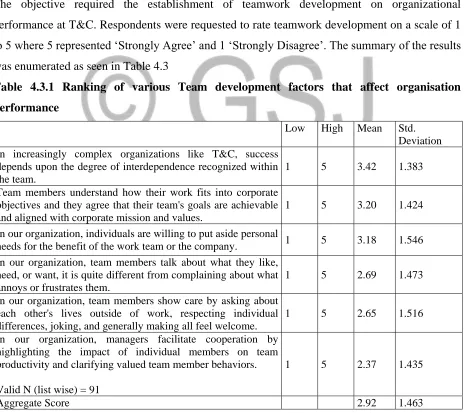
The objective required the establishment of teamwork development on organizational
performance at T&C. Respondents were requested to rate teamwork development on a scale of 1
to 5 where 5 represented „Strongly Agree‟ and 1 „Strongly Disagree‟. The summary of the results
was enumerated as seen in Table 4.3
Table 4.3.1 Ranking of various Team development factors that affect organisation
performance
Low High Mean Std. Deviation In increasingly complex organizations like T&C, success
depends upon the degree of interdependence recognized within the team.
1 5 3.42 1.383
Team members understand how their work fits into corporate objectives and they agree that their team's goals are achievable and aligned with corporate mission and values.
1 5 3.20 1.424
In our organization, individuals are willing to put aside personal
needs for the benefit of the work team or the company. 1 5 3.18 1.546 In our organization, team members talk about what they like,
need, or want, it is quite different from complaining about what annoys or frustrates them.
1 5 2.69 1.473
In our organization, team members show care by asking about each other's lives outside of work, respecting individual differences, joking, and generally making all feel welcome.
1 5 2.65 1.516
In our organization, managers facilitate cooperation by highlighting the impact of individual members on team productivity and clarifying valued team member behaviors.
Valid N (list wise) = 91
1 5 2.37 1.435
The overall aggregate mean score for the objective is 2.92 and the standard deviation is 1.463.
This on average affirmed that the respondents acknowledged that teamwork development was
relevant to ensure employees understand what their jobs entail and work together collectively,
and this was ultimately aimed at improving organizational performance. This supported the
statement suggesting that „in increasingly complex organizations like T&C, success depends
upon the degree of interdependence recognized within the team‟ with the highest mean score of
3.42 and a standard deviation of 1.383. The statement of „in our organization, managers facilitate
cooperation by highlighting the impact of individual members on team productivity and
clarifying valued team member behaviors‟ with the lowest mean score of 2.37 and a standard
deviation of 1.435. This implied that most of the respondents at T&C did not experience
managers and leaders facilitating cooperation between team members. The findings are in
agreement with the assertion by Hersey (2017) who narrates that team work is essential in
corporate for better output and a better bonding among employees.
4.3.2 Ranking of Organizational Performance factors
The dependent variable was organizational performance at T&C. Respondents were requested to
rate organizational performance on a scale of 1 to 5 where 5 represented „Strongly Agree‟ and 1 „Strongly Disagree‟. The summary of the results was enumerated as seen in Table 4.4
Table 4.4 Organizational Performance
Low High Mean Std. Deviation In our organization, human capital management is key in
driving long-term operation effectiveness. 1 5 4.33 .920 In our organization, how human capital utilization is done has
affected effectiveness in our operations. 1 5 4.27 .932 Through human capital management, there has been great
increase in sales in our organization. 1 5 3.97 1.178 There is increased profitability since the introduction of an
independent HR department in our organization. 1 5 3.66 1.301 In our organization, human capital management has affected
relevant skills that are required to enhance organization performance.
Valid N (list wise) = 91
1 5 3.58 1.221
The overall aggregate mean score for the dependent variable is 3.96 and the standard deviation is
1.110. This on average affirmed that the respondents acknowledged that the performance of
T&C was efficient, effective, relevant and financially profitable. The aggregate parameters for
the variables are employee training with a mean score of 4.31 and a standard deviation of 0.812,
employee motivation with a mean score of 3.95 and a standard deviation of 0.941, employee
creativity with a mean score of 3.94 and a standard deviation of 1.058, and teamwork
development with a mean score of 2.92 and a standard deviation of 1.463. From the study scales,
employee training and employee motivation provide high contributions to organizational
performance.
4.4 Inferential Statistics
4.4.1 Influence of Teamwork Development on Organizational Performance
The study sought to investigate the effect of teamwork development on organizational
performance. Regression analysis (see table 4.5) was done with organizational performance as
the dependent variable and teamwork development as the predictor factor. The regression
analysis revealed a relationship R = 0.623 which showed a strong positive correlation and
revealed that teamwork development and organizational performance are fundamentally related,
and R2 = 0.389 which meant that 38.9% of variation in organizational performance can be
explained by a unit change in teamwork development. The results were enumerated as seen in
Table 4.5
Table 4. 5 Model Fitness for Teamwork Development
Model R R Square Adjusted R Square
Std. Error of the Estimate 1 .623a .389 .382 .68017 Predictors: (Constant), Teamwork Development
The values of F = 56.580 show that teamwork development statistically and significantly affects
organizational performance which means the regression model is a good fit of the data and that
teamwork development significantly influences the performance of T&C. The level of
significance is 0.000 which is less than 0.05 hence the regression model significantly predicts the
Table 4.6 ANOVAa Results for Teamwork Development
Model Sum of Squares
df Mean Square F Sig.
1
Regression 26.176 1 26.176 56.580 .000b Residual 41.174 89 .463
Total 67.350 90
a. Dependent Variable: Organization Performance b. Predictors: (Constant), Teamwork Development
The study outcome indicated that addition of teamwork development to T&C has a significant
positive impact on organizational performance. The results indicate that there is significant
relationship between teamwork development and organizational performance; p < 0.05 (P =
0.01). Thus, the values of teamwork development are statistically significant (t = 7.522, p < .05)
which means an increase in mean index of teamwork development will increase organizational
performance by a positive unit mean index value of 68.4 percent. The regression model
explaining the results enumerated in Table 4.7 is given by: Organizational Performance = 1.152
+ 0.684 (Teamwork Development). The model shows that teamwork development positively
affects organizational performance at T&C.
Table 4.7 Regression Coefficientsa for Teamwork Development
Model Unstandardized Coefficients
Standardized Coefficients
t Sig. 95.0% Confidence Interval for B B Std. Error Beta L.B U.B (Constant) 1.152 .367 3.136 .002 .422 1.883 Teamwork
Development .684 .091 .623 7.522 .000 .503 .865 a. Dependent Variable: Organization Performance
5. SUMMARY, CONCLUSIONS AND RECOMMENDATIONS
5.1 Summary of findings
The objective of this study was to determine the effect of teamwork development on
organizational performance at T&C. The study findings revealed and established the overall
aggregate mean score for the objective is 2.92 and the standard deviation is 1.463. This on
average affirmed that the respondents acknowledged that teamwork development was relevant to
ensure employees understand what their jobs entail and work together collectively, and this was
relationship R = 0.623 which showed a strong positive correlation and revealed that teamwork
development and organizational performance are fundamentally related, and R2 = 0.389 which
meant that 38.9% of variation in organizational performance can be explained by a unit change
in teamwork development. The results indicate that there is significant relationship between
teamwork development and organizational performance; p < 0.05 (P = 0.01). Thus, the values of
teamwork development are statistically significant (t = 7.522, p < .05) which means an increase
in mean index of teamwork development will increase organizational performance by a positive
unit mean index value of 68.4 percent.
5.2 Conclusions
The study established a significant positive relationship with organizational performance. The
study established and provided evidence that organizational success depends upon the
interdependence recognized within teams and how vital it is for team members to understand
their roles and work to achieve corporate goals thus having a positive influence on organizational
performance.
5.3 Recommendations
The study recommends that T&C should ensure teamwork development is present in all
departments as in the current dynamic business environment, many organizations find the use of
References
Abudi, G. (2010). The Five Stages of Team Development: A Case Study. Project Management,
Project Smart.
Abuzid, H. F. T., & Abbas, M. (2017). Impact of Teamwork Effectiveness on Organizational
Performance Vis-a-Vis Role of Organizational Support and Team Leader's Readiness: A
Study of Saudi Arabian Government Departments Work Teams. International Business
Management, 100(3), 683-691.
Agarwal, S., & Adjirackor, T. (2016). Impact of teamwork on organizational productivity in
some selected basic schools in the Accra metropolitan assembly. European Journal of
Business, Economics and Accountancy, 4(6), 40-52.
Ayan A. O., (2014). Impact of teamwork on organizational performance in Kenya with special
focus to Kenya Livestock Marketing Council (KLMC)-Nairobi. Master of Human
Resource Management, University of Nairobi.
Babbie, E., and Mouton, J. (2001). The Practice of Social Research. South Africa Oxford
University Press, Cape Town.
Collings, D., and Scullion, H. (2014) Talent management: Progress and prospects, Human
Resource Management Review, Vol. 25, Pages 233-235.
Connelly, L. M. (2008) Pilot studies. Medsurg Nursing, Vol 17, Page 411-412
Cooper, D.R. and Schindler, P.S. (2003) Business Research Methods. 8th Edition.
Creswell, J. W. (2008). Educational Research: Planning, conducting, and evaluating quantitative
and qualitative research, 3rd edition, Pearson Education, Inc.
Delarue, A., Van Hootegem, G., Procter, S., & Burridge, M. (2008). Teamworking and
organizational performance: A review of survey‐based research. International Journal of
Management Reviews, 10(2), 127-148.
Hersey, P., (2017). Management of Organizational Behavior. New Jersey: Pearson education
Jalal H, & Putri R (2015) Examining the effect of employee empowerment, teamwork, and
employee training on job satisfaction. Procedia – Social and Behavioural Sciences Vol
219. Page 272 – 282
Karanja, E. W., Muraguri, C., & Kinyua, G. (2018). Effects of Teamwork on Performance of the
Water Service Regulatory Board. The Strategic Journal of Business & Change
Kothari C. R (2007) Quantitative Techniques. Vikas Publishing House
Lipnack, J., & Stamps, J. (1997). Reaching across space, time, and organizations with
technology.
Mugenda (1999) Research methods: Quantitive and qualitative approaches: Olive M Publication:
Nairobi Acts 1999.
Mugenda, O. M. & Mugenda, A. G. (2003). Research methods: Quantitative and qualitative
Approaches. Nairobi: African Centre for Technology Studies.
Ooko, P., & Odundo, P. (2015). Impact of teamwork on the achievement of targets in
organisations in Kenya. A case of SOS children„s villages ELDORET. European Journal
of Business and Management, 7, 69-77.
Pfeiffer, J. W., & Jone, J. E. (1973). 1974 Annual Handbook for Group Facilitators. Pfeiffer &
Co.
Sekeran, U., 2003, Research method for business: A skill building approach, 4th edition, John
Wiley & Sons.
Shirouyehzad H & Tavakoli M (2013) Ranking the branches of a private bank through the
service quality gap approach and by using multi criteria decision making, International
Journal of Productivity and Quality Management. Vol 12, Pg 327 – 344.
Sims, H. P., & Manz, C. C. (1994). Business without bosses: How self-managing teams are
building high-performing companies.
Tuckman, B. W. (1965). Developmental sequence in small groups. Psychological bulletin, 63(6),
384.
Tuckman, B. W., & Jensen, M. A. C. (1977). Stages of small-group development revisited.
Group & Organization Studies, 2(4), 419-427.
Vaskova, R. (2007). Research on Teamwork and High Performance Work Organization,