IJSRR, 7(2) April – June, 2018 Page 327
Research article
Available online www.ijsrr.org
ISSN: 2279–0543
International Journal of Scientific Research and Reviews
Think Before you Speak: Forensic Evaluation of Hate Speeches
Choudhary Sumit Kumar
1, Mathur Surbhi
2#and Karkhanis Ruttuja
31
Department of Forensic Science, Raksha Shakti University, Ahmedabad, Gujarat
2Institute of Forensic Science, Gujarat Forensic Sciences University, Gandhinagar, Gujarat 3
Institute of Behavioral Science, Gujarat Forensic Sciences University, Gandhinagar, Gujarat
ABSTRACT
Voice has always been the fundamentally singular and crucial medium of communication for human beings through which they can successfully share their feelings and emotions with the society. Article 19 of Indian Constitution guarantees the freedom of speech and expression, giving every citizen an equal right to communicate in the way they desire. This freedom of expression nowadays has extended to unpopular ideas and statements which shocks, offends and disturb humanity. Incidents of hate speeches are becoming popular in our country where the speakers express their hatred towards a particular group of people on the basis of their religion, race, caste, gender, ethnic origin or sexual orientation. Despite of many laws enacted to fight against this menace, it is still practiced with full force and passion all over the country. The speakers using such abusive words later on deny of being the source of these communications and also justify upon their intention behind such statements. The main objective of this paper is to study the significance of forensic technology in linking these verbal communications with the particular speaker. The integration of technologies can also aid in determining the intention of the speakers in making such disputable assertations.
KEYWORDS
: Forensic, speech, hate, speakers*Corresponding Author:
Surbhi Mathur
Institute of Forensic Science,
Gujarat Forensic Sciences University,
Gandhinagar, Gujarat
IJSRR, 7(2) April – June, 2018 Page 328
INTRODUCTION
Freedom of expression is the most significant right for a democratic society1, which plays a vital role in the progress and development of every man. It has been preserved under article 19 of the
Universal Declaration on Human Rights and is important for a person to attain self fulfillment and
strengthen the capacity to fully enjoy freedom2. Responsible speech is the soul of the liberty granted under article 21 of the Constitution. One of the biggest challenges before the principle of free speech
to ensure that this liberty is not exercised to injure the right of any individual or the weaker section of
the society. In a country like India, with diverse castes, creed, religions and languages, this issue
poses a greater challenge3. This freedom of expression nowadays has extended to unpopular ideas and statements which shocks, offends and disturb humanity. Incidents of hate speeches are becoming
popular in our country where the speakers express their hatred towards a particular group of people
on the basis of their religion, race, caste, gender, ethnic origin or sexual orientation4. Despite of many laws enacted to fight against this menace, it is still practiced with full force and passion all
over the country.
Voice has always been the fundamentally singular and crucial medium of communication for
human beings through which they can successfully share their feelings and emotions with the
society5,6. Voice patterns of every individual are unique combinations of their physiological and behavioral characteristics7. It becomes crucial evidence8 in many law enforcement cases like blackmailing, ransom demands, threatening, extortion, deception, harassment calls and more recently
for the cases involving the speeches of hatred. It has been effectively used to identify criminals,
group of criminals, and supporters of criminals9.
It is usually observed that the speakers using abusive or damaging words in their speeches
later on deny of being the source of these communications and also justify upon their intention
behind such statements. With the advancement of forensic technologies in India, it is possible to link
these verbal communications with the particular speaker. The integration of technologies can also aid
in determining the intention of the speakers in making such disputable assertations. In today’s world,
it is not at all difficult to imagine the society where it is very much possible to detect whether the
individual is actually the orator behind specific communication or he is lying. It is also possible to
detect his or her intentions while making any particular statement.
A sound spectrograph is an instrument which is successfully used in India and abroad for
IJSRR, 7(2) April – June, 2018 Page 329
technique can be profitably used for linking any hate speech with the voice behind that. In
conjugation to voice spectrograph, the instrument called Layered Voice Analyzer (LVA) can be
strongly used for detecting stress and deception in any verbal communications12. This will provide reliable clues regarding the intentions of the speakers while making any harmful and disrespectful
statements.
MATERIALS AND METHODS
For conducting the study, total 30 video recordings of 10 different individuals (i.e. 3
recordings per individual) available were collected from youtube. Samples of each individual include
1 recording of their hate speech and 2 control video recordings in mp4 format. The video recordings
were then converted from .mp4 format to audio .mp3 format at sampling rate 11 kHz and 16 bit rate
mono channel using online converter. The audios of hate speech of all 10 individuals were then
subjected to Layered voice analysis (LVA) technique. The Emotional, Stress, cognitive functioning
and deception parameters were used to analyze the LVA subjective report.
The voice recordings of hate speech of all 10 individuals were also compared to their
respective control voice samples, both audibly and spectrographically, to find out the similarities and
dissimilarities in their phonetic, acoustic and linguistic features including speech quality, delivery &
flow of speech, speech rate, degree of phonation, pronunciation, talking style, frequently used words,
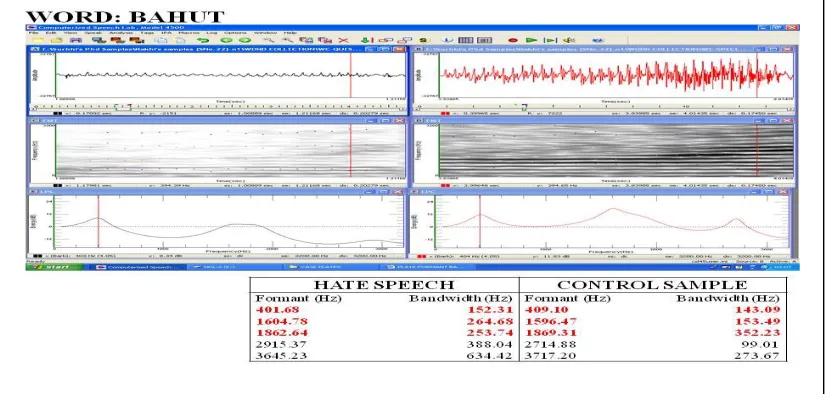
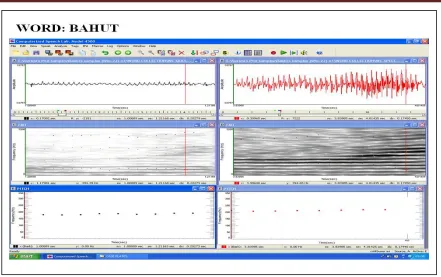
nasality, intonation pattern, fundamental frequency, formant patterns, pitch and energy contour (as
seen in figure 1 to 3). The results for the analysis were recorded and were interpreted to frame the
final conclusions.
IJSRR, 7(2) April – June, 2018 Page 330 Figure 2: Comparison of pitch pattern of hate speeches and their control counterparts using CSL software
IJSRR, 7(2) April – June, 2018 Page 331
RESULTS & DISCUSSIONS
Spectrographic analysis of voice recordings
The auditory and spectrographic comparison of hate speeches with their respective control
audio recording revealed that voice in both the recording belongs to same individual with highly
probable identity, in respect of their acoustic cues and other linguistic and phonetic features. All
considered parameters showed no significant variation at p=0.05.
Analytical Result of Layered Voice Analyzer (LVA)
From the analytical report derived from the system of the layer voice analysis of all the 10
samples it has been derived that deception pattern is followed by stress and higher cognitive
processing with less of guilt and positive stress. The excitement is voice modulation is been followed
by the deception while the samples with stable speech are using the less cognitive functioning and
average level thinking. When the global stress is stable the guilt complex is absent. While presenting
hate speech there is high usage of higher cognitive functioning with less guilt associated. Mainly
where the global frequency stress is unstable the guilty complex pattern goes high. This means when
a specific speech is made with a specific goal and the cognitive functioning goes higher the guilty
complex pattern is seen more. This is also reflected in the voice manipulation pattern. The more
higher the stress less of guilt is seen, stability in the stress pattern would also result in the less of guilt
while and unstable stress factor leads to increase in guilt patter. In all the 10 hate speeches the higher
mental processing has been used. That leads to deception and less guilt produced by the presenters.
In a study done by M.EI Uali Abeida in 2013 it was seen that perceived stress and personality
features of hyperactivity and impulsivity are independent factors related to vocal nodules13.
Around 70% of the speech done is guilt free. The deception pattern is clearly been seen due to use of
higher cognitive functioning. The speeches made have been a perfect “Hate Speeches” on and
respective particular topic.
REFERENCES
1. Mill JS. On Liberty and Utilitarianism. 4th ed. Bantam Classic: New York; 2008:272 2. Bardes BA, Shelley MC, Schmidt SW. American Government and Politics Today: The
Essentials. 17th ed. Cengage Learning: Boston, USA; 2014
3. Law Commission of India. “Report on Hate Speech” [online]. 2017 [March 2017] Available
IJSRR, 7(2) April – June, 2018 Page 332
4. European court of Human Rights. "Factsheet – Hate speech” [online]. 2018 [March 2018]
Available from: URL. http://www.echr.coe.int/Documents/FS_Hate_speech_ENG.pdf
5. Mathur S, Choudhary SK, Vyas JM. Speaker Recognition System and its Forensic
implications: A review. IJLTEMAS.2014; 3(4): 56-62.
6. Klevans RL, Rodman RD. Voice recognition. Artech House: Boston; 1997:171
7. Chenafa M, Istrate, D, Vrabie V, Herbin M. Biometric system based on voice recognition
using multiclassifiers. Biometrics and Identity Management. 1st ed. Springer-Verlag Berlin: Heidelberg; 2008:206-215.
8. Hollien H. Forensic voice identification. Academic Press: California, USA; 2002:235.
9. Holmes J, Holmes W. Speech synthesis and recognition. 2nd ed. Taylor & Francis: London; 2001:298.
10.Kersta LG. Voiceprint Identification. JASA.1962; 34(5) Available on
https://doi.org/10.1121/1.1937211
11.Kersta LG. Voiceprint Identification, Police Law Quarterly; 1974; 3(3) Available on
http://heinonline.org/HOL/LandingPage?handle=hein.journals/polqua3&div=21&id=&page=
12.Harnsberger JD, Hollien H. Assessing Deception by Voice Analysis: Part II: The LVA. ISJ.
2016; 8(1) Available on
http://www.investigativesciencesjournal.org/article/viewFile/16038/10140
13.El UAM, Fernandez LR, Valles VH, García CJ, Rueda GP, Ortiz GA. Study of the Influence
of Psychological Factors in the Etiology of Vocal Nodules in Women. J Voice. 2013; 27(1):
129.e15-129.e20 Available on http://dx.doi.org/10.1016/j.jvoice.2011.08.012
14.Sharma S. “Hate Crimes in India: An economic analysis of violence and atrocities against
scheduled castes and scheduled tribes” [online]. 2012 [May 2012] Available from: URL: