Smart Attendance System Using Cd-Lbp Algorithm
Gnanaprakash V, Harini P, Harish K, Suresh G, Purusothaman P,Abstract: Over past few years, Automatic Face Recognition (AFR) have seen a huge performance improvement and this technology is now widely used in almost all commercial and security applications. It is now dragging its concentration on several automatic attendance system. Maintaining attendance is mandatory and important in all the institutions. In olden days, manual method of taking the attendance by a staff was carried out which especially needs more time and man power. To make this process automatized, Biometric attendance system emerged with marking the attendance through the fingerprints of the students. Although it is better than the manual method, it fails in the fact that it makes the students stand in a long queue which is again time consuming.Face recognition is also available in the same biometric module, it is used for analysing individuals only which still needs huge time. The proposed system gives an efficient way to automatically recognize the faces of the students and maintain attendance database based on their presence in a real time background. The results have shown improved behaviour over manual attendance system with a higher accuracy. It also tends to highly increase the security of the attendance management system.
Index Terms: automatic attendance, biometric, face recognition, face detection, LBP algorithm, Haar features, python packages
—————————— ——————————
1.
INTRODUCTION
Attendance management in all institutions is very essential for monitoring employee or student performance. In this respect, each institution has its own framework. Some use the paper or file-based approach to take attendance manually and some have adopted automatic methods using some biometric techniques. Yet in those methods students have to wait for long timein a queue when they enter the institution. Automatic Face recognition consists of two steps called the training and testing phases. In the training phase, facesare detected from the image and stored in a database. The images should be trained with a unique Id and name of the users. Then the detected faces are compared with the database for verification in the testing phase. In the training phase, facesare detected from the image and stored in a database. The images should be trained with a unique Id and name of the users. Then the detected faces are compared withthe database for verification in the testing phase. A number of methods are proposed for face detection like Vialo Jones Method, the FloatBoost algorithm, Ada Boost algorithm, the S-Ada Boost algorithm Bayes classifier. By using the efficient algorithm for face detection and face recognition, we can achieve greater results with higher accuracy.
2
LITERATURE
REVIEW
In [1], attendance system based on fingerprint verification has been developed which can be used to place the students finger on the sensor during that time without the instructor’s intervention. This system provides a fool proof method for marking the attendanceRFID based system is introduced [2] where the students take a RFID tag and they have to place that on the RFID card reader to record theirattendance. Still this system gives a fraudulent access because an unauthorized person makes use of RFID card and enters into the institution [2]. In [3], Iris recognition system based Daugman’s algorithm is developed that does capturing the image of iris. It will recognise and extract the feaures of it. It may have difficulty to lay the transmission lines where the topography is bad. In [4], the authors proposed a method which is consist of many stages such as facial skin detection, facial features localisation, representative features extraction and facial matching. A face identification technique has been presented that is equipped for preparing the picture essentially quick and accomplishes high recognition rates [5].
In [6], a quick and reliable automatic human Support Vector Machines(SVM) and theface identification systems is developed for the need of localizing and feature extraction from it. In [7], creators have proposed the current procedures for facial component point discovery from shading pictures which incorporates format coordinating facial geometric and symmetric analysis. An efficient algorithm is introduced in [8] for Multi Layer Perception (MLP) which is used for face recognition. In [8], a face identification framework is also introduced to find the similarity between two faces of a same person.
3
BACKGROUND
INFORMATION
3.1 Pre-processing
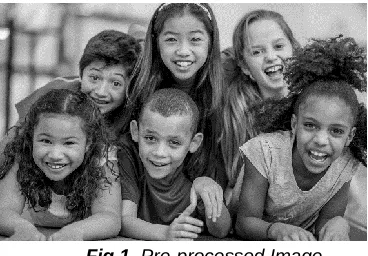
For the training phase, the student faces are captured through a video of 10 seconds by the webcam in the system. It is then converted into 61 image frames. All the images should be of same pixel size. The image captured is then converted into gray scale and the histogram is normalized.
————————————————
Mr. Gnanaprakash V is currently working as an Assistant professor in Department of Electronics and Communication Engineering, Bannari Amman Institute of Technology, Sathy, India. His areas of interest are Artificial Intelligence, Machine Learning and Deep Learning.
E-mail:[email protected],
Ms.Harini P and Mr.Harish K are currently pursuing Bachelor Degree in Electronics and Communication Engineering, Bannari Amman Institute of Technology, Sathy, India.
Email:[email protected], [email protected]
Mr. Suresh G is currently working as an Assistant professor in Department of Electronics and Communication Engineering, Bannari Amman Institute of Technology, Sathy, India. His areas of interest are Artificial Intelligence, Machine Learning and Deep Learning. E-mail:[email protected] Mr.Purusothaman P is currently working as an Assistant professor in
Department of Information Technology, Bannari Amman Institute of Technology, Sathy, India. His areas of interest are Artificial Intelligence,
Machine Learning and Deep Learning.E-mail:
385 Fig 1. Pre-processed Image
3.2 Feature Extraction
A feature is a snippet of information in an image that is relevant to solving a specific issue. It could be something as basic as a single pixel value, or highercomplex like shapes, edges, corners. Using efficient algorithms, many essential features can be extracted from the image. Here we use Vialo – JonesAlgorithm for feature extraction.
3.2.1 Vialo-Jones Algorithm
This calculation is named after two computer vision scientists Paul Viola and Michael Jones who proposed this strategy in 2001.They built up a general object location system that had the option to give aggressive object detectionrates. It tends to be utilized to take care of an assortment of location issues, yet the fundamental inspiration
1. Haar-like features selection 2. Integral image creation 3. Running Ada Boost training 4. Creating classifier cascades
When an image is given, the algorithm looks at several smaller sub regions and tries to find a face by looking for specific features in each sub region. It needs to verify many different positions and scales because an picture can have many different faces of various sizes. Haar-like features are used for face detection.
3.2.2 Haar features
Fig 2. Haar like rectangular features
4
FACE
DETECTION
Face Detection takes place in a detection window. A minimum and a maximum window size is chosen, and for each size a sliding step size is picked. Then the detection window is moved over the image as follows:
1. Set the sliding step and minimum window size comparing to that size.
2. Slide the window vertically and horizontally for the chosen window size, with the same step. A set of N face recognition filters is applied at each step. If a filter gives a positive answer, the face detection is in the current widow.
3. Stop the procedure if the size of the window is the maximum size. Otherwise increase the sliding step and corresponding size of the window to the next chosen size and go to the step 2.originates from face
recognition. TheViola-Jones algorithm has 4 main procedures as follows:
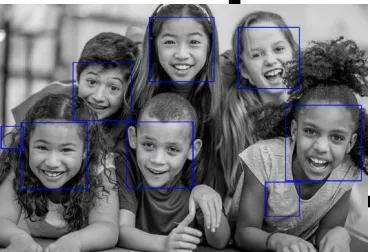
The result seems to be a collection that included the coordinates of the bounding box and facial landmarks, and the network’s confidence in detecting that area as a face. Once this process is complete, all the faces will be detected in the given image. This process will draw a rectangular boundary box around each and every faces detected in an image. By using the x, y, and z coordinates, the rectangular boxes are drawn. Here two bounding lines represent the x and y coordinates of the top left corner, and another two lines represent the width and the height of the box, respectively. Thus the facial landmarks are selected.
Fig 3.Face detection in an image
5
IMAGE
DATABASE
The obtained faces are then stored in a folder with a unique ID and name. The images with no faces detected or the unknown images will be stored in a separate folder. The face recognition (training) should be done with a single candidate whereas the face recognition (testing) can be done with several students simultaneously.
6
FACE
RECOGNITION
Face detection solely determines the presence of a human face, whereas face recognition identifies the person to which the detected face belongs to. In the testing phase, the model will recognise the students present in the institution and mark attendance for only those students. For this to happen, every day when all the students are gathered in the classroom the web cam connected to the system will capture the image of the students. After getting the best image, it will convert it into a grayscale image. Then the model will detect the faces in the grayscale image. By comparing the detected faces with the database present, it will recognise the students name in the image. Here we use LBPH face recogniser algorithm for best and accurate results.
6.1 LBPH Algorithm
The major steps of the LBPH algorithm include: 1. Taking the Parameters
2. Applying the LBP operation 3. Histogram extraction 4. Performing face recognition Taking the Parameters:
The parameters considered are,
387 Radius: It is used to build circular local binary pattern and to
represent the radius around the pixel in the centre
Grid Y: If the cells are more, the grid is finer, and the dimensionality of the resulting feature vector will be higher. Grid X: the no of cells in the horizontal direction to make the grid finer.
Applying the LBP operation:
The second step of the LBPH algorithm is to create an intermediate image that describes the given image in a best way than the original image, by highlighting the useful facial characteristics. It uses a concept of a sliding window, which is performed based on the two parameters called neighbours
and radius.
Histogram Extraction:
In this step, We divide the image into several grids with the help of Grid X and Grid Y parameters using the image generated in the previous step.
Performing face recognition:
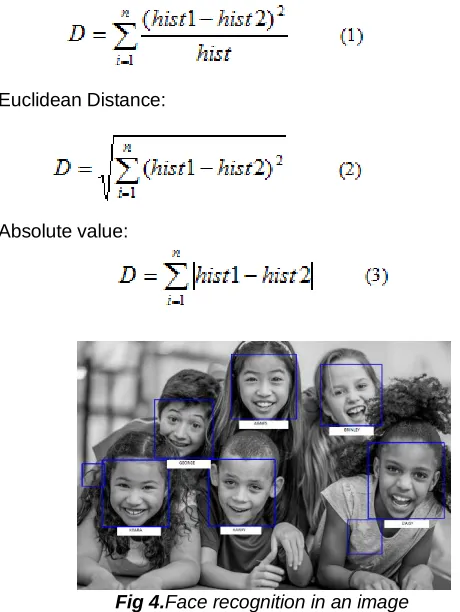
In the last step, we need to compare two histograms and return the image with the closest histogram. Various approaches can be used to calculate the distance between two histograms like chi-square, absolute value and Euclidean distance.
The metrics to compare the histograms are Chi-Square :
Euclidean Distance:
Absolute value:
Fig 4.Face recognition in an image
7
ATTENDANCE
DATABASE
MANAGEMENT
The students those who are present in the class are marked attendance in an Excel sheet in a daily base. The attendance taken in the same day are marked in the same Excel sheet. Whereas theattendance taken in a new day will be marked in a separate google sheet to avoid confusion. Each and every
google sheet is named with the date and time at which it is entered.
Fig 5. Attendance database
8
EXPERIMENTAL
SETUP
The hardware and software setup required for the project is to be done perfectly before initializing the work.
8.1 Hardware Setup
The hardware requirements for the project are,
1. A computer should be installed in the class room where the whole system is to be deployed.
2. Camera must be accurately positioned in the class room to obtain the snaps of the students. Optimum Resolution should be 512 by 512 pixels.
3. Additional memory is required to store the images and attendance database.
8.2 Software Setup
This work requires python prompt to be installed to run the python scripts. Here we used Anaconda command prompt available under Anaconda python distribution. It also requires several python packages to perform specific functions which can be installed using PIP,a python
8.3 Python packages
8.3.1 NumPy- Numerical python (NumPy) helps us to perform operations on multi dimensional arrays. It also provides vectorization of several mathematical operations on NumPy array type, which helps to speed up the process. 8.3.2 Pandas - Pandas is a package designed specifically to do operations with labelled and relational data simply and intuitively. It is good for data wrangling, quick data manipulation, visualization and aggregation.
8.3.3 Tkinter - The standard library for GUI in Python is the Tkinter. Python when combined with Tkinter provides a quick and easiest way to create GUI applications with the help of Tk GUI toolkit.
8.3.4 cx_Freeze-cx_Freeze is a set of modules and scripts for changing Python scripts into executable file. It requires Python 2.7 version or higher version. cx_Freeze is available under an open-source license.
8.5.5 Python Imaging Library-Python Imaging Library is used for opening, performing operations and saving different formats of image files. It is a free library for the Python language.
9
RESULT
ANALYSIS
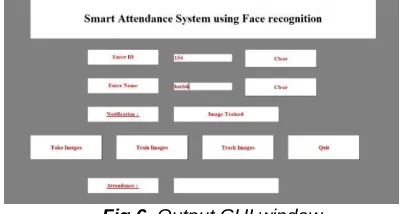
After completing the hardware and software setup, Run the python script. A GUI window will be opened which will ask for user registration. Each student has to register their faces with their name and unique ID. After that, the model has to be trained. Whenever, attendance has to be taken, it will capture the students’ image and post the attendance in the database.
Fig 6. Output GUI window
10
CONCLUSION
Automatic Attendance System has been imagined to diminish the blunders thathappen in the customary attendance taking framework. The point is to robotize also, make a system that is valuable to the association, for example, a institution. The effective and exact method for attendance in the workplace condition that can supplant the old manual techniques. This strategy is secure enough, dependable and accessible for use. No requirement for particular equipment for introducing the system in the workplace. It tends to be developed utilizing a camera and PC only. It also tend to give the best results results and accuracy by eliminating the time required for the manual attendance system. The face recognition can also be applied in several fields like medical, military and commercial applications.
11
FUTURE
WORK
In future, this smart attendance system can be deployed using the surveillance camera in the workplace which will eliminate the need for a separate web cam. It will also eliminated the need for a standalone PC in separate classroom which can be monitored by a single server system. More efficient algorithms can be used to increase the accuracy further. Use of Convolutional Neural Network (CNN) will also give better results. We can also use separate cloud services to store a huge amount of data. Future systems with API (Application Program Interface) can also be created. This type of process can also be used for different applications of the same kind. Thus, this system will have a huge growth in the future to make things automated. It will widely reduce the man power and also increase the security of the whole process.
REFERENCES
[1] Mohamed BK, Raghu C, ―Fingerprint attendance system for classroom needs,‖ India Conference (INDICON), 433-438,2012.
[2] Lim T, Sim S ,Mansor M, ―RFID based attendance system,‖ Industrial Electronics & Applications, IEEE Symposium, 2(3), 778-782,2009.
[3] Kadry S, maili KS, ―A design and implementation of a wireless iris recognition attendance management system,‖ Information Technology and control, 36(3), 323-329,2007. [4] Semary NA, Ahmed FawziGad, ―A Proposed Framework for Robust Face Identification,‖ System Computer
Engineering and System (ICCES), 62-67,2014.
[5] Viola P, Jones MJ, ―Robust Real-Time Face Detection,‖ International Journal of Computer Vision, 57(2), 137-154,2004.
[6] Amr El Maghraby, Mahmoud Abdalla, Othman Enany Mohamed & El Nahas Y, ―Hybrid Face Detection System Using Combination of Viola-Jones Method and Skin Detection,‖ International Journal of Computer Applications, 71(6), 15-22,2013.
[7] Gargesha M, Panchanathan S, ―A Hybrid Technique for Facial Feature Point Detection,‖ IEEE Proceedings of SSIAI, 134-138,2002.