1244
Development Of Analog Material Based Physics
Module To Improve Concept Understanding And
Creative Thinking
Fitri April Yanti, Heru Kuswanto, Mundilarto, Jumadi, Friska Octavia Rosa
Abstract : The purpose of this research is to develop and analyze the feasibility of analog material based physics module. This research and development is using 4D model. This development is assessed based on the feasibility aspects of presentation, content, and language by lecturers, peer reviewers and students. Based on the validation of content, presentation and language feasibility aspects, the analog material-based physics module is then tested for practicality through a limited trial and tested for effectiveness through extensive trials. The essay type test instrument was first validated by experts and the empirical tests were tested to 100 other students who participated as test takers after they had already studied the materials. Data collection techniques through tests, N-Gain and MANOVA were used to analyze data. The result of the research is (1) the analog-based physics module which was applied to the candidate of physics lecturer was characterized by the learning step in the module that was adjusted with the analogy method (2) the quality of the analog material-based physics module on the electronic structure of atoms developed by either categories (3) Analogy-based physics material was effectively used to improve students’ understanding of concepts and creative thinking.
Index Terms: Module Development, Physics Material, Analogy Method, Understanding Concept, Creative Thinking. —————————— ——————————
1.
INTRODUCTION
Learning in universities is complex. Lesson materials delivered more abstract materials. Lecturers often have difficulty in delivering such abstract materials. Students have different pace in understanding the materials, which adds to the problems facesd by lecturers in delivering abstract materials. Understanding concepts of abstract materials wrongly can lead to misconceptions among students (Erökten & Gökharman, 2013; Knol et al, 2015; Linsey et al, 2012; Mellor, 1968). The results of the define phase analysis indicate that the students need printed materials that can be used to facilitate their understanding of atomic electronic structure materials. Appropriate learning methods are also needed to deliver abstract materials into more real ones. As stated by (Yener, 2012; Sarikaya, Walsh, et al, 2007), useful methods are methods that build student knowledge and make students play an active role. A method that can be used to teach abstract materials is the analogy method. The analogy method can be used to help students understand concepts. The analogy method is a method that directs the thinking ability of each individual related to his experience in everyday life. According to (Glynn & Takahashi, 1998), the Theoretical Framework's representation methods of analogy in the text can help students build meaningful relationships between what they already know and what they learn. Learning science should involve students in knowledge building and the creation of new ideas from what they already know as in the constructivist view. In addition, analogy can help students visualize abstract concepts, and organize their thinking about a meaningful topic. Learning takes place effectively using the
analogy method. The use of analogy design is done intact and structured. The analogy method is not only applicable in the form of learning methods, but also applicable in the student module. The method of analogy, by explaining the features that exist in the surrounding learning environment, is not limited to the relevance of the material being studied (Sarikaya, 2007). This module provides learning materials, especially for students who have difficulty understanding abstract materials. The objectives of this research are (1) to develop analog material-based physics module, (2) to know the quality of analogue material-based physics module, (3) to test the effectiveness of analog material-based physics module to improve students’ understanding of concepts and creative thinking.
2
LITERATURE
REVIEW
2.1 Analog Method
The analogy method is based on the constructivism theory of connecting old knowledge with new knowledge (Erdo, 2014; Grandas, 2015; Green & Armstrong, 2007; Loc & Uyen, 2014; A Stonys, Sapragonas, & Mockus, 2010). The analogy method will describe the material discussed with the real thing in found in everyday life. Appropriate analogy is used to describe microscopic material or any abstract ideas which are difficult to perceive by the senses, such as the electronic structure of an atom. The analogy shapes the students' knowledge and should be analogues and targets of high relevance and irrelevance (Duit, 1991; Schiff, 2009; Linsey et al, 2008; Yener, 2012; Gentner et al, 2001; Linsey et al, 2007). Analogy is formed from the environment spontaneously then the analogy is chosen because of it’s the way each individual constructs a concept will be different from one another so that in this case students are not given limits in providing an analogy that is certainly in accordance with the concept learned (Bio et al, 2014; Cokelez & Dumon, 2005; Kimia & Ganesha, 2014; Linsey et al, 2008; Mizuguchi et al, 2005; Suja, 2014).
2.2 Understanding Concepts
Understanding concepts of physics by learners is derived from the process of finding and discovering their own concepts. Most learners are able to solve certain conceptual problems ————————————————
Fitri April Yanti, is currently Ph.D student of physic education at Universitas Negeri Yogyakarta, Indonesia. E-mail: [email protected]
Heru Kuswanto is currently associate professor of physic education at Universitas Negeri Yogyakarta, Indonesia. E-mail: [email protected]
Mundilarto, is currently professor of physic education at Universitas Negeri Yogyakarta, Indonesia. E-mail: [email protected]
Jumadi, is currently professor of physic education at Universitas Negeri Yogyakarta, Indonesia. E-mail: [email protected]
Friska Octavia Rosa is currently lecturer of physic education at Universitas Muhammadiyah Metro, Lampung, Indonesia.
1245
that come from the teacher (Rani, Wiyatmo, & Kustanto, 2017), but do not understand the underlying concepts. Understanding the concept is based on the following indicators: re-state a concept, give examples, classify objects, and apply the concept (Mutohar, 2016). Such indicators can be achieved through appropriate learning methods. Understanding concepts can be improved through inquiry methods of learning and problem-based learning (Hung & Jonassen, 2006; Sholikhan, 2017), whereas conceptual understanding in students can be improved through analogy method (Nottis, 2001). Understanding concepts in learning should be tailored to the level of cognitive development of learners.
2.3 Creative thinking
Creativity is one of the forms of intelligence of a person in doing things and encompassing various functions of the brain (Fatmawati, 2016; Sari, Permanasari, & Supriyanti, 2017). The creativity of a person is also part of the cognitive function that can help explain and interpret abstract concepts by involving various skills such as curiosity, discoverability, exploration, quest for certainty and enthusiasm. All these skills develop during childhood (Florence Beetlestone, 2011). Creativity must have a process or stage which is called creative (Kristiyanti, 2019). Creative indicators include: fluency, flexibility, originality, elaboration (Salim, Zubaidah, & Hamdani, 2012; Sunaryo, 2014).
3
METHOD
3.1 Experimental Design
This research is an educational research and development (R & D) that is research the development model used is the Thiagarajan model. The Thiagarajan model consists of four stages called the 4D model (four-D models). The four stages based on Thiagarajan are definitions, design, development and disseminate. Results of needs analysis, literature, material are taken to develop materials, methods, and test instruments. The definition stage is the learning needs analysis phase. At this stage, needs analysis is based on student’s characteristics, subject matter analysis, and curriculum. The design stage is to create a module design on the atomic electronic structure materials. The development stage aims to produce a analogue material-based physics module. Different modules developed using the concept in accordance with the analogy method. The presentation of electronic atomic structure materials that have abstract characteristics will be understood more easily using analogy. Assessment of learning outcomes done before and after the learning aims to know the differences in learning in the experimental and control groups. The learning module developed is effective after being able to improve students’ learning outcomes.
3.2 Participant
The subjects of the study were the physics education students. With probability sampling technique, 50 students were selected and divided into two groups; the first group served as the experimental class and the second group served as the control class. The module effectiveness test involves 25 students of the 3rd semester as an experimental class. Students in the experimental class are those who no longer studied the electronic structure of atoms. The study was conducted at Muhammadiyah Metro University from
September to December 2017. 3.3 Instrument
The research Instrument was done through evaluation process by experts and physics lecturer. Instruments were evaluated in terms of material and language. Another aspect tested was its feasibility. The instrument test involved 250 respondents to obtain empirical validity and test reliability. Data were analyzed using the QUEST software. The test results showed that all test items had INFIT MNSQ between 0.76 to 1.33 which means the test item is valid and the test item's reliability is 0.77 which means that all tested items are reliable.
3.4 Data analysis
Data obtained through research instruments were analyzed using SPSS 16.0. Analysis using SPSS is necessary to ensure that the data are normally distributed and homogeneous. Using the average score, the earned score was calculated. The different responses between the two classes were then analyzed using MANOVA. The descriptive data obtained from the assessor, was first used to determine the validity and reliability of the research instrument. The Aiken's V equation is used to ensure the validity of the research instrument. Analysis of the validity of research instruments, was measured by calculating the score of each aspect of assessment using the formula:
V = Information:
s = r - lo
V = index of expert agreement on the validity of items R = The number given by an expert
lo = The lowest validity score (in this case = 1) n = Number of experts
c = The highest validity score (in this case = 5)
Furthermore, the reliability of the instrument to evaluate the developed product was determined using Cohen's kappa analysis, with the criterion that a good instrument will have a reliability coefficient greater than or equal to 75%.The feasibility analysis of learning device product is done by calculating the average score for each aspect using the following formula:
Information:
= the average score of each indicator n = number of appraisers
∑ X = the number of scores per indicator
MANOVA is used to determine the difference in response between two classes. This study used the posttest-postest control group design shown in Table 1 (Wiersma & Jurs, 2009: 146).
TABEL1.
PRETEST-POSTEST CONTROL GROUP DESIGN
Class Pretest Treatment Posttest
Experiment O1 X1 O2
1246
Where, O1 = Pretest, O2 = Posttest,
X1 = using analogical material-based physics modules, and X2 = not using material-based analytical physics module. This product is applied to the experimental class and the results are compared to the control class. Data obtained from pretest and posttest were analyzed descriptively and quantitatively. Each learning improvement achieved by the two classes was determined by calculating the gain score of each student test result. The average gain scores of the experimental class were also compared with the control class. The developed evaluation rubric was evaluated by three experts, whose evaluations indicate that was valid and reliable
4 RESULT
AND
DISCUSSION
The unique characteristics of the module as a product of development have three main points: 1) The accuracy of the analogy used in the form of critical instruction, visual presentation, and real examples from everyday life to minimize misconception; 2) The existence of triggers of new ideas that provide freedom to analogize a concept that is relevant independently; 3) Assessment of deductive and inductive patterns as supplement in exploring appropriate and relevant analytical abilities with abstract concepts. Students can search for similar and unlimited analogical material but remain relevant to the same or related material (Sarikaya, 2007). Based on the requirement analysis, the analogy-based physics learning module was developed on electronic atomic structure materials. The following sub-chapter discusses the atomic orbitals in analog -based module design.
Stage 1: Introduce the concept of target
The target concept used is the radiation of energy absorbed by the atoms causing the electrons to move from the lower-energy (smaller) n orb into the higher-lower-energy orbit (n larger). In contrast, radiation energy (in the form of photons) is emitted when electrons move from higher-energy orbits into lower-energy orbits.
Stage 2: Review analogy concepts
The concept used as an analogy is the transfer of tennis balls up or down the stairs. The ball can be on the stairs to any but not possible in the area between the steps. The move from the lower steps to the higher steps is the process of requiring energy, and vice versa
Stage 3: Identify the relevant analogy and target properties Identification of relevant properties between analogy and target is shown in Table 2
TABLE2.
IDENTIFY THE RELEVANT PROPERTIES BETWEEN ANALOG AND
TARGET ON IONIC BONDS
Analog Target
Source: https: //en.wikipedia.org/wiki/Elektron
Stage 4: Mapping the relevant properties analog to the target The mapping of analog and target relevant properties on the electron displacement is shown in Table 3
TABLE3.
THE MAPPING OF ANALOG AND TARGET’S RELEVANT PROPERTIES
ON THE ELECTRON
Analog Target
Tennis ball As an elelctron
Stairs As an elelctron orbit
Step 5: Identify the analog’s properties that are not relevant to the nature of the target
The identification of analog’s properties irrelevant to the electron target’s properties displacements is shown in Table 4
TABLE4.
IDENTIFICATION OF ANALOG’S PROPERTIES THAT ARE IRRELEVANT
TO THE TARGET’S PROPERTIES OF ELECTRON DISPLACEMENT
Analog Target
The transfer of tennis balls on each ladder has the same distance as the distance between one ladder and to another
In the electron displacement, the amount of energy involved in the transfer of electrons from one orbit to another depends on the difference in energy levels from the initial to final states.
Stage 6: Make a conclusion
Electrons move from lower-energy orbits to higher-energy orbits. The radiation energy (in the form of photons) is emitted when electrons move from higher-energy orbits into lower-energy orbits. The amount of lower-energy involved in electron displacement depends on the difference in the energy level of the initial and final states.Based on the response data, students agree on the lesson materials using analog-based physics module.
TABLE5.
STUDENTS’RESPONSE DATA TO ANALOG-BASED PHYSICS MODULE
No Statements % Agreement
1. Students are happy during the learning activities using the developed module.
95 2. Students understand the material of
electronic structure of atoms much better when presented using analog material-based physics module.
95
3. The modules used in this lesson can help students in the learning process.
85 4. After following the lesson using the
analog-based physics module, students found that the electronic structure of the atoms becomes an easy, fun and great lesson materials which enhance student's analogy.
95
5. In general, this developed module is good 85
1247
conclusion is that there is a difference in improving the conceptual understanding and students' creative thinking between experimental classes (after learning using an analog material-based physics module) and classroom control (after learning in other ways).
TABEL 6.
RESULTS OF MANOVA
Effect Sig Criteria for Decision
Decision Coclusion Hot
telling's Trace
0.000 sig<0.05 Ho rejected
There is a difference in the increased students’ understanding of the concept and creative thinking between the experimental and control classes.
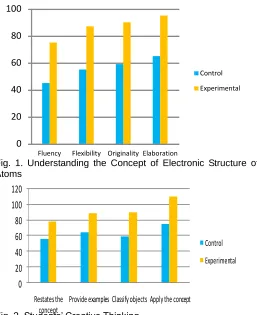
The comparison of test results in relation to the dependent variable between the experimental class and the control class is presented in Figures 1 and 2. The effect of the use of analog material-based physics module is analyzed. The data show that there is an increased understanding of student concepts. There is a change in understanding the concept of the electronic structure of atoms. This is in line with the research findings by (Harrison & Treagust, 2006; Samara, 2016) which state that using the analogy method can facilitate understanding through analogies of objects that are around it.
Fig. 1. Understanding the Concept of Electronic Structure of Atoms
Fig. 2. Students’ Creative Thinking
The improvement of students' creative thinking can be seen from the difference in scores between the experimental class
and the control class. The scores were obtained after the learning is complete. In the research, the influence of the use of analog-based learning model to improve the students’ understanding of concept and creative thinking was analyzed. The data obtained shows that there is an increased understanding of concepts among students. It impacts on their creative thinking ability which then helps them to understand the concept of electronic structure of atoms. Students in the experimental class are more active in communicating ideas than those in the control class. Student creativity is part of the cognitive function that can help explain and interpret abstract concepts by involving various skills such as curiosity, discoverability, exploration, search for certainty and enthusiasm (Beetlestone: 2011). The results of this development show that the analogy method integrated in the analog-based physics module can be used to explain the abstract physics concepts.
5 CONCLUSION
The analog-based physics module on the lesson materials of the electronic structure of atoms being developed is feasible for use in learning activities as a learning medium. It has received good assessment and can be tested for use in the physics learning on the electronic structure of atoms. This can help improve understanding of concepts and creative thinking among the physics education students.
REFERENCES
[1]. Bio, B., Suardana, I. N., & Kirna, I. M. (2014). Analysis of Learning Difficulties of Senior High School Students in Learning Atomic Structure. E-Journal Kimia Visvitalis, 2(2), 107–116.
[2]. Chan, J., Paletz, S. B. F., & Schunn, C. D. (2012). Analogy as a strategy for supporting complex problem solving under uncertainty. Memory & Cognition, 40(8), 1352– 1365. https://doi.org/10.3758/s13421-012-0227-z
[3]. Chang, C., Tsai, L., & Chen, C. (n.d.). A study to the influence of applying analogy method in concept development.
[4]. Cokelez, A., & Dumon, A. (2005). Atom and molecule: Upper secondary school French students’ representations in long-term memory. Chemistry Education Research and Practice, 6(3), 119–135. https://doi.org/10.1039/b4rp90005g
[5]. Duit, R. (1991). On the role of analogies and metaphors in learning science. Science Education, 75(6), 649–672. https://doi.org/10.1002/sce.3730750606
[6]. Erdo, R. T. (2014). Teaching Chemical Equilibrium by Analogy- Based Worksheets Teaching Chemical Equilibrium by Analogy-Based Worksheets. Turkish Journal of Teacher Education, 3(September 2016), 0–14. [7]. Erökten, S., & Gökharman, H. K. (2013). The effect of
analogy method on student achievement in the unit ―the structure and properties of matter‖ ??ivril sample. World Applied Sciences Journal, 23(6), 744–750. https://doi.org/10.5829/idosi.wasj.2013.23.06.589
[8]. Fatmawati, B. (2016). The analysis of students’ creative thinking ability using mind map in biotechnology course. Jurnal Pendidikan IPA Indonesia, 5(2), 216–221. https://doi.org/10.15294/jpii.v5i2.5825
[9]. Gentner, D., Holyoak, K. J., & Kokinov, B. N. (2001). The Analogical Mind: Perpectives from Cognitive Science. Eurasia Journal of Mathematics, Science & Technology
0 20 40 60 80 100
Fluency Flexibility Originality Elaboration
Control
Experimental
0
20
40
60
80
100
120
Restates the concept
Provide examples Classify objects Apply the concept Control
1248
Education, 3(4), 562. https://doi.org/10.1017/CBO9781107415324.004
[10]. Glynn, S. M., & Takahashi, T. (1998). Learning from analogy-enhanced science text. Journal of Research in Science Teaching, 35(10), 1129–1149.
https://doi.org/10.1002/(SICI)1098-2736(199812)35:10<1129::AID-TEA5>3.0.CO;2-2
[11]. Grandas, M. (2015). the Potential of Design-By-Analogy Methods To Support Product , Service and Product Service Systems Idea Generation. International Conference on Engineering Design, (July), 1–12.
[12]. Green, K. C., & Armstrong, J. S. (2007). Structured analogies for forecasting. International Journal of Forecasting, 23(3), 365–376. https://doi.org/10.1016/j.ijforecast.2007.05.005
[13]. Harrison, A., & Treagust, D. (2006). Teaching and learning with analogies. Metaphor and Analogy in Science Education, 11–24. https://doi.org/10.1007/1-4020-3830-5_2
[14]. Hung, W., & Jonassen, D. H. (2006). Conceptual understanding of causal reasoning in physics. International Journal of Science Education, 28(13), 1601– 1621. https://doi.org/10.1080/09500690600560902 [15]. Kimia, J. P., & Ganesha, U. P. (2014). Penggunaan
analogi dalam pembelajaran kimia. Jurnal Pendidikan Indonesia, 3(2), 397–410.
[16]. Knoll, S. W., Horton, G., Krull, C., & Dittmar, T. (2015). Improving the Effectiveness of Ideation Using Analogies : Choosing the Right External Stimuli. Jurnal of Creativity and Business Innovation, 1(JUNE), 5–18.
[17]. Kristiyanti, E. (2019). Model Penyelenggaraan Pendidikan Inklusif bagi Penyandang Disabilitas Intelektual : Studi Kasus di DKI Jakarta. Indonesian Journal of Religion and Society, 1(1), 66–79. https://doi.org/10.36256/ijrs.v1i1.26
[18]. Linsey, J. S., Laux, J., Clauss, E. F., Wood, K., & Markman, a. (2007). Effects of Analogous Product Representation on Future Design-by-Analogy. Proceeding of the 2007 International Conference on Engineering Design, (August), 1-13x.
[19]. Linsey, J. S., Markman, A. B., & Wood, K. L. (2012). Design by Analogy: A Study of the WordTree Method for Problem Re-Representation. Journal of Mechanical Design, 134(4), 041009–041009. https://doi.org/10.1115/1.4006145
[20]. Linsey, J. S., Wood, K. L., & Markman, A. B. (2008). Modality and representation in analogy. Ai Edam, 22(02), 85–100. https://doi.org/10.1017/S0890060408000061 [21]. Loc, N. P., & Uyen, B. P. (2014). Using Analogy in
Teaching Mathematics : An Investigation of Mathematics Education Students in School of Education - Can Tho University, 2(7), 91–98.
[22]. Mellor, D. H. (1968). Models and Analogies in Science: Duhem versus Campbell ? Isis, 59(3), 282–290. [23]. Mizuguchi, T., Takata, N., Ikeda, K. I., & Nakashima,
H. (2005). Atomic structure and electronic state of 〈110〉
symmetric tilt boundaries in palladium. Nippon Kinzoku Gakkaishi/Journal of the Japan Institute of Metals, 69(11), 1010–1015. https://doi.org/10.2320/jinstmet.69.1010 [24]. Mutohar, A. (2016). Analisis Kemampuan
Pemahaman Konsep. FKIP UMP, 5–14.
[25]. Rani, S. A., Wiyatmo, Y., & Kustanto, H. (2017). Concept attainment worksheet to enhance concept
knowledge and science process skills in physics instruction. Jurnal Pendidikan IPA Indonesia, 6(2), 326– 334. https://doi.org/10.15294/jpii.v6i2.10520
[26]. Salim, A., Zubaidah, & Hamdani. (2012). Kemampuan Berpikir Kreatif Siswa dalam Penyelesaian Soal Open-Ended Materi Statistika Pada Kelas IX SMP. Jurnal Pendidikan Dan Pembelajaran Untan, 6(7), 1–8.
[27]. Samara, N. A. H. (2016). Effectiveness of analogy instructional strategy on undergraduate student’s acquisition of organic chemistry concepts in Mutah University, Jordan. Journal of Education and Practice, 7(8), 70–74.
[28]. Sari, D. K., Permanasari, A., & Supriyanti, F. M. T. (2017). Profile of students’ creative thinking skills on quantitative project-based protein testing using local materials. Jurnal Pendidikan IPA Indonesia, 6(1), 71–75. https://doi.org/10.15294/jpii.v6i1.9516
[29]. Sarikaya, M. (2007). Prospective teachers’ misconceptions about the atomic structure in the context of electrification by friction and an activity in order to remedy them. International Education Journal, 8(1), 40– 63.
[30]. Schiff, R. (2009). Analogical Problem Solving in Children Learning Disabilities. Journal of Learning Disabilities, 42(1), 3–14. https://doi.org/10.1177/0022219408326213
[31]. Sholikhan, S. (2017). Understanding Concepts Through Inquiry Learning Strategy. IOSR Journal of Research & Method in Education (IOSRJRME), 07(01), 97–102. https://doi.org/10.9790/7388-07010597102 [32]. Stonys, A, Sapragonas, J., & Mockus, S. (2004). The
analogy method for the description of external characteristic of inner combustion engines. Transport, 19(5), 214–218.
[33]. Stonys, Agnius, Sapragonas, J., & Mockus, S. (2016). The analogy method for the description of external characteristic of inner combustion engines, 4142(October).
[34]. Suja, I. W. (2014). Strategi ―ERMO‖ Dalam Pengajaran Konsep-Konsep Kimia. Prosiding Seminar Nasional Kimia, (September), 16–23.
[35]. Sunaryo, Y. (2014). Model Pembelajaran Berbasis Masalah Untuk Meningkatkan Kemampuan Berpikir Kritis Dan Kreatif Matematika Siswa SMA Di Kota Tasikmalaya. Jurnal Pendidikan Dan Keguruan, 1(2), 41–51. https://doi.org/10.1007/s13398-014-0173-7.2
[36]. Walsh, L. N., Howard, R. G., & Bowe, B. (2007). Phenomenographic study of students’ problem solving approaches in physics. Physical Review Special Topics - Physics Education Research, 3(2), 1–12. https://doi.org/10.1103/PhysRevSTPER.3.020108