Changing Attention
Thesis submitted for the degree of Doctor of Philosophy
John Dylan McCarthy
University College London
June 1996
ProQuest Number: 10045798
All rights reserved
INFORMATION TO ALL USERS
The quality of this reproduction is dependent upon the quality of the copy submitted.
In the unlikely event that the author did not send a complete manuscript and there are missing pages, these will be noted. Also, if material had to be removed,
a note will indicate the deletion.
uest.
ProQuest 10045798
Published by ProQuest LLC(2016). Copyright of the Dissertation is held by the Author.
All rights reserved.
This work is protected against unauthorized copying under Title 17, United States Code. Microform Edition © ProQuest LLC.
ProQuest LLC
789 East Eisenhower Parkway P.O. Box 1346
Acknowledgments
All my love and respect to my family and the M cCarthy clan back in Leigh . I'm sorry I've been aw ay for so long, but you know w hat they say: " A man's gotta do w hat a man's gotta do". I ju st hope it was w orth it.
Special thanks to my supervisors for all their help. To G eorge H oughton for giving me space to explore my ideas and guiding me with his invisible hand and to Phil Reed for his invaluable help in structuring the thesis. I couldn't have done it w ithout you.
To Ruth, Alistair, Fergus, Sophie, John Draper, Tamar and all my friends from U .C .L ., you've all helped in m ore ways than I can put in words. Thankyou for your consistent support and encouragem ent. If I had friends half as good as you I'd still be a lucky man .To Em m a, Jon, Alf, M att D., and Cass, thanks for growing up with me, being true friends and sharing your know ledge and wisdom.
All my love, respect and appreciation to Carla for w aking me up and then putting up with me for so long. I'm sorry this thesis had such a high price.
Abstract
Contents
CHAPTER 1:
Frameworks for Changing Attention
1.1 A ttentional Frameworks 13
1.2 A ttention and the Linear Fram ew ork 14
1.3 Attention and the Cyclic Fram ew ork 17
1.4 Repetition Effects 18
1.4.1 W ord Repetition Effects 19
1.4.2 Covert Orienting 20
1.5 Posners' Fram ew ork 22
1.5.1 The Posterior N etw ork 22
1.5.2 The A nterior N et work 22
1.5.3 The Vigilance N etwork 23
1.5.4 Summary 24
1.6 A General Attentional Fram ew ork 24
CHAPTER 2:
Experience and Changing Attention
2.1 The Effects of Experience 28
2.2 Tw o Procedures for Studying Experience Effects 28
2.3 M ultiple Repetition Paradigm s 30
2.3.1 The Orienting Response 30
2.3.2 The Stimulus Repetition Effect 32
2.3.3 Opposing M ental Biases 33
2.3.4 Learning Effects 36
CHAPTER 3:
A GAIN Model and the Novel Popout Paradigm
3.1 Overview 42
3.2 The H oughton & Tipper (1994) O pponent Process M odel 42 3.3 The General A ttentional-Intentional N etw ork (GAIN) 45
3.4 Empirical Issues and the GAIN Model 47
3.5 The Novel Popout Paradigm 47
3.6 Novel Popout and the G A IN M odel 49
CHAPTER 4:
Novel Popout and Task Demands
4.1 Introduction 52
4.2 Experim ent 4.1 53
4.2.1 M ethod 54
4.2.2 Results and Discussion 57
4.3 Experim ent 4.2 59
4.3.1 M ethod 60
4.3.2 Results and Discussion 60
CHAPTER 5:
Category Popout and Novel Popout With Picture
Stimuli
5.1 Introduction 66
5.2 Experim ent 5.1 69
5.2.1 M ethod 71
5.2.2 Results and Discussion 74
5.3 Experim ent 5.2 77
5.3.1 M ethod 78
5.3.2 Results and Discussion 83
5.4 General Discussion 86
CHAPTER 6:
Associations in the GAIN Model
6.1 Introduction 89
6.2 W hat Type of Association? 90
6.3 A ssociated Features in the GAIN M odel 92
6.3.1 Intrinsic Association 93
6.3.2 Extrinsic Association 95
6.3.2a S-node Association 96
6.3.2b N-node A ssociation 98
CHAPTER 7:
Novel Popout in Dynamic Displays
7.1 Introduction 102
7.2 Experim ent 7.1 102
7.2.1 M ethod 104
7.2.2 Colour M anipulation 110
7.2.3 Results and Discussion 111
7.3 Experim ent 7.2 113
7.3.1 M ethod 113
7.3.2 Results and Discussion 117
7.4 General Discussion 124
CHAPTER 8:
Motion in Mind
8.1 Summary 127
Illustrations
Page
14 Figure 1.1: 16 Figure 1.2: 17 Figure 1.3:
25 Figure 1.4:
31 Figure 2.1 :
37 Figure 2.2:
39 Figure 2.3:
43 Figure 3.1:
44 Figure 3.2:
45 Figure 3.3:
48 Figure 3.4:
55 Figure 4.1 :
57 Figure 4.2:
58 Figure 4.3:
61 Figure 4.4:
62 Figure 4.5:
Neills' (1995) conception of alternative selection processes.
The feature integration fram ew ork (adapted from Treism an, 1988). The perceptual cycle (adapted from N eisser, 1976)
Synthesized framework o f attentional processes.
Structure o f the orienting reflex arc (adapted from Sokolov, 1975). Associative formation within and between objects.
Functionality of the dual processing loops in the general framework.
The H oughton & Tipper (1994) selective attention model and its relationship with the domains o f the general framework.
Opponent process interaction betw een the attention control field and object field.
Adaptation o f the Houghton & Tipper (1994) selective attention model. Novel Popout results obtained by Johnston et al. (1990).
Display sequence and timing for Experim ent 4.1
Page
72 Figure 5.1:
73 Figure 5.2:
75 Figure 5.3:
76 Figure 5.4:
76 Figure 5.5:
80 Figure 5.6:
81 Figure 5.7:
82 Figure 5.8:
84 Figure 5.9:
85 Figure 5.10
90 Figure 6.1 :
92 Figure 6.2:
94 Figure 6.3:
97 Figure 6.4:
98 Figure 6.5:
100 Figure 6.6:
106 Figure 7.1: 107 Figure 7.2: 108 Figure 7.3: 109 Figure 7.4: 110 Figure 7.5: 111 Figure 7.6: 112 Figure 7.7:
Display sequences and timing for the four control conditions in Experim ent 5.1.
Display sequences and timing for the four experim ental conditions in Experim ent 5.1.
The effects o f Category and Preexposure in Experim ent 5.1.
Localization perform ance by Picture Set and Preexposure Condition. Preexposure effects with orienting arrays displaying ISet-A and 3 Set-F pictures.
Preexposure arrays used in Experim ent 5.2. Novel Pictures used in Experim ent 5.2
Display sequences and timing for Experim ent 5.2. The Effects o f Exposure Tim e and Probed Picture. Perform ance change across the trials o f Experim ent 5.2.
The effect of preexposing fam iliar words together or separately. Associations between the representations of previously selected, (but currently unattended), stimuli in the Target Field.
Grouping as intrinsically shared attention. The association of selected features via S-nodes. Reduced gain o f repeated features via N-nodes. The revised GAIN model with associative nodes.
Sample frame from an orienting array. Sample fram e from a preexposure array. An exam ple of an approaching array.
The construction of O rienting displays from a template.
Page
115 Figure 7.8:
116 Table 7.1:
117 Figure 7.9:
118 Figure 7.10:
119 Figure 7.11:
120 Figure 7.12:
121 Figure 7.13:
122 Figure 7.14:
123 Figure 7.15:
The construction o f twenty orienting arrays from five templates. Display sequences across the four conditions.
Selection biases relative to the Red colour cue. Selection biases relative to the Cyan colour cue. Selection biases relative to the Yellow colour cue. Selection biases relative to the B lue colour cue. Selection biases relative to the G reen colour cue. Conditional probabilities in the One Novel condition. Selection probabilities for the Novel cue.
129 Figure 8.1: 129 Figure 8.2: 132 Figure 8.3:
The expansion of a fam iliar domain into novel territory. A novel intrusion into a fam iliar domain.
Chapter 1
Frameworks for
Changing Attention
"
Since the su ccessio n o f tw o acts is usually re g a rd e d as an in dication o f
th eir ca u sa l relationship, (p o st hoc ergo p r o p te r hoc), thought is g e n e ra lly
a c c e p te d a s the cau se o f action. When the external influence, ie. the sen so ry
stim ulus, rem ains unnoticed, w hich o ccu rs very often, thought is even
a c c e p te d a s the in itial cau se o f actions. A d d to this the stro n g ly su b jective
n atu re o f thought, a n d yo u w ill realize how firm ly m an m ust b elieve in the
v o ic e o f self-con sciou sn ess when it tells him how such things occur. B ut
a ctu a lly this is the g r e a te st o f fa lseh o o d s: the in itial cause o f an y a ction
a lw a y s lies in the extern al sen so ry stim ulation, becau se w ith ou t this thought
is inconceivable.
"1.1
Attentional Frameworks
1.2
Attention and the Linear Framework
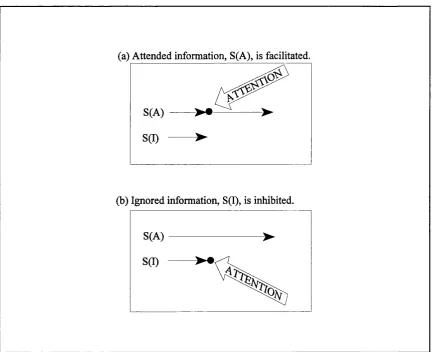
Selective attention is conceptualised by contem porary theories as a process that highlights a particular information source for potential action (Allport, 1980; Colby 1991). S election operates by differentially processing a subset of information from the total informational set. As described by Neill et al. (1995), current conceptions of attention assum e that information is processed autom atically up to a point where attention intervenes to select o r gate certain information for further processing. The information that isn't selected is assumed to receive no further processing. The selection process itself has been characterised in two distinct ways. One view suggests that attended inform ation is selected through direct facilitation (See Fig. 1.1a). A logical alternative to the facilitation hypothesis is that selection is achieved by inhibiting information to be ignored. This allows the attended inform ation to proceed unhindered (See Fig. 1.1b).
(a) Attended information, S(A), is facilitated.
S(A)
(b) Ignored information, S(I), is inhibited.
S(A)
S(I)
As noted by Allport (1993) the above conceptions o f attention are underpinned by a set o f assumptions about cognitive and perceptual-m otor architecture. O f relevance to the present argum ent are: (1) that information follows a linear unidirectional sequence from sensory input to response; and (2) that there is a single locus of selection at some point in the sequence, such that only a subset of the information available is processed further. These assumptions form the foundations o f an information processing fram ework with a long history and a large influence. A unidirectional processing sequence can be seen in fram ew orks dating from Broadbents' (1958) conception through to contemporary versions some thirty years later (Cowan, 1988). Similarly, the single locus assumption has generated a huge body o f research ta rg e tin g w hether selection occurs early or late in the process sequence. Again, this assumption has driven research for over thirty years, from the formation of opposing cam ps in the early sixties (eg. Treism an, 1964; Deutsch & D eutsch, 1963) through to new age compromises o f the nineties advocating a flexible locus of selection (eg. Yantis & Johnston,
1990).
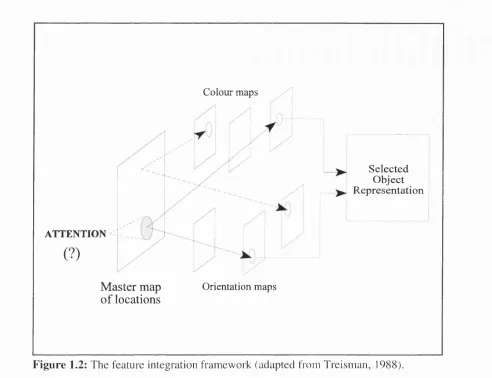
One influential model o f this type is Feature Integration (FI) theory (Treism an, 1988). As illustrated in Fig. 1.2, FI theory assumes an early stage o f visual processing in which the different dimensions of stimuli are initially conjoined. This "master map of locations" shows where object boundaries are located but does not indicate the featural m akeup o f objects. To "retrieve" the features of an object it must be attended. This is achieved by activating a set o f locations in the master map to route the information on to specialised processing modules. The specialised modules are tuned to particular visual features such as colour and orientation. A tte n tio n to a particular region o f the m aster map allows these modules to recover (or process) the perceptual features within the region. Once recovered, the features are ultim ately recom bined into a temporary object representation at the final processing stage. Thus, the basic processing sequence is a unidirectional progression from stim ulation to representation. Within this sequence attention operates at the earliest stage to govern w hich representation is recovered.
ATTENTION
(?)
Colour maps
Selected Object Representation
Master map
o f locations
Orientation maps
F ig u re 1.2: The feature integration framework (adapted from Treisman, 1988).
operating on the map of locations is simply assumed as given. Yet in the model it is not clear from where the signal for this process originates. Another way to describe this issue is to distinguish between the site of selective effects and the source of signals which initiate those eft'ects (Posner & Peterson, 1990). Thus, although FI theory focuses on the site of selective effects, it has nothing to say about the source of the signal that produces these effects. This is perhaps not surprising, as the ultimate source of selective signals is usually the experimental instruction. However, in most everyday behaviour we not select things in response to instructions. Instead, selective behaviour develops over time through learning about the relevant and irrelevant aspects of an environment. Thus, in order to develop an account of source signals for selection, we must describe how these signals can develop through repeated experience. Within the linear framework, this involves an account of how input relates to source signals as well as how the source signals relate to the selection site.
1.3
Attention and the Cyclic Framework
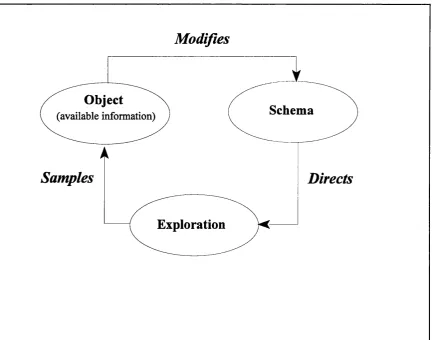
An alternative fram ew ork to accom m odate the issue o f source signals is ! Neissers' (1976) perceptual cycle. According to Neisser, perception is a constructive process o f testing anticipations. These anticipations are em bodied in preexisting associative structures called schemata. To test anticipations there is exploration of the environm ent through eye, head and body m ovem ents that make certain information available in the optic array. An outcom e of th ese explorations is that new information is picked up, which in turn modifies the original schema. Once modified a new schema is then available to direct further exploration. This cycle o f p rocesses is illustrated in Fig. 1.3. Within this fram ework, selection is a process that determines a particular associative structure to test. For example, if we look at a necker cube, then there are two alternative anticipations we can make about the structure o f the figure. The selection o f one over the other involves the establishment o f a perceptual cycle for that particular anticipation. One advantage of this fram ework is that no assumptions are made
Modifies
Object
(available information)
Schema
Samples
Directs
Exploration
about the direction o f processing o r the locus o f selection. At any given mom ent many concurrent anticipations may be active, any of which could direct further exploration. Some o f these might be activated by the concurrent stimulation, yet others m ight be activated indirectly by som e previous event. Furtherm ore, the fram ework also allows for different percep tu al cycles to be concurrently tested, such as listening to a friend while driving, or watching television while knitting.
There are two notable features in this framework. First, it should be evident that the process o f exploration or m ovem ent is fundamental to the sampling process. In other words, the ability to test simultaneous anticipations is restricted by the com patibilities in action they involve. For example, in vision, high quality of sampling is restricted to foveated stimuli. So if a subject is presented simultaneously with tw o novel objects, a selection m ust be made betw een directing sampling tow ards one object or the other. W ith this view, attention is essentially a process o f response selection, as it is the nature o f the response that governs how stimuli are subsequently sampled. The second feature to note is that attention is fundamentally a dynamic concept (Boring, 1970). In other words, what is selected at any given m om ent will be affected by the preceding actions. Therefore, to investigate changes in attention, we m ust address how selection at one point in time can affect selection at a later point.
1.4
Repetition Effects
Perhaps the simplest way to study such attentional change is to address w hat happens under conditions o f repetition. Over short temporal intervals, responses to a second event can provide information about the tim e course of processes engaged to the first event. Thus, by looking at responses to repeated events it is possible to unravel the dynam ics o f the processes engaged w hen a stimulus is selected.
second stimuli is attributed to the orienting of attention tow ards that event. In contrast, a diminished response is attributed to the withdrawal of attention from the event. The negative effect on perform ance tends to suggest that representations are actively inhibited after selection has occurred.
1.4.1 Word Repetition Effects
The contrasting effects of stimuli repetitions have been observed with w ord stimuli. O ne o f the m ost robust effects o f w ord repetition is an increased efficiency in w ord recognition. This has been observed with in lexical decision, naming and w ord com pletion task s (Scarborough et al., 1977; Scarborough et al., 1979; Tulving et al. 1982). Although these benefits are relatively small they are also very persistent and can be observed with long repetition intervals o f an hour, day or year (Morton, 1979; Jacoby and Dallas, 1981; Salasoo et al., 1985). One interpretation o f these effects is that they reflect the coincidence o f the second word presentation with an episodic memory trace of the first presentation. The benefit observ ed will thus be a function of the similarity o f a w ord to the trace o f its previous presentation (Jacoby, 1983).
be reported as "When she spilled the ink there was all over" (Kan wisher, 1987; Kan w isher and Potter, 1989, 1990). The effect can also occur when the second item is a hom ograph (eg. "He
w o un d the cloth around the wound on his hand") or a homonym of the first (eg. "She rose,
from the chair to take the red rose from the bouquet"). One interpretation o f these contrasting effects is that they reflect changes in event perception. Thus, if attention has recently been withdrawn from an event then a subsequent occurrence of that event will fail to engage attention.
1.4.2 Covert Orienting
One explanation of lO R is in terms of response inhibition. In a cue-target paradigm , the subject must avoid responding to the cue but make a speeded response to the target. Thus, although there is repetition in the spatial sequence o f events, there is no repetition in the task requirements to the two events. Because of this H arvey (1980) has argued that the inhibition observed to the second event may be due to a response inhibition to the previous cue. However, further work by Maylor and Hockey (1984) discounts this explanation by showing the same lO R effect in a strictly repeating target-target paradigm. Therefore, the inhibition to a repeated spatial event is observed irrespective of the task dem ands to the initial event. In light o f this finding M aylor and Hockey (1985) attribute lO R to an externally or stimulus driven bias against responding to a recently stim ulated location. One possible function o f this process is to induce efficient responding to novelty in the visual environment.
1.5
Posners* Framework
In recent years the cue-target m anipulation discussed above has been established as a stan dard paradigm for investigating attentional orienting. In com bination with pharmacology, neurophysiology and neuropsychology this relatively simple manipulation has proved very productive in m apping the attentional functions o f a variety o f brain areas (See Colby, 1991). The m ost influential fram ework to em erge from this venture is the attentional network scheme proposed by Posner and colleagues. Drawing on a range of evidence, Posner and Rothbart (1990) suggest the operation of at least three attentional netw orks, the Posterior Network, the Anterior Network and the Vigilance Network. O f these, the Posterior N etw ork is attributed the function o f orienting o r moving attention in space. The following section presents a b rief description the three networks and their underlying anatom y and function.
1.5.1 The Posterior Network
The Posterior Network is associated with "moving" or orienting attention to different spatial events. Such orienting may be initiated by both Endogenous (goal state) and E x ogen ou s (input state) signals. Anatomically, the network involves thalamic areas o f the pulvinar nucleus, portions of the parietal lobe and midbrain areas o f the superior colliculus. In an attempt to unravel the functions of these three areas Posner et al. (1984) distinguished three aspects o f attentional orienting: 1) the ability to EN G A G E attention to a location (Pulvinar); 2) the ability to D ISEN G A G E attention from a location (Parietal A reas); and 3) the ability to M O V E attention from one location to another (Superior Colliculus). Through coordination o f these three functions the network effectively "explores" feature space through sam pling at different locations.
1.5.2 The Anterior Network
States. F or example, when C orbetta et al. (1991) com pared passive with active viewing conditions, they observed additional activity in the anterior cingulate, basal ganglia sites and right lateral frontal cortex when stimuli where actively selected. Furtherm ore, Posner et al. (1988) observed that activation o f the system during detection tasks was related to the number o f
targets
presented rather than the actual num ber of events. The system is active for a large variety o f target types, w hether they involve colour, form, motion or w ord semantics (C orbetta et al., 1990; Peterson et al., 1990), and has recently been proposed as a general source o f Endogenous orienting signals to the posterior network.1.5.3 The Vigilance Network
1.5.4 Summary
A t present, Posners' scheme offers a loose fram ew ork to interpret psychological empiricism from a neuro-anatomical perspective. With the advent o f scanning techniques such as PET and M R I this type o f approach is becoming increasingly important. Furtherm ore, as psychologists, we should recognise that our existing fram eworks, or gram m ars, require a
degree o f translation into the language o f neuroanatomy.
U sing the cue-target paradigm as the basic m ethodology, Posners' fram ew ork has been m ost useful in the investigation o f areas associated with Posterior N etw ork, M ore specifically, it has offered an insight into the short term dynam ics o f attentional engagem ent, disengagement and motion. However, the framework also offers the possibility dealing with learning and long term attentional change in neuro-anatomical terms. W ith this in m ind, the following section presents a more general framework which attem pts to integrate the psychological and neuro-anatomical perspectives on attentional phenom ena.
1.6
A General Attentional Framework
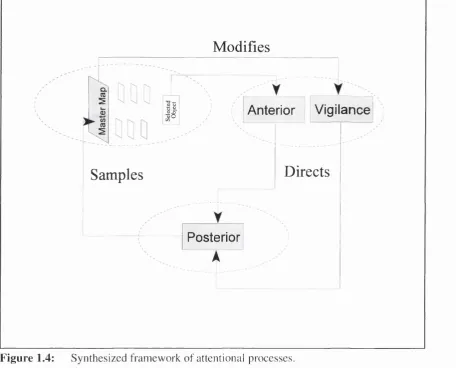
Modifies
CL (C
II
Anterior
i
Vigilance
Samples
Directs
Posterior
F ig u re 1.4: Synthesized framework of attentional processes,
learning and development.
An integrated framework of these three approaches is presented in Fig. 1.4. The basic structure is modelled on a cyclic processing sequence. However, in contrast to Neissers' (1976) scheme the framework is completely internalised. In the original perceptual cycle, the dom ains of object information and exploration were conceived as external variables. The available information was equated with the optic array (Gibson, 1966) and exploration was equated with observable movement. Yet, in theory, the cyclic approach is applicable to changing the point o f view relative to any information source, whether external or internal. To accom m odate this idea an early internal information source is assumed, analogous to Treismans' master map (See Section 1.2). The exploration of this source is mediated by the P o sterio r network. This controls exploration of the map by engaging, disengaging and moving attention to different information sites. Finally, the two classes of schema directing this exploration are equated with the Anterior and Vigilance networks outlined by Posner. The A nterior network is associated with Endogenous or internally driven source signals for
Chapter 2
Experience and
Changing Attention
"
R epetition, ah, there's the rub,"
2.1
The Effects of Experience
T he single repetition methodology reviewed in the previous chapter is useful in revealing the dynamics of attention when a particular event is attended. However, it is also of interest how such dynam ics m ight change with further repetition or experience o f events. As w e become more familiar with an object our sampling can becom e "tuned" to inform ative or relevant aspects o f that object. For example, with a fam iliar face or object, a few lines on a page may be sufficient to recreate a fam iliar impression of that object. Conversely, we may ex p erien ce as novel a feature which in reality we have been exposed to many times. To examine this issue the present chapter reviews experiments where subjects are given extended experience with stimuli. In brief, these studies suggest that multiple repetition o f stimuli induces two opposing changes in behaviour. These can be summarized as an enhancem ent in the encoding o f stimuli and a decline in the alertness to stimuli. From a sam pling perspective, enhanced encoding can be understood as a tuning of sampling processes to informative or relevant aspects o f a selected object. By contrast, the decline in alertness may be understood as a reduced tendency to sample repeated objects further. In the final section o f the chapter these tw o changes will be equated with the functionality of the two processing loops outlined in the general framework.
2.2
Two Procedures for Studying Experience Effects
In contrast, automatic processing is observed with extended practice, and is less dependant on the selection set size. As practice proceeds, subjects appear to "autom atically" detect the presence o f targets w ithout the need to search. An im portant variable m odulating the developm ent o f automatic processing is the consistent-m apping o f stimuli to particular responses from trial to trial. In other words, for autom aticity to develop, one set o f item s (eg. the letters A to N) must always be associated with a selection response and another set of item s (eg. the letters O to Z) m ust always be associated with an ignore response. U nder
varied-m apping conditions, where the associations change across trials, only a small
inprovem ent with practice is observed (Shiffrin & Schneider, 1977). Furtherm ore, a reversal o f m apping after extended consistent-mapping training can produce a dramatic decline in selection perform ance. For example, Schneider et al. (1984) showed that under these conditions detection accuracy drops to well below that observed in unpractised subjects, and requires o v er 1000 further trials to regain a naïve perform ance level. This suggests that autom atic selection occurs despite the intention of subjects (Posner & Snyder, 1975).
A second approach to studying experience effects is to again provide subjects with an initial
Endogenous or goal driven
selection bias but then introduce an additional association w hich subjects m ustdiscover.
F or example, in a study by Lam bert and Hockey (1986), subjects w ere asked to judge w hether a presented stimulus was horizontally o r vertically oriented. Because the orientation o f targets was varied from trial to trial, subjects never knew which response w as required. However, on one side of the display diam ond shaped stimuli were more likely to appear, and on the other side elliptical stimuli were m ore likely. Therefore, although subjects could not predict stimulus orientation, they could generate an expectancy o f its shape when an event was detected. Consequently, the results show that RT is faster for diamonds than ellipses when the stimulus appears where diamonds are likely, and RT is faster for ellipses than diamonds when the stimulus appears where ellipses are likely. The expectancy o f shape therefore speeds the selection of stimuli's orientation. A nalogous results have been shown with expectancy o f position (Posner et al., 1980), colour (Humphreys,2s2
Multiple Repetition Paradigms
A
third and simpler approach is to repeat stimuliwithout any initial selection bias.
In the sections below, a num ber of studies o f this type are reviewed. Broadly speaking they illustrate tw o contrasting effects o f experience. One is an enhancem ent in the encoding of events (or Perceptual Learning). Within the general fram ework, this is interpreted as an elaboration o f target representations in the A nterior netw ork that enhances subsequent selection efficiency. However, this change is balanced by the second consequence of repetition, namely a decline in further sampling (or H abituation). In the general fram ework this is attributed to the development o f a temporary representation of events in the V igilance netw ork that inhibits the selection of repeated events.2.3.1 The Orienting Response
One o f the earliest measures o f Exogenous attention is the O rienting Reflex/Response (O R ), first described by Pavlov (1927). As a behaviour, the OR is som ew hat complex. Although initially it was described as an intermption o f ongoing activity, (or external inhibition o f conditioned reflexes), further studies have revealed an array o f behavioural and physiological components. The most frequently used as measures o f orienting are changes in heart rate, skin conductance, alpha-rhythm depression and an orienting o f sense receptors to the source o f stimulation. W ithin the animal literature, this focusing tow ards the inform ation source has been described as the targeting response (Konorski, 1948).
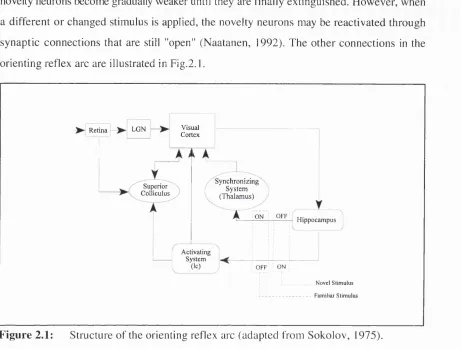
novelty neurons become gradually weaker until they are finally extinguished. However, when a different or changed stimulus is applied, the novelty neurons may be reactivated through synaptic connections that are still "open" (Naatanen, 1992). The other connections in the orienting reflex arc are illustrated in Fig.2.1.
LGN — Visual
Cortex Retina
Superior Colliculus
Synchronizing System (Thalamus)
O F F O N
Hippocampus
Activating System
(Ic) O F F O N
N ovel S tim u lu s F am ilia r S tim u lu s
Figure 2.1:
Structure of the orienting reflex arc (adapted from Sokolov, 1975).When a novel stimulus is presented, activation from the hippocampal neurons is thought to switch on an "activating" system and inhibit a "synchronising" system. Anatomically, the activating system involves the locus coeruleus, which is a central component of Posners' Vigilance network. This in turn is connected to the superior colliculus, which within Posners framework mediates the moving of attention'. The synchronising system is thought to involve interactions between the thalamus and cortical feature detectors and appears to correspond to the "engage" function of Posners Posterior network. When a mismatch signal is received from the hippocampus there is a desynchronisation of the engage function that temporarily interrupts ongoing activity (Danilova, 1975). Simultaneously, output from the activating system enhances the excitability of cortical neurons and alters the
Sokolov (1975) suggests instead that the superior colliculus is involved in specialised visual reflexes. One of such reflex may mediate the detection of abrupt visual onsets (Yantis and Jonides, 1990).
response characteristics of the superior colliculus (D ubrovinskaya, 1975). However, w hen a stimulus is repeatedly presented, the influence o f the activating system will gradually disappear as output from the hippocampus becom es blocked. Simultaneously there is an enhancem ent o f activity in the synchronizing system that leads to the generation o f slow waves in the cortex. These two changes "create a favourable background for the realisation o f stereotyped reflexes" (Sokolov, 1975).
To summarize, Sokolovs' model outlines the m echanism for two systems o f reactions. When novelty is introduced an activation-desynchronisation reaction occurs which facilitates processing o f the new information. B ut as events becom e familiar this is replaced by a synchronisation-inactivation reaction that tends to impede external signal detection. Of particular interest however, are the anatomical and functional overlap between the attentional m echanism s described by Sokolov (1975) and Posner and R othbart (1990). In Posners' fram ew ork the orienting response is mediated through an interaction o f the Vigilance and Posterior attentional networks. However, an im portant addition from Sokolov's m odel is the hippocam pus, which maintains a temporary record o f repeated and non-reinforced events.
2.3.2 The Stimulus Repetition Effect
The effects o f stimulus repetition have been studied in the context o f other paradigm s. Cantor (1969) reviews a range o f experiments that suggest children (4-6 yrs) respond m ore slow ly to a stimulus if they have been previously exposed to a series o f brief presentations (20-40) o f that stimulus. This effect is observed (i) with simple lights or buzzer stim uli (Cantor and C antor, 1964), (ii) in simple and choice RT tasks (C antor and Cantor, 1965) and with either passive or contingent responding during fam iliarization (Bogartz and W itte, 1966). In addition, increasing the duration of each preexposure trial increases the decrem ent in R T (W itte, 1967).
repetition. However, if the repeated stimulus is the target and a warning signal is presented, then RT is faster to a repeated stimulus. K raut (1976) suggests this is due to the facilitation
in en co d in g as a consequence of repetition. In a later study. K raut and Sm othergill (1978) j
replicated these findings in adults. They further show ed that although responses w ere slower for repeated stimuli, (in an un-signaUed RT task), the pattern can be reversed if testing occurs 15 or 30 mins after preexposure. Therefore, the alertness decrem ent was relatively transient in co m pariso n to encoding facilitation. A follow-up study by K raut et al. (1981) produced sim ilar conclusions with repeated word stimuli.
T hese results show that repetition may have tw o empirical effects that w ork in opposition. One is to decrease the alertness to stimuli and the other increases their encoding. The observed response to repeated stimuli will therefore depend on w hether the task dem ands rapid orienting or rapid encoding. If subjects attention is pre-focused by a warning signal and instructions to respond, then a reaction time advantage is observed to familiarised stimuli. However, in circumstances where no instmctions are given it m ight be expected that selection o f fam iliar stimuli would be less likely due to the alertness decrement.
2.3.3 Opposing Mental Biases
As another example o f inhibited perceptual processing following repetition, Johnston and Hawley contrast word superiority and inferiority effects. Since Cattel
(1886),
it has been known that a single word can be identified m ore accurately than a single letter. M ore recent investigations have further shown that identification of a letter, such as T, is quicker when presen ted in a w ord (eg. M ETER), than when presented in a non-w ord (eg. R ETEM ), or alone (Reicher,1969).
One interpretation o f this effect is the interactive activation model (McClelland & Rumelhart,1981),
which suggests processing at the word level may facilitate processing at the letter level. However, other findings suggest that letter detection may also beimpaired
by familiarity and conceptual processing. Healy(1976)
showed that detection o f a letter, such as T, in a passage of text is often lower when it em bedded in a very fam iliar w ord such as TH E, than in a less familiar w ord such as TA R (See also, Healy and Drewnowski,1983).
This effect can be disrupted by several changes in procedure such as (i) presenting words in a list, (ii) requiring right-left scanning o f w ords, (iii) presenting a long space before or after the words, or (iv) presenting words in isolation. A ccording to Johnston and Hawley (1994)
these findings indicate conceptual processing of words has a inhibitory effect on perceptual processing for very familiar words. A more general interpretation suggests that patterns of stimulus sampling will vary with different tasks and with repetition of those tasks. For example, in normal reading. O' Regan(1979)
suggests that w ord TH E may be identified parafoveally and skipped over by foveal fixations. This will obviously affect the am ount o f inform ation uptake from the word.study time with novices it was unaffected by study time in experts. This suggests that stimulus sampling performed by experts may be (i) very fast and efficient and (ii) rigidly governed by structures (or chunks) form ed through previous experience. Such conclusions are also supported by studies o f chess expertise. For example, Chase and Sim on (1973) showed that b e tte r players w here quicker in their encoding of positions. This was indicated by shorter glances. In addition, they suggested that the number o f pieces encoded in a chunk varied with expertise., estimating that the strongest players encoded about 2.5 pieces/chunk com pared to only 1.9 pieces/chunk for the weakest players. Given such changes in stimulus sampling it may be possible to observe negative effects on perceptual processing.
An experiment by Hippel et al. (1993) may be a case in point. Subjects w ere required to first read the "washing clothes" passage of Brandsford and Johnson (1973). H alf the subjects were given the disambiguating title to encourage conceptual processing w hereas the o th e r half w ere not. On later tests of perceptual identification, stem com pletion and w ord fragment completion they show that perceptual memory for words is much low er for subjects w ho read the passage conceptually than for naïve readers. They conclude " that although schem ata facilitate organised conceptual processing, and hence recall, they simultaneously inhibit perceptual encoding. This inhibitory effect should em erge because schem ata allow perceivers to rely on prior knowledge in place of incoming information".
active inhibition o f a representation of the green light. Put quite simply, the green light is not encoded because the subject is not looking at it. Therefore, actions initiated by prior stimuli m ay affect how subsequent stimuli are sampled. A similar point was made in the study by O 'Regan (1979) which suggested that frequent words may be identified parafoveally. Here, the increased detection efficiency, induced through prior sampling, makes it unnecessary to foveate common words. Therefore, it m ight be more meaningful to discuss the decrem ent in letter detection as due to a shift in strategy or response rather than inhibition per se^.
2.3.4 Learning Effects
Within animal learning, the phenom ena of Latent Inhibition and Perceptual Learning are further testimony to the contrasting effects of repetition. Latent Inhibition or LI was first o b served by Lubow and M oore (1959). The basic observation is that non-contingent preex p o su re o f a stimulus results in a
slowing
of later conditioning to that stimulus. It has been observed in a variety o f animal paradigms and more recently has been dem onstrated in children and adults (Ginton et al. 1975; Kaniel and Lubow, 1986). In contrast, if two stimuli are preexposed, then there may be anenhancement
o f subsequent discrimination learning using those tw o stimuli. This is known as Perceptual Learning (Gibson and Gibson, 1955; G ibson and W alk, 1956).According to the Pearce-Hall (1980) theory, the associability of a stimulus declines because the subject pays less attention to it. By using the Orienting Response, OR, as an index o f attention, Kaye and Pearce (1984) showed that OR's (i) habituate during repeated, unreinforced presentations, (ii) gradually recover when the stimulus is paired with a reinforcer and then (iii) habituate again as conditioning proceeds and the reinforcer becom es well predicted. A similar sequence is observed under normal conditioning procedures. The OR's
habituate over a series of conditioning trials, rapidly recover when the reinforcer is omitted and then subsequently habituate again as the non-reinforced presentations continue. Therefore if the OR is taken as a measure of attention or alertness then the evidence suggests attention declines as events are repeated and alertness recovers as events are changed.
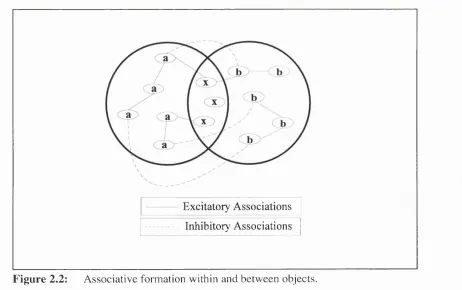
The encoding effects of repetition are described by McLaren, Kaye and M ackintosh (1989). They suggest that any two objects, A and B, can be conceived as represented by two discrete sets of elements or features. Two subsets a and b will be unique elements to the two objects and there will also be an intersection x of common elements (See Fig. 2.2). Sampling of these elements is assumed to have three different consequences. First, repetitive sampling reduces associability or attention. Secondly, elements sampled simultaneously will become positively associated. As it is assumed that sampling occurs to objects, this will results in the form ation of a-x and b-x associations. This process increases generalisation between the stimuli as the previously unique elements a and b are now associated through common elements a:. T o account for Perceptual Learning they suggest a third process that counteracts
Excitatory Associations Inhibitory Associations
Figure 2.2:
Associative formation within and between objects.such generalisation. This is the formation of inhibitory connections between elem ents that are negatively correlated. As sampling is directed to objects, the activation o f the unique elem ents a and b would be negatively correlated through time. Therefore, inhibitory associations w ould be form ed between a and h elements. These inhibitory associations will reduce the generalisation between the objects by increasing their discriminability. They represent a control structure that groups elements unique to particular objects or samples.
2A_
Summary
In the above sections, literature on the orienting response, stimulus repetition and latent inhibition illustrates that simple passive preexposure leads to a decline in subsequent sampling o f stimuli. This is indexed by habituation o f the OR, slowed responses to unsignalled familiar events and retarded classical conditioning to familiar events. T o date, the m ost comprehensive account o f this change is Sokolovs' (1975) orienting reflex arc, which assigns a central role to the hippocampus in forming representations o f repeated events. Furtherm ore, in other respects the model shares much o f the underlying anatomy of Posners' Posterior and Vigilance networks. Considering this similarity, it seems reasonable to interpret the sampling decline as m ediated by the V igilance-Posterior loop in the general framework.
As shown in figure 2.3, both processing loops are assumed to
operate
on a master map of locations. An implication of this arrangement is that the loops operate on information that is not currently selected. This is a logical necessity, as the function of both loops is to mediate a change in subsequent sampling. They must therefore operate on currently unselected information to determine whether that information should be selected or ignored.0)
Samples
Modifies
l||
;
Anterior
y'
Vigilance
System(W in dow )
C o n tex t-G ro u n d
l ^ s t e m
(F ram e)
Tunes In
Posterior
Tunes Out
Figure 2.3:
Functionality of the dual processing loops in the general framework.A further feature of figure 2.3 is that the Vigilance-Posterior loop
originates
in the master map of locations. This implies there can be a reduced tendency to select information that has never actually been selected. Justification for this assumption is derived from studies showing reduced interference with consistent distracters. For example, Lorch, Anderson and Wells (1984) demonstrated a speeding of reaction time in a categorization task when irrelevant patterns, which flanked the targets in the task, remained consistent. However, whenthese patterns were subsequently changed, slower reaction times to the task em erged. Along similar lines, Tipper, B ourque, Anderson and B rehaut (1989) dem onstrate RT gains in a standard Stroop task when irrelevant word stimuli rem ain consistent throughout the task. To capture this idea the Vigilance netw ork is labelled as a context-ground system. This is intended to m ake explicit, the claim that habituation or the reduced tendency to select does not depend on stimuli being initially selected^.
By com parison, the A nterior-Posterior loop is assum ed to
originate
at the selected object representation stage of Treismans' (1988) model. This implies that selection is necessary to enhance future encoding o f stimuli. The main justification for this is an assumption that enhanced encoding depends on high quality sampling which is only obtained once a stimulus is selected. To capture this idea the A nterior network is labelled as a target- figure system. This is intended to make explicit, the claim that selection is necessary to enhance or tune future encoding.T o explore these ideas further the following chapter presents a simplified netw ork m odel o f the general framework. The model is developed to provide constraints on the interpretation o f these changes and will subsequently be used as an aid in discussing the empirical findings.
Chapter 3
A GAIN Model
and the
Novel Popout Paradigm
'"Thus, b y ou r m ovem ents, w e f in d it is the sta tio n a ry fo rm o f the
ta b le in sp a c e which is the cause o f the changing im age in o u r eyes.
We explain the ta b le as having existen ce in depen den t o f ou r
o b serva tio n becau se a t any m om ent w e like, sim p ly b y assu m in g the
p r o p e r p o sitio n w ith re sp e c t to it, w e can o b se rv e it.
"2 il
Overview
Within this chapter a netw ork model o f the general fram ew ork will be presented and discussed. This purpose o f this model is to specify in more detail the com putational functions of the Endogenous and Exogenous processing loops. In the second half of the chapter, the em pirical problem s in dissociating the processing loops will be examined. As a potential solution to these problem s it is argued that a com parison needs to m ade o f attentional responses to novel and familiar stimuli. One paradigm which makes this com parison is the
Novel Popout
procedure developed by Johnston et al. (1990). In the final section o f the chapter the netw ork model is applied to the empirical findings from the Novel P opout paradigm.3.2
The Houghton & Tipper (1994) Opponent Process Model
The general attentional network is adapted from a selective attention model initially developed by Houghton and Tipper (1994). As originally conceived their m odel was designed to account for selectivity in response to Endogenous source signals. In particular it has been applied to situations in which the subject has prior information about the target to be selected. For example, if a subject is presented with a red and a green object, the m odel describes how selection can occur if the subject is told to select the red object.
Anterior network
Visual Cortex
OBJECT FIELD
TARGET FIELD
i ' > MATCHING ^
FIELD
1 '
X \ ^
ACF
Posterior network
Figure 3.1:
The Houghton & Tipper ( 1994) selective attention model and its relationship with the domains of the general framework.functionally to Posners' Anterior network. Furthermore, Houghton and Tipper (1994) coincide with Posner on the underlying anatomy, citing evidence that certain prefrontal areas (eg. principal sulcus, inferior convexity) are known to maintain "visual" representations (Fuster, 1980;Goldman-Rakic, 1987). In simple functional terms, the Target, Object and Matching Fields, compare what the subject is looking for (ie. the target) with what is actually received (ie. the objects). If a match is detected then a selection signal is generated by the M atching field and passed on to the ACF.
The selection process itself is induced by the Attentional Control Field or ACF. The ACF receives the selection signal from the Matching field and then feeds back to the Object Field to induce selection through an opponent process of amplification and inhibition. The opponent process which produces selection is illustrated in Fig. 3.2.
The basic architecture is a symmetrical interaction between nodes in the Object field and an opponent process in the ACF. The Object field nodes can be taken to represent any external signal (or vector) that is received due to stimulation. The two opposing nodes in the
ACF field are assumed to operate on this signal, to either amplify or inhibit its signal strength (or vector length). Amplification of a received signal is achieved by increasing the feedback from the ON-CELL in the ACF. This process corresponds the ENGAGE function of Posners' Posterior network. The inhibition of a received signal is achieved by increasing the feedback from the OFF-CELL in the ACF. This corresponds to the DISENGAGE function of Posners' Posterior network.
E x te r n a l S ig n al
-A w
Wl W 1
Object Field
ON-CHANNEL I W 2 OFF-CHANNEL
"
K
ACF
ON-CELL OFF-CELL
E x c ita to ry lin k
In h ib ito ry lin k
\
Selection bias
Figure 3.2:
Opponent process interaction between the attention control field and object field.In this model, engaging and disengaging attention is viewed as a process which biases the relative strength or GAIN of the received signals. Without selection bias, nodes in the object field receive equivalent excitatory and inhibitoiy feedback signals such that the null signal gain sums to zero. However, if a selection bias signal is introduced, (eg. to increase ON-CELL activation), then this balance will be perturbed, and a new equilibrium state will
em erg e .
3.3
The General Attentional-lntentional Network (GAIN)
The H oughton and Tipper (1994) attentional model was originally proposed as an account of
Endogenous
selection, where subjects have a prior target to search for. Within their model, the representation of a target in the Target Field acts as the source signal to bias the selection process. The GAIN model retains this architecture but also allows that past target representations may be activated directly by signals received in the Object Field. This addition is shown in figure 3.3. Thus, if an object has been previously selected, a representation of this target may develop in the Target Field. If this object is subsequently presented then the target representation may be reactivated. This indicates that a target is1
o
Target Field
Matching Field
V_
o f fX
-Monitor Field
Vigilance
ACF
Posterior
Figure 3.3:
Adaptation of the Houghton & Tipper(1994)
selective attention model.An interpretation of attention as the modulation of signal gain is not a necessary requirement o f Houghton and Tipper (1994) model. For example, if engaging attention is viewed as a process which synchronises or locks signals to a particular frequency, (eg. Sokolov, 1975; M oran and Desimone, 1985), then the ON and OFF cell interaction can represent the modulation of this functional process.
p re se n t but not w here the target is located. To locate the target, a the matching process is en acted to discover where sampling should be directed. W ith extended practice, the representation o f the target will becom e tuned to the m ost inform ative aspects o f the object. A consequence o f this tuning is that the detection and matching functions will becom e more efficient such that a target is located relatively automatically. A nother benefit of this extension is to provide a feedback signal to the target field that a match or mismatch has been made. Such information can provide a cue for the generation o f subsequent targets. M ore im portant, how ever, the addition ensures that the whole model operates as a closed system. Thus, transform ations in any given field can be explained with reference to the others.
Changes in Exogenous selection are ascribed to transform ations in the Posterior and V igilance netw orks o f the general framework. This is incorporated into the GAE^ model through the addition o f a processing field that monitors incoming inform ation and acts back on the ACF to tune out repeated events. The nature of this interaction is illustrated in Fig. 3.3. The function o f the M onitor Field is analogous to the neural m odel in Sokolovs' (1975) orienting reflex arc. With extended experience repeated events in the object field will receive a reduction in gain from the ACF. Thus, when an unexpected or novel stimulus is presented, this stimulus will have an activation advantage in the object field which enhances its likelihood o f selection.
3.4
Empirical Issues and the GAIN Model
The studies in Chapter 2 show both a decline in sampling and an elaboration of associations as an event is repeated. This presents a considerable empirical problem in dissociating the two processes. For example, with a measure such as reaction time, enhanced encoding will speed RT to a stimulus whereas a decline in sampling will slow RT. Thus, with a unidimensional measure such as RT, it will be impossible to determine to w hat extent a change in RT is due to enhanced encoding or sampling decline. A potential solution to this problem is suggested by the GAIN model outlined above. According to the model, selection probability may be enhanced for two distinct reasons. First, if an object is repeatedly selected as a ta rg e t then a representation of the object will become tuned in the T arget Field. This tuning corresponds to an the enhanced encoding o f the object. Thus, when the object is subsequently presented, it will automatically activate the representation in the target field w hich biases tow ards selection of the object. Secondly, when events are repeated, the M onitor Field o f the model will tune out these events in the Object Field. Thus, when novel events are presented, these events will have an activation advantage in the O bject Field, which increases their probability o f selection. The important point to note is that
enhanced selection
o f a repeated target depends on changes in the Target Field. By contrast,enhanced selection
o f novel events depend on changes in the M onitor Field. The novel events will not be represented in the Target Field as they have not been previously selected. In view o f this, it m ight be possible to dissociate the tw o processing loops by com paring the selection perform ance with novel and fam iliar objects.3.5
The Novel Popout Paradigm
before. Finally, mixed arrays were composed of three familiar words and one novel word. The pattern o f results obtained is presented in Fig.3.4. An inspection of the figure reveals that localisation accuracy is highest for all familiar arrays and lowest for all novel arrays. However, w hen the arrays contain a mixture of familiar and novel items, this pattern is reversed, the accuracy being higher for the novel items over familiar items. This effect was dubbed
"Novel
Popout".
70
c
g HM
N
65
(0
o
o
o 0)
S
60
Ü
55
Localization Accuracy by Array Type
Novel
Familiar
1:3
N o v eli Fa m iliar Ratio
0:4
Figure 3.4:
Novel Popout results obtained by Johnston et al. (1990).Two associative explanations of the effects considered by Johnston et al.(1990) are perceptual confusion and retrieval confusion. The perceptual confusion account assumes that associations are formed between word representations, as an array is repeated. One consequence of these associations is that activation of a single word representation will
co-activate the other representations of an array. Thus, when a word representation from a familial' array is associated with a particular location, the other words in that array will also be associated with that location. Along similar lines, the retrieval confusion account notes that following repetition each familiar word has been seen many times at each location.
C onsequently, when a familiar w ord is presented as a probe, the interference between locations associated with the probe will confound the retrieval process.
While both these accounts predict a novel popout effect when aiTays contain a mixture o f novel and familiar objects, they also predict poor perform ance when all the array words are fam iliar. This prediction is not supported, as localisation is actually superior in all familiar arrays. Consequently, Johnston et al. interpret their results in term s o f tw o processes, perceptual fluency and attention redistribution. They claim that "perceptual fluency" builds up for objects that are repeatedly presented in a particular context. The consequence being that objects in familiar scenes will be perceived and localised with greater speed and accuracy than th o se in novel scenes. However, if a scene contains a mixture o f novel and familiar objects there will be a
segmentation
o f the field into fluently and non-fluently perceived areas. W hen this occurs attention will "flow rapidly and automatically" away from the fluently perceived areas towards the non-fluently perceived, resulting in enhanced processing o f objects within this area.Although this verbal account does predict the empirical findings, it suffers from a lack o f specificity. No com putational details are given as to how fluent perception is achieved or how "attention" becom es redistributed. To address these problem s the following section exam ines how the GAIN model can be applied to the results o f Johnston et al.(1990).
3.6
Novel Popout and the GAIN Model
The first effect to be explained is the localisation advantage o f novel over familiar words in mixed arrays. This is the N ovel Popout effect. The explanation o f popout draws on evidence o f the previous chapter suggesting a decline in sampling following repetition. W ithin the GAIN model, this is mediated by the M onitor Field and the ACF, which inhibits the gain control o f events in the Object Field. Thus, if tw o objects are presented, one o f which has been repeated, then activation in the Object Field will be greater for events associated with the novel object. On the assumption that object events com pete laterally with each other, this
activation advantage will increase the probability o f novel events being selected. In other w ords, the initial activation advantage in the object field will result in preferential sampling o f th e novel stimuli. Recent w ork by Miller et al..(1991) supports this interpretation. By measuring single neuron responses in IT cortex, they show that the responses to novel stimuli decline as the stimuli becom e fam iliar to the animal. Furtherm ore, w ork by Lm et al. (1993) suggests that subpopulations o f IT cells serve as "adaptive m nem onic filters" for short term memory, with high levels o f activation providing feedback signals to orienting systems so that sampling can be redirected. Therefore, the operation o f GAIN provides a ready explanation o f the popout effect, and is broadly consistent with known physiological processes.
T he second difference to be addressed is the baseline localisation advantage o f aU familiar over all novel arrays. In the GAIN model, repetition o f events in the M onitor Field will inhibit the gain control o f these events in the Object Field. Therefore, if we only consider the M onitor-ACF processing route then performance should be worse with all fam iliar arrays and superior with aU novel arrays. The fact that the opposite pattern is observed suggests that changes in another pathway contribute to the result.
Chapter 4
Novel Popout
and
Task Demands
''One o f th ese things is n o t like the o th er ones,
three o f th ese things a re kinda the same..."
4.1
Introduction
In the GAIN model, there is an important functional difference betw een the operations o f the A nterior and Vigilance processing loops. While both pathways involve a matching p ro cess, the A nterior route functions to
facilitate selection
of events that match target represen tation s, whereas the Vigilance route functions toinhibit selection
o f events that m atch m onitor representations. The facilitation is a bias tow ards events that are "relevant" o r reinforced. By contrast, the inhibition is bias away from events that are "irrelevant" or unreinforced. An im portant prediction o f this account is that the manipulation o f relevance sho uld modify bias from the Target-M atching fields o f the model. To investigate this prediction, the present chapter exam ines the effects of task dem and in the popout paradigm.In the paradigm developed by Johnston et al. (1990), the arrays presented were alw ays 'relevant' in that every array presented was probed for memory. As this procedure encourages extensive sampling o f each array presented, it was conjectured that this will have an effect on associative formation. M ore specifically, it is assumed that representations in the Target Field o f the GAIN model, will be elaborated to increase the efficiency o f subsequent ta rg e t m atching. This will tend to boost perform ance on familiar w ords to produce the baseline advantage with all familiar arrays. Furtherm ore, it may m ask the novel popo ut in m ixed arrays through an enhancem ent of fam iliar w ord performance.
To address these issues two changes are introduced to the paradigm. The first change is to familiarise words during a preexposure phase. During this phase the arrays are repeatedly p resen ted 5-8 times but subjects are not probed for a response. This is intended to make explicit the "irrelevance" o f the preexposure period by removing any task dependant reinforcem ent. U nder these conditions it is expected that a reduction in sampling will be observed.
Nested within the above manipulation is a second change designed to explicitly control relevance. This focuses on the task demands during the preexposure phase. One group of subjects are instructed to simply watch the arrays until probed. This is called the
passive
group. The second group o f subjects are instructed to name the w ords in all the arrays presented. This is called theactive
group. Therefore, with the active group an attem pt is made to reintroduce relevance o f the words. Because all words are to be named, each array is alw ays relevant to the required response. The prediction is that this will reintroduce the enhanced perform ance on all fam iliar arrays observed by Johnston et al.. (1990).These predictions are investigated in two studies. The first study exam ines the effect o f the manipulations with m ixed arrays. The second study focuses on the baseline difference between all fam iliar and all novel arrays.