68
Systematic Dynamic Scheduling Algorithm For
Networked Control System
M.Brindha, I.Hameem ShanavasAbstract : Distributed structure in Networked Control system is used in shared communication medium to transfer the data between other components that were identified in the system. In this paper, the problems related to the planning of Network control system along with the performance of the framework have been investigated. This work centers around the designing and implementation of static and dynamic scheduling concept together with predictive algorithm for Network Control System (NCS). The problems related to communication and control are included while structuring the framework.
Index Terms: Network Induced Delay (NID), Maximum-Error-First (MEF), Network Control system (NCS), Maximum Allowable Delay Bound (MADB),
————————————————————
1. INTRODUCTION
For the past two decades, major developments in computer communication networks domain have turned it feasible in incorporating feedback in communication for achieving ongoing necessities [1]. This resulted in the climb towards an alternative thought in the analysis of control systems and specific designs, NCS has closed loops through a real-time network. These Network Control System have received expanding contemplations in the recent years because of their ease, consistency and simple support. NCS is used in Unmanned Aerial Vehicle, automobiles, robotic systems, smart vehicle structures, modern aircraft control, etc. On the other hand, the incorporation of communication channels to control structures turns the design and investigation of these closed-loop systems to be more tedious and complex [2]. Conventional system speculations possessing these reservations over non-delayed sensing and determination have to be checked clearly before relating it to the NCS. Network influenced delay characteristically result in negative effect in Network Control’s performance and stability [3]. In Network Control System, dissimilar delay with flexible length has occurred as a result of transferring data through the shared network mediums. These different delays are accountable towards planning of the given systems [4],[5]. Such delays might act worst within the sight of variations and might be unpredictable. From this time forward, it is imperative to develop a couple of methodologies to decrease these delays to design a reasonable control practice and scheduling algorithm [6]. In a control system with feedback, it could be seen that the inspected information have to be shared within the sampling period of the system, and stability must be guaranteed regardless of the problem, for example, NIDs, other unexpected variations from the norm in the framework or communication medium[7],[8]. The computed control signal and the sampled data ought to be shared in the given duration or delay towards ensuring stability of the structure. This particular delay bound can be characteristically denoted as Maximum Allowable Delay Bound (MADB) [9].
2. NETWORK CONTROL SYSTEM
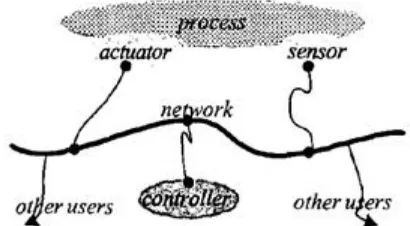
Traditional control systems possess only one central control unit that controls each process and devices. But it has different demerits like single-point failure, lower performance, lower dependability and incapability in analyzing the complex distributed control schemes. The prevailing technologies in industrial system and commercial system perform mixing computations, communications and controls into dissimilar stages of mechanical operations and data processes [10]. Feedback loops are integrated over these control networks. Communication mediums are shared by all the elements like sensors and controllers in these systems. Similar communication mediums shall be shared by dissimilar systems. A real-time distributed scheme possessing intelligent agent for connecting and communicating with the environment via communication mediums, is referred as Network Control System (NCS). Fig.1 exhibits the articulation of an NCS. This scheme includes process/industry, controllers, actuators and sensors. Sensor detects the yielding of industry and transfers the sampled information to controller via Communication medium. Actuator obtains the information and translates into reasonable structure for feeding it to the industry. The registers in the controller collects the control information and transfer to the industry through the communication medium.
Figure 1: Schematic representation of Network control System
The existing solutions addresses the modern control problems which are to be distributed through the processing functions of the given system for more number of physical nodes and to incorporate the controlling and communication methodologies. These shared bus systems need only lesser ————————————————
Prof. M. Brindha is the Research Scholar & Associate Professor, Department of Electronics & Communication, MVJ College of Engineering, Bangalore, India. Email:- [email protected]
Dr. I. Hameem Shanavas is the Associate Professor, Department of Electronics & Communication, MVJ College of Engineering, Bangalore, India. Email:[email protected]
number of complex wirings that shall be scaled down to installation/maintenance expenditure. Meanwhile, this can also bring down the chance of a fault which influences the whole framework.
3. NETWORKED INDUCED DELAYS
NIDs are present in this framework if a system is not present for duration for transmitting information, thereby it needs to pause for its turn for data transmission. This delay is based on the design of these frameworks and the specified systems. Delay in the NCS frameworks include: (i) Communication delay amid actuator and controller (τca), (ii) calculation time in
the controller (τc), and (iii) communication delay amid sensors
and controllers (τsc). In real world applications, sensor’s
controller and actuator’s controller delays are unalike, is a and time varying function depending upon the network and prevailing situations. Because of the delay persuaded by network, the components might not acquire their chance for sharing the information that results in transmission failure, and missing data that affects the performances of the real time systems. When this delay dominates the system, then the nodes (Sensor and Controller) will not certainly transmit the data within the stipulated time and consequently result in poor stability of the system. Therefore, these delays cannot be ignored while devising scheduling schemes and modelling NCS. A reliable algorithm should be devised to keep this delay within the available limit to make sure the stability of framework.
4. SCHEDULING ALGORITHM
Performance of Network Control System relies upon the Control systems, yet in addition on the booking calculation of system assets. It is increasingly fitting to explore the constant timetable hypothesis of the Network Control under the terms, where the system asset is limited. Time Availability over shared networks for correspondence amid sensors and controllers is an immediate limiting factor towards presentation of Network Control System. The general performances of Network Control System that includes a couple of control loops which were not simply dependable on the structure of control algorithms, also rely upon the allocation of bandwidths and scheduling of shared resources. The significant disparity amid CPU and network scheduling is the information transmission to the systems is ordinarily non-preemptive when task execution is non-preemptive.
Framework in a Network Control System should manage the scheduling algorithm over certain attributes even from processor scheduling algorithm, for instance, rate monotonic scheduling approaches and deadline monotonic scheduling approaches. The processor based approaches possess difficulties in association with NCSs, studying the way over which a repeated transmission of periodic information holding existing value and has no effect on controlling these frameworks.
4.1 Rate Monotonic Scheduling Algorithm
Static scheduling algorithms are believed as Rate Monotonic, thereby suits better in probable circumstances. The priority of the tasks will be connected based on their periods, i.e., the extensive-period tasks possess least priority and the smallest one will possess highest priority. The task priority will be constant value over entire run time. The foremost constraint
which guarantees the potential scheduling for RM shall be represented as,
)
1
2
(
1
n
nU
(1)
n i i iT
C
U
1 (2)Here, U represents CPU usage, n signifies task number, Ci
represents the period for computing the task i, and Ti
represents task period i. RM scheduling approach performs well when compared to every constant-priority assignments. But, any other constant-priority algorithms will not perform scheduling of the task which were not planned by Rate Monitoring. Static Scheduling schemes works well if the system is ideal, i.e., there is zero interference, delays, network failure and node failure. But Static Scheduling schemes will not work if there is any interference or node failure or component failure.
4.2 Dynamic Scheduling Algorithm
Maximum Error First (MEF) algorithm is a closed-loop dynamic scheduling approach. MEF follows the strategy on the basis of constant feedback from every loops. MEF is accountable in selecting the framework tasks at run time by constantly varying the requirements of the control loop. The scheduler node re-assesses the outputs from the system and the reference data attained from actuators and sensors. The error values will be subsequently attained. The allocated priorities for the loops possessing maximum values of error together with the fact that it requires rapid concern in decreasing the error with the objective that these systems attain steady state ultimately. Scheduler node concludes priority and transfers trigger signal towards controller node for transmitting data swiftly for controlling the system. The complexity here is to change the priority of the nodes in a random fashion dynamically based on the error values generated. The controller has to additionally act as a comparator also apart from computing a suitable control signal.
4.3 Predictive Controller
70
communication channel, because the past control information is utilized by the framework. The accessible bandwidth is used in an efficient method when examined with the framework deprived of predictive controller. The scheduling work is targeted towards ensuring the system stability under specified time duration.
5.THE
CHOICE
OF
BANDWIDTH
AND
SAMPLING PERIOD
To assure satisfactory control performance, it is important in considering “the rule of thumb” for selecting sample period Ts
over digital control in the limit of reasonable sampling rates at 4 to 10 per rise time, Trise.
10
4
s rise
T
T
(3)
In case of system control, NIDs reduce the control performances. For maintaining satisfactory control performance over digital control, NID has to be viewed while selecting the sampling period. When NID is more prominent towards data sampling time, more than one sensor’s information reaches at few controller’s sampling interval, only last sensor’s data will be used for creating the controller’s signal. This results in information loss. At some controller sampling intervals, sensor information from any sensors will not arrive and results in empty sampling. Information loss and empty sampling period will decrease the control performance and introduces substantial alteration in controller data too. The control data alteration will cause high frequency noise at actuators provoking in top wear. Hence, every sensor’s data have to be reached at controller nodes before the subsequent sensor’s data were to be assessed.Assume the NCS with M control loops that share the Communication network. The Controller for each control loop is structured ahead of time without considering the impact of the system. Each Control loop has two information transmitting nodes of sensor and controller, while the sensor node is excluded in light of the fact that it doesn't transmit the information through the system. In this way, there are an aggregate of N=2M information transmitting nodes in the system. The total information transmission nodes in the medium is represented as N = 2M. Assuming T being vector coordinates of sampling time of M control loops, i.e T = [T1, T2, . . . TM], Ti
represents the order of increasing number or equal numbers, i.e., Ti Ti+1, i. The data that can be provided in T1 is
expressed as,
L
Nσ
T
r
1 (4)Here, N represents the total amount of transmitting nodes of information and σ represents the overhead. When r N, network organizes the information transfer for every N nodes, thereby network traffic gets somewhat loaded. When r<N, it has to be noted if the designed NCSs would be schedulable or not, if so, how to schedule the information for every nodes. Considering U as the usage of network, that shall be described as the portion of interval in which the network medium will be remaining engaged for information transmission, U shall be represented as L/T1, and could be
represented as,
M
1 i
K
i1
2
(5)In the event that is more prominent than r, Network limit can't oblige info traffic, for example, network system being overloaded. Hence, the designers have to either pick the system possessing greater bandwidth and reduced overhead (σ), or lessen the quantity of nodes (N).
6. EXPERIMENTAL RESULTS OF NETWORK
CONTROL SYSTEM
NCS is organized with dual control loops encompassing 4 data transmission nodes (2 sensors and 2 controllers). Direct Current drive possesses one sensor for recognizing its position. The PID controller is estimated in controlling the DC drive positions.
G1(s) = (166.67S + 166.67)/ ( S 2
+12.5S) G2(s) = (128.2S + 128.2)/ ( S
2
+9.6S)
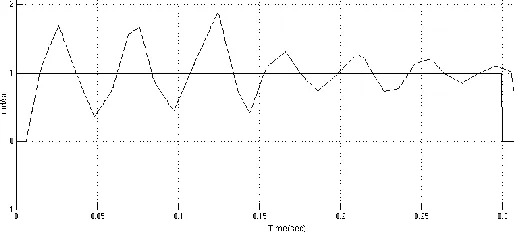
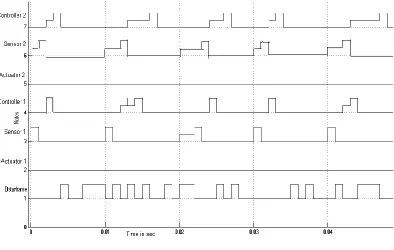
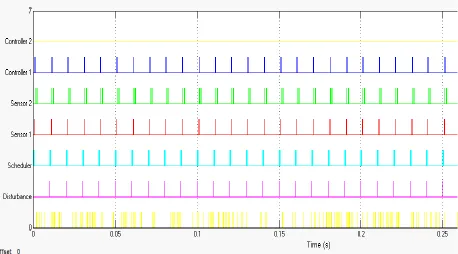
Network Control System has been simulated with the help of True time simulator. Network Control System has been modelled and Static scheduling algorithm has been employed. CAN is employed and 40% of disturbance has been integrated in the system for studying the real-time behaviour of the system. The loop priory has been predefined in the static scheduling algorithm. Direct Current Drive 1 has been assumed to possess maximum priority in comparison with Direct Current Drive 2. Sensors in Direct Current Drive 1 transmit signal towards controller, thereby sensors at Direct Current Drive 2 transmits signal to its controller. Further, controller at Direct Current Drive 1 calculates the control signal and transfers the signal towards actuator, trailed by controller of Direct Current drive 2. Fig.2 describes the static scheduling at sampling period of 10 ms and data rate of 80000 bits/second. Sensor 1 forwards the tested signal towards Controller 1 trailed by Sensor 2 towards Controller 2 via CAN. In static scheduling, priorities will be assigned. Constantly, sensor 1 will be transmitting the sampled signal and after that sensor 2 will follow it. In the meantime, Controller 1 processes control signals and sends towards Actuator 1 trailed by Actuator 2. Fig 3 displays the outputs of DC Drive 1 and Fig 4 displays the outputs of DC Drive 2. DC Drive 1 attains steady state subsequent to numerous oscillations. DC Drive 2 attains steady state subsequent to lengthier time duration in comparison with DC Drive 1.
Figure 3: DC Drive 1 Simulation Output Waveform using static scheduling
Figure 4: DC Drive 2 Simulation Output Waveform using static scheduling
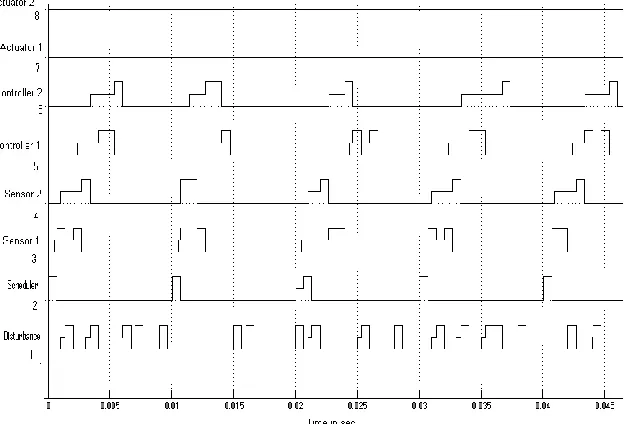
Scheduler Node is encompassed in the system where dynamic scheduling has been executed. Scheduler Node will be selecting priority of sensors and transfers the priority towards dissimilar sensors via equivalent Controller Area Network. Currently, 40 percentage noise has been incorporated at the Controller Area Network. Fig.5 represents the Maximum-Error-First Scheduling when the Sampling interval is 10 ms and the data rate is 80 kilobits/ second. Main priority has been assumed to sensor 1 and subsequently to
72
Figure 5: Plot of MUF scheduling with 40% noise
Figure 6: DC Drive 1 Simulation output with Dynamic Scheduling
When Predictive control approach is incorporated with dynamic scheduling approach, the system attains steady state quickly even in the availability of interference in the communication medium. Network Controlled System has been simulated with 40% noise in Controlled Area Network. Fig.8 validates the scheduling plot. Fig.9 displays the outputs
of DC Drive 1 and Fig.10 displays the outputs of DC Drive 2. It is understood that, DC Drive 1 and DC Drive 2 attains steady state faster in comparison with the system, which is achieved particularly with Maximum Error First Scheduling procedure.
Figure 8: Graphical plot of Scheduling with 40% noise
74
Figure 10: DC Drive 2 Simulated Output with Predictive Algorithm
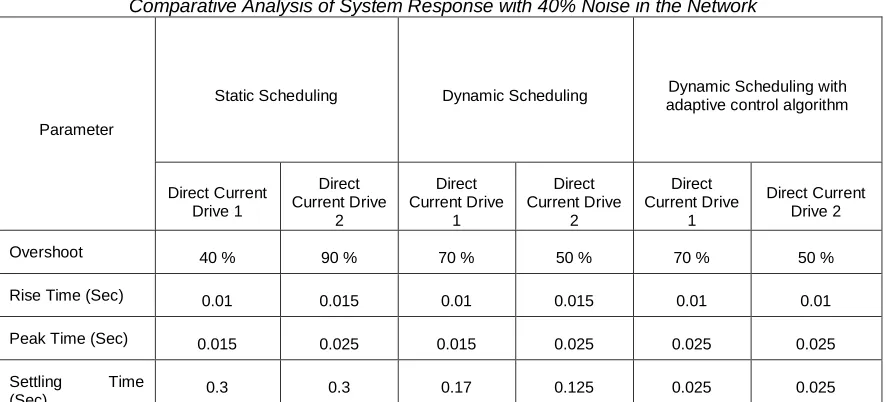
Table 1
Comparative Analysis of System Response with 40% Noise in the Network
Parameter
Static Scheduling Dynamic Scheduling Dynamic Scheduling with adaptive control algorithm
Direct Current Drive 1
Direct Current Drive
2
Direct Current Drive
1
Direct Current Drive
2
Direct Current Drive
1
Direct Current Drive 2
Overshoot 40 % 90 % 70 % 50 % 70 % 50 %
Rise Time (Sec) 0.01 0.015 0.01 0.015 0.01 0.01
Peak Time (Sec) 0.015 0.025 0.015 0.025 0.025 0.025
Settling Time
(Sec) 0.3 0.3 0.17 0.125 0.025 0.025
7. CONCLUSION
Static scheduling algorithm functions well in ideal conditions i.e., if there being no impact of interferences or disturbances in the frameworks. The system stability shall not be confirmed when noise is prevalent in the frameworks with fixed priority scheduling. The dynamic algorithm performs well even in presence of uncertainties and preferred throughput shall be attained with reduced time. Simulation results revealed that, Output of DC Drive 2 achieves stable state faster by the usage of dynamic scheduling algorithm in comparison with static scheduling algorithm. Throughput shall be improved when predictive algorithm has been combined with dynamic scheduling algorithms. The communication channel is reachable by each component for data transfer in spite of extra scheduler node being included at the system. The system stability shall be guaranteed even at the availability of non-linearity in the system. This algorithm is realistic to be accomplished with improved execution even with network induced delay and data packet drops. With developing real-time scenarios for NCS, secured control is imperative matter for any real-time applications. The present controller can be improved to suit the necessities of the system or novel protocols can be created to suit the necessities of the system. The best methodology is to absorb Control and communication policies to upgrade the performance of the
system as both are dependent on one another in NCS. Most importantly current researchers adopt the co design approach and the coordinated efforts between the control and communication to accomplish the ideal system performance. The problem of secured control and node failure should also be analyzed in real time applications.
REFERENCES
[1] Rachana Ashok Gupta, Member, IEEE, and Mo-Yuen Chow, Fellow, IEEE, “Networked Control System: Overviewand Research Trends”, IEEE transactions on Industrial Electronics, Vol.. 57, No. 7, July 2010, pp: 2527 -2535.
[2] Jiannian Weng, Yong Wang , Jiawei Wang, and Chunhua Shi, “Truetime based feedback scheduler design for Networked Control System”, International Journal of Innovative Computing, Information and Control ICIC International ISSN 1349-4198 Volume 6, Number 4, April 2010, pp: 1-10.
[4] H Voit , A Annaswamy, “Adaptive control of a Networked Control System with hierarchical scheduling”, IEEE, Proceedings of the 2011 American Control Conference, USA, 29 June-1 July 2011, DOI: 10.1109/ACC.2011.5991565
[5] Wang Jie ; Liu Wei-dong, “Control and scheduling co-design of networked control system”, IEEE International Conference on Signal Processing, Communications and Computing (ICSPCC), 14-16 Sept. 2011,DOI: 10.1109/ICSPCC.2011.6061586
[6] Lixian Zhang, Huijun Gao, OkyayKaynak, “Network-Induced Constraints in Networked Control Systems—A Survey”, IEEE Transactions on Industrial Informatics, Volume: 9 , Issue: 1 , Feb. 2013, DOI: 10.1109/TII.2012.2219540, pp: 403 -416
[7] X ianghui Cao , Peng Cheng , Jiming Chen , Youxian Sun, “An Online Optimization Approach for Control and Communication Codesign in Networked Cyber-Physical Systems”, IEEE Transactions on Industrial Informatics ( Volume: 9 , Issue: 1 , Feb. 2013 ) DOI: 10.1109/TII.2012.2216537, pp: 439-450.
[8] Anton Cervin, ” Stability and worst-case performance analysis of sampled-data control systems with input and output jitter”, 2012 American Control Conference (ACC), IEEE, Montreal, QC, Canada, 27-29 June 2012, DOI: 10.1109/ACC.2012.6315304
[9] Sanad Al-Areqi , Daniel Görges ,Sven Reimann , Steven Liu, “Event-based control and scheduling codesign of networked embedded control systems”, 2013 American Control Conference, Washington, DC, USA, 17-19 June 2013, DOI: 10.1109/ACC.2013.6580665