Licensed under Creative Common Page 1094
http://ijecm.co.uk/
ISSN 2348 0386
DEVOLUTION AND UNIVERSAL HEALTH COVERAGE
IN KENYA: SITUATIONAL ANALYSIS OF HEALTH
FINANCING, INFRASTRUCTURE & PERSONNEL
Timothy Chrispinus Okech
Associate Professor of Economics, United States International University-Africa, Kenya [email protected]
Abstract
Availability and comprehensiveness of health services offered at a health facility is critical in
realizing universal health coverage. This however partially requires a strong, efficient, as well as
well-run health system, a sufficient capacity of well-trained, motivated health workers and a
system for financing health services. The Kenya government with support of development
partners has over the years initiated various policies and strategies aimed at realizing universal
coverage. The paper aimed at taking stock of the country’s health financing, infrastructure and
personnel and how these impact on health care delivery as the country moves towards
universal coverage. To accomplish this, both primary and secondary data were collected in
terms of health care financing, health infrastructure and personnel and how they impact on
delivery of health care services. Notable findings include government’s commitment towards
universal coverage through increased revenue allocation as well as investment in both health
infrastructure and personnel aimed at enhancing geographical access. Notwithstanding this
however, there is limited solidarity in financing of health care and that a significant portion of the
financing is off-budget and skewed towards one donor raising sustainability and equity
concerns. In terms of infrastructure there exist significant gaps, especially specialized medical
equipment, maintenance of the equipment and the personnel to operate the equipment.
Similarly, a number of the facilities in the country have dilapidated infrastructure coupled with
disjointed health investments. Significant gaps were also identified in a number of key health
personnel with a number opting to join private practice, while others opting for career change in
spite of the resources invested in training them. In lieu of the findings, various recommendations
Licensed under Creative Common Page 1095 tracking the enactment of Health Act, development of health investment policy that assures
coordinated, prioritized and sustainable investment; finalization and implementation of schemes
of service across counties. Other recommendations include policy guidelines and procedures
that support public private partnership initiatives such as the “Beyond Zero” campaign for
purposes of equity and sustainability; and finally continuous investment in human resources
guided by policy guidelines.
Keywords: Devolution, Health care Financing, Health Personnel, Health Infrastructure, Universal
coverage
INTRODUCTION
Devolution entails transfer of responsibilities for services to lower tiers that elect their own political leaders, raise their own revenues, and have independent authority to make investment decisions. In a devolved system, local governments have clear and legally recognized geographical boundaries over which they exercise authority and within which they perform public functions (World Bank, 2012). Globally, there has been a trend in the devolution of authority in healthcare whereby the authority that was often sitting with one central Ministry or Department of Health devolved over time (KPMG, 2015). For instance, Ethiopia has moved from centrally-organized authority to a situation where block grants are redistributed from regional governments to districts. The districts, in turn, set their own priorities and are free to allocate the budget to health facilities and are relatively free to spend their budget on whatever health facility they want. In Ghana, the situation is a bit more complicated where on one side there is the GHS to which the responsibility of managing health facilities has been delegated and on the other side, is the District Assembly with the district departments of health that act as devolved entities (World Bank, 2012; KPMG, 2015).
Licensed under Creative Common Page 1096 At national level, health leadership is provided by the Ministry of Health (MOH). The key mandates of the MOH include development of national policy; provision of technical support at all levels; monitoring quality and standards in health services provision. Others include provision of guidelines on tariffs for health services; conducting studies required for administrative or management purposes. At the county level, the county governments are responsible for county legislation; executive functions - functions transferred from the national government and functions agreed upon with other counties; establishment and staffing of a public service. Other functions include provision of infrastructure and equipment for health facilities such as new wards, provision of ambulances, and recruitment of additional health workers. The two levels of government though distinct are interdependent and conduct business on the basis of consultation and cooperation (GoK, 2010; World Bank, 2014).
In the Constitution, the government provided the necessary legal framework for ensuring a comprehensive and people driven health care delivery aimed at enhancing access to quality health care. The county and national governments aimed at improving geographical access by the populace including the poor and other vulnerable groups. The constitution also provides for the right to access emergency health services by all including children and persons living with disabilities. In 2013, the national government announced the abolition of user fees at primary health care facilities and introduced free maternal health care services in public health facilities. Similarly in the draft Health Bill of 2015, the government declared access to reproductive health and emergency medical treatment as a right by all persons (Okech & Lelegwe, 2016). All these initiatives it can be argued are aimed at realizing universal health coverage. Further, in the Health Financing Strategy, the government reiterated its commitment towards universal coverage by emphasizing social health protection to all Kenyans. This has been compounded by introducing social solidarity mechanisms founded on complementary principles of social health insurance and tax financing aimed at protecting the poor and other vulnerable groups (NHIF, 2015). Recently, the government edged closer to implementing universal coverage and settled on NHIF as a vehicle towards the realization of universal coverage (NHIF, 2015; Okech & Lelegwe, 2016).
Licensed under Creative Common Page 1097 iii) financial risk protection which aims at ensuring that the cost of care does not put people at risk of financial hardship (WHO, 2010). Four key elements are identified by World Health Organization (WHO) necessary towards the realization of universal coverage. One, a strong, efficient, well-run health system; two, a system for financing health services; three, access to essential medicines and technologies; and finally a sufficient capacity of well-trained, motivated health workers (WHO, 2010). In addition to the above initiatives aimed at universal coverage, the Kenya government continued to fast track other initiatives including developing and piloting a national referral strategy, strengthening of private public partnership (PPP) such as the “Beyond Zero” campaign, health insurance subsidies targeting disadvantaged groups.
Considering that a strong, efficient, run health system and a sufficient capacity of well-trained, motivated health workers among other pillars are important in realizing universal coverage, the paper aimed at taking stock of the country’s health infrastructure and personnel
and how these impact on health care delivery. However, before enumerating these, the methodology utilized as well as a brief of the health situation and health service delivery is provided in that order.
METHODOLOGY
Both primary and secondary data were collected regarding health infrastructure and personnel. In terms of secondary data, a review of relevant literature on key policy initiatives aimed at universal coverage and how they have impacted on health infrastructure and personnel was undertaken. This information was obtained from various sources including Ministry of Health official documents such as the draft Kenya National Health Sector Strategic Plan (KHSSP) III, draft Health Policy Framework, 2012 - 2030, draft Health Care Financing Strategy, and National government documents such as Vision 2030, Medium Term Expenditure Framework (MTEF) paper, National Hospital Insurance fund documents (Manuals, strategic plans, operational plans, among others), the Constitution and the Draft Health Bill, 2015. Additional data was also collected from relevant commissioned studies such as Kenya Health Labour Market Assessment report, status of the Managed Equipment Scheme, journal articles, among others. This was supported by in-depth interviews with key stakeholders in the sector at both National level and county levels.
Health Indicators
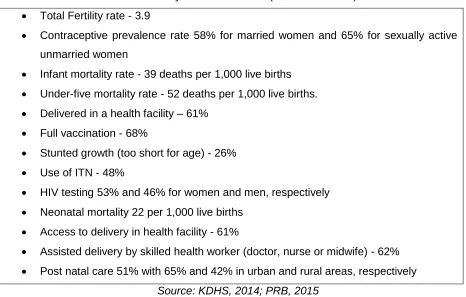
Licensed under Creative Common Page 1098 and be geared towards providing health services within easy reach of Kenyans (Okech & Lelegwe, 2016). It has also placed considerable emphasis on preventive, promotive and rehabilitative health services without ignoring curative services. The initiatives have contributed towards improvements in the health indicators as shown in table 1.
Table 1: Key Health Indicators (check the KDHS)
Total Fertility rate - 3.9
Contraceptive prevalence rate 58% for married women and 65% for sexually active
unmarried women
Infant mortality rate - 39 deaths per 1,000 live births
Under-five mortality rate - 52 deaths per 1,000 live births.
Delivered in a health facility – 61%
Full vaccination - 68%
Stunted growth (too short for age) - 26%
Use of ITN - 48%
HIV testing 53% and 46% for women and men, respectively
Neonatal mortality 22 per 1,000 live births
Access to delivery in health facility - 61%
Assisted delivery by skilled health worker (doctor, nurse or midwife) - 62%
Post natal care 51% with 65% and 42% in urban and rural areas, respectively
Source: KDHS, 2014; PRB, 2015
Although the health indicators have improved over time, most still fall below the 2015 Millennium Development Goals (MDGs). Similarly, the indicators continue to lag behind those of the rest of world including sub-Saharan Africa (SSA).
KENYA’S POLICY REFORMS TOWARDS UNIVERSAL HEALTH COVERAGE (OKECH & LELEGWE, 2016)
Licensed under Creative Common Page 1099 life expectancy started to improve (GoK, 2010). This was partially attributed to enhanced provision of primary health care (PHC) and continued training of skilled health workers in line with WHO guidelines. Similarly, the government expanded the training program for the various cadres of health personnel and health infrastructure in various parts of the country as key elements of providing comprehensive health care.
In 1980’s the policy shift from purely government provided for care to cost sharing was
followed by the 1993 institutional and structural reforms, and market orientation of the health services. This period however coincided with policy reversals with mixed equity implications. For instance, following the reduction in donor funding and the macroeconomic problems the country experienced over this period, the health sector became too large for the government to handle single handed. To cope with this, the government introduced cost sharing in public health though this was abandoned before it was reintroduced a few years later. To caution the poor, and other vulnerable groups, the government with support from key stakeholders, introduced a system of waivers and exemptions which was however riddled with implementation weaknesses with minimal realization of the intended objectives (Okech & Lelegwe, 2016).
In the recognition of the role of a well run health system and financing play in contributing towards universal coverage, the government in 1994, developed the Health Policy Framework and a five-year National Health Sector Strategic Plan (NHSSP) of 1999-2004 wherein targets and processes driving the health sector development, as well as healthcare service delivery were articulated. The reforms relating to the way the healthcare services were not only reorganized but also financed, delivered and evaluated were initiated. In the document, equitable allocation of government resources to reduce disparities in health status and increased cost-effectiveness and efficiency of resource allocation and use were emphasized. Others included enhanced regulatory role of the government in health care provision; creation of an enabling environment for increased private sector as well as community involvement in service provision and financing; and increase and diversify per capita financial flows to the health sector. All these measures it can be argued were key ingredients necessary in universal coverage.
Licensed under Creative Common Page 1100 purposes of enhancing financial protection and broadening the coverage, while enhancing governance of the institution. NHIF service coverage however, was not expanded at that time while the envisaged benefit package remained narrow (Okech, 2014; Okech & Lelegwe, 2016).
In 2007, the government launched the country’s development blue print dubbed “Vision 2030” where the health sector was accorded the recognition of driving the country towards a
competitive environment and a medium income country (GoK, 2007). This was to be realized through the provision of robust health infrastructure in terms of equipment, strengthening health service delivery, development of risk pooling financing mechanisms, while at the same time ensure AID effectiveness and harnessing social solidarity in the country.
In the Health Financing Strategy of 2010, the government further committed itself towards universal coverage by emphasizing social health protection to all Kenyans by introducing social solidarity mechanisms founded on complementary principles of social health insurance and tax financing for purposes of financial protection of the poor and other vulnerable groups. In order to achieve the set objectives, the government reiterated its commitment to amend the NHIF Act for purposes of enhancing access, and broadening benefit package. In the new constitution promulgated in 2010, the government provided the necessary legal framework for ensuring a comprehensive and people driven health care delivery aimed at enhancing access to quality and affordable health care. The Constitution introduced a devolved system of governance with two tier government systems namely the County and National government with the goal of enhancing utilization and geographical access to quality care by all Kenyans. The constitution further provides for the right to access health care including emergency health services by all including children and persons living with disabilities as key areas of focus in health services delivery.
Licensed under Creative Common Page 1101 and other medical supplies, poor maintenance of equipment, lack of transport, and medical facilities have continued to be experienced in many public health facilities countrywide.
Recent initiatives of “Beyond Zero Tolerance” campaign for expectant mothers,
children and breast cancer are some of the latest efforts towards UHC. This has seen many stakeholders pull resources towards the initiatives although there are still no reliable statistics to inform policy dialogue on the pack of the initiatives. Whereas this is positive step in the right direction, there is lack of policy to support the initiative to ensure sustainability in the event of political regime change, which is undoubtedly expected in a democratic society. It may be necessary to learn from economies where such initiatives have been mooted and implemented like in the United States under the Obama Care initiative. Recently the government identified and settled on NHIF as official vehicle for the successful implementation of universal health coverage for the country (NHIF, 2015). The Government gazetted increased contribution rates to cater for both in-patient and out-patient cover in an enhanced benefit package partially contributing to increment in revenue. The national scheme envisages universal coverage in which both in patient and out-patient services for members are catered for (Okech & Lelegwe, 2016).
THE HEALTH SERVICES DELIVERY
Background
Availability and comprehensiveness of health services offered at a health facility is critical in realizing universal health coverage (WHO, 2010). This depends partially on the number and quality of health workers at facilities and the appropriate health infrastructure as well as a system of financing the services. Similarly, a healthy population plays a critical role in boosting economic growth, poverty reduction and realization of social, economic and political goals (GoK, 2007; Sohnen et al., 2015). Key areas of focus for Kenya’s health sector, as laid out in the Kenya Vision 2030 document, are access, quality, capacity and institutional development. Achieving these healthcare goals depends greatly on the financing mechanisms, having the necessary human resources for health and infrastructure to deliver the healthcare services.
Health Care Financing System
Government’s commitment towards the financing of the health sector is exhibited through
Licensed under Creative Common Page 1102 Figure 1: Health Sector Resource Allocation (Ksh. Billions)
Notwithstanding the allocations which continue to show an upward trend in absolute terms, the Ministry reports reveal existence of high out of pocket spending which continuous to be a challenge to access. Also, the financing is skewed towards one partner mainly US government and that a great proportion of the financing estimated at 65% is off – budget in 2012/13 financial
year. This raises issues of long term sustainability if history is anything to inform the future. Other reports also show that financial access to health care services is still a serious problem in Kenya. For instance in P4H report of 2014, it was noted that, while average total health expenditure (THE) per Kenyan was estimated at USD 42.2 in 2009/10 considered sufficient to buy a basic package of essential health services, there is strong variation (P4H, 2014). During this period, out-of-pocket spending was 25% of THE, an indication that many Kenyans may not rely on equitable pre-paid financing mechanisms (MOH, 2010; P4H, 2014).
Similarly, about 15% of Kenyans spent more than 40% of non-food expenditure on health care. This P4H avers if not carefully addressed could lead to catastrophic health spending and in the process impoverish the already impoverished households. If transportation costs, accommodation and food for those who accompany the patient are considered the percentage could be much higher. Considering that health is not only a consumer good but also an investment, households have devised various coping mechanisms which in the process impact on them negatively. These include mortgaging their limited assets such as land, household items or seek alternative health care or simply opt to stay at home.
The share of government spending in the government budget depicts general under-financing of publicly provided for services, even though for some services especially for non-communicable diseases, the gap is bridged by donors (Bultman, 2014; P4H, 2014). This according to P4H is related to the co-existence of several different coverage schemes with the
0 10 20 30 40 50 60 70 80
2002/03 2003/04 2004/05 2005/06 2006/07 2007/08 2008/09 2009/10 2010/11 2011/12 2012/13 15.4 16.7 19.9
23.8
28.6 29.7 32.7 40
46 57
Licensed under Creative Common Page 1103 main ones being the GOK free-care initiatives at primary health care facilities and free maternal care at higher levels, GOK subsidized access for other care at referral levels, the NHIF, as well as Private Health Insurance (PHI). Devolution according to P4H adds to the complexity, as counties are now expected to finance health service provision for both primary and secondary care services from their block grant allocation.
The gloom situation is further made worse with the existence of fragmented financing of the health system which creates obstacles for an integrated service provision (P4H, 2014). Fragmented financing mechanisms are likely to create incentives working against this principle. Ordinarily, patients have an incentive to seek care where they are covered against the costs of treatment. Where hospital treatment is covered, patients may bypass primary facilities where adequate treatment can be provided at the lowest possible costs (P4H, 2014). Whereas some areas in need may fall between the gaps of different funders (especially if the areas are poor and providers are motivated by profits), some may be oversupplied with care, especially high-cost technologies. This does not only reduce available funding for investments into disadvantaged areas, but also increases recurrent costs. This is especially the case for diagnostic devices, where providers can induce demand while quality of care may suffer notwithstanding the expected disparities in terms of access (P4H, 2014).
Health Personnel
The country’s health sector still faces significant human resource shortages, in spite of the
investments the government has made over the years since independent and following the devolution of health services (MoH, 2015). The situation is attributed to the increase in population growth rate which has continued to put pressure on demand for health care augmented by the freeze in recruitment of health personnel over time. The Ministry of Health notes that human resource investments need to be designed to address the availability of appropriate and equitably distributed health workers, attraction and retention of required health workers, improving of institutional and health worker performance, and finally training capacity building and development of the health workforce (MoH, 2015).
Based on the Ministry’s staffing norms and standards, Kenya’s forecasted occupational
Licensed under Creative Common Page 1104 based on the projected number. Sohnen et al avers that there is little consensus about the role of community health workers, despite their high benefit/cost ratio, the budgetary resources for providing them with stipends.
Notwithstanding this, reports show that more than 5,000 Kenyan trained doctors have emigrated for reasons attributable to poor pay and 3,000 more have left health to join others sectors, leaving 3,440 doctors for the nearly 46 million Kenyans who undoubtedly depend on national and county hospitals (Kenya Health Labor Market Assessment Report of 2015). According to Kenya Medical Practitioners, Pharmacists and Dentists Union (KMPP&DU), the report did not however capture the fact that majority of these doctors had either emigrated or left the health sector after 2013, following the devolution of health services to the county government. Many have cited negative effects of devolution including lack of schemes of service at county level that continued to negatively impact on human resources’ practices such
as recruitment and retention, promotion, delayed salaries, lack of harmonization of salaries, lack of opportunities for continuous medical education, among others. Measured against the World Health Organization’s staffing norms and standards, Kenya has a shortage of 83,000 doctors.
Most acute gaps based on numbers required, and proportional gaps are for general clinical officers, public health officers, public health technicians, enrolled nurses, pharmaceutical technologists and patient attendants (Kenya Health Labor Market Assessment Report, 2015).
Doctors according to KMPP&DU are poorly paid and the end result is that most doctors only work for the government to fulfill their internship requirements, while mark timing for greener pastures in other parts of the world such as Australia, USA, United Kingdom or South Africa. This is partially attributed to availability of opportunities for continuous medical education for career growth and advancement in skills, and appropriate infrastructure (medical equipment). Other challenges cited include dysfunctionality of human resource management at the devolved level with cases of low morale, disjointed promotions, salary differentials amongst workers in the same job group across counties, among others.
On the positive side however, some of these challenges are currently being addressed through the proposed staffing norms, private public initiatives such as “Beyond Zero” tolerance,
Licensed under Creative Common Page 1105 In both the Ministry’s published norms guidelines, and in its actual practice, the tendency has
been to allocate more budget for the middle categories requiring three years of training, exemplified by registered (diploma-level) nurses, and significantly fewer jobs for less costly occupational categories such as enrolled (certificate-level) nurses (two years of training), and nursing assistants and patient attendants (one year of training). This trend resonates with global trend towards professionalization of nursing, including higher levels of training and education. Also, while some healthcare professionals flow out to join teaching and/or research, others upgrade to special consultants and/or venture into administration, business, teaching, or Information and Communications Technology (ICT). Although the occupational structure of each facility will depend on the actual capacities of the clinical staff and the needs of the patient population served, at the aggregate national level, one would expect a country with a shortage of training capacity and an excess supply of less-educated workforce to have a health workforce that exhibits a pyramid structure (Sohnen et al., 2015).
Currently, a number of health facilities have acquired specialized machines and equipment through the National government’s Managed Equipment Scheme with through
in-depth interview with key stakeholders in the facilities, it was pointed out that a number are however lying idle and gathering dust, despite costing the county government millions of every month in lease fee. This was attributed to lack of necessary personnel to operate the machines and equipment as well as lack of proper infrastructure for their installation. Like most countries in Africa, the shortage of healthcare workers is not unique to Kenya. Indeed, Kenya is one of the countries identified by the WHO as having a “critical shortage” of healthcare workers. The WHO
has set a minimum threshold of 23 doctors, nurses and midwives per population of 10, 000 as necessary for the delivery of essential child and maternal health services. Kenya’s most recent
ratio stands at 13 per 10 000. This shortage is markedly worse in the rural areas where, as noted in a recent study by Transparency International, under-staffing levels of between 50 and 80 percent were documented at provincial and rural health facilities (Transparency Intrnational, 2015).
Health Infrastructure
Licensed under Creative Common Page 1106 hierarchical-pyramidal organization comprising five levels, the lowest being the village dispensary with Kenyatta National Hospital (KNH) at the apex. The health sector requires establishment of an effective organization and management system to deliver on the KEPH. Based on current populations, Table 2 provides the required units at each level.
Table 2: Organization and management system to deliver on the KEPH
The sector is targeting to have a community unit for every 5,000 persons, giving an
overall target of having 8,000 functional Community Units
At the primary care level, there are 7,568 units that qualify to function as such primary
care units – 2,526 dispensaries, 3,929 private clinics, 935 health centres, and 178 maternity homes.
For the County level, there are 489 hospitals, representing public and non public level
hospitals at district / sub district levels
Finally, the National referral hospitals are 12 – Kenyatta National Hospital, Moi
Teaching and Referral Hospital, Spinal Injury hospital, Pumwani hospital, Mathari hospital, plus the 7 Provincial General Hospitals
Sub County management units are 360, while Counties are 47 in total. National
Management Units are 5, and include Ministry of Health Headquarters, Kenya Medical Research Institute, Pharmacy and Poisons Board, National Quality Control Laboratories, National Public Health Laboratories, Government Chemist, National Blood Transfusion Services, and Radiation Protection Board.
Licensed under Creative Common Page 1107 like courier companies to collect/deliver stocks/specimens, car hire for referral in rural areas with appropriate reimbursement and ambulances for bigger hospitals.
Availability and functionality of diagnostic and medical equipment is critical in treatment however, most of medical equipment used in public health facilities is more than 20 years old (some double their lifespan) and characterized by frequent breakdowns. Furthermore, most public facilities do not have modern equipment such as dialysis machines, radiology equipment, laundry machines and theatre equipment. The available equipment falls far short of the required numbers, of those available, about 50% of the equipment is too old to pass required standards and that maintenance of equipment has been inadequate (MoH, 2015).
Distribution of health infrastructure remains skewed with some areas of the county facing significant gaps, while others have optimum/surplus numbers (MoH, 2015). With establishment of Counties, the National level prioritize establishment of a minimum number of health facilities, based on the expected services as defined in the KEPH. According to the most recent health management information system (HMIS) data, there are over 5,000 health facilities across the country operated by three owner systems, with the government running 41% of the facilities, non-governmental organizations (NGOs) 15%, and private businesses 43%. The government owns most of the hospitals, health centers, and dispensaries, while clinics and nursing homes are entirely in the hands of the private sector. Health facilities are unevenly distributed across the country. For instance, the best-off Central Kenya has about twice the number of facilities per population as the worst-off provinces (Nyanza and Western). Central, Coast, and Eastern regions have better ratios than the national average. On the other hand, Nyanza has a higher number of hospital beds and cots per 100,000 population than Central. Northeastern and Eastern regions have the worst ratios of hospital beds and cots per 100,000 population, while Coast has the best (144, 145 and 274, respectively). Because of their relatively small geographical sizes, Nairobi followed by Central has the minimal distance to a health facility. (Wamai, 2004; MoH, 2010; MoH, 2015).
Licensed under Creative Common Page 1108 Insurance Scheme (NHIF). Similarly, cases of significant gaps in essential specialized care capacity exists forcing individuals to seek these services abroad again impacting the pursuit of financial protection. Whereas the “Beyond Zero” tolerance initiative are lauded, human capacity
remain a concern notwithstanding lack of policy direction for the sustainability.
CONCLUSION
Availability and comprehensiveness of health services offered at a health facility is critical in realizing UHC. This partially depends on the availability of a strong, efficient, well-run health system as well as a sufficient capacity of well-trained, motivated health workers and the financing system. Similarly, a healthy population plays a critical role in boosting economic growth, poverty reduction and realization of social, economic and political goals (GoK, 2007; Sohnen et al., 2015). The Kenya government has over the years with support from key stakeholders’ initiated various policies and strategies aimed at realizing these. These are laid
out in the Vision 2030, Constitution, Proposed Health Bill of 2015, NHSSP III, among other documents. In a nutshell, there is considerable government commitment and political good will towards provision of quality and affordable health care while ensuring geographical access. The efficiency of the health system compounded by the capacity of well-trained, motivated health personnel negates the government’s desires. There are significant gaps in health infrastructure
particularly with regard to specialized medical equipment, maintenance of the equipment and the personnel to operate the equipment. Similarly a number of the facilities in the country have dilapidated infrastructure with disjointed investment which raises sustainability. Further, there seem to be significant gaps in a number of key health personnel with a number opting to joining private practice or changing career altogether.
There are also concerns that many primary care facilities not offering comprehensive package of primary care services and that facility investments is not matched with other investments (HRH, commodities, etc), thereby affecting functionality after completion of investments (MoH, 2015). Similarly, there is limited investment in maintenance of physical infrastructure although investments in medical equipment are ongoing in selected hospitals. Of concern however, is lack of comprehensive, coordinated investment leading to gaps in some facilities and limited investment in maintenance of medical equipment. Thus, despite the positive gains in terms of health indicators, Kenya’s progress towards universal coverage exhibit matters
of concern like other developing countries. It appears that the display of leadership by both national and county leadership can be a sword with two edges. For instance, the country’s
Licensed under Creative Common Page 1109 implement the provisions. This has been compounded by lack of policy guidelines to address health infrastructure and deployment of staff at the two levels of government.
Whereas devolution is expected to bring on board various positive gains as demonstrated in the improved health indicators, it is important that there is constructive engagement between the national government and county government and other key stakeholders on how to effectively deliver health care to the Kenyan populace through necessary concerted efforts in the financing of health care system, investing in both health infrastructure and personnel. Key issues that merit attention will fast tracking the implementation of health financing system that assures social solidarity; fast tracking the enactment of Health Act, development of health investment policy whereby proposals for investment in infrastructure should be geared towards addressing and achieving equitable geographical access to health care; the finalization and implementation of schemes of service across counties. Other recommendations include policy guidelines and procedures to support public private partnership initiatives such as the beyond Zero” campaign for purposes of equity; continuous investment in
human resources guided by policy guidelines.
REFERENCES
Bernard F. C., (2012) “Decentralisation and Governance in the Ghana Health Sector”,. The International Bank for Reconstruction, The World Bank, Washington
Bultman, Jan (2014): Kenya. Health Financing Strategy Development. Options for Reform and choices to be made
GoK (1999), Kenya National Health Sector Strategic Plan (KHSSP) I, Government Printers, Nairobi GoK (2007), Kenya Vision 2030, Government Printers, Nairobi
GoK (2010a), The Constitution, Government Printers, Nairobi
GoK (2012) Kenya National Health Sector Strategic Plan (KHSSP) III, Government Printers, Nairobi GoK (2014) Kenya Demographic Health Survey, Government Printers, Nairobi
GoK, (1994), Kenya Health Policy Framework, Government Printers, Nairobi GoK, (2015), Kenya Health Bill 2015, Government Printers, Nairobi
GoK/Health Systems 2020 Project (2009), Kenya National Health Accounts 2005/2006. Bethesda, MD: Health Systems 20/20 project, Abt Associates Inc
Government of Kenya. (2010b). Kenya Health Situation Analysis, Trends and Distribution, 1994 – 2010 and Projections to 2030. Ministry of Medical Services and Ministry of Public Health and Sanitation. Harmonization for Health in Africa (2010) Improving Financial Access to Health Services in West and Central Africa: Report of the Technical Workshop to Share Experiences in the Development and Implementation of Policies – Dakar, Senegal, HHA, Dakar.
KPMG (2015), Devolution of Healthcare Services in Kenya,
Licensed under Creative Common Page 1110 Meessen, B. David H., Mathieu N., Valery R., Abdelmajid T., Christine K.T., Lucy G., (2009), Health Policy and Planning Vol. 26; 2: PP 16-29.
Ministry of Health (1999). National Health Sector Strategic Plan: 1999– 2004 (NHSSP). Nairobi: Ministry of Health, Health Sector Reform Secretariat
Ministry of Health (2003), Kenya Household Health Expenditure and Utilization Survey. Nairobi: Ministry of Health; 2003.
Ministry of Health (2007). Facts and Figures at a Glance: Health and Health-related Indicators 2006. Nairobi: Division of Policy and Planning, Ministry of Health
Ministry of Health (2008): Sector Plan for Health 2008-2012. Ministry of Medical Services and Ministry of Public Health and Sanitation
Ministry of Health (2010), Draft Health Financing Strategy of 2010
MoH (2014) Kenya Health Sector Reforms and Roadmap Towards Universal Health Coverage MoH (2015) Kenya Demographic and Health Survey (KDHS), Key Health Indicators
Ministry of Health (2012) draft Health Policy Framework, 2012 – 2030, unpublished reports
Ministry of Health, (2014) Towards Universal Health Coverage: The Kenya Health Strategic and Investment Plan, 2014 – 2018 / Human Resources for Health Norms and Standards Guidelines for the Health Sector,
Ministry of Medical Services (2012), Sessional paper no. 7 of 2012 on The Policy on Universal Health care Coverage in Kenya
National Hospital Insurance Fund (2005), NHIF accreditation manual. National hospital insurance fund, Government Printer
NHIF (2015), Contribution and deductions rates. [http://www.nhif.or.ke/healthinsurance/ rates Nyamwaya D., (2011) Draft Report: Situational Analysis of Health promotion in Kenya, MOHS
Okech C. T., & Lelegwe L.S., (2016), Analysis of Universal Health Coverage and Equity on Health Care in Kenya, Global Journal of Health Science; Vol. 8, No. 7;
Okech C.T., (2014) Review of On-going Efforts in the Implementation of the Health Financing Functions and Proposal for Feasible Financing Options, Report submitted to Future Group
P4H (2014), Options for Kenya’s health financing system A P4H Policy Brief,
Population Reference Bureau (PRB) (2015), World Population Highlights, Washington DC
Sohnen E, Lara G., Alec H. Omolo J., and Karau J., (2015), Kenya Health Sector Labor Market Assessment, Draft
The World Health Organisation. (May, 2012) Country Health Profile. Retrieved from http://www.who.int/countries/ken/en/
Transparency International – Kenya. (2011). The Kenya Health Sector Integrity Study Report.
Wamai R.G. (2004) Recent International Trends in NGO Health System Development, Organization, and Collaborations with Government in Transforming Health Care Systems: The Case of Finland and Kenya. Department of Social Policy/Institute of Development Studies. Finland: University of Helsinki; 2004 Jun. Witter S, Khadka S, Nath H, Tiwari S. (2011). The national free delivery policy in Nepal: early evidence of its effects on health facilities. Health Policy and Planning Vol 26: 2; PP 84–91.
World Bank (2012) World Bank Fiscal Decentralisation Knowledge Programme Team. Devolution Without Disruption: Pathways to a Successful New Kenya
World Health Organisation. (August, 2010) Global Atlas of Health Work Force.