https://doi.org/10.5194/esd-9-647-2018
© Author(s) 2018. This work is distributed under the Creative Commons Attribution 4.0 License.
Interannual variability in the gravity wave drag – vertical
coupling and possible climate links
Petr Šácha1,2, Jiri Miksovsky1, and Petr Pisoft1
1Department of Atmospheric Physics, Faculty of Mathematics and Physics, Charles University,
V Holesovickach 2, 180 00 Prague 8, Czech Republic
2Faculty of Sciences, Universidade de Vigo, Ourense, Spain
Correspondence:Petr Šácha ([email protected])
Received: 2 January 2018 – Discussion started: 12 January 2018 Revised: 4 April 2018 – Accepted: 26 April 2018 – Published: 24 May 2018
Abstract. Gravity wave drag (GWD) is an important driver of the middle atmospheric dynamics. However, there are almost no observational constraints on its strength and distribution (especially horizontal). In this study we analyze orographic GWD (OGWD) output from Canadian Middle Atmosphere Model simulation with specified dynamics (CMAM-sd) to illustrate the interannual variability in the OGWD distribution at particular pressure levels in the stratosphere and its relation to major climate oscillations. We have found significant changes in the OGWD distribution and strength depending on the phase of the North Atlantic Oscillation (NAO), quasi-biennial oscillation (QBO) and El Niño–Southern Oscillation. The OGWD variability is shown to be induced by lower-tropospheric wind variations to a large extent, and there is also significant variability detected in near-surface momentum fluxes. We argue that the orographic gravity waves (OGWs) and gravity waves (GWs) in general can be a quick mediator of the tropospheric variability into the stratosphere as the modifications of the OGWD distribution can result in different impacts on the stratospheric dynamics during different phases of the studied climate oscillations.
1 Introduction
Although the internal gravity wave (GW) sourcing (e.g., ad-justment processes; Plougonven and Zhang, 2014), propa-gation and breaking is governed to some extent by pro-cesses in the stratosphere, there is a significant portion of the GW spectra created in the troposphere (mostly orogra-phy and convection; Alexander et al., 2009). The highest-amplitude upward-propagating modes can break already in the troposphere and lower or middle stratosphere (Fritts et al., 2016). Model experiments with gravity wave drag (GWD) parameterization showed that the orographic GWD in the lower stratosphere can significantly affect the development of the sudden stratospheric warming (Pawson, 1997; Lawrence, 1997; Šácha et al., 2016; White et al., 2017, 2018) and the large-scale flow in the lower stratosphere and troposphere in general (McFarlane, 1987; Alexander and Shepherd, 2010; Sandu et al., 2016; Šácha et al., 2016; White et al., 2017). In the global climate models, non-orographic GWs are
usu-ally considered to break in the upper stratosphere and higher above (Scinocca, 2003). It is well recognized that there is a need for continued and additional research efforts on strato-spheric dynamics (Añel, 2016) as complex understanding and unbiased modeling of stratospheric conditions is vital for climate research (Manzini et al., 2015; Calvo et al., 2015).
observations alone (Alexander and Sato, 2015; Geller et al., 2013). Only by employing substantial approximation and ne-glecting observational filter effects, Ern et al. (2011) gave a methodology to estimate absolute values of a “potential ac-celeration” caused by GWs. Some information can also be derived using ray-tracing simulations (Kalisch et al., 2014). However, numerical simulations remain the major source of the GWD variability global description. This is also the rea-son why we study the interannual variability in the GWD using output from the Canadian Middle Atmosphere Model with specified dynamics (CMAM-sd) in this paper. Although the orographic GW parameterization schemes present a se-vere simplification of reality (e.g., assuming vertical prop-agation only; Kalisch et al., 2014), they are the only avail-able source providing three-dimensional decadal-long infor-mation on the GWD that is necessary to test the hypothesis of a connection between climate oscillations and GWD dis-tribution. To our knowledge the interannual variability in GW model parameterization outputs has not been studied before. The study is structured as follows. The next section intro-duces the model, CMAM-sd simulation and the orographic GWD (OGWD) parameterization scheme together with sta-tistical methods used in our study. The second section is ded-icated to the OGWD analysis, assessing the realism of its climatology first. This is followed by an interannual vari-ability analysis where significant differences in the distribu-tion of OGWD depending on the Southern Oscilladistribu-tion (SO), North Atlantic Oscillation (NAO) and quasi-biennial oscil-lation (QBO) are illustrated. In the third section we examine the correspondence of OGWD to tropospheric conditions and analyze the variability in orographic gravity wave (OGW) momentum fluxes at the 850 hPa level. Finally, a summary of results and a discussion of the uncertainties and implications of our paper are given.
2 Methodology
2.1 CMAM-sd and its GWD parameterizations
The CMAM chemistry climate model with 71 levels up to about 100 km with variable vertical resolution and a trian-gular spectral truncation of T47, corresponding to a 3.75◦ horizontal grid, has been used for producing the specified dynamics (sd) simulation of the time period between 1979 and 2010. Up to 1 hPa the horizontal winds and temperatures are nudged to the 6 hourly horizontal winds and tempera-tures from ERA-Interim (Dee et al., 2011), as described in more detail in McLandress et al. (2013). Due to this nudging, CMAM not only realistically reproduces the climate char-acteristics of real atmosphere but also follows its historical trajectory in a deterministic sense. This also applies to the activity of internal climate variability modes and their spatial response patterns, as illustrated by the samples in Figs. S1 and S2 in the Supplement.
OGWD is parameterized using the scheme of Scinocca et al. (2000). This OGWD scheme employs two vertically propagating zero-phase-speed GWs to transport the tal momentum to the left and right of the resolved horizon-tal velocity vector at the launch layer, which extends from the surface to the height of the subgrid topography and the static stability. Functional dependence is on the near-surface wind speed, relative orientation of the subgrid topography (determining the orientation of the GW momentum flux) and the static stability in the source region. There are also two dimensionless parameters in the OGWD scheme allowing us to arbitrarily control the total value of launch momen-tum and the vertical flux of horizontal momenmomen-tum (more de-tail in McLandress et al., 2013) indirectly also influencing the breaking level. The setting used in CMAM-sd has been tuned for polar-ozone chemistry studies in CMAM since it produces reasonable zonal-mean zonal winds and polar tem-peratures in the winter lower stratosphere (Scinocca et al., 2008). As the parameterized orographic GWs propagate up-ward they are subject to both critical-level filtering and non-linear saturation (using a convective instability threshold), where the functional dependence is on the resolved horizon-tal wind speed and direction and static stability in the place (refer to Scinocca et al., 2000, for exact description).
The CMAM non-orographic GW parameterization
scheme (Scinocca et al., 2008) is based on launching a glob-ally uniform isotropic non-orographic GW spectrum in four cardinal horizontal directions at approximately 125 hPa. The aim is to produce a reasonable seasonal evolution of the zonal-mean zonal temperature and winds in the mesosphere. The zonal and meridional asymmetry stems from propagation effects only. For these reasons it is clear that the resulting non-orographic GWD (NOGWD) is not suitable for our analysis.
2.2 Multiple linear regression and other statistical methods
long-term trend component. The time series of the respec-tive indices were used in the form available from the KNMI Climate explorer database (https://climexp.knmi.nl; last ac-cess: 29 October 2017). Additional experiments have also been carried out to investigate the effects of internal climate variability modes with dominant decadal and multi-decadal components: the Pacific Decadal Oscillation (PDO) and the Atlantic Multidecadal Oscillation (AMO). However, due to their largely statistically nonsignificant influence on GWD, as well as aliasing with other predictors (particularly the Southern Oscillation index), only results obtained without considering PDO and AMO are presented here. The statis-tical significance of the regression coefficients has been esti-mated by moving-block bootstrap, with the block size chosen to accommodate the autocorrelated structures in the regres-sion residuals. MLR has also been used to assess the associ-ations between GW effects and local circulation (character-ized by geopotential height or wind speed at various pressure levels); the stepwise version of linear regression was used for some of these analysis setups, to identify the predictors most relevant to the OGWD output. Due to the distinct annual cy-cle of the activity of the orographic GWs (with their strongest manifestations typically observed during the cold part of the year), seasonal specifics need to be considered in the attribu-tion analysis. While a sub-seasonal setup (such as an analy-sis carried out separately for individual months of the year) would be desirable, it would be difficult to achieve because of the relative shortness (a mere 32 years) of the time series analyzed here and the resulting limited amount of indepen-dent samples. For this reason, the separation into traditionally defined climatological seasons was used instead.
3 Results
GW influence on the stratospheric circulation is often esti-mated and compared to forcing from resolved waves on the basis of zonal means (see, e.g., Albers and Birner, 2014). However, as we show in the first section of results, the CMAM-sd OGWD climatological horizontal distribution at 100, 50, 30 and 10 hPa is highly zonally asymmetric and OGWD tends to be distributed in local hotspots. The dif-ferent dynamical effect of hotspots instead of zonally sym-metric forces has been already shown numerically by Šácha et al. (2016). Results in the next sections illustrate that the studied atmospheric phenomena are connected with a differ-ent OGWD distribution and thus with a potdiffer-entially differdiffer-ent impact on the stratospheric dynamics.
Geller et al. (2013) made a first formal comparison be-tween GW momentum fluxes from models and observations concluding that the geographical distribution of the fluxes from models and observations compares reasonably well, ex-cept for certain features connected mainly to non-orographic GWs. We are interested mainly in the geographical distri-bution, and so we simply compare the CMAM-sd OGWD
hotspots with observed GW activity (not only momentum flux) hotspots at selected pressure levels in the stratosphere. The CMAM-sd momentum flux climatologies are shown in the Supplement.
3.1 CMAM-sd GWD climatology
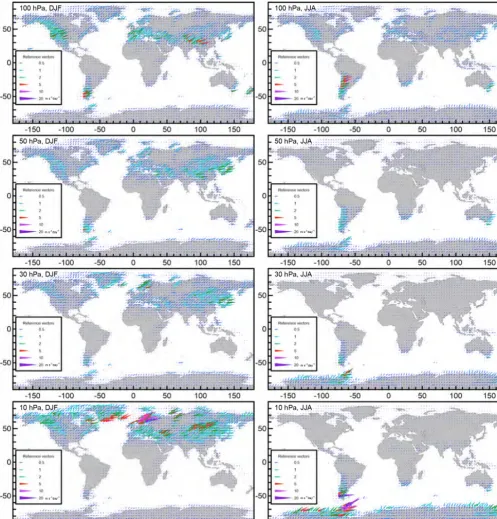
First, we examine if the orographic GW parameterization scheme from CMAM-sd distributes the OGWD realistically. Figure 1 shows the OGWD climatology at 100, 50, 30 and 10 hPa levels. The 100 hPa level is traditionally below the level taken into account in the GW analyses from satellite observations (e.g., Alexander et al., 2010; Šácha et al., 2015; Wright et al., 2016a). At this level, in the DJF season, the OGWD is dominated by a Himalayan hotspot, which has not received significant attention in observational analyses yet (probably due to its emergence at rather lower levels). However, enhanced momentum fluxes have already been ob-served in this region, e.g., by Wright et al. (2016a). An-other hotspot emerging in the Northern Hemisphere (NH) is connected with the Rocky Mountains. These hotspots are not visible at the higher levels. In the Southern Hemisphere (SH), during southern summer conditions, we see compa-rable magnitudes of OGWD (up to 20 m s−1 day−1) as for the NH connected with the southern tip of the Andes, Tas-mania and New Zealand. Those high OGWD values in the summer hemisphere vanish at higher levels, which is in line with Baumgaertner and McDonald (2007), who attributed the small amount of summertime potential energy to lower-level critical filtering.
Figure 1.Mean seasonal wind tendency due to OGWs (m s−1day−1) at the 100 hPa(a, b), 50 hPa(c, d), 30 hPa(e, f)and 10 hPa(g, h)level, during DJF(a, c, e, g)and JJA(b, d, f, h)seasons.
in the parameterization and the lack of direct observational information on the OGWD and GWD in general.
Figure 2 gives an illustration of how much the OGWD is changing on the interannual scale. Note that the arrows do not show the drag direction but illustrate a ratio of the merid-ional and zonal SD (both always positive). We see that at
Figure 2.Standard deviation (SD) of the monthly series of wind tendency due to OGW (m s−1day−1), displayed in a vector-like form and assigning the value for the eastward component to thexaxis and value for the northward component to theyaxis.
The OGWD variability at the 30 hPa level is dominated by the EA/NP and Scandinavian hotspots with maximum val-ues of SD below 5 m s−1day−1. This magnitude is reached only in the Antarctic Peninsula region in JJA in the SH. In the NH, the meridional component has relatively lower vari-ability than at 10 hPa.
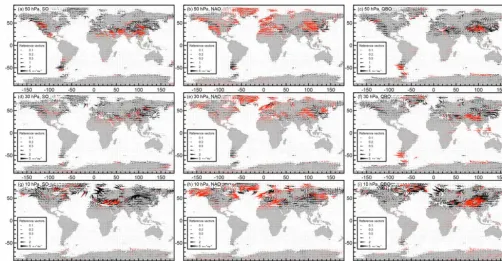
Figure 3.Response of the OGWD (m s−1day−1) at the 50 hPa(a, b, c), 30 hPa(d, e, f)and 10 hPa(g, h, i)level related to the activity of the Southern Oscillation(a, d, g), North Atlantic Oscillation(b, e, h)and quasi-biennial oscillation(c, f, i). The responses correspond to the increase in the oscillation index by four times its SD, i.e., to the transition of the respective oscillation from a highly negative to a highly positive phase; red symbols pertain to locations with at least one wind tendency component response statistically significant at the 95 % confidence level; bright red indicates at least one component significant at the 99 % confidence level. Analysis period: 1979–2010, monthly data, DJF season.
contribution of the meridional OGWD component variability is bigger than at 50 and 30 hPa. In SH in DJF and JJA, the variability in the Andes dominates.
Generally, the OGWD varies interannually by about half of the climatological OGWD magnitude (even reaching it at 10 hPa), with respective hotspots dominating the variability at the particular pressure levels of their climatological influ-ence.
3.2 MLR results
Responses of the OGWD to the phase of major internal cli-mate oscillations are shown at the 50, 30 and 10 hPa levels. In the NH in DJF, the variability connected with NAO domi-nates by far (Fig. 3, middle column) in the sense that it is dis-tributed across the whole hemisphere with many significant regions and responses of up to 5 m s−1day−1. As could be
expected from the NAO definition, it is most pronounced in regions surrounding the North Atlantic. Note especially that at all analyzed isobaric levels, there is a dipole-like structure between Greenland and Scandinavia together with coastal ar-eas in other places in western Europe. That indicates that dur-ing the positive NAO phase the GW activity suppresses the eastward wind above Greenland and enhances it above west-ern Europe while the opposite is true of the negative phase.
A similar dipole can be found at the western coast of North America, but only at the 50 hPa level. At higher levels, the signal above Alaska is more pronounced. The NAO signal is also pronounced in northeastern America, central Asia and partly in the EA/NP region (at 50 and 30 hPa levels) and in northern Asia for the 10 hPa level. There is also a sig-nificant signal exceeding 2 m s−1 day−1 in northern Africa for the 50 hPa level. The SO signal in the DJF season in the NH is mostly pronounced at 50 and 10 hPa level. At 50 hPa it constitutes a ring of significant OGWD responses higher than 2 m s−1day−1, whereas at the 10 hPa level the signal in northeastern America, Turkey, Iran and the Caucasus region dominates. At 50 hPa there is also a strong localized signal in the southern tip of South America. The QBO signal in DJF is mostly pronounced in central Asia in the NH and southern Andes together with the Antarctic Peninsula at 50 and 30 hPa in the SH.
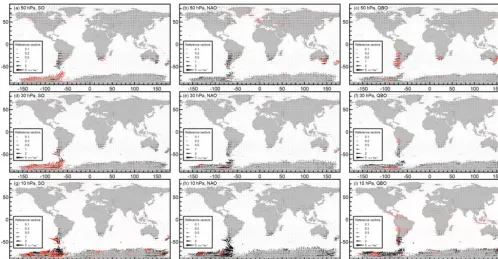
Figure 4.Response of the OGWD (m s−1day−1) at the 50 hPa(a, b, c), 30 hPa(d, e, f)and 10 hPa(g, h, i)level related to the activity of the Southern Oscillation(a, d, g), North Atlantic Oscillation(b, e, h)and quasi-biennial oscillation(c, f, i). The responses correspond to the increase in the oscillation index by 4 times its SD, i.e., to the transition of the respective oscillation from a highly negative to a highly positive phase; red symbols pertain to locations with at least one wind tendency component response statistically significant at the 95 % confidence level; bright red indicates at least one component significant at the 99 % confidence level. Analysis period: 1979–2010, monthly data, JJA season
and New Zealand at 50 hPa. The results of the regression of solar activity and volcanic forcing were not shown be-cause they gain a mostly insignificant OGWD signal. Only at 50 hPa is there a weak (up to 1 m s−1 day−1) significant solar signal in northeastern America and Antarctica in their respective winter periods.
To illustrate that it is necessary to consider geographical distribution for the analysis of the interannual variability in OGWD, we show the MLR results also for zonal means of OGWD (shown for DJF only). For the zonal OGWD compo-nent (Fig. 5), we can see that there is only a weak positive nificant NAO signal at all levels and a very small positive sig-nificant SO signal at 50 hPa between 20–30◦N correspond-ing to the belt described in the discussion of the Fig. 3. The magnitude of the detected signal is lower than 1 m s−1day−1 everywhere. For the QBO and also for the meridional com-ponent (Fig. 6) of all indices, the signal is not significantly positive or negative or lower than 0.1 m s−1 day−1 almost anywhere. The situation is similar also for the JJA season (not shown).
The general finding of the results presented above is that the OGWD varies locally by a few meters per second per day depending on the phase of the climate indices and also that the geographical variation in hotspots can vary from a phase to phase. The analysis also points to the important finding
that the significant signal connected to the climate oscilla-tions diminishes in the case of the traditional zonal-mean ap-proach.
3.3 Explanatory factors
(a) SO, DJF, 50 hPa, eastward tendency
(i) QBO, DJF, 10 hPa, eastward tendency
Regression-estimated OGWD responses (m s day ) to indices of SO, NAO and QBO and their 95 % confidence interval
° N
° N
(f) QBO, DJF, 30 hPa, eastward tendency (c) QBO, DJF, 50 hPa, eastward tendency (b) NAO, DJF, 50 hPa, eastward tendency
(e) NAO, DJF, 30 hPa, eastward tendency
(h) NAO, DJF, 10 hPa, eastward tendency (d) SO, DJF, 30 hPa, eastward tendency
(g) SO, DJF, 10 hPa, eastward tendency
° N
° N
° N
° N
° N
° N
° N -1
-1
Figure 5.Response of the zonal-mean OGWD (m s−1day−1) at the 50 hPa(a, b, c), 30 hPa(d, e, f)and 10 hPa(g, h, i)level related to the activity of the Southern Oscillation(a, d, g), North Atlantic Oscillation(b, e, h)and quasi-biennial oscillation(c, f, i). The responses correspond to the increase in the oscillation index by 4 times its SD, i.e., to the transition of the respective oscillation from a highly negative to a highly positive phase; the blue curve shows the signal value and blue shading illustrates the 95 % confidence interval. Analysis period: 1979–2010, monthly data, DJF season.
(a) SO, DJF, 50 hPa, northward tendency
(i) QBO, DJF, 10 hPa, northward tendency ° N
° N (f) QBO, DJF, 30 hPa, northward tendency
(c) QBO, DJF, 50 hPa, northward tendency (b) NAO, DJF, 50 hPa, northward tendency
(e) NAO, DJF, 30 hPa, northward tendency
(h) NAO, DJF, 10 hPa, northward tendency (d) SO, DJF, 30 hPa, northward tendency
(g) SO, DJF, 10 hPa, northward tendency
° N
° N
° N
° N
° N
° N
° N
to indices of SO, NAO and QBO and their 95 % confidence interval Regression-estimated OGWD responses (m s-1day )-1
Figure 6.Response of the meridional mean OGWD (m s−1day−1) at the 50 hPa(a, b, c), 30 hPa(d, e, f)and 10 hPa(g, h, i)level related to the activity of the Southern Oscillation(a, d, g), North Atlantic Oscillation(b, e, h)and quasi-biennial oscillation(c, f, i). The responses correspond to the increase in the oscillation index by 4 times its SD, i.e., to the transition of the respective oscillation from a highly negative to a highly positive phase; the blue curve shows the signal value and blue shading illustrates the 95 % confidence interval. Analysis period: 1979–2010, monthly data, DJF season.
OGWD variability is directly influenced by the variability at the surface or in the lower troposphere.
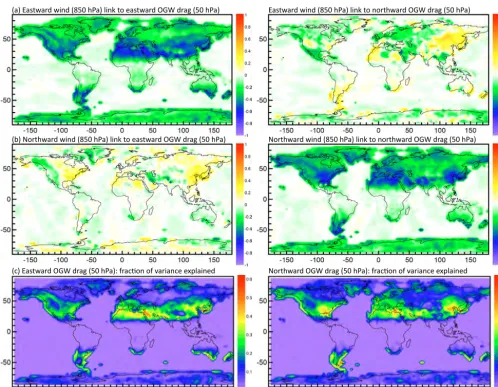
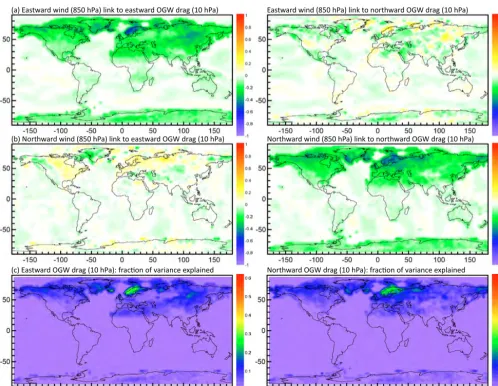
Figures 7, 8 and 9 present an analysis of daily data aimed at estimating how much of the OGWD variability at a given level can be explained by 850 hPa wind vari-ance. At 50 hPa, we can see that the link between the lower-tropospheric winds and OGWD is strongly expressed in a belt in the midlatitudes and tropics of the NH. The frac-tion of variance explained is maximal and the geographical
distribution is also very similar for the links between zonal wind/the zonal OGWD component and meridional wind/the meridional OGWD component. In the regions with signifi-cant orography and particularly in the region of the EA/NP hotspot (which dominates the OGWD field at 50 hPa in the NH), the majority of OGWD variance is explained by lower-tropospheric winds.
(a) Eastward wind (850 hPa) link to eastward OGW drag (50 hPa)
(b) Northward wind (850 hPa) link to eastward OGW drag (50 hPa)
Eastward wind (850 hPa) link to northward OGW drag (50 hPa)
Northward wind (850 hPa) link to northward OGW drag (50 hPa)
(c) Eastward OGW drag (50 hPa): frac�on of variance explained Northward OGW drag (50 hPa): frac�on of variance explained
Figure 7.(a, b)Standardized regression coefficients between orographic gravity wave drag at the 50 hPa level (predictand) and eastward and northward wind components at the 850 hPa level (predictors), during the DJF season.(c)Coefficient of determination, i.e., the fraction of total variance of OGWD explained through the regression mappings by both components of wind at the 850 hPa level. Analysis period: 1979–2010, daily data, DJF season.
explained is located up- and downwind from the Andes. Also interestingly, at 50 hPa, in the southern Andes/Antarctic Peninsula region, a larger fraction of the meridional OGWD component variance is explained by surface conditions than for the zonal component. Otherwise, the fraction of the OGWD variability explained in the Australian/New Zealand hotspot (connected in previous analyses mainly with the NAO signal) is about two-fifths of the total variance.
At the 30 hPa level the fraction of variance explained is lower – around one-third of the variance in eastern Asia and locally in northern Atlantic coastal regions and in the SH. In the eastern Asia region this is due to the stratospheric back-ground affecting the critical line occurrence and propagation of the GWs between 50 and 30 hPa. Interestingly, for the meridional OGWD component, the fraction of variance ex-plained is slightly higher. At the 10 hPa level, there is a single
maximum of explained total variance (around one-third) in Scandinavia. A similar amount of variance is also explained by 850 hPa winds for Iceland but for the zonal OGWD com-ponent only.
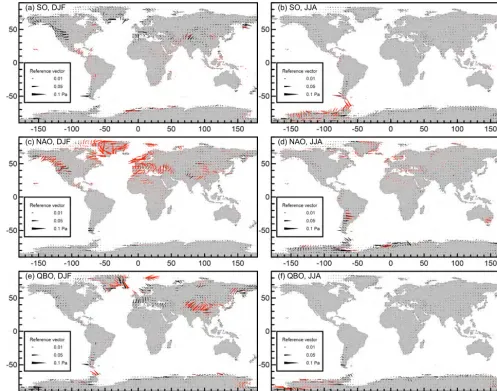
Another approach allowing us to assess the variability in the orographic GW sourcing is to analyze the 850 hPa oro-graphic GW fluxes as a proxy and apply the MLR method. However, with this method it is not possible to link the results directly with the variability in the OGWD because processes like the Doppler shifting of amplitudes or critical line varia-tions can alter the resulting OGWD significantly. Also note, that this analysis is made with monthly data and the compa-rability with previous analyses is limited.
variabil-(a) Eastward wind (850 hPa) link to eastward OGW drag (30 hPa)
(b) Northward wind (850 hPa) link to eastward OGW drag (30 hPa)
Eastward wind (850 hPa) link to northward OGW drag (30 hPa)
Northward wind (850 hPa) link to northward OGW drag (30 hPa)
(c) Eastward OGW drag (30 hPa): frac�on of variance explained Northward OGW drag (30 hPa): frac�on of variance explained
Figure 8.(a, b)Standardized regression coefficients between orographic gravity wave drag at the 30 hPa level (predictand) and eastward and northward wind components at the 850 hPa level (predictors), during the DJF season.(c)Coefficient of determination, i.e., the fraction of total variance of OGWD explained through the regression mappings by both components of wind at the 850 hPa level. Analysis period: 1979–2010, daily data, DJF season.
ity in central Asia (Himalayas), Greenland, Iceland and Sval-bard connected with the QBO. The SO signal is largely in-significant in the NH, but in the SH in JJA it is most strongly pronounced mainly in the southern tip of the Andes and Antarctic Peninsula. In the SH in JJA, some regions of sig-nificant signal in GW sourcing variability connected with the NAO (the Andes, Australia and New Zealand) and QBO (Antarctica) can also be found.
Although the strong QBO signal may be surprising, the QBO phase exhibits a distinct and in some regions statisti-cally significant influence on the lower-tropospheric winds in CMAM-sd (not shown). The influence of the QBO on the surface meteorological conditions has been pointed out in the literature in detail before (e.g., Marshall and Scaife, 2009; Hansen et al., 2016).
4 Summary and discussion
The study presented here introduces an analysis of interan-nual variability in the CMAM-sd OGWD at particular pres-sure levels in the stratosphere. Building on the results of Šácha et al. (2016), the aim of our paper has been to evaluate if the tropospheric variability can affect the OGWD distribu-tion in the stratosphere.
miss-(a) Eastward wind (850 hPa) link to eastward OGW drag (10 hPa)
(b) Northward wind (850 hPa) link to eastward OGW drag (10 hPa)
Eastward wind (850 hPa) link to northward OGW drag (10 hPa)
Northward wind (850 hPa) link to northward OGW drag (10 hPa)
(c) Eastward OGW drag (10 hPa): frac�on of variance explained Northward OGW drag (10 hPa): frac�on of variance explained
Figure 9.(a, b)Standardized regression coefficients between orographic gravity wave drag at the 10 hPa level (predictand) and eastward and northward wind components at the 850 hPa level (predictors), during the DJF season.(c)Coefficient of determination, i.e., the fraction of total variance of OGWD explained through the regression mappings by both components of wind at the 850 hPa level. Analysis period: 1979–2010, daily data, DJF season.
ing observational constraints on the OGWD in general). In the second section, results of the MLR analysis of monthly OGWD data are presented showing a significant NAO, SO and QBO signal of a few (up to 5) m s−1day−1in the OGWD at 50, 30 and 10 hPa. Depending on the phase of the cli-mate oscillations, OGWD values in the hotspot regions and also the distribution of OGWD hotspots vary interannually on the selected pressure levels. However, in the case of the traditional zonal-mean analysis, the detected signal is small and mostly insignificant. In the last part we demonstrate that a large fraction (over hotspots like EA/NP) of the described OGWD variance can be linked to the variance of 850 hPa winds. We also find significant NAO, SO and QBO signals in the orographic GW momentum fluxes at 850 hPa suggest-ing different orographic GW sourcsuggest-ing in a model dependsuggest-ing on the phase of these phenomena.
pro-(a) SO, DJF
(f) QBO, JJA (d) NAO, JJA (b) SO, JJA
(c) NAO, DJF
(e) QBO, DJF
Figure 10.Response of the orographic GW momentum fluxes (Pa) at the 850 hPa level related to the activity of the Southern Oscillation(a, b), North Atlantic Oscillation(c, d) and quasi-biennial oscillation(e, f)during DJF(a, c, e)and JJA(b, d, f)seasons. The responses correspond to the increase in the oscillation index by 4 times its SD, i.e., to the transition of the respective oscillation from a highly negative to a highly positive phase; red symbols pertain to locations with at least one orographic GW flux component response statistically significant at the 95 % confidence interval. Analysis period: 1979–2010, monthly data.
cesses (Doppler shifting, critical-level variations). However, it makes little sense to look for the causality between GWs and PWs (background field for GWs) when only the steady state (monthly data) is considered.
There is also a factor of longitudinal variability in the OGWD (and GWD in general). For the PW breaking there is almost no information in the literature about the geometry and longitudinal variability in the imposed drag force. But for the GWs, it has been shown in Šácha et al. (2016) that local-ized forces can lead to dynamical responses different from the reactions to a zonally averaged forcing. Although the gravity waves are a small-scale phenomenon, they are often organized in large-scale hotspots constituting a large-scale forcing. We argue that incorporating these effects into
Our analysis relies on parameterized processes, and thus the results can be highly model dependent considering that other models use different OGWD parameterizations than CMAM. The NOGWD in CMAM-sd at the vertical domain of our analysis is clearly underestimated compared to the cur-rent consensus on the GW distribution and impacts on the stratosphere (e.g., Hoffmann et al., 2013; Holt et al., 2017; Polichtchouk et al., 2007). It would be highly interesting to look at NOGWD variations connected with variability in jets, fronts, etc., in future research. For the real atmosphere our re-sults strongly suggest that GWs can play a much bigger and different role in the troposphere–stratosphere coupling and in shaping the stratospheric dynamics than is currently ac-knowledged. However, at the current stage it is impossible to evaluate the actual details of the connection between climate oscillations (tropospheric variability) and OGWD changes. This is partly due to the nudging procedure, which prevents us from analyzing the GWD impact on the circulation be-cause this impact is weakened by the relaxation towards ERA-I data. However, as we have only analyzed the OGWD interannual variability, the nudging is very advantageous for us (compared to a free running model), since the distribution of gravity wave momentum fluxes in CMAM-sd can resem-ble the distribution of real fluxes (McLandress et al., 2013).
From a methodological point of view we must also note that GWs and their effects are handicapped by the use of monthly mean data because the GWs are very intermittent in the atmosphere (e.g., Hertzog et al., 2012; Wright and Gille, 2013), and also in CMAM, the OGWD shows large daily (and shorter, not shown) variability. Therefore, for example, the monthly mean values may be hiding 1 order stronger in-termittent drag values. During the analysis, there were also indications of noteworthy deviations from linear behavior in some regions, encouraging future transition to nonlinear re-gression techniques.
In our future work, we aim to separate and estimate the dynamical impacts of the different OGWD distributions be-longing to the respective phases of the NAO, SO and QBO by producing sensitivity simulations with a mechanistic model with prescribed OGWD values and a distribution according to MLR results from CMAM.
Data availability. CMAM outputs are available upon regis-tration at the website of the Canadian Centre for Cli-mate Modelling and Analysis: http://cliCli-mate-modelling.canada.ca/ climatemodeldata/cmam, last access: 29 October 2017.
Supplement. The supplement related to this article is available online at: https://doi.org/10.5194/esd-9-647-2018-supplement.
Competing interests. The authors declare that they have no con-flicts of interest.
Acknowledgements. The work presented here would not have been possible without the utilized CMAM datasets from the Canadian Centre for Climate Modelling and Analysis. This study was supported by GA CR under grant nos. 16-01562J and 18-01625S. In later stages of the manuscript preparation, Petr Šácha was supported by the Government of Spain under grant no. CGL2015-71575-P. Petr Šácha thanks Juan Añel and Laura de la Torre for fruitful discussions. We thank our col-league Ales Kuchar for his assistance with data preparation. We also thank the two anonymous reviewers whose insightful and constructive comments helped to improve and clarify this paper.
Edited by: Zhenghui Xie
Reviewed by: two anonymous referees
References
Albers, J. R. and Birner, T.: Vortex preconditioning due to plane-tary and gravity waves prior to sudden stratospheric warmings, J. Atmos. Sci., 71, 4028–4054, https://doi.org/10.1175/JAS-D-14-0026.1, 2014.
Alexander, M. J. and Grimsdell, A. W.: Seasonal cycle of orographic gravity wave occurrence above small islands in the Southern Hemisphere: Implications for effects on the general circulation, J. Geophys. Res.-Atmos., 118, 589–599, https://doi.org/10.1002/2013JD020526, 2013.
Alexander, S. P. and Sato, K.: Gravity wave dynamics and cli-mate: An update from the SPARC gravity wave activity, SPARC Newsletter, 44, 9–13, 2015.
Alexander, S. P. and Shepherd, M. G.: Planetary wave activity in the polar lower stratosphere, Atmos. Chem. Phys., 10, 707–718, https://doi.org/10.5194/acp-10-707-2010, 2010.
Alexander, S. P., Klekociuk, A. R., and Tsuda, T.: Gravity wave and orographic wave activity observed around the antarc-tic and arcantarc-tic stratospheric vorantarc-tices by the cosmic gps-ro satellite constellation, J. Geophys. Res.-Atmos., 114, D17103, https://doi.org/10.1029/2009JD011851, 2009.
Alexander, M. J., Geller, M., McLandress, C., Polavarapu, S., Preusse, P., Sassi, F., Sato, K., Eckermann, S., Ern, M., Hertzog, A., Kawatani, Y., Pulido, M., Shaw, T. A., Sig-mond, M., Vincent, R., and Watanabe, S.: Recent develop-ments in gravity-wave effects in climate models and the global distribution of gravity-wave momentum flux from observa-tions and models, Q. J. Roy. Meteor. Soc., 136, 1103–1124, https://doi.org/10.1002/qj.637, 2010.
Añel, J. A.: The stratosphere: history and future a cen-tury after its discovery, Contemp. Phys., 57, 230–233, https://doi.org/10.1080/00107514.2015.1029521, 2016. Baumgaertner, A. J. G. and McDonald, A. J.: A gravity wave
climatology for antarctica compiled from challenging min-isatellite payload/global positioning system (champ/gps) ra-dio occultations, J. Geophys. Res.-Atmos., 112, D05103, https://doi.org/10.1029/2006JD007504, 2007.
Calvo, N., Polvani, L. M, and Solomon, S.: On the surface impact of arctic stratospheric ozone extremes, Environ. Res. Lett., 10, 094003, https://doi.org/10.7916/D8HD7VHJ, 2015.
sud-den warming observed by saber, J. Geophys. Res.-Atmos., 120, 12018–12026, https://doi.org/10.1002/2015JD023966, 2015. Dee, D. P., Uppala, S. M., Simmons, A. J., Berrisford, P., Poli, P.,
Kobayashi, S., Andrae, U., Balmaseda, M. A., Balsamo, G., Bauer, P., Bechtold, P., Beljaars, A. C. M., van de Berg, L., Bidlot, J., Bormann, N., Delsol, C., Dragani, R., Fuentes, M., Geer, A. J., Haimberger, L., Healy, S. B., Hersbach, H., Hólm, E. V., Isaksen, L., Kållberg, P., Köhler, M., Matricardi, M., McNally, A. P., Monge-Sanz, B. M., Morcrette, J.-J., Park, B.-K., Peubey, C., de Rosnay, P., Tavolato, C., Thépaut, J.-N., and Vitart, F.: The era-interim reanalysis: configuration and perfor-mance of the data assimilation system, Q. J. Roy. Meteor. Soc., 137, 553–597, https://doi.org/10.1002/qj.828, 2011.
de la Torre, A., Alexander, P., Hierro, R., Llamedo, P., Rolla, A., Schmidt, T., and Wickert, J.: Large-amplitude grav-ity waves above the southern andes, the drake passage, and the antarctic peninsula, J. Geophys. Res.-Atmos., 117, D02106, https://doi.org/10.1029/2011JD016377, 2012.
Ern, M., Preusse, P., Gille, J. C., Hepplewhite, C. L., Mlynczak, M. G., Russell, J. M., and Riese, M.: Implica-tions for atmospheric dynamics derived from global ob-servations of gravity wave momentum flux in stratosphere and mesosphere, J. Geophys. Res.-Atmos., 116, D19107, https://doi.org/10.1029/2011JD015821, 2011.
Fritts, D. C., Smith, R. B., Taylor, M. J., Doyle, J. D., Eck-ermann, S. D., Dörnbrack, A., Rapp, M., Williams, B. P., Pautet, P., Bossert, K., Criddle, N. R., Reynolds, C. A., Rei-necke, P. A., Uddstrom, M., Revell, M. J., Turner, R., Kaifler, B., Wagner, J. S., Mixa, T., Kruse, C. G., Nugent, A. D., Wat-son, C. D., Gisinger, S., Smith, S. M., Lieberman, R. S., Laugh-man, B., Moore, J. J., Brown, W. O., Haggerty, J. A., Rock-well, A., Stossmeister, G. J., Williams, S. F., Hernandez, G., Murphy, D. J., Klekociuk, A. R., Reid, I. M., and Ma, J.: The Deep Propagating Gravity Wave Experiment (DEEPWAVE): An airborne and ground-based exploration of gravity wave prop-agation and effects from their sources throughout the lower and middle atmosphere, B. Am. Meteorol. Soc., 97, 425–453, https://doi.org/10.1175/BAMS-D-14-00269.1, 2016.
Geller, M., Alexander, M. J., Love, P. T., Bacmeister, J., Ern, M., Hertzog, A., Manzini, E., Preusse, P., Sato, K., Scaife, A., and Zhou, T. H.: A comparison between gravity wave momentum fluxes in observations and climate models, J. Climate, 26, 6383– 6405, https://doi.org/10.1175/JCLI-D-12-00545.1, 2013. Hansen, F., Matthes, K., and Wahl, S.: Tropospheric qbo–enso
interactions and differences between the atlantic and pacific, J. Climate, 29, 1353–1368, https://doi.org/10.1175/JCLI-D-15-0164.1, 2016.
Hertzog, A., Alexander, M. J., and Plougonven, R.: On the inter-mittency of gravity wave momentum flux in the stratosphere, J. Atmos. Sci., 69, 3433–3448, https://doi.org/10.1175/JAS-D-12-09.1, 2012.
Hindley, N. P., Wright, C. J., Smith, N. D., and Mitchell, N. J.: The southern stratospheric gravity wave hot spot: individual waves and their momentum fluxes measured by COSMIC GPS-RO, At-mos. Chem. Phys., 15, 7797–7818, https://doi.org/10.5194/acp-15-7797-2015, 2015.
Hoffmann, L., Xue, X., and Alexander, M. J.: A global view of stratospheric gravity wave hotspots located with Atmospheric
Infrared Sounder observations, J. Geophys. Res.-Atmos., 118, 416–434, https://doi.org/10.1029/2012JD018658, 2013. Hoffmann, L., Grimsdell, A. W., and Alexander, M. J.: Stratospheric
gravity waves at Southern Hemisphere orographic hotspots: 2003–2014 AIRS/Aqua observations, Atmos. Chem. Phys., 16, 9381–9397, https://doi.org/10.5194/acp-16-9381-2016, 2016. Holt, L. A., Alexander, M. J., Coy, L., Liu, C., Molod, A.,
and Pawson, S.: An evaluation of gravity waves and gravity wave sources in the Southern Hemisphere in a 7 km global climate simulation, Q. J. Roy. Meteor. Soc., 143, 2481–2495, https://doi.org/10.1002/qj.3101, 2017.
John, S. R. and Kumar, K. K.: Timed/saber observations of global gravity wave climatology and their interannual variability from stratosphere to mesosphere lower thermosphere, Clim. Dy-nam., 39, 1489–1505, https://doi.org/10.1007/s00382-012-1329-9, 2012.
Kalisch, S., Preusse, P., Ern, M., Eckermann, S. D., and Riese, M.: Differences in gravity wave drag between realistic oblique and assumed vertical propagation, J. Geophys. Res.-Atmos., 119, 10081–10099, https://doi.org/10.1002/2014JD021779, 2014. Lawrence, B. N.: The Effect of Parameterized Gravity Wave Drag
on Simulations of the Middle Atmosphere during Northern Win-ter 1991/1992 – General Evolution, Springer, Berlin, Heidelberg, 291–307, https://doi.org/10.1007/978-3-642-60654-0_20, 1997. Manzini, E., Karpechko, A. Y., Anstey, J., Baldwin, M. P.,
Black, R. X., Cagnazzo, C., Calvo, N., Charlton-Perez, A., Chris-tiansen, B., Davini, P., Gerber, E., Giorgetta, M., Gray, L., Hardiman, S. C., Lee, Y.-Y., Marsh, D. R., McDaniel, B. A., Purich, A., Scaife, A. A., Shindell, D., Son, S.-W., Watan-abe, S., and Zappa, G.: Northern winter climate change: Assess-ment of uncertainty in cmip5 projections related to stratosphere-troposphere coupling, J. Geophys. Res.-Atmos., 119, 7979– 7998, https://doi.org/10.1002/2013JD021403, 2014.
Marshall, A. G. and Scaife, A. A.: Impact of the qbo on sur-face winterclimate, J. Geophys. Res.-Atmos., 114, D18110, https://doi.org/10.1029/2009JD011737, 2009.
McFarlane, N. A.: The effect of orographically ex-cited gravity wave drag on the general circulation of the lower stratosphere and troposphere, J. At-mos. Sci., 44, 1775–1800, https://doi.org/10.1175/1520-0469(1987)044<1775:TEOOEG>2.0.CO;2, 1987.
McLandress, C., Scinocca, J. F., Shepherd, T. G., Reader, M. C., and Manney, G. L.: Dynamical control of the mesosphere by orographic and nonorographic gravity wave drag during the ex-tended northern winters of 2006 and 2009, J. Atmos. Sci., 70, 2152–2169, https://doi.org/10.1175/JAS-D-12-0297.1, 2013. Pawson, S.: Effects of Gravity Wave Drag in the Berlin
Troposphere-Stratosphere-Mesosphere GCM, Springer, Berlin, Heidelberg, 327–336, https://doi.org/10.1007/978-3-642-60654-0_22, 1997.
Pisoft, P., Šácha, P., Miksovsky, J., Huszar, P., Scherllin-Pirscher, B., and Foelsche, U.: Revisiting internal gravity waves analy-sis using GPS RO density profiles: comparison with temperature profiles and application for wave field stability study, Atmos. Meas. Tech., 11, 515–527, https://doi.org/10.5194/amt-11-515-2018, 2018.
Pogoreltsev, A. I., Vlasov, A. A., Fröhlich, K., and Ja-cobi, C.: Planetary waves in coupling the lower and up-per atmosphere, J. Atmos. Sol.-Terr. Phy., 69, 2083–2101, https://doi.org/10.1016/j.jastp.2007.05.014, 2007.
Polichtchouk, I., Shepherd, T. G., Hogan, R. J., and Bechtold, P.: Sensitivity of the Brewer-Dobson circulation and polar vortex variability to parametrized nonorographic gravity-wave drag in a high-resolution atmospheric model, J. Atmos. Sci., 75, 1525– 1543, https://doi.org/10.1175/JAS-D-17-0304.1, 2018.
Šácha, P., Kuchaˇr, A., Jacobi, C., and Pišoft, P.: Enhanced internal gravity wave activity and breaking over the northeastern Pacific– eastern Asian region, Atmos. Chem. Phys., 15, 13097–13112, https://doi.org/10.5194/acp-15-13097-2015, 2015.
Šácha, P., Lilienthal, F., Jacobi, C., and Pišoft, P.: Influence of the spatial distribution of gravity wave activity on the middle at-mospheric dynamics, Atmos. Chem. Phys., 16, 15755–15775, https://doi.org/10.5194/acp-16-15755-2016, 2016.
Sandu, I., Bechtold, P., Beljaars, A., Bozzo, A., Pithan, F., Shepherd, T. G., and Zadra, A.: Impacts of parameter-ized orographic drag on the northern hemisphere win-ter circulation, J. Adv. Model. Earth Sy., 8, 196–211, https://doi.org/10.1002/2015MS000564, 2016.
Scinocca, J. F.: An accurate spectral nonorographic gravity wave drag parameterization for general circulation models, J. Atmos. Sci., 60, 667–682, https://doi.org/10.1175/1520-0469(2003)060<0667:AASNGW>2.0.CO;2, 2003.
Scinocca, J. F. and McFarlane, N. A.: The parametriza-tion of drag induced by stratified flow over anisotropic orography, Q. J. Roy. Meteor. Soc., 126, 2353–2393, https://doi.org/10.1002/qj.49712656802, 2000.
Scinocca, J. F., McFarlane, N. A., Lazare, M., Li, J., and Plummer, D.: Technical Note: The CCCma third generation AGCM and its extension into the middle atmosphere, Atmos. Chem. Phys., 8, 7055–7074, https://doi.org/10.5194/acp-8-7055-2008, 2008. White, R. H., Battisti, D. S., and Roe, G. H.: Mongolian mountains
matter most: Impacts of the latitude and height of asian orogra-phy on pacific wintertime atmospheric circulation, J. Climate, 30, 4065–4082, https://doi.org/10.1175/JCLI-D-16-0401.1, 2017. White, R. H., Battisti, D. S., and Sheshadri, A.: Orography
and the boreal winter stratosphere: The importance of the Mongolian mountains, Geophys. Res. Lett., 45, 2088–2096, https://doi.org/10.1002/2018GL077098, 2018.
Wright, C. J. and Gille, J. C.: Detecting overlapping gravity waves using the s-transform, Geophys. Res. Lett., 40, 1850–1855, https://doi.org/10.1002/grl.50378, 2013.
Wright, C. J., Hindley, N. P., and Mitchell, N. J.: Combin-ing airs and mls observations for three-dimensional grav-ity wave measurement, Geophys. Res. Lett., 43, 884–893, https://doi.org/10.1002/2015GL067233, 2016a.