PERFORMANCE ANALYSIS OF OSCM
TRANSMISSION SYSTEMS BY USING
DUAL ELECTRODE MZ-MODULATOR
ASHOKA KUMAR RATHA
Lecturer Department of ECE, Bharath University, 173 Agharam Road,Selaiyur,Chennai-600073,Tamilnadu,India
Dr.A.SIVANANTHA RAJA
Asst.Professor Department of ECE, A.C.College of Engineeing and Technology, Karaikudi-630004,Tamilnadu,India
Abstract:
In this paper, the performance of OSCM transmission system using dual electrode MZ modulator was analyzed and investigated by simulation through the use of optisim software. The dual electrode z-cut LiNbO3 MZM makes the use of two linear polarizer’s placed before and after it respectively. By carefully selecting the angles of the two linear polarizers, the third order intermodulation and harmonic distortion can be suppressed significantly. The performance of the system was investigated by varying few parameters such as data rate, optical modulation index, subcarrier frequency, phase shift difference between branches of dual electrode MZ modulator, fiber length and phase of the local oscillator at the receiver side.
Keywords-Optical fiber link; subcarrier multiplexing; nonlinear distortion.
1. Introduction
In fiber-optic transmission system, transmission capacity and distance of optical signal are always important factors to improve the performance of the fiber-optic transmission system. Various transmission technologies have been developed such as Wavelength Division Multiplexing (WDM), Frequency Division Multiplexing (FDM) and etc. in order to meet high demands on the performance of the transmission system [1-3]. Among such multiplexing schemes, optical SCM has been proposed as one of the transmission methods that gives better performance to the fiber optic transmission system.
Optical Subcarrier Multiplexing (OSCM) is a method for multiplexing many different fiber optics-based communication links into a single uplink fiber [4-5]. SCM follows a different approach compared to WDM. In WDM a terahertz optical carrier is modulated with a baseband signal of typically hundred of Mbit/s. In an SCMA infrastructure, the baseband data is first modulated on a GHz wide subcarrier that is subsequently modulated in the THz optical carrier. This way each signal occupies a different portion of the optical spectrum surrounding the centre frequency of the optical carrier. At the receiving side, as normally happens in a commercial radio service, the receiver is tuned to the correct subcarrier frequency, filtering out the other subcarriers.
Transmission of optical subcarrier multiplexed signal through an optical fiber may create a significant power penalty at the receiver due to the effect of fiber chromatic dispersion [6-8]. When such signal is modulated by a dual electrode MZ modulator, that will significantly improves the system immunity to chromatic dispersion, as well as being more spectrally efficient. Suppose that an optical carrier transport two RF carriers at f1 and f2. Due to the non linearity characteristics of modulation both harmonic distortion (HD) and intermodulation distortion (IMD) are generated. Generally IMDs are occur at 2f1±f2 and 2f2±f1 i.e. the third order IMDs are generally more detrimental to the RF carriers. In order to reduce such non linearity, a linearised dual electrode MZM has been proposed. This technique utilizes DC biasing at quadreture, so that both TE and TM mode have exact opposite slope, which are used for the cancellation of 3IMDs.The objective of this project is to analyze the performance of OSCM transmission system by employing a dual electrode MZ modulator. Some selections of the performance parameter are done based on the quality of the detected baseband signal.
2. Linearized Dual Electrode MZ-Modulator
When the optical signal enters to the modulator via first linear polarizer which is set at an angle ‘α’ with respect to z-axis, this will excite both TE and TM modes. Both of these modes are modulated to different modulation depth. In the other word, the z-(TM) axis will carry more 3-IMD, while the x-(TM) axis will carry less 3-IMD. The optical signal is then passed to second linear polarizer i.e. set to an angle ‘β’ with respect to z-axis. These two angles are related to each other, so they will be selected in such a fashion so as to maximize the RF subcarrier and suppress the 3-IMD.By carefully selecting α and β of the two linear polarizer, the combined 3-IMD from two arm of the dual electrode MZM can be cancelled. The RF signal is applied to the electrode, which are 900 phase shifted from each other.
Fig.1: Linearized Dual Electrode MZM
Where v (t) = ( )[ Ω ( ) + Ω ( ) ]
3. Experimental Setup
Ablock diagram for implementation of a single channel OSCM transmission system employs dual electrode MZM as shown in figure 2. The digital data bits are generated by pseudorandom number generator. This data was then sent to the BPSK modulator, where it was up converted to 2GHz by mixing it with the 2GHz microwave subcarrier.
Fig.2: Simulation block diagram
In subcarrier multiplexed optical transmission system a large number of modulation formats can be feasible. In this system BPSK is used as RF modulation format. It involves switching the phase of a sinusoidal signal in accordance with the incoming data. One important feature of PSK signal is that, envelopes become constant throughout the transmission of the signal that avoids the effect of amplitude non linearity [9]. The microwave subcarrier signal generated from BPSK modulator was applied to the upper arm of MZM. A combination of the 900 phase shifted microwave subcarrier signal and a ground signal is fed to the lower arm of the MZM. A CW laser is used which generates optical carriers that will carry the multiplexed signal through the standard single mode fiber. One important feature of SMF is that it can be used for long distance communication due to low attenuation, higher bandwidth and low dispersion.
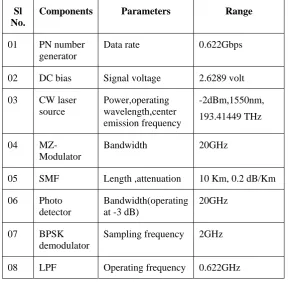
detector, which carries the RF subcarrier signal and the other two are clock signal and sinusoidal signal. The clock signal determines the instant of time over which the signal is sampled in BPSK demodulator where as the sinusoidal wave generator provides the reference electrical carrier for the demodulation process. Coherent detection is takes place at the receiver side, which requires that the microwave subcarrier signal in the demodulation must be adjusted to have the same phase of the one in the MZM. This requirement causes complexity at the demodulator side. Any phase mismatch causes signal distortion and sometimes it is very difficult to recover the signal at the receiver output [10]. Finally the baseband signal is passed through LPF which is used to smooth out the data stream and filters the unwanted sidebands. The electrical scopes, electrical power meters and BER estimator are used for the analysis and observe the simulation results. The system has been constructed by considering the fallowing parameter as shown in the fallowing table.1
Sl No.
Components Parameters Range
01 PN number generator
Data rate 0.622Gbps
02 DC bias Signal voltage 2.6289 volt
03 CW laser source
Power,operating wavelength,center emission frequency
-2dBm,1550nm,
193.41449 THz
04 MZ-Modulator
Bandwidth 20GHz
05 SMF Length ,attenuation 10 Km, 0.2 dB/Km
06 Photo detector
Bandwidth(operating at -3 dB)
20GHz
07 BPSK demodulator
Sampling frequency 2GHz
08 LPF Operating frequency 0.622GHz
Table 1: Simulation Specification Of OSCM Transmission System
4. Results And Discussion
4.1. Data rate:- For high speed data transmission and to avoid the effect of chromatic dispersion, we have to choose an acceptable level of data rate in the range between 0.2Gbps to 3Gbps. In this experiment the data rate was fixed at 0.622Gbps. Chromatic dispersion is highly depends on data rate and its effect is inversely proposnal to data rate. The fallowing figure.3 shows the relationship between BER and data rate of the transmitted signal. From the fig we found that at a bit rate of 2 Gbps, the BER of the detected signal is very high. This is because the subcarrier frequency is maintained at 2GHz. When the bit rate is equal and greater than half of 2GHz, then we cannot able to recover the original signal because the signal itself is distorted and the useful information is filter out. But when the bit rate is equal and less than half of 2GHz, then we can easily recover the original signal without any complexity.
4.2. OMI:- Sometimes the level of optical modulation cannot be high due to the exsistance of non linear relationship between the output intensity of the MZM and the modulating signal. High value of OMI leads to generation of fundamental harmonics which will cause interchannel crosstalk .where as on the other hand low value of OMI leads to inefficient modulation and the modulated signal degrade the quality of signal at the receiver output. So we must choose the OMI value very carefully, which can be calculated as
OMI=
Where is the peak to peak value of the modulating signal. The quality of baseband signal for higher OMI is better then that for lower OMIbecause higher OMI gives higher modulatioon effiency and better receiver sensitivity. From the fallowing figure.4 shows at 0.1 we get the quality factor as 29.96597dB while at 0.4 we get quality factor as 36.778dB.
Fig.4:Quality factor vs. OMI
4.3. Subcarrier frequency:- The frequency of microwave subcarrier is considered as an important parameter while we are designing a SCM transmission system. Because if we are keeping the sub carrier frequency as low as possible then we can easily avoid the effect of polarization walk off and PMD effects. But however the power level will limit the transmitted data rate of the digital source. In this experiment, the subcarrier frequency is varied from 0.5GHz to 4GHz.In order to get lower PMD effect, high bandwidth effect and better system performance, the subcarrier frequency is kept at 2GHz. From the fallowing figure.5 we get that at 0.5GHz the quality factor is 9.456dB. For subcarrier frequency lower then the data rate the received signal is not able to detected and probability of bit error is very high.
Fig.5:Quality factor vs. Subcarrier frequency.
Fig.6:Optical peak power vs. Phase shift.
4.5. Phase of the local oscillator:- At the receiver side the received signal is multiplied with local carrier at certain subcarrier frequency. A set of phase of local oscillator is varied from 0rad to 2.2rad in order to get microwave subcarrier properly at the receiver side. The fallowing figure.6 shows that the carrier phase of 1.2rad best matches with the phase at which the subcarrier frequencies are transmitted at the transmitter side and thus produce the better quality of received signal. For a local carrier phase of 2.8rad, the quality factor of received signal is very low due to the mismatch between the phase of transmitted subcarrier frequency and the phase that is multiplied from the local oscillator at the receiver side.
Fig.6:Quality factor vs. Phase of local carrier
5. Conclusion
Basically the objective of this paper is to analyze the performance of OSCM transmission system by using dual electrode MZ modulator. Optimization of system performance can be done by making tradeoffs among some important performance parameters of the components. The parameters that have been considered in this project are data rate, OMI, subcarrier frequency, phase shift across the arms of MZ modulator, phase of the local oscillator. There are still a lots of performance parameters that can be considered in order to further improve the performance of OSCM system.
References
[1] B. J. Koshy, and P. M. Shankar, "Spread-Spectrum Techniques for Fiber-Fed Microcellular Networks", IEEE Trans. on Vehicular Technology, vol. 48, no. 3, May 1999, pg847 - 857.
[2] E. Dahlman, et al.. "UMTS/IMT 2000 Based on Wideband CDMA",IEEE Communication Magazine, vol. 36, no.9, Sept 1998, pg70 - 80.
[3] S. Kajiya, K.Ksukamoto, and S. Komaki, "Proposal of Fiber-Optic Radio Highway Networks Using CDMA Method", IEICE Trans. On Electronics, Nov 1996, pg496 - 500.
[4] J. C. Palais, 2005, "Fiber Optic Communications", Pearson Prentice Hall.
[5] M Arsat,N.M.Nawawi,”Performance analysis of subcarrier syatem for Radio over Fiber Technology” proceedings of IEEE August 2008,pg226-229.
[6] G. H. Smith and D. Novak, “Broad-band millimeter-wave (38 GHz) fiber-wireless transmission system using electrical and optical SSB modulation to overcome dispersion effects,” IEEE Photon. Technol.Lett., vol. 10, no. 1, pp. 141–143, Jan. 1998.
[7] A. Loayssa, C. Lim, A. Nirmalathas, and D. Benito, “Design and performance of the bidirectional optical single-sideband modulator,” J.Lightw. Technol., vol. 21, no. 4, pp. 1071–1082, Apr. 2003.
[8] B. Davies and J. Conradi, “Hybrid modulator structures for subcarrier and harmonic subcarrier optical single sideband,” IEEE Photon. Technol. Lett., vol. 10, no. 4, pp. 600–602, Apr. 1998
[9] Rongqing Hui, Benyuan Zhu, Renxiang Huang, Christopher T. Allen, Kenneth R. Demarest, and Douglas Richards, "Subcarrier Multiplexing of high-speed optical transmission", Journal of Lightwave Technology,Vol. 20, No.3, March 2002