This may be the author’s version of a work that was submitted/accepted
for publication in the following source:
Yi, Honglei &
Yang, Jay
(2014)
Research trends of post disaster reconstruction: The past and the future.
Habitat International
,
42
, pp. 21-29.
This file was downloaded from:
https://eprints.qut.edu.au/64638/
c
Consult author(s) regarding copyright matters
This work is covered by copyright. Unless the document is being made available under a Creative Commons Licence, you must assume that re-use is limited to personal use and that permission from the copyright owner must be obtained for all other uses. If the
docu-ment is available under a Creative Commons License (or other specified license) then refer to the Licence for details of permitted re-use. It is a condition of access that users recog-nise and abide by the legal requirements associated with these rights. If you believe that
this work infringes copyright please provide details by email to [email protected]
License: Creative Commons: Attribution-Noncommercial-No Derivative
Works 2.5
Notice:
Please note that this document may not be the Version of Record
(i.e. published version) of the work. Author manuscript versions (as
Sub-mitted for peer review or as Accepted for publication after peer review) can
be identified by an absence of publisher branding and/or typeset
appear-ance. If there is any doubt, please refer to the published source.
Research Trends of Post Disaster Reconstruction:
the Past and the Future
Abstract
Natural disasters can have adverse effect on human lives. To raise the awareness of research and better combat future events, it is important to identify recent research trends in the area of post disaster reconstruction (PDR). The authors used a three-round literature review strategy to study journal papers published in the last decade that are related to PDR with specific conditions using the Scopus search engine. A wide range of PDR related papers from a general perspective was examined in the first two rounds while the final round established 88 papers as target publications through visual examination of the abstracts, keywords and as necessary, main texts. These papers were analysed in terms of research origins, active researchers, research organisations, most cited papers, regional concerns, major themes and deliverables, for clues of the past trends and future directions. The need for appropriate PDR research is increasingly recognised. The publication number multiplied 5 times from 2002 to 2012. For PDR research with a construction perspective, the increase is sixfold. Developing countries such as those in Asia attract almost 50% researchers’ attention for regional concerns while the US is the single most concentrated (24%) country. Africa is hardly represented. Researchers in developed countries lead in worldwide PDR research. This contrasts to the need for expertise in developing countries. Past works focused on waste management, stakeholder analysis, resourcing, infrastructure issue, resilience and vulnerability, reconstruction approach, sustainable reconstruction and governance issues. Future research should respond to resourcing, integrated development, sustainability and resilience building to cover the gaps. By means of a holistic summary and structured analysis of key patterns, the authors hope to provide a streamlined access to existing research findings and make predictions of future trends. They also hope to encourage a more holistic approach to PDR research and international collaborations.
Keywords: post disaster reconstruction, construction, research trends, sustainability, resilience
Paper type: Literature review
Introduction
Academic journals are an important source of research information (Lee et al., 2009). As a prelude to comprehensive studies, many past researchers conducted content analysis of published papers in related academic journals, for instance, science education (Tsai and Lydia Wen, 2005), public relations (Ki and Shin, 2006), and general management (Pilkington and Chai, 2008). In the construction area, Ke et al. (2009) reviewed Public-Private Partnership (PPP) papers published between 1998 and 2008 to report the authors’ contribution and PPP research trends. Yuan and Shen (2011) presented the latest development on construction and demolition waste management through analysing publications from 2000 to 2009 in eight major international journals.
Recently, an increasing number of publications on natural disaster research appeared in academic journals around the globe. But it is still a relatively new research field without any systematic review of past efforts. To fill this gap, the authors reviewed publications in academic journals from 2002 to 2012 to stock-take past research progress and identify potential PDR research trends relevant to the construction industry. To start this journey, they have three questions in mind: (a) how was PDR research distributed worldwide? (b) who did most research? and (c) what were the main research themes?
Research Backgrounds
Reports of natural disasters fill the media in recent years. Almost every week there are places seriously affected (DeChano et al., 2006). Disasters can occur with formidable forces and crushing effects. They often cost our society a lot more than we expect. During the last decade, disasters caused an average damage bill of approximate US$67 billion every year (Guha-Sapir et al., 2011).The economic loss associated with disasters has increased 14-fold since the 1950s. Meanwhile, from 1994 to 2003, disasters annually claimed an average of 58,000 lives. In the single year of 2003, 1 out of 25 people across the globe was affected by disasters (Guha-Sapir et al., 2004). Figure 1 presents the economic and human impact of reported disasters between 2000 and 2011 (UNISDR, 2012). Statistics also reveal that developing countries tend to encounter more disasters than developed countries (ISDR, 2005). Key disaster events reported in the past decade were mostly from developing countries. For example, the drought happened in China in August 2002, the Indian Ocean Tsunami affected Indonesia, Sri Lanka, Malaysia and other countries in December 2004, the earthquakes hit Kashmir in October 2005 and China in May 2008, and also the deluge occurred in Pakistan in July 2010. Poor preparedness undoubtedly leads to vulnerability, which results in more grievous poverty and backwardness (Guha-Sapir et al., 2004).
After the worst is over, Post Disaster Reconstruction (PDR) is a very important aspect of work as it provides long-term developmental guidance. As stated in A Handbook For Reconstructing After Natural Disasters
Poor PDR efforts can lead to instability, vulnerability, poverty, or the combination of them, which is often evident in developing countries (El-Masri and Tipple, 2002). For disaster-prone regions in developing countries, PDR can also provide a rare opportunity for the local society to build a better place with multiple objectives.
Figure 1. The Economic and Human Impact of Disasters between 2000 and 2011. Edited from UNISDR publication(2012)
Despite the wide range of concerns it raises, Post Disaster Reconstruction is still lacking an authoritative definition with detailed aims, contents, and characteristics (Miller and Rivera, 2011, Lizarralde, 2004). It is referred to by other names as well, for example, Post Disaster Recovery (Alexander et al., 2006, Nagamatsu and Hayashi, 2012), Post Disaster Rebuilding (Olshansky et al., 2006), and Post Disaster Redevelopment (Simunovich, 2008). It’s believed that the differences between these concepts exist. Yet no specific comparison has been reported in academia. Being a new topic once again contributes to this fact.
PDR can’t be overestimated in our society. There had been many reports on PDR problems in practice, making it necessary to systematically analyse the current PDR research for future improvements. Absence of an overall plan (Olsen et al., 2005), chaos of decision making process (Johnson et al., 2006), poor performance of resource availability(Chang et al., 2010a), lack of considerations of affected people(Guarnacci, 2012), and insufficiency of sustainability and resilience delivery(Alexander et al., 2006), are just a few examples of the reported problems. By focusing on construction aspects of PDR and presenting future trends, the research discussed in this paper has the potential to contribute to knowledge gaps as well as to industry practice.
2000 2001 2002 2003 2004 2005 2006 2007 2008 2009 2010 2011 Economic damage in USD (
Billion) 46 27 52 69 136 214 34 74 190 46 131 363 People affected (Million) 174 108 659 255 161 160 126 211 221 199 261 162 People killed (Thousand) 16.7 39.5 21.3 113.5244.9 93.1 29.9 22.4 242.2 16 308.2 32.8
Methodology and approach
Research on Post Disaster Reconstruction is a relatively new topic with rapid development potential. To date however, only a limited number of journals cover it, for example Disaster Prevention and Management, International Journal of Disaster Resilience in the Built Environment, and Journal of Homeland Security and Emergency Management. Other journals on general construction and built environment topics, such as
Building and Environment, Habitat International and ASCE Construction Engineering and Management,
occasionally feature PDR-related papers. However, to ensure no papers with high relevancy are left out, it is necessary to search PDR-related papers published by all journals.
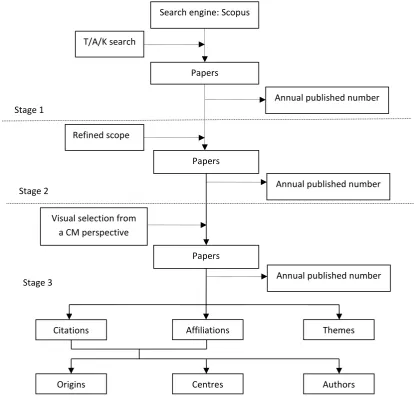
Inspired by a previous comprehensive search (Ke et al., 2009), the authors conducted document study of a three-round literature review of PDR papers published from 2002 to 2012, in which publication coverage, active contributors, and research focus were identified among a range of study criteria. A framework of this approach is shown in Figure 2.
Figure 2. The research framework Search engine: Scopus
Papers T/A/K search
Annual published number
Refined scope
Papers
Annual published number
Visual selection from a CM perspective
Papers
Annual published number
Citations Affiliations Themes
Origins Centres Authors
Stage 1
Stage 2
Stage 3
In Round 1, the “Scopus” search engine was adopted by the authors to go through “titles/abstract/keyword”. Scopus is owned by Elsevier as one of the leading international publishers of academic journals, and supported by qualified database of Elsevier. It is believed to have better performance than other engines such as PubMed, Web of Science, and Google Scholar, in terms of coverage and accuracy (Falagas et al., 2008). It is also popular among construction researchers (Ke et al., 2009, Yuan and Shen, 2011). In the subject areas of both “Physical Sciences” and ”Social Sciences”, and with the document type of “article or review”, post disaster reconstruction, reconstruction after disaster, post disaster recovery, recovery after reconstruction, post disaster rebuilding and other relative keywords were included in the initial search to identify papers. The complete search code is listed as follows:
KEY(post disaster reconstruction) OR KEY(reconstruction after disaster) OR KEY(post disaster recovery) OR KEY(recovery after disaster) OR
TITLE-ABS-KEY(post disaster rebuilding) OR TITLE-ABS-KEY(rebuilding after disaster) ORKEY(post disaster redevelopment) OR
TITLE-ABS-KEY(redevelopment after disaster)) AND DOCTYPE(ar OR re) AND SUBJAREA(mult OR ceng OR CHEM OR com p OR eart OR ener OR engi OR envi OR mate OR math OR phys OR mult OR arts OR busi OR deci OR econ OR psyc ORsoci) AND PUBYEAR > 2001 AND PUBYEAR < 2013
The main purpose in this Round was to testify the level of attention PDR attracts in research as well as establishing boundaries of study, so the search result was only helpful in presenting an annual number of PDR publications.
In Round 2, the scope was refined to subject areas of “social science”, “environmental science”, “engineering”, “business, management and accounting”, “economics, econometrics, and finance”, “psychology”, “decision science”, with language of “English”. While this further reduced the paper number, the result the may still not be the exact output this study is looking for. Some papers have only made a passing reference to disasters and reconstructing communities on their way to focus on other aspects such as economics. Even they appear to have met the search code, they were eliminated.
In Round 3, publications were visually examined and sifted through the abstracts and keywords. Irrelevant papers were excluded and papers addressing PDR issues from a construction industry perspective were extracted as target. Following this, the number of publications of most prolific authors and their contributions, their affiliated research centres and origins, as well as research themes and trends in PDR were explored through an in-depth content analysis of selected papers.
order of authorship suggests the degree of contribution. The corresponding part, or proportion, was calculated as a score by the formula listed below. An example will be given in the next section.
Score=∑
where n means the number of authors contributed to the paper, and i is the order of each specific writer.
Results and Discussions
Holistic view of PDR papers published between 2002 and 2012
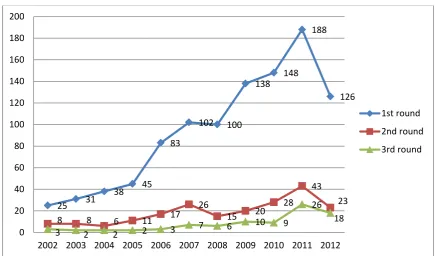
Round 1 of the search through Scopus yielded 1024 papers. The number of papers each year increased from 25 in 2002 to 126 in 2012. Similar trends existed in Round 2 and 3. These trends reinforced that PDR as a research topic has received increasing attention during the last decade (Figure 3). A sharp growth in number between 2009 and 2011 is evident, perhaps in response to the worldwide focus on China’s Wenchuan earthquake mid 2008 and the Japanese tsunami early 2011.
Figure 3. Number of PDR papers published between 2002 and 2012
59 journals published the target PDR papers. 18 produced two or more over the study period (Table 1).
Table 1. Journals that produced two or more target papers
Journal title Number
Natural Hazards Review 5
Environmental Hazards 4
International Journal of Disaster Resilience in the Built Environment 4 25 31
38 45 83
102 100 138
148 188
126
8 8 6 11 17 26
15 20 28
43 23
3 2 2 2 3 7 6
10 9 26
18 0
20 40 60 80 100 120 140 160 180 200
2002 2003 2004 2005 2006 2007 2008 2009 2010 2011 2012
Asian Journal of Social Science 3
Disasters 3
Global Environmental Change 3
Journal of the American Planning Association 3
Building and Environment 2
Community Development Journal 2
Construction Management and Economics 2
Environment and Urbanization 2
Habitat International 2
Journal of Infrastructure Systems 2
Local Environment 2
Planning 2
Proceedings of the Institution of Civil Engineers: Municipal Engineer 2 Proceedings of the Institution of Civil Engineers: Urban Design and Planning 2
Socio-Economic Planning Sciences 2
Active Authors, Research Centres and Origins, and Regional Concerns
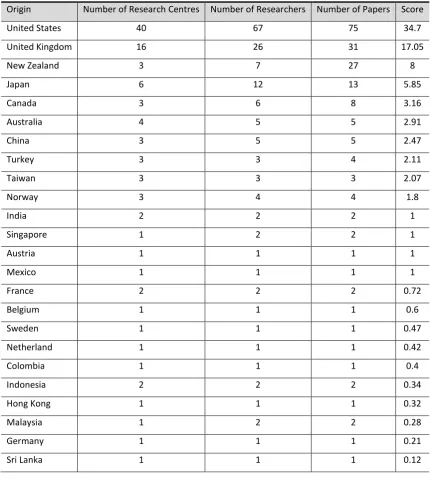
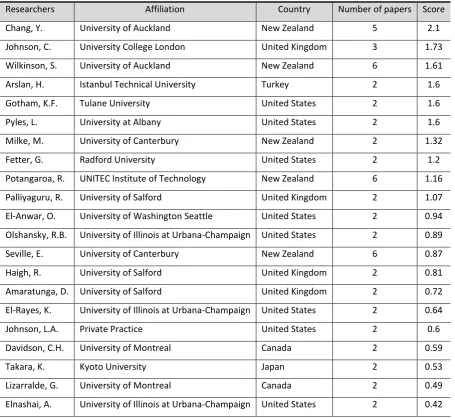
Each identified paper was given one score shared by all of its authors. For instance, in one of the target papers (Xiao et al., 2012), Xiao and Xie from China published one paper in collaboration with Zhang from Germany, and the score for each individual author is 0.47, 0.32, and 0.21 respectively, with a score of 0.79 awarded to China. Accordingly, Table 2, Table 3, Table 4 and Table 5 present information on the country of origin, affiliation, active authors and their contribution to the PDR research.
In Table 2, research origins of published PDR papers are listed along with the number of research centres (e.g. a university), researchers, identified papers, and score for each research origin. The US has the largest representation at 34.7%, with 67 researchers from 40 research centres producing 75 papers. While the US has many disasters of its own such as the hurricanes, it has significant advantage in knowledge and technologies to conduct related research than the developing countries. Table 3 shows that the research origin of most papers is in the developed world, such as the US, New Zealand and Japan. The six top ranked countries cover most of the publications (82%). Issues of national economy, construction education, PDR awareness and English proficiency may contribute to developing countries being less active. But many papers by authors from developed countries address PDR issues of developing countries such as China, Sri Lanka, and Indonesia.
Table 2. Research origin of published PDR papers
Origin Number of Research Centres Number of Researchers Number of Papers Score
United States 40 67 75 34.7
United Kingdom 16 26 31 17.05
New Zealand 3 7 27 8
Japan 6 12 13 5.85
Canada 3 6 8 3.16
Australia 4 5 5 2.91
China 3 5 5 2.47
Turkey 3 3 4 2.11
Taiwan 3 3 3 2.07
Norway 3 4 4 1.8
India 2 2 2 1
Singapore 1 2 2 1
Austria 1 1 1 1
Mexico 1 1 1 1
France 2 2 2 0.72
Belgium 1 1 1 0.6
Sweden 1 1 1 0.47
Netherland 1 1 1 0.42
Colombia 1 1 1 0.4
Indonesia 2 2 2 0.34
Hong Kong 1 1 1 0.32
Malaysia 1 2 2 0.28
Germany 1 1 1 0.21
Sri Lanka 1 1 1 0.12
publications. For instance, L.A. Johnson from a private practice in the United States published two papers with a score of 0.6. This gives more evidence to support the fact that PDR is becoming an overall concern of our society.
Table 3. Researchers involved in two or more papers
Researchers Affiliation Country Number of papers Score Chang, Y. University of Auckland New Zealand 5 2.1 Johnson, C. University College London United Kingdom 3 1.73 Wilkinson, S. University of Auckland New Zealand 6 1.61 Arslan, H. Istanbul Technical University Turkey 2 1.6 Gotham, K.F. Tulane University United States 2 1.6 Pyles, L. University at Albany United States 2 1.6 Milke, M. University of Canterbury New Zealand 2 1.32 Fetter, G. Radford University United States 2 1.2 Potangaroa, R. UNITEC Institute of Technology New Zealand 6 1.16 Palliyaguru, R. University of Salford United Kingdom 2 1.07 El-Anwar, O. University of Washington Seattle United States 2 0.94 Olshansky, R.B. University of Illinois at Urbana-Champaign United States 2 0.89 Seville, E. University of Canterbury New Zealand 6 0.87 Haigh, R. University of Salford United Kingdom 2 0.81 Amaratunga, D. University of Salford United Kingdom 2 0.72 El-Rayes, K. University of Illinois at Urbana-Champaign United States 2 0.64 Johnson, L.A. Private Practice United States 2 0.6 Davidson, C.H. University of Montreal Canada 2 0.59
Takara, K. Kyoto University Japan 2 0.53
Lizarralde, G. University of Montreal Canada 2 0.49 Elnashai, A. University of Illinois at Urbana-Champaign United States 2 0.42
Table 4. Research centres with highest scores
Research Centre Country Number of Researchers Number of Papers Score
University of Auckland New Zealand 3 7 4.18
University of Salford United Kingdom 4 3 3
University of Canterbury New Zealand 3 7 2.66
Virginia Tech United States 4 4 2.4
Tulane University United States 2 2 2
University of Illinois at Urbana-Champaign United States 3 6 1.95
Istanbul Technical University Turkey 1 2 1.6
Oxford Brookes University United Kingdom 2 2 1.6
Texas A and M University United States 4 4 1.41
United Nations Centre for Regional
Development Japan 2 2 1.4
Kyoto University Japan 3 4 1.34
Radford University United States 1 2 1.2
University of Montreal Canada 3 5 1.16
UNITEC Institute of Technology New Zealand 1 6 1.16
University of New Orleans United States 2 2 1.08
Keio University Japan 2 2 1.02
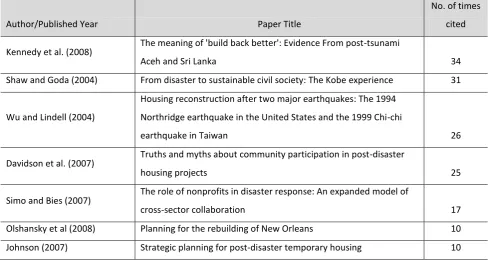
When referring to any factual material which is not original, citation of references from the primary source is often recommended. Besides, research findings can be well supported by suitable references (Ke et al., 2009). As a result, it’s important to analyse the citation of selected papers to further appraise contributions of a specific author and his/her publications. Most frequently cited papers are listed in Table 5. With a sound interpretation of the vital notion of “Build Back Better” in PDR, the paper of Kennedy et al (2008) has been cited for 34 times which brought it to the first place. The research team led by R.B. Olshansky in the US produced two of the most frequently cited papers (Olshansky et al., 2008, Olshansky et al., 2006). Another research team lead by the most active author Y. Chang also made a significant contribution and one of their papers was included in the list (Chang et al., 2010b).
Table 5. Most frequently cited papers
Author/Published Year Paper Title
No. of times cited
Kennedy et al. (2008) The meaning of 'build back better': Evidence From post-tsunami
Aceh and Sri Lanka 34
Shaw and Goda (2004) From disaster to sustainable civil society: The Kobe experience 31
Wu and Lindell (2004)
Housing reconstruction after two major earthquakes: The 1994 Northridge earthquake in the United States and the 1999 Chi-chi
earthquake in Taiwan 26
Davidson et al. (2007) Truths and myths about community participation in post-disaster
housing projects 25
Simo and Bies (2007) The role of nonprofits in disaster response: An expanded model of
cross-sector collaboration 17
Olshansky et al (2006) Rebuilding communities following disaster: Lessons from Kobe and
Los Angeles 9
Alexander et al. (2006)
Sustainable livelihood considerations for disaster risk management: Implications for implementation of the Government of Indonesia
tsunami recovery plan 9
Johnson et al (2006) A systems view of temporary housing projects in post-disaster
reconstruction 8
Hayles (2010) An examination of decision making in post disaster housing
reconstruction 7
Ganapati and Ganapati (2009) Enabling participatory planning after disasters 7 Olsen et al (2005) Rebuilding after the Tsunami: Getting it right 7 Chang et al (2010) Resourcing for a resilient post-disaster reconstruction environment 6
Platt et al (2002) Rebuilding the North Carolina coast after Hurricane Fran: Did public
regulations matter? 6
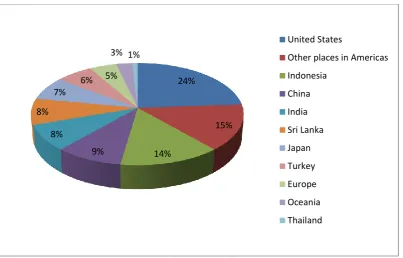
Figure 4. Distribution of Regional Concerns of the Target Papers
Research Intentions and Results
Another aspect worthy of consideration is the research intent, processes and results reported in target papers. Compared to many traditional topics in building and construction research, PDR has a relatively short history and smaller body of knowledge. It is therefore understandable that most of the target papers (82 out of 88, or 93.2%) reported research aimed at identifying issues, understanding the implications, and evaluating the impacts, rather than on theoretical breakthroughs. While earlier efforts concentrated on reporting disasters and subsequent PDR practices (Bradshaw, 2002, Platt et al., 2002), from the middle of 2000’s more were directed towards the identification of current problems and future solutions through a range of methods such as case study (Johnson et al., 2006, Shaw, 2006, Spaling and Vroom, 2007), questionnaire survey (Zhang and Peacock, 2010, Chang, 2012, Mills et al., 2011), in-depth interview (Daly and Brassard, 2011), and comparative study (Koshiyama, 2011, Kitzbichler, 2011). Mitchell et al. (2012) studied post disaster housing issues after the three Hurricanes (namely Andrew, Katrina and Ike) in the US. They conducted a review of scholarly empirical research, congressional investigations and testimonies and studied major laws and regulations passed after the disasters, to identify problems in the recovery process and make recommendations for future practice. As researchers gain better understanding and establish principles of PDR, they venture into more exploratory quantitative research and have produced some theoretical models (Haigh and Sutton, 2012, Gotham and Campanella, 2011) and decision making frameworks (Pyles and Harding, 2012). For example, Xiao et al. (2012) first established the relationship between building waste and structure type following an earthquake through a comprehensive analysis of building damage in different structures and characteristics of building waste from each structure, developed an estimation formula to appraisal building waste generated based on previous analysis, and proposed ways of dealing with the waste.
24%
15%
14% 9%
8% 8%
7%
6% 5% 3% 1%
United States
Other places in Americas Indonesia
Research Themes in PDR
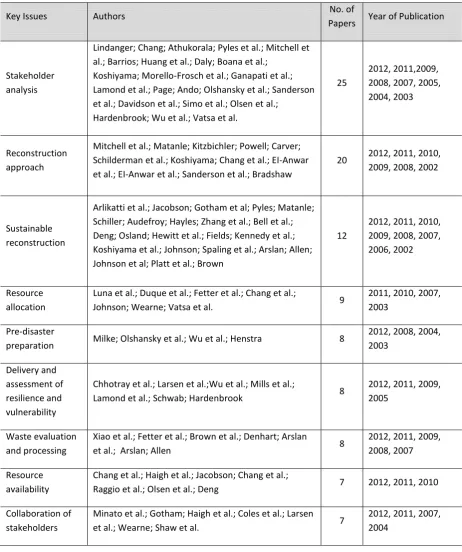
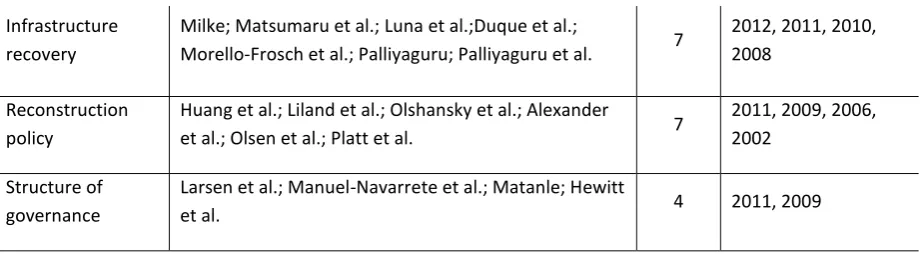
Contents of the 88 target papers were analysed following the initial inspection of keywords and abstracts. Key issues addressed in each paper were extracted as shown in Table 6.
Table 6. Key issues addressed in target papers
Key Issues Authors No. of
Papers Year of Publication
Stakeholder analysis
Lindanger; Chang; Athukorala; Pyles et al.; Mitchell et al.; Barrios; Huang et al.; Daly; Boana et al.;
Koshiyama; Morello-Frosch et al.; Ganapati et al.; Lamond et al.; Page; Ando; Olshansky et al.; Sanderson et al.; Davidson et al.; Simo et al.; Olsen et al.;
Hardenbrook; Wu et al.; Vatsa et al.
25
2012, 2011,2009, 2008, 2007, 2005, 2004, 2003
Reconstruction approach
Mitchell et al.; Matanle; Kitzbichler; Powell; Carver; Schilderman et al.; Koshiyama; Chang et al.; EI-Anwar et al.; EI-Anwar et al.; Sanderson et al.; Bradshaw
20 2012, 2011, 2010, 2009, 2008, 2002
Sustainable reconstruction
Arlikatti et al.; Jacobson; Gotham et al; Pyles; Matanle; Schiller; Audefroy; Hayles; Zhang et al.; Bell et al.; Deng; Osland; Hewitt et al.; Fields; Kennedy et al.; Koshiyama et al.; Johnson; Spaling et al.; Arslan; Allen; Johnson et al; Platt et al.; Brown
12
2012, 2011, 2010, 2009, 2008, 2007, 2006, 2002
Resource allocation
Luna et al.; Duque et al.; Fetter et al.; Chang et al.;
Johnson; Wearne; Vatsa et al. 9
2011, 2010, 2007, 2003
Pre-disaster
preparation Milke; Olshansky et al.; Wu et al.; Henstra 8
2012, 2008, 2004, 2003
Delivery and assessment of resilience and vulnerability
Chhotray et al.; Larsen et al.;Wu et al.; Mills et al.;
Lamond et al.; Schwab; Hardenbrook 8
2012, 2011, 2009, 2005
Waste evaluation and processing
Xiao et al.; Fetter et al.; Brown et al.; Denhart; Arslan
et al.; Arslan; Allen 8
2012, 2011, 2009, 2008, 2007 Resource
availability
Chang et al.; Haigh et al.; Jacobson; Chang et al.;
Raggio et al.; Olsen et al.; Deng 7 2012, 2011, 2010 Collaboration of
stakeholders
Minato et al.; Gotham; Haigh et al.; Coles et al.; Larsen et al.; Wearne; Shaw et al. 7
Infrastructure recovery
Milke; Matsumaru et al.; Luna et al.;Duque et al.;
Morello-Frosch et al.; Palliyaguru; Palliyaguru et al. 7
2012, 2011, 2010, 2008
Reconstruction policy
Huang et al.; Liland et al.; Olshansky et al.; Alexander
et al.; Olsen et al.; Platt et al. 7
2011, 2009, 2006, 2002
Structure of governance
Larsen et al.; Manuel-Navarrete et al.; Matanle; Hewitt
et al. 4 2011, 2009
Using these key issues as a thread, the authors of this paper combined pattern identification in abstracts with keywords matching and double-checked detailed contents where necessary. They categorised the key issues covered into eight most common research themes in PDR. To name these research themes, they referred to established research fields as well as directly using original descriptions in the target papers. The eight themes are: (1) waste management; (2) stakeholder analysis; (3) resourcing; (4) infrastructure issue; (5) resilience and vulnerability; (6) reconstruction approach; (7) sustainable reconstruction; and (8) governance issue.
To ensure subjectivity and reliability during the identification and classification of research themes from previous papers, the authors analysed each paper with the same criteria of assessment. They also checked with several researchers and industry contacts in this field to reach an agreement when encountering discrepancy in the interpretation of topics or terminologies. This has avoided and eliminated subjective views. Besides, this study is aimed at identifying and comparing common grounds of the target papers rather than the differences. Hence the approach adopted is appropriate and sufficient. As reflected by the target publications, the major PDR research themes between 2002 and 2012 are presented in Table 7.
Table 7. Major Research Themes of PDR Papers
Themes 2002 2003 2004 2005 2006 2007 2008 2009 2010 2011 2012 Total Percent-age waste
management 0 0 0 0 0 2 1 1 0 2 2 8 6.56%
stakeholder
analysis 0 1 2 2 0 5 2 4 0 7 9 32 26.23%
resourcing 0 1 0 0 0 2 0 0 3 7 3 16 13.11%
infrastructure
issue 0 0 0 0 0 0 1 0 1 3 2 7 5.74%
resilience and
vulnerability 0 0 0 1 0 0 0 2 0 3 2 8 6.56%
reconstruction
sustainable
reconstruction 2 0 0 0 1 3 0 1 1 3 1 12 9.84%
governance
issue 1 0 0 1 3 0 0 2 0 4 0 11 9.01%
More specifically, each theme has the following sub topics of PDR research:
1) Waste management: debris disposal, evaluation of waste accompanying reconstruction, impact of waste, ways of dealing with the waste, and waste management;
2) Stakeholder analysis: identification of stakeholders, need/perception/characteristic of each stakeholder, participation and collaboration of all stakeholders;
3) Resourcing: resource planning, resource allocation, resourcing challenges, and critical factors affecting resource availability;
4) Infrastructure issue: importance of infrastructure reconstruction, quality of infrastructure, and difficulties of recovery of infrastructure;
5) Resilience and vulnerability: assessment of resilience and vulnerability, how resilience is delivered, resilience generation, levels of resilience, and successful factors of resilience;
6) Reconstruction approach: pre-disaster preparation, factors affecting reconstruction, decision making, types of reconstruction approaches, selection of design/material/location, and integration of approaches;
7) Sustainable reconstruction: definition and characteristic of sustainability, assessment of sustainability, strategy for sustainability, sustainable goal, and key challenges towards sustainable reconstruction; 8) Governance issue: reconstruction policy, governance structure, governance levels, long-term
management strategy, and integrated management.
Several themes above relate to more traditional problems in the construction industry, such as waste management, stakeholder analysis, resourcing and governance. As existing research has already covered these areas extensively, it will be possible to respond to these issues within the PDR context by adapting worked theories and examples. Other themes reflect new and emerging challenges in construction, for instance issues of resilience, vulnerability and sustainable deconstruction and reconstruction. These new areas of research interests warrant further investigation. Authors of many target papers point out the limitations of their works, future research directions and on-going efforts to fill the research gaps. A close examination of these discussions have allowed the authors of this paper an opportunity to synthesize the recommendations into new and potential research trends for PDR, as below.
constructability issues with resource supply and demands. How to meet the demands of necessary resources while minimizing impacts on the already volatile environment, society and economy will be keenly discussed. Alternative designs with flexible and interchangeable materials, proactive processing of waste from deconstruction, and coordinated recycling and reuse, can also be new research topics that respond to the challenges of construction waste reduction and resourcing problems during PDR.
Integrated development – in the context of PDR, past research tend to separate the issues of buildings and infrastructure. One of the painful lessons learned is that the disaster relief and reconstruction efforts can be severely hampered by poor conditions of local infrastructure. Desirable PDR works should not only help victims of the disasters piece their lives together, but also provide better living standard, encourage regional development, alleviate poverty and improve communication. This is particularly important for developing countries. Integrated development can be supported by (a) Master planning of communities, (b) Transport oriented development (TOD), (c) Stakeholder engagement through partnerships, and (d) Whole development and assessment cycles. Building and infrastructure development issues should be tackled in a connected way, with considerations of urban planning, energy supply, economic development, education, community building and social welfare aspects. New development should also have in mind future upgrades, renewal and deconstruction. Research that will entice such holistic solutions may flourish in the near future.
Sustainability – sustainability focus after disasters? The answer is a firm yes because sustainable development principles can contribute to resilience and robustness of the built environment (Guarnacci, 2012, Mayunga, 2009). Sustainability considerations should be borne in mind not only in new project deliverables but also during the processes of reconstruction planning. One of the vital principles is to involve all stakeholders, introduce proactive goals and strategies, and start the evaluation at the early stages of PDR rather than “revisiting” the issues after life returns to normal. It might be necessary to establish suitable assessment systems for both the reconstruction process and reconstructed projects respectively, as most current rating tools do not have specific models to deal with PDR issues. Meanwhile, the authors see a research potential to continually improve existing assessment systems so that they can make differentiations between projects, and between normal construction works and the specific efforts of PDR.
Conclusions
Research on Post Disaster Reconstruction (PDR) is gaining momentum rapidly around the world following a series of devastating disasters over the last decade. In the new digital age, extensive media reporting provide vivid and explicit coverage that not only fuel public interests but also raise our societal expectations. Researchers around the world have not ignored such challenges and opportunity. They produced a significant number of publications to report their works.
The authors of this paper conducted a three-round literature review of journal papers published between 2002 and 2012 in the field of Post Disaster Reconstruction research. Using the Scopus search engine, they adopted a combination of title, abstract and keyword searches and visual confirmations to identify 88 papers as target publications to study past trends, identify patterns and predict future directions from a construction research perspective. Content analysis was supported by simple statistics to present a picture on the importance of Post Disaster Reconstruction and distribution of research activities to date.
While most of the disaster prone countries are represented, research efforts in developing countries in Asia and South America are lagging behind the developed world. Africa is hardly covered. These regions need to catch up and secure the necessary expertise as well as tools to better prepare for natural disasters. With concentration of research capacity and technologies, the US leads the charge of PDR research understandable. University of Auckland in New Zealand, University of Salford in the UK and Virginia Tech in the US were the most active contributors to PDR research. There is an imbalance between the regional concerns and research progress in contrast to the distribution of active authors and institutions. This presents the potential for future cooperations between developing and developed countries.
Research in the last decade exhibited a shift of focus from reporting issues, through identifying factors and patterns, to theory and model building based on theoretical analysis and quantitative calculations. According to the target publications, researchers followed eight major research themes including (1) waste management; (2) stakeholder analysis; (3) resourcing; (4) infrastructure issue; (5) resilience and vulnerability; (6) reconstruction approach; (7) sustainable reconstruction; and (8) governance issue. Future research efforts are likely to be on Resourcing, Integrated Development, Sustainable Construction and Embodied Resilience. To this end, it will either require existing tools be adapted or new tools developed to allow the specific issues and elements of post disaster reconstruction efforts to be effectively managed and evaluated.
Acknowledgments
The authors wish to acknowledge the China Scholarship Council for their funding support and the Queensland University of Technology, Australia for providing necessary research facilities and supervision.