R E S E A R C H
Open Access
Development of a framework and coding
system for modifications and adaptations of
evidence-based interventions
Shannon Wiltsey Stirman
1,2,3*, Christopher J Miller
2,5, Katherine Toder
4and Amber Calloway
6Abstract
Background:Evidence-based interventions are frequently modified or adapted during the implementation process. Changes may be made to protocols to meet the needs of the target population or address differences between the context in which the intervention was originally designed and the one into which it is implemented [Addict Behav2011,36(6):630–635]. However, whether modification compromises or enhances the desired benefits of the intervention is not well understood. A challenge to understanding the impact of specific types of modifications is a lack of attention to characterizing the different types of changes that may occur. A system for classifying the types of modifications that are made when interventions and programs are implemented can facilitate efforts to understand the nature of modifications that are made in particular contexts as well as the impact of these modifications on outcomes of interest.
Methods:We developed a system for classifying modifications made to interventions and programs across a variety of fields and settings. We then coded 258 modifications identified in 32 published articles that described interventions implemented in routine care or community settings.
Results:We identified modifications made to the content of interventions, as well as to the context in which interventions are delivered. We identified 12 different types of content modifications, and our coding scheme also included ratings for the level at which these modifications were made (ranging from the individual patient level up to a hospital network or community). We identified five types of contextual modifications (changes to the format, setting, or patient population that do not in and of themselves alter the actual content of the intervention). We also developed codes to indicate who made the modifications and identified a smaller subset of modifications made to the ways that training or evaluations occur when evidence-based interventions are implemented. Rater agreement analyses indicated that the coding scheme can be used to reliably classify modifications described in research articles without overly burdensome training.
Conclusions:This coding system can complement research on fidelity and may advance research with the goal of understanding the impact of modifications made when evidence-based interventions are implemented. Such findings can further inform efforts to implement such interventions while preserving desired levels of program or intervention effectiveness.
Keywords:Implementation, Modification, Adaptation, Sustainability
* Correspondence:[email protected]
1Women’s Health Sciences Division, National Center for PTSD, Boston, MA,
USA
2VA Boston Healthcare System, Boston, MA, USA
Full list of author information is available at the end of the article
Background
Evidence-based programs and interventions are fre-quently modified during the implementation process to address differences between the context in which the intervention was originally designed and tested, and the one into which it is ultimately implemented [1]. Descrip-tions of modificaDescrip-tions in the research literature range broadly from slight changes in terminology or delivery in different languages, to removal of core components or integration with other interventions. Modifications can include adaptations, which are planned or purpose-ful changes to the design or delivery of an intervention, but they can also include unintentional deviations from the interventions as originally designed. That is, some modifications occur with the intention to retain fidelity to the fundamental elements or spirit of the interven-tion, whereas others may be unplanned changes made in reaction to a specific circumstance. Some may be rela-tively minor, while others might represent a significant change. Such variation in the nature of modifications can have very different implications for outcomes of interest. While some modifications might facilitate im-plementation and sustainability by improving the fit be-tween the intervention and the target population or the context into which it is introduced, modifications may also erode treatment integrity. However, little research has been conducted to determine whether modifications of different natures compromise or enhance the desired benefits of interventions. Assessing fidelity, which prises adherence to the intervention components, com-petence or skill with which the intervention is delivered, and differentiation from other treatments [2], by itself may fail to capture certain types of modifications (e.g., minor changes to terminology or language). While the recommended considerations for fidelity include unique and essential elements, necessary but not unique, ac-ceptable but not necessary, and proscribed elements [3], most fidelity instruments do not contain an exhaustive listing of acceptable and proscribed behaviors. Thus, fidelity monitoring alone will not facilitate an under-standing of whether different types of modifications are detrimental, non-detrimental or enhancements [4,5]. Without a better understanding of the nature and im-pact of modification, and the levels of fidelity necessary to promote desired outcomes, it is difficult to determine the best course of action with respect to the implemen-tation of complex interventions in different contexts. This manuscript presents a comprehensive framework and model for classifying a broad range of modifications that may be made to evidence-based interventions. Such a framework, by quantifying the specific types and levels of modifications, can allow for more precise determin-ation of the effects of such modificdetermin-ations on clinical or implementation outcomes of interest.
While the case has been made both for strict fidelity to interventions and for modifying interventions as ne-cessary [4,6-10], few studies have examined the impact of modifications to treatments on health-related behav-iors or outcomes. Among those studies, results have not been consistent. Levitt and colleagues compared out-comes of an intervention for post-traumatic stress dis-order (PTSD) that included the option to use certain prescribed modifications, such as repeating or skipping modules, with clinical outcomes from a randomized controlled trial [11]. In this study, levels of fidelity to core intervention components remained high when the intervention was delivered with modifications, and PTSD symptom outcomes were comparable to those in a controlled clinical trial [11]. Galovski and colleagues also found positive outcomes when a highly specified set of adaptations were used in a different PTSD treatment [12]. Other studies have demonstrated similar or im-proved outcomes after modifications were made to fit the needs of the local audience and expand the target population beyond the original intervention. For ex-ample, an enhanced outcome was demonstrated after modifying a brief HIV risk-reduction video intervention to match presenter and participant ethnicity and sex [13]; effectiveness was also retained after modifying an HIV risk-reduction intervention to meet the needs of five different communities [14]. However, in other stud-ies, modifications to enhance local acceptance appeared to compromise effectiveness. For example, Stanton and colleagues modified a sexual risk reduction intervention that had originally been designed for urban populations to address the preferences and needs of a more rural population, but found that the modified intervention was less effective than the original, unmodified version [15]. Similarly, in another study, cultural modifications that reduced dosage or eliminated core components of the Strengthening Families Program increased retention but reduced positive outcomes [16].
[24-26] have also made recommendations regarding specific processes for adapting mental health interventions to address individual or population-level needs while pre-serving fidelity. Some work has been done to characterize and examine the impact of modifications made at the indi-vidual and population level. For example, Castro, Barrera and Martinez presented a program adaptation framework that described two basic forms of cultural adaptation: the modification of program content and modification of pro-gram delivery, and made distinctions between tailored and individualized interventions [27]. A description of person-centered interventions similarly differentiates between tailored, personalized, targeted and individualized inter-ventions, all of which may actually lie on a continuum in terms of their complexity and comprehensiveness [27].
While these existing recommendations and models for adaptation provide critical guidance regarding the process of adaptation, particularly to improve the cul-tural relevance and individual-level ‘fit’ of interventions, adaptations may also occur to address provider needs or constraints in the intervention or program setting or healthcare system. Relatively little research has been conducted to empirically classify the nature of the full range of modifications made to interventions in routine care settings. Recognizing the benefits to identifying common types of modifications to evidence-based inter-ventions, Hill and colleagues identified the types of mod-ifications made for a single evidence-based prevention program in a statewide implementation [20]. Although they suggested that their study was a starting point in the development of a set of modification categories that generalize across interventions, the modifications that they identified were highly specific to the intervention that they examined. A more general and developed tax-onomy can facilitate efforts to understand the nature of modifications that are made, whether by design or hap-penstance, as well as the impact of different types of modi-fications on implementation and health-related outcomes of interest. As a next step toward this understanding, it is necessary to identify the types of modifications that may occur when implementing interventions under a broad set of circumstances and in a variety of settings.
The purpose of this study was to develop a coding scheme to characterize modifications made to evidence-based interventions when they are implemented in con-texts or with populations that differ from that in which they were originally developed or tested. Such a system can facilitate more systematic study of the types of mod-ifications that are most commonly made across different contexts, populations and interventions. Additionally, it can provide a way to study the impact of different types of modifications on outcomes of interest. Hill and colleagues described a theory that a few types of modi-fications are likely to comprise the majority of all
modifications that occur in practice [20]. Identifying what those modifications are, and what their impacts are for different interventions, can assist intervention devel-opers and those who implement the interventions in de-termining and facilitating the range of modifications that are acceptable—and in preventing those that are not. We therefore sought to identify examples of a variety of modifications that practitioners, treatment developers, and other stakeholders made to a diverse set of interven-tions and programs. We intended this framework to apply in particular to three types of programs and interventions outlined by Scheirer [28]: those implemented by individual providers; programs requiring coordination among mul-tiple staff; and new procedures aimed at targeting individ-ual behaviors or behavioral health conditions.
Method
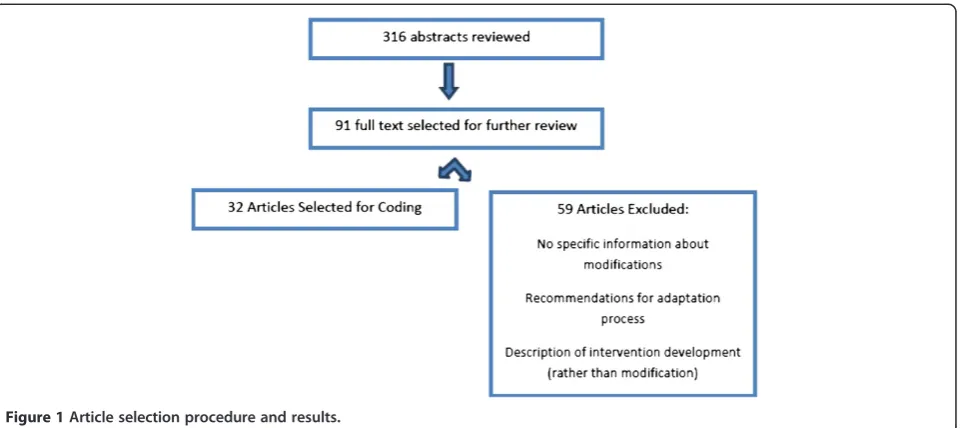
In developing the coding system, we searched the litera-ture for articles published or in press before June, 2012, that assessed or described modifications to interventions implemented in routine service settings. We searched the following databases: Medline, ISI, PsycInfo, Aca-demic Search Premier, Health Source, ERIC, Pubmed and Google Scholar, using the terms ‘modif’ or ‘adapt’ and ‘evidence based treatment’or ‘evidence-based inter-vention.’ We also employed a snowballing strategy, in which we searched the reference sections of articles that we identified as well as theoretical papers on implemen-tation that discussed modification and adapimplemen-tation. Two authors (SWS, AC) reviewed abstracts and full text arti-cles when necessary to determine their eligibility for this project and discussed one difference of opinion regard-ing inclusion with the rest of the study team. We in-cluded articles that provided sufficient detail about one or more modifications to facilitate coding. Modifications could be either adaptations (intentional, planned changes that typically included an effort to preserve fidelity) or changes that were made without premeditation during the delivery of the intervention. Articles were excluded if they assessed fidelity but did not describe modifications; if the interventions were developed, as opposed to being modi-fied, for the purpose of the study or implementation pro-ject; or if they only provided recommendations for adaptation of an intervention without describing at least one specific modification that was made during the course of a research or implementation effort (Figure 1).
was rooted in grounded theory [29,30] to code the data from these articles. Using an iterative process, the study team examined the subset of identified segments that de-scribed modifications to identify emergent themes or cat-egories. We then applied these themes to additional segments, allowing additional categories to emerge until theoretical saturation was achieved and a comprehensive coding scheme was developed. We specified characteris-tics of each category of modifications and ensured that the categories were mutually exclusive and exhaustive by com-bining or revising redundant codes. We also provided a draft of the framework and codebook to seven implemen-tation researchers who were interested in the subject of modification and requested feedback. No additional codes or alternative classification structures were suggested, al-though some suggested combining some similar con-structs into a single code and identified aspects of the codebook that could be clarified. After this feedback was incorporated, two team members (SWS, KT) then re-examined the article data, such that all segments identified in each article were coded with the finalized codebook. The two raters overlapped on 20% of the identified seg-ments, and we computed Cohen’s kappa coefficients [31] to determine interrater reliability for each rating category.
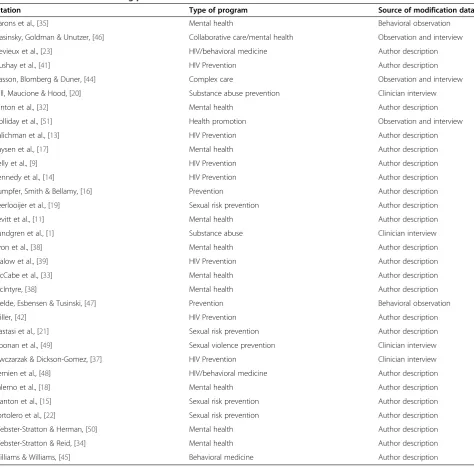
Results
A total of 32 articles were identified [9,11,13,15-18,20,32-51], which described 258 unique modifications (see Table 1). The types of intervention included preventive and health promotion interventions (n = 15), mental or behavioral health (n = 13), behavioral medicine (n = 3), and a multidi-mensional complex care coordination intervention (n = 1). Settings in which the interventions were delivered in-cluded hospitals and medical clinics, mental health clinics, substance abuse treatment programs, human service
organizations, housing shelters, community organizations, employment settings, bars, and schools. Twenty-three arti-cles provided author descriptions of modifications, four identified modifications through interviews with providers, two utilized observation or fidelity rating, and three based findings on a combination of observation and interviews.
Classification of modifications
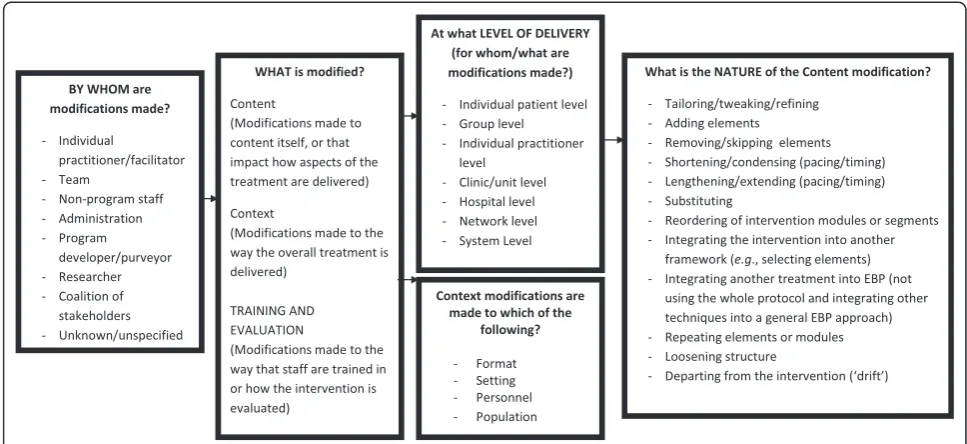
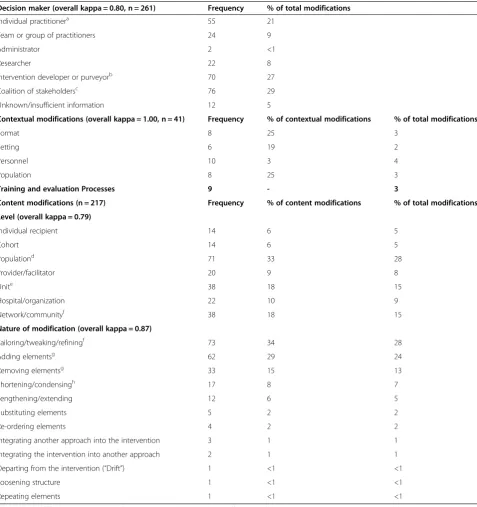
Our coding process resulted in the identification of modifications to the context of program or intervention delivery, modifications to the intervention or program content itself, and modifications made during an imple-mentation effort to training or evaluation processes. Fur-thermore, we included a code specifying who made the decision to make each modification. Figure 2 represents the coding system that emerged from this process, which is described in greater detail below. A comprehensive coding manual that includes decision rules and instruc-tions regarding how to code each level is available by re-quest from the first author. Contextual modifications include format, setting, channel of delivery and inter-vention recipients, and are about ‘setting the stage’ for an intervention to be delivered. Content modifications focus on the actual delivery of the intervention content. Training and evaluation modifications represent changes made ‘behind the scenes’ during an implementation ef-fort. Although modifications to context and training/ evaluation codes were not always accompanied by sub-stantial changes to the intervention content, we included them because it is possible that such changes could have an impact on fidelity, clinical outcomes, or the success of an implementation effort. Table 2 includes the fre-quency with which each modification occurred, along with rater agreement statistics.
By whom was the decision to modify made?
This code indicates the individual or group of individ-uals who made the decision regarding whether or how to modify the intervention. Cohen’s kappa for this code was 0.80, indicating substantial agreement.
1. Provider, practitioner, or facilitator: The individual who delivers the intervention made the modification. 2. Team/multiple providers: A group of providers
modified the treatment (e.g., either an intervention that requires multiple providers is modified by those providers, or a unit of providers decide together to deliver a program or intervention in a different way).
3. Administrator or supervisor: The individual responsible for oversight of an individual provider, team, unit, organization or system decided how to modify the intervention or program.
4. Researcher: A researcher determined how to modify a program or intervention for the purposes of research (e.g., to study the impact of a particular adaptation or set of adaptations).
5. Purveyor or intervention developer: The individual who developed the intervention or an (often external) individual with expertise in the
intervention who was tasked with supporting the implementation determined how to adapt or modify
Table 1 Articles included in coding procedure
Citation Type of program Source of modification data
Aarons et al., [35] Mental health Behavioral observation
Blasinsky, Goldman & Unutzer, [46] Collaborative care/mental health Observation and interview
Devieux et al., [23] HIV/behavioral medicine Author description
Dushay et al., [41] HIV Prevention Author description
Hasson, Blomberg & Duner, [44] Complex care Observation and interview
Hill, Maucione & Hood, [20] Substance abuse prevention Clinician interview
Hinton et al., [32] Mental health Author description
Holliday et al., [51] Health promotion Observation and interview
Kalichman et al., [13] HIV Prevention Author description
Kaysen et al., [17] Mental health Author description
Kelly et al., [9] HIV Prevention Author description
Kennedy et al., [14] HIV Prevention Author description
Kumpfer, Smith & Bellamy, [16] Prevention Author description
Leerlooijer et al., [19] Sexual risk prevention Author description
Levitt et al., [11] Mental health Author description
Lundgren et al., [1] Substance abuse Clinician interview
Lyon et al., [38] Mental health Author description
Malow et al., [39] HIV Prevention Author description
McCabe et al., [33] Mental health Author description
McIntyre, [38] Mental health Author description
Melde, Esbensen & Tusinski, [47] Prevention Behavioral observation
Miller, [42] HIV Prevention Author description
Nastasi et al., [21] Sexual risk prevention Author description
Noonan et al., [49] Sexual violence prevention Clinician interview
Owczarzak & Dickson-Gomez, [37] HIV Prevention Clinician interview
Remien et al., [48] HIV/behavioral medicine Author description
Salerno et al., [18] Mental health Author description
Stanton et al., [15] Sexual risk prevention Author description
Tortolero et al., [22] Sexual risk prevention Author description
Webster-Stratton & Herman, [50] Mental health Author description
Webster-Stratton & Reid, [34] Mental health Author description
the treatment. If the purveyor and researcher are the same individual, the coding decision is made based on whether the modification is for research or implementation purposes.
6. Coalition of Stakeholders: A group of stakeholders actively participated in the decision-making regarding the types of modifications that are made to an intervention. If the purveyor or researchers used focus groups, interviews, or other means of gathering input to guide their decisions regarding modifications, this code was NOT used, unless stakeholders also directly participated in the process of using that information to adapt the intervention.
Contextual modifications
Similar to Castro and colleagues’description of differing forms of delivery [27], contextual modifications were de-fined as changes made to delivery of the same program content, but with modifications to the format or channel, the setting or location in which the overall intervention is delivered, or the personnel who deliver the intervention. We also include in this category the population to which an intervention is delivered. Modifications were only coded as contextual if an intervention was specifically designed for a particular context or population and then applied elsewhere or delivered in a different format than originally designed. Modifications were considered to be contextual if one of the elements described below was changed, whether or not alterations to the content of the intervention were made. When content-level changes were also made, they were coded separately. A total of 41 contextual modifications (16% of the total sample of
modifications) were described in the sample of articles. The subset of segments that was double-coded for reliabil-ity purposes indicated perfect agreement for the presence of contextual modifications.
1. Format: Changes are made to the format or channel of treatment delivery (e.g., a treatment originally designed to be used one-on-one that is now delivered in a group format).
2. Setting: The intervention is being delivered in a different setting or location (e.g., a treatment originally designed to be used in a mental health clinic setting that is now delivered in primary care). 3. Personnel: The intervention is being delivered by
personnel with different characteristics (e.g., a treatment originally designed to be administered by a mental health professional is now delivered by clergy).
4. Population: An intervention that was specifically developed to target a particular population is being delivered to a different population than originally intended (e.g., an intervention developed for patients with Borderline Personality Disorder is now being delivered to individuals with Substance
Dependence).
expanding training from a single day to a three-day work-shop, or making changes to the type of evaluation data or procedures for collecting evaluation data.
Content modifications
Content modifications are changes made to the inter-vention procedures, materials or delivery. They appear
Table 2 Modifications and adaptations made to programs and interventions
Decision maker (overall kappa = 0.80, n = 261) Frequency % of total modifications
Individual practitionera 55 21
Team or group of practitioners 24 9
Administrator 2 <1
Researcher 22 8
Intervention developer or purveyorb 70 27
Coalition of stakeholdersc 76 29
Unknown/insufficient information 12 5
Contextual modifications (overall kappa = 1.00, n = 41) Frequency % of contextual modifications % of total modifications
Format 8 25 3
Setting 6 19 2
Personnel 10 3 4
Population 8 25 3
Training and evaluation Processes 9 - 3
Content modifications (n = 217) Frequency % of content modifications % of total modifications
Level (overall kappa = 0.79)
Individual recipient 14 6 5
Cohort 14 6 5
Populationd 71 33 28
Provider/facilitator 20 9 8
Unite 38 18 15
Hospital/organization 22 10 9
Network/communityf 38 18 15
Nature of modification (overall kappa = 0.87)
Tailoring/tweaking/refiningf 73 34 28
Adding elementsg 62 29 24
Removing elementsg 33 15 13
Shortening/condensingh 17 8 7
Lengthening/extending 12 6 5
Substituting elements 5 2 2
Re-ordering elements 4 2 2
Integrating another approach into the intervention 3 1 1
Integrating the intervention into another approach 2 1 1
Departing from the intervention (“Drift”) 1 <1 <1
Loosening structure 1 <1 <1
Repeating elements 1 <1 <1
Note: Three modifications that were identified in the articles did not contain sufficient detail to be rated.
a
Raw agreement for this category was 100%.
b
Raw agreement for this category was 82%.
c
Raw agreement for this category was 73%.
d
Raw agreement for this category was 87%.
e
Raw agreement for this category was 67%.
f
Raw agreement for this category was 91%.
g
Raw agreement for these categories was 83%.
h
to occur at multiple levels and in differing contexts, ranging from changes made for an individual recipient to changes made uniformly across an entire network, community or system. Therefore, we included a code for both the level at which the modification was made (e.g., for a single patient vs. across the entire clinic), and the nature of the modification itself. A total of 217 content modifications (84% of all identified modifica-tions) were described in the articles that were reviewed. Table 2 summarizes the frequency with which modifica-tion occurred at the following levels. Cohen’s kappa for agreement on levels was 0.79, indicating substantial agreement [52].
Levels at which content modifications occur
1. Individual recipient level: The intervention is modified for a particular recipient (e.g., simplifying language if a patient has cognitive impairment or if language barriers exist; changes to increase cultural relevance for an individual recipient).
2. Cohort level: The intervention is modified for individuals grouped within the intervention setting into a treatment group, a class, or other type of cohort (e.g., a specific psychotherapy group, grade or classroom).
3. Population level: The intervention is modified for application to a particular cultural, ethnic, clinical or social group (e.g., repetition of intervention
components for all patients with cognitive impairments; development of culturally relevant vignettes to be used with all individuals of a particular ethnic identity).
4. Provider/facilitator level: Modifications are made by a clinician/facilitator for all of their participants (e.g.,‘I never set an agenda when I do cognitive therapy’).
5. Unit level: A modification is made by all of the facilitators in a unit (e.g., clinic/department/grade) within a larger organization (e.g.,‘We can only do 60-minute intervention sessions instead of 90-minute sessions in our clinic’).
6. Hospital/Organization level: Modifications are made by an entire organization.
7. Network/Community level: Modifications are applied by an entire network or system of hospitals/ clinics/schools (e.g., a Veterans Affairs VISN; school district) or community.
Types of content modifications
We identified 12 different types of content modifica-tions. Cohen’s kappa for the nature of modifications was 0.87, suggesting that rater agreement for these categories was in the‘almost perfect’range [52]. Regarding reliability
for individual codes, raw agreement was at least 80% for each code that was applied more than 15 times in our dataset; less frequently-applied codes were not subjected to reliability analyses.
1. Tailoring/tweaking/refining: This code was assigned to any minor change to the intervention that leaves all of the major intervention principles and techniques intact while making the intervention more appropriate, applicable or acceptable (e.g., modifying language, creating slightly different versions of handouts or homework assignments, cultural adaptations). 2. Adding elements (intervention modules or
activities): Additional materials or activities are inserted that are consistent with the fundamentals of the intervention (e.g., adding role play exercises to a unit on assertiveness in a substance abuse
prevention intervention).
3. Removing elements (removing/skipping intervention modules or components): Particular elements of the intervention are not included (e.g., leaving out a demonstration on condom use in an HIV prevention intervention for adolescents).
4. Shortening/condensing (pacing/timing): A shorter amount of time than prescribed is used to complete the intervention or intervention sessions (e.g., shorter spacing between sessions, or shortening sessions, offering fewer sessions, or going through particular modules or concepts more quickly without skipping material).
5. Lengthening/extending (pacing/timing): A longer amount of time than prescribed by the manual/ protocol is spent to complete intervention or intervention sessions (e.g., greater spacing between sessions, longer sessions, more sessions, or spending more time on one or more modules/activities or concepts).
6. Substituting elements: A module or activity is replaced with something that is different in substance (e.g., replacing a module on condoms with one on abstinence in an HIV prevention program).
7. Re-ordering elements: Modules/activities or concepts are completed in a different order from what is recommended in the manual/protocol. This code would not be applied if the protocol allows flexibility in the order in which specific modules or interventions occur.
8. Integrating another approach into the intervention: The intervention of interest is used as the starting point, but aspects of different therapeutic
9. Integrating the intervention into another approach: Another intervention is used as the starting point, but elements of the intervention of interest are introduced (e.g., integrating motivational enhancement strategies into a weight loss intervention protocol).
10.Repeating elements: One or more modules, sessions, or activities that are normally prescribed or
conducted once during a protocol are used more than once.
11.Loosening structure: Elements intended to structure intervention sessions do not occur as prescribed in the manual/protocol (e.g., the‘check-in’at the beginning of a group intervention is less formally structured; clinician does not follow an agenda that was established at the beginning of the session). 12.Departing from the intervention (‘drift’): The
intervention is not used in a particular situation or the intervention is stopped, whether this stoppage was for part of a session or a decision to discontinue the intervention altogether (e.g.,‘this client was so upset that I just spent the rest of today’s session letting him talk about it instead of addressing his health behaviors’).
Discussion
This study represents an effort to systematically characterize the types of modifications that are made to interventions when they are implemented in real world settings. On a high level, two of the major categories of coding mapped onto Castro and colleagues’ distinction between modifications of program content, and modifica-tion of the form of delivery (e.g., location of delivery, deliv-ery person, or channel of delivdeliv-ery) [27]. In a sample of studies described in peer-reviewed articles, which repre-sent a variety of interventions and contexts, we found that contextual modifications were occasionally reported, but that content modifications were reported much more frequently. Tailoring the intervention to address language, cultural differences, literacy, or situational constraints was the most commonly identified content modification, followed by the addition or removal of elements and changes to the length or pacing of the intervention.
Other modifications identified in our coding process, such as drift and loosening of structure, occurred rela-tively rarely within the articles that we reviewed. This low frequency in the current sample is not surprising, as such behaviors are unlikely to occur in a planned manner, and may be less likely to be emphasized when describing an evidence-based intervention in a peer-reviewed article. Furthermore, relatively few of the arti-cles that were sampled employed the type of observation or stakeholder interviews through which such behaviors
may be identified. While drift might also be considered a discontinuation of the intervention entirely or a lack of fidelity rather than a modification, it also seems import-ant to capture it in a system designed to classify devia-tions from and modificadevia-tions to a protocol in order to better measure its impact on outcomes of interest. For example, the impact of the option to occasionally or strategically drift on clinician or client satisfaction may be important to explore, in addition to the impact of drift on clinical effectiveness.
In contrast to the findings in Hill and colleagues’study [20], most of the articles that we found in our search process described modifications that were made pro-actively in recognition of key differences between the implementation setting and the original intervention. In another report, we describe findings that emerged when we applied this framework to interview data from a sam-ple of community-based mental health service providers who were trained in an EBP [53]. Several of the lower-frequency modifications identified in the current study were endorsed much more frequently in that study, suggesting that modifications made proactively may dif-fer from those made once implementation is underway. Thus, at this stage of development, we determined that it is important to represent a more exhaustive set of pos-sible modifications in the classification system.
determining whether particular elements can be removed, re-ordered, integrated or substituted without compromis-ing effectiveness.
Despite the breadth of the coding system we developed, interrater agreement for the subset of independently-coded articles was quite high, reaching standards of ‘sub-stantial agreement’and ‘almost perfect’agreement for the level and nature of modifications, respectively [52]. Within our research group, this level of reliability was achieved after a brief series of hour-long weekly coding meetings, suggesting that our coding scheme can be used to reliably classify modifications described in research articles with-out overly burdensome training.
We note several potential limitations to the study and framework. First, our search process was not intended to identify every article that described modifications to evidence-based interventions, particularly if adaptation or modification was not a major topic addressed in the article. Instead, we sought to identify articles describing modifications that occurred across a variety of different interventions and contexts and to achieve theoretical saturation. In the development of the coding system, we did in fact reach a point at which additional modifications were not identified, and the implementation experts who reviewed our coding system also did not identify any new concepts. Thus, it is unlikely that additional articles would have resulted in significant additions or changes to the system.
In our development of this framework, we made a number of decisions regarding codes and levels of cod-ing that should be included. We considered includcod-ing codes for planned vs. unplanned modifications, major vs. minor modifications (or degree of modification), codes for changes to the entire intervention vs. changes to spe-cific components, and codes for reasons for modifica-tions. We wished to minimize the number of levels of coding in order to allow the coding scheme to be used in quantitative analyses. Thus, we did not include the above constructs, or constructs such as dosage or inten-sity, which are frequently included in frameworks and measures for assessing fidelity [56]. Additionally, we in-tend the framework to be used for multiple types of data sources, including observation, interviews and descrip-tions, and we considered how easily some codes might be applied to information derived from each source. Some data sources, such as observations, might not allow coders to discern reasons for modification or make distinctions between planned and unplanned modifica-tions, and thus we limited the framework to character-izations of modifications themselves rather than how or why they were made. However, sometimes, codes in the existing coding scheme implied additional information such as reasons for modifying. For example, the numer-ous findings regarding tailoring interventions for specific
populations indicate that adaptations to address differ-ences in culture, language or literacy were common. Aarons and colleagues offer a distinction of consumer-driven, provider-consumer-driven, and organization-driven adapta-tions that might be useful for researchers who wish to include additional information regarding how or why particular changes were made [35]. While major and minor modifications may be easier to distinguish by con-sulting the intervention’s manual, we also decided against including a code for this distinction. Some inter-ventions have not empirically established which particular processes are critical, and we hope that this framework might ultimately allow an empirical exploration of which modifications should be considered major (e.g., having a significant impact on outcomes of interest) for specific interventions. Furthermore, our effort to develop an ex-haustive set of codes meant that some of the types of modifications, or individuals who made the modifications, appeared at fairly low frequencies in our sample, and thus, their reliability and utility require further study. As it is applied to different interventions or sources of data, additional assessment of reliability and further refinement to the coding system may be warranted.
interviewing can increase the likelihood that sufficient in-formation is obtained to make an appropriate judgment. Despite these measures, interrater reliability may vary across different data sources, although additional work by our research group suggests that reliability remains high when the coding scheme is applied to interview data [53]. We are currently examining reliability when the coding scheme is used for observation using audio recordings of psychotherapy sessions as well, and we recommend that when using this framework, researchers assess reliability.
We believe that the framework that we present can be used flexibly depending on the goals of the research and the type of data collection that occurs. For example, re-searchers may wish only to code exclusively for content or context-level modifications if they are interested in determining the impact of specific types of modifications on health outcomes. Similarly, the code for the decision maker may not be necessary if researchers are studying modifications made by one particular group or evaluating adaptations that were pre-specified by a single decision-maker before implementation began. However, this code might be very informative if the researchers wish to under-stand the impact of the nature and process of modification on outcomes such as stakeholder engagement or fidelity to core program or intervention elements.
This coding system may be used to advance research that is designed with the goal of understanding the impact of changes made to interventions in particular contexts. Ultimately, such an understanding will require simultan-eous use of this coding scheme and treatment outcome as-sessments, in order to help researchers and clinicians determine what specific types of modifications are most useful in increasing the effectiveness of interventions. Such an understanding will allow stakeholders to make more informed decisions about whether and how to mod-ify the interventions when implementing them in contexts that differ from those in which they were originally devel-oped and tested. Additionally, when used in the context of fidelity monitoring, this system can provide more useful information about what actually occurs when lower levels of adherence are identified, as well as the types of modifi-cations that can occur within acceptable levels of fidelity. Baumann and colleagues suggested that there is a range of feasible fidelity, as well as a point of ‘dramatic mutation,’ at which the intervention is no longer recognizable or ef-fective [8]. This system of characterizing modifications may be useful in determining these ranges and boundaries with greater specificity. By understanding the types of mod-ifications that can be made while keeping the intervention out of the range of dramatic mutation, stakeholders may ul-timately find it easier to adapt interventions as needed while attending to an intervention’s most critical compo-nents. Investigations of the impact of particular types of modifications on clinical outcomes can further inform
efforts to implement evidence-based interventions while pre-serving desired levels of effectiveness. Finally, another potential area of investigation using this framework is on the impact of specific modifications on implementation outcomes such as adoption and sustainability. Additional knowledge about these critical issues in implementation science will yield im-portant guidance for those wishing to advance the imple-mentation of evidence-based programs and interventions.
Competing interests
The authors declare that they have no competing interests.
Authors’contributions
SWS conceptualized the study, contributed to the data collection and coding, and was the predominant contributor to this article. CM assisted with data analyses, assessment of reliability, interpretation of results, and contributed to the text of the manuscript. KT and AC assisted with literature searches, codebook development, and coded articles in the study. All authors did critical reading and modification of drafts and approved the final manuscript.
Acknowledgments
The preparation of this article was supported through funding from the National Institute of Mental Health (R00 MH 01800) [Dr. Stirman]. At the time that this study was being conducted, Dr. Stirman was a Fellow at the Implementation Research Institute (IRI), at the George Warren Brown School of Social Work, Washington University in St. Louis, which is funded through an award from the National Institute of Mental Health (R25 MH080916-01A2) and the Department of Veterans Affairs, Health Services Research & Development Service, Quality Enhancement Research Initiative (QUERI). We wish to thank Jennifer Gamarra and Andrea DeVito for their assistance with the preparation of this manuscript. The content is solely the responsibility of the authors and does not necessarily represent the official views of the National Institute of Mental Health, the National Institutes of Health, or the Department of Veterans Affairs.
Author details
1Women’s Health Sciences Division, National Center for PTSD, Boston, MA,
USA.2VA Boston Healthcare System, Boston, MA, USA.3Department of Psychiatry, Boston University, Boston, MA, USA.4Department of Psychiatry, University of Pennsylvania, Philadelphia, PA, USA.5VA Center for Organization, Leadership and Management Research, Boston, MA, USA. 6Department of Psychology, University of Massachusetts Boston, Boston, MA,
USA.
Received: 18 September 2012 Accepted: 29 May 2013 Published: 10 June 2013
References
1. Lundgren L,et al:Modifications of evidence-based practices in community-based addiction treatment organizations: a qualitative research study.Addict Behav2011,36(6):630–635.
2. Schoenwald SK,et al:Toward the effective and efficient measurement of implementation fidelity.Adm Policy Ment Health2011,38(1):32–43. 3. Waltz J,et al:Testing the Integrity of a Psychotherapy Protocol:
Assessment of Adherence and Competence.J Consult Clin Psychol1993,
61(4):620–630.
4. Stirman SW,et al:The sustainability of new programs and interventions: A review of the empirical literature and recommendations for future research.Implementation Sci2012,7:17.
5. Zvoch K:Treatment fidelity in multisite evaluation.Am J Evaluation2009,
30(1):44–61.
6. Dusenbury L,et al:A review of research on fidelity of implementation: implications for drug abuse prevention in school settings.Health Educ Res2003,18(2):237–256.
7. Schoenwald SK GA, Chapman JE, Frazier SL, Sheidow AJ, Southam-Gerow MA:Toward the effective and efficient measurement of implementation fidelity.Administration Policy Mental Health and Mental Health Serv Res2011,
8. Bauman LJ, Stein REK, Ireys HT:Reinventing fidelity: the transfer of social technology among settings.Am J Community Psychol1991,19(4):619–639. 9. Kelly JA,et al:Transfer of research-based HIV prevention interventions to
community service providers: fidelity and adaptation.AIDS Educ Prev
2000,12:87–98.
10. Elliot DSMS:Issues in disseminating and replicating effective prevention programs.Prev Sci2004,5(1):47–53.
11. Levitt JT,et al:The flexible application of a manualized treatment for PTSD symptoms and functional impairment related to the 9/11 World Trade Center attack.Behav Res Ther2007,45(7):1419.
12. Galovski TE,et al:Manualized therapy for PTSD: Flexing the structure of cognitive processing therapy.J Consult Clin Psychol2012,80(6):968–981. 13. Kalichman SC,et al:Culturally tailored HIV-AIDS risk-reduction messages
targeted to African-American urban women:impact on risk sensitization and risk reduction.J Consult Clin Psychol1993,61(2):291–295.
14. Kennedy MG,et al:The effect of tailoring a model HIV prevention program for local adolescent target audiences.AIDS Educ Prev2000,12(3):225–238. 15. Stanton B,et al:The complex business of adapting effective interventions to
new populations: an urban to rural transfer.J Adolesc Health2005,37(163):17–26. 16. Kumpfer KLAR, Smith P, Bellamy N:Cultural sensitivity and adaptation in
family-based prevention interventions.Prev Sci2002,3(3):241–246. 17. Kaysen D,et al:Adaptation of cognitive processing therapy for treatment of torture
victims: Experience in Kurdistan, Iraq.Psychological Trauma2013,52(2):184–192. 18. Salerno A,et al:Wellness self-management: an adaptation of the illness management and recovery program in New York State.Psychiatr Serv
2011,62(5):456–458.
19. Leerlooijer JN,et al:The world starts with me: using intervention mapping for the systematic adaptation and transfer of school based sexuality education from Uganda to Indonesia.TBM2011,1(2):331–340. 20. Hill LG, Maucione K, Hood BK:A focused approach to assessing program
fidelity.Prev Sci2007,8:25–34.
21. Nastasi BK,et al:The participatory intervention model: a framework for conceptualizing and promoting intervention acceptability.School Psychology Quarterly2000,15(2):207–232.
22. Tortolero SR,et al:Using intervention mapping to adapt an effective HIV, sexually transmitted disease, and pregnancy prevention program for high-risk minority youth.Health Promot Pract2005,6(3):286–298. 23. Devieux JG,et al:Cultural adaptation in translational research: field
experiences.J Urban Health2005,82(2 Suppl 3):iii82–iii91.
24. Goldstein NE,et al:Guidelines for adapting manualized interventions for new target populations: a step‐wise approach using anger management as a model.Clin Psychology: Science and Practice2012,19(4):385–401.
25. Lau AS:Making the case for selective and directed cultural adaptations of evidence-based treatments: examples from parent training.Clin Psychology: Science & Practice2006,13(4):295–310.
26. Aarons G,et al:Dynamic adaptation process to implement an evidence-based child maltreatment intervention.Implementation Science2012,7(32). 27. Castro FG, Barrera M Jr, Martinez CR Jr:The cultural adaptation of
prevention interventions: Resolving tensions between fidelity and fit.
Prev Sci2004,5(1):41–45.
28. Scheirer MA:Linking Sustainability Research to Intervention Types.
Am J Public Health2013,103(4):e73–e80.
29. Glaser BG, Strauss AL:The Discovery of Grounded Theory: Strategies for Qualitative Research.Chicago, IL: Aldine Publishing Company; 1967. 30. Strauss A, Corbin J:Basics of qualitative research. Techniques and procedures
for developing grounded theory; 1998.
31. Cohen J:Weighted kappa: Nominal scale agreement provision for scaled disagreement or partial credit.Psychol Bull1968,70(4):213–220. 32. Hinton DEPT, Tran M, Safren SA, Otto MW, Pollack MH:CBT for Vietnamese
refugees with treatment-resistant PTSD and panic attacks: a pilot study.
J Trauma Stress2004,17(5):429–433.
33. McCabe KMYM, Garland AF, Lau AS, Chavez G:The GANA program: a tailoring approach to adapting parent child interaction therapy for Mexican Americans.Education & Treatment of Children2005,28(2):111–129.
34. Webster-Stratton C, Reid M:Adapting the Incredible Years Child Dinosaur Social, Emotionalm and problem Solving Intervention to Address Comorbid Diagnoses.J Child Serv2008,3(3):17–30.
35. Aarons G,et al:Adaptation happens: a qualitative case study of implementation of the incredible years evidence-based parent training program in a residential substance abuse treatment program.
J Child Serv. in press.
36. McIntyre LL:Adapting Webster‐Stratton's incredible years parent training for children with developmental delay: findings from a treatment group only study.J Intellect Disabil Res2008,52(12):1176–1192.
37. Owczarzak J, Dickson-Gomez J:Provider Perspectives on Evidence Based HIV Prevention Interventions: Barriers and Facilitators to Implementation.
AIDS Patient Care STDS2011,25(3):171–179.
38. Lyon AR,et al:Easier Said Than Done: Intervention Sustainability in an Urban After School Program.AdministrationPolicy Mental Health and Mental Health Serv Res2011,38(6):504–517.
39. Malow RM,et al:Increasing access to preventative health care through cultural adaptation of effective HIV prevention interventions: a brief report from the HIV prevention in haitain youths study.ABNF J2004,
132:127–132. November/December.
40. Devieux JG, Malow, Robert M, Rosenberg, Rhonda, Dyer, Janyce G:Context and common ground: cultural adaptation of an intervention for minority HIV Infected individuals.J Cult Divers2004,11(2):49–59.
41. Dushay RA,et al:Lowering HIV risk among ethnic minority drug users: comparing culturally targeted intervention to a standard intervention.
Am J Drug Alcohol Abuse2001,27(3):501–524.
42. Miller RL:Adapting an evidence-based intervention: tales of the hustler project.AIDS Educ Prev2003,15(1):127–138.
43. Nastasi BK,et al:Participatory model of mental health programming: Lessons learned from work in a developing country.School Psychology Review1998,27(2):260–276.
44. Hasson H, Blomberg S, Duner A:Fidelity and moderating factors in complex interventions: a case study of a continuum of care program for frail elderly people in health and social care.Implementation Science2012,7(23). 45. Williams RB, Williams VP:Adaptation and implementation of an evidence
based behavioral medicine program in diverse global settings: the Williams life skills experience.TBM2011,1(2):303–312.
46. Blasinsky M, Goldman HH, Unutzer J:Project IMPACT: A report on barriers and facilitators to sustainability.Administration Policy Mental Health and Mental Health Serv Res2006,33(6):718–729.
47. Melde C, Esbensen F-A, Tusinski K:Addressing Program Fidelity Using Onsite Observations and Program Provider Descriptions of Program Delivery.Eval Rev2006,30(6):714–740.
48. Remien RH,et al:Moving From Theory to Research to Practice: Implementing an Effective Dyadic Intervention to Improve Antiretroviral Adherence for Clinic Patients.Acquiring Immune Definciency Syndrome
2006,43(1):S69–S78.
49. Noonan R,et al:Adoption, Adaptation, and Fidelity of Implementation of Sexual Violence Prevention Programs.Health Promot Pract2009,10(1):59S–70S. 50. Webster-Stratton C, Reid MJ:Adapting The Incredible Years, an evidence-based parenting programme, for families involved in the child welfare system.J Child Serv2010,5(1):25–42.
51. Holliday J,et al:High Fidelity? How should we consider variations in the delivery of school based health promotion interventions?Health Educ J
2009,68(44).
52. Landis JR, Koch GG:The measurement of observer agreement for categorical data.Biometrics1977,33(1):159–174.
53. Stirman SW,et al:Modifications made to cognitive therapy by community mental health providers: Implications for effectiveness and sustainability.Psychiatr Serv2013 (in press).
54. Shediac-Rizkallah MC, Bone LR:Planning for the sustainability of community-based health programs: conceptual frameworks and future directions for research, practice and policy.Health Educ Res1998,13(1):87–108. 55. Scheirer MA, Dearing JW:An agenda for research on the sustainability of
public health programs.Am J Public Health2011,101(11):2059–2067. 56. Bishop DC,et al:Measuring Fidelity and Adaptation: Reliability of a Instrument for
School-Based Prevention Programs.Evaluation & The Health Professions; 2013.
doi:10.1186/1748-5908-8-65