S Y S T E M A T I C R E V I E W
Open Access
Variation in the operationalisation of dose
in implementation of health promotion
interventions: insights and
recommendations from a scoping review
Samantha Rowbotham
1,2*, Kathleen Conte
1,2and Penelope Hawe
1,2Abstract
Background:While‘dose’is broadly understood as the‘amount’of an intervention, there is considerable variation in how this concept is defined. How we conceptualise, and subsequently measure, the dose of interventions has important implications for understanding how interventions produce their effects and are subsequently resourced and scaled up. This paper aims to explore the degree to which dose is currently understood as a distinct and well-defined implementation concept outside of clinical settings.
Methods:We searched four databases (MEDLINE, PsycINFO, EBM Reviews and Global Health) to identify original
research articles published between 2000 and 2015 on health promotion interventions that contained the word ‘dose’or‘dosage’in the title, abstract or keywords. We identified 130 articles meeting inclusion criteria and extracted data on how dose/dosage was defined and operationalised, which we then synthesised to reveal key themes in the use of this concept across health promotion interventions.
Results:Dose was defined in a variety of ways, including in relation to the amount of intervention delivered and/or received, the level of participation in the intervention and, in some instances, the quality of intervention delivery. We also observed some conflation of concepts that are traditionally kept separate (such as fidelity) either as slippage or as part of composite measures (such as‘intervention dose’).
Discussion:Dose is not a well-defined or consistently applied concept in evaluations of health promotion interventions. While current approaches to conceptualisation and measurement of dose are suitable for
interventions in organisational settings, they are less well suited to policies delivered at a population level. Dose often accompanies a traditional monotonic linear view of causality (e.g. dose response) which may or may not fully represent the intervention’s theory of how change is brought about. Finally, we found dose and dosage to be used interchangeably. We recommend a distinction between these terms, with‘dosage’having the advantage of capturing change to amount‘dispensed’over time (in response to effects achieved). Dosage therefore acknowledges the inevitable dynamic and complexity of implementation.
Keywords:Dose, Health promotion, Implementation, Evaluation, Intervention delivery
© The Author(s). 2019Open AccessThis article is distributed under the terms of the Creative Commons Attribution 4.0 International License (http://creativecommons.org/licenses/by/4.0/), which permits unrestricted use, distribution, and reproduction in any medium, provided you give appropriate credit to the original author(s) and the source, provide a link to the Creative Commons license, and indicate if changes were made. The Creative Commons Public Domain Dedication waiver (http://creativecommons.org/publicdomain/zero/1.0/) applies to the data made available in this article, unless otherwise stated.
* Correspondence:[email protected] Submitted to: Implementation Science
1Menzies Centre for Health Policy, School of Public Health, Faculty of
Medicine and Health, Charles Perkins Centre, University of Sydney, Sydney, Australia
2
Introduction
Implementation of effective interventions at scale is
es-sential to improving population health [1]. Health
pro-motion interventions often seek to address multiple risk factors simultaneously and at various levels, including the individual, interpersonal, organisational and/or en-vironmental level. Such interventions are often imple-mented within complex systems, which may respond in
unpredictable ways to the intervention [2]. The need to
understand how such interventions are implemented is pressing, particularly if we are to draw conclusions about their effectiveness and enable implementation of the same interventions in different settings.
Several frameworks have been developed to guide the
evaluation of implementation efforts [3–8]. A key
con-cept in many of these frameworks is dose, broadly
understood to refer to the ‘amount’of intervention
pro-vided. Dose is a particularly important concept, as un-derstanding how much of an intervention is delivered (and to whom) is critical if we are to replicate and scale up interventions, provide appropriate resourcing and have confidence that observed effects (or lack thereof )
can be attributed to the intervention [9]. However,
un-derstanding dose in relation to health promotion inter-ventions is not necessarily straightforward.
When it comes to the practice of medicine, dose is commonly understood to mean the amount of a treat-ment, usually a drug, delivered with the aim of achieving
a particular physiological response [10]. While the
thera-peutic effect of the treatment may vary as a result of other factors (e.g. interactions with other medications, differences in metabolism), the measurement of the dose (i.e. amount) of a drug being delivered is usually straightforward and is typically measured in metric mass
units (e.g. milligrammes). However, outside of medicine, the operationalisation and measurement of dose be-comes more difficult.
How dose is conceptualised differs somewhat across implementation frameworks. For example, Dusenbury
and colleagues [4] define dose as the ‘amount of
pro-gram content received by participants’ (p. 241, italics
added), while Dane and Schneider [3] refer to‘exposure,’
which focuses on thedeliveryof the intervention and
in-cludes ‘(a) the number of sessions implemented; (b) the
length of each session; or (c) the frequency with which
program techniques were implemented’ (p. 45). Steckler
and Linnan [11] distinguish between‘dose delivered’,
de-fined as the ‘number or amount of intended units of
each intervention or each component delivered or
pro-vided,’and ‘dose received,’ which is‘the extent to which
participants actively engage with, interact with, are ceptive to, and/or use materials or recommended
re-sources’(p. 12). In some of these frameworks, dose is a
single element of a larger framework. In others, dose is a composite concept made up of multiple elements. For
example, Wasik and colleagues [12] distinguish between
implementation and intervention dose and further sub-divide the latter into the amount of intervention intended,
offered, and received. Legrand and colleagues [7] provide
an equation to calculate dose that involves measuring de-livery quantity and quality and participation quantity and
quality. Finally, Cheadle and colleagues [13] introduce the
concept of ‘population dose’which is defined as a product
of the reach of an intervention and the strength of the ef-fect (estimated as the efef-fect on each person reached by the
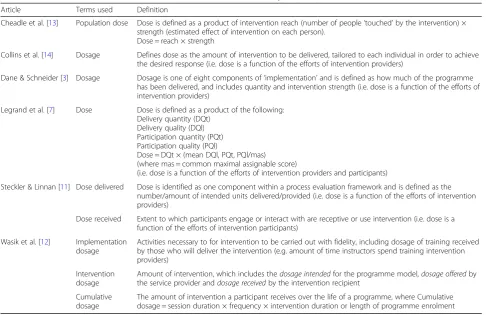
intervention). See Table1for an overview of how dose is
conceptualised across these frameworks.
How we conceptualise and measure the dose of inter-ventions has important implications for understanding how interventions produce their effects, and for whether and how interventions are resourced and scaled up. Pol-icy makers want to know what they need to fund and implement to produce population-level health gains,
while practitioners want to know‘how much’they need
to do to ensure that health promotion programmes
‘work’ at a local level. As indicated in Table1, there is
considerable variation in how dose is conceptualised and measured. These incongruences are important re-gardless of whether one subscribes to the view that the fidelity of the intervention lies in the faithful replication
of particular core programme components [15] or in
more complex understanding of the intervention where effects are seen to derive more from interaction with the dynamic properties of the system into which the
intervention is introduced [16, 17]. It is therefore vital
to think critically about what dose means so that re-searchers and policymakers can gain the evidence they need to inform decisions.
Contributions to the literature
Dose is considered to be the‘amount’of an intervention and is a key concept in many implementation frameworks Until now, there has been little systematic investigation
exploring variation (and contradictions) in how dose has been conceived and measured within health promotion interventions
The review reveals that dose delivered and dose received are conceptually distinct and may achieve health effects through separate pathways, encouraging researchers to measure dose in multiple ways and to use complex and complicated logic models to understand how change
takes place
Aim
The variation in how dose is defined across the
frame-works in Table1prompted us to undertake an
investiga-tion of the nature and extent of differences in how dose has been conceptualised and measured in the implemen-tation of health promotion interventions. We chose to focus our review on health promotion interventions be-cause of the wide variation of intervention types that exist in this space. Health promotion interventions may include, for example, educational, behavioural, environ-mental, regulatory and/or structural actions, such as mass media campaigns; legislation and regulation; changes to infrastructure; and community, school, and workplace health and safety programmes. In doing so, we sought to identify key elements of dose that have been monitored during implementation and understand the degree of variation in the application of dose across interventions.
Methods
A scoping review was used as it allows for rapid map-ping of the key concepts underpinning a research area
[18]. The methodology for this scoping review was based
on the framework outlined by Arksey and O’Malley [19]
and ensuing recommendations made by Levac and col-leagues [20].
Identifying relevant studies
We searched four electronic databases, MEDLINE, Psy-cINFO, Embase and Global Health, to identify articles
pub-lished in English. See Table2for search terms and strategy.
Search terms were piloted and refined prior to use, includ-ing consultation with experts and checkinclud-ing for capture of studies that the authors expected to be included.
Study selection
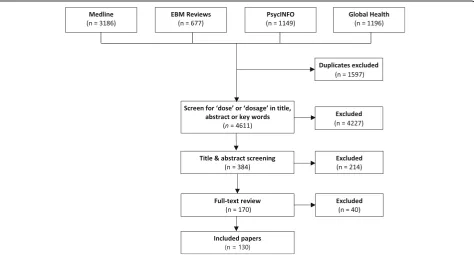
After removing duplicates, a total of 4611 articles were identified. Given the large number of results, we decided to further focus the search by identifying a subset of
arti-cles that contained the term‘dose’or‘dosage’within the
title, abstract or key words, using a structured field search in Endnote.
Table 1Overview of selected theoretical frameworks that include the concept of dose
Article Terms used Definition
Cheadle et al. [13] Population dose Dose is defined as a product of intervention reach (number of people‘touched’by the intervention) × strength (estimated effect of intervention on each person).
Dose = reach × strength
Collins et al. [14] Dosage Defines dose as the amount of intervention to be delivered, tailored to each individual in order to achieve the desired response (i.e. dose is a function of the efforts of intervention providers)
Dane & Schneider [3] Dosage Dosage is one of eight components of‘implementation’and is defined as how much of the programme has been delivered, and includes quantity and intervention strength (i.e. dose is a function of the efforts of intervention providers)
Legrand et al. [7] Dose Dose is defined as a product of the following: Delivery quantity (DQt)
Delivery quality (DQl) Participation quantity (PQt) Participation quality (PQl)
Dose = DQt × (mean DQl, PQt, PQl/mas) (where mas = common maximal assignable score)
(i.e. dose is a function of the efforts of intervention providers and participants)
Steckler & Linnan [11] Dose delivered Dose is identified as one component within a process evaluation framework and is defined as the number/amount of intended units delivered/provided (i.e. dose is a function of the efforts of intervention providers)
Dose received Extent to which participants engage or interact with are receptive or use intervention (i.e. dose is a function of the efforts of intervention participants)
Wasik et al. [12] Implementation dosage
Activities necessary to for intervention to be carried out with fidelity, including dosage of training received by those who will deliver the intervention (e.g. amount of time instructors spend training intervention providers)
Intervention dosage
Amount of intervention, which includes thedosage intendedfor the programme model,dosage offeredby the service provider anddosage receivedby the intervention recipient
Cumulative dosage
The amount of intervention a participant receives over the life of a programme, where Cumulative dosage = session duration × frequency × intervention duration or length of programme enrolment
Table 2Overview of search strategy
Search terms
(intervention OR innovation OR strateg$ OR program OR policy) AND (dos$ OR reach OR exposure OR integrity OR fidelity OR implementation OR uptake OR adoption) AND (measur$ OR defin$ OR concept$ OR performance monitoring OR process evaluation OR program evaluation) AND (health education OR health promotion)
Search limits
The criteria for study inclusion were refined through discussion among the research team as the reviewers
be-came more familiar with the research [20]. A two-stage
screening process was used to select studies for inclu-sion: (1) title and abstract review and (2) full-text review. Articles were included if they were peer-reviewed, ori-ginal research which used the concept of dose in relation to a health promotion intervention. Studies of medical treatments (e.g. medication, surgery), conference ab-stracts and dissertations were excluded. Studies of effect-iveness were included, as well as studies of diffusion and scale-up, as both types of studies have the opportunity to operationalise dose as part of intervention implemen-tation. Hence, both types of studies can inform ideas about best ways to measure dose.
Title and abstract review was conducted by one reviewer (SR), and a second reviewer (KC) reviewed a random sam-ple of 77 articles (20%) for reliability purposes. Percentage
agreement was 95% (Cohen’s kappak= 0.90) and all
dis-agreements were discussed and resolved. Figure1outlines
the flow of articles through the review process.
Data extraction and synthesis
We developed a template to extract study characteristics, intervention details, sample, dose terms and definitions
and other implementation concepts (see Additional file1
for data extraction template). The template was pretested on a randomly selected subset of five articles. The charac-teristics of each full-text article were then extracted by
one reviewer, while a second reviewer performed data ex-traction on a random sample of 20% of articles to check
for consistency. There was 91% agreement (k= 0.52)
be-tween the coders and all disagreements were discussed and resolved.
Extracted data were imported into NVivo qualitative
data management software [21] for further coding and
synthesis using an inductive approach to identify key patterns in how dose was defined and operationalised across studies, and the original articles were revisited frequently to check interpretations. Data synthesis was performed by one reviewer (SR) and refined through on-going discussion with other authors.
Results
Characteristics of included articles
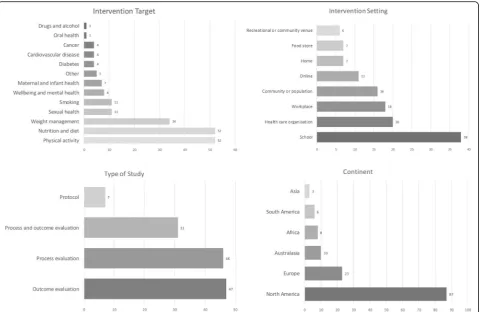
A total of 130 articles were included in the review. Inter-ventions were conducted across a range of settings, most frequently school, workplace and health care settings. The most common types of interventions were those which aimed to provide information or education or in-crease awareness about an issue, such as school curricu-lums, mass media campaigns and information leaflets. Interventions that sought to support behaviour change through strategies such as goal setting, motivational interviewing and counselling were also common in this sample. Less common were interventions providing fi-nancial incentives or involving restrictions, regulation or
structural and environmental change. See Fig. 2 for a
summary of article characteristics and Additional file 2
for details of all included articles.
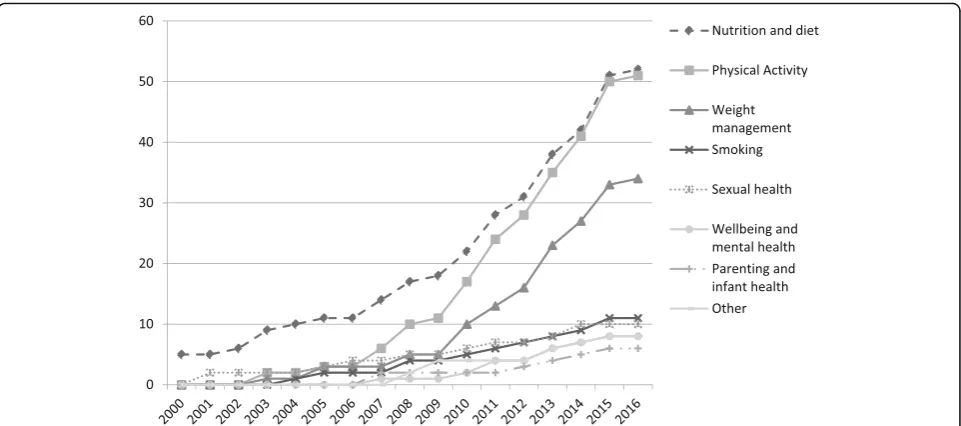
The number of articles using the concept of dose has increased in recent years, with over two-thirds of the pa-pers in our sample having been published since 2010. Within our sample, physical activity and nutrition were the most frequent intervention targets for studies using the concept of dose. A cumulative frequency chart (see
Fig. 3) indicates that the use of ‘dose’ in interventions
targeting nutrition and diet, physical activity and weight management has increased considerably in the last decade.
Variation in terms used to refer to the concept of‘dose’
Across the sample, there was a range of terms used to refer to dose. Here, we provide a brief overview of these terms and how they were applied. In the subse-quent section, we unpack the operationalisation of dose in more depth.
Dose and dosage were used somewhat interchangeably
Nearly half of the studies used the term dose (n = 56),
with a handful using the term dosage (n = 7). It is
worthwhile noting that in medicine, the terms‘dose’and
‘dosage’ refer to different things: dose refers to the
amount of medication (usually measured by weight) given at a single time, while dosage refers to amount of medication per unit of time (i.e. the rate at which dose is administered) and implies a medication regimen rather than a single administration. Within our sample, these terms were used somewhat interchangeably and did not align with the definitions used in medicine. In particular,
the term‘dose’was used in a variety of ways, sometimes
to refer to the amount of intervention at a single time point, but often also to refer to the delivery or receipt of the intervention over time. For example, Ayala and
colleagues [22] measured ‘intervention dose’ as ‘the
number of classes each community participant attended between baseline and 6 months and between 6 and 12
months’ (p. 2264). The term‘dosage’was generally used
to refer to the proportion, duration or frequency of inter-vention components over the interinter-vention period. For
example, Fagan and colleagues [23] defined programme
dosage as ‘the extent to which programs achieved the
required number, length, and frequency of sessions’
(p. 244).
Dose delivered and dose received were well differentiated
The termsdose delivered(n =33) anddose received(n =28)
were commonly used, frequently appearing together as
dif-ferentiated concepts within the same papers (n = 27). For
example, Curran and colleagues [24] defined dose delivered
as‘the amount of intended units of each intervention
com-ponent provided to target audience’and dose received as
‘the extent of engagement of participants’(p. 721).
Dose-response was captured in about half of the studies
Sixty-four studies (49%) went beyond simply defining and measuring dose and linked their measure of dose to the outcomes of the study. For example, in their evaluation of phone-based weight loss programmes, Sherwood and
col-leagues [25] defined dose as the number of telephone
counselling sessions provided and reported that more counselling calls were associated with greater weight loss and a higher frequency of engaging in weight-related self-monitoring behaviours. It was most common to use
the term‘dose-response’although three studies used the
term‘dose-effect’to mean the same thing.
Some studies developed new terms to capture particular aspects of dose
Occasionally, new terms were introduced to identify
par-ticular aspects of dose. For example, two studies [26,31]
used the term‘population dose’to refer to the effect size
of an intervention, calculated as intervention reach multiplied by effect size for each person. This measure of dose attempts to capture the impact of interventions delivered at the population level, where traditional mea-sures of dose may fall short.
Other terms used to refer to dose included ‘minimum
dose sample’to refer to a sample of participants who
par-ticipated to a minimum extent [27] and ‘dose intensity’
which was defined as the relative difference in intensity of
dose across similar versions of the same intervention [28]
In this case, a ‘higher dose intensity’ in a church-based
lifestyle intervention involved adding, for example, follow-up phone calls, increasing the number of sessions and providing on-site equipment.
Wasik and colleagues [12] argued that dosage must be
considered on two levels: (1) the intervention staff learn-ing new skills and (2) the target group (intended benefi-ciaries). They suggest that one component of what they callimplementation dosage‘refers to implementation ac-tivities necessary for intervention to be carried out with
fidelity’. They further suggest that another necessary
consideration is what they callintervention dosagewhich
is the amount of intervention provided that is necessary
to change the target group’s behaviour. These factors,
they argue, are critical for cost, staffing, replication and scale-up considerations. However, the new term is an umbrella for several variables: a conventional view of dose (amount of an intervention), its delivery over time, its potency (capacity to bring about an effect) and inter-action with context. The term implies a critical threshold level of dosage. Critical levels of the other factors need to be examined as well.
Variation in how dose was operationalised
While most studies provided a definition of dose and/or detail on how it was operationalised, there was some
variation in how this was presented. Table3presents an
overview of how dose has been operationalised across studies. The main way in which dose was operationalised was in terms of the amount of intervention delivered and/or received, with these aspects being relatively well delineated. However, in some instances, there was an ap-parent conflation of dose with other concepts such as fi-delity to planned intervention and participant satisfaction. These aspects are unpacked in more detail below.
Dose as intervention delivered
Consistent with the frameworks outlined in Table 1, a
large proportion of studies operationalised dose in terms
of the amount of intervention delivered, considered as a
function of the efforts of intervention providers. Most frequently, this was captured using measures such as the number of intervention components delivered (e.g.
num-ber of lessons, posters and stickers delivered; [29]),
fre-quency or duration of intervention components (e.g.
lesson length; [30]) and time spent on intervention
activ-ities [31]. For example, Baquero and colleagues [32]
measured dose delivered as the number and length of
home visits completed, Hall and colleagues [33] as the
duration of education classes delivered, and Rosecrans
and colleagues [8] as the number of intervention
mate-rials (food samples, flyers and recipes distributed). A handful of studies operationalised dose as the
intensity of intervention delivery by creating discrete categories. For example, Koniak-Griffin and colleagues
[34] considered the effect of ‘treatment dosage
(intensity)’ such that ‘participants were classified into
two categories (low/medium and high intensity levels)’
(p. 80) based on class attendance and teaching and coaching contacts received, while Rubinstein and
col-leagues [35] examined ‘potential changes in outcomes
with increasing intensity (dose) of the intervention’
(p. 56).
Table 3Overview of the key ways in which the terms dose, dose delivered and dose received were conceptualised across the included intervention studies
Operationalisation Dose or
dosage
Dose delivered
Dose received
Planned intervention
Amount of intervention planned (e.g. number of intervention components planned; intended length of
intervention components) ✓
Intervention delivery
Number of intervention components delivered ✓ ✓
Length/duration of intervention components ✓ ✓
Frequency of delivery of intervention components ✓ ✓
Completeness of intervention delivery (amount of intervention components delivered as a proportion of those planned)
✓ ✓
Intensity of intervention ✓
Availability of intervention ✓ ✓
Content of intervention components (and degree to which these were delivered as planned) ✓
Intervention receipt
Number of intervention components received ✓ ✓
Exposure ✓ ✓
Reach ✓
Attendance ✓ ✓
Completion of intervention activities ✓
Use of intervention materials ✓
Extent of engagement with intervention ✓ ✓
Other concepts
Number of people trained to deliver intervention ✓
Commitment to intervention ✓ ✓
Satisfaction with intervention ✓ ✓
Perceptions of intervention feasibility ✓
Note: While some of the concepts in this table would perhaps not usually be considered to be part of dose, this synthesis is based on a consideration of how dose was defined and operationalised in practice across the included articles. We explore the implications for these conceptualisations of dose in the
Some studies also consideredcompletenessof interven-tion delivery, where the number of interveninterven-tion compo-nents delivered was considered as a proportion of those
planned (e.g. [23,31,36]). One school-based study called
this ‘fidelity to classroom dose’and while time spent on
each activity was also measured, it was referred to as
‘duration’, not dose [37]. Given that fidelity of an
inter-vention might manifest in a number of ways (e.g. teach-ing quality, information accuracy), this non-conventional conflating of fidelity and dose together as a term could mislead readers who do not take care to read the details
of author’s methods. But it was not uncommon; a
num-ber of studies used composite measures of dose that
in-corporated a range of elements including aspects of quality of communication. For example, in their evalu-ation of a school-based tobacco intervention, Goenka
and colleagues [38] refer to ‘dose given (completeness)’,
which they define as ‘the quantity and rigour of
imple-mentation of the intended intervention units that are
ac-tually delivered to the participants’ (p. 925, italics
added). This is calculated as a composite score across a range of variables, including percentage of classroom sessions and intra-session elements delivered, proportion of posters displayed, proportion of postcards delivered, participation in an inter-school event, proportion of teachers and student peer leaders trained to deliver the intervention and proportion of sessions where teachers
and peer leaders communicated well [38]. As such, their
conceptualisation of ‘dose given’contains a number of
different elements of dose related not only toquantityof
dose delivered, but also quality of delivery and
imple-mentation dose(i.e. training to deliver the intervention). These authors then investigated which aspects were most strongly associated with programme effects. Qual-ity of delivery and implementation dose would typically be considered to be distinct from dose delivered, so re-ferring to these together within the composite term
‘dose given’could potentially mislead the reader.
Dose as intervention received
Another common way in which dose was operationa-lised was in terms of the amount of intervention re-ceived by participants, which was generally captured in one of two ways, implying either an active or passive role for participants. Measures of dose that implied a more passive role for participants included the number ofintervention components receivedby participants (such
as telephone calls, leaflets, home visits; e.g. [39–41]). A
number of studies also used the concepts of exposure
and reach. For example, Lee-Kwan and colleagues [42] conducted a modified Intervention Exposure Assessment survey to assess whether people had seen the interven-tion materials (within a retail setting). In the context of
media campaigns, both Farrelly and colleagues [43] and
Huhman and colleagues [44] referred to dose in terms of
reach or exposure to the campaign, to examine the
dose-response. Similarly, Birnbaum and colleagues [45]
indicated that participants could be identified as‘
belong-ing to one of four exposure groups (or“doses”): (1)
con-trol group: lowest exposure, (2) school environment interventions only, (3) classroom curriculum plus school environment interventions, and (4) peer leaders plus classroom curriculum plus school environment
interven-tions: highest exposure’(p. 428). Here, dose was defined
according to the logic of the intervention designers, with some categories being reasoned to be lower or higher than another in terms of what appears to be the
inter-vention’s penetration into different ecological levels (i.e.,
organisational level versus group level).
Concerning measures of dose that implied a more
ac-tive role for participants, Steckler and Linnan [11] define
dose received as the extent to which participants engage or interact with, are receptive to or use an intervention, such that dose received is a function of the actions of intervention participants. Examples from studies in our sample included those measuring attendance and
par-ticipation rates [46, 47], time spent engaged in
interven-tion activities [48], use of intervention components [49]
and completion of intervention activities [8, 50–52]. A
number of studies also considered dose received in terms of the extent to which participants actively
en-gaged with intervention components [38, 47, 49]. One
study also measured the amount of intervention received
in terms of the number of activities rememberedby
par-ticipants at the end of the intervention [31]. The last
ex-ample could be considered problematic if used on its own as, cognitively speaking, remembering an activity is a step beyond being exposed to it and programme ef-fects may or may not be captured through conscious
re-call processes. However, the school-based health
education programme being assessed in that study also used observer rating of lessons delivered, and teacher re-ports of components delivered to assess differences in participant-perceived dose and dose as measured by
ob-servers and‘deliverers’[31].
As with dose as intervention delivered, some studies conflated dose received with other implementation
con-cepts. For example, Berendsen and colleagues [53]
stud-ied a lifestyle intervention in primary care settings and
‘dose received was defined as participant satisfaction and
perception of the program that was delivered to them’
(p. 4). While the latter idea (perception that the programme was delivered) would commonly be used as a way of tapping into dose received, the former (satisfac-tion) might be thought of as something separate. This illustrated a tendency in the literature to characterise dose in terms of the extent to which the intervention
makes a conceptual distinction between dose received and satisfaction throughout the paper, but measuring
and listing them together, i.e. as‘dose received (exposure
and satisfaction)’ (p. 76) could mislead readers into
thinking they were treated as one and the same.
One investigator team reported on participants’ ‘
evalu-ation of dose received’[55] and defined this as the
par-ticipants’views about intervention feasibility. This is not
conflating the definition of feasibility with dose. Evalu-ation involves two processes: (1) observEvalu-ation/measure-
observation/measure-ment and (2) judgeobservation/measure-ment [56]. By declaring that they are
‘evaluating’, both processes are assumed and indeed in
this study, both processes were performed. However, the
use of the words ‘evaluating’dose as opposed to ‘
meas-uring’dose could mislead readers not familiar with these
distinctions from the field of evaluation to think there is definitional slip about dose.
A small proportion of studies referred to‘dose’but did not operationalise it in their methods
While most studies provided some detail on how dose was measured, 15 (11.5%) studies referred to dose with-out any further detail. Of these, most used the term dose when interpreting their results but did not refer to the measurement or operationalisation of dose within their methods or findings. For example, Kelishadi and
col-leagues [57] state that‘the overall lower increase of junk
food consumption …showed that the dose or intensity
of our community-based and school-based interventions, although not sufficient, was necessary to act against
other forces in the community’[57] but did not refer to
the measurement of dose elsewhere within the main body of the paper. The effect was that it was not clear what was actually considered the dose of the interven-tion (i.e. what components and how much of these was considered to have brought about the observed effect).
Discussion
We have presented the results of a scoping review ex-ploring how dose is defined and operationalised in the implementation and evaluation of health promotion in-terventions. The findings suggest that there are some commonalities in how dose was defined and operationa-lised across studies, with studies most commonly
focus-ing on measurements of (1) the amount of intervention
delivered, where dose is conceptualised as a function of intervention providers and the focus is on the supply side
of the intervention and (2) theamount of intervention
re-ceived, where the focus is on how much of the
interven-tion the recipients’actually get, sometimes conceptualised
as a function of the actions of recipients (e.g. whether they attend sessions or collect intervention materials). Most of the studies within this review measured dose in some form and in that sense, we note that they complied with
the Template for Intervention Description and Replication (TIDieR) guidelines for intervention reporting (Item 8:
‘when and how much’) [58].
However, in many instances, it would not have been easy for study authors to fit health promotion interventions into the conceptual framing of dose delivered and dose received. While some aspects of health promotion interventions allow for such a separation, for example, dose delivered as the number of intervention materials (e.g. leaflets, posters) dis-played within an intervention site or dose received as the number of intervention materials taken away by participants, the distinction becomes somewhat arbitrary for components that concern participant interaction and engagement (such
as team competitions) [52]. Similarly, the separation of
com-ponents like phone calls and home visits (i.e. events for which delivery and receipt are inseparable) into categories of
‘delivered and received’could seem somewhat artificial.
How-ever, despite these difficulties, the distinction between dose delivered and dose received is important. In a notable ex-ample, Wilson and colleagues demonstrated that their inter-vention achieved moderate to high levels of dose delivered and only moderate levels of dose received and that the former was better than the latter in terms of achieving health outcomes. This was sufficient for them to recommend to others replicating their intervention to spend more time making sure components of interventions are delivered and to worry less about people completing all the activities as di-rected [52].
All studies were limited by what was measurable and hence investigators may have had to devise a proxy for what might have been their preferred way to measure dose. Within environmental interventions dose measure-ment is often based on recall or self-report of what
people saw (e.g. [42]) although this is not, strictly
speak-ing, the same as being exposed. Identifying what should be measured in order to capture dose is also likely to be problematic when considering population-level policy interventions, such as increasing the amount of urban
green space in order to improve health [59]. For
ex-ample, should ‘dose’ be counted as the number of new
trees planted, amount of coverage of green space relative to size of neighbourhood or something else? Traditional conceptualisations of dose as intervention components delivered and received are not easily applied to such in-terventions. Such considerations have important impli-cations for how interventions are planned, resourced and delivered, highlighting the need for critical thought
about how we capture the‘dose’ of population level
in-terventions that go beyond‘traditional’health promotion
interventions. While our review highlighted some novel attempts to capture dose, we may need to look more to disciplines like geography and political science in order
to further the notion of dose as applied to
Unfortunately, our capacity to review innovative ap-proaches to how policy and environmental interventions
in health promotion are addressing‘dose’may have been
limited by our choice of ‘dose’ and ‘dosage’as our
pri-mary search terms. For example, if a study assessed the impact of policy exposure without using the word dose, our search would not have captured this. This was the chief limitation of our study design and is a clear priority area for further investigation. Progress in the scanning and benchmarking of international obesity policy could
provide an example in this direction [60].
A few investigators expanded on the traditional con-cept of dose, seeking to combine it with other elements to tell a story that is more than just amount received or delivered. As discussed previously, Wasik and colleagues
[12] developed the term implementation dosageto refer
to activities needed to achieve fidelity and intervention dosage (defined as the amount of intervention needed to
change the target group’s behaviour). In a similar vein,
Cheadle and colleagues [13, 26] offer the concept of
population dose, defined as‘the estimated
community--level change in the desired outcome expected to result from a given community-change strategy, operational-ized as the product of penetration (reach divided by
tar-get population) and effect size’ [13]. This approach has
been applied to measurement of the impact of commu-nity, organisation and school level policy and environ-mental changes to improve physical activity and
nutrition [26,61]. Cheadle reports that he and his team
first ‘tested’ the lay understanding of dose with health
department practitioners, community groups, funders and the federal government and decided to build on it
because it conveys the notion of ‘active ingredient’ as
something that makes something happen [15]. The ideas
of both Wasik et al. and Cheadle et al. draw attention to the dynamics of the change process and the role of dose
in the change process. The idea of ‘intervention dose’
(although Wasik et al. use ‘dosage’) has caught on, with
researchers now applying it to fields like (medical) qual-ity improvement where they define intervention dose as quantity, exposure, intensity, scope, reach, engagement, duration and quality.
In a sense, therefore,‘dose’ has become the gateway
for the appreciation of factors that others would con-sider to be part of process evaluation, such as fidelity or
rigour [11]. Whether this is a problem depends on
whether these conceptualisations of dose lead to an
over-simplification of ‘what’ has to be transported for
place-to-place achieve effects. That is, if the measure-ment of dose overemphasises the intervention at the expense of understanding contextual dynamics. Cot-terill and colleagues have recently suggested changes to the TIDieR guidelines in acknowledgement that all aspects of an intervention can change over time and
researchers need to be alert to differences arising
through adaptation [62]. A population health and
pol-icy version of the checklist has since been launched which, in addition to tracking planned and unplanned variation, calls for the date and duration of
interven-tion to be reported [63]. Researchers have also been
urged to fully appreciate the complex, non-monotonic
ways in which dose response is brought about [64].
This implies a need to not ‘over assume’ the
critical-ity of dose, vis-à-vis other options, such as the critical
threshold aspects within the context (e.g. demograph-ics, interactivity, existing resources).
Another implication is that researchers should
measure dose in multiple ways and fully interrogate the meaning of the results. An exemplar in this
re-gard is the work by Goenka and colleagues [38] in
evaluating a school-based tobacco prevention programme in schools in India. They found that the proportion of teachers trained to deliver the intervention was a better predictor of the results than time spent on the interven-tion. The findings point to the possibility of a multi-strand pathway of change in school settings where, in this in-stance, the proportion of teachers trained acts as an alter-native or additional casual pathway to health outcomes
[16]. This idea invites the use of complicated and/or
com-plex logic models in intervention evaluation where the
‘dose’of multiple factors, and the way each interacts with
the others, become critical considerations [65].
Interac-tions among causal factors might explain non-linear,
dose-response relationships where the same‘amount’
de-livered at different times in an intervention’s history or in
different contexts has different proportional effects on outcome, because of the cumulative effects of reinforcing feedback loops and/or the existence of threshold effects or
‘tipping points’[65]. Conclusion
It seems vital that researchers in health promotion con-tinue to measure dose in multiple ways, and further ex-plore how to define and measure the dose of population-level interventions and policies. We suggest
researchers also reverse their tendency to use ‘dose’and
‘dosage’interchangeably. Dosage’s focus on rate of
deliv-ery over time requires researchers to monitor response
to ‘dose’ and adjust accordingly. It embraces the
com-plexity of intervention design and evaluation that is now
being more widely acknowledged [66,16].
Additional files
Additional file 1:Data extraction template with example data
extraction. (DOCX 15 kb)
Abbreviations
TIDieR:Template for Intervention Description and Replication
Acknowledgements
We would like to thank Dr. Andrew Milat and Professor John Wiggers for providing feedback on the initial study protocol and search strategy and to delegates at the Emerging Health Policy Research Conference at the Menzies Centre for Health Policy, University of Sydney in July 2016 for providing feedback on early insights from this work.
Dedication
We dedicate this work to our colleague, mentor, and above all, our friend,
Associate Professor Sonia Wutzke (1970–2017). The public health community
is richer for having had you as one of its most passionate advocates and our lives are richer for having known you.
Funding
The work was funded by the National Health and Medical Research Council of Australia (NHMRC) through its Partnership Centre grant scheme [grant number GNT9100001]. NSW Health, ACT Health, the Australian Government Department of Health, the Hospitals Contribution Fund of Australia and the HCF Research Foundation have contributed funds to support this work as part of the NHMRC Partnership Centre grant scheme. The contents of this paper are solely the responsibility of the individual authors and do not reflect the views of the NHMRC or funding partners.
Availability of data and materials
The datasets during and/or analysed during the current study are available from the corresponding author on reasonable request.
Authors’contributions
SR developed and executed the search strategy and review process, led the data extraction and synthesis process and drafted the manuscript. KC performed data extraction and contributed to the refinement of the search strategy, data analysis and drafting of the manuscript. PH conceived the original idea for the paper and contributed to the development of the search strategy, data analysis, and drafting of the manuscript. All authors read and approved the final manuscript.
Ethics approval and consent to participate Not applicable
Consent for publication Not applicable
Competing interests
The authors declare that they have no competing interests.
Publisher’s Note
Springer Nature remains neutral with regard to jurisdictional claims in published maps and institutional affiliations.
Received: 19 May 2018 Accepted: 22 April 2019
References
1. Milat AJ, King L, Bauman A, Redman S. Scaling up health promotion
interventions: an emerging concept in implementation science. Health Promot J Aust. 2011;22:238.
2. Moore G, Audrey S, Barker M, Bond L, Bonell C, Cooper C, et al. Process
evaluation in complex public health intervention studies: the need for guidance. J Epidemiol Community Health. 2014;68:101.
3. Dane AV, Schneider BH. Program integrity in primary and early secondary
prevention: are implementation effects out of control? Clin Psychol Rev.
1998;18:23–45.
4. Dusenbury L, Brannigan R, Falco M, Hansen WB. A review of research on
fidelity of implementation: implications for drug abuse prevention in school settings. A review of research on fidelity of implementation: implications for
drug abuse prevention in school settings, vol. 18; 2003. p. 237–56.
5. Baranowski T, Stables G. Process evaluations of the 5-a-day projects. Health
Educ Behav. 2000;27:157–66.
6. Saunders RP, Evans MH, Joshi P. Developing a process-evaluation plan for
assessing health promotion program implementation: a how-to guide.
Health Promot Pract. 2005;6:134–47.
7. Legrand K, Bonsergent E, Latarche C, Empereur F, Collin JF, Lecomte E, et al.
Intervention dose estimation in health promotion programmes: a framework and a tool. Application to the diet and physical activity promotion PRALIMAP trial. BMC Med Res Methodol. 2012;12:146.
8. Rosecrans AM, Gittelsohn J, Ho LS, Harris SB, Naqshbandi M, Sharma S.
Process evaluation of a multi-institutional community-based program for
diabetes prevention among first nations. Health Educ Res. 2008;23:272–86.
9. Scheirer MA, Shediac MC, Cassady CE. Measuring the implementation of
health promotion programs: the case of the breast and cervical cancer
program in Maryland. Health Educ Res. 1995;10:11–25.
10. National Cancer Institute. NCI dictionary of Cancer terms. 2018.https://
www.cancer.gov/publications/dictionaries/cancer-terms/def/dose. Accessed 8 May 2019.
11. Steckler AB, Linnan L. Process evaluation for public health interventions and
research. Jossey-Bass San Francisco, CA; 2002.
12. Wasik BA, Mattera SK, Lloyd CM, Boller K. Intervention dosage in early
childhood care and education: it’s complicated. Washington, DC: Office of
Planning, Research and Evaluation, Administration for Children and Families, U.S. Department of Health and Human Services; 2013.
13. Cheadle A, Schwartz P, Rauzon S, Bourcier E, Senter S, Spring R. Using the
concept of "population dose" in planning and evaluating community-level
obesity prevention initiatives. Am J Eval. 2013;34:71–84.
14. Collins LM, Murphy SA, Bierman KL. A conceptual framework for adaptive
preventive interventions. Prev Sci. 2004;5:185–96.
15. Bellg AJ, Borrelli B, Resnick B, Hecht J, Minicucci DS, Ory M, et al. Enhancing
treatment fidelity in health behavior change studies: best practices and recommendations from the NIH behavior change consortium. Health Psychol. 2004;23:443.
16. Hawe P. Lessons from complex interventions to improve health. Annu Rev
Public Health. 2015;36:307–23.
17. Hawe P, Shiell A, Riley T. Theorising interventions as events in systems. Am J
Community Psychol. 2009;43:267–76.
18. Mays N, Roberts E, Popay J. Synthesising research evidence In: Fulop N,
Allen P, Clarke A, Black N, editors. Studying the organisation and delivery of
health services: research methods; 2001. p. 188–220.
19. Arksey H, O'Malley L. Scoping studies: towards a methodological framework.
Int J Soc Res Methodol. 2005;8:19–32.
20. Levac D, Colquhoun H, O'Brien KK. Scoping studies: advancing the
methodology. Implement Sci. 2010;5:69.
21. QSR International Pty Ltd. NVivo pro software. In., 11 edn; 2015.
22. Ayala GX. Effects of a promotor-based intervention to promote physical
activity: familias sanas y activas. Am J Public Health. 2011;101:2261–8.
23. Fagan AA, Hanson K, Hawkins JD, Arthur MW. Bridging science to practice:
achieving prevention program implementation fidelity in the community
youth development study. Am J Community Psychol. 2008;41:235–49.
24. Curran S, Gittelsohn J, Anliker J, Ethelbah B, Blake K, Sharma S et al.
Process evaluation of a store-based environmental obesity intervention on two American Indian Reservations. Process evaluation of a store-based environmental obesity intervention on two American Indian
reservations 2005;20:719–29.
25. Sherwood NE, Jeffery RW, Welsh EM, VanWormer J, Hotop AM. The
drop it at last study: six-month results of a phone-based weight loss
trial. Am J Health Promot. 2010;24:378–83.
26. Cheadle A, Rauzon S, Spring R, Schwartz PM, Gee S, Gonzalez E, et al. Kaiser
Permanente’s community health initiative in northern California: evaluation
findings and lessons learned. Am J Health Promot. 2012;27:e59–68.
27. Hwang KO, Ottenbacher AJ, Graham AL, Thomas EJ, Street RL Jr, Vernon
SW. Online narratives and peer support for colorectal cancer screening: a
pilot randomized trial. Am J Prev Med. 2013;45:98–107.
28. Thomson JL, Goodman MH, Tussing-Humphreys L. Diet quality and
physical activity outcome improvements resulting from a church-based diet and supervised physical activity intervention for rural, southern, African American adults: Delta body and soul III. Health Promot Pract.
2015;16:677–88.
29. Chittleborough CR, Nicholson AL, Young E, Bell S, Campbell R.
30. Nicklas TA, Nguyen T, Butte NF, Liu Y. The children in action pilot study. Int
J Child Health Nutr. 2013;2:296–308.
31. Buckley L, Sheehan M. A process evaluation of an injury prevention
school-based programme for adolescents. Health Educ Res. 2009;24:507–19.
32. Baquero B, Ayala GX, Arredondo EM, Campbell NR, Slymen DJ, Gallo L, et al.
Secretos de la Buena Vida: processes of dietary change via a tailored nutrition communication intervention for Latinas. Health Educ Res. 2009;24:
855–66.
33. Hall WJ, Zeveloff A, Steckler A, Schneider M, Thompson D, Trang P, et al.
Process evaluation results from the HEALTHY physical education
intervention. Health Educ Res. 2012;27:307–18.
34. Koniak-Griffin D, Brecht M-L, Takayanagi S, Villegas J, Melendrez M, Balcazar
H. A community health worker-led lifestyle behavior intervention for Latina (Hispanic) women: feasibility and outcomes of a randomized controlled trial.
Int J Nurs Stud. 2015;52:75–87.
35. Rubinstein A, Miranda JJ, Beratarrechea A, Diez-Canseco F, Kanter R,
Gutierrez L, et al. Effectiveness of an mHealth intervention to improve the cardiometabolic profile of people with prehypertension in low-resource urban settings in Latin America: a randomised controlled trial. Lancet
Diabetes Endocrinol. 2016;4:52–63.
36. Ross MW, Essien EJ, Ekong E, James TM, Amos C, Ogungbade GO, et al. The
impact of a situationally focused individual human immunodeficiency virus/ sexually transmitted disease risk-reduction intervention on risk behavior in a
1-year cohort of Nigerian military personnel. Mil Med. 2006;171:970–5.
37. Day ME, Strange KS, McKay HA, Naylor P-J. Action schools! BC--healthy
eating: effects of a whole-school model to modifying eating behaviours of
elementary school children. Can J Public Health. 2008;99:328–31.
38. Goenka S, Tewari A, Arora M, Stigler MH, Perry CL, Arnold JPS, et al. Process
evaluation of a tobacco prevention program in Indian schools--methods,
results and lessons learnt. Health Educ Res. 2010;25:917–35.
39. Caldera D, Burrell L, Rodriguez K, Crowne SS, Rohde C, Duggan A. Impact of
a statewide home visiting program on parenting and on child health and
development. Child Abuse Negl. 2007;31:829–52.
40. Goode AD, Winkler EAH, Lawler SP, Reeves MM, Owen N, Eakin EG. A
telephone-delivered physical activity and dietary intervention for type 2 diabetes and hypertension: does intervention dose influence outcomes?
Am J Health Promot. 2011;25:257–63.
41. Lane A, Murphy N, Bauman A. An effort to‘leverage’the effect of
participation in a mass event on physical activity. Health Promot Int. 2015;
30:542–51.
42. Lee-Kwan SH, Goedkoop S, Yong R, Batorsky B, Hoffman V, Jeffries J, et al.
Development and implementation of the Baltimore healthy carry-outs feasibility trial: process evaluation results. BMC Public Health. 2013;13.
43. Farrelly MC, Davis KC, Haviland ML, Messeri P, Healton CG. Evidence of a
dose-response relationship between“truth”antismoking ads and youth
smoking prevalence. Am J Public Health. 2005;95:425–31.
44. Huhman ME, Potter LD, Duke JC, Judkins DR, Heitzler CD, Wong FL.
Evaluation of a national physical activity intervention for children: VERB
campaign, 2002-2004. Am J Prev Med. 2007;32:38–43.
45. Birnbaum AS, Lytle LA, Story M, Perry CL, Murray DM. Are differences in
exposure to a multicomponent school-based intervention associated with
varying dietary outcomes in adolescents? Health Educ Behav. 2002;29:427–43.
46. Oude Hengel KM, Blatter BM, van der Molen HF, Joling CI, Proper KI,
Bongers PM, et al. Meeting the challenges of implementing an intervention to promote work ability and health-related quality of life at construction
worksites: a process evaluation. J Occup Environ Med. 2011;53:1483–91.
47. Robbins LB, Pfeiffer KA, Wesolek SM, Lo Y-J. Process evaluation for a
school-based physical activity intervention for 6th- and 7th-grade boys: reach,
dose, and fidelity. Eval Program Plann. 2014;42:21–31.
48. Sharma SV, Shegog R, Chow J, Finley C, Pomeroy M, Smith C, et al. Effects
of the quest to Lava Mountain computer game on dietary and physical activity behaviors of elementary school children: a pilot group-randomized
controlled trial. J Acad Nutr Diet. 2015;115:1260–71.
49. Coffeng JK, Hendriksen IJM, van Mechelen W, Boot CRL. Process evaluation
of a worksite social and physical environmental intervention. J Occup
Environ Med. 2013;55:1409–20.
50. Bolier L, Haverman M, Kramer J, Westerhof GJ, Riper H, Walburg JA, et al. An
internet-based intervention to promote mental fitness for mildly depressed
adults: randomized controlled trial. J Med Internet Res. 2013;15:209–26.
51. Buller DB, Borland R, Woodall WG, Hall JR, Hines JM, Burris-Woodall P, et al.
Randomized trials on consider this, a tailored, internet-delivered smoking
prevention program for adolescents. Health Educ Behav. 2008;35:260–81.
52. Wilson MG, Basta TB, Bynum BH, DeJoy DM, Vandenberg RJ, Dishman
RK. Do intervention fidelity and dose influence outcomes? Results from the move to improve worksite physical activity program. Health Educ
Res. 2010;25:294–305.
53. Berendsen BAJ, Kremers SPJ, Savelberg HHCM, Schaper NC, Hendriks
MRC. The implementation and sustainability of a combined lifestyle intervention in primary care: mixed method process evaluation. BMC Fam Pract. 2015;16:37.
54. Androutsos O, Apostolidou E, Iotova V, Socha P, Birnbaum J, Moreno L,
et al. Process evaluation design and tools used in a kindergarten-based, family-involved intervention to prevent obesity in early childhood. The
ToyBox-study. Obes Rev. 2014;15:74–80.
55. Branscum P, Sharma M, Wang LL, Wilson B, Rojas-Guyler L. A process
evaluation of a social cognitive theory-based childhood obesity prevention intervention: the comics for health program. Health Promot
Pract. 2013;14:189–98.
56. Deniston OL. Whether evaluation—whether utilization. Eval Program
Plann. 1980;3:91–4.
57. Kelishadi R, Sarrafzadegan N, Sadri GH, Pashmi R, Mohammadifard N,
Tavasoli AA, et al. Short-term results of a community-based program on promoting healthy lifestyle for prevention and control of chronic diseases in a developing country setting: Isfahan healthy heart program. Asia Pac J
Public Health. 2011;23:518–33.
58. Hoffman T, Glasziou P, Bouton I, Milne R, Perera R. Better reporting of
interventions: template for intervention description and replication checklist guide (TIDieR). BMJ. 2014.
59. Jorgensen A, Gobster PH. Shades of green: measuring the ecology of urban
green space in the context of human health and well-being. Shades of green: measuring the ecology of urban green space in the context of
human health and well-being 2010;5:338–363.
60. Sacks G, The food-EPI Australia project team. Policies for tackling obesity
and creating healthier food environments: scorecard and priority recommendations for Australian governments. Melbourne: Deakin University; 2017.
61. Heelan KA, Bartee RT, Nihiser A, Sherry B. Healthier school environment
leads to decreases in childhood obesity: the Kearney Nebraska story. Child
Obes. 2015;11:600–7.
62. Cotterill S, Knowles S, Martindale A-M, Elvey R, Howard S, Coupe N, et al.
Getting messier with TIDieR: embracing context and complexity in intervention reporting. BMC Med Res Methodol. 2018;18.
63. Campbell M, Katikireddi SV, Hoffmann T, Armstrong R, Waters E, Craig P.
TIDieR-PHP: a reporting guideline for population health and policy interventions. BMJ. 2018;361:k1079.
64. Fedak KM, Bernal A, Capshaw ZA, Gross S. Applying the Bradford Hill criteria
in the 21st century: how data integration has changed causal inference in molecular epidemiology. Emerg Themes Epidemiol. 2015;12:14.
65. Rogers PJ. Using programme theory to evaluate complicated and complex
aspects of interventions. Evaluation. 2008;14:29–48.
66. Grudniewicz A, Tenbensel T, Evans JM, Gray CS, Baker GR, Wodchis WP.
‘Complexity-compatible’policy for integrated care? Lessons from the