S Y S T E M A T I C R E V I E W
Open Access
How the study of networks informs
knowledge translation and implementation:
a scoping review
Stephanie M. N. Glegg
1,2,3*, Emily Jenkins
4and Anita Kothari
5Abstract
Background:To date, implementation science has focused largely on identifying the individual and organizational barriers, processes, and outcomes of knowledge translation (KT) (including implementation efforts). Social network analysis (SNA) has the potential to augment our understanding of KT success by applying a network lens that examines the influence of relationships and social structures on research use and intervention acceptability by health professionals. The purpose of this review was to comprehensively map the ways in which SNA methodologies have been applied to the study of KT with respect to health professional networks.
Methods:Systematic scoping review methodology involved searching five academic databases for primary research on KT that employed quantitative SNA methods, and inclusion screening using predetermined criteria. Data extraction included information on study aim, population, variables, network properties, theory use, and data collection methods. Descriptive statistics and chronology charting preceded theoretical analysis of findings.
Results:Twenty-seven retained articles describing 19 cross-sectional and 2 longitudinal studies reported on 28 structural properties, with degree centrality, tie characteristics (e.g., homophily, reciprocity), and whole network density being most frequent. Eleven studies examined physician-only networks, 9 focused on interprofessional networks, and 1 reported on a nurse practitioner network. Diffusion of innovation, social contagion, and social influence theories were most
commonly applied.
Conclusions:Emerging interest in SNA for KT- and implementation-related research is evident. The included articles focused on individual level evidence-based decision-making: we recommend also applying SNA to meso- or macro-level KT activities. SNA research that expands the range of professions under study, examines network dynamics over time, extends the depth of analysis of the role of network structure on KT processes and outcomes, and employs mixed methods to triangulate findings, is needed to advance the field. SNA is a valuable approach for evaluating key network characteristics, structures and positions of relevance to KT, implementation, and evidence informed practice. Examining how network structure influences connections and the implications of those holding prominent network positions can provide insights to improve network-based KT processes.
Keywords:Knowledge translation, Evidence-based practice, Social network analysis, Information flow, Scoping review, Network, Implementation
© The Author(s). 2019Open AccessThis article is distributed under the terms of the Creative Commons Attribution 4.0 International License (http://creativecommons.org/licenses/by/4.0/), which permits unrestricted use, distribution, and reproduction in any medium, provided you give appropriate credit to the original author(s) and the source, provide a link to the Creative Commons license, and indicate if changes were made. The Creative Commons Public Domain Dedication waiver (http://creativecommons.org/publicdomain/zero/1.0/) applies to the data made available in this article, unless otherwise stated.
* Correspondence:[email protected]
1
Rehabilitation Sciences, The University of British Columbia, 212 - 2177 Wesbrook Mall, Vancouver, BC V6T 1Z3, Canada
2Therapy Department, Sunny Hill Health Centre for Children, 3644 Slocan Street, Vancouver, BC V5M 3E8, Canada
Background
The “science” of knowledge translation (KT), namely the study of the processes, determinants, and out-comes of KT and evidence informed practice (EIP) efforts [1], is of high interest to researchers because of the significant challenges that exist in getting research into practice. To date, KT scientists have targeted their efforts primarily at identifying the key processes of KT, understanding the influences on these processes, and evaluating the effectiveness of various strategies to support them [2–5]. However, identifying the spe-cific mechanisms by which KT strategies, particularly complex multi-faceted ones, have been effective requires additional research. Furthermore, limited in-formation is available to clinicians and researchers about the role of social relationships and network con-nections in facilitating KT [6].
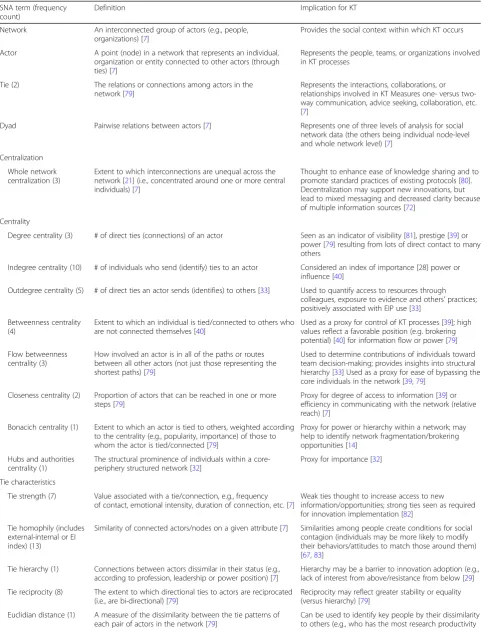
Social network analysis (SNA) is a research para-digm concerned with the patterns of connections (i.e., ties) between actors (i.e., people or entities) within an interconnected group or network, and how this“social structure” impacts outcomes of interest [7]. Key SNA terms that provide the context for this review are de-fined in Table 1, along with their application to the study of KT. Actors may be individuals, organizations, countries, or other entities; ties reflect the connections or linkages between them [7]. The structural charac-teristics of both whole and individuals’ networks can be studied. Included with the paradigm are theories, such as network, graph, diffusion, and social influence theories, and a set of methodologies that can be
ap-plied across a range of substantive problems.
Visualization, or mapping, and the use of network de-scriptive statistics can provide a visual and empirical basis for comparison across networks, including
identifying important strengths, gaps, or differences between networks that merit further exploration through qualitative means. Statistical and computa-tional modeling can also be used to explain and to predict network-related phenomena, and to simulate the complexities inherent in network dynamics.
SNA offers an alternate perspective to behavior change theory-based approaches prevalent in KT
sci-ence [5]. These latter approaches focus on
individual-level factors influencing behavior change, often from a social cognition perspective [5]. Con-versely, SNA proposes a network-level perspective that examines how connections among individuals or entities, and the nature of the associated interactions, influence an outcome (e.g., accessing or sharing dence, changing practice behaviors based on evi-dence). The paradigm respects the socially driven nature of innovation uptake, and the value inherent in examining not only the processes involved in KT but also the social structures and characteristics of the networks of relationships within which KT occurs. Examples of network-related KT processes that can be examined from a SNA lens include one-way versus two-way exchange of information, the timing and pre-diction of evidence uptake by different types of indi-viduals, the influence of specific types of people on behavior change, individuals’capacity for change based on their positions in the network, gaps in the flow of or access to information or resources required for evi-dence use, and testing the effectiveness of strategies to
address gaps or inefficiencies identified in the
network.
Recent systematic reviews on SNA in health care have focused on quality and patient safety initiatives [8,9], on a single profession (i.e., nursing) [10,11], or on only select network properties (e.g., the study of brokers) [12]. Some reviews focus on conditions (e.g., obesity networks) [12] to explore possible network interactions for potential treatments. Given the com-plex and interprofessional nature of health care prac-tice, a study of the full breadth of health professions and network properties is required. Furthermore, some of these reviews included non-health care litera-ture (e.g., from television production and corporate business contexts) [13], or neglected to include social sciences databases in which most SNA journals are indexed. The existing broad reviews of health profes-sional networks [6,14,15] do include some studies on KT-related phenomena (e.g., diffusion, knowledge transfer); however, the majority of their content cen-tered on the study of social interactions that have
im-plications for organizational functioning (e.g.,
friendships, work task assignments, staff recruitment, social support trust), but were not linked directly to
Contributions to the literature
This review synthesizes the KT literature employing a social network analysis (SNA) approach to the study health professionals, to demonstrate the utility of SNA for advancing KT science
Also summarized is the use of theory in this SNA research to demonstrate the fit of SNA with theoretical approaches used in KT research, including diffusion of innovation and complexity theory
Table 1Social network analysis (SNA) terms and their implications for knowledge translation
SNA term (frequency count)
Definition Implication for KT
Network An interconnected group of actors (e.g., people, organizations) [7]
Provides the social context within which KT occurs
Actor A point (node) in a network that represents an individual, organization or entity connected to other actors (through ties) [7]
Represents the people, teams, or organizations involved in KT processes
Tie (2) The relations or connections among actors in the network [79]
Represents the interactions, collaborations, or relationships involved in KT Measures one- versus two-way communication, advice seeking, collaboration, etc. [7]
Dyad Pairwise relations between actors [7] Represents one of three levels of analysis for social network data (the others being individual node-level and whole network level) [7]
Centralization
Whole network centralization (3)
Extent to which interconnections are unequal across the network [21] (i.e., concentrated around one or more central individuals) [7]
Thought to enhance ease of knowledge sharing and to promote standard practices of existing protocols [80]. Decentralization may support new innovations, but lead to mixed messaging and decreased clarity because of multiple information sources [72]
Centrality
Degree centrality (3) # of direct ties (connections) of an actor Seen as an indicator of visibility [81], prestige [39] or power [79] resulting from lots of direct contact to many others
Indegree centrality (10) # of individuals who send (identify) ties to an actor Considered an index of importance [28] power or influence [40]
Outdegree centrality (5) # of direct ties an actor sends (identifies) to others [33] Used to quantify access to resources through colleagues, exposure to evidence and others’practices; positively associated with EIP use [33]
Betweenness centrality (4)
Extent to which an individual is tied/connected to others who are not connected themselves [40]
Used as a proxy for control of KT processes [39]; high values reflect a favorable position (e.g. brokering potential) [40] for information flow or power [79]
Flow betweenness centrality (3)
How involved an actor is in all of the paths or routes between all other actors (not just those representing the shortest paths) [79]
Used to determine contributions of individuals toward team decision-making; provides insights into structural hierarchy [33] Used as a proxy for ease of bypassing the core individuals in the network [39,79]
Closeness centrality (2) Proportion of actors that can be reached in one or more steps [79]
Proxy for degree of access to information [39] or efficiency in communicating with the network (relative reach) [7]
Bonacich centrality (1) Extent to which an actor is tied to others, weighted according to the centrality (e.g., popularity, importance) of those to whom the actor is tied/connected [79]
Proxy for power or hierarchy within a network; may help to identify network fragmentation/brokering opportunities [14]
Hubs and authorities centrality (1)
The structural prominence of individuals within a core-periphery structured network [32]
Proxy for importance [32]
Tie characteristics
Tie strength (7) Value associated with a tie/connection, e.g., frequency of contact, emotional intensity, duration of connection, etc. [7]
Weak ties thought to increase access to new information/opportunities; strong ties seen as required for innovation implementation [82]
Tie homophily (includes external-internal or EI index) (13)
Similarity of connected actors/nodes on a given attribute [7] Similarities among people create conditions for social contagion (individuals may be more likely to modify their behaviors/attitudes to match those around them) [67,83]
Tie hierarchy (1) Connections between actors dissimilar in their status (e.g., according to profession, leadership or power position) [7]
Hierarchy may be a barrier to innovation adoption (e.g., lack of interest from above/resistance from below [29]
Tie reciprocity (8) The extent to which directional ties to actors are reciprocated (i.e., are bi-directional) [79]
Reciprocity may reflect greater stability or equality (versus hierarchy) [79]
Euclidian distance (1) A measure of the dissimilarity between the tie patterns of each pair of actors in the network [79]
the exchange or application of evidence to inform practice. Similarly, the emphasis on outcomes related to work satisfaction, leadership roles, professional be-haviors, protocol efficiency, patient flow, operating room layout, technology adoption, and workplace per-formance reduce the extent to which KT-specific out-comes can be explored. The review by Chambers et al.
[6] described primarily the settings and outcomes of these studies, whereas the current study aims to de-scribe in detail the nature of the application of SNA to the study of KT. Such an approach aims to advance the science of KT by providing insight into worthwhile methodological directions this literature can provide.
Evidence for the effectiveness of specific KT
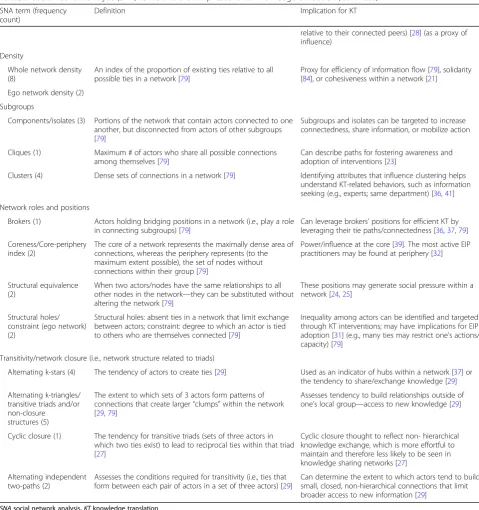
Table 1Social network analysis (SNA) terms and their implications for knowledge translation(Continued)
SNA term (frequency count)
Definition Implication for KT
relative to their connected peers) [28] (as a proxy of influence)
Density
Whole network density (8)
An index of the proportion of existing ties relative to all possible ties in a network [79]
Proxy for efficiency of information flow [79], solidarity [84], or cohesiveness within a network [21]
Ego network density (2)
Subgroups
Components/isolates (3) Portions of the network that contain actors connected to one another, but disconnected from actors of other subgroups [79]
Subgroups and isolates can be targeted to increase connectedness, share information, or mobilize action
Cliques (1) Maximum # of actors who share all possible connections among themselves [79]
Can describe paths for fostering awareness and adoption of interventions [23]
Clusters (4) Dense sets of connections in a network [79] Identifying attributes that influence clustering helps understand KT-related behaviors, such as information seeking (e.g., experts; same department) [36,41]
Network roles and positions
Brokers (1) Actors holding bridging positions in a network (i.e., play a role in connecting subgroups) [79]
Can leverage brokers’positions for efficient KT by leveraging their tie paths/connectedness [36,37,79]
Coreness/Core-periphery index (2)
The core of a network represents the maximally dense area of connections, whereas the periphery represents (to the maximum extent possible), the set of nodes without connections within their group [79]
Power/influence at the core [39]. The most active EIP practitioners may be found at periphery [32]
Structural equivalence (2)
When two actors/nodes have the same relationships to all other nodes in the network—they can be substituted without altering the network [79]
These positions may generate social pressure within a network [24,25]
Structural holes/ constraint (ego network) (2)
Structural holes: absent ties in a network that limit exchange between actors; constraint: degree to which an actor is tied to others who are themselves connected [79]
Inequality among actors can be identified and targeted through KT interventions; may have implications for EIP adoption [31] (e.g., many ties may restrict one’s actions/ capacity) [79]
Transitivity/network closure (i.e., network structure related to triads)
Alternating k-stars (4) The tendency of actors to create ties [29] Used as an indicator of hubs within a network [37] or the tendency to share/exchange knowledge [29]
Alternating k-triangles/ transitive triads and/or non-closure
structures (5)
The extent to which sets of 3 actors form patterns of connections that create larger“clumps”within the network [29,79]
Assesses tendency to build relationships outside of one’s local group—access to new knowledge [29]
Cyclic closure (1) The tendency for transitive triads (sets of three actors in which two ties exist) to lead to reciprocal ties within that triad [27]
Cyclic closure thought to reflect non- hierarchical knowledge exchange, which is more effortful to maintain and therefore less likely to be seen in knowledge sharing networks [27]
Alternating independent two-paths (2)
Assesses the conditions required for transitivity (i.e., ties that form between each pair of actors in a set of three actors) [29]
Can determine the extent to which actors tend to build small, closed, non-hierarchical connections that limit broader access to new information [29]
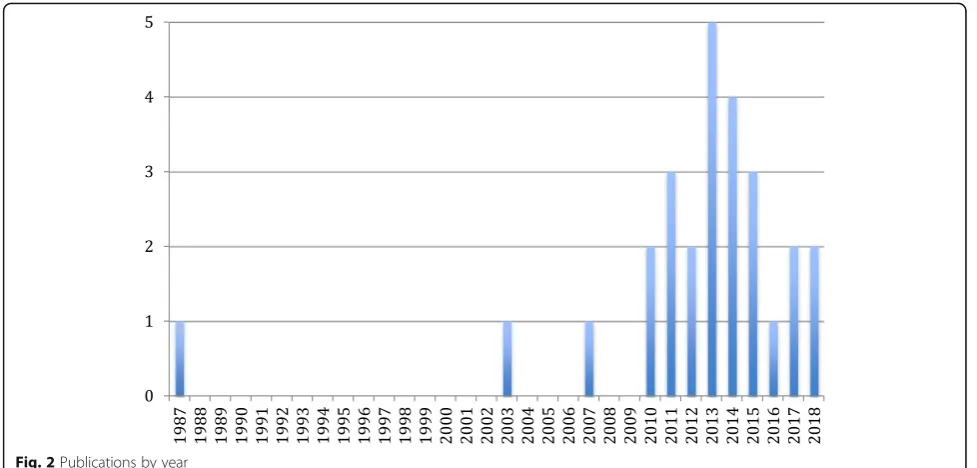
interventions or for the identified relationships be-tween network properties and other variables relevant to KT can be sought elsewhere. Furthermore, none of these reviews examined the use of theory in their in-cluded body of literature specifically, despite this focus being an identified gap [6]. Given the rapid growth of the use of SNA in the health care context over the past 8 years (see Fig.2), an updated and more directed search is warranted. A targeted examination of the research specific to SNA in KT and EIP is required to inform the application of SNA methodologies in this field, with attention paid to the insights offered by both the structural properties examined and the theor-etical perspectives applied.
A SNA perspective can broaden our understanding of the mechanisms by which KT efforts are effective by examining the social structures and relationships that fa-cilitate or hinder KT and EIP. This understanding will augment our knowledge base by expanding the range of KT determinants worthy of consideration. As re-searchers gain interest in the social drivers of KT and EIP, this review will provide a foundation for developing key research questions and SNA-driven methodological approaches for KT research that are based on estab-lished and relevant theories. Furthermore, this review will add to the current theorizing in the field related to a systems-focused understanding of KT and implementa-tion processes. Specifically, implementaimplementa-tion happens within a complex system, and network approaches have been used to study complex systems; the link between the two areas demands greater attention. Given these gaps, the purpose of this article is to synthesize the ways in which SNA methodology can be used to advance the science of KT.
Methods
The purposes of a scoping review are to examine the extent, range, and nature of research in a given field; to determine the utility of conducting a subsequent sys-tematic review; to summarize a body of research; and/ or to identify research gaps, making it an ideal ap-proach to map the KT literature utilizing SNA [16]. The specific objectives of this scoping review were (1) to describe the literature on SNA as it has been applied to KT and EIP involving health care professionals, in terms of its research design, methodology, and key findings; (2) to provide a critical analysis of the results in the context of existing theory; and (3) to identify strengths and gaps to inform future research. The scop-ing methodology, as described by Levac, et al.’s [17] modification of Arksey and O’Malley’s [16] guidelines, was applied. Step six in the methodology, consultation with key stakeholders, is optional and was not applied in the current review.
Step 1: identify the research question
The specific research questions developed for this review were:
1. How has SNA been applied to health professional networks in the field of KT/EIP with respect to study aims, data collection and analysis methods, and populations, context, variables, and structural properties under study?
2. What are the primary theoretical underpinnings that explain the link between the network properties and KT/EIP?
3. What are the gaps in the literature that can inform future research directions?
Step 2: identify relevant literature
The search strategy involved a systematic search of peer-reviewed English SNA literature in November 2015, repeated in July 2018, within five primary litera-ture databases: MEDLINE, Cumulative Index to Nurs-ing and Allied Health Literature (CINAHL), Embase, Web of Science (Science, Social Sciences Citation, and Arts and Humanities Citation Indexes), and Socio-logical Abstracts. Wherever possible, keywords were mapped to subject headings, which were focused to narrow the search (e.g., SNA terms) and exploded to
broaden the search’s scope (e.g., health care
professional-related terms) to best capture relevant arti-cles. Keywords encompassed concepts related to social networks, KT, implementation and EIP, as well as health care professionals. Because of the lack of consist-ent indexing terms addressing the concept of KT [18], keywords and subject headings were drawn from empirically evaluated search strategies on this topic to foster relevant results [18–20]. The Appendixprovides the detailed search strategy for MEDLINE; other data-base strategies are available on request.
Step 3: select the literature
Retrieved articles were screened for inclusion by two
au-thors (SG and EJ). Inclusion criteria included
inform clinical decision-making. Dyadic (i.e., pair-level), ego-network (i.e., individuals’networks), and whole net-work (e.g., departmental or organizational-level) proper-ties and variables were of interest. Exclusion criteria included non-English articles for feasibility, and articles that did not quantify SNA data or network properties to focus on articles that described, predicted, or explained network-related phenomena in the context of KT in quantitative terms specific to SNA (e.g., empirical stud-ies whose analysis employed network data and analysis methods, as opposed to discussion papers). To target the scope toward evidence use by health professionals (i.e., to maintain relevance to KT involving health profes-sionals within health care organizations), articles were excluded if they focused on online or social media-based
networks (e.g., virtual communities of practice),
policy-level KT, use of research by patients, focused on communication not explicitly involving research evi-dence or clinical decision-making about care based on
evidence, or focused on the implementation of
non-clinical interventions (e.g., electronic medical
re-cords, non-research-related quality improvement
initiatives).
Step 4: chart the data
SG extracted the data using a structured table developed a priori in accordance with the research questions. Informa-tion from each study was captured with respect to study aim, population, sample size, variables, KT process and structural properties examined, theoretical perspective and data collection, and analysis methods employed. A second reviewer (AK) screened the extracted data for accuracy.
Step 5: collate, summarize, and report results
Descriptive statistics, including frequency counts and percentages, were calculated to provide an overview of the literature’s breadth. Articles were charted by year of publication and country of first author to illustrate the chronological and geographical development of the field. Each network property identified in the reviewed articles
is presented with respect to the relational parameter it represents in the context of studying KT. Key findings related to network properties were compiled and sum-marized narratively. An analysis of the use of SNA and the theory that informed this body of research was then performed.
Results
Publication characteristics
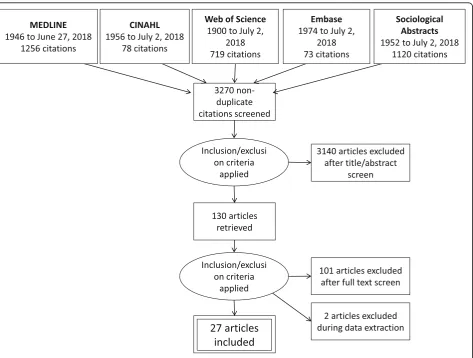
A total of 3531 articles were retrieved, of which 27
met inclusion criteria. Figure 1 shows the PRISMA
flow diagram of included and excluded studies.
Figure 2 depicts the frequency of publications by
year. The USA and Italy (eight each) led in
fre-quency, with Canada (4), Australia (2), the
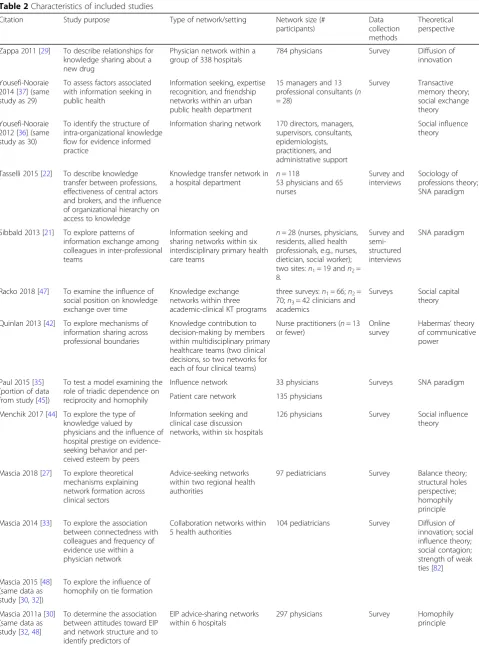
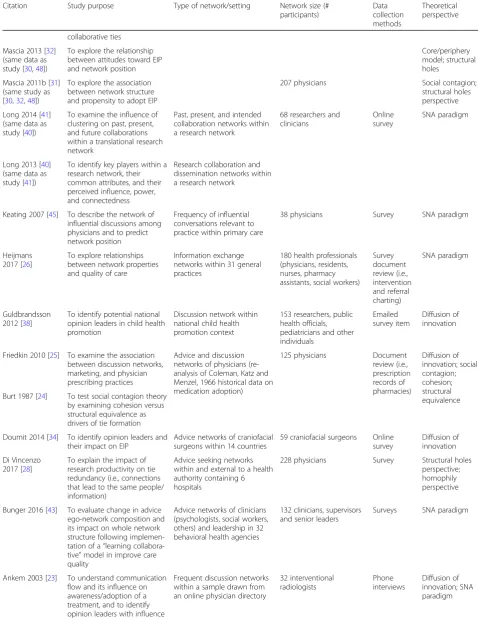
Netherlands (2), the UK (2), and Sweden (1) follow-ing. Study characteristics are presented in Table 2. Tallies and proportions of these studies presented in the following paragraphs do not sum to 100% in cases where the categories of characteristics are not
mutually exclusive (e.g., a study may employ
visualization of network properties while also pre-senting descriptive network property values).
Study design and data collection
The 21 studies’ data sets were described in 27 articles, all but 2 of which employed cross-sectional designs yielding data at single time-points. Seventeen (81%) of the studies collected SNA data through surveys, 2 (10%) using a survey alongside interviews to support SNA data interpretation [21, 22], and 1 (5%) through telephone
interviews [23]. Two (10%) studies employed document review (i.e., prescription, referral, or intervention re-cords); one for SNA data collection and one to support outcome measurement [24–26].
Networks and actors
Physician-only networks were the most commonly studied (11, 52%) [23–25,27–35], followed by interpro-fessional networks of researchers and clinicians (6, 29%) [36–41]. Only one study (5%) examined the net-work of nurses and physicians [22], and one a network of nurse practitioners [42]. Two of the interprofessional networks included public health officials [36–38], one included leadership (i.e., directors, managers) and ad-ministrative support personnel [36, 37], and one in-cluded leadership and knowledge brokers [39]. In some cases, interprofessional network members’ professions or formal roles within the network were not clearly in-dicated [21, 38, 39]. For two studies, the analysis of a subset of network members (i.e., managers/professional consultants; physicians with specific clinical workloads) was carried out [35,40].
Studies examined networks ranging in size from 13 to 784 participants, with a mean of 153. Just over half the studies (12, 57%) were conducted across organizational boundaries [23–28, 30–35, 43]. Eight (38%) were conducted within a single health care organization [21,22,29,36,37,39,42,44,
45], one (5%) was conducted within a research-focused net-work [40,41], and one (5%) within a health-specific field at a national level [38].
Table 2Characteristics of included studies
Citation Study purpose Type of network/setting Network size (# participants)
Data collection methods
Theoretical perspective
Zappa 2011 [29] To describe relationships for knowledge sharing about a new drug
Physician network within a group of 338 hospitals
784 physicians Survey Diffusion of innovation
Yousefi-Nooraie 2014 [37] (same study as 29)
To assess factors associated with information seeking in public health
Information seeking, expertise recognition, and friendship networks within an urban public health department
15 managers and 13 professional consultants (n = 28)
Survey Transactive memory theory; social exchange theory
Yousefi-Nooraie 2012 [36] (same study as 30)
To identify the structure of intra-organizational knowledge flow for evidence informed practice
Information sharing network 170 directors, managers, supervisors, consultants, epidemiologists, practitioners, and administrative support
Social influence theory
Tasselli 2015 [22] To describe knowledge transfer between professions, effectiveness of central actors and brokers, and the influence of organizational hierarchy on access to knowledge
Knowledge transfer network in a hospital department
n= 118
53 physicians and 65 nurses
Survey and interviews
Sociology of professions theory; SNA paradigm
Sibbald 2013 [21] To explore patterns of information exchange among colleagues in inter-professional teams
Information seeking and sharing networks within six interdisciplinary primary health care teams
n= 28 (nurses, physicians, residents, allied health professionals, e.g., nurses, dietician, social worker); two sites:n1= 19 andn2= 8.
Survey and semi-structured interviews
SNA paradigm
Racko 2018 [47] To examine the influence of social position on knowledge exchange over time
Knowledge exchange networks within three academic-clinical KT programs
three surveys:n1= 66;n2= 70;n3= 42 clinicians and academics
Surveys Social capital theory
Quinlan 2013 [42] To explore mechanisms of information sharing across professional boundaries
Knowledge contribution to decision-making by members within multidisciplinary primary healthcare teams (two clinical decisions, so two networks for each of four clinical teams)
Nurse practitioners (n= 13 or fewer)
Online survey
Habermas’theory of communicative power
Paul 2015 [35] (portion of data from study [45])
To test a model examining the role of triadic dependence on reciprocity and homophily
Influence network 33 physicians Surveys SNA paradigm
Patient care network 135 physicians
Menchik 2017 [44] To explore the type of knowledge valued by physicians and the influence of hospital prestige on evidence-seeking behavior and per-ceived esteem by peers
Information seeking and clinical case discussion networks, within six hospitals
126 physicians Survey Social influence theory
Mascia 2018 [27] To explore theoretical mechanisms explaining network formation across clinical sectors
Advice-seeking networks within two regional health authorities
97 pediatricians Survey Balance theory; structural holes perspective; homophily principle
Mascia 2014 [33] To explore the association between connectedness with colleagues and frequency of evidence use within a physician network
Collaboration networks within 5 health authorities
104 pediatricians Survey Diffusion of innovation; social influence theory; social contagion; strength of weak ties [82]
Mascia 2015 [48] (same data as study [30,32])
To explore the influence of homophily on tie formation
Mascia 2011a [30] (same data as study [32,48]
To determine the association between attitudes toward EIP and network structure and to identify predictors of
EIP advice-sharing networks within 6 hospitals
297 physicians Survey Homophily
Table 2Characteristics of included studies(Continued)
Citation Study purpose Type of network/setting Network size (# participants)
Data collection methods
Theoretical perspective
collaborative ties
Mascia 2013 [32] (same data as study [30,48])
To explore the relationship between attitudes toward EIP and network position
Core/periphery model; structural holes
Mascia 2011b [31] (same study as [30,32,48])
To explore the association between network structure and propensity to adopt EIP
207 physicians Social contagion;
structural holes perspective
Long 2014 [41] (same data as study [40])
To examine the influence of clustering on past, present, and future collaborations within a translational research network
Past, present, and intended collaboration networks within a research network
68 researchers and clinicians
Online survey
SNA paradigm
Long 2013 [40] (same data as study [41])
To identify key players within a research network, their common attributes, and their perceived influence, power, and connectedness
Research collaboration and dissemination networks within a research network
Keating 2007 [45] To describe the network of influential discussions among physicians and to predict network position
Frequency of influential conversations relevant to practice within primary care
38 physicians Survey SNA paradigm
Heijmans 2017 [26]
To explore relationships between network properties and quality of care
Information exchange networks within 31 general practices
180 health professionals (physicians, residents, nurses, pharmacy assistants, social workers)
Survey document review (i.e., intervention and referral charting)
SNA paradigm
Guldbrandsson 2012 [38]
To identify potential national opinion leaders in child health promotion
Discussion network within national child health promotion context
153 researchers, public health officials, pediatricians and other individuals
Emailed survey item
Diffusion of innovation
Friedkin 2010 [25] To examine the association between discussion networks, marketing, and physician prescribing practices
Advice and discussion networks of physicians (re-analysis of Coleman, Katz and Menzel, 1966 historical data on medication adoption)
125 physicians Document review (i.e., prescription records of pharmacies)
Diffusion of innovation; social contagion; cohesion; structural equivalence Burt 1987 [24] To test social contagion theory
by examining cohesion versus structural equivalence as drivers of tie formation
Doumit 2014 [34] To identify opinion leaders and their impact on EIP
Advice networks of craniofacial surgeons within 14 countries
59 craniofacial surgeons Online survey
Diffusion of innovation
Di Vincenzo 2017 [28]
To explain the impact of research productivity on tie redundancy (i.e., connections that lead to the same people/ information)
Advice seeking networks within and external to a health authority containing 6 hospitals
228 physicians Survey Structural holes perspective; homophily perspective
Bunger 2016 [43] To evaluate change in advice ego-network composition and its impact on whole network structure following implemen-tation of a“learning collabora-tive”model in improve care quality
Advice networks of clinicians (psychologists, social workers, others) and leadership in 32 behavioral health agencies
132 clinicians, supervisors and senior leaders
Surveys SNA paradigm
Ankem 2003 [23] To understand communication flow and its influence on awareness/adoption of a treatment, and to identify opinion leaders with influence
Frequent discussion networks within a sample drawn from an online physician directory
32 interventional radiologists
Phone interviews
Study purposes and data analysis methods
A SNA perspective has been used to explore the patterns and efficiencies of information sharing within and across professions, to identify positions of influence and determine their effectiveness, to predict or to explain patterns of ties based on attributes or network structure, to compare the structural characteristics of different models of KT, and to examine the relationship between network properties and EIP attitudes and behaviors. Using a longitudinal approach, SNA has been used to evaluate the influence of social struc-ture on knowledge exchange over time, as well as to evaluate
network change following a quality improvement
intervention.
The majority of articles focused on information flow, while individuals’adoption of a clinical practice, involve-ment in collaborations that support KT or EIP, and evi-dence-informed group decision-making garnered less interest. No research was available on other KT activ-ities, such as the processes involved in developing guide-lines or other KT tools, adapting knowledge to the local context, assessing barriers to change, facilitating depart-mental- or organizational-level practice or service deliv-ery changes (including de-implementation), monitoring evidence use, evaluating KT effectiveness, or sustaining change over time [46].
Describing networks
Eight (29%) of the 27 articles described networks by deriving network properties from relational data [21, 22, 30,36, 39,
40,42]. Two articles (10%) used conventional descriptive sta-tistics (e.g., frequency counts, proportions) to describe social network data [34,38]. Network visualizations illustrated the data in 13 (48%) articles [22, 30, 32,34–37,40, 42–45]. Of these, ten articles presented whole network graphs (i.e., illus-trations of the network structure), two presented network graphs of subgroups within the network, and one mapped whole networks within graphs that accounted for covariates. Network properties represented in the graphs included cen-trality (i.e., connectedness, brokers (i.e., bridgers)), core ver-sus periphery structure (i.e., central areas of high connectivity versus peripheral areas of lower connectivity), and tie strength (e.g., frequency of contact); and attributes,
such as gender, professional role, size of clinical practice, and division, department or team, and organization or site. Visu-alizations were used to depict network property configura-tions (i.e., illustrated the definiconfigura-tions of network properties) in two articles. Conventional charts (e.g., boxplots, scatterplots and bar, line, and area charts) were also used in six articles to visualize relationships between variables (e.g., network prop-erties with one another, diffusion or adoption over time, cen-trality versus adoption timing, or receipt of useful information, percentage of ties by strength at different time points).
Testing hypotheses (network modeling)
Fourteen articles described the use of regression, including ordinary least squares [24,28,32,44,47], ordinal logistic re-gression [33], multi-level modeling [25,26,37], P2 logistic re-gression [35, 45], linear regression [22], and MR-QAP analysis [30, 48]. Regression was used to test theory about the cause of social structure [24, 25,28,35, 48], to explain the impact of social structure on knowledge exchange behav-iors [47], ease of knowledge transfer [22], receipt of useful knowledge [22], or quality of care [26], and to describe the influence of hospital prestige on evidence-seeking behavior and perceived esteem by peers [44]. Three articles reported pairedttests or Wilcoxon ranks to evaluate differences be-tween groups [22,26] or time points [43], the latter of which also employed analysis of variance. Two articles described the use of the Chi-square test to examine associations be-tween attributes and network position, or bebe-tween two attri-butes [23,40]. Exponential random graph models were used in three instances to predict or to explain the formation of ties based on attributes and network structure [27,29,37], and a single study employed factor analysis to construct groupings of individuals based on frequency of information exchange [23]. No studies employed stochastic actor-based network modeling to examine network change over time.
Sample hypotheses relating to tie formation included predictors, such as homophily, existing ties (leading to reciprocity), and having a formal mechanism within the organization for interacting. Further hypothesis examples included that higher professional status would be associ-ated with more knowledge exchange, tie homophily (i.e.,
Table 2Characteristics of included studies(Continued)
Citation Study purpose Type of network/setting Network size (# participants)
Data collection methods
Theoretical perspective
D’Andreta 2013 [39]
To compare the network structures of three research/KT program initiatives
Informal advice giving and seeking networks within each of three academic-clinical KT programs
n= ~ 260 (directors, managers, program leaders, knowledge brokers, researchers, and others unspecified)
Online survey
SNA paradigm; Epistemic differences perspective
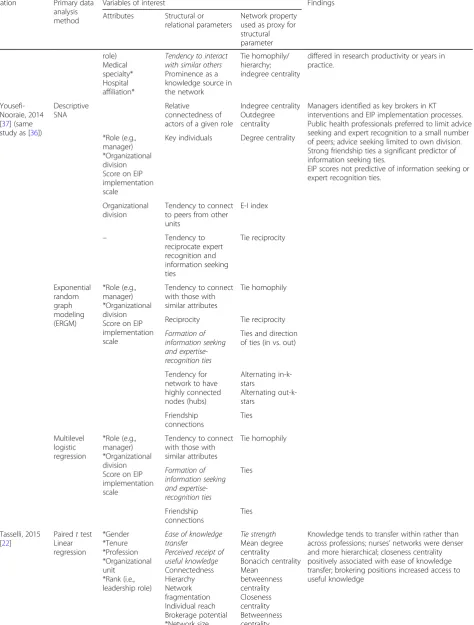
Table 3Variables, network properties and key findings
Citation Primary data analysis method
Variables of interest Findings
Attributes Structural or relational parameters
Network property used as proxy for structural parameter
Descriptive/exploratory studies
Yousefi-Nooraie 2012 [36] (same study as [37])
Deriving network properties to describe the network
_ Connectedness Whole network
density
Low density (1.2%) observed
Information exchange
Tie reciprocity Head management division identified as central cluster bridging organizational divisions, with hierarchical information flow.
Expertise recognition and information seeking clustered within divisions; friendships spanned departments;
Friendship and expertise recognition predicted information seeking ties;
Network-identified brokers should receive same interventions and supports as formal brokers Prestige (key actors) Indegree centrality
Mediating power of actors
Betweenness centrality
Subgroups of connected actors
Clusters
Brokers (actors connecting distinct teams/clusters of alters)
Brokerage patterns (measured by which groups the information source amd its recipients belonged)
Sibbald 2013 [21]
Deriving network properties to describe the network
– Cohesiveness related
to giving and seeking research-related information
Whole network density
Low density for information seeking and giving (7–12%) observed; suggested these behaviors not a central focus of the interprofessional relationships
Profession Key players (prestige) in giving and seeking research information
Indegree centrality Medical residents prominent in knowledge exchange; physician seen as primary implementer of evidence; nurses as intermediaries between physicians and support staff; allied health more likely to draw information from external networks
Quinlan 2013 [42]
Deriving network properties to describe the network
Profession tenure of the team Occupational distance among members Number of team members
Communicative power (i.e., the facilitation of mutual understanding among other team members)
Flow betweenness centrality
True interprofessional decision-making attributed to low structural hierarchy. Nurse practitioners (in newly formed teams) and registered nurses (in established teams) tended to have greatest communicative power. Mutual understanding and professions’involvement varied across clinical decision-making episodes
Change in flow betweenness centrality between clinical decisions
Long 2014 [41] (same study as [40])
Descriptive SNA; correlations among specific network properties and/or attributes
Geographic proximity profession (e.g., clinicians/ researchers)
Grouping based on similarity in attributes
# components Geographical proximity, professional homophily associated with clustering (past collaborations); geographical proximity and past collaborative ties influenced current and future collaborations. Intended future collaborations were more interprofessional.
Network density varied across networks (current 4%, future 27%, past 31%).
Weak ties and reputation associated with intention for future collaboration; strong ties associated with current collaborations.
External-internal (E-I) indices based on tie homophily
Clustering coefficients (comparing ego-and whole net-work density)
– Past strong
collaborations; Current or future collaborations
Past collaboration network tie strength; Current or future collaboration ties
Previous experience in the field
Current or future collaborations
Current or future collaboration ties
Actor’s reputation
Indirect contacts Future collaboration network tie strength
Future intended collaborations
Future
Table 3Variables, network properties and key findings(Continued)
Citation Primary data analysis method
Variables of interest Findings
Attributes Structural or relational parameters
Network property used as proxy for structural parameter
Long 2013 [40] (same study as [41])
Chi square analyses to test for association between attributes and network position (i.e., key actor status) Current workplace Gender Membership in other networks Qualifications Approach to work within the network
Key actors (with respect to power, influence or connectedness)
Indegree centrality Betweenness centrality
A manager, and specific researchers and clinicians identified as key players. Apart from expert status and valuing
adequate network resources, network-identified central players and formal brokers had little in common.
Planned interventions and support for formal broker roles may be misdirected if not also offered to network-perceived central players or brokers.
Network members may be better able to correctly identify central actors than formal brokers
Guldbrandsson 2012 [38]
Traditional descriptive statistics, e.g., frequency counts, percentages Profession Work organization Geographical region Information seeking about child health promotion
Tie homophily (%) Indegree centrality (frequency of being named)
Organization and professional field were shared in nearly half of all information seeking ties
Doumit 2014 [34]
Percentage of people nominating an actor; descriptive statistics (frequency counts, percentages)
– Influence by central
actors
Degree centralization
Six individuals with high credibility influenced 85% of the network, suggesting opinion leaders have potential for supporting evidence use Reasons for change in medical approach (proportions) – –
Barriers to clinical decision-making (proportions)
– –
D’Andreta 2013 [39]
Deriving network properties to describe the network (descriptive SNA) KT model adopted
Prestige within the network
Degree centralization
KT teams with different models of KT (i.e., focus on research dissemination vs. knowledge co-production and brokering vs. integrated research-clinical collaboration)
varied in their structural properties (e.g. the prominence and control of leaders in KT processes)
Control over knowledge
Betweenness centralization
Access to knowledge Closeness centralization
Alternate paths for knowledge flow that circumvent central actors Flow betweenness centralization Organizational role (e.g., director, support staff) Core
actors—dominant individuals with frequent knowledge exchange Coreness scores (core-periphery algorithm) Predictive/explanatory studies Zappa 2011 [29]
Descriptive SNA
External communication (# visits from drug representatives); research orientation (# publications); clinical experience; hierarchical position (administrative Colleagues with whom knowledge is discussed and transferred
Network density Low network density (0.3%)
Components Multiple small components suggested lack of strong opinion leaders to drive treatment adoption. Findings suggest physicians tend to build small, closed, non-hierarchical internal, and external connections within their professional group, potentially limiting broader access to new information
Isolates tended to be clinically experienced and active in research.
Advice sharing more likely if physicians shared a medical speciality, geographic proximity but Exponential
Random Graph models (p* models)
Tendency to exchange information with a number of sources
Alternating k-stars
Tendency to share knowledge within a small peer group (network closure)
Table 3Variables, network properties and key findings(Continued)
Citation Primary data analysis method
Variables of interest Findings
Attributes Structural or relational parameters
Network property used as proxy for structural parameter
role) Medical specialty* Hospital affiliation*
differed in research productivity or years in practice.
Tendency to interact with similar others Prominence as a knowledge source in the network
Tie homophily/ hierarchy; indegree centrality
Yousefi-Nooraie, 2014 [37] (same study as [36])
Descriptive SNA
Relative connectedness of actors of a given role
Indegree centrality Outdegree centrality
Managers identified as key brokers in KT interventions and EIP implementation processes. Public health professionals preferred to limit advice seeking and expert recognition to a small number of peers; advice seeking limited to own division. Strong friendship ties a significant predictor of information seeking ties.
EIP scores not predictive of information seeking or expert recognition ties.
*Role (e.g., manager) *Organizational division Score on EIP implementation scale
Key individuals Degree centrality
Organizational division
Tendency to connect to peers from other units
E-I index
– Tendency to
reciprocate expert recognition and information seeking ties
Tie reciprocity
Exponential random graph modeling (ERGM)
*Role (e.g., manager) *Organizational division Score on EIP implementation scale
Tendency to connect with those with similar attributes
Tie homophily
Reciprocity Tie reciprocity
Formation of information seeking and expertise-recognition ties
Ties and direction of ties (in vs. out)
Tendency for network to have highly connected nodes (hubs)
Alternating in-k-stars
Alternating out-k-stars
Friendship connections
Ties
Multilevel logistic regression
*Role (e.g., manager) *Organizational division Score on EIP implementation scale
Tendency to connect with those with similar attributes
Tie homophily
Formation of information seeking and expertise-recognition ties
Ties
Friendship connections
Ties
Tasselli, 2015 [22]
Pairedttest Linear regression
*Gender *Tenure *Profession *Organizational unit
*Rank (i.e., leadership role)
Ease of knowledge transfer
Perceived receipt of useful knowledge Connectedness Hierarchy Network fragmentation Individual reach Brokerage potential *Network size
Tie strength Mean degree centrality Bonacich centrality Mean
betweenness centrality Closeness centrality Betweenness centrality
Table 3Variables, network properties and key findings(Continued)
Citation Primary data analysis method
Variables of interest Findings
Attributes Structural or relational parameters
Network property used as proxy for structural parameter
*Degree centrality
Menchik 2010 [44]
OLS regression
# medical literature database searches per month # journals read regularly *Age *Gender *Tenure at hospital *Medical school *% clinical time *Sub-specialization Prestige of hospital (published rankings)
Relational esteem by colleagues
Indegree centrality Physicians in higher prestige hospitals were less likely to be named as advice givers. Prestige in these settings associated with medical school attended.
In lower-prestige hospitals, regularly reading a range of journals, and less time spent on clinical work increased likelihood of high esteem by colleagues
Mascia 2014 [33]
Ordinal logistic regression
Self-reported frequency of EIP use
*Gender *# patients in caseload *area of clinical practice (e.g., asthma, urology, etc.)
*# article subscriptions *perceptions of barriers to availability of evidence *perceptions of difficulty applying evidence to practice *Organizational affiliation *Affiliation to formal groups *Collaborative nature of actor’s medical practice
Degree of collaboration with colleagues
Outdegree centrality
Degree centrality directly associated with physicians’EIP use
Mascia 2018 [27]
Exponential random graph models
*Past task force involvement *Tenure *Gender *Geographic distance *Association members *Health district
Tendency to reciprocate advice Tendency to seek advice from an indirect tie Tendency for local, generalized exchange of advice *Tendency to form advice ties *Popularity as an advice source *Advice-seeking activity
Tie reciprocity Transitivity (path closure) Cyclic closure *Density *Indegree centrality *Outdegree centrality *Formation of non-closure structures *Tie homophily (of attributes)
Table 3Variables, network properties and key findings(Continued)
Citation Primary data analysis method
Variables of interest Findings
Attributes Structural or relational parameters
Network property used as proxy for structural parameter
*Brokering
Mascia 2015 [48] (same data as [31], [30] and [32])
Multiple regression-quadratic as-signment procedure (MR-QAP)
Age Gender Tenure/seniority
Frequency of collaboration Similarity of professional role, institution and geographical location
Tie strength Tie homophily
Ties more likely if specialization, institution were the same between individuals; less likely if similar roles, greater difference in time since graduation and further geographic distance; professional homophily better predictor than institutional homophily
Mascia 2013 [32] (same data as [48], [30] and [31])
Descriptive SNA
Age* Gender* Hospital tenure* Tenure in health authority* Managerial role* Geographical distance from colleagues* Affiliation with other organizations* Self-reported EIP adoption (i.e. frequency of database searching)
Connectedness Whole network density
Low density (5.7%) observed
OLS regression
Network authority(i.e., importance—relevant and popular)
Hubs and authorities centrality
The most active EIP practitioners likely to be found at network periphery (i.e. least central)
Degree of coreness in the network
Network coreness score (degree centrality and core-periphery position)
Mascia 2011b [31] (same data as [48], [32] and [30])
Ordinal logistic regression
Tendency to adopt EIP (self-reported frequency of peer-reviewed research use)
Age* Gender* Tenure in health authority/ organization* Managerial role* # publications* Perceived access to evidence* Hospital affiliation*
Extent to which a given tie is redundant because of concurrent ties with another alter
Ego-network constraint
Physicians with greater network constraint (i.e., many redundant ties) reported decreased EIP adoption. May be related to information bias—tendency of physicians to interpret the information in a way that is congruent with their previous knowledge or opinion.
High degree centrality associated with EIP use. Individual’s network
size*
Total # of ties in ego-network (indegree + outde-gree centrality)*
Mascia 2011a [30] (same data as [32, 48])
Descriptive SNA
– Average number of
advice exchange colleagues
Mean ego-network density
Advice sharing most likely when physicians shared a medical specialty, geographic proximity, similar attitudes toward EIP, or had co-authored publications.
Collaboration less likely when actors held similar managerial roles, or were at different hospitals/ clinical/geographical areas.
Tendency for colleagues to both give and receive advice with one another
Tie reciprocity
Multiple regression quadratic assignment procedures (MR-QAP analysis)
– Advice exchange
among pairs of physicians
Ego-network ties
Similarity between pairs of tied actors in: Geographical distances Gender* Age* Medical specialization*
Table 3Variables, network properties and key findings(Continued)
Citation Primary data analysis method
Variables of interest Findings
Attributes Structural or relational parameters
Network property used as proxy for structural parameter
Clinical experience* Tenure in health authority/ organization* Managerial role* # publications* Co-authorship* EIP adoption (self-reported frequency of peer-reviewed re-search use)*
Paul 2015 [35] Extended p2 model with Bayesian modeling and estimation *Age Patient age Patient sex Patient race Patient health status Patient intensity of care
Relative # shared patients *Same gender *Same specialty *Same location Reciprocity Social dependence (clustering) Density Tie homophily Tie reciprocity Alternating independent two-paths Transitive triads Alternating k-stars (two-stars)
Low network density (0.10) observed. Triadic clustering higher than chance. Ties not associated with gender/specialty homophily.
Location positively associated with ties. Complementary expertise positively associated with patient sharing.
Transitivity may account for reciprocity
Gender Clinic % female patients Self-identify as expert # clinics per week
# years practicing in the city Tenure at hospital Years clinical experience Location of training Involvement in influential discussions Whole network density
Low density (0.154) observed; reciprocity more likely than not—may be an artifact of transitivity; high triadic clustering observed; same clinic and gender, expert, higher clinical caseload increased tendency for tie formation
Keating 2007 [45]
P2 logistic regression analysis
Self-identified experts seen as more influential; no relationship between # years in practice or location of work or training.
Clustering with respect to EIP knowledge exchange observed between those with greater # of patients and higher frequency of clinical sessions.
High reciprocity observed in the absence of opinion leaders with high centrality. Being perceived as
influential
Indegree centrality
Perceiving others as influential
(information seeking)
Outdegree centrality
Reciprocity Tie reciprocity
Heijmans 2017 [26]
Paired samplet tests/ Wilcoxon tests Logistic multi-level analyses *Patient age *Patient sex *Patient group *Patient illness status *Treatment/ control group for parallel randomized controlled trial
Connectedness Frequency of contact Influence of coordinator Similarity in attitudes related to treatment goals
Presence of opinion leader *Network size Density Tie strength Degree centrality Homophily (E-I index)
% of possible in-degree ties
Low density (0.37 and 0.38) observed. Most ties between those who did not value achieving treatment goals.
General practitioner most likely named as opinion leader.
Nurse performance associated with consistently identified opinion leader.
Lack of tie homophily for positive attitudes associated with poor clinical outcomes
Friedkin 2010 [25]
Random intercept multi-level event history model Professional age Chief or honorary position (yes/no) Number of journals read Value keeping up with scientific developments Physicians’ adoption of a new antibiotic (i.e., prescribing behavior) Marketing patterns of drug companies
Influence of advisors/ discussion partners
Contact network role (CNET)—a summative measure of 4 measures of structural cohesion and structural equivalence; position in the medical advice network
Table 3Variables, network properties and key findings(Continued)
Citation Primary data analysis method
Variables of interest Findings
Attributes Structural or relational parameters
Network property used as proxy for structural parameter
Proportion of previous adopters at a given time (“internal contagion”)
Di Vincenzo 2017 [28]
Ordinary Least Squares regression
# publications *Tenure *Managerial role *Geographic distance *Hospital affiliation *# publications from same-specialty colleagues
Dependence on others/access to new information Relative productivity among ego-network colleagues Same role Same specialty
Ego-network constraint Euclidian distance *Ego-network size
Young employees appeared to have more redundant networks (greater need for advice). Hospital affiliation (i.e., context) influenced constraint.
Constraint negatively associated with ego-network size and relative productivity (mediated by profes-sional group membership), positively with product-ivity, Euclidean distance, role/specialty homophily (augments impact of productivity on prestige)
Burt 1987 [24] Ordinary least squares regression with likelihood-ratio chi-squared test
Timing of adoption Relative timing of adoption within the network Professional age Contact with drug company Number of journals read Number of house calls vs. office visits Value keeping up with scientific developments
Position in the medical advice/ discussion network
Structural equivalence
Adoption by others in equivalent positions within the network was a stronger predictor of adoption than adoption by those in an individual’s advice or discussion networks.
Early adopters tended to participate in a range of EIP behaviors.
Adoption by prominent physicians seen to be related to their desire to avoid being late adopters. Influence of advisors/
discussion partners
Structural cohesion
Ankem 2003 [23]
Chi-square statistics
Preferred information source Timing of awareness of the intervention Timing of intervention adoption
– – Clinical networks were most prominent in fostering
awareness and adoption of a clinical intervention, but research and social networks also likely to influence these processes.
Early adopters tended to rely on journals and conferences for information informing practice change; late adopters to a greater extent by network contacts.
Factor analysis
Specialization Hospital City Timing of adoption Frequency of communication with colleagues
Types of relations within the network (e.g., clinical, research, leisure)
Ties
Groupings of information exchange relations
Cliques
Longitudinal evaluative studies
Racko 2018 [47]
Ordinary least squares regression
Professional status (ranking) *Professional role *Gender *Education *Organizational status
Research collaboration Joint decision-making
Connectedness to high-status individuals Connectedness to knowledge brokers
Ego-network size via tie heterophily Tie strength Mean status score of ego-network relative to whole network % of possible ties *Tie homophily
Higher social status associated with more research collaboration at all time points, and joint decision-making in early phases.
Higher-status ties with peers, ties to formal knowledge brokers and ties to unfamiliar peers inconsistently predicted knowledge exchange, research collaboration and joint decision-making over time.
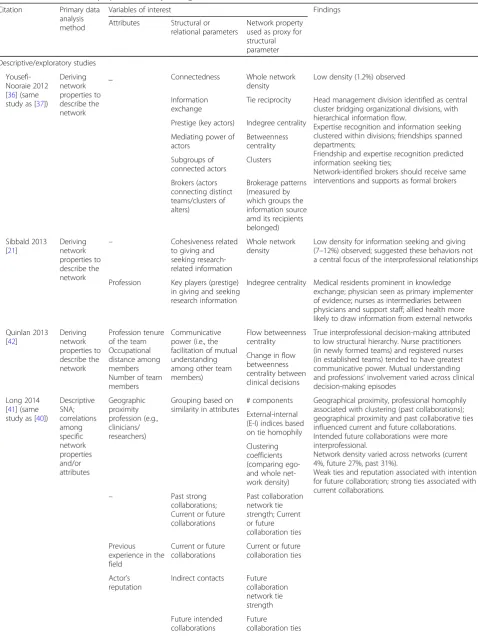
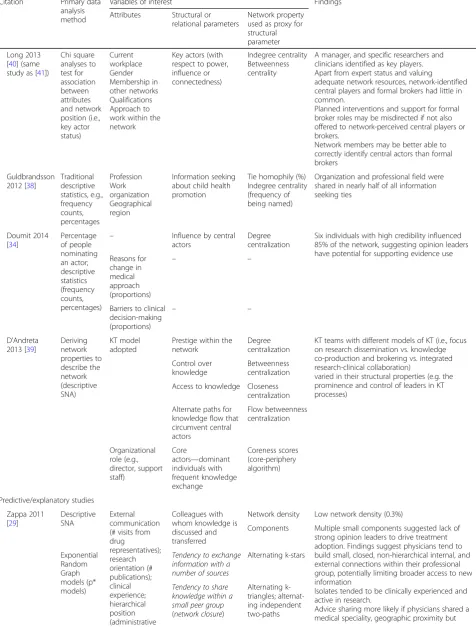
sharing the same profession with a connection) would be associated with greater knowledge transfer ease, the pres-ence of brokers (bridgers) would be associated with an increase in the receipt of useful information, particularly to managers, and that greater connectivity, frequency of contact, homophily, the presence of a highly connected clinical coordinator, and being an opinion leader would be associated with an increase the use of best practices. For more information about the full array of correlational, dependent and independent variables and covariates (both relational variables and attributes) identified in the in-cluded studies, refer to Table3.
Information seeking patterns varied across professions and networks, with health professionals from some disci-plines having a tendency to form small, closed sub-groups, while others demonstrated greater connectivity and reach within the network, increased hierarchy (e.g., reliance on “gatekeepers” of information spreading it in a top-down approach), or relied more on sources of in-formation or support external to the network (e.g., other organizations). Available information suggests that iso-lated individuals and those less connected at the periph-ery of the network may have more clinical experience and be more evidence-based in their practices than those at the network core [29, 32]. In the absence of a core-periphery structure (i.e., a more highly connected center with a less connected network periphery), degree centrality (i.e., the number of connections an individual has) may be a key factor associated with EIP use, at least for physicians [33]. A network-identified broker or opin-ion leader may increase access to useful knowledge [14], improve practice performance [26], and facilitate networking across professions [47].
Network properties
Table 3 summarizes the key variables under study, the network properties that were derived from relational data, and the relational parameters (i.e., the constructs for which the network properties were acting as prox-ies). For example, network density was used as a proxy for connectedness in one study, and for representing the number of shared patients in another. Attributes of interest (which included individual characteristics, such as profession and gender; environmental characteristics, such as organization; social attributes, such as per-ceived reputation; and KT-related measures, such as EIP attitude scores) are also presented to offer a sum-mary of the nature of non-SNA variables that have been analyzed alongside network properties. Study findings are presented in the final column for interest.
Eleven articles explored only a single or pair of net-work properties. Although 28 netnet-work properties were identified during data extraction, the majority of authors examined centrality, tie characteristics (e.g., the directions of the interactions; similarity in characteris-tics among pairs of connected individuals), and density (i.e., the proportion of ties relative to all possible ties) as their network properties of interest. Tie homophily (i.e., similarity of connected individuals on a given attri-bute, such as gender), indegree centrality (i.e., the num-ber of people naming an individual as being connected to them), whole network density, the presence of ties, and tie reciprocity (i.e., bi-directionality in reported interactions or connections) were the most prevalent structural properties studied. The study authors’ discus-sions about the influences of these network properties
were clearly linked to prominent theoretical
Table 3Variables, network properties and key findings(Continued)
Citation Primary data analysis method
Variables of interest Findings
Attributes Structural or relational parameters
Network property used as proxy for structural parameter
Connectedness to unfamiliar peers *Intra-professional whole network size
interprofessional networking
Bunger 2016 [43]
Pairedttests; one-way analysis of variance; de-scriptive SNA
Role (faculty expert, internal colleague, external peer, private practitioner, other)
Connectedness Lack of advice seeking/sharing Reciprocity Similarity in connectedness Tendency for sub-groups to form Same institution Frequency of communication
Density Isolates Tie reciprocity Indegree centralization Clustering Tie homophily Tie strength
Ego-network size decreased, more markedly for senior leaders.
Exposure to private practitioners and“others” decreased; exposure to experts increased. Substantial turnover in dyads was reported, with greater tie density around central core of experts. Reciprocity and tie heterophily increased over time
perspectives. Less emphasis was placed on the analysis of centralization (i.e., the evenness of the distribution of connections), subgroups (i.e., groups of connected individuals not connected to other groups within the network), and transitivity (i.e., patterns related to sets of three individuals and their tendencies to share con-nections with one another).
Attributes, such as research versus clinical product-ivity, professional field or specialty, leadership role and organizational prestige [29, 30, 35, 38, 44, 48], as well as the presence of other types of ties (e.g., friendship, expertise recognition, previous collabora-tions) [30, 36], appear to be predictive or explanatory factors for the formation of information seeking or research collaboration ties. Conflicting findings re-garding the influence of EIP attitudes, experience, gender, and geographical proximity on tie formation were identified [27, 30, 35, 37, 45].
Use of theory
Diffusion of innovation was the theory most fre-quently applied (seven articles) [23–25, 29, 33, 34,
38]; social contagion theory [24, 25, 33] and social in-fluence theory [33, 36, 44] were used in four and three studies, respectively. A model combining trans-active memory theory and social exchange theory [37], as well as Habermas’ theory of communicative power [42], social capital theory [47], sociology of professions theory [22], balance theory [27], and an epistemic differences perspective [39], were applied in one instance each. Most commonly, theory was used to select network properties to examine and to de-velop hypotheses to test. In addition, theory was used to provide background information about SNA or the topic under study, to assist in the interpretation of findings, and to develop and test new analytical methods to advance the field of SNA.
Several other articles employed SNA-specific theor-etical perspectives to exploratory analysis, including applying Granovetter’s strength of weak ties perspec-tive [33], examining the association between structural holes (i.e., areas lacking connections) and the estab-lishment of brokers that bridge network gaps [27, 28] or between a lack of ties and EIP attitudes [32], examining the role of social pressure on tie formation [24, 25], exploring the influence of being within a highly connected core of the network versus a less connected peripheral area on attitudes toward EIP [32], and evaluating network dynamics relative to the homophily principle (i.e., the tendency of people to form connections with similar others) [27, 28]. Seven articles employed a SNA paradigm without reference to a specific theory [21, 26, 35, 40, 41, 43, 45].
Discussion
Publication characteristics
While SNA has a long history in fields, such as soci-ology, mathematics, and psychsoci-ology, its popularity in health care has shown momentum since the early 2000s [6]. Annual publication trends suggest an emer-ging interest in SNA as an approach to study KT processes and determinants since 2010. This concen-tration follows work by Thomas Valente and colleagues in the mid-late 2000s. Their work applied SNA in health care to identify and to evaluate brokers and opinion leaders as a means of promoting behavior change, linked communication networks and diffusion principles to health promotion research, and applied network principles to the study of community-based cancer research [49–51]. Increasing interest in the util-ity of SNA across a range of health care contexts, and the relative maturity of this field, may contribute to its continued use in the newer field of KT to embed new practices across settings.
Study design and data collection
More longitudinal research would allow us to determine the direction of the causal relationships between network structures and attribute variables, such as EIP attitudes and behaviors, for better prediction of imple-mentation outcomes. Such research would also enable the evaluation of changes in network connection pat-terns over time. This approach can be used to assess the impact of network interventions. Network interventions can use socially based strategies to identify and target network gaps [52] (e.g., interactive forums to help estab-lish connections for isolated individuals or groups) to enhance KT processes, organizational capacity, or adher-ence to desired behavior (e.g., through social influadher-ence) [53]. Network interventions may also harness strengths in a network [52,53] (e.g., engaging highly connected in-dividuals to exert influence or to share resources) to bet-ter mobilize EIP attitudes, behaviors, or information flow for sustained implementation.