R E S E A R C H
Open Access
Theory-based development of an
implementation intervention to increase
HPV vaccination in pediatric primary care
practices
Jane M. Garbutt
1,2*, Sherry Dodd
2, Emily Walling
2,3, Amanda A. Lee
4, Katharine Kulka
2and Rebecca Lobb
4Abstract
Background:The national guideline for use of the vaccine targeting oncogenic strains of the human papillomavirus (HPV) is an evidence-based practice that is poorly implemented in primary care. Recommendations include completion of the vaccine series before the 13th birthday for girls and boys, giving the first dose at the 11- to 12-year-old check-up visit, concurrent with other recommended vaccines. Interventions to increase implementation of this guideline have had little impact, and opportunities to prevent cancer continue to be missed.
Methods:We used a theory-informed approach to develop a pragmatic intervention for use in primary care settings to increase implementation of the HPV vaccine guideline recommendation. Using a concurrent mixed methods design in 10 primary care practices, we applied the Consolidated Framework for Implementation Research (CFIR) to systematically investigate and characterize factors strongly influencing vaccine use. We then used the Behavior Change Wheel (BCW) and the Theoretical Domains Framework (TDF) to analyze provider behavior and identify behaviors to target for change and behavioral change strategies to include in the intervention.
Results:We identified facilitators and barriers to guideline use across the five CFIR domains: most distinguishing factors related to provider characteristics, their perception of the intervention, and their process to deliver the vaccine. Targeted behaviors were for the provider to recommend the HPV vaccine the same way and at the same time as the other adolescent vaccines, to answer parents’questions with confidence, and to implement a vaccine delivery system. To this end, the intervention targeted improving provider’s capability (knowledge, communication skills) and motivation (action planning, belief about consequences, social influences) regarding implementing guideline recommendations, and increasing their opportunity to do so (vaccine delivery system). Behavior change strategies included providing information and communication skill training with graded tasks and modeling, feedback of coverage rates, goal setting, and social support. These strategies were combined in an implementation intervention to be delivered using practice facilitation, educational outreach visits, and cyclical small tests of change.
Conclusions:Using CFIR, the BCW and the TDF facilitated the development of a pragmatic, multi-component implementation intervention to increase use of the HPV vaccine in the primary care setting.
Keywords:HPV vaccine, Implementation strategies, CFIR, TDF
* Correspondence:[email protected] 1
Department of Medicine, Washington University, St. Louis, MO, USA 2Department of Pediatrics, Washington University School of Medicine, Campus Box 8116, 660 S. Euclid Ave, St. Louis, MO 63110, USA Full list of author information is available at the end of the article
Background
There is a critical need for theory-based implementa-tion intervenimplementa-tions to improve the use of evidence-based practices in healthcare settings [1–4]. A conceptual framework that describes interactions between individ-uals, organizations, and the external environment can guide a comprehensive assessment of the implementa-tion problem and identify important variables to con-sider when designing an implementation intervention. Improving use of evidence-based practices requires behavior change, and in order to design effective inter-ventions and allow purposeful improvements when interventions fail, it is necessary to understand these behaviors in context [1–3, 5]. Models and theories of behavior and behavior change can be used to determine who and what needs to change and to identify behavior change strategies.
Until recently, this reasoned approach to develop-ment of impledevelop-mentation interventions was hindered by a bewildering array of implementation frameworks and psychological theories of behavior change. In the past 10 years, behavioral scientists have tried to simplify im-plementation frameworks and psychological theory for use by implementation researchers. Damschroder and colleagues developed the Consolidated Framework for Implementation Research (CFIR) to consolidate and unify key constructs from 19 published implementation theories [3]. The CFIR identifies five major domains of organizational context that influence successful imple-mentation: characteristics of the implementation inter-vention, the inner setting (the context through which implementation will proceed), the outer setting (the context in which the organization resides), implemen-ter’s characteristics, and the processes of implementa-tion [3]. Michie and colleagues consolidated 33 theories of behavior and behavior change in order to develop a theoretical framework for understanding behavior change among health professionals [5–7]. Using con-sensus among experts, they identified a theoretical framework with 14 theoretical domains (or key theoret-ical constructs) covering the main factors influencing provider’s clinical behaviors and behavior change (The-oretical Domain Framework, TDF) [5, 6, 8]. These do-mains have been linked to a simplified model of behavior change, the COM-B model, using a “Behavior Change Wheel” (BCW). The COM-B model character-izes behavior change in terms of capability, opportunity, and motivation (COM-B). The BCW illustrates the in-terventions and behavior change functions that link the TDF to the COM-B model [2,5,7].
The Center for Disease Control and Prevention (CDC) national guideline for use of the human papillo-mavirus (HPV) vaccine is an evidence-based practice that is poorly implemented in pediatric practices [9,
10]. The HPV vaccine is an effective vaccine targeting oncogenic HPV strains. It is predicted to prevent over 90% of cancer attributed to HPV including cervical cancer and other genitourinary and oral cancers in men and women [11]. Importantly, cancer prevention requires vaccination prior to exposure to the sexually transmitted virus. To achieve this goal, the CDC guide-line recommends completing the HPV vaccine series for girls and boys before their 13th birthday and giving the first dose at their 11- to 12-year-old check-up visit concurrent with other recommended vaccines [9, 12]. However, the vaccine is underused and opportunities to prevent HPV-related cancers are being missed [13]. In 2016, 10 years after the vaccine was first introduced in the U.S., only 49.5% of eligible females and 37.5% of eligible males aged 13–17 years had completed the vaccine series [11].
Theory-informed implementation interventions are urgently needed to increase use of HPV vaccine as rec-ommended in the CDC guideline. Missing from the research is a comprehensive assessment of the imple-mentation problem and theory-informed behavior change implementation strategies. Systematic reviews suggest that physician-level interventions such as audit and feedback and reminders and patient-level interventions such as education and reminder and recall have had at best a modest effect (~ 5% increase) [10, 14–16]. Provider-focused multi-component inter-ventions were considered to be the most promising. Studies showing larger effects have been criticized for being methodologically lacking [10, 14–16]. Theory-informed, multi-component interventions may be more effective than prior interventions that failed to address all relevant barriers, and pragmatic ap-proaches may provide scalable apap-proaches to increase use of this important vaccine.
providers working in independent offices. These com-ponents were combined to form a cohesive interven-tion for future evaluainterven-tion.
Methods
The study was approved by the Washington University Human Research Protection Office and was guided by an Advisory Board of three pediatricians, one pediatric nurse practitioner, and two parents. The Advisory Board assisted in the interpretation of study findings and the development of the intervention.
Study participants
We invited all members of the Washington University Pediatric and Adolescent Ambulatory Research Consor-tium (WU PAARC) to participate. WU PAARC is a practice-based research network of 79 community pedia-tricians and 6 pediatric nurse practitioners associated with Washington University. The 16 providers from ten practices who volunteered to participate comprised the study sample. Each participant provided written consent and received $50 for completion of the semi-structured interview as a token of appreciation for their time.
Identification of barriers and facilitators for HPV vaccine use
Guided by the CFIR, we used qualitative methods to iden-tify barriers and facilitators to guideline-recommended HPV vaccine use and quantitative methods to identify vaccine coverage rates. We then integrated results from the qualitative and quantitative methods to identify theoretical factors that distinguished HPV coverage [17].
Collection and analysis of qualitative data
The provider interview guide addressed the main CFIR constructs and included both general and specific open-ended questions. The interviews were designed to last about 30 min and were conducted at the practices between January 27, 2016, and May 24, 2016, by the principal investigator (JG) and co-investigator (EW). All interviews were digitally recorded and transcribed verbatim by trained transcriptionists. The transcripts were organized using NVivo software, and each tran-script was analyzed using consensual qualitative
research methods with multiple analysts from diverse disciplines [18].
Collection and analysis of vaccination data
For each provider, we abstracted gender, date of birth, date of vaccine, and type of vaccine (HPV, tetanus, diphtheria, and pertussis, Tdap, and meningococcal, MCV4) from the chart of eligible adolescents. These included 11- to 15-year-old girls and boys who attended at least one office visit from January 1, 2014, to December 31, 2014. For each practice and provider, we computed the overall coverage with HPV vaccine as the percentage of girls and boys who completed the vaccine series (requiring three doses in 2014) by their 13th birthday (a HEDIS measure for adolescent care).
Integrated analysis of qualitative and vaccine coverage data
For each transcript, ratings were assigned that reflected the valence (positive or negative influence) of each CFIR construct on implementation of HPV vaccine according to the CDC guideline. This was done using a consensus process. We examined rating patterns within and across providers in the lowest and highest tertile groups for HPV vaccine coverage to identify barriers and facilitators and constructs that distinguished between groups [18]. Using maximum variation sampling based on coverage (i.e., quantitative findings) enabled us to highlight quali-tative results that differed by coverage [18].
Development of the implementation intervention
et al. and by Powell et al. to help us to derive the intervention strategies [19–21]. Finally, we combined intervention components into a cohesive intervention for future testing.
Results
Identification of barriers and facilitators for HPV vaccine use
Study participants
Sixteen providers (15 pediatricians and one pediatric nurse practitioner) participated in both the qualitative and quantitative studies. Five were male, 11 were female, 13 were Caucasian, 2 were African American, and one was Asian. The 16 providers were drawn from ten prac-tices, nine of which had multiple providers (2–6 pro-viders per practice). Eight practices used an electronic medical record (EMR).
Interviews
A brief overview of the qualitative data analysis within the CFIR framework is provided here.
All providers were aware of the CDC recommenda-tions to complete the HPV vaccine series by age 13 and universally assumed responsibility for vaccine de-livery. Providers typically recommended initiation and completion of the HPV vaccine series during 11- to 12-year-old well visits; however, the strength of this recommendation varied. Most providers felt that infor-mation about vaccine benefits was needed to counter the misinformation parents received from the media and other sources. To meet this perceived need, pro-viders routinely informed parents that HPV vaccine prevents cancer and sometimes they mentioned the prevention of warts. Providers varied in sharing per-sonal information about vaccinating their children or grandchildren. Some provided the information rou-tinely while others only provided this information if asked. All providers used the vaccine information sheets (VIS) from the CDC to provide parental educa-tion. Whenever parents wanted to know which of the available vaccines at 11- to 12-year-old well visits were mandatory for school attendance, providers routinely recommended the HPV, Tdap, and MCV4 vaccines, but suggested HPV vaccine was optional.
Delivery of HPV vaccine fit well with existing workflows in practices that delivered Tdap and MCV4 to all adoles-cents at the 11- to 12-year-old check-up visits, but required an additional visit when vaccination was delayed. Most providers were unaware of how their medical assist-ant or nurse approached scheduling follow-up doses with parents, and teamwork to deliver the vaccine series was uncommon. All providers offered vaccine-only visits and follow-up doses at acute care visits, and few practices rou-tinely booked follow-up appointments or made reminder
calls to parents. Most often the responsibility to schedule the second and third doses was left to the parent.
Commonly reported difficulties with providing HPV vaccine included taking longer to discuss HPV vaccine than other vaccines and dealing with the resistance and hesitancy of parents. Many felt that they could not persuade hesitant parents to provide HPV vaccine for their child and some preferred to delay discussion of prevention of a sexually transmitted cancer until the child was older and the parent was more accept-ing. Despite commonly experiencing challenges with giving HPV vaccine, few providers reported efforts to improve the system of vaccine delivery and none monitored vaccine coverage.
Vaccine coverage
In 2014, across all study sites, 13.9% of 4592 eligible teens had completed the HPV vaccine series before their 13th birthday (16.9% girls, 11.3% boys). This metric varied among practices from 2.3% to 25.5%. In the five practices where more than one provider partici-pated in the study, this metric varied four- to fivefold among providers within the same practice. Due to this intra-practice variation among providers, we chose to analyze the integrated data at the level of the individual provider rather than at the level of the practice.
Integrated analysis
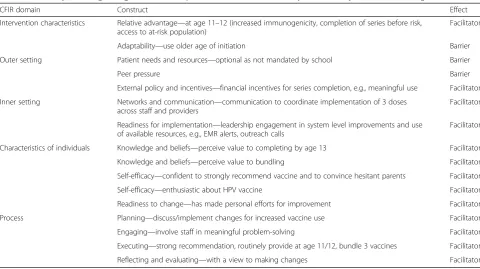
We identified fourteen constructs that distinguished be-tween providers with higher versus lower HPV vaccine coverage that span the five domains of the CFIR. They are summarized and characterized as facilitators and barriers to guideline-recommended vaccine use in Table1.
Development of the implementation intervention
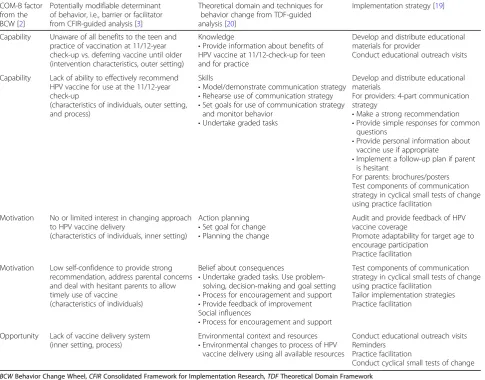
As illustrated in Table 2, behavior change strategies were chosen to influence the determinants of the three essential conditions of behavior changes from the BCW (i.e., capability, opportunity, and motivation), address the distinguishing barriers to implementation, and incorpor-ate the distinguishing facilitators from Table 1. To in-crease capability, the intervention is designed to improve provider’s knowledge, communication skills, and self-efficacy regarding implementing guideline recommenda-tions. Audit and feedback of vaccine coverage data will be used to increase motivation, and opportunity to in-crease vaccine use will occur through development of an integrated system for vaccine delivery within the prac-tice. Strategies to change physician behavior will include providing information, communication skill training with graded tasks and modeling, action planning, goal setting, and social support. These strategies have been combined in an implementation intervention to be delivered using educational outreach visits, use of cyclical small tests of change, and practice facilita-tion (Table 2). These approaches were chosen as they have been shown to be effective in primary care practices that lack resources needed to implement change processes [22–24].
Tools
Educational materials for the provider include a commu-nication strategy to help providers present information
in a more deliberate and impactful way to promote HPV vaccination before the preteen becomes sexually active.
Educational materials for the parent were developed as those currently available to provide information about HPV vaccine were judged to be inadequate by the Advisory Board. Specifically, our parent advisors felt the CDC brochures contained too much informa-tion and would not be read and providers wanted a generic brochure that could be used for girls and boys. Guided by the Advisory Board, we worked with the Health Communication Research Laboratory at the George Warren School of Social Work at Washington University to develop posters and a brochure to provide important information about HPV and HPV vaccine and to promote vaccine use. We tested the acceptability of these materials with a sample of 21 parents recruited from study practices and revised them to include their suggestions for improvement and address their concerns.
Discussion
National recommendations for new vaccinations are not usually packaged for easy implementation and primary care providers continue to face considerable barriers when trying to implement the adolescent immunization schedule for HPV vaccine [25–28]. By using the CFIR to systematically examine the complex web of factors that influence the use of this important vaccine in the
Table 1Summary of distinguishing factors for completion of HPV vaccine series by 13th birthday characterized using the CFIR(1)
CFIR domain Construct Effect
Intervention characteristics Relative advantage—at age 11–12 (increased immunogenicity, completion of series before risk, access to at-risk population)
Facilitator
Adaptability—use older age of initiation Barrier
Outer setting Patient needs and resources—optional as not mandated by school Barrier
Peer pressure Barrier
External policy and incentives—financial incentives for series completion, e.g., meaningful use Facilitator
Inner setting Networks and communication—communication to coordinate implementation of 3 doses across staff and providers
Facilitator
Readiness for implementation—leadership engagement in system level improvements and use of available resources, e.g., EMR alerts, outreach calls
Facilitator
Characteristics of individuals Knowledge and beliefs—perceive value to completing by age 13 Facilitator
Knowledge and beliefs—perceive value to bundling Facilitator
Self-efficacy—confident to strongly recommend vaccine and to convince hesitant parents Facilitator
Self-efficacy—enthusiastic about HPV vaccine Facilitator
Readiness to change—has made personal efforts for improvement Facilitator
Process Planning—discuss/implement changes for increased vaccine use Facilitator
Engaging—involve staff in meaningful problem-solving Facilitator
Executing—strong recommendation, routinely provide at age 11/12, bundle 3 vaccines Facilitator
primary care setting, we identified facilitators and bar-riers to following national guidelines across all five do-mains of the conceptual framework. Accepting vaccination by age 13 was a critical aspect of providers’ ability and confidence to recommend the vaccine, ad-dress parental hesitancy, and promote timely HPV vac-cine use. Other opportunities for improvement included better teamwork to share the work of vaccine delivery and increase efficiency and ensure opportunities for vac-cination were not missed.
Our findings informed a theory-based, multi-component implementation strategy to change provider behavior regarding vaccine use. Using the TDF, we identified behav-ioral change targets and behavbehav-ioral change approaches for providers. The intervention includes audit and feedback of vaccine coverage data to motivate providers to change their approach to deliver HPV vaccine. Several features of the audit and feedback component are considered “best practices” [29]. These include using recent, individual-level data, providing feedback in several different formats
(table, graph, oral), and repeating feedback cycles. At a brief educational outreach visit, information about the benefits of using the 11- to 12-year-old check-up visit to initiate the vaccine series, both for the patient and for the practice will be shared. The theory-based communication plan provides key elements to guide practitioners’ conver-sations about HPV vaccine and facilitate providing a strong and persistent recommendation to complete the vaccine series by age 13. As most independent primary care practices lack the infrastructure and support for prac-tice change, pracprac-tice facilitation will be used to assist providers to implement the change process and to engage staff in the process [22]. Our hope is that this multi-component intervention designed to address multiple barriers will have a greater and more sustainable effect on HPV vaccine use than prior interventions focused on one or two barriers.
Several features of the proposed intervention are in-novative and may inform implementing behavior change in primary care practice. We developed a
Table 2Selection of behavior change techniques and implementation change strategies to increase HPV vaccine use
COM-B factor from the BCW [2]
Potentially modifiable determinant of behavior, i.e., barrier or facilitator from CFIR-guided analysis [3]
Theoretical domain and techniques for behavior change from TDF-guided analysis [20]
Implementation strategy [19]
Capability Unaware of all benefits to the teen and practice of vaccination at 11/12-year check-up vs. deferring vaccine until older (intervention characteristics, outer setting)
Knowledge
•Provide information about benefits of HPV vaccine at 11/12-check-up for teen and for practice
Develop and distribute educational materials for provider
Conduct educational outreach visits
Capability Lack of ability to effectively recommend HPV vaccine for use at the 11/12-year check-up
(characteristics of individuals, outer setting, and process)
Skills
•Model/demonstrate communication strategy
•Rehearse use of communication strategy
•Set goals for use of communication strategy and monitor behavior
•Undertake graded tasks
Develop and distribute educational materials
For providers: 4-part communication strategy
•Make a strong recommendation
•Provide simple responses for common questions
•Provide personal information about vaccine use if appropriate
•Implement a follow-up plan if parent is hesitant
For parents: brochures/posters Test components of communication strategy in cyclical small tests of change using practice facilitation
Motivation No or limited interest in changing approach to HPV vaccine delivery
(characteristics of individuals, inner setting)
Action planning
•Set goal for change
•Planning the change
Audit and provide feedback of HPV vaccine coverage
Promote adaptability for target age to encourage participation
Practice facilitation
Motivation Low self-confidence to provide strong recommendation, address parental concerns and deal with hesitant parents to allow timely use of vaccine
(characteristics of individuals)
Belief about consequences
•Undertake graded tasks. Use problem-solving, decision-making and goal setting
•Process for encouragement and support
•Provide feedback of improvement Social influences
•Process for encouragement and support
Test components of communication strategy in cyclical small tests of change using practice facilitation
Tailor implementation strategies Practice facilitation
Opportunity Lack of vaccine delivery system (inner setting, process)
Environmental context and resources
•Environmental changes to process of HPV vaccine delivery using all available resources
Conduct educational outreach visits Reminders
Practice facilitation
simple, theory-based communication strategy that builds on established behaviors used to recommend other childhood vaccines. The implementation ap-proach will allow providers to practice their communi-cation about HPV vaccine, an effective strategy for learning new skills [30]. Few studies have tried to im-prove the quality of provider communication. Training providers to use an announcement approach has been shown to increase HPV vaccine coverage by 5% [31], but the broader literature of message framing has yielded mixed results [32]. Also, the intervention will allow autonomy for providers to select the target age for vaccine initiation with the goal to complete the series by age 13 to 15. Autonomy is important for in-trinsic motivation and may be important to engage pro-viders in the change process [33]. Involving other staff members in the system of care may be a pragmatic, al-ternative approach to EMR-reminders [28] and other strategies that may not be scalable without support. Practice facilitation has been used successfully to im-plement evidence-based interventions in primary care practice that lack the resources to engage in the change process [22].
Our study is limited in several respects. Our sample consists of a small number of providers from one geo-graphic area and may not be representative of other populations. However, we believe the study sample is representative of providers working in small-scale, independently run community-based pediatric prac-tices in our community with considerable variation in the context of how the providers practiced. In this setting, we were unable to examine the effect of deliv-ery systems or practice leader engagement on vaccine use. Completion of the three-dose series before the 13th birthday was low among participants but is con-sistent with concurrent national data for this age group [34]. The time span for collecting the quantitative and qualitative data were different (2014 and 2016 respect-ively). National data show the increase in HPV vaccine coverage from 2014 to 2016 was minimal (about 5%) [11, 34, 35], but if changes in coverage were not equal across providers, then our assessment of barriers and facilitators may be inaccurate.
Conclusions
In conclusion, study and national data suggest that wide-spread efforts to increase HPV vaccine use are urgently needed. We used the CFIR, the TDF, and BCW to sys-tematically examine the use of this vaccine in independ-ent primary care practices, idindepend-entify targeted provider behaviors for change, and guide our selection of behavior change components needed to increase HPV vaccine use according to guideline recommendations. This theory-informed, multi-component implementation strategy
merits further investigation. After pilot testing to assess feasibility, we are planning to seek funding to complete a rigorous evaluation in a clinical trial in the primary care setting to evaluate the effectiveness of this imple-mentation strategy to make large improvements in HPV vaccine use.
Abbreviations
CDC:Centers for Disease Control and Prevention; EMR: Electronic medical record; HEDIS: Healthcare Effectiveness Data and Information Set; HPV: Human papillomavirus; MCV4: Meningococcal B vaccine; NCATS: National Center for Advancing Translational Sciences; NIH: National Institutes of Health; Tdap: Tetanus, diphtheria, and pertussis vaccine; U.S.: United States; VIS: Vaccine information sheet; WU PAARC: Washington University Pediatric and Ambulatory Research Consortium
Acknowledgements Not applicable.
Funding
This study was supported by the Washington University Institute of Clinical and Translational Sciences grant UL1 TR000448 from the National Center for Advancing Translational Sciences (NCATS) of the National Institutes of Health (NIH), with co-funding from St. Louis Children’s Hospital. This study’s contents are solely the responsibility of the author and do not necessarily represent the official view of NCATS or NIH. The sponsors had no involvement in the design and conduct of the study; collection, management, analysis, and interpretation of the data; preparation, review, or approval of the manuscript; and decision to submit the manuscript for publication.
Availability of data and materials
Data sharing is not applicable to this article as no datasets were generated or analyzed during the current study.
Authors’contributions
JMG designed the study, conducted provider interviews, analyzed and interpreted the qualitative and quantitative data, developed the intervention, and drafted the manuscript. SD conducted parent interviews, analyzed and interpreted the qualitative data, and critically reviewed and edited the manuscript. EW conducted provider interviews, analyzed and interpreted the qualitative data, and critically reviewed and edited the manuscript. AAL analyzed and interpreted the qualitative data and critically reviewed and edited the manuscript. KK analyzed and interpreted the qualitative data and critically reviewed and edited the manuscript. RL designed the study, analyzed and interpreted the qualitative data, and critically reviewed and edited the manuscript. All authors read and approved the final manuscript.
Ethics approval and consent to participate
This study was approved by the Washington University Human Research Protection Office (Ref # 210510093). Each participant provided written consent.
Consent for publication Not applicable.
Competing interests
The authors declare that they have no competing interests.
Publisher’s Note
Springer Nature remains neutral with regard to jurisdictional claims in published maps and institutional affiliations.
Author details
1Department of Medicine, Washington University, St. Louis, MO, USA. 2
Received: 13 December 2017 Accepted: 18 February 2018
References
1. Sales A, Smith J, Curran G, Kochevar L. Models, strategies, and tools. Theory in implementing evidence-based findings into health care practice. J Gen Intern Med. 2006;21(Suppl 2):S43–9.
2. Michie S, van Stralen MM, West R. The behaviour change wheel: a new method for characterising and designing behaviour change interventions. Implement Sci. 2011;6:42.
3. Damschroder LJ, Aron DC, Keith RE, Kirsh SR, Alexander JA, Lowery JC. Fostering implementation of health services research findings into practice: a consolidated framework for advancing implementation science. Implement Sci. 2009;4:50.
4. Davies P, Walker AE, Grimshaw JM. A systematic review of the use of theory in the design of guideline dissemination and implementation strategies and interpretation of the results of rigorous evaluations. Implement Sci. 2010;5:14. 5. Cane J, O'Connor D, Michie S. Validation of the theoretical domains
framework for use in behaviour change and implementation research. Implement Sci. 2012;7:37.
6. Michie S, Johnston M, Abraham C, Lawton R, Parker D, Walker A, Psychological Theory G. Making psychological theory useful for implementing evidence based practice: a consensus approach. Qual Saf Health Care. 2005;14(1):26–33.
7. Atkins L, Francis J, Islam R, O’Connor D, Patey A, Ivers N, Foy R, Duncan EM, Colquhoun H, Grimshaw JM, et al. A guide to using the Theoretical Domains Framework of behaviour change to investigate implementation problems. Implement Sci. 2017;12(1):77.
8. French SD, Green SE, O'Connor DA, McKenzie JE, Francis JJ, Michie S, Buchbinder R, Schattner P, Spike N, Grimshaw JM. Developing theory-informed behaviour change interventions to implement evidence into practice: a systematic approach using the Theoretical Domains Framework. Implement Sci. 2012;7:38.
9. Meites E, Kempe A, Markowitz LE. Use of a 2-dose schedule for human papillomavirus vaccination—updated recommendations of the advisory committee on immunization practices. MMWR Morb Mortal Wkly Rep. 2016; 65(49):1405–8.
10. Smulian EA, Mitchell KR, Stokley S. Interventions to increase HPV vaccination coverage: a systematic review. Hum Vaccin Immunother. 2016;12(6):1566–88. 11. Walker TY, Elam-Evans LD, Singleton JA, Yankey D, Markowitz LE, Fredua B, Williams CL, Meyer SA, Stokley S. National, regional, state, and selected local area vaccination coverage among adolescents aged 13-17 years—United States, 2016. MMWR Morb Mortal Wkly Rep. 2017;66(33):874–82. 12. Markowitz LE, Dunne EF, Saraiya M, Chesson HW, Curtis CR, Gee J, Bocchini
JA Jr, Unger ER, Centers for Disease C, Prevention. Human papillomavirus vaccination: recommendations of the Advisory Committee on Immunization Practices (ACIP). MMWR Recomm Rep. 2014;63(RR-05):1–30.
13. President’s Cancer Panel Annual Report 2012–2013.http://deainfo.nci.nih. gov/advisory/pcp/annualReports/HPV/PDF/PCP_Annual_Report_2012-2013. pdf. Accessed 26 Feb 2018.
14. Niccolai LM, Hansen CE. Practice- and community-based interventions to increase human papillomavirus vaccine coverage: a systematic review. JAMA Pediatr. 2015;169(7):686–92.
15. Fu LY, Bonhomme LA, Cooper SC, Joseph JG, Zimet GD. Educational interventions to increase HPV vaccination acceptance: a systematic review. Vaccine. 2014;32(17):1901–20.
16. Walling EB, Benzoni N, Dornfeld J, Bhandari R, Sisk BA, Garbutt J, Colditz G. Interventions to improve HPV vaccine uptake: a systematic review. Pediatrics. 2016;138(1):e20153863.
17. Fetters MD, Curry LA, Creswell JW. Achieving integration in mixed methods designs—principles and practices. Health Serv Res. 2013;48(6 Pt 2):1–23. 18. Palinkas LA. Qualitative and mixed methods in mental health services and
implementation research. J Clin Child Adolesc Psychol. 2014;43(6):851–61. 19. Powell BJ, Waltz TJ, Chinman MJ, Damschroder LJ, Smith JL, Matthieu MM,
Proctor EK, Kirchner JE. A refined compilation of implementation strategies: results from the Expert Recommendations for Implementing Change (ERIC) project. Implement Sci. 2015;10:21.
20. Michie S, Johnston M, Francis J, Hardeman W, Eccles M. From theory to intervention: mapping theoretically derived behavioral determinants to behavior change techniques. Appl Psychol. 2008;57(4):660–80.
21. Michie S, Richardson M, Johnston M, Abraham C, Francis J, Hardeman W, Eccles MP, Cane J, Wood CE. The behavior change technique taxonomy (v1) of 93 hierarchically clustered techniques: building an international consensus for the reporting of behavior change interventions. Ann Behav Med. 2013;46(1):81–95.
22. Baskerville NB, Liddy C, Hogg W. Systematic review and meta-analysis of practice facilitation within primary care settings. Ann Fam Med. 2012;10(1):63–74. 23. Chhina HK, Bhole VM, Goldsmith C, Hall W, Kaczorowski J, Lacaille D. Effectiveness of academic detailing to optimize medication prescribing behaviour of family physicians. J Pharm Pharm Sci. 2013;16(4):511–29. 24. Margolis PA, Lannon CM, Stuart JM, Fried BJ, Keyes-Elstein L, Moore DE Jr.
Practice based education to improve delivery systems for prevention in primary care: randomised trial. BMJ. 2004;328(7436):388.
25. Holman DM, Benard V, Roland KB, Watson M, Liddon N, Stokley S. Barriers to human papillomavirus vaccination among US adolescents: a systematic review of the literature. JAMA Pediatr. 2014;168(1):76–82.
26. Oster NV, McPhillips-Tangum CA, Averhoff F, Howell K. Barriers to adolescent immunization: a survey of family physicians and pediatricians. J Am Board Fam Pract. 2005;18(1):13–9.
27. Perkins RB, Clark JA. What affects human papillomavirus vaccination rates? A qualitative analysis of providers’perceptions. Womens Health Issues. 2012; 22(4):e379–86.
28. Fiks AG, Grundmeier RW, Mayne S, Song L, Feemster K, Karavite D, Hughes CC, Massey J, Keren R, Bell LM, et al. Effectiveness of decision support for families, clinicians, or both on HPV vaccine receipt. Pediatrics. 2013;131(6): 1114–24.
29. Ivers NM, Sales A, Colquhoun H, Michie S, Foy R, Francis JJ, Grimshaw JM. No more‘business as usual’with audit and feedback interventions: towards an agenda for a reinvigorated intervention. Implement Sci. 2014;9:14. 30. Berkhof M, van Rijssen HJ, Schellart AJ, Anema JR, van der Beek AJ. Effective
training strategies for teaching communication skills to physicians: an overview of systematic reviews. Patient Educ Couns. 2011;84(2):152–62. 31. Brewer NT, Hall ME, Malo TL, Gilkey MB, Quinn B, Lathren C.
Announcements versus conversations to improve HPV vaccination coverage: a randomized trial. Pediatrics. 2017;139(1):e20161764. 32. Gilkey MB, McRee AL. Provider communication about HPV vaccination: a
systematic review. Hum Vaccin Immunother. 2016;12(6):1454–68. 33. Pink DH. Drive: the suprising truth about what motivates us. New York:
Riverhead Books, Penguin Group (USA) Inc.; 2009.
34. Reagan-Steiner S, Yankey D, Jeyarajah J, Elam-Evans LD, Curtis CR, MacNeil J, Markowitz LE, Singleton JA. National, regional, state, and selected local area vaccination coverage among adolescents aged 13-17 years—United States, 2015. MMWR Morb Mortal Wkly Rep. 2016;65(33):850–8.
35. Laurie D, Elam-Evans DY, Jeyarajah J, Singleton JA, Robinette Curtis C, MacNeil J, Hariri S. National, regional, state, and selected local area vaccination coverage among adolescents aged 13–17 years—United States, 2013. In: Morbidity and mortality weekly report (MMWR). 1600 Clifton Road Atlanta: Centers for Disease Control and Prevention. 2014;63:625-33.
• We accept pre-submission inquiries
• Our selector tool helps you to find the most relevant journal
• We provide round the clock customer support
• Convenient online submission
• Thorough peer review
• Inclusion in PubMed and all major indexing services
• Maximum visibility for your research
Submit your manuscript at www.biomedcentral.com/submit