Ignite Your Bliss:
A Case Study on Cost Curves Analysis
Karla Borja, University of Tampa, USAMelissa Irvine, University of Tampa, USA Troy Land, University of Tampa, USA Robert Wilson, University of Tampa, USA
ABSTRACT
Cost curves analysis is a challenging economics subject to teach. It requires the presentation of extensive cost tables, cost equations, and a set of cost curves, which students tend to find highly theoretical. In addition, the literature on real-world applications of cost curves analyses is limited, mainly because firms release their cost structures at current output levels rather than at potential output levels. Thus, there are few available pedagogical tools for economics instructors to use when facing the difficult task of linking the theory to the firm’s real-world cost analyses. This paper contributes to economics pedagogy by briefly proposing a case study on a yoga retreat business that serves as a valuable example of a cost curves analysis.
Keywords: Case Study; Cost Curves Analysis; Economics
INTRODUCTION
ll standard introductory economics texts offer some level of cost curves analysis. Chapters on economic cost analysis assist in an understanding of market power and pricing strategy through which firms optimize profits by attaining a level of output that makes the marginal costs equal the marginal revenues. The typical introduction to cost analysis includes a presentation of extensive cost tables, cost equations, and cost curves. The student must be able to calculate or graph the total, marginal, and average cost curves and evaluate them against revenue values in order to predict firm behavior. For these theoretical exercises, the market must provide enough firm-level information about total costs at different production stages. In practice, however, most firms provide data only on the current production level.
THE YOGA RETREAT INDUSTRY
The yoga industry is experiencing significant growth. The 2002 National Health Interview Survey (NHIS), featured in the Supplement of Alternative Medicine, reported that approximately 5.1% of Americans, or ten million adults, practiced yoga in 2002 (Birdee et al., 2008). In 2006, it was estimated that about three million adults practiced yoga at least twice a week (Moran, 2006). In addition, spending on yoga classes and yoga-related products and services doubled between 2004 and 2008, from $2.9 billion to $5.7 billion (Higgins, 2010).
Yoga retreats are held throughout the world, featuring diverse locations and amenities, from an all-inclusive luxury retreat at a sprawling estate in France to no-frills accommodations in Kerala, India. These retreats vary in length from overnight stays to weeklong getaways. The typical yoga traveler will find an option among many that fits his/her time and budget constraints, offering accommodations and a locale suitable to his/her preferences. Yoga and travel have been grafted onto the mainstream; many chain hotels and bed-and-breakfasts look for ways to incorporate yoga into their programs to capture incremental revenue from each reservation. Yoga is provided as an amenity rather than as the sole focus of the hotel’s services, but these programs compete with yoga retreats by attracting more casual practitioners (Higgins, 2010).
Typical U.S. yoga practitioners are females between 18 and 53 years of age. They are likely to be career-oriented and college-educated, with many disclosing annual earnings over $50,000. It is less likely for them than their non-practicing peers to be married or to have young children. The typical yoga practitioner is also more likely to live in metropolitan areas in the western and northeastern regions of the U.S. (Saper et al., 2004).
FIRST RETREAT DESTINATION: ITALY
For her first yoga retreat destination, Melissa chose a villa in the Italian countryside. Melissa will conduct two one-week retreats in July and offer daily photography workshops in conjunction with the daily yoga classes. The getaway package will include shuttle service to and from the Florence airport, six-night accommodation, twice-daily yoga classes, twice-daily photography workshops, a hiking excursion, a walking tour in a medieval town, and wine tastings. The villa can be rented in part or in full. A partial lease will accommodate up to eight guests, while the full estate accommodates up to 14 guests.
DEMAND AND COST STRUCTURE
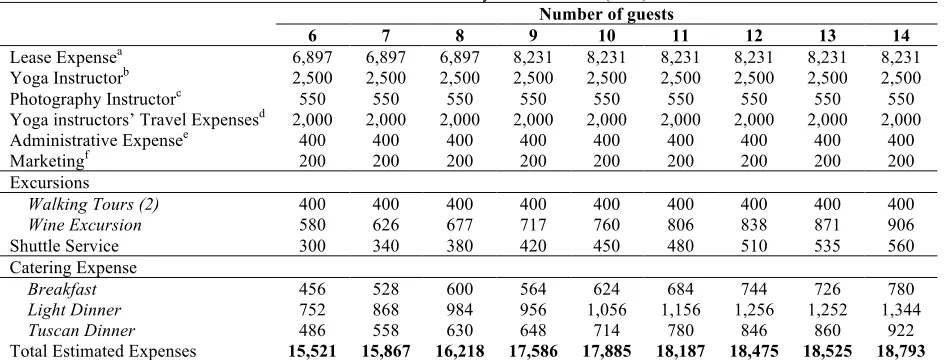
Table 1. Estimated Weekly Cost Structure (US$)
Number of guests
6 7 8 9 10 11 12 13 14
Lease Expensea 6,897 6,897 6,897 8,231 8,231 8,231 8,231 8,231 8,231 Yoga Instructorb 2,500 2,500 2,500 2,500 2,500 2,500 2,500 2,500 2,500 Photography Instructorc 550 550 550 550 550 550 550 550 550 Yoga instructors’ Travel Expensesd 2,000 2,000 2,000 2,000 2,000 2,000 2,000 2,000 2,000 Administrative Expensee 400 400 400 400 400 400 400 400 400
Marketingf 200 200 200 200 200 200 200 200 200
Excursions
Walking Tours (2) 400 400 400 400 400 400 400 400 400
Wine Excursion 580 626 677 717 760 806 838 871 906
Shuttle Service 300 340 380 420 450 480 510 535 560
Catering Expense
Breakfast 456 528 600 564 624 684 744 726 780
Light Dinner 752 868 984 956 1,056 1,156 1,256 1,252 1,344
Tuscan Dinner 486 558 630 648 714 780 846 860 922
Total Estimated Expenses 15,521 15,867 16,218 17,586 17,885 18,187 18,475 18,525 18,793
Notes: a The partial-rent of the villa is $6,897 with a maximum of 8 guests. Full villa rent expense is $8,231 with a maximum of 14 guests. bOne-week instructor fees for daily yoga classes. cOne-week instructor fees for 2-hours daily photography classes. dIt includes yoga instructor’s per diem, lodging, and local travel expenses. The photography instructor is a local resident; thus there is no travel expense for her/him. eAdministrative costs include international calls, utility bills, and accounting services. fMarketing includes online ad placements in targeted publications (e.g. Yoga Journal), as well as social media accounts (e.g.
facebook and twitter).
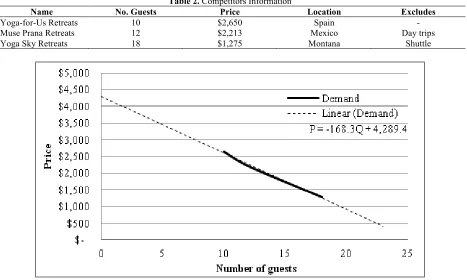
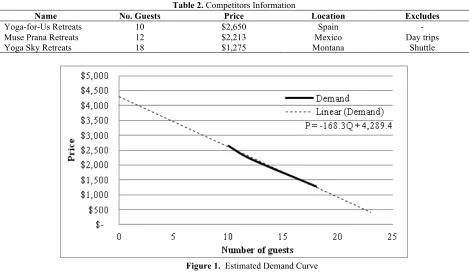
Melissa’s goal is to make this Italian retreat profitable and use the experience gained to open new locations throughout the world. While Melissa has been unable to find local competitors who offer both yoga and photography retreats, she has found three competitors who offer services and accommodations that are similar, albeit in different locales and involving different activities. Information regarding prices and group sizes for three competitors, along with a recommended demand curve, is presented in Table 2 and Figure 1.
Table 2. Competitors Information
Name No. Guests Price Location Excludes
Yoga-for-Us Retreats 10 $2,650 Spain -
Muse Prana Retreats 12 $2,213 Mexico Day trips
Figure 1. Estimated Demand Curve
Given the information about her competitors, Melissa struggled to decide how much she should charge, what the market would bear, and how many guests she would need to book in order to maximize her profits. She also wondered what she could do from sales and marketing perspectives to attract sufficient reservations.
AUTHOR INFORMATION
Karla Borja is the contacting author and an assistant professor of economics at the University of Tampa. 401 W. Kennedy Blvd. Tampa, FL 33606. [email protected]. Website: http://www.ut.edu/KarlaBorja/?terms=karlaborja.
Melissa Irvine is an MBA student at the University of Tampa. 2723 N. Ridgewood Ave., Tampa, FL 33602. [email protected]
Troy Land is an MBA student at the University of Tampa. 10124 Westpark Preserve Blvd., Tampa, FL 33625. [email protected]
Robert Wilson is an MBA student at the University of Tampa. 4347 Silver Falls Dr., Land O Lakes, FL 34639. [email protected]
REFERENCES
Birdee, G. S., Legedza, A. T., Saper, R. B., Bertisch, S. M., Eisenberg, D. M., Phillips, R. S. (2008) Characteristics of Yoga Users: Results of a National Survey. Journal of General Internal Medicine, 23(10):1653-8. Higgins, M. (2010, February 2). Rolling Out the Yoga Mat. The New York Times, Travel. Retrieved from:
http://travel.nytimes.com/2010/02/07/travel/07pracyoga.html?_r=0.
Moran, S. (December 28, 2006). Meditate on This: Yoga Is Big Business. The New York Times, Business. Retrieved from: http://www.nytimes.com/2006/12/28/business/28sbiz.html?_r=0.
TEACHING NOTES
Summary
Melissa, an employee of a financial services firm, is contemplating leaving her current position to start Ignite Your Bliss, a yoga retreat business in which she conducts weeklong retreats in various locations that combine guests’ passion for yoga with other interests, such as photography and cooking. Melissa has estimated the costs of her first retreat and has gathered market and competitor information. She must now determine how many guests she will need to book and how much she can and must charge to maximize profits. Melissa must also consider the sales and marketing activities she will need to pursue to maximize her reservations. Finally, Melissa must ensure that the endeavor will be sufficiently financially lucrative to justify leaving her current position, with its annual salary of $52,000.
Given the information relevant to this case, we recommend the discussion items below:
1. Describe the market structure within which Ignite Your Bliss is competing. Given the market structure, determine the optimal marketing and price strategies.
2. Using the information provided in Tables 1 and 2 and Figure 1, develop a cost curve analysis that includes a table of total and marginal revenues, total and marginal costs, and average total costs at different levels of output (e.g. number of guests per retreat). Then, numerically and graphically determine the optimal level of output, optimal price per retreat, and total profits (Table 3 and Figure 2 provide possible solutions).
3. Using the information provided in Tables 1 and 2, determine the fixed and variable costs. Calculate and graph the average fixed and variable cost curves and determine the shut-down price.
4. Determine the accounting and economic profits, and define the break-even number of retreats per year required to cover Melissa’s opportunity costs.
Table 1. Estimated Weekly Cost Structure (US$)
Number of guests
6 7 8 9 10 11 12 13 14
Lease Expensea 6,897 6,897 6,897 8,231 8,231 8,231 8,231 8,231 8,231 Yoga Instructorb 2,500 2,500 2,500 2,500 2,500 2,500 2,500 2,500 2,500 Photography Instructorc 550 550 550 550 550 550 550 550 550 Yoga instructors’ Travel Expensesd 2,000 2,000 2,000 2,000 2,000 2,000 2,000 2,000 2,000 Administrative Expensee 400 400 400 400 400 400 400 400 400
Marketingf 200 200 200 200 200 200 200 200 200
Excursions
Walking Tours (2) 400 400 400 400 400 400 400 400 400
Wine Excursion 580 626 677 717 760 806 838 871 906
Shuttle Service 300 340 380 420 450 480 510 535 560
Catering Expense
Table 2. Competitors Information
Name No. Guests Price Location Excludes
Yoga-for-Us Retreats 10 $2,650 Spain -
Muse Prana Retreats 12 $2,213 Mexico Day trips
Yoga Sky Retreats 18 $1,275 Montana Shuttle
Figure 1. Estimated Demand Curve
Table 3. Cost Curves and Optimal Number of Guests
# Guests Price TR MR TC MC ATC Profit (Quantity) (# Guests*P) ∆TR/∆Q VC + FC ∆TC/∆Q TC/Q TR - TC
6 3,280 19,679 15,521 2,587 4,158
7 3,112 21,781 2,102 15,867 346 2,267 5,913
8 2,943 23,546 1,765 16,218 350 2,027 7,328
9 2,775 24,975 1,429 17,586 1,369 1,954 7,389
10 2,607 26,067 1,092 17,885 299 1,789 8,182
11 2,438 26,823 756 18,187 302 1,653 8,636
12 2,270 27,242 419 18,475 288 1,540 8,767
13 2,102 27,325 83 18,525 51 1,425 8,799
A = Optimal Number Of Guests (MR=MC); B = Total Profit Area
Figure 2. Cost Curves and Optimal Number of Guests