Pionic Deuterium
Th. Strauch1, F. D. Amaro2, D. F. Anagnostopoulos3, P. B¨uhler4, D. S. Covita2a, H. Gorke5, D. Gotta1b, A. Gruber4, A. Hirtl4c, P. Indelicato6, E.-O. Le Bigot6, M. Nekipelov1, J. M. F. dos Santos2, Ph. Schmid4, S. Schlesser6, L. M. Simons7, M. Trassinelli6dJ. F. C. A. Veloso8, and J. Zmeskal4
1 Institut f¨ur Kernphysik, Forschungszentrum J¨ulich, D–52425 J¨ulich, Germany 2 Dept. of Physics, Coimbra University, P-3000 Coimbra, Portugal
3 Dept. of Materials Science and Engineering, University of Ioannina, GR-45110 Ioannina, Greece 4 Stefan Meyer Institut for Subatomic Physics, Austrian Academy of Sciences, A-1090 Vienna, Austria 5 Zentralabteilung f¨ur Elektronik, Forschungszentrum J¨ulich GmbH, D-52425 J¨ulich, Germany
6 Laboratoire Kastler Brossel, UPMC-Paris 6, ENS, CNRS; Case 74, 4 place Jussieu, F-75005 Paris, France 7 Laboratory for Particle Physics, Paul Scherrer Institut, CH–5232 Villigen, Switzerland
8 Dept. of Physics, Aveiro University, P-3810 Aveiro, Portugal
Abstract. The strong interaction shiftǫπD
1s and broadeningΓ
πD
1s in pionic deuterium have been remeasured with
high statistics by means of theπD(3p−1s) X-ray transition using the cyclotron trap and a high-resolution crystal spectrometer. Preliminary results areǫπD
1s =(−2325±31) meV (repulsive) andΓ
πD
1s(1171
+23
−49) meV which yields
for theπD scattering length aπD =[−(24.8±0.3)+i (6.3+−00..31)]·10
−3m−1
π. From the imaginary part the threshold
parameter for pion production is determined to beα=(252−+115)µb.
1 Introduction
The deuterium experiment is embedded in a series of mea-surements [1–3] aiming at a precision determination of the pion-nucleon scattering length comprising
– pionic hydrogen (πH),
– pionic deuterium (πD),
– muonic hydrogen (µH), and
– the characterisation of the Bragg crystal spectrometer using narrow X-ray lines from few-electron atoms pro-duced by means of an electron-cyclotron resonance trap (ECRIT).
In this contribution, first results of theπD measurement are presented.
2 Strong-interaction effects
The complex pion-nucleus scattering length aπAof a pionic atom formed with a nucleus A(Z,N) is related in leading
a present address: Dept. of Physics, Aveiro University, P-3810
Aveiro, Portugal
b corresponding author: [email protected]
c present address: Universit¨atsklinik f¨ur Nuklearmedizin,
Medizinische Universit¨at Wien, 1090 Vienna, Austria
d present address: Inst. des NanoSciences de Paris, CNRS
UMR7588 and UMPC-Paris 6, F-75015 Paris, France
order to the 1s-state shiftǫ1sand widthΓ1s by the Deser formula [4]
ǫ1s−iΓ1s
2 =−
2α3µ2c4
~c aπA+... (1)
Ellipsis stand for corrections to the Deser formula because
aπDis determined from a Coulomb bound state [5]. InπH, the ground-state shift and broadening may be related to theπN isoscalar and isovector scattering lengths a+and a−by
ǫ1sπH∝aπ−p→π−p =a++a− + ...
Γπ1sH∝(aπ−p→π0n)2 = 2(a−)2 + ... . (2)
In this case, Γ ∝ a2 because the hadronic broadening is due to a scattering process – the charge-exchange reaction π−p→π0n [6]. The corrections here have been calculated in various approaches and amount up to a few per cent of the leading contribution and include to some extent already electromagnetic and strong isospin-breaking terms [7–12]. In the case ofπD, the real partℜaπDof the scattering length, being proportional to the hadronic shiftǫ1sπD, maybe written by regarding the deuteron as a free proton and neu-tron as leading order and then applying additional correc-tions. One may write
ℜaπD=aπ−p→π−p+aπ−n→π−n + ...
= 2a+ + ... (3)
DOI:10.1051/epjconf/20100303006
where ellipsis stand for the higher order terms from mul-tiple scattering (depending also on a+and a−), absorptive
and possibly electromagnetic and strong isospin-breaking corrections. The second order correction is dominated by (a−)2being comparable in magnitude to the leading order term [13, 14] because of the smallness of a+ as required by chiral symmetry [15, 16]. The nuclear structure is taken into account by folding with the deuteron wave function.
The pionic deuterium shift provides a constraint on the πN scattering lengths a+and a−. Its quality decisively
de-pends on the precision of the data triple (ǫπD 1s,ǫ
πH 1s ,Γ
πH 1s), for which a first set of precision data has been obtained in the last decade [17–20]. Vice versa, starting from the el-ementary pion-nucleon processes and involving properly nuclear structure, multiple scattering, and absorptive phe-nomena, the hadronic s-level shift of theπD system must be calculable unambiguously [21–31].
The forthcoming results forπH from this measurement series will improve the constraint [12], in particular by a better determination of the hadronic broadening inπH [3]. Finally, the accuracy for a+will be determined mainly by the poorly known low-energy constant f1[12].
Secondly,πD gives access to pion absorption and pro-duction NN↔NNπat threshold [32]. The hadronic broad-eningΓπ1sDmainly is due to true absorption (π−d→nn)
be-ing the inverse and charge symmetric reaction of pion pro-duction (pp→π+d) – in contrast toπH where the width is exclusively due to charge-exchange and radiative capture.
The relative strength of true absorption to radiative cap-ture (π−d → nnγ) was measured to S = nnnnγ = 2.83±
0.04 [33], and the branching ratio of internal pair conver-sion (π−d →nne+e−) and charge exchange (π−d→ nnπ0) was found to be 0.7% [34] and 1.45±0.19·10−4[35], re-spectively. Hence, the relative strength of the true absorp-tion channel to all other processes is obtained to S′ = nn/(nnγ+nne+e−+nnπ0) =2.76± 0.04, i. e., about 2/3 of the hadronic width and with that of the imaginary part
ℑaπD is related to the processπ−d → nn, which can be linked with pion production.
Pion production at low energies is usually parametrised by [36]
σpp→π+d =αC2 0η+βC
2 1η
3+... (4)
whereη=p∗π/Mπis the reduced momentum of the pion in
theπd rest frame. Forη → 0 higher partial waves (β, ...) vanish and only the threshold parameterαcontributes rep-resenting pure s-wave production. The correction factors
Citake into account the Coulomb interaction. C20is of the order of 30% [37, 38] and an important source of uncer-tainty in the determination ofαfrom cross-section data.
Another approach to determineαis to exploit theπD ground state broadening where uncertainties stemming from Coulomb correction factors and normalisation of cross sec-tions are avoided. To derive the relation between α and
ℑaπDas obtained from pionic deuterium, purely hadronic (non-experimental) cross sections ˜σare introduced to cir-cumvent the problem of diverging Coulomb cross section at threshold. Detailed balance relates pion production and
absorption by
˜
σπ+d→pp = 2 3 ·
p∗p
p∗ π
!2
·σ˜pp→π+d (5)
with p∗pand p∗πbeing final state center-of-mass (CMS) mo-menta [32]. Neglecting Coulomb and isospin breaking cor-rections, which are assumed to be at most a few per cent [39], charge symmetry requires equal strength for the transitions π−d → nn andπ+d → pp.
Combining optical theorem, charge invariance, detailed balance and inserting the parametrisation of the pp→π+d cross section (4), the imaginary part of theπ−d→nn
scat-tering length is related to the threshold parameterαby
ℑaπD=(1+ 1
S′)· ℑaπ−d→nn (6)
=(1+ 1 S′)·
p∗π
4π·σ˜π−d→nn
=(1+ 1 S′)·
1 6π·
(p∗p)2
mπ
·α . (7)
The factor (1+1/S′) corrects for the non true absorption channels.
For comparison of pionic-atom and pion-production data, the channels pp→ π+d and np→ π0d can be used
because in the limit of charge independence 2·σnp→π0d= σpp→π+d. Restricting to s waves, in both reactions the same transition of the nucleon pair3S
1(I=0)→3P1(I =1) oc-curs which corresponds also to pion absorption at rest on the deuteron’s isospin 0 nucleon-nucleon pair.
3 Atomic cascade
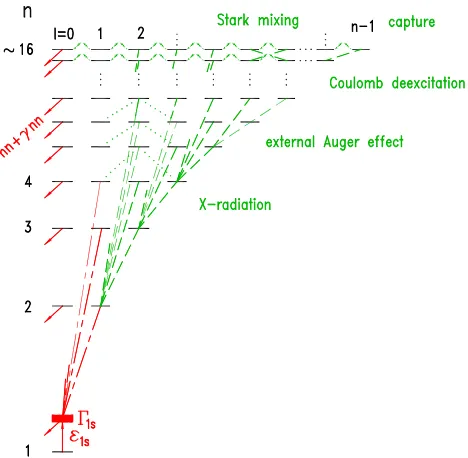
After pion capture in hydrogen isotopes, a quantum cas-cade starts from main quantum numbers at about n ≈16. The upper and medium part of the de-excitation cascade is dominated by collisional processes (Stark mixing, external Auger effect, Coulomb de-excitation). In the lower part X-radiation becomes more and more important (Fig. 1) [40– 42]. Besides radiative de-excitation by X-ray emission all cascade processes depend on the environment, e. g., the density of the target gas.
Stark mixing essentially determines the X-ray yields in exotic hydrogen. Because these systems are electrically neutral and small on the atomic scale, they penetrate sur-rounding atoms and, thus, experience a strong Coulomb field. Non-vanishing matrix elementshnlm | E| nl′m′iin the presence of the electric field mix atomic states of the same principle quantum number n according to the selec-tion rules ∆l = ±1 and∆m = 0 [43]. An induced s state, from where pions disapper by nuclear reactions, leads to a depletion of the cascade. The Stark mixing rate is propor-tional to the number of collisions during the exotic atom’s life time and explains the strong decrease of the X-ray yields with increasing target density [40].
a Doppler broadening of subsequent X-ray transitions. Doppler broadening was directly observed first in the time-of-flight spectra of monoenergetic neutrons from the charge exchange reaction at restπ−p→π0n [45, 46].
A dedicated measurement of theµH(3p−1s) transition has been performed within this series of experiments [47]. In µH, where no hadronic broadening occurs, only the Doppler broadening exclusively from acceleration effects during the atomic cascade contributes and was directly ob-served as a significantly increased line width. The data were used – among others – to confirm that the methods used to quantify the corrections to the line width in pionic hydrogen and deuterium are sufficiently well defined [3]. Details may be found elsewhere [48].
The acceleration due to Coulomb de-excitation is coun-teracted by elastic and inelastic scattering. This leads to a rather complex velocity distribution with tails below the peaks caused by the Coulomb transitions which are at 12, 20, 38, and 81 eV for the∆n=1 transitions (7−6), (6−5), (5−4), and (4−3), respectively.
Cascade calculations have been extended to follow the development of the velocity during the de-excitation cas-cade and, therefore, predict kinetic energy distributions at the time of X-ray emission from a specific level (extended standard cascade model ESCM [42]). Calculations exist at present only for muonic and pionic hydrogen. Figure 2 shows such a prediction forπH where energies have been scaled to theπD case. It turned out in the analysis of the µH(3p−1s) line shape that the first ESCM predictions could not describe the measured spectrum [47]. Therefore, a model independent approach was used to extract the rel-ative strength of Doppler contributions directly from the measured line shape; a method applied successfully first in the neutron time-of-flight analysis [46]. Here, the kinetic
Fig. 1.De-excitation cascade in pionic deuterium. The hadronic shift is defined toǫ1s≡Eexp−EQED, i. e., a negative sign as is the case inπD corresponds to a repulsive interaction.
Fig. 2.Prediction for the kinetic energy distribution of theπH atom at the instant of (3p−1s) transition scaled to the kinemat-ics of theπD system for a density of 10 bar equivalent. For the analysis, the distribution was tentatively approximated by a box describing the low-energy component and a second one for the high-energy component around 80 eV. The low-energy compo-nent reaching 0.55 dominates the distribution (note the broken vertical scale).
energy distribution is modeled by boxes around the peaks generated by Coulomb transitions. One approach as used in the analysis of this experiment is included in Figure 2.
In the case of exotic hydrogen, Auger emission is only possible during the collision with other target atoms (ex-ternal Auger effect). Auger transitions prefer de-excitation steps as small as possible given that the energy gain ex-ceeds the binding energy of the electron. Consequently, Auger emission contributes mainly in the range n≈6−10 and∆n=1 transitions are favored [40, 42]. Due to the mass difference, Doppler broadening from recoil is negligibly small compared to the one caused by Coulomb transitions. It is known from muon-catalysed fusion experiments that duringµH+H2collisions metastable hybrid molecules are formed like [(ppµ)p]ee [49, 50]. An analogue process is expected inπD+D2 collisions, Such complex’ are as-sumed to stabilise non radiatively by Auger emission. How-ever, radiative decay out of molecular states has been dis-cussed, and its probability is predicted to increase with nu-clear mass [49–52]. Possible X-ray transitions from molec-ular states would falsify the value for the hadronic shift de-termined from the measured X-ray energy. As molecular formation is collision induced, the fraction of molecules formed and the corresponding X-ray rate should depend on the target density. Therefore, a possiblity to identify such radiative contributions is a measurement of the X-ray energy at three different densities (3.3, 10, and 17.5 bar equivalent density in this experiment).
4 Experiment
Fig. 3.Setup of theπD experiment in theπE5 area at the Paul Scherrer Insitut (PSI). The roof of the concrete shielding is omit-ted tp show the vacuum system connecting the cyclotron trap (up-per right), crystal chamber (up(up-per left) and the cryostat of the X-ray detector (bottom left).
II [1] and decelerated using a set of degraders optimized to the number of pion stops in a cylindrical cryogenic tar-get cell of 22 cm length and 5 cm in diameter in the center of the trap. The cell was filled with deuterium gas cooled by means of a cold finger. About 0.5% of the incoming pions per bar equivalent pressure are stopped in D2gas. X-radiation could exit the target cell axially through a 5µm thick mylarR window. The window foil is supported by horizontal aluminum bars.
The Johann-type Bragg spectrometer was equipped with a spherically bent Si crystal cut parallel to the (111) plane having a radius of curvature of R=2982.2±0.3 mm. The reflecting area of the crystal having 10 cm in diameter was restricted by a circular aperture to 95 mm in diameter to avoid edge effects and to 60 mm horizontally to keep the Johann broadening small [53, 54].
Such a spectrometer is able to measure simultaneously an energy interval according to the width of the X-ray source when using a correspondingly extended X-ray de-tector. Being a pixel device, CCDs are ideally suited for X-rays in the few keV range because they combine an intrin-sic position resolution with the good energy resolution of semiconductor detectors. In addition, the granularity of the CCDs allows for efficient background rejection by means of pattern recognition (cluster analysis). Photo electrons from few-keV X-ray conversion are stopped within a few micrometer and, therefore, deposit charge in one or two pixels with a common boundary. Beam induced background, mainly high energy photons from neutrons produced in nuclear pion absorption and captured by surrounding nu-clei, leads to larger structures. Together with the massive concrete shielding (Fig. 3) such events are efficiently sup-pressed (Fig. 5).
In this experiment, a 3×2 array of charge-coupled de-vices (CCDs) was used covering in total 72 mm in height and 48 mm in width [55]. Monte Carlo studies show that
about 2/3 of the intensity of the reflection is covered by the height of the array. The detector surface was oriented perpendicular to the direction crystal – detector.
The CCDs’ depletion depth of about 30µm yields an optimum quantum efficiency in the 3-4 keV range. A pixel size of 40µm provides a two-dimensional position resolu-tion sufficient to measure precisely the shape of the diff rac-tion image. The relative orientarac-tion of the individual CCDs as well as the exact pixel size was obtained by means of an optical measurement using a nanometric grid [56]. The CCDs are operated at a temperature of−100◦C.
X-ray energies of the ground-state transitions in muonic and pionic hydrogen isotopes are in the few keV range, where no narrowγlines of sufficient intensity are available to be used to determine precisely the function of a low-energy crystal spectrometer. However, from highly stripped atoms produced in an electron-cyclotron resonance trap (ECRIT) narrow X-ray lines are emitted at high rate.
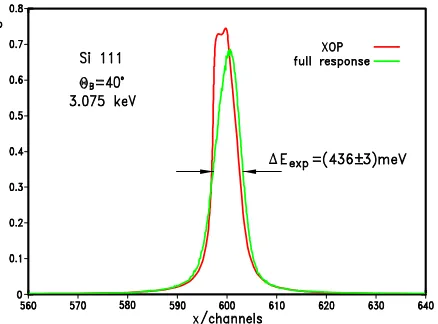
The spectrometer response was measured using the nar-row M1 X-ray line from helium-like argon of 3.104 keV as described in [57, 58] yielding a resolution of 436±3 meV (FWHM) when scaled to the energy of theπD(3p−1s) transition of 3.075 keV. This value is close to the intrin-sic resolution of 403±3 meV given by the rocking curve width as calculated for an ideal flat crystal with the code XOP [59].
The response is constructed from the intrinsic proper-ties of the Si (111) material as calculated from the dynami-cal diffraction theory with the code XOP [59]. The rocking curve is then convoluted with the experiment geometry by means of a Monte-Carlo ray-tracing code (Fig. 4). Devi-ations from this ideal response are introduced by convo-luting with an additional Gaussian contribution which was determined from the measurement of the M1 transition in helium-like argon.
In the Johann set-up the energy calibration must be provided by a reference line of known energy. In order to avoid any mechanical changes, only X-rays having about the same Bragg angles are suitable for precision
ments. The best angular matching for theπD(3p−1s) mea-surement was found for the gallium Kαfluorescence lines. For energy calibration, the Ga Kα2transition (9224.484±
0.027 eV [60]) was chosen because of the smaller experi-mental uncertainty. The energy of theπD(3p−1s) line is obtained by the angular distance to the Ga reference line to be calculated from the position difference of the reflections on the detector and the distance crystal – detector.
The fluorescence target itself was made of a 25×20 mm2 GaAs plate mounted in the rear part of the gas cell but out-side the pion stop volume at 82 mm offthe center of the cyclotron trap and away from the crystal. The X-rays were excited by means of an X-ray tube mounted on a window of the cyclotron trap chamber below the gas cell. The value for the tabulated Ga Kαenergies [60] was obtained from measurement also using the compound GaAs [61]. There-fore, a possible chemical shift must not be considered.
The distance center of the crystal to center of the cy-clotron trap was 2100 mm being about 10% outside the Rowland circle fulfilling the focal condition R·sinΘB. The advantage placing the X-ray source offthe focal position is that one averages over non uniformities of the target. Both GaAs and D2target are large enough that no cuts in the tails of the reflection occur. The distance crystal – de-tector, chosen close to the assumedπD focal length, was determined to yCD =1918.1 ± 0.5 mm by a survey mea-surement.
Alternating measurements of the Ga fluorescence ra-diation and theπD line were performed at least once per day (Fig. 7). The Ga fluorescence X-rays together with two inclinometers mounted at the crystal and detector cham-bers were used to monitor the stability of the line posi-tion. Details on the experimental setup maybe found else-where [62].
5 Analysis
The X-ray detector raw data are made available as the dig-italised charge contents and a position index of the pixel. At first, the cluster analysis is performed. As expected, at 3.1 keV only single (≈75%) or two pixel events (≈25%) contribute. Hot and defect pixels are masked by software. The cluster analysed charge (ADC) spectra of the CCDs show a pronounced peak originating fromπD X-rays on a largely suppressed background (Fig. 5). For each CCD, an individual energy calibration was performed because of the different gain and noise behaviour. The energy resolution in terms of charge is determined by means of a Gaussian fit.
Applying an energy cut in the ADC spectra, an addi-tional background reduction is achieved. Several ADC cuts with a width of 1σto 4σof the respective Gaussian width were used to study the influence of peak-to-background on the result for the hadronic broadening. The minimum rel-ative statistical error is achieved for a cut of 2.5σof the detector’s (charge) resolution. With this energy cut, from fits to the position spectra (similar to the one shown in Fig-ure 7 – bottom) count rates of 1448±49, 4010±74, and
Fig. 5.Background suppression achieved by the cluster analysis of theπD raw data.
4877±80 were obtained for the πD(3p−1s) line at the equivalent densities of 3.3, 10, and 17.5 bar, respectively.
In the case of the Ga calibration line, compact clusters up to size 9 were accepted. Because of the larger penetra-tion depth (5 and 105µm for 3.075 and 9.224 keV in sil-icon [63], respectively), X-rays also convert at the bound-ary of the depletion region where charge diffusion is al-ready significant. As the calibration measurements were performed without pion beam, the number of background events is negligibly small and, hence, no suppression algo-rithm is necessary to clean the Ga spectra.
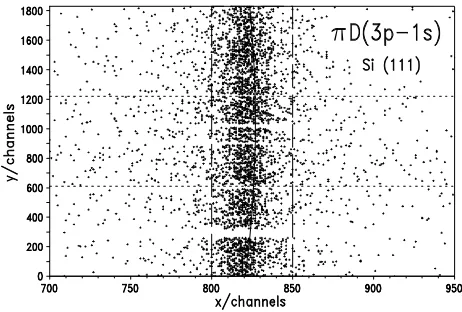
The resulting hit pattern shows curved reflections on the CCD surface. The curvature is corrected for by means of a parabola fit (Fig. 6) before projecting onto the axis of dispersion, which is equivalent to an energy axis.
Fig. 6.πD(3p−1s) reflection after correction for curvature. The original curvature is indicated by the parabola in the scatter-plot of the already corrected data. One channel (pixel) in the di-rection of dispersion (x) corresponds in first order reflection to 76.402±0.001 meV.
5.1 Energy calibration
proce-dure was used for the tabulated values of the Ga KαX-ray energies [61].
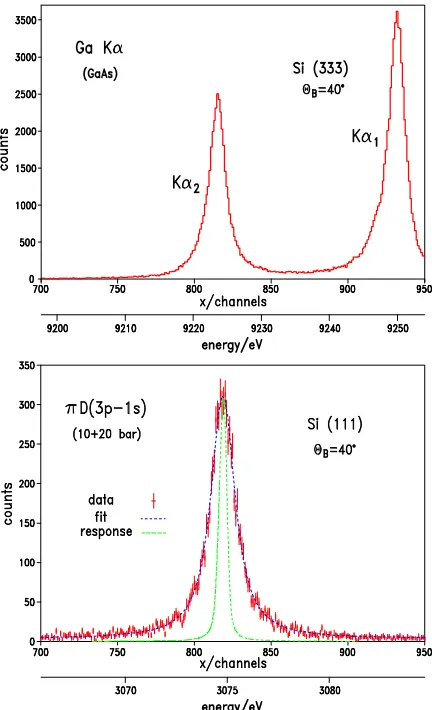
TheπD line was modeled both with a Voigt profile, where Doppler broadening and response function are ap-proximated by a single Gaussian, and secondly, the true response as determined from the ECRIT data convoluted with the imaging properties and including the Doppler con-tributions from Coulomb de-excitation (Fig. 7). Both meth-ods yield the same position value within a few hundreds of a pixel.
A significant correction to the Bragg angle is the in-dex of refraction shift [59] because theπD and the Ga Kα line is measured in first and third order, respectively. In ad-dition, bending and penetration correction due to the sub-stantially different energy must be considered. Mechani-cal shifts from temperature and vibrations are corrected by means of the inclinometer data.
In total, a systematic error of±8 meV was deduced for the measurement of theπD(3p−1s) energy. The com-bined statistical error obtained as weighted average from the data taken at the three different D2 densities amounts
Fig. 7.Ga Kα2calibration line andπD(3p−1s) transition
mea-sured at an equivalent density of 10 bar. The narrow structure shown inside theπD line represents the resolution of the crystal spectrometer.
to ±11 meV. The largest contribution to the error stems from the uncertainty of the energy of the Ga Kα2 line of
±27 meV. For the transition energy, we find
EπD(3p−1s) =3075.583±0.030 eV. (8)
5.2 Line width
To the line shape contribute the response of the spectrome-ter, the Doppler broadening from Coulomb transitions, and the natural line width of theπD(3p−1s) transition. The natural line width is given by the width of the 1s state of about 1 eV because nuclear reactions from the 3p level are negligible and the radiative width is 28µeV.
The model free approach to identify possible Doppler contributions uses narrow boxes of e few eV width around the kinetic energies as suggested by the energy release of Coulomb transitions. Following the experience from the analysis of theµH(3p−1s) line shape, one tries to identify consecutively individual contributions starting with only one contribution of the lowest possible energy, which cor-responds toπD systems not accelerated or moderated down by collisions to energies of a few eV or below. It is suf-ficient to approximate the various kinetic energy compo-nents by box-like distributions as shown in the analysis of theµH experiment.
Aχ2 analysis, done by means of the MINUIT pack-age [64], shows that a low-energy contribution is manda-tory. It was found that the kinetic energy must not exceed 8 eV; a result found independently for taken at 10 bar and the 17.5 bar equivalent density (Fig. 8). The result for the natural line width Γ1s turned out to be insensitive to the upper boundary of the low-energy box for values≤ 8 eV. Therefore, the low-energy component was fixed to a width of 2 eV in the further analysis.
Noteworthy to mention that the ESCM prediction for the kinetic energy distribution forπH(3p−1s) case scaled toπD kinematics (Fig. 2) is unable to reproduce theπD(3p−
1s) line shape because of rather strong contributions of (4−
3) and (5−3) Coulomb transitions. Searches for any higher energy contributions failed even when using the sum spec-trum of the two measurements at 10 and 17.5 bar. This re-sult is rather surprising because also the first analyses of the new pionic hydrogen data show that at least one high-energy component must be assumed to describe the line shape of theπH (4−1), (3−1), and (2−1) transitions [3, 65]. Though a significantly better description of theµH(3p−1s) line shape could be achieved after a recalculation of colli-sion cross sections [47, 66–68], there is no explanation for the absense of any high-energy components inπD.
Fig. 8.Search for evidence and width of the low-energy compo-nent in the kinetic energy distribution. Diamonds (leftχ2 scale)
are due to the 10 bar data. Squares (right scale) are from a simul-tanuous fit to the two spectra taken at 10 and 17.5 bar.
distribution allowing a certain variety for the shape of the box’ extension (Fig. 9).
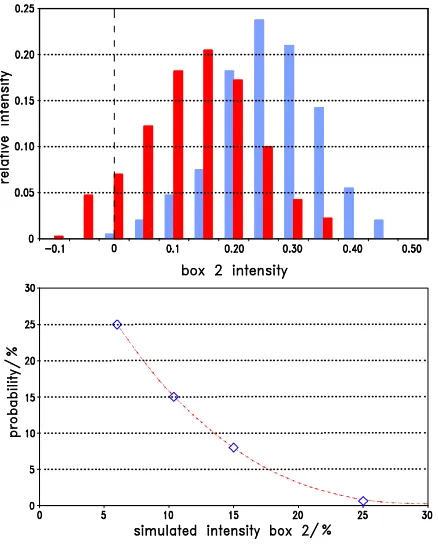
Fig. 9.Top: distributions of relative intensity found from a fit with two boxes when a Doppler contribution of 10% and 25% relative intensity, respectively, is assumed. The result is based on 400 Monte-Carlo simulations each performed for the statistics of the sum of the 10 and 17.5 bar data. Bottom: probability to miss a Doppler contribution at 80 eV as a function of its relative intensity.
Assuming weight zero for box 2 results in an upper limit forΓ1s, and using the limit of sensitivity of 10% for a second box yields a lower bound forΓ1s(− △Γsys)
ac-cording to the above-mentioned 1σcriterion (Fig. 9). The distribution of the results for the weight a second box (box
2 intensity) and the Lorentz widthΓ reflects the fluctua-tions due to the limited statistics (Fig. 10).
Fig. 10. Distributions of relative intensity of a Doppler box around Tkin=80 eV of 10% relative intensity versus the Lorentz widthΓextracted from a set of 400 Monte-Carlo simulations per-formed for the statistics of the sum of the 10 and 17.5 bar data. The input value forΓ=1130 eV.
6 Results
For extracting the hadronic shift, the pure electromag-netic transition energy has been recalculated to be EQED
= 3077.9062 ±0.0079 eV. The error of this calculation is dominated by the uncertainty of the charged pion mass (0.0077 eV) [69] where the accuracy of deuteron (0.0012 eV) and pion radius (0.0010 eV) contribute only marginal. The numerical accuracy of this calculation is as-sumed to be better than 1 meV [70].
Combining measured and calculated QED transition energy, we obtain for the hadronic shift
ǫ1s= −(2323 ±31) meV. (9)
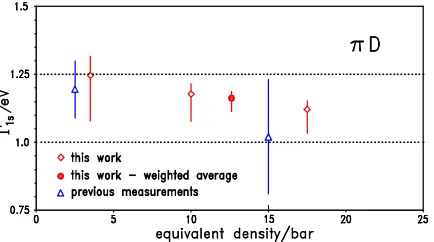
This result is compared to previous measurements in Fig-ure 11. Note that the new result for the electromagnetic transition energy differs slightly from the values as used in the previous experiments [18, 19].
The hadronic broadening is mainly extracted from the sum spectrum of the 10 bar and 17.5 bar measurement us-ing only a low-energy component for the kinetic energy distribution because no density dependence is identified within the experimental accuracy. The combined result
Γ1s= 1171+23
−49
!
meV. (10)
is obtained by averaging according to the statistical weight. It is in good agreement with the earlier measurements, but is a factor of about 3 more precise (Fig. 12).
Evaluating the Deser formula, one obtains for the com-plex scattering length
aLOπD= 24.8±0.3 −i 6.2+0.1
−0.3
!
Fig. 11.Experimental information on the hadronic shift in pionic deuterium. The error of the individual measurements at 3.3, 10, and 17.5 bar and, therefore, also of the weighted average is dom-inated by the uncertainty of the Ga Kα2energy. The results from
the two previous experiments [18, 19] are adjusted according to the new values for the pure electromagnetic transition energies.
Fig. 12.Experimental information on the hadronic broadening in pionic deuterium. Data points of previous measurements are taken from [18] and [19].
and the value for the threshold parameterαderived from theℑaπDreads
α= 252+5
−11
!
µb. (12)
The parameterαas determined from pion production experiments shows wide fluctuations even when compar-ing recent data [71–80]. In some cases, only the statistical error is given for the cross section of the production exper-iments, but the fluctuations suggest significant systematic uncertainties, which may arise in uncertainties of the nor-malisation and/or the Coulomb corrections (Fig. 13).
7 Summary
The (3p−1s) X-ray transition in pionic deuterium has been studied to determine the strong-interaction effects with in-creased precision. An accuracy of 1.3% was obtained for the shift, which matches with the theoretical uncertainty of 1.5% achieved recently [84, 85]. The experimental uncer-tainty is dominated by the error of the calibration transi-tion Ga Kα2(1.2%), which could be decreased by a factor
Fig. 13.Threshold parameterαfor pion production in the reac-tion pp→dπ+. Input in the Figure (from left to right) are from previousπD experiments ([18, 19]), this experiment, pion produc-tion and absorpproduc-tion cross secproduc-tions ([71–74, 74–77, 79, 80]), and a selection of theoretical approaches ([36, 81, 37, 82, 83]).
of about 2 by a remeasurement using a double flat crystal spectrometer in case a significant theoretical progress re-quires further improvement. The new value for the shift is significantly smaller (≈4%) than the results reported from the two earlier precision measurements. About 40% of the discrepancy is due to the new calculation of theπD(3p−1s) electromagnetic transition energy.
The theoretical understanding of NN ↔ NNπ reac-tion is continuously increasing. Within the approach of chi-ral perturbation theory a study of pion production includ-ing the next-to-leadinclud-ing order (NLO) terms yieldsαNLO =
220µb [83, 86] in good agreement with the
pionic-deuter-ium result (Fig. 13). At NLO the theoretical uncertainty is estimated to about 30%. It is expected to decrease be-low 10% within a few years from forthcoming NNLO cal-culations [85]. Hence, the experimental accuracy of 4.2% for the hadronic broadening inπD reaches already the ex-pected final uncertainty of the theoretical calculations.
Noteworthy, that at the 10% level no components from high-energy Coulomb transitions could be identified from the fit to the line shape.
References
1. PSI experiments R-98-01 and R-06-03, www.fz-juelich.de/ikp/exotic-atoms
2. D. Gotta, Prog. Part. Nucl. Phys.52(2004) 133 3. D. Gotta et al., Lect. Notes Phys.745(2008) 165 4. S. Deser, L. Goldberger, K. Kaufmann, and
W. Thirring, Phys. Rev.96(1954) 774 5. T. L. Trueman, Nucl. Phys.26(1961) 57
6. G. Rasche and W. S. Woolcock, Nucl. Phys. A405 (1982) 381
7. D. Sigg et al., Nucl. Phys. A609(1996) 310
8. V. E. Lyubovitskij and A. Rusetsky, Phys. Lett. B494 (2000) 9
9. J. Gasser et al., Eur. Phys. J. C26(2002) 13
11. G. C. Oades, G. Rasche, W.S. Woolcock, E. Matsinos, A. Gashi, Nucl. Phys. A794(2007) 73
12. J. Gasser, V. E. Lyubovitskij, and A. Rusetsky, Phys. Rep.456(2008) 167
13. A. W. Thomas and R. H. Landau, Phys. Rep. B 58 (1980) 121
14. T. E. O. Ericson and W. Weise, Pions and Nuclei (Clarendon, Oxford 1988)
15. S. Weinberg, Phys. Rev. Lett.17(1966) 616 16. Y. Tomozawa, Nuovo Cim. A46(1966) 707
17. D. Sigg et al., Phys. Rev. Lett.75(1995) 3245; Nucl. Phys. A609(1996) 269; erratum A617(1997) 526 18. D. Chatellard et al., Phys. Rev. Lett.74(1995) 4157;
Nucl. Phys. A625(1997) 855
19. P. Hauser et al., Phys. Rev. C58(1998) R1869 20. H.-Ch. Schr¨oder et al., Eur. Phys. J C21(2001) 473 21. V. V. Baru and A. E. Kudryavtsev, Phys. of At. Nucl.
60(1997) 1475
22. S. R. Beane, V. Bernard, T.–S. Lee, and U.– G. Meißner, Phys. Rev. C57, (1998) 424
23. A. Deloff, Phys. Rev. C64(2001) 065205
24. T. E. O. Ericson, B. Loiseau and A. W. Thomas, Phys. Rev. C66(2002) 014005
25. A. Deloff, Fundamentals in Hadronic Atom Theory, World Scientific, London (2003)
26. S. R. Beane, V. Bernard, E. Epelbaum, U.–G. Meißner, and D. R. Phillips, Nucl. Phys. A720(2003) 399 27. B. Burasoy and H. W. Grieshammer, Int. J. Mod. Phys.
E12(2002) 65
28. M. D¨oring, E. Oset, and M. J. Vicente Vacas, Phys. Rev. C70(2004) 045203
29. U.- G. Meißner, U. Raha, and, A. Rusetsky, Eur. Phys. J. C41(2005) 213
30. U.- G. Meißner, U. Raha, and, A. Rusetsky, Phys. Lett. B639(2006) 478
31. M. P. Valderrama and E. R. Arriola, arxiv:nucl-th/0605078 (2006)
32. K. Brueckner, R. Serber, and K. Watson, Phys. Rev.81 (1951) 575
33. V. L. Highland et al., Nucl. Phys. A365(1981) 333 34. D. W. Joseph, Phys. Rev.119(1960) 805
35. R. MacDonald et al., Phys. Rev. Lett.38(1977) 746 36. A. H. Rosenfeld, Phys. Rev.96(1954) 139
37. A. Reitan, Nucl. Phys. B11(1969) 170
38. H. Machner and J. Niskanen, Nucl.Phys. A776(2006) 172
39. V. Baru, A. Rusetski, priv. comm.
40. E. Borie and M. Leon, Phys. Rev. A21(1980) 1460 41. F.J. Hartmann, Proc. of Physics of Exotic Atoms on
Electromagnetic Cascade and Chemistry, 1989, Erice, Italy, 1989 (Plenum Press, New York 1990) p. 23 and
p. 127, and references therein
42. T. S. Jensen and V. E. Markushin, Eur. Phys. J. D19 (2002) 165; Eur. Phys. J. D21(2002) 261; Eur. Phys. J. D21(2002) 271
43. H. A. Bethe and E. E. Salpeter, Handbuch der Physik BandXXXV(Springer–Verlag, Berlin 1957)
44. L. Bracci and G. Fiorentini, Nuovo Cim. A43(1978) 9
45. J. B. Czirr et al., Phys. Rev.130(1963) 341
46. A. Badertscher et al., Europhys. Lett.54(2001) 313, and references therein
47. D. S. Covita et al., Phys. Rev. Lett.102(2009) 023401 48. D. S. Covita, PhD thesis, University of Coimbra
(Coimbra 2008)
49. D. Taqqu, AIP Conf. Proc.181(1989) 217
50. S. Jonsell, J. Wallenius, and P. Froelich, Phys. Rev. A
59(1999) 3440
51. E. Lindroth, J. Wallenius, and S. Jonsell, Phys. Rev. A
68(2003) 032502; Phys. Rev. A69(2004) 059903(E) 52. S. Kilic, J.-P. Karr, and L. Hilico, Phys. Rev. A 70
(2004) 042506
53. J. Eggs and K. Ulmer, Z. angew. Phys.,20(2)(1965) 118
54. G. Zschornack, Nucl. Instr. Meth.200(1982) 481 55. N. Nelms et al., Nucl. Instr. Meth. A484(2002) 419 56. P. Indelicato et al., Rev. Sci. Instrum. 77 (2006)
043107
57. D. F. Anagnostopulos et al., Nucl. Instr. Meth. A545 (2005) 217
58. M. Trassinelli et al., J. Phys., Conf. Ser.58(2007) 129 59. M. Sanchez del Rio and R. J. Dejus, Proc. SPIE3448
(1998) 246
60. R. Deslattes, E.G. Kessler, Jr., P. Indelicato, L. de Billy, E. Lindroth, and J. Anton, Rev. Mod. Phys., vol.75, no. 1, 35 (2003)
61. T. Mooney, priv. comm.
62. Th. Strauch, PhD thesis, Universit¨at zu K¨oln (Cologne 2009)
63. WM.J. Veigele, At. Data and Nucl. Data Tables 5 (1973) 51
64. F. James and M. Roos, Comput. Phys. Commun. 10 (1975) 343
65. A. Hirtl, PhD thesis, Technische Universit¨at Wien (Vi-enna 2008)
66. V. N. Pomerantsev and V. P. Popov, JETP. Lett.83, 331 (2006); Phys. Rev. A73, 040501(R) (2006)
67. T. S. Jensen, V. N. Pomerantsev, and V. P. Popov, arXiv:0712.3010v1 [nucl-th] (2007)
68. V. P. Popov and V. N. Pomerantsev,
arXiv:0712.3111v1 [nucl-th] (2007)
69. C. Amsler et al. (PDG 2008), Phys. Lett. B667(2008) 1 70. P. Indelicato, priv. comm.
71. F. S. Crawford and M. L. Stevenson, Phys. Rev. 97 (1955) 1305
72. C. M. Rose, Phys. Rev.154(1967) 1305
73. C. Richard-Serre et al., Nucl. Phys. B20(1970) 413 74. J. H¨ufner, Phys. Rep.21(1975) 1
75. D. Aebischer et al., Nucl. Phys. B108(1976) 214 76. D. A. Hutcheon et al., Phys. Rev. Lett.64(1990) 176 77. B. G. Ritchie et al., Phys. Rev. Lett.66(1991) 568 78. D. A. Hutcheon et al., Phys. Rev. A535(1991) 618 79. P. Heimberg et al., Phys. Rev. Lett.77(1996) 1012 80. M. Drochner et al., Nucl. Phys. A643(1998) 55 81. D. S. Koltun and A. Reitan, Phys. Rev. 141 (1969)
1413
82. I. R. Afnan and A. W. Thomas, Phys. Rev. C10(1974) 109
85. C. Hanhart et al., in preparation