Electron Emission From Selected Metal
Surfaces By Multiphoton Processes
by
Andrew Reid Birrell
A thesis submitted in partial fulfilment of the requirement for the degree of
Doctor of Philosophy
In the unlikely event that the author did not send a complete manuscript and there are missing pages, these will be noted. Also, if material had to be removed,
a note will indicate the deletion.
uest.
ProQuest 10105192
Published by ProQuest LLC(2016). Copyright of the Dissertation is held by the Author.
All rights reserved.
This work is protected against unauthorized copying under Title 17, United States Code. Microform Edition © ProQuest LLC.
ProQuest LLC
789 East Eisenhower Parkway P.O. Box 1346
Dedication
In memory of my father who died of cancer over six years ago; you are still sadly missed Dad.
"There is a tide in the affairs of men. Which taken at the flood, leads on to fortune;
Omitted, all the voyage of their life Is bound in shallows and in miseries."
work function (0 ) of the surface; the excess photon energy being transferred to the released electron as kinetic energy. However, when very intense radiation fields are incident upon the surface, new multiquantum phenomena become possible, such that when n},ù)>0, electrons are also emitted. The further phenomenon of above-threshold ionization (ATI) in which the ionised electron acquires additional quanta (stico) from the radiation field is well-known for gas-phase atoms, but is still the subject of intense investigation for solids.
Contents
Page
Abstract
3
Contents
4
List of Tables
8
List of Figures
10
Acknowledgements
26
Chapter 1
Introduction
27
1.1 The Single-Photon Photoelectric Effect 27
1.1.1 Summary 32
12 The Multiquantum Photoelectric Effect 34 1.2.1 Multiphoton Ionisation (MPI) of Atoms 40
1 3 Review Of The Multiquantum Photoelectric 41 Effect (MPE)
1.4 Thermionic Emission And Work Function 59
1.4.1 Thermionic Emission 59
1.4.2 Work Function 61
2.2 The Vacuum System 68
2 3 Target Materials 71
2.3.1 Work Function 72
2.3.2 The Reflectivity of a Metal 74
2.3.3 The Target Surface Profile 81
2.4 Electron Optics 83
2.4.1 The Physical Properties of an Electron Beam 83
2.4.2 The Electrostatic Lenses 86
2.4.3 Electron Energy Spectrometers ^ 90
2.4.4 The Retarding Field Analyser 91
2.4.5 The 180° Concentric Hemispherical Analyser 92 2.4.6 The Design and Operational Characteristics 96
of the Electrostatic Lens Systems
2.4.7 The Channel Electron Multiplier 99
2.5 Experimental Design 102
2.5.1 Assembly 102
2.5.2 Electronics 104
2.5.3 Data Acquisition 107
2.6 An Experimental Test Of The Electron Optics System 109
Chapter 3
The Laser System
118
3.1 Introduction 118
3.1.1 Properties of Laser Light 120
3.1.2 Laser Theory 122
3.1.3 The Nd:YAG Laser 126
3.2 The Design And Construction Of The Quantel 128 Nd:YAG Nanosecond Laser System
3.2.1 Laser Maintenance 138
3 3 Laser Power And Beam Profiles 139
3.3.1 Laser Power Measurements 139
3.3.2 Laser Power Output 140
3.3.3 Laser Stability Time 141
3.3.4 The Laser - Spatial Profile 142
3.3.5 Results from s y s t e m a 143
3.3.6 Results from s y s t e m b 146
3.37 The laser - temporal profile 149
3.4 Transport Optics 151
3.4.1 Introduction 151
3.4.2 Optical System for 1064nm Radiation 151 3.4.3 Optical System for 532nm Radiation 157 3.4.4 Light Scattering within the Interaction Chamber 158
4 2 The Retarding Field Analyser (RFA) 161 4.2.1 Experiments with Unpolarised Laser Radiation 161 4.2.2 Experiments with Polarised Laser Radiation 165
4.2.3 Alternative Target Surfaces 165
4.2.4 Summary 171
4.3 The Concentric Hemispherical Analyser (CHA) 172 4.3.1 Kinetic Energy Distribution of Photoelectrons 172
4.3.1a Results 172
4.3.1b Discussion 183
4.3.1c Conclusions 192
4.4 The Multiquantum Photoelectric Effect As A 192 Function Of Laser Intensity And Polarisation
4.4.1 Polarisation Dependence of the Multiquantum 192 Photoelectric Effect
4.4.2 Laser Intensity Dependence of the 201 Multiquantum Photoelectric Effect
4.5 Summary 208
Chapter 5
Conclusions & Suggestions
For Future Work
209
List O f Tables
Table
Page
2.1 The properties and dimensions of the target metals. 72
2.2 The work functions, 0 , of various metals. Typical errors 73 of the tabulated quantities (columns 2-7) are 5%.
2 3 The number of photons (Dj, Dj) required to achieve 74 multiquantum photo-ejection from various metals using both
the fundamental and frequency-doubled Nd:YAG laser radiation.
2.4 The reflectivities of pure, flat, strain-free, oxide-free, T>ulk' 75 samples taken at room temperature (Weaver et al. (1981A&B)).
2.5 The reflectivity of a gold surface at 1). varying angles of 80 incidence and 2). varying wavelengths of incident radiation on a
bulk metal sample (Washburn (1929)).
2.6 A table of the typical potentials applied to the lens elements 94 in the retarding field analyser and the photoelectron detection system.
2.10 A table describing the data associated with Figure 2.23. 113
3.1 The specifications of the laser system. 129
3.2 The legend for the optical head layout. 132
10
List O f Figures
Figure
Page
1.1 A simple apparatus used to observe the photoelectric effect. 32
12 An evaluation with monochromatic light and varying intensity. 33 The curves are marked /;, I2 and f with increasing light intensity.
1 3 The light intensity is constant and the wavelength is varied. 33 The curves are marked and with increasing wavelength.
1.4 A simplified rectangular potential diagram describing the 35 three electron emission processes.
1.5 The principle of the multiquantum photoeffect process. 36
1.6 A diagram illustrating the transition interval between the 38 domination of the pure non-linear multiquantum photoeffect and
optical tunnel emission.
1.7 The photoelectric current versus peak radiation power 43 incident on a sodium surface {Teich & Wolga (1968)).
1.8 The values of the peak electron current and of the 44 parallel E and perpendicular components of the electric field
1.9 The photoelectric current versus relative laser intensity 46 of the fundamental frequency of a ruby laser incident on an
evaporated gold film {Logothetis & Hartman (1967)).
1.10 The energy distribution of photoelectrons emitted from 47 gold, stainless steel and potassium iodide (KI) {Logothetis &
Hartman (1969)).
1.11 The dependence of the electron current. I, on the laser 48 power density, P {Farkas, Kertész, Ndray & Varga (1967B)).
1.12 The dependence of the electron signal, emitted from 49 the gold target on the incident laser intensity, {Farkas, Horvdth
& Kertész (1972)).
1.13 The maximum laser-induced current from tungsten versus 51 maximum incident laser irradiance. The initial surface temperature
was approximately 3(X)K {Bechtel & Franken (1975)).
1.14 A photoelectron spectrum from multiphoton (hu=1.17eV) 52 absorption of polycrystalline copper with linearly polarised light
(perpendicular to the surface); the incident laser intensity was Ijnc=5xlO*Wcm'^ {Luan et al. (1989)).
1.15 A set of photoelectron spectra from multiphoton absorption 53 of polycrystalline copper with linearly polarised light at different
12
1.16 The polarisation dependence of photoelectron emission from 55 polycrystalline copper versus polarisation angle, 8w (with respect to
the surface normal) and for Ij„g=5xlO*Wcm'^ {Luan et al. (1989)).
1.17 The laser intensity dependence of the measured (energy- 56 integrated) photoelectron signal. The slope of the graph, n,
is 3 {Luan et at. (1989)).
1.18a The measured integral electron energy distribution of 58 photoelectrons obtained at I = 120MWcm'^ {Farkas, Toth &
Kôhâzi-Kis (1993)).
1.18b The corresponding differential energy distribution curve 58 derived from {1.18a} {Farkas, Toth & Kôhâzi-Kis (1993)).
1.19 An above-threshold photoeffect spectrum obtained with the 59 second harmonic of the laser light (A=530nm) at I = 30MWcm'^.
The peak structure appeared only in a quahtative form {Farkas, T6th & Kôhâzi-Kis (1993)).
1.20 A simplified model of electrons in a metal showing 62 electron emission.
1.21 The density of occupied and empty states in a metal. 62
2.1 A schematic diagram of the vacuum system. 69
2.2 The reflectivity of polycrystalline copper. Each plot is 76 the result of a different author {Weaver et al. (198IB)).
emitting face of the gold target after it had been subjected to hours of intense laser radiation.
2.6 The definition of the symbols in the Helmholtz-Lagrange 84 law {Harting & Read (1976)).
2.7 An illustration of the pupil, window and beam angle. 85
2.8 An illustration of the pencil angle formed in the emission 86 system.
2.9a&b The diagrams showing the dimensions A, G and D of 87 {a} a two-element electrostatic lens and {b} a three-element lens.
2.10 A diagram showing the principle of spherical aberration. 88 Axial rays are focused at while zonal and marginal rays are
focused at F, and F„, respectively.
2.11 A diagram showing the principle of chromatic aberration. 91
2.12 The integral electron energy distributions and their 93 corresponding differential energy distribution curves for the
retarding field analyser.
2.13 A schematic diagram of the retarding field analyser and the 94 photoelectron detection system.
14
analyser. R, and are the radii of the inner and outer hemispheres respectively.
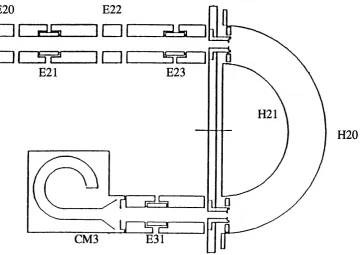
2.15 A schematic diagram of the concentric hemispherical analyser, 98 the electrostatic lens systems and the photoelectron detection system.
2.16 A side-on-view of the concentric hemispherical analyser, 100 associated electrostatic lens elements and the photoelectron detection
system. The channel electron multiplier was housed in a protective copper box.
2.17 An angular view of the concentric hemispherical analyser, 101 associated electrostatic lens elements and the photoelectron detection
system. The diameter of the entrance aperture to the first lens element was 1.0mm.
2.18 A cross-sectional view of a lens element mounted on an 104 optical bench.
2.19 An end-on-view of the lens systems with the hemispheres 105 in position as shown.
2.20 A schematic diagram of the power supplies providing the 106 voltages to the electrodes in the electron spectrometer.
2.21 A schematic diagram of the integrator/amplifier. 108
2.22 A schematic diagram of a hairpin filament mounted on 111 a ceramic plate. All dimensions measured in mm.
234e Left by 0.60mm 115
2 3 4 f Right by 0.60mm 115
234g Up by 0.20nun 115
234h Down by 0.20mm 115
2341 Up by 0.40nun 116
234j Down by 0.40mm 116
234k Up by 0.60mm 116
2341 Down by 0.60mm 116
3.1 The number of atoms in a natural two-state system as a 123 function of energy. The dotted line shows the Maxwell-Boltzmann
function, decaying exponentially with increasing energy {Solymar &
Walsh
(1989)).
3.2 The three level system. The strong "pump' signal has 125 'equalised' levels and Ej such that Eg has a greater population
than Eg. The dotted line shows how population is changing with energy, as in Figure 5.7, but now it has a positive slope (Solymar
& Walsh
(1989)).
3 3 A simplified energy level diagram for the neodymium ion 127 in YAG showing the principal laser transitions. Laser emission also
results from transitions between the levels and the % ^ / 2 and %^i2
levels, but at only one tenth of the intensity of the transition shown
(Wilson & Hawkes
(1989)).
16
3.5 The optical head layout. 131
3.6 A photograph of the amplifier and oscillator laser heads 133 respectively.
3.7 A photograph of the constituent components of the 135 oscillator laser head. Its key features are indicated.
3.8 The frequency doubling option. 137
3.9 The laser oscillator flashlamp output. 141
3.10 The laser stabiUty curve. 142
3.11 The spatial profile of the laser beam. 144
3.12 Identical to the previous profile except that the laser pulse 145 energy has been increased from 500mJ to 700mJ by increasing the
applied flashlamp voltage from 1.15kV to 1.20kV.
3.13 The output from the laser resonator before amplification. 146
3.14 The output from the laser optical head at 532nm. 147
3.15 The laser pulse exiting the interaction chamber. 147
3.16 The target was in the path of the impinging laser beam. 148
3.17 An aperture was placed in the path of the laser beam and 148 the target was moved away from the incident beam.
3.20 The percentage of laser light transmitted through uncoated 153 BK7 glass at various wavelengths (JML Direct (1993)).
3.21 A diagram showing the set-up and function of the thin film 155 plate polariser {CVI (1992)).
3.22 A diagram showing the directions of polarisation of the 155 transmitted and reflected components of light {CVI (1992)).
3.23 The percentage of laser light reflected by the beamsplitter 155 cube at various wavelengths when set to transmit the V component
of light {CVI (1992)).
3.24 Unpolarised hght passes through the first polariser and is 156 linearly polarised. The second polariser attenuates the through
beam with attenuation dependent on 0 {Oriel (1990)).
4.1a&b The measured electron energy distributions of ejected 162 electrons from a copper target using the RFA. The laser beam
was unpolarised. The collection time for each spectrum was 2 hours. Although both spectra were recorded with the laser beam incident at a glancing angle (85°), in {b} the target was moved further into the path of the beam. This had the effect of increasing the overall photoelectron yield, especially at high kinetic energies.
4.1c The measured electron energy distribution of ejected electrons 163 from a copper target using the RFA. The target was moved further
18
4,ld The background electron signal with the laser beam not 163 impinging directly onto the target.
4 Ja& b The measured electron energy distributions of ejected 166 electrons from a copper target using the RFA. In {a} the electric
field of the laser beam was polarised perpendicularly to the target surface, in {b}, parallel to the surface. The collection time for each spectrum was 2 hours. In {a}, a significant number of electrons were ejected with kinetic energies greater than 3eV, while in {b}, the number of electrons ejected with energies greater than 3eV was negligible.
4.2c&d As 4.2 {a} & {b} except that the copper target was 167 moved further into the path of the beam. In {c} the laser beam
was p-polarised and in {d} s-polarised. In {d}, still no significant number of electrons were ejected with kinetic energies greater than 3eV. This is characteristic of a thermionic emission process.
4.3a&b The measured electron energy distributions of ejected 168 electrons from a silver target using the RFA. The electric field
of the laser beam was p-polarised, i.e. perpendicular to the silver surface. The collection time for each spectrum was IV2 hours.
In (b} the target was moved further into the path of the beam.
43c& d As 4.3 {a} & {b} except that the silver target was 169 moved further into the path of the p-polarised beam.
43e& f Similar to the previous spectra except that the target 170 surface was now almost fully in the path of the impinging laser
each spectrum was 4 hours, hi {a}, the peak electron intensity is twice that shown in {b} indicating that electron emission is more favourable when p-polarised light is incident on the target.
4.4c An identical spectrum as Figure 4Ab except that the plot 174 has been magnified to show more detail. The incident laser beam
was s-polarised.
4.4d The measured electron energy distribution of ejected 174 electrons from a heated tungsten filament using the CHA. Few
electrons were emitted with energies greater than 2eV, whereas in {c} the electron intensity peak is at 2eV, suggesting that with s-polarised light another photoemission process was occurring.
4.5a&b The measured electron energy distributions of ejected 175 electrons from a copper target using the CHA. In {a} the electric
field of the laser beam was polarised perpendicularly to the target surface, in {b}, parallel to the surface. The collection time for each spectrum was 1 hour. These spectra illustrate that with p-polarised light {a}, electrons were ejected with kinetic energies greater than 6eV.
4.6a&b The measured electron energy distributions of ejected 177 electrons from a copper target using the CHA. In {a} the electric
20
3eV. The difference between the peaks is «1.75eV, greater than the laser photon energy.
4.7a&b The measured electron energy distributions of ejected 178 electrons from a copper target using the CHA. In {a} the electric
field of the laser beam was polarised perpendicularly to the target surface, in {b}, parallel to the surface. The collection time for each spectrum was 15 hours. The glancing angle was increased by 3® so as to reduce the signal contribution by thermionic emission processes. A high-energy 'shoulder' is clearly visible for p-polarised light at 4eV.
4.8a&b The measured electron energy distributions of ejected 179 electrons from a silver target using the CHA. In (a) the electric
field of the laser beam was polarised perpendicularly to the target surface, in {b}, parallel to the surface. The collection time for each spectrum was 1 hour. As with a copper target, the number of electrons emitted from the silver surface was greater with p-polarised light.
4.9a&b The measured electron energy distributions of ejected 180 electrons from a silver target using the CHA. In {a} the electric
field of the laser beam was polarised perpendicularly to the target surface, in {b}, parallel to the surface. The collection time for each spectrum was 1 hour. Effectively no electrons were emitted from the silver surface with energies greater than 6eV when subjected to s-polarised light.
4.10a&b The measured electron energy distributions of ejected 181 electrons from a silver target using the CHA. In {a} the electric
4.10c&d As 4.10 {a} & {b} except that the laser pulse energy 182 was increased by adjustment of the laser oscillator flashlamp voltage.
In {d} the electron energy basewidth has remained the same as {b} but the peak electron intensity has doubled, hi {c} the peak electron intensity has also doubled but the electron energy FWHM has now widened and hence the smaller peak at 5eV is now more difficult to detect.
4.11a&b The measured electron energy distributions of ejected 184 electrons from a gold target using the CHA. In {a} the electric
field of the laser beam was polarised perpendicularly to the target surface, in {b}, parallel to the surface. The collection time for each spectrum was IV2 hours. Only one peak was observed
(centred at 2eV energy) in (b) but in {a} the main peak is at ~2eV with a long high-energy shoulder extending to 12eV.
4.12a&b The measured electron energy distributions of ejected 185 electrons from a gold target using the CHA. In {a} the electric
field of the laser beam was polarised perpendicularly to the target surface, in {b}, parallel to the surface. The collection time for each spectrum was IV2 hours. Substantially more electrons were
emitted from the surface and electrons emitted with energies up to 13eV were recorded with p-polarised light.
4.13a&b The measured electron energy distributions of ejected 186 electrons from a gold target using the CHA. The electric field
22
surface. The collection time for each spectrum was IV2 hours.
In {b} the target was moved further into the path of the beam, increasing the photoelectron yield at high kinetic energies.
Similar results were found with the RFA for copper {Figure 4.1}.
4.14a&b The measured electron energy distributions of ejected 190 electrons from a silver target using the CHA. In {a} the electric
field of the laser beam (hu=2.34eV) was polarised perpendicularly to the target surface, in {b}, parallel to the surface. The collection time for each spectrum was 7 hours. In both spectra, the main peak has an electron energy of 1.25eV. A second smaller peak is clearly visible at 2.75eV in (a) but is not observed in {b}.
4.15a&b The measured electron energy distributions of ejected 191 electrons from a silver target using the CHA. The electric field
of the laser beam (hu=2.34eV) was polarised perpendicularly to the target surface. The collection time for each spectrum was 10 hours. In {b} the laser pulse energy was increased by adjustment of the laser oscillator flashlamp voltage. This had the effect of extending the electron energy distribution and enhancing the high-energy peak.
4.16a The polarisation dependence of photoelectron emission 194 from a gold surface versus polarisation angle, "n. The ejected
electrons had a kinetic energy of 3eV.
4.16b As {a} except that the ejected electrons had a kinetic 194 energy of 6eV. At 90®, the polarised laser radiation was
incident perpendicularly to the gold surface.
incident perpendicularly to the gold surface.
4.16e&f The measured electron energy distributions of ejected 196 electrons from a gold target using the CHA. In {e} the electric
field of the laser beam was polarised perpendicularly to the target surface, in {f}, parallel to the surface. The collection time for each spectrum was 1 hour. The polarisation dependence of photoelectron emission was investigated by recording the ejected electron intensities at certain discrete electron kinetic energies of 3, 6, 8 and lOeV.
4.17a The polarisation dependence of photoelectron emission 197 from a silver surface versus polarisation angle, r|. The ejected
electrons had a kinetic energy of 3eV.
4.17b As {a} except that the ejected electrons had a kinetic 197 energy of 5eV. At 90°, the polarised laser radiation was
incident perpendicularly to the silver surface.
4.17c The polarisation dependence of photoelectron emission 198 from a silver surface versus polarisation angle, r\. The ejected
electrons had a kinetic energy of 6eV.
4.17d As {c} except that the ejected electrons had a kinetic 198 energy of 8eV. At 90°, the polarised laser radiation was
incident perpendicularly to the silver surface.
24
electrons had a kinetic energy of 4eV.
4.18b As {a} except that the ejected electrons had a kinetic 199 energy of 6eV. At 90°, the polarised laser radiation was
incident perpendicularly to the copper surface.
4.18c The polarisation dependence of photoelectron emission 200 from a copper surface versus polarisation angle, r\. The ejected
electrons had a kinetic energy of SeV.
4.19a The measured electron energy distribution of ejected 204 electrons from a gold target using the CHA. The electric field
of the laser beam was polarised perpendicularly to the target surface. The collection time was 1 hour.
4.19b The laser intensity dependence of the measured 204 photoelectron signal from a gold surface. The ejected electrons
had a kinetic energy of 3eV. The slope of the graph, n, is 4.5.
4.19c The laser intensity dependence of the measured 205 photoelectron signal from a gold surface. The ejected electrons
had a kinetic energy of 5eV. The slope of the graph, n, is 8.0.
4.19d As {c} except that the ejected electrons had a kinetic 205 energy of 7eV. The slope of the graph, n, is 8.0.
4.19e The laser intensity dependence of the measured 206 photoelectron signal from a gold surface. The ejected electrons
had a kinetic energy of 9eV. The slope of the graph, n, is 9.0.
photoelectron signal from a copper surface. The ejected electrons had a kinetic energy of 2eV.
26
Acknowledgements
To Dr. Nigel J. Mason for his expert supervision and encouragement during the course of this work.
To Dr. Shen Ning for getting me started on this project and his help throughout. To Martin Schafer for assisting me with my research when it was in its infancy. To Jon Gingell for his assistance with some of the figures in this thesis.
To Edward Oldfield and Ivan Rangué for their technical assistance.
To my fellow colleagues in the atomic physics group: Parveen Akther, Dr. Julia Davies and Jon Gingell.
To my chums on the third floor: Dr. Paul Ashley, Rowan Finch, Andrew Gamer and Dr. Jeremy Moxon.
To the close friends that I have made while at University College (not in any particular order): Derek Thomas, John O'Brien, Mike Cresswell, Charles Wiles, Steven West, Giles Sparrow, Simon Masterton, Hannah Westoby, Alan Radley. To the staff of the Physics and Astronomy department, particularly the people that work so hard behind the scenes (especially Catherine and John McManus.). To the Physics and Astronomy department and the Engineering and Physical Sciences Research Council (EPSRC) for financial support.
To the board of Oxley Developments Company Limited for taking me on as Technical Sales Engineer', in particularly the chairwoman, Mrs. Ann Oxley and Mr. Peter Scutt, my boss.
To Mike S. Elliot of Elliot Scientific Limited for being 'a nice g u /. To my mother and sister for putting up with me all these years.
To my fiancée Gillian Midgley for always being there when I needed her (which was extremely often).
Chapter 1
INTRODUCTION
1.1
T H E
S I N G L E
-
P H O T O N
PHOTOELECTRIC EFFECT
In 1839, Edmund Becquerel made the important discovery that when two metal electrodes are immersed in a liquid electrolyte solution, a small but detectable current is generated upon illumination of one of the electrodes with sunlight. Subsequently, Becquerel experimented with a number of different electrodes and electrolytic solutions. He found that cells containing platinum or gold electrodes coated in silver chloride and with water acidified with nitric acid as an electrolyte generated a steady current for about two hours. Blue light was found to be a better current generator than either red or yellow hght, the energy of the illuminating beams being equal. This phenomenon was entitled 'The Photovoltaic
^ e c t.
28
of long submarine cables, he observed that as the selenium bars became exposed to sunhght their resistance fell by up to 100%. It was possible that such an effect was due to simply a thermal change in resistance of the bars, therefore he placed them in cool water and determined that the decrease in resistance did not diminish as a function of temperature. He correctly concluded from this that the reduction in resistance of the selenium bars was an effect of the illuminating hght.
However, the most conclusive evidence for 'A Pkotoemissive Effect was made by Heinrich Hertz in 1887. During his classical researches on electric waves and osciUations, Hertz observed that sparks occurred more readüy in the air gap of his transmitter when light was directed at one of the metal terminals. He reported that: Tn a series of experiments on the effects of resonance between very rapid electric oscillations that I carried out and recently published, two electric sparks were produced by the same discharge of an induction coil, and therefore simultaneously. One of these, spark A, was the discharge of the induction coil, and served to excite the primary osciUation. The second, spark B, belonged to the induced or secondary oschlation. I occasionally enclosed spark B in a dark case so as to make observations more easily, and in so doing I observed that the maximum spark length became decidedly smaller inside the case than it was before.' {Hertz (1887)).
By studying the interference between the two sparks Hertz concluded that ultra violet hght was responsible for the observed phenomenon. Hertz also found that the effect of the radiation was greatest when it was incident on the negative terminal of the gap, that a larger rounded metal terminal yielded a greater effect than a smaU pointed one, and that heshly polished surfaces were more responsive to the ultra-violet radiation than tarnished surfaces.
proportional to the hght intensity for a given frequency. This was in contrast to the conventional theory of hght as a wave, which would not predict any wavelength dependence, since the energy of a wave is only proportional to its amplitude. The solution to this paradox was due to Einstein's hypothesis that hght is quantised in photons. In 1905, when Einstein was just 26 years old, he published the now classic paper entitled: 'On a heuristic viewpoint concerning the production and transformation of hght' that was to bring Einstein the Nobel Prize for Physics sixteen years later.
The fundamental theory of photoelectric emission was put forward by Einstein on the basis of Planck's quantum theory. In 1900, Max Planck derived a formula for the spectral emittance, Sx, of a blackbody;
Sx = {(2Tic"h)/A.5} X { l/e^ /^ "-l} , (1.1)
where c is the speed of sound in air, h is Planck's constant, X is the wavelength of emittance, k is Boltzmann's constant and T is the temperature of the emitter.
30
- that travel with the velocity of light. Together Planck and Einstein found that the quanta associated with a particular frequency, u, of light must all have the same energy and that this energy E is directly proportional to u . That is E=hu. Einstein extended Plank's quantum theory of thermal radiation and apphed it to the photoelectric effect and made the assumption that in the photoelectric effect one photon is completely absorbed by one electron which thereby gains the quantum of energy and may be emitted from the metal. The electrons are initially bound in the metal, but if the quantum of energy hu absorbed by an electron exceeds the magnitude of the binding energy, it is released from the metal and takes up the balance of the energy in the form of kinetic energy. Hence the maximum possible kinetic energy, V2mv^^^ of the photoelectrons is determined by the energy of each
photon, hu;
hu = V2mv^„,, + 0 , (1.2)
where the work function, 0 , is the minimum energy needed to extract an electron
from the surface of the material. More tightly bound electrons or electrons which have suffered collisions inside the metal before escaping from the surface may emerge with kinetic energies less than the maximum. From Eq. 1.2 it is clear that the maximum kinetic energy is directly proportional to the frequency and that there must be a threshold frequency, u^, given by hug=0 , below which there wül
be no photoemission. The value ofu^ depends on the work function for each particular material.
L i g h t
32
Electrons
Evacuated quartz tube
rA/WWV
{Figure 1.1} A simple apparatus used to observe the photoelectric effect.
curves converge towards the same point on the ordinate (assuming that the sensitivity of the cathode is constant) but the maximum velocity of the electrons increases as the wavelength decreases.
L L l
SummaryIn this section, the origin of the single-photon photoelectric effect was discussed. This included a brief summary of the early important findings, from The
Photovoltaic Effect discovered by Becquerel, to an analysis of Einstein's
Photoelectric Equation; hu = V2mv^ + 0 .
{Figure 1.2} An evaluation with monochromatic light and varying intensity. The curves are marked /,, and T, with increasing hght intensity.
{Figure 1.3} The light intensity is constant and the wavelength is varied. The curves are marked 1% and with increasing wavelength.
34
1.2
The Multiquantum Photoelectric Effect
The phenomenon of multiquantum photoelectric emission has been of interest to physicists for at least a quarter of a century. In the multiquantum photoelectric effect, photon energies less than the work function of the target material can lead to the emission of electrons from the solid surface. The necessary requirement to achieve this multiquantum photoelectric emission is a sufficiently intense light source. These high intensities have only recently become available with the advent of high-power pulsed laser systems.
When the surface of a solid, in particularly a metal, is subjected to the high-intensity oscillating electromagnetic field of a laser beam, electron emission can arise through either; (1) the photoelectric effect, (2) tunnel-emission due to the oscillating electric field or (3) thermionic emission. Each of these three processes is shown in Figure i,4 on a simplified rectangular potential diagram.
In this work, direct photon-electron interactions involved in the photoelectric effect were to be investigated. Thermionic emission processes resulting from indirect photon-electron interactions cannot, however, be overlooked since thermionic emission readily occurs in tandem with the photoelectric effect. Hence, contributions from thermionic emission must also be quantified.
Prior to the development of lasers in the 1960's, photoelectron emission was only known in the form of the linear photoelectric effect given by Einstein's equation; hu = V2myp'^^ + 0 (Eq. 1.2), and by the linear relationship: j oc I between the
photoelectric current j and the light intensity I. For these single-photon absorption processes, the photoelectric effect is restricted to photons of energies hw>0 .
With typical values of 0S;4eV for the majority of common metals, the maximum wavelength, = ^c/0 , to achieve electron emission is A,^^^:s310nm, i.e. in the
Work function
\ 2 . Tunnel emission
Fermi
{Figure 1.4} A simplified rectangular potential diagram describing the three electron emission processes.
effect may be produced by simultaneous absorption of n quanta. Hence, with multiquantum absorption processes from intense laser fields, electron emission becomes feasible for considerably longer wavelengths, i.e. in the visible and the infra-red parts of the electromagnetic spectrum. The first theoretical works
{Makinson & Buckingham (1951); Smith (1962); Adawi (1964); Teich & Wolga
(1968); Marinchuk (1971) and Barashev (1972)) estimated the photocurrent produced in such multiquantum processes by calculating the transition probability from the fundamental bound state to the free electron bound state. Einstein's simple equation and the linearity relationship are then no longer strictly valid and must be replaced by the multiquantum photoeffect equation;
nhu = V2m v\ (T3)
36
i
{Figure 1.5} The principle of the multiquantum photoeffect process.
In the multiquantum photoeffect, the work function 0 o f a metal, characterised by the Fermi energy of the Somm erf eld-type conduction electron gas will always be higher than the photon energy hu of the irradiating laser light. Within the fermi sea the electrons are able to move freely in all directions except in the direction normal to the surface. Hence, the multiquantum photoelectric effect is a vectorial one and depends only on the laser electric field component, E^, which is perpendicular to the surface; j a « p.
Figure 1.5 shows the principle of the multiquantum photoeffect process. An
electron is emitted from the surface even though the incident photon energy is smaller than the electron binding energy. This process occurs through simultaneous absorption of several photons (two photons in the case of Figure
1.5), in a time period determined by The Heisenberg Uncertainty Principle; and
Horvath & Kertész ( 1972) showed, using mode-locked laser pulses, that a decrease in the order of the non-linearity of photoemission, n, occurred when the gold target was subjected to picosecond laser pulses of extremely high intensities (=16GWcm^). This phenomenon the authors attributed to the theoretically predicted {Keldysh (1965) and Bunkin & Fedorov (1965)) appearance of optical turmel emission. However, in the case of metal targets, there is a transition interval between the domination of the pure non-linear multiquantum photoeffect and the on set of optical tunnel emission [Figure 7.6}. Keldysh (1965) derived a formula from which the dominant type of electron emission can be calculated by defining a parameter, y. The dependence of the photoelectric current, j, on the laser intensity. I, in the pure non-linear multiquantum photoeffect case is j a a r . In this instance, y » 1. While in the pure optical tunnel-emission case, j a exp(»P/E), where P is a constant. In this instance, y < 1. In both cases, however;
y = (27iu\/2m<ï>)/eE, (1.4)
38
lo g j
Î
» 1y«i
MULTIPHOTON
TUNNELING Bunkin
Fedorov
lo g I ( - E ' )
{Figure 1.6} A diagram illustrating the transition interval between the domination of the pure non-linear multiquantum photoeffect and optical tunnel emission.
Fermi-Dirac energy distribution than is characteristic at room temperature. These electrons may then be ejected from the metal surface by a multiphoton effect.
Early experimental and theoretical work have suggested that the multiquantum photoeffect is characterised by:
1). A strong polarisation dependence; the photocurrent depending only on the component of the optical field strength which is perpendicular to the target surface. This phenomenon was first demonstrated by Farkas, Ndray & Varga (1967).
2). The photocurrent varies with laser intensity in the form of a power dependence of order n, until at higher intensities where the dependence is found to be of the form n + x, where x can be greater than or less than n, depending on the experimental conditions.
3). The time delay between the arrival of an incident laser pulse on the target surface and the emission of the photoelectron pulse is immeasurable. However, thermal electrons are time-delayed.
4). Owing to the non-linear response of the target cathode, the duration of the ^ photoemission pulse T is shorter than that of the exciting laser pulse T^. With
Gaussian pulse shapes: T = TjVn.
40
1,2*1 Multiphoton Ionisation (MPI) O f Atoms
Several authors have made analogies between the multiquantum photoelectric effect of surfaces and the multiphoton ionisation effect of gaseous atomic targets. It is therefore necessary to briefly review MPI processes.
In 1931, Goppert-Mayer published the first theoretical paper to discuss multiphoton processes. It was entitled 'Simultaneous two-photon absorption'. Other theoretical papers followed some years later; Keldysh (1965), Zernik &
Klopfenstein (1965), Klarsfeld (1970), Faisal (1973) and Klar^eld & Maquet
(1979). It was, however, to be another 30 years before the first experiment was performed to demonstrate such a process since, until then, no intense monochromatic light source existed that was capable of probing such effects.
Voronov & Delone in 1965, followed by Agostini et a l, 1968, were the first to observe multiphoton ionisation (MPI) of rare-gas atoms. These early experiments on multiphoton ionisation of atoms were concerned with observing the behaviour of the total ionisation cross-section. It was not until the early 1980's that investigators began studying the angular and kinetic energy distributions of the electrons ejected in the process. The reason for observing the energy of the emitted electrons is to discover whether, in a specified laser intensity range, the bound electron absorbs predominantly the minimum number of photons necessary for the atom to be ionised, or whether additional absorption of photons in the continuum is of significance - 'above-threshold ionisation' - an expression first used by Gontier et al (1980). (In some hterature, above-threshold ionisation, 'ATI', is referred to as excess photon absorption, 'EPA'). The first experimental evidence of multiphoton above-threshold ionisation was reported in a letter by
Agostini et al (1981). In this experiment, xenon gas was ionised by the field of
al (1988), Petite & Agostini (1988), Schwier et al (1988), Feldmann (1990) and
Muller {\990). N
It has therefore been proposed that the multiquantum photoelectric process may show similar effects to the multiphoton ionisation process, with the target surface absorbing s photons greater than n, the number needed to overcome the surface work function; the excess energy (approximately s minus n) being transferred into the kinetic energy of the photoelectrons. The multiquantum photoelectron kinetic energy spectrum for solids may therefore be analogous to the multiphoton ionisation spectrum for gases, showing discrete peaks for each quanta, (Sj-n),
(Sj-n) The purpose of this project was, in part, to validate this hypothesis. However, it is first necessary to review earlier experimental work on the multiquantum photoelectric effect (MPE).
1.3
Review Of The Multiquantum Photoelectric
Effect (MPE)
Experimental studies of the multiquantum photoelectric effect from a metal surface were initiated in 1964 by Teich, Schroeer & Wolga, whose preliminary investigations resulted in the demonstration of a two-quantum photoeffect from a sodium surface. The results of a more detailed study were published by Teich &
Wolga in 1968. In both experiments the authors focused a pulsed gallium arsenide
42
peak power was studied using a calibrated filter to control the laser intensity, I, incident on the sodium surface between 2xlO^Wcm'^ :$ I 5 lO^Wcm'^. In logarithmic coordinates the plot was found to be a straight line with gradient 2
{Figure 7.7}, in direct agreement with theoretical predictions (e.g. Smith (1962)).
This the authors directly attributed to the double-quantum surface photoelectric effect of a metal.
The research groiç) headed by Prof. Gyozo Farkas of The Central Research Institute for Sohd State Physics in Hungary has since established itself as the world leaders in this field by pubhshing a number of important papers from 1967 to the present day. Their first paper {Farkas, Ndray & Varga (1967)) was entitled 'Dependence of non-classical electron emission fi*om metals on the direction of polarisation of laser beams'. In this paper the authors described an experiment performed using a passively Q-switched ruby laser (hu=1.786eV, 30ns FWHM pulse width, peak power density = 0.5MWcm'^) incident on a bulk solid silver surface (0=4.8eV). The laser beam was passed through a polarising optic prior to impinging unfocused onto the surface. The target was mounted in a glass bulb under vacuum ( &= 1 0 ® torr) at a glancing angle of 87® to the incoming laser beam.
Any electrons emitted from the target were detected on an electrode, an accelerating potential of +1000V having been apphed to it. The resulting electron emission from the surface was measured as a current and showed a strong dependence on the direction of polarisation of the incoming laser beam [Figure
1.8}, It was therefore thought that since thermal processes were known to be
independent of the polarisation of the hght, another process had to be responsible for the production of electrons - a multiquantum photoelectric effect. Under these experimental conditions (high reflectivity of silver at 0.6943 pm (hu=1.786eV), low power density on the target surface, a calculated target temperature increase of less than 10® C) the contribution due to thermionic emission was felt to be neghgible.
<
t-Z
LU CE
cr
=) o o CE
I—
( S L O P E = 2 )
o
LU
LU
o
k-o X
CL -16
5 0 0 1 0 0
10
PEAK I N C I D E N T P O WE R ( m W )
{Figure 1.7} The photoelectric current versus peak radiation power incident on a sodium surface {Teich & Wolga (1968)).
44
a , u .
max
{Figure 1.8} The values of the peak electron current and of the parallel E and perpendicular components of the electric field plotted versus angle, ([)''. (|)® is the angle between the plane of polarisation of the electric vector and the plane of incidence {Farkas, Ndray & Varga (1967)). On the figure, the authors incorrectly labelled E and E^. They should be the opposite way round
intensity (hu = 1.786eV) revealed two distinct processes {Figure L9}. For laser intensities greater than about IMWcm'^, the electron signal was veiy strongly dependent on the laser intensity. This the authors attributed to thermionic emission due to heating of the metal surface. For laser intensities less than IMWcm'^, the electron signal followed a third-power dependence on the laser intensity. This the authors stated strongly indicated a three-photon surface effect.
The energy distributions of the ejected electrons with 3.57eV photons incident on various targets was measured 'indirectly' using the retarding potential field method. Retardation curves were recorded and differentiation of these curves resulted in ejected electron energy distributions as shown in Figure LIO. In the case of gold (0=4.8eV), the maximum energy of the photoelectrons should be (2hu - 0 ) = 2.4eV. From Figure 1.10 one obtains E^„^~2.5eV, as expected.
Farkas, Kertész, Ndray & Varga (1967A) expanded on their multiquantum
46
<
o
Q. S l o p e 3
n ' O
Relotive L o s e r I n t e n s i t y Vj (I«= 14
{Figure 1.9} The photoelectric current versus relative laser intensity of the fundamental frequency of a ruby laser incident on an evaporated gold fihn
{Logothetis & Hartman (1967)).
retarding potential field analyser and it was found that a significant number of the ejected electrons had energies greater than lOeV.
• o
3 4 7 2 A S t a i n l e s s
S t e e l
'— S t a i n l e s s 6 9 4 3 A S t e e l
LU
20
10
0 1 2 3
En e r g y of Emi t t e d E l e c t r o n s in eV
{Figure 1.10} The energy distribution of photoelectrons emitted from gold, stainless steel and potassium iodide (KI) (Logothetis & Hartman (1969)).
measured electron current against the laser output power density {Figure 1,11).
48
[au]
3
2
!
I
I I
I
I
I I M
/ L _ . - .
20 25 2) 40 50 Ü0 720
PI MW/cm*]
{Figure 1.11} The dependence of the electron current, I, on the laser power density, P {Farkas, Kertész, Ndray & Varga (1967B)).
n = 4 /
10
10
2 5
1
V,
{Figure 1.12} The dependence of the electron signal, Vj^lj emitted from the gold target on the incident laser intensity, {Farkas, Horvdth & Kertész (1972)).
50
signal as a function of incident laser intensity was recorded and at low power densities an n-order process was observed (gradient = 4), thus indicating a multiphoton process. However, at high power densities the slope of the curve gradually decreased to a final value of n ~ 1.2. This phenomenon the authors interpreted as due to the onset of optical field emission.
Another research group involved in the early work in this field was led by Bechtel
& Franken (1975) of the University of Michigan. A Q-switched ruby laser
operating at its fundamental frequency (hu = 1.786eV, pulse duration = 13 or 20 nanoseconds FWHM) was directed onto a tungsten (0=4.5eV) target mounted in a vacuum chamber with a typical background pressure of 1 x 10 ^ torr. The laser-induced electron currents produced from the target surface were detected on a fast oscilloscope. A high-voltage power supply was used to maintain the collector electrode at a positive potential with respect to the target. The dependence of the measured electron signal as a function of the incident laser intensity was recorded and is shown in Figure 1,13, A slope of n ^ 6 was evaluated whose value is
compatible neither with a pure multiphoton photoemission process nor with thermionic emission. This anomaly the authors explained was due to a process they called 'two-photon-assisted thermionic emission'. This is a laser-induced effect that is dependent on the temperature of the electron emitting surface. The incident laser radiation produces a rise in temperature at and very close to the target surface so that there is an increase in the number of electrons in the tail of the Fermi-Dirac energy distribution than is typical at room temperature. These electrons are subsequently ejected from the surface by a single- or multi-photon effect. The authors show that this 'assisted thermionic emission' manifests itself by increasing the slope (n) of the electron emission versus incident laser irradiance graph.
Slope % 6
z ÜJ
oc
cc o
10 20 40 60 80 100
RRADI ANCE ( M W / c m
{Figure 1.13} The maximum laser-induced current from tungsten versus maximum incident laser irradiance. The initial surface temperature was approximately 300K {Bechtel & Franken (1975)).
copper rod (99.5% purity, 2.7mm diameter) was mounted inside a vacuum chamber (pressure ~ 5x10^ mbar) such that it was at the focus (1 0 0pm waist) of
an 8.5ns pulsed Nd:YAG laser (photon energy, hu = 1.17eV). The copper rod was mounted at an extremely narrow glancing angle (8 ^ .0 lo the incident linearly
52
D
d
Z 0. 5
a c
00
0
5 10e L e c t r o n
e n e r g y ( e V ){Figure 1.14} A photoelectron spectrum from multiphoton (hu = 1.17eV) absorption of polycrystalline copper with linearly polarised hght (perpendicular to the surface); the incident laser intensity was Ijj^^.=5xlO®Wcm‘^ {Luan et aL (1989)).
mode. The energy resolution of the CMA was estimated to be 0.3eV. The typical collection time for a single spectrum was typicalty about 3 hours.
2 2 . 5 0
3 3 . 7 5
5 6 . 2 5
6 7 . 5 0
7 8 . 7 5
9 0
0
e L e c t r o n e n e r g y
( e V )10
M
the angle of the incident electric field was rotated through W (from being perpendicular to parallel to the copper surface), so the appearance of the photoelectron spectrum subtly changed. The main electron peak, with an energy of approximately 1.6eV, gradually disappeared whilst any apparent structure became less evident and merged into the electron spectrum background.
The authors also measured the total ejected electron signal as a function of polarisation angle, 0o {Figure L16). They concluded that only the electric field component incident perpendicularly to the metal surface should cause appreciable electron emission as a result of the multiquantum photoelectric effect. Finally, the dependence of the total electron current emitted from the copper surface was measured as a function of the incident laser intensity [Figure 1,17}. This dependence was found to be slightly less than the value of 4 (n) predicted by theory. This the authors attributed was possibly due to the extreme sensitivity of the measured slope to the irregular behaviour of the multi-mode laser pulse.
0 .5
G 4.5 9 0
p o L a r i z a t / ' o n a n g i e { d e g r e e s )
{Figure 1.16} The polarisation dependence of photoelectron emission from polycrystalline copper versus polarisation angle, 0<j (with respect to the surface
normal) and for I^^=5xlO^ Wcm'^ (Luan et aL (1989)).
56
u 10
3 1 0
2
10
CO
1 0 '
0
1 0
1 0' 10
i n c i d e n t L a s e r i n t e n s i t y ( G W / c m
{Figure 1.17} The laser intensity dependence of the measured (energy-integrated) photoelectron signal. The slope of the graph, n, is 3 {Luan et al
(1989)).
thermionic electrons are emitted isotropically from the heated target surface, electrons ejected due to multiphoton processes are highly directional in nature. Because of this strong directionality of the above-threshold photoeffect (ATP) electrons, the centre of the laser spot on the gold surface with respect to the 1
gave the integral energy distribution;
j(U J oc N(E) dE, (1.5)
where N(E) is the number of electrons with energy E in a dE interval. On differentiating this distribution, N(E) is obtained.
Figure L18a shows the measured integral electron energy distribution curve
obtained for a gold surface. It is concluded from this figure that the sequence of regular steps in the photoelectron spectrum (superimposed on a background of thermionic electrons) is a direct consequence of the absorption of photons in excess of the minimum number required for electron ejection. On differentiating this energy distribution. Figure 1.18b is obtained. The regular steps are now replaced by regular well-defined peaks separated by the photon energy of the applied laser radiation (hu=1.17eV). The experiment was repeated with frequency-doubled laser radiation (hu=2.346eV), and the result is shown in
Figure 1.19. Now the ATP structure is apparently separated by twice the
fundamental laser photon energy.
The authors point out that the short term stability of the output intensity of the laser beam (approximately 2%) was 2 0 minutes but that slow long term
58
09
I
n
d 7 0
60
5 0 4 0 3 0 2 0
10
0
4 5 6 7 8 9 10
Electron e n er g y [eVj
{Figure 1.18a} The measured integral electron energy distribution of photoelectrons obtained at I = 120MWcm'^ {Farkas, Tdth & Kôhâzi-Kis (1993)).
{Figure 1.18b} The corresponding differential energy distribution curve derived from {1.18a} {Farkas, Tdth & Kôhâzi-Kis (1993)).
09
r 3
2
3 4 5 6 7
Electron e n er g y [eVl
nL.
m
z
2
1
0
0 1 2 3 4 5 6 7 8 9 1 0 1 1
E le c t r o n energy, E [eV]
{Figure 1.19} An above-threshold photoeffect spectrum obtained with the second harmonic of the laser light (X=530nm) at I = 30MWcm‘^. The peak structure appeared only in a qualitative form {Farkas, Tdth & Kôhâzi-Kis (1993)).
1.4
Thermionic Emission And Work Function
1.4.1 Thermionic Emission